Think of a fractional CMO as a seasoned pilot you hire for the trickiest parts of a long flight—takeoff and landing—without keeping them on the payroll for the whole journey. You're bringing in a marketing pro to steer your company through the make-or-break stages of growth.
This isn't just a consultant who drops a PowerPoint in your lap and walks away. A true fractional CMO rolls up their sleeves and joins your leadership team. They take ownership of your marketing strategy and actually drive the work. They're on the hook for building the plan, leading your team (or helping you build one), and delivering results you can see on a dashboard, all on a part-time basis.
It's the perfect middle ground between hiring a junior marketer who can't see the big picture and taking the massive financial leap of a full-time C-suite executive.
What Exactly Are Fractional CMO Services?
For growing B2B tech companies, the leadership question isn't a simple "hire or don't hire" anymore. It's about finding the right puzzle piece for where you are right now.
A fractional CMO brings a special mix of big-picture strategic thinking and flexible, hands-on work. They become a real partner, focused on building a marketing engine that lasts and is wired directly to your business goals.
This model gives you a smart alternative to the traditional full-time hire or a project-based agency. Here's a look at how it fits into the modern leadership puzzle.

As you can see, a full-time CMO gives you dedicated, in-house leadership. An agency handles specific projects. The fractional CMO carves out a unique space in the middle: a flexible but powerful layer of strategic command.
A Cost-Effective Path to Expert Leadership
One of the biggest draws for startups, especially, is the bottom line. The numbers tell a pretty clear story.
The fractional work world has exploded, doubling to 120,000 professionals in just two years. A full-time CMO in the US will run you anywhere from $250,000 to $570,000 a year once you add up salary, bonuses, and benefits.
In sharp contrast, fractional CMO services typically fall in the $60,000 to $180,000 annual range. That’s a potential 50-75% cost savings without sacrificing an ounce of leadership quality. You can dig into these market shifts and find more detailed fractional work statistics online. This financial breathing room lets you pour precious cash back into your product, sales, or other critical growth areas.
Fractional CMO vs. Full-Time CMO vs. Agency at a Glance
When you're deciding on marketing leadership, you're usually weighing these three options. Each has its place, but they solve very different problems. This table breaks down the core differences to help you see which one feels right for your current needs.
| Factor | Fractional CMO | Full-Time CMO | Agency |
|---|---|---|---|
| Primary Focus | Strategy, team building, and revenue alignment | Long-term vision, company culture, and deep integration | Campaign execution and specific deliverables |
| Cost | Mid-range retainer (no benefits/equity) | High salary + benefits + bonus + equity | Project-based or monthly retainer |
| Commitment | Flexible (typically 3-12 months) | Long-term (2-4+ years) | Short to mid-term (project or annual) |
| Onboarding Speed | Very fast (days to weeks) | Slow (months) | Fast (weeks) |
| Expertise | Broad strategic and multi-channel experience | Deep company and industry knowledge | Specialized in specific channels (e.g., SEO, PPC) |
| Accountability | Tied to strategic KPIs and business goals | Tied to company-wide performance and MBOs | Tied to campaign metrics and SOW |
| Best For | Startups needing senior strategy without the cost | Mature companies needing a dedicated leader | Companies needing to outsource tactical execution |
Ultimately, the right choice depends entirely on your company's stage, budget, and what you need to get done now. A fractional CMO is built for agility and impact, an in-house CMO is for deep, long-term integration, and an agency is for scaling specific tasks.
Why Smart Founders Hire a Fractional CMO
Bringing on a fractional CMO isn't about just filling a box on an org chart. It's a strategic power play for founders who need to punch above their weight class—without the long-term cost and commitment of a full-time executive. The real "why" boils down to three huge advantages: instant expertise, critical flexibility, and a much-needed outside perspective.
In a startup, every move matters. There’s zero room for expensive marketing mistakes. A fractional CMO is the steady hand of someone who has been here before, multiple times. They don't just bring a playbook; they help you write your playbook, fast-tracking your growth and saving you from costly trial-and-error.
Get Instant Access to C-Suite Expertise
Imagine you're launching a new SaaS product. Your small marketing team is great at the day-to-day grind—social media posts, a blog here and there—but they're missing a unified strategy. A fractional CMO walks in on day one, asking the tough questions that connect your product’s features to what your customers actually need.
This isn't just advice; it's wisdom in action. They’ve built and scaled marketing teams before, so they already know which metrics really drive revenue, which tech tools are worth the money, and how to structure a team that gets things done. It's also why so many smart startups use them to help pitch investors and secure funding. They can turn your vision into a story that clicks with both customers and VCs.
Scale Your Leadership Up or Down with Agility
Startup growth is never a straight line. You might need heavy strategic firepower for a three-month product launch, but not for the six months that follow. The fractional model is built for this reality.
The old full-time executive model locks you into a long-term commitment. A fractional engagement lets you dial senior leadership up for the moments that matter and then scale back, tying your leadership costs directly to your immediate needs.
This kind of agility is a huge advantage. Let's say your company is entering a new market. A fractional CMO can jump in to:
- Build the market entry strategy: They'll handle the competitor research, figure out who to target, and nail the initial messaging.
- Run point on the launch: They'll lead the team through the first critical 90 days to make sure you get off to a strong start.
- Help hire their replacement: Once the foundation is solid, they can help you find and onboard a full-time marketing director to take over.
All of this happens without the HR headaches, long recruiting cycles, or hefty severance packages that come with a permanent hire.
Gain a Clear, Unbiased Outside Perspective
Founders and their early teams live and breathe the product. That passion is essential, but it can also create blind spots. A fractional CMO brings a fresh, objective viewpoint, completely free from internal politics or baggage tied to past decisions.
They can challenge long-held assumptions about your ideal customer with hard data. Because their reputation is tied to your results—not climbing a corporate ladder—their advice is always focused on one thing: driving real growth. This external perspective is often the spark you need to break through a growth plateau and see your business in a powerful new light.
How Fractional CMO Engagements Actually Work

So, what does bringing on a fractional CMO actually look like? It’s not about adding another face to endless Zoom calls. It’s a structured partnership designed for impact, and it usually falls into one of three common ways of working together.
Think of these as different tools for different jobs. You wouldn't use a sledgehammer to hang a picture. The right model depends entirely on what you need right now—whether that’s a full strategy, ongoing leadership, or just a quick, focused win.
Understanding these setups is the key to picking the right partner and knowing exactly what to expect from day one. Let's break down how fractional CMO services are typically structured.
The Strategic Roadmap Engagement
This is where it all starts. It's built for startups that have found their footing but are now staring at a wall, wondering which way to go next. It’s for founders who know they need to scale but aren’t sure which levers to pull first.
The whole point here is to deliver a clear, documented plan. The fractional CMO comes in as an architect, working with your team to design a complete marketing blueprint from the ground up.
Key activities usually include:
- Deep-Dive Discovery: Getting under the hood of your business, talking to customers, and checking out the competition.
- Ideal Customer Profile (ICP) Refinement: Using data and real conversations to zero in on your most valuable audience.
- Messaging and Positioning: Nailing the story that makes you the obvious choice in a crowded market.
- 12-Month Action Plan: A tangible roadmap outlining priorities, channels, budget, and the metrics that matter.
This is a focused project, typically lasting 60-90 days. You walk away with a crystal-clear plan you can either run with on your own or use as the launchpad for a longer-term partnership.
The Growth Accelerator Retainer
Once you have the map, you need someone to lead the expedition. The Growth Accelerator is an ongoing retainer where the fractional CMO becomes your part-time head of marketing.
This is the most common way fractional CMOs work. They join your team for a set number of hours each week or month, providing consistent leadership, mentorship, and accountability.
This model isn’t about one-off projects; it's about building a growth engine that lasts. A fractional CMO doesn’t just hand you a map—they get in the driver’s seat and help you navigate.
In this role, the fractional CMO will:
- Lead and Mentor the Team: Manage your current marketers (or help you hire the right ones), set priorities, and help them grow.
- Manage the Marketing Budget: Make sure every dollar is spent wisely and tied to a clear return.
- Drive Execution: Oversee campaigns, report on how things are going, and adjust the strategy when the data points in a new direction.
- Own the Results: Take responsibility for hitting key marketing goals like lead generation, pipeline growth, and customer acquisition cost.
The Project-Based Sprint
Sometimes, you don’t need a long-term leader or a year-long plan. You just need a specialist to come in and knock down a single, crucial domino. That’s what a Project-Based Sprint is for.
This is a short, intense engagement laser-focused on one high-impact goal. It’s designed to deliver a tangible win quickly, often in 30 to 90 days.
Common sprints include:
- A complete website rebrand and relaunch.
- Building and executing a go-to-market strategy for a new product.
- Setting up a new marketing automation platform or CRM.
This approach is perfect when you need a burst of senior-level expertise to clear a specific hurdle without a long-term commitment. It's about applying targeted force exactly where you need it most. To learn more about organizing your marketing efforts, check out our detailed outsource marketing guide for tech startups.
Understanding Pricing Structures
Of course, the big question is always about the cost. Pricing for fractional CMO services can vary based on experience, the scope of work, and even where they're located.
In the United States, monthly retainers typically fall between $10,000 and $20,000. Rates in European markets are often a bit lower, around $7,000 to $15,000, with emerging markets being lower still.
A popular hybrid model is also catching on, combining a smaller base retainer with performance bonuses tied to goals like new leads or revenue growth. This creates a powerful win-win where your success is truly their success. You can explore more details on fractional CMO pricing models to see how these structures drive real business results.
What a Fractional CMO Actually Delivers (The Tangible Stuff)
Theory is nice, but what do you actually get when you hire a fractional CMO? Let's move past the jargon and look at the real, tangible assets that land on your desk. This is about turning big-picture strategy into tools that directly fuel your growth.
Imagine a B2B tech startup, let’s call them "SynthAI," that’s hit a wall. Great product, but their marketing feels random and all over the place. A fractional CMO comes in, and within 90 days, the fog starts to clear. This isn't about endless meetings—it’s about producing concrete things that build immediate momentum.
The work shifts from scattered tactics to a deliberate, measurable plan. A great fractional CMO isn't just an advisor; they're a builder, creating the foundational assets your team needs to move forward with confidence.
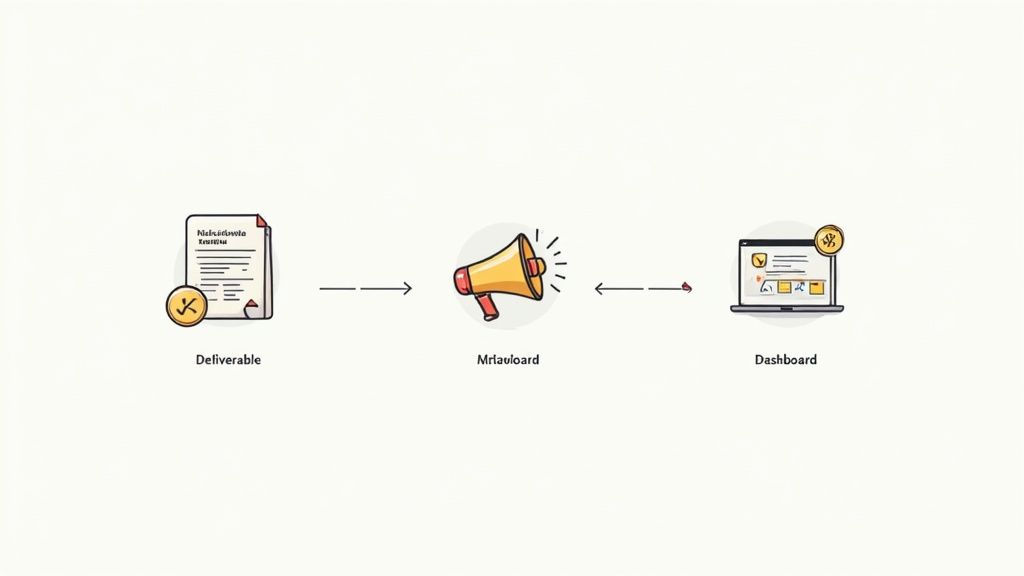
From Strategy to Actionable Assets
In the first 30 days, the fractional CMO dives deep into SynthAI’s world. They interview the founders, talk to customers, and size up the competition. This isn't just busywork. It leads to something critical.
A Competitive Positioning Matrix: A clear, one-page document showing exactly where SynthAI fits in the market, who they're up against, and the one unique thing they offer that no one else can touch.
Suddenly, this document becomes the North Star for all marketing. The sales team knows how to frame the product. The content team knows what stories to tell. It’s the first piece of the puzzle, bringing a level of strategic clarity that was completely missing.
From there, the focus shifts to the audience and the game plan. By day 60, the fractional CMO has developed two more essential assets.
- Refined Ideal Customer Profiles (ICPs): They move beyond vague descriptions to build data-backed personas. These detail the real pain points, goals, and buying triggers of their best-fit customers.
- A 12-Month Marketing Roadmap: This isn't a wish list. It’s a detailed plan outlining key initiatives, channel priorities, budget allocation, and timelines for the next four quarters.
This is an actionable blueprint that connects every marketing activity directly back to the company’s revenue goals.
Building a Measurable Growth Engine
By day 90, the final pieces of the foundation are locked in. The fractional CMO puts a system in place for accountability and measurement. A huge part of the job is proving value, and that means helping startups accurately measure marketing ROI.
This leads to the creation of a Marketing KPI Dashboard. This isn’t a vanity board filled with likes and shares. It’s a focused dashboard tracking the metrics that actually matter to the CEO and investors—things like Customer Acquisition Cost (CAC), Lifetime Value (LTV), and marketing-sourced pipeline. For a deeper look, our guide on how to measure marketing ROI offers a complete framework.
The impact of this focused work can be surprisingly fast. We've seen companies struggling with visibility generate a 40% increase in qualified leads within weeks of a strategy revamp. Some B2B tech clients have even tripled enterprise leads, generating over 500 new opportunities a year after bringing in a fractional CMO. It really highlights the "immediacy of impact" this model can have when the right leadership is in place.
Finding and Onboarding Your Ideal Fractional CMO
You’re sold. A fractional CMO feels like the right move, but the thought of finding the perfect one can be a little daunting. How do you actually find a strategic leader who gets your vision and can turn it into a sales pipeline?
The key is to have a deliberate process—not just post a job and cross your fingers.
Think of this like casting the lead role in a movie. You need someone with the right experience, chemistry with the team, and the chops to carry the story forward. A great hire always starts with a crystal-clear understanding of the part they need to play.
Here’s a simple playbook for finding, vetting, and bringing on your new marketing leader so you can make a confident decision that pays off fast.
Start by Defining Your Mission
Before you even start looking, you have to know exactly what problem you’re trying to solve. “We need better marketing” isn’t a goal; it’s a symptom.
Get specific. What is the single most important thing you need a marketing leader to accomplish in the next six months?
Are you struggling to…
- Generate qualified leads? Then you need someone with deep demand-generation experience.
- Explain what you do? A leader skilled in brand positioning and messaging should be your priority.
- Prepare for a Series A funding round? Look for a strategist who can build a compelling, data-backed growth story.
Write down your top one or two objectives. This clarity becomes your filter, helping you instantly separate the great candidates from the merely good ones. Without it, you risk hiring a brilliant tactician when what you really needed was a high-level strategist.
Know Where to Look for Top Talent
Once your goals are clear, it’s time to start the search. Your ideal candidate probably isn’t scrolling through generic job boards. They’re usually found through more focused channels where quality beats quantity.
Here are the most effective places to find high-caliber fractional CMO services:
- Niche Firms and Agencies: Companies like Chief Outsiders or Kalungi specialize in placing experienced marketing executives. They have a pre-vetted roster and can match you with someone whose background fits your industry and stage.
- Trusted Networks: Your best source is often your own network. Ask your investors, board members, and fellow founders for recommendations. A referral from someone who already gets your business is gold.
- Professional Communities: Platforms like Fractional Jobs have become hubs for experienced independent executives. These are great places to connect directly with proven talent.
A great fractional CMO isn’t just looking for a gig; they’re looking for a partnership. They want to work with founders who have a clear vision and are ready to execute. Your clarity and preparation will attract the best of the best.
The Interview Questions That Matter
When you start talking to candidates, don't get bogged down in tactical questions about specific social media platforms or SEO tools. You're hiring a strategist, not a specialist. Your goal is to understand their thinking process.
Focus on questions that reveal how they approach problems:
- "Walk me through your first 90 days. What would you do to get up to speed and start making an impact?"
- "Tell me about a time you built a marketing strategy from scratch. What was your process, and what were the results?"
- "Our biggest challenge is [your specific problem]. How would you start diagnosing the root cause?"
Listen for answers that are heavy on the "why" (the strategy) and not just the "what" (the tactics). The right candidate will ask you as many questions as you ask them. For more on this, check out our complete guide on how to hire a fractional CMO and what to look for.
Onboarding for Immediate Impact
Finding the right person is only half the battle. How you bring them into your company determines how quickly they can start delivering value. A successful onboarding isn't a welcome lunch and a new email address.
It’s about giving them deep, immediate access. From day one, your fractional CMO needs:
- Full access to your data: Google Analytics, CRM, sales reports—everything.
- Time with key people: Schedule meetings with your head of sales, product lead, and a few of your top customers.
- A seat at the leadership table: Include them in your executive team meetings so they understand the entire business context.
The faster they can get up to speed on your business, the faster they can start building the marketing engine you need to win.
Is Your Startup Ready for a Fractional CMO?
So, you've seen what a fractional CMO can do, but the real question is whether it's the right move for your startup, right now. The answer has less to do with your industry and everything to do with where you are in your growth journey.
This isn't a one-size-fits-all solution. Timing is everything. Jump in too early, and you're just burning cash. Wait too long, and you're leaving serious growth on the table.
Let’s do a quick gut check. If you find yourself nodding along to most of these, you’ve probably hit the point where a fractional CMO becomes a game-changer.
Key Readiness Indicators
Think of these as the tell-tale signs that you've outgrown your current marketing setup.
- You've nailed product-market fit. Customers love your product and are happily paying for it. The problem? You have no idea how to pour gas on the fire and actually scale.
- Your team is busy, but not strategic. You have marketers creating content and running ads. But their efforts feel disconnected—more like a collection of random tasks than a unified plan that brings in money.
- You're gearing up for a funding round. You need C-level thinking to build a compelling, data-backed growth story that gets investors excited.
- The founder is still the head of marketing. You’ve stretched yourself as far as you can. You need a real expert to build a growth engine so you can get back to focusing on the product and the big picture.
If your marketing feels more like a list of activities than a predictable system for winning customers, that's a clear signal you’re ready. A fractional CMO is the specialist you bring in to design and build that system.
A Simple Decision Framework
To make it even clearer, let's break it down into a simple "if-then" framework. This will help you figure out if a fractional CMO is your next move or if another option makes more sense for where you are today.
| If your startup is… | Then you likely need… |
|---|---|
| Pre-seed and still building the MVP | A hands-on marketing consultant for one-off tasks like initial market research or running customer interviews. |
| Seed-stage with early traction | A fractional CMO to build your foundational go-to-market strategy, nail down your messaging, and map out a 12-month growth plan. |
| Series A with a team in place | A fractional CMO to provide ongoing leadership, mentor your existing team, and scale your marketing for predictable growth. |
| A scale-up with an established team | A fractional CMO for a specific, high-impact project, like launching into a new market or rolling out a major product. |
This is the final check. If you have a solid product but a shaky marketing strategy—or a good team that just needs an experienced leader to show them the way—then a fractional CMO isn't just a nice-to-have. It’s your most logical and powerful next move.
The Fractional CMO FAQ: Your Questions Answered
Even when the upside seems obvious, bringing a new leader into the mix naturally raises a few questions. Founders always want to know what it's really like to work with a fractional executive day-to-day. So let's get into the nuts and bolts of it.
Here are the most common questions I hear about fractional CMOs, with straight answers to give you the clarity you need.
How Much Time Do I Actually Get?
This is always the first question, and the answer is simple: you get what you need. A fractional engagement isn't a rigid, one-size-fits-all package. The time commitment is flexible and built around your specific goals and budget.
Here’s what that usually looks like:
- One day a week (8-10 hours): This is perfect for high-level strategic oversight, running the weekly team meeting, and making sure the big projects stay on track.
- Two days a week (16-20 hours): This is a more hands-on model for companies that need deeper involvement in campaign planning, execution, and direct team mentorship.
- Project-based sprints: Need to launch a new go-to-market plan in 90 days? This model dedicates a focused block of time to that one specific outcome.
The whole point is to give you the right level of leadership at the right time. You get maximum impact without paying for idle hours.
Can a Fractional CMO Actually Manage My Team?
Absolutely. In fact, leadership and mentorship are a huge part of the job. A good fractional CMO doesn’t just hand down strategy from on high. They get in the trenches with your team to guide the work.
Think of them as a player-coach. They step in to fill the leadership gap for your existing marketers—setting clear priorities, clearing roadblocks, and helping your team level up their skills. They bring the structure and accountability that turns a group of individuals into a high-performing marketing team.
One of the biggest mistakes is to see a fractional CMO as just another consultant. A consultant gives advice; a fractional CMO takes ownership. They are on the hook for the team’s performance and the marketing results.
What's the Real Difference Between a Fractional CMO and a Consultant?
It all comes down to one word: ownership.
A marketing consultant is usually hired for a specific, one-and-done task—maybe doing market research or an SEO audit. They deliver their report, and their work is done.
A fractional CMO, on the other hand, takes on the responsibility and accountability of an executive. They own the marketing strategy, they manage the budget, they lead the team, and they are responsible for hitting growth targets. They become a real part of your leadership team, just on a part-time basis.
How Long Does an Engagement Last?
This is another area where flexibility is key. Engagements can range from short, intense sprints to ongoing retainers that last a year or more.
The most common setups are:
- 3-Month Sprints: Perfect for foundational work, like building out a marketing roadmap or running a new product launch from start to finish.
- 6-Month Retainers: This is often the sweet spot. It provides enough time to not only put a solid strategy in place but also start seeing and measuring the results.
- Annual Agreements: Ideal for scale-ups that need consistent, long-term leadership to drive growth and mentor an expanding team as the company matures.
The best fractional CMOs will let you scale the engagement up or down as your needs change. It’s all about fitting what your business needs at that moment.
Ready to see how a fractional CMO can build your growth engine? At Value CMO, we provide the senior marketing leadership you need to hit your goals without the full-time overhead. Schedule a call to discuss your growth strategy.