Ever feel like you’re doing a million marketing things but not actually getting anywhere? Marketing consulting is all about bringing in an expert from the outside to figure out what’s broken, spot the opportunities everyone else is missing, and build a real, strategic roadmap for growth. It’s a partnership designed to create a predictable engine for finding and keeping customers—moving way beyond just managing the day-to-day campaigns.
What Is Marketing Consulting Really About?

Think of a marketing consultant as an architect for your company’s growth. An architect doesn’t just show up with a hammer and nails; they start with a detailed blueprint. They analyze the terrain (your market), understand your vision (your business goals), and design a structure that’s actually built to last.
In the same way, a top-tier consultant doesn't just jump in by launching random ads or firing off social media posts. Their real job is to design the entire system that attracts, engages, and converts customers. They ask the big, foundational questions that so many tech startups—laser-focused on building the product—often forget to ask.
This strategic-first approach is exactly why the field is booming. The global marketing consulting market is expected to hit $88.4 billion by 2025, which tells you just how much companies need expert-led strategy in a crowded market. You can see more on this trend from industry researchers at IBISWorld.
The Strategist vs. The Doer
It's so easy to get consultants, agencies, and in-house marketers mixed up. While their jobs can sometimes overlap, their core functions are worlds apart.
- The In-House Marketer: This is your person on the ground, deep in the daily execution. They’re running the campaigns, writing the copy, and managing the social accounts. Think of them as the skilled craftsperson laying the bricks.
- The Marketing Agency: An agency is a crew of specialists you hire to execute specific jobs at scale, like running big ad campaigns or handling your entire SEO operation. They are the construction team brought in to build specific parts of the house.
- The Marketing Consultant: This is the expert who designed the blueprint in the first place. They make sure the foundation is solid, the structure is sound, and every single activity ladders up to the overall growth plan.
A great consultant provides the strategic 'why' before your team even thinks about the 'how.' They build the roadmap, get your team aligned, and make sure every marketing dollar is spent on work that directly drives revenue.
This kind of strategic leadership is a game-changer for B2B tech startups. Founders are usually brilliant at building a product but often need a clear, structured path to market. A consultant provides that clarity, turning great technology into a commercially successful business.
Sometimes, this role is filled by a senior-level expert who joins the team on a part-time basis. To see how this works in practice, you can learn more about what a fractional CMO is and how they operate. It’s a smart model that gives startups access to top-tier strategic thinking without the cost and commitment of a full-time executive hire.
The Core Services a Marketing Consultant Delivers
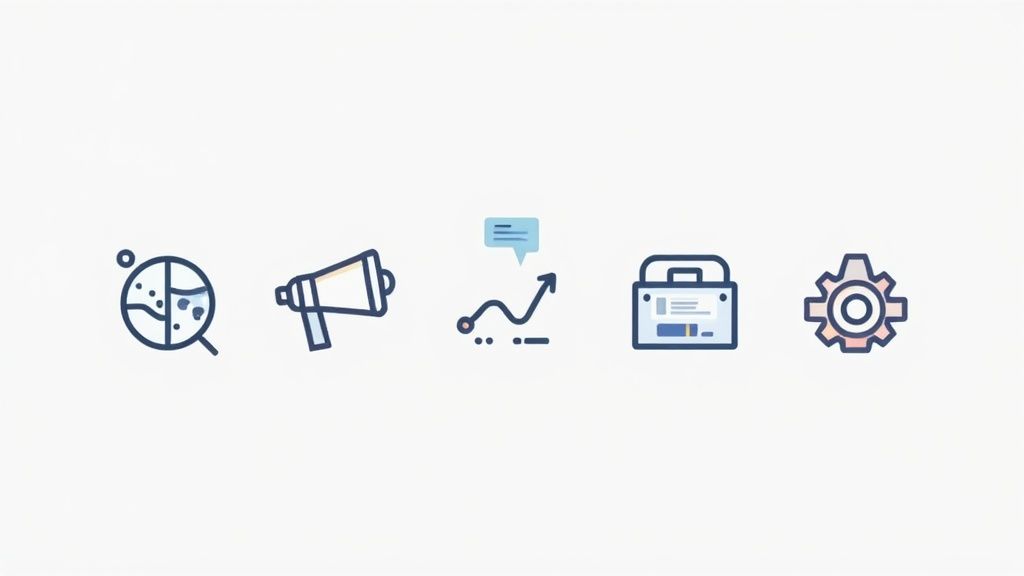
So, what do you actually get when you hire a marketing consultant? It’s not just a stack of reports and PowerPoint decks. A top-tier consultant delivers high-impact strategic work that becomes the foundation for predictable revenue. They bring the clarity and direction that turn a great tech product into a real business.
These services aren’t just a checklist of tasks; they’re interconnected parts of a larger growth engine. Think of it like building a performance vehicle. You need a powerful engine (demand generation), a solid chassis (brand positioning), a GPS with a clear destination (GTM strategy), and a skilled driver (your sales team). A consultant makes sure all those components are designed and assembled to work together perfectly.
Let's unpack the core deliverables you should expect.
Go-To-Market Strategy Development
A Go-To-Market (GTM) strategy is your playbook for reaching customers and winning your market. It's the most important document you can have, yet a shocking number of startups try to fly blind without one.
A consultant builds this playbook by getting ruthless answers to foundational questions:
- Who is your Ideal Customer Profile (ICP)? They move past vague descriptions to define exactly which companies get the most value from your product and are therefore most likely to buy.
- What channels will you use to reach them? Instead of throwing money at everything, they pinpoint the specific marketing channels—like content, paid ads, or partnerships—where your ideal buyers actually hang out.
- How will you win? They map out the competitive landscape and define a unique angle that makes your startup the obvious choice.
A founder might think their product is for "all small businesses." A good consultant drills down to find the sweet spot: "B2B SaaS companies with 50-200 employees in the fintech space struggling with data compliance." That kind of focus stops you from wasting time and money chasing the wrong leads.
Brand Messaging and Positioning
Once you know who you're targeting, you have to figure out what to say. This is where brand messaging and positioning come in. A consultant helps you craft a compelling story that resonates with sophisticated B2B buyers.
This isn’t about dreaming up a catchy slogan. It's about owning a specific spot in the market.
Before: A startup describes their product with a list of technical features, leaving buyers confused about its real-world value.
After: A consultant repositions the product around a core customer pain point. The message flips from "We offer an AI-powered data encryption algorithm" to "We help CFOs eliminate data compliance risks so they can sleep at night."
That shift from features to outcomes is everything. It's how you connect with the executives who sign the checks, making your value instantly clear and memorable.
Building a Demand Generation Engine
A GTM strategy is just a plan on paper until you build a system to execute it. A demand generation engine is that system—a predictable, scalable process for creating a steady pipeline of qualified leads. This is one of the most valuable things a consultant can build for you.
They design and help implement this engine by integrating the right tactics, such as:
- Content Marketing: Creating valuable articles, whitepapers, and webinars that attract and educate your ICP.
- Performance Marketing: Setting up and optimizing targeted ad campaigns on platforms like LinkedIn or Google to capture buyers with active intent.
- Email Nurturing: Building automated email sequences that guide prospects through the buying journey until they’re ready for a sales call.
This work transforms your lead flow from an unpredictable trickle into a reliable, measurable stream of opportunities for your sales team.
Sales Enablement and MarTech Stack Audit
Finally, a consultant makes sure your marketing efforts actually help the sales team close deals. Sales enablement is all about creating the content and tools salespeople need to win, like sharp case studies, competitive battle cards, and product one-pagers.
They also perform a MarTech stack audit. Most startups collect marketing tools (CRM, email automation, analytics) that are underused, misconfigured, or redundant. A consultant audits your stack to ensure your tools work together efficiently, give you accurate data, and deliver a real return on investment. This simple audit alone can often save thousands of dollars and countless hours of frustration.
When Your Tech Startup Needs a Marketing Consultant
https://www.youtube.com/embed/3l-uyHmjIyw
How do you know when it’s actually time to bring in an expert? For a lot of tech founders, the thought of hiring a consultant only pops up when something feels seriously broken. But here’s the thing: the best time to get strategic help is often before you hit a wall.
Catching the signs early can save you months of wasted effort and burned cash. These aren’t just small bumps in the road; they're specific, growth-killing problems that signal a clear need for an outside perspective.
Think of this as a quick diagnostic. If your startup looks like any of these scenarios, it’s a pretty strong sign that a marketing consultant could give you the clarity and direction needed to get unstuck and back to growing.
Your Lead Flow Is Unpredictable
One month, the sales pipeline is packed. The next, it’s a ghost town. This feast-or-famine cycle is a classic symptom of a marketing plan built on random acts and guesswork, not a repeatable system.
An unpredictable lead flow makes it impossible to forecast revenue, plan hiring, or scale the business with any real confidence. It puts the entire company in a reactive, stressful position.
A consultant hits this problem head-on. They come in to design and build a demand generation engine—a predictable process for attracting, nurturing, and converting leads. This turns your marketing from a lottery ticket into a reliable, measurable asset.
You Cannot Clearly Explain Your Product's Value
You’ve built an amazing piece of technology with a ton of powerful features. The problem? When you try to explain what it does, you can see people’s eyes glaze over. This is a dead giveaway that you have a messaging and positioning issue.
If you find yourself listing features instead of explaining benefits, you’re forcing the buyer to do all the heavy lifting. They don't buy features; they buy solutions to their problems.
A consultant acts as a translator, shifting your message from what your product is to what it does for the customer. They help you craft a compelling narrative that connects your technology to tangible business outcomes, making your value proposition instantly clear.
Your Junior Marketers Are Spinning Their Wheels
You did the right thing and hired a couple of eager, junior marketers. They're working hard, but without a clear, senior-level strategy to guide them, their efforts feel scattered. They might be busy, but they aren't necessarily being effective.
This is a super common scenario that leads to a burned-out team and painfully slow progress for the business. Your team doesn't just need a to-do list; they need a playbook. A consultant provides that strategic leadership, mentoring your team and building a focused plan they can execute with confidence. Strategic guidance is crucial for growing startups, and it's not limited to marketing. As you build your advisory circle, consider how to approach finding a startup business coach for a wider view on mentorship.
You Are Launching Into a New Market Blind
Trying to break into a new country or a new industry vertical is a high-stakes gamble. You’re up against unknown competitors, different buyer habits, and unique cultural details. Going in without a tailored strategy is like trying to navigate a maze blindfolded.
A marketing consultant with experience in market expansion can de-risk this process in a big way. They do the research, map out the competitive landscape, and build a localized Go-To-Market strategy. This prep work ensures your launch is a calculated, strategic move—not just a hopeful leap of faith. Choosing the right path is vital, and our comprehensive outsource marketing guide for tech startups can offer more direction on how to structure your efforts for the best results.
Understanding Marketing Consulting Engagement Models
Bringing on a marketing consultant isn't a one-size-fits-all deal. The right partnership is flexible, designed to plug in the exact strategic support your tech startup needs, right when you need it most. Knowing how these engagements work makes top-tier thinking accessible, even for early-stage companies without a C-suite budget.
Think of it like hiring a personal trainer. You don't just sign up for a generic program. You might need a long-term coach to overhaul your entire fitness lifestyle, a specialist for a six-week sprint to nail a specific goal, or an expert to check in with monthly to keep you on track. Marketing consulting works the same way.
Let's break down the three primary models so you can see which one fits your startup's stage, budget, and immediate goals.
The Fractional CMO Model
A Fractional Chief Marketing Officer (CMO) is exactly what it sounds like: you get the strategic leadership of an experienced C-suite marketing executive for a "fraction" of the cost of a full-time hire. This person embeds into your leadership team, typically working with you one or two days a week.
This model is a game-changer for startups that need serious, senior-level direction but aren’t ready for a $250,000+ annual salary plus benefits. A Fractional CMO doesn't just give advice—they own the marketing strategy, mentor your junior team members, manage budgets, and drive the execution of your growth plan.
- Who it's for: Startups that have a small (often junior) marketing team but need senior leadership to build a coherent strategy and guide their day-to-day work.
- Why it works: It closes the critical leadership gap that holds so many companies back, giving you the C-level thinking needed to build a scalable marketing function.
Project-Based Sprints
Sometimes you don’t need a long-term leader. You have a single, critical, and time-sensitive problem that needs to be solved with focused expertise. That’s where project-based sprints come in.
These are short-term, high-intensity engagements with a crystal-clear scope and a specific deliverable. A consultant is brought in to tackle one big challenge, get it done, and hand over the keys.
A project sprint is like calling in a specialist surgeon for a complex procedure. They aren't your primary care doctor; they are the expert you hire to execute with precision and step away once the patient is stable.
Common project sprints include:
- Building a complete Go-To-Market strategy for a new product launch.
- Overhauling your brand messaging and positioning from the ground up.
- Auditing and reconfiguring your entire MarTech stack for better ROI.
- Designing and implementing your first lead-nurturing sequences.
This model is perfect when you have a well-defined need and require a heavy dose of expert horsepower to get it across the finish line—fast.
Advisory Retainers
The third model is the advisory retainer. This is the lightest-touch option, built for companies that already have a solid marketing leader in place but need an external expert for high-level guidance, accountability, and a second set of eyes.
With a retainer, you're buying a block of a consultant's time each month. This can be used for regular strategy sessions, board meeting prep, or ad-hoc calls to troubleshoot a specific challenge. The consultant acts as a strategic sounding board and mentor for your internal team lead.
It’s a cost-effective way to get continuous access to top-tier expertise without the deep operational involvement of a Fractional CMO. It keeps your team sharp and prevents strategic drift over the long term.
Choosing Your Consulting Engagement Model
Not sure which model makes the most sense for you? This table breaks it down to help you decide.
| Model | Best For | Typical Duration | Core Outcome |
|---|---|---|---|
| Fractional CMO | Startups needing C-level leadership but not ready for a full-time hire. | 6-12+ months | A scalable marketing function with clear strategy and execution. |
| Project Sprint | Teams facing a specific, time-sensitive challenge that needs expert execution. | 4-12 weeks | A defined deliverable, like a GTM plan or a new messaging framework. |
| Advisory Retainer | Companies with an in-house leader who needs a strategic sounding board. | 3-6+ months | Ongoing strategic guidance and course correction from an external expert. |
Each of these models solves a different problem. The key is to honestly assess where your biggest gap is—leadership, execution, or high-level guidance—and choose the engagement that fills it.
How to Choose the Right Marketing Consulting Partner
Finding the right marketing consultant can feel like digging for gold. A lot of people call themselves strategists, but the ones who actually move the needle—the partners who challenge your assumptions and build real value—are rare.
Your goal isn't to hire a yes-man who just agrees with everything you say. You need a partner who will push back, bring a strong point of view, and connect every single marketing action back to a business outcome. That requires a vetting process that goes way deeper than a slick website or a wall of logos. You have to scrutinize their experience, their process, and their results with a critical eye. A great consultant doesn’t just show up with a list of tactics; they bring a framework for thinking about growth.
Validate Their Niche Experience
First things first, have they actually lived and breathed your world? B2B tech marketing, especially for SaaS, is its own unique beast. It has its own language, its own sales cycles, and its own buyer personas. Generic marketing experience rarely cuts it here.
You need someone who gets the difference between MQLs and SQLs, knows the sting of customer churn, and has actually built a go-to-market strategy for a technical product. Don't be shy about asking direct questions about their hands-on experience in B2B tech or SaaS.
A consultant's real value comes from pattern recognition. Someone who has seen the inside of dozens of B2B tech companies can spot your challenges and opportunities much faster than a generalist ever could.
This decision is too important to guess on. This infographic offers a simple decision tree to help you map out which consulting model might fit your immediate needs, pointing you toward the right type of partner from the get-go.
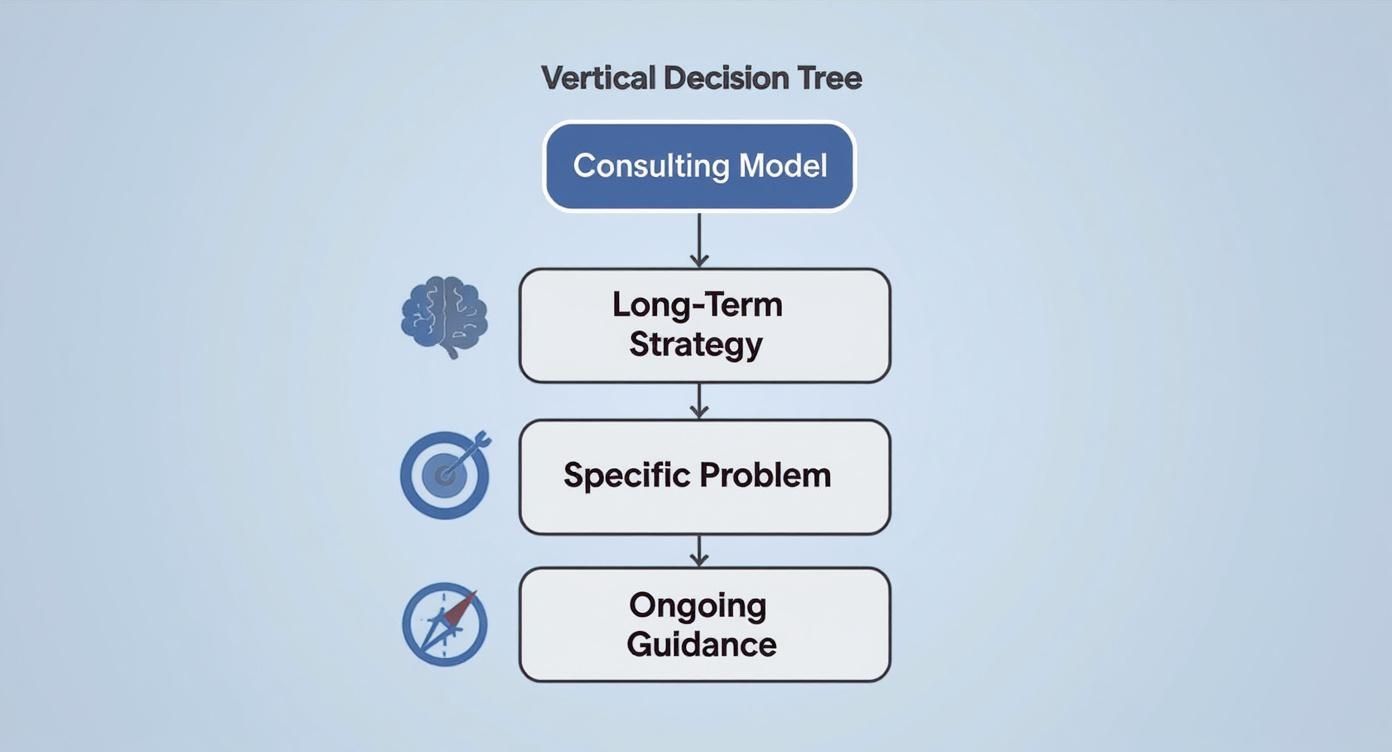
As you can see, aligning your main challenge—whether it’s long-term strategy, a specific problem, or ongoing guidance—with the right engagement model is the first step toward a successful partnership.
Scrutinize Case Studies for Real Impact
Every consultant has case studies, but most of them are packed with vanity metrics like "increased website traffic by 300%." That sounds impressive, but without business context, it's meaningless. Did that traffic actually convert into leads? Did any of those leads turn into paying customers?
When you’re looking at their past work, dig for the numbers that matter:
- Pipeline Growth: Ask for hard numbers on how they grew qualified leads or the total value of the sales pipeline.
- Customer Acquisition Cost (CAC): Did their strategies make it cheaper to land new customers over time?
- Sales Cycle Velocity: Did their work on messaging and sales enablement help the sales team close deals faster?
A top-tier consultant will always tie their work back to revenue. If they can’t, it’s a massive red flag.
Assess Their Strategic Process
Finally, you need to understand how they work. A great consultant doesn’t just walk in with a pre-baked list of solutions. They should have a clear, structured process for diagnosing your problems and building a strategy that fits your business.
This strategic process is so valuable that the global consulting market is projected to hit $1.06 trillion in revenue by 2025. The strategy segment alone, which is exactly where a great marketing consultant plays, is expected to reach $91.38 billion, all because business challenges are getting more complex. You can read more about these fascinating consulting industry trends.
A consultant’s ability to deliver value hinges on their process. Ask them to walk you through their first 90 days. What do they do in week one? What questions do they ask? Who on your team do they need to talk to? A clear, confident answer shows they have a system that works—one that creates clarity and drives results.
From Strategic Insight to Measurable Impact
So, we've walked through the entire journey of marketing consulting—from what it actually is, to pinpointing the exact moment your B2B tech startup needs to bring in an expert. You now have a clear framework for understanding the different ways to engage a consultant and how to pick a partner who will actually move the needle for your business.
Remember, the road from a great product to a market-leading company isn't paved with hustle alone. It’s built on strategic clarity.
Hiring a marketing consultant is a direct investment in that clarity. It’s about ditching the guesswork and unpredictable results for a system built to deliver sustainable growth. And it’s an investment more and more companies are making. The U.S. consulting market is set to grow at a CAGR of 8% through 2025—a loud and clear signal that expert guidance is in high demand.
Beyond a Temporary Fix
Here’s the thing: a great consulting partnership isn’t just about getting a project over the finish line. It’s about building a lasting capability inside your own company.
The ultimate sign of a successful engagement is when the consultant makes themselves obsolete. They don't just solve problems for you; they teach your team how to solve them, leaving behind a stronger, more capable marketing function.
This means every single action has to be tied to a real, tangible outcome. A huge piece of this is knowing how to measure marketing ROI, something any good consultant will help you master. When you focus on the metrics that actually matter, every strategic insight translates into a measurable impact on your bottom line. We also have our own in-depth guide on how to measure marketing ROI with actionable steps you can take.
Think of a marketing consultant less like a temporary fix and more like a strategic catalyst. They’re the partner who accelerates your trajectory, helping you build a powerful, in-house marketing engine that becomes a durable competitive advantage long after they’re gone.
Marketing Consulting FAQs
We've covered a lot of ground, but it's normal to have a few questions left. When you're thinking about a strategic move like bringing in a marketing consultant, you want to be sure you have all the facts.
To get you that final bit of clarity, here are some straight answers to the questions I hear most from founders.
How Much Does Marketing Consulting Cost?
This is always the first question, and the honest answer is: it varies a lot. The cost really depends on the consultant's track record, the work you need done, and how you decide to work together.
Here’s a rough breakdown:
- Project-Based Sprints: These can run from $5,000 for a quick audit to $50,000+ for something big, like a full Go-To-Market strategy.
- Advisory Retainers: For ongoing strategic advice, you're typically looking at $2,000 to $10,000 a month.
- Fractional CMOs: This model offers deep, embedded leadership and can range from $7,000 to $20,000+ per month—a fraction of what you'd pay a full-time executive.
The key is to see this as an investment in your growth, not just another line item on the budget. A good consultant should deliver a return that makes their fee look small.
How Quickly Can I Expect to See Results?
Marketing is a long game, but that doesn't mean you should wait forever to see progress. While a major jump in qualified leads might take six months, you should feel the impact in the first few weeks.
A great consultant delivers "quick wins" within the first 30-60 days. This could be clarifying your brand messaging, finding wasted ad spend, or getting your sales and marketing teams aimed at the same target. These early wins build momentum while the bigger growth engine is being built.
What’s the Difference Between a Consultant and a Coach?
This is a really important distinction. A marketing coach is your guide—they act as a mentor, helping you or your team find the answers and build skills internally. They help you think through problems and hold you accountable.
A marketing consultant, on the other hand, is a hands-on strategist and problem-solver. They don’t just guide you; they get in the trenches, analyze your data, build the strategic plan, and often help direct its execution. While they definitely do a lot of coaching, their main job is to deliver a specific strategic outcome.
Think of it like this: a coach helps you become a better chef. A consultant designs the entire menu and kitchen process for your restaurant.
At Value CMO, we provide the strategic leadership B2B tech startups need to build a predictable growth engine. If you're ready to stop guessing and start executing a clear, actionable marketing plan, we should talk. Learn more about our fractional CMO services.