So, what exactly is a marketing lead? In simple terms, it's someone—an individual or a whole company—who’s shown some real interest in what you’re selling. They haven't just stumbled upon your site; they've interacted with your marketing in a way that basically says, "I'm curious." Think of it as a clear signal of interest, an open door for a conversation that goes beyond just knowing you exist.
Moving Beyond a Simple Contact List
Let's be real—your CRM is probably a mixed bag. You've got contacts from webinars, a few LinkedIn connections, and maybe a dusty list from a trade show two years ago. Staring at that database, it's nearly impossible to tell who’s a hot prospect and who's just… there. This is where truly understanding what a marketing lead is becomes your best filter.
Think of your entire contact database like a pantry full of ingredients. Some are fresh, some are expired, and some just don't belong in the dish you’re making tonight. A marketing lead, on the other hand, is a prepped ingredient—washed, chopped, and ready for the chef (your sales team) to work their magic. It’s not just another name and email; it's a prospect who has pretty much raised their hand.
What Makes a Lead a Marketing Lead?
A marketing lead, often called a Marketing Qualified Lead (MQL), is a potential customer who has actively engaged with your marketing and fits the specific criteria you've set. That engagement signals they’re far more likely to become a paying customer than some random name on a list. The distinction is a big deal, especially for B2B tech companies where the sales cycle is long and relationships are everything.
This intense focus on qualified interest is why 85% of B2B companies name lead generation as their top marketing priority. But here’s the catch: 61% of marketers also say it’s their biggest headache. Nailing this means you stop wasting time and money chasing dead ends and start focusing on real opportunities.
The core difference is intent. A contact simply exists in your system. A marketing lead has taken an action—like downloading an ebook or requesting a demo—that shows genuine curiosity and a potential need.
By separating simple contacts from true marketing leads, you lay the groundwork for a smarter, more predictable growth engine. You can finally build a reliable pipeline and move beyond guesswork. It’s the first real step in understanding the critical differences between demand generation vs lead generation and how the two must work together.
Understanding the Lead Alphabet: MQLs, SQLs, and PQLs
Once you've filtered out the noise and identified your true marketing leads, you'll see they don't all act the same. B2B tech loves its acronyms, but three are non-negotiable for mapping a lead's journey: MQL, SQL, and PQL. Nailing these definitions is the secret to getting your marketing and sales teams on the same page and creating a handoff so smooth it feels automatic.
Think of it like dating. Someone who just browses your online profile and likes your bio is showing early interest—that's your Marketing Qualified Lead (MQL). They’ve checked out your content, but they aren't ready to schedule a first date just yet.
This is how a lead typically moves through the funnel, from a name in your database to someone ready to talk business.
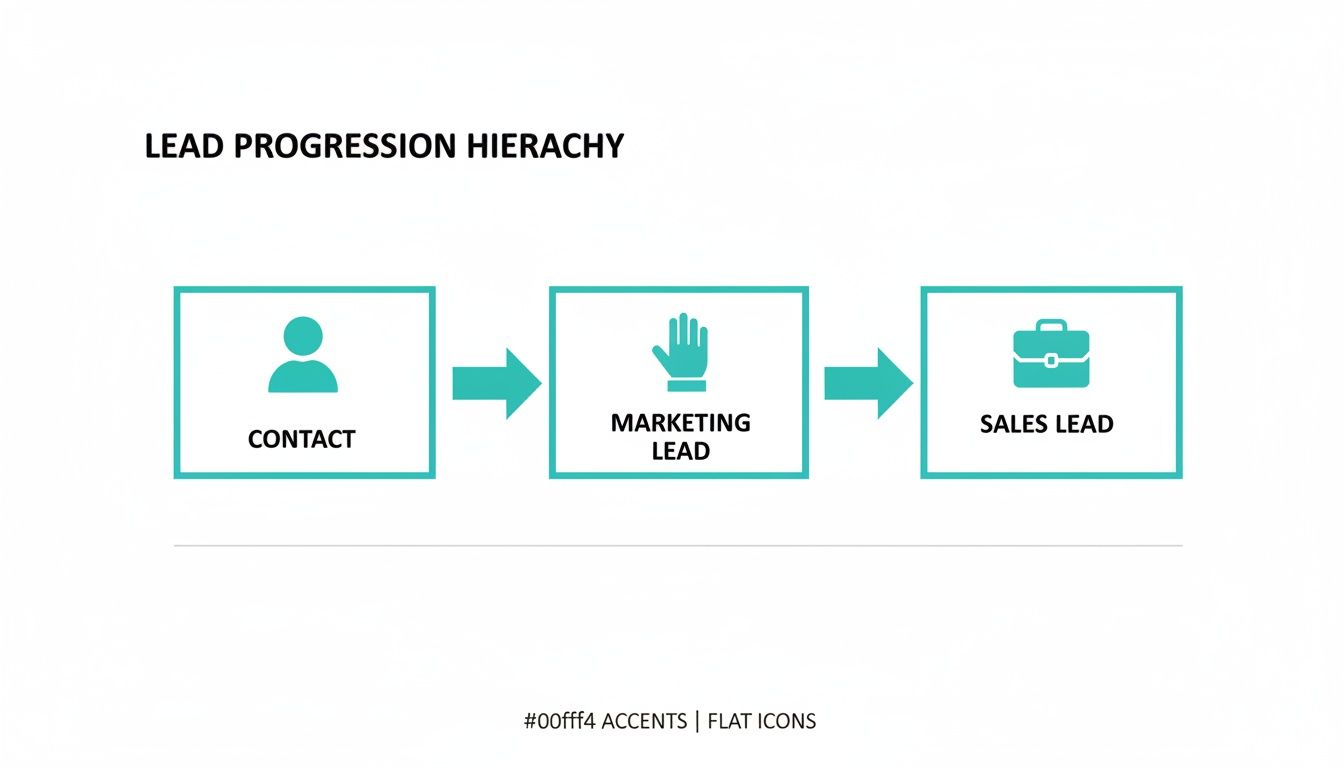
The key takeaway? Not every contact becomes a marketing lead, and definitely not every marketing lead is ready for a sales call right away.
Differentiating Each Lead Type
So, what separates these leads in the real world? It all boils down to what they do and the intent behind those actions. Each acronym signals a different level of readiness, telling you exactly how—and when—to engage.
-
MQL (Marketing Qualified Lead): This is someone who has engaged with your marketing but hasn't explicitly asked to talk to sales. They fit your ideal customer profile and have shown curiosity by, say, downloading an industry report or attending a webinar. They're warm, but they still need a bit of nurturing. For a deeper dive, check out the marketing qualified lead (MQL) definition and how to manage these prospects effectively.
-
PQL (Product Qualified Lead): This lead has already used your product, usually through a free trial or a freemium plan, and has seen its value firsthand. For a project management tool, a PQL might be a user who created three projects and invited two teammates. Their actions signal strong product adoption and a high chance of converting to a paid plan. They've essentially taken your product on a "first date" and liked what they saw.
-
SQL (Sales Qualified Lead): This is the lead everyone wants. An SQL has been vetted, shows clear buying intent, and is ready for a direct sales conversation. They've raised their hand by requesting a custom demo or filling out a "Contact Sales" form. In our dating analogy, they're ready to talk about a serious relationship.
Understanding the lines between MQL, PQL, and SQL is fundamental. It stops your sales team from wasting cycles on prospects who are just browsing and tells marketing exactly when a lead is primed for a real sales conversation. This shared language is what keeps great opportunities from falling through the cracks.
How to Build Your Lead Qualification Machine
Knowing the difference between an MQL and an SQL is a great start, but how do you systematically separate the window shoppers from the serious buyers? You need a reliable filter—a lead qualification machine that protects your sales team’s most valuable asset: their time.
This isn’t about guesswork. It’s about building a blueprint for your ideal customer.
Think of it like setting up a velvet rope at an exclusive event. Not everyone who lines up gets in. Your bouncer (the qualification process) checks each person against a specific guest list, making sure only the right people get through. This process stops your team from chasing every email address and lets them focus on prospects with real potential.
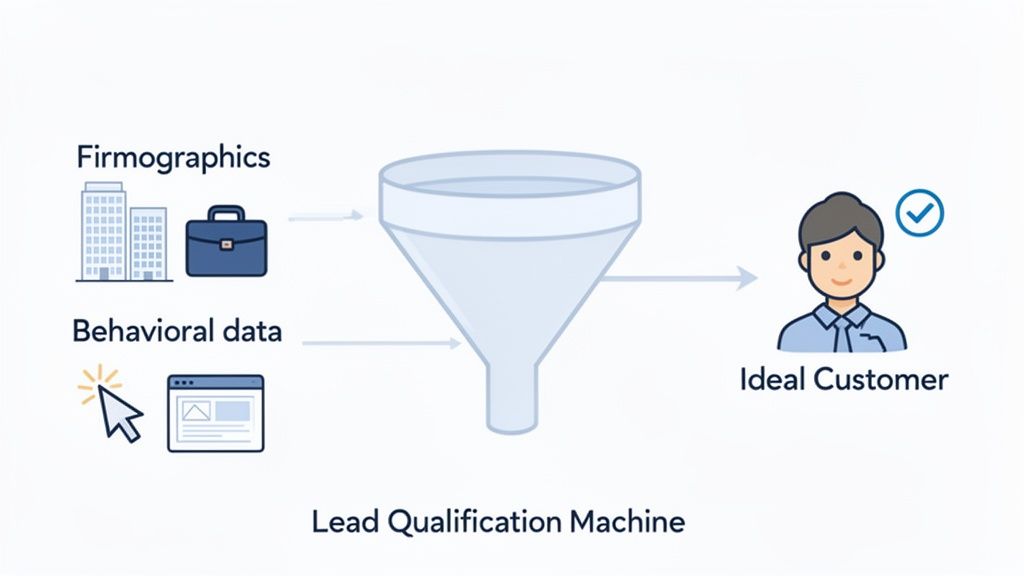
This "guest list" is built from two critical types of data. When you put them together, they create a powerful profile of a high-quality marketing lead.
The Two Pillars of Lead Qualification
To build an effective filter, you have to look at two things: who a lead is and what they’ve done. This combo gives you a clear, multidimensional view of their potential fit and interest level.
-
Firmographics (The "Who"): This is straightforward data about the lead’s company. It's the first check—does their company match your Ideal Customer Profile (ICP)? You're looking at things like their industry, company size, geographic location, and annual revenue.
-
Behavioral Data (The "What"): This is all about tracking their actions. It shows how a lead interacts with your brand, revealing their level of interest and intent. Did they visit your pricing page? Download a case study? Attend a product webinar?
By combining these two pillars, you create a shared definition of a "good lead" that both marketing and sales can agree on. That alignment is the bedrock of any efficient growth engine.
A lead from a 500-person SaaS company (firmographics) who watched your entire demo video (behavioral data) is exponentially more valuable than a student who downloaded an ebook just for research. Qualification is how you spot the difference instantly.
Why This Matters for B2B Tech
For B2B tech companies, especially venture-backed scale-ups, this process is non-negotiable. The investment in finding prospects is significant, with U.S. digital lead generation ad spend hitting $3.24 billion in 2023. When you're spending that kind of money to get attention, you can't afford to waste it on poor-fit leads.
Modern strategies use AI-driven scoring to analyze behavioral patterns, uncovering high-potential MQLs that manual reviews might miss. With 85% of B2B marketers relying on content to generate leads, having a robust qualification machine ensures every webinar attendee and whitepaper download is properly evaluated. You can find more insights on how B2B companies are approaching this at Martal.ca.
This strategic filtering is the first step toward turning raw interest into measurable action.
Turning Interest Into Action with Lead Scoring
You’ve built a system to identify prospects who are a good fit. Great. But how do you measure their actual level of interest in real time? This is where lead scoring comes in, turning abstract curiosity into a concrete, actionable number.
Think of lead scoring as a simple points system that ranks leads based on how likely they are to buy. It’s an objective, data-driven way to separate the casual browsers from the genuinely interested buyers, making sure your sales team focuses its energy where it counts. This process gets rid of the guesswork and makes your entire sales motion far more efficient.
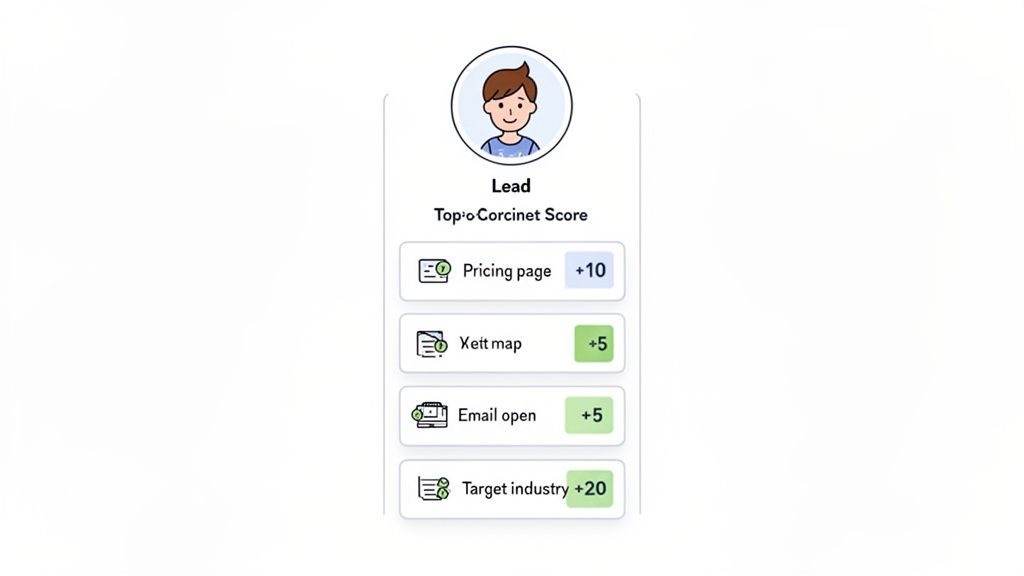
The idea is to assign positive or negative points to a lead based on who they are and what they do. This creates a dynamic score that rises and falls with their engagement, giving you a clear signal of their sales readiness.
How to Assign Lead Scores
A good lead scoring model blends both demographic fit and behavioral signals. You want to reward leads who not only match your ideal customer profile but also actively engage with your brand.
Here’s a simple way to think about it:
- Explicit Data (Fit): This is the information the lead gives you. If they match your ICP, award points. For example, give +20 points if their company is in a target industry or +10 points if their job title is ‘Director’ or above.
- Implicit Data (Interest): These are the behavioral clues you track online. Give points for actions that signal buying intent. For instance, +10 points for visiting the pricing page, +5 for opening a nurture email, and +15 for attending a product webinar.
By blending these two types of data, you create a holistic score that reflects both who the lead is and how interested they are. A high score means you have a high-fit, high-intent prospect who is likely ready for a sales conversation.
This method ensures your sales team always connects with the hottest leads first. For a deeper dive on setting up a robust system, it’s worth exploring some established lead scoring best practices that seasoned B2B companies use to dial in their models.
To make this more concrete, here's a sample lead scoring model designed for a B2B SaaS startup. You can adapt this framework to your own business, assigning points based on what you already know about your best customers.
Sample Lead Scoring Model for a B2B SaaS Startup
| Action or Attribute | Points Awarded | Rationale |
|---|---|---|
| Job Title is C-Suite/VP | +20 | Indicates decision-making authority. |
| Visited Pricing Page | +15 | A strong signal of buying intent. |
| Requested a Demo | +50 | The highest-intent action a lead can take. |
| Company is in Target Industry | +15 | Confirms a good fit with your ideal customer profile. |
| Downloaded a Case Study | +10 | Shows interest in proof and results. |
| Unsubscribed from Emails | -25 | A clear signal of disinterest. |
This systematic approach transforms your pipeline from a simple list of names into a prioritized queue of opportunities, ready for your sales team to engage and close.
Mastering the Handoff from Marketing to Sales
Even a perfect marketing lead dies on the vine if the handoff to sales is slow or fumbled. This moment is where more deals collapse than anywhere else in the funnel. Think of it like a relay race: a clean baton pass keeps the momentum going. A clumsy one kills it.
This is where marketing and sales alignment stops being a buzzword and starts being a necessity. When the process is disjointed, leads get frustrated repeating their story, and all the intent marketing worked so hard to build just evaporates. Success comes down to a clear, shared playbook.
Defining the Trigger Point
First things first: you have to agree on the exact moment a lead is ready for sales. The best way to do this is with a trigger score—a specific lead score that, once hit, automatically flips the switch and turns an MQL into a Sales Qualified Lead (SQL). For instance, you might decide that any lead who racks up 100 points is officially "sales-ready."
That score becomes the official trigger. It’s not a gut feeling; it’s a data-backed signal that both teams have signed off on. This eliminates the guesswork and makes sure sales only spends time on leads who have shown real, meaningful interest.
To make it stick, smart B2B tech companies create a simple Service Level Agreement (SLA). An SLA is just a written handshake between teams.
- Marketing’s Promise: We will only pass over leads that hit the 100-point trigger score.
- Sales’s Promise: We will follow up on every single one of those leads within 24 hours.
This simple pact creates accountability and ensures leads get attention while they’re still hot.
A lead’s value decays shockingly fast. A study by LeadResponseManagement.org found the odds of contacting a lead drop by 10 times in the first hour. An SLA isn’t just red tape; it's a commitment to speed.
Providing Critical Context
Finally, a smooth handoff isn’t just about speed—it’s about context. The sales team needs more than a name and an email. Marketing has to package up the essential background intel so sales can walk into that first conversation armed with relevance.
This context should live right inside your CRM and include key details like:
- Which specific ebook or case study they downloaded.
- The webinar topic they just sat through.
- The fact they lingered on the pricing page.
When a salesperson can open their first call with, "I saw you downloaded our guide on AI implementation," instead of a generic, "Just calling to see how I can help," the entire dynamic changes. The conversation starts from a place of value. This seamless transfer of intelligence is what turns a good marketing lead into a closed deal.
Building Your Lead Generation Engine with Expert Help
Feeling overwhelmed by all the moving parts? Defining, qualifying, scoring, and handing off leads can feel like a full-time job in itself. You're not alone.
Building a predictable pipeline isn’t about chasing tactics. It’s about engineering a system where every piece works together smoothly. This is where strategic expertise becomes a real game-changer.
Instead of navigating the complexities through trial and error, a seasoned marketing leader builds this engine from the ground up with a proven roadmap. It’s a systematic approach that sidesteps common pitfalls and speeds up growth—all without the cost and long-term commitment of a full-time executive.
The Fractional CMO Blueprint for Growth
An experienced fractional CMO doesn't just offer advice; they execute a clear, multi-step process designed for B2B tech startups. This isn't theory. It’s a practical plan for building a sustainable lead machine that actually delivers results.
Here’s what that process looks like in action:
- Defining Your Ideal Customer: Everything starts here. We go way beyond surface-level demographics to build a rich Ideal Customer Profile (ICP) that informs every single decision.
- Choosing the Right Tech Stack: You don’t need every shiny new tool. The focus is on selecting a lean, right-fit stack—think CRM and automation—that scales with you, not against you.
- Designing Intelligent Nurture Campaigns: We craft automated email sequences that guide prospects through their journey, delivering the right content at just the right time to build trust and move them forward.
- Setting Up Actionable Dashboards: Forget vanity metrics. We build dashboards that track what truly matters: pipeline velocity, conversion rates, and your all-important cost per SQL.
A well-built lead generation engine doesn't run on hope. It runs on a clear strategy, smart automation, and a deep understanding of your ideal customer. It’s about creating a predictable path from initial interest to closed deal.
Ultimately, building a robust pipeline requires a data-driven approach. As you refine your system, it's crucial to implement effective data-driven lead generation strategies to ensure every action is measured and optimized.
For startups looking to implement this kind of expert-led framework, exploring an outsourced marketing partnership provides the strategic leadership needed to build momentum and drive measurable revenue growth.
A Few Final Questions From the Founder's Desk
Even with a solid plan, a few questions always pop up when you're in the thick of it. Here are the most common ones I hear from founders and marketing leaders trying to get their lead engine running.
How Many Leads Do We Actually Need?
There’s no magic number, but you can get pretty close by working backward from your revenue target.
First, take your revenue goal and divide it by your average deal size. That tells you how many new customers you need to hit the number. From there, look at your historical conversion rates—how many leads turn into sales conversations, and how many of those conversations close. That math will tell you exactly how many leads you need to feed the top of your funnel. If you don't have historical data, a good advisor can help you benchmark realistic rates for a forecast.
What's the Biggest Mistake Founders Make with Leads?
Easy. Treating every lead the same. When you don’t have a solid qualification and scoring system in place, your sales team ends up wasting precious hours on contacts who are a terrible fit. Meanwhile, the prospects who are genuinely interested and ready to talk lose momentum and go cold.
A very close second is the lack of a clear, written agreement between marketing and sales on what a "good" lead actually is. That misalignment creates friction, finger-pointing, and a leaky funnel where your best opportunities just slip away.
Can I Do This Without Buying a Ton of Expensive Software?
Absolutely, especially when you're just starting out. You can get a surprising amount done with a simple CRM and your email platform. I’ve seen early-stage teams use a basic spreadsheet to manually track lead scores as they get off the ground.
As you grow, though, marketing automation platforms become a total game-changer. They handle all the scoring, nurturing, and routing for you, freeing up your team to focus on strategy and the stuff that really moves the needle. An experienced advisor can point you to the right tools for your specific stage and budget so you don't over-invest before you need to.
Ready to build a predictable lead generation engine that drives real growth? Value CMO provides the fractional CMO expertise B2B tech startups need to turn marketing efforts into measurable revenue. Learn more about how we build growth roadmaps that work.