Let’s be honest, hiring a full-time executive is a huge step, especially when you’re a founder laser-focused on growth. So, what is a fractional CMO? Think of them as your strategic marketing co-pilot—a seasoned leader who joins your team part-time to nail specific growth goals and build a marketing engine that practically runs itself.
Your Guide to Understanding a Fractional CMO

Here’s a simple way to think about it: if you were building your dream house, you'd hire an expert architect to design the blueprint. You wouldn’t keep them on the payroll full-time to also lay bricks and paint walls, right? You bring them in for their high-level expertise, get the plan just right, and then let your builders execute. A fractional CMO does the exact same thing for your business's growth plan.
They aren't just consultants who drop off a strategy deck and disappear. A real fractional CMO embeds themselves in your leadership team, taking genuine ownership of your marketing for a "fraction" of the time and cost. For startups and scale-ups needing C-suite guidance without the six-figure salary, this model is a total game-changer.
Fractional CMO At a Glance
To make it crystal clear, here’s a quick side-by-side look.
| Attribute | Fractional CMO | Full-Time CMO |
|---|---|---|
| Commitment | Part-time, flexible contract (think 10-20 hours/week) | Full-time employee (40+ hours/week) |
| Cost | $6,000 – $15,000+ per month retainer | $250,000 – $450,000+ annual total compensation |
| Focus | Strategic leadership, building systems, mentoring your team | Day-to-day management, team leadership, execution |
| Best For | Startups & scale-ups needing senior strategy without the overhead | Mature companies with large teams and budgets |
| Onboarding | Super fast (days or weeks) | Can be lengthy (months) |
It's not about one being "better" than the other; it’s about finding the right expertise for where your business is right now.
Bridging the Leadership Gap
So many growing companies get stuck in a tricky spot. They’ve outgrown the skills of a junior marketer or a scattered team of freelancers, but they’re just not ready to commit to a full-time Chief Marketing Officer. This is the exact gap a fractional CMO was born to fill.
They step in to provide immediate, senior-level direction. In a nutshell, a fractional CMO is a part-time marketing executive who brings top-tier strategic leadership to a few companies at once, making that high-level expertise affordable. You can see how this model works in this fractional executive playbook.
A fractional CMO doesn't just give advice; they roll up their sleeves. Their whole goal is to build a sustainable marketing system, mentor your team, and create momentum that lasts long after they're gone.
This approach gives you a powerful mix of strategy and hands-on execution. They don’t just ask "what should we do?"—they define the strategy, build the plan, and lead your team to get it done. For founders, this means immediate access to:
- Executive-Level Strategy: Deep experience in go-to-market planning, budgeting, and team building.
- Hands-On Leadership: Direct oversight of campaigns, projects, and vendors.
- Cost-Effective Expertise: Senior talent for a fraction of what you'd pay a full-time executive in salary and benefits.
Ultimately, a fractional CMO is the smart hire when you need a focused, data-driven growth plan now but aren’t ready to bring that talent in-house forever. It’s all about getting the right leader at the right time.
What a Fractional CMO Actually Delivers
Theory is great, but what does a fractional CMO actually do day-to-day? Let's forget the abstract definitions for a minute. Their real job is hands-on execution that builds momentum. This isn’t about just giving advice; it’s about a leader who steps in to build, run, and fine-tune your marketing from the inside out.
A great fractional CMO doesn’t just show up with a fancy slide deck. They embed themselves in your leadership team, roll up their sleeves, and take full ownership of the results. The goal is to turn marketing chaos into a predictable, well-oiled growth machine.
The First 90 Days: A Framework for Impact
To get a clear picture of what they deliver, let’s walk through what a typical “first 90 days” looks like. This initial period is all about laying a solid foundation for growth you can actually build on.
Month 1: Audit and Strategy Blueprint
The first 30 days are for deep discovery and planning. No guesswork here. A fractional CMO will:
- Run a full marketing audit: They’ll dig into your current team, tech stack (MarTech), budget, and performance data. The goal is to find quick wins and plug the biggest leaks.
- Define your ideal customer: A core deliverable is nailing down your target audience by leading the process of creating effective buyer personas. This simple step makes sure every dollar you spend from here on out is razor-focused.
- Build the Go-to-Market (GTM) strategy: They'll create a clear, actionable roadmap that details your goals, channels, and the core messaging you need to win over your market.
Month 2: Building the Growth Engine
With a strategy locked in, the focus immediately shifts to building the machine. This is where the plan becomes reality.
- Set up KPIs and dashboards: They’ll build a performance dashboard with clear Key Performance Indicators (KPIs) to track what really matters. No more vanity metrics.
- Optimize the budget: The fractional CMO will reallocate your marketing spend, cutting out what’s not working and doubling down on the channels with the highest potential for real ROI.
- Manage vendors and projects: They'll step in to own the relationships with agencies, freelancers, and tech providers, making sure projects stay on track and deliver real value.
Month 3: Execution and Team Empowerment
The final leg of this initial sprint is all about putting the plan into action and leveling up your team for the long haul. Key deliverables include:
- Mentor your existing team: A huge part of their role is coaching junior marketers and giving them the guidance they need to grow. To learn more, check out our detailed guide on the different roles of a chief marketing officer.
- Launch initial campaigns: They oversee the first strategic campaigns under the new GTM plan, gathering real-world data to fine-tune the approach.
- Create repeatable playbooks: They'll document key processes and build systems so your team can run effective marketing programs long after their engagement is over.
A fractional CMO’s deliverable isn't a one-time report. It's a functioning, data-driven marketing system built to generate a predictable pipeline and revenue for your business.
By the end of 90 days, you don't just have a plan—you have a revitalized marketing function with clear direction, accountable leadership, and measurable momentum. That hands-on approach is what separates a true fractional CMO from a typical consultant.
Choosing Your Marketing Leadership Model
You’ve got a few options for marketing leadership, but which one is right for you right now? Get this wrong, and you’ll burn through cash and kill your momentum. This isn’t just about filling a box on an org chart; it’s about finding the right partner for your specific stage of growth.
Founders usually find themselves weighing three paths: hiring a fractional CMO, committing to a full-time executive, or outsourcing to a marketing agency. Each has its pros and cons, and the best fit really depends on your immediate needs, long-term goals, and—let's be real—your budget.
This decision tree shows exactly where a fractional CMO fits in—building strategy, mentoring your team, and owning the results.
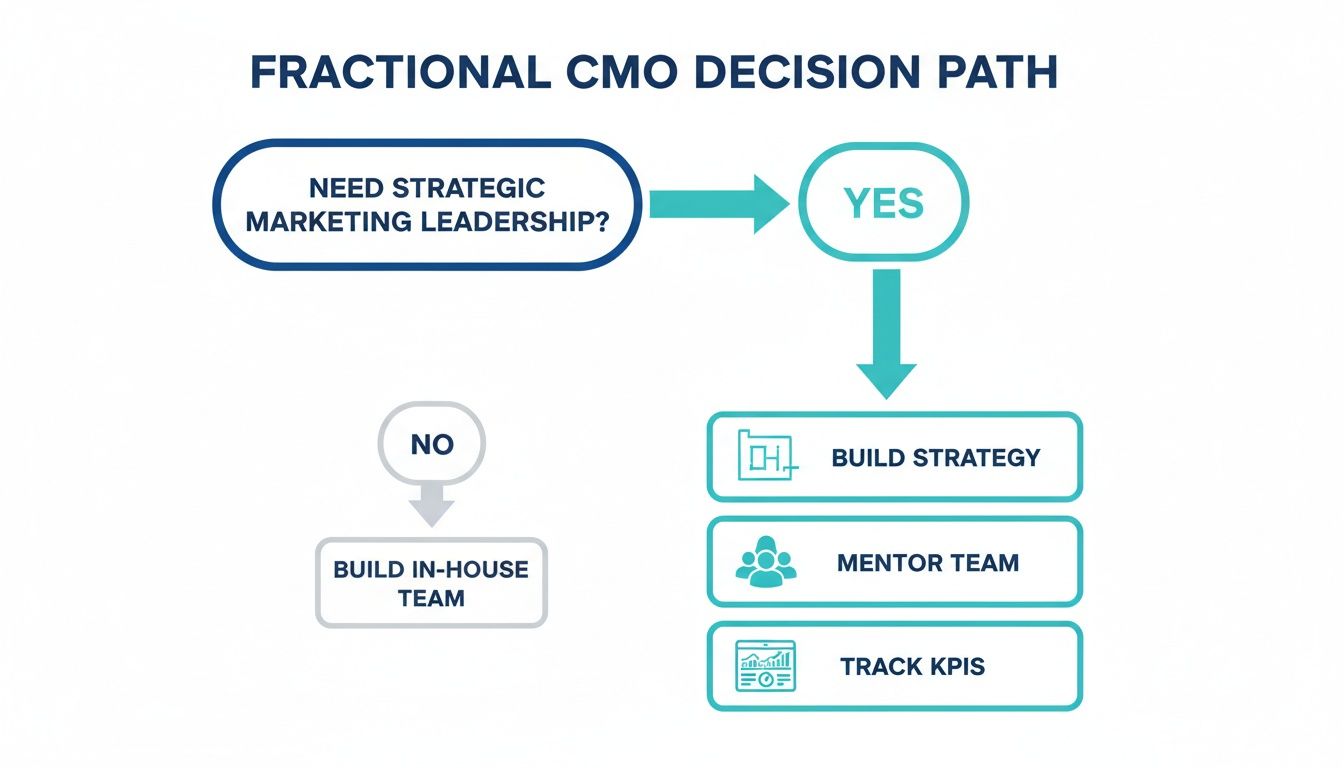
As you can see, the fractional path makes a ton of sense when you need strategic direction and team development, not just another pair of hands to run tasks.
Comparing Leadership Models
So, how do these models really stack up when you look at what founders care about most: cost, strategic depth, and how fast you see results?
The table below breaks it down, but the short version is that you're trading off cost, commitment, and control.
Comparing Leadership Models
| Criteria | Fractional CMO | Full-Time CMO | Marketing Agency |
|---|---|---|---|
| Cost | $6K-$15K/month (fractional) | $250K+ per year (fully loaded) | $5K-$50K+/month (retainer) |
| Strategic Ownership | High. Acts as a true leadership partner. | Highest. Fully embedded in the company. | Low to medium. Focus is on execution. |
| Speed to Impact | Fast. Onboards in weeks, no recruiting lag. | Slow. 3-6 months to hire and ramp up. | Medium. Specialist tasks start quickly. |
| Team Development | Core focus. Mentors and builds your team. | Core focus. Manages team day-to-day. | Not a focus. They use their own team. |
| Flexibility | High. Scales up or down as needed. | Low. A long-term, fixed commitment. | Medium. Can change services, but within a contract. |
Let's unpack what those differences actually mean in the real world.
The Full-Time CMO
This is the traditional route. You bring on a dedicated executive who lives and breathes your company, fully invested in its long-term success.
- Upside: Total dedication, deep cultural integration, and hands-on, daily team management.
- Downside: It's a huge cost ($250,000+ in total compensation), a long and competitive hiring process, and a significant, long-term commitment. It's a big bet.
The Marketing Agency
Agencies bring a team of specialists to the table who can execute specific tasks like SEO, content creation, or paid ads. They're great for getting tactical work off your plate.
- Upside: Access to a diverse skill set for specific channels without the overhead of full-time hires.
- Downside: They rarely provide deep strategic ownership and can feel like an outside vendor just checking boxes. An agency won't mentor your internal team or align sales and marketing from the inside.
The Fractional CMO
This model gives you the best of both worlds. You get the C-suite strategic brain of a full-time CMO but with the flexibility and lower cost of an external partner.
- Upside: Senior-level strategy and hands-on leadership at a fraction of the cost. They onboard quickly to make an immediate impact and focus on building a sustainable system you'll eventually own.
- Downside: They aren’t in the day-to-day weeds. Their focus is high-level strategy and team leadership, not being another full-time doer.
For most B2B tech startups, the fractional model simply hits that sweet spot. It closes the critical gap between having no marketing leadership and not being ready for a permanent C-suite salary. It’s an investment in building a rock-solid foundation.
You can dive deeper into the nuances by exploring different forms of outsourced marketing. The goal is to bring in an expert to build your growth engine, mentor your team, and then help you hire their full-time replacement when the time is right.
Why Smart Founders Are Hiring Fractional CMOs
The buzz around fractional CMOs isn't just another trend. It’s a real strategic shift in how fast-growing companies build their marketing, and the smart founders I talk to are hiring them for reasons that go way beyond just saving money.
The real value? Getting an unbiased, expert perspective that can slice right through internal gridlock.
A founding team is often too close to their product to see the whole picture. A fractional CMO walks in without the baggage of internal politics or being tied to "the way we've always done things." This fresh set of eyes is incredibly powerful for challenging assumptions, spotting blind spots in your go-to-market strategy, and unlocking growth that was invisible from the inside.
Rapid Implementation of Proven Playbooks
Startups just don't have time for a long learning curve. A seasoned fractional CMO doesn't show up to learn on your dime; they arrive with a toolkit of proven marketing playbooks, frameworks, and processes ready to roll on day one. They’ve already seen what works (and what doesn’t) across dozens of companies at your exact stage.
Instead of reinventing the wheel, they can immediately stand up systems for:
- Lead Generation: Building a predictable pipeline that keeps your sales team fed and happy.
- Brand Positioning: Carving out a unique and defensible space in a market that’s only getting more crowded.
- Marketing Operations: Installing the right MarTech stack and dashboards to measure what actually matters to the business.
This ability to execute quickly gives you an immediate shot of momentum—something that's absolutely critical for early-stage companies trying to hit aggressive growth targets. It's the difference between months of painful trial-and-error and a few weeks of focused, high-impact action.
Access to an Extended Network and Scalable Support
One of the most underrated benefits is the instant access you get to the fractional CMO’s entire professional network. Need a top-tier SEO consultant, a world-class copywriter, or the perfect automation tool? They already have trusted contacts and can make the right connection with a single email.
This creates incredible efficiency, saving you the time, money, and risk of vetting vendors yourself.
On top of that, the model is built to be flexible. You can ramp up their involvement during a product launch or a critical growth sprint, then dial it back down as needed. This ensures your leadership investment always matches your current needs without the fixed overhead of a full-time hire.
For founders, a fractional CMO installs the investor-grade accountability and reporting needed to build confidence. They transform marketing from a cost center into a documented, data-driven revenue engine that directly elevates your company's valuation.
This approach delivers both top-level strategic direction and tangible business outcomes. Statistics show that companies engaging fractional CMOs often see up to 50% cost savings compared to full-time hires, with typical engagements building repeatable marketing systems in just 6-18 months. You can explore more about these strategic findings on Intelligent People.
It’s about making a smart, strategic investment that pays dividends long after the contract ends.
So, What Does This Actually Cost?
Alright, let's get down to it. How does a fractional CMO engagement actually work, and what’s the investment look like? This isn't about buying a block of hours; it’s about investing in a specific outcome. The whole point is flexibility—the structure is built to fit your company’s stage and budget, not the other way around.
Unlike a rigid, full-time salary, fractional models are clear and adaptable. This gives you the confidence to plan your budget and know exactly what you’re getting for your money.
How These Engagements Are Typically Structured
Most fractional CMOs work on a retainer. It’s the best way to ensure they’re truly embedded in your leadership team. But "retainer" can mean a few different things.
- Monthly Retainer: This is the most common setup. You pay a flat fee each month for a set amount of dedicated time, usually the equivalent of one or two days a week. This model is perfect for deep integration and consistent, ongoing strategic leadership.
- Project-Based Fee: Got a single, high-stakes project coming up? Think a big product launch or a major rebrand. A project-based engagement makes a ton of sense here. It has a defined scope, a clear start, and a firm end date.
- Advisory Retainer: This is a lighter-touch approach. It’s ideal for companies that already have a solid marketing director but need a senior strategic sounding board. The fractional CMO acts more like a coach or an advisor to your internal leader.
This flexibility means you can dial the support up or down based on what you need right now.
What to Expect for Your Investment
There’s no one-size-fits-all price tag here. The investment for a fractional CMO typically ranges from $6,000 to over $15,000 per month. What drives that number? Mostly the scope of work, the CMO's specific industry experience (especially in niche B2B tech), and how fast your company is growing.
But what does that cash actually get you? Way more than just a few hours of advice. A typical monthly retainer buys you:
- Dedicated Time: Usually 10-20 hours a week, often blocked out as one or two specific days where their focus is 100% on your business.
- Consistent Leadership: Expect them in your weekly leadership meetings, running one-on-ones with your marketing team, and sitting in on key strategy sessions.
- Tangible Deliverables: This is the real meat—from building the GTM strategy and budget plans to creating KPI dashboards and managing your vendors.
The real value isn't just in the hours logged. It's in the accelerated decision-making and momentum you gain. You're paying an expert to build your marketing engine and level up your team, delivering a return that blows the monthly fee out of the water.
This model gives you access to C-suite expertise without the fully loaded cost of a full-time executive, which can easily top $300,000 a year once you factor in salary, benefits, and equity. It’s a strategic investment designed to produce a measurable, scalable return.
How to Find and Hire the Right Fractional CMO

Finding the right fractional CMO can be a massive force multiplier for your startup. But the wrong hire? That’s a quick way to burn precious time and money.
This isn’t just about checking boxes on a resume. It’s about finding a true strategic partner who understands your company’s unique stage, culture, and challenges. The search requires a clear game plan.
The whole process kicks off with knowing where to even look. You might stumble upon candidates on platforms like LinkedIn, but the real A-players often come from more curated, trusted sources.
- Trusted Networks: Your first call should always be to your investors, advisors, and fellow founders. A warm referral from someone who already gets your business is the absolute gold standard.
- Specialized Firms and Collectives: Most top-tier fractional CMOs are part of private firms or exclusive collectives. These groups do the heavy lifting of vetting their members, ensuring a high bar for experience and a proven track record in specific niches, like B2B tech.
Vetting for Strategic Fit, Not Just Skills
Once you have a shortlist, the vetting process needs to go way deeper than a standard interview. A great fractional CMO is more than a collection of past accomplishments. They’re a strategic thinker who can diagnose problems and build systems from scratch. Your real goal is to understand how they think.
Ditch the generic questions. Instead, dig into their real-world experience with sharp, scenario-based questions that really test their thinking.
The best conversations happen when you move past their resume and start discussing your actual business challenges. A top candidate will start problem-solving with you right there in the interview, offering initial thoughts on your go-to-market strategy or team structure.
Key Questions to Ask a Potential Fractional CMO
To separate the true strategists from the consultants who just talk a good game, focus your questions on results, process, and alignment. This is how you spot a partner who can genuinely move the needle for your business.
- "Walk me through a time you took a company at our stage from X to Y. What was the exact plan, what were the KPIs, and what were the first 90 days like?" This cuts right to the chase, testing for hands-on experience and a results-first mindset.
- "Here is our current marketing challenge [describe a real, nagging problem]. How would you approach diagnosing and solving it?" This reveals their strategic thinking and problem-solving process in real-time. It’s like a mini work session.
- "How do you align with sales and product teams to ensure a cohesive go-to-market strategy?" This is non-negotiable. Misalignment between departments is a notorious growth killer, and a great CMO is an expert at bridging those gaps.
- "Describe your leadership and team mentoring style. How would you level up our existing junior marketers?" This uncovers their ability to be a true leader and builder, not just a contractor punching a clock.
Making the right choice here is absolutely crucial. For a more detailed guide on the vetting and hiring process, you can learn more about how to hire a fractional CMO effectively.
Remember, the right partner won't just advise you from the sidelines. They will integrate into your team, execute a plan, and build a marketing engine designed to last.
Your Top Questions, Answered
If you're thinking about bringing in a fractional CMO, you're bound to have some questions. It's a different way of hiring leadership, after all. Let's clear up a few of the most common things founders ask.
How Much Time Do They Really Spend With Us?
It always comes down to what you need, but most engagements land somewhere between 10 to 20 hours a week. Think of it as one to three dedicated days where they’re focused on strategy, leading your team, and making sure the work gets done. The whole point is to deliver maximum impact, not to clock maximum hours.
Will They Work With My Existing Marketing Team?
Absolutely. In fact, that's one of their most critical jobs. A good fractional CMO doesn’t just show up and give orders; they lead, coach, and level up the marketers you already have. They provide the strategic framework and mentorship that turns a scattered team into a focused growth engine. This is often where founders see the biggest long-term value.
A great fractional CMO’s success isn't measured in hours—it’s measured against the KPIs that matter to your business. We're talking real results: more qualified leads, a lower Customer Acquisition Cost (CAC), better conversion rates, and a predictable revenue pipeline.
Is This a Short-Term Fix or a Long-Term Play?
It’s flexible enough to be either, which is one of the biggest advantages of the model.
- Short-Term: Many founders bring in a fractional CMO for 6-18 months to build a solid marketing foundation. A common end goal is for them to help you hire their full-time replacement once the system is running smoothly.
- Long-Term: For other companies, it makes sense to keep a fractional CMO on in a high-level advisory role indefinitely. Once the marketing engine is built, they can provide ongoing guidance without the full-time cost.
The engagement flexes to fit what your business needs as it grows.
Ready to see how a fractional CMO can build a focused, data-driven growth roadmap for your B2B tech company? Value CMO delivers senior marketing leadership without the full-time overhead. Let's build your growth engine.