A fractional CMO is the senior marketing leader you bring in part-time to build and run your growth engine—all without the full-time executive salary. Think of them as the strategic mind that architects the plan and then guides your team to bring it to life.
Your Startup’s On-Demand Growth Architect

Ever feel like your marketing is just a bunch of random tactics? You're running ads, posting on social media, and sending out emails, but nothing feels connected. There’s no clear "why" behind it all. That’s a classic sign that you've hit a growth plateau.
So many ambitious companies get to a point where sheer hustle just isn't enough. The marketing tricks that used to work start to fizzle out, and the path forward gets a little foggy. This is the exact moment a fractional CMO can become your most valuable player.
Beyond Consulting: A True Leadership Partner
Don't mistake a fractional CMO for a consultant who just drops off a fancy strategy deck and disappears. Think of them more like a seasoned executive who plugs right into your leadership team. They're the master architect for your entire marketing department, responsible for designing the growth blueprint and then sticking around to oversee its construction.
Their real job is to turn marketing from a line item in your budget into a predictable revenue machine. They do this by zeroing in on what truly matters:
- Building a Cohesive Strategy: They make sure every marketing activity ties back to your big-picture business goals.
- Mentoring Your Team: They help your in-house marketers level up their skills and fill in any crucial gaps.
- Driving Measurable Results: They focus on the metrics that your board actually cares about, like pipeline growth and how much it costs to get a new customer (CAC).
- Providing Unbiased Leadership: They bring a fresh, outside perspective to challenge old habits and unlock new opportunities.
A big part of this is building a solid, actionable plan to guide all your marketing efforts. This often starts with a detailed roadmap, a process that’s covered really well in this founder's playbook for a digital marketing strategy for startups.
A fractional CMO doesn’t just fill a leadership gap; they install a growth-oriented operating system into your business. They bring the frameworks, experience, and accountability you need to turn ambitious goals into real-world outcomes.
Ultimately, they're the secret weapon for businesses that are ready to move beyond just "doing marketing." They provide the strategic clarity and hands-on guidance needed to build a marketing function that doesn't just support the business—it actively drives its growth.
The Core Responsibilities a Fractional CMO Delivers

So, what does a fractional CMO actually do day-to-day? Their role is a lot more hands-on than just dishing out high-level advice. They're on the hook for tangible outcomes and become the driving force behind your growth engine.
Think of them as the executive producer of your marketing department. They don't just write the script; they cast the right players, direct the action, and make sure the final product delivers on its promise to your audience—and your bottom line.
Architecting a Rock-Solid Marketing Strategy
The first and most important job is to build a strategy that actually makes sense. This isn't some vague mission statement. It’s a detailed blueprint that connects every marketing dollar and every team action directly to what your business is trying to achieve.
They start by asking the tough questions: Who are we really selling to? What unique problem do we solve for them? Why should they choose us over anyone else? This deep dive helps define two critical things:
- Ideal Customer Profile (ICP): Moving beyond basic demographics to build a rich picture of your perfect customer—their pain points, what motivates them, and where they hang out online.
- Go-to-Market (GTM) Plan: Designing the specific game plan for reaching, engaging, and winning over that ideal customer. This covers everything from your brand message and positioning to picking the right channels to focus on.
This strategic foundation stops marketing from feeling like a bunch of disconnected activities and turns it into a focused, unified effort.
Mentoring and Leveling Up Your Internal Team
A great fractional CMO doesn't just lead; they build up the people around them. In many startups, the marketing team is full of talented but more junior specialists who are great at getting things done but lack senior-level strategic guidance.
A fractional CMO steps in as a coach and mentor, bridging this critical leadership gap. They provide the direction your team needs to grow and perform at a higher level. This mentorship is one of the most valuable things they do. To learn more, check out our guide on the roles of a chief marketing officer.
A fractional CMO’s goal isn’t to make you dependent on them. It's to build a high-performing marketing engine—and the team to run it—that can thrive long after they’re gone. They’re there to work themselves out of a job by building up your internal strength.
This hands-on coaching elevates your team’s skills, boosts morale, and ensures the grand strategy is actually executed with precision.
Building a Smart MarTech Stack and Managing Vendors
The modern marketing technology landscape is a jungle of tools, platforms, and confusing acronyms. It's way too easy to waste thousands of dollars on software that isn't the right fit or isn't being used properly.
A fractional CMO acts as your expert guide through this maze. They figure out what you actually need to build a lean, effective MarTech stack—the collection of tech you use to run and measure your marketing. This means picking the right CRM, marketing automation, and analytics tools that give you the most bang for your buck.
They also take the lead in managing outside vendors and agencies. Whether it’s an SEO firm, a PR agency, or freelance writers, the fractional CMO makes sure these partners are on the same page with the strategy and are held accountable for results.
Leveraging AI and Automation for Efficiency
Finally, a forward-thinking fractional CMO is always looking for ways to get more done with less. Today, that means intelligently using AI and automation to make your marketing machine more efficient.
They spot opportunities to automate repetitive tasks, personalize customer journeys at scale, and use AI-powered analytics to uncover deeper insights. This isn't about replacing people; it's about empowering them. By automating the routine stuff, they free up your team to focus on the high-value creative and strategic work they do best.
This focus on efficiency has cemented their role as true growth accelerators. In fact, the sector is projected to expand alongside digital marketing's $1.5 trillion trajectory by 2030, with firms realizing they can get superior outcomes while spending far less than the typical $250,000-$347,000 CMO salary.
From strategy to team building and technology, a fractional CMO’s responsibilities are all connected and purpose-driven, aimed at one thing: building a scalable and predictable revenue engine for your business.
What to Expect When You Hire a Fractional CMO
So you’ve decided a fractional CMO might be the right move. What actually happens when they walk through your (virtual) door?
First, forget the idea of a consultant who just drops off a strategy deck and vanishes. A true fractional CMO becomes part of your team. They roll up their sleeves and get to work, focusing on real-world outcomes from day one. Their job is to bring clarity, build a plan, and get your marketing engine humming.
Unlike hiring someone full-time, the relationship is built around flexible, high-impact projects. Let's break down the most common ways this partnership works so you know exactly what you're getting.
The 90-Day Marketing Roadmap
Think of this as the foundational sprint. It’s the perfect starting point for companies that feel stuck, are struggling with scattered marketing efforts, or simply don't have a clear path forward. The entire goal is to move from guesswork to a concrete, actionable plan in a single quarter.
This isn’t some theoretical exercise. The fractional CMO works shoulder-to-shoulder with your team to build a strategic blueprint that will guide your efforts for the next 6 to 12 months. It’s all about creating alignment and building momentum—fast.
Here’s what you should get from a 90-Day Roadmap:
- A Deep-Dive Audit: A no-nonsense look at your current marketing, team skills, and tech stack to figure out what’s working, what’s broken, and where the quick wins are.
- ICP & Messaging Sharpening: Workshops and research to nail down your Ideal Customer Profile and craft a message that actually cuts through the noise.
- An Actionable Growth Plan: A detailed, prioritized plan outlining key projects, channel strategies, budget recommendations, and the crucial KPIs you’ll use to track real progress.
The 90-Day Roadmap is designed to put an end to "random acts of marketing." It gives your team the strategic clarity they've been craving so they can focus on the activities that will actually move the needle on revenue.
At the end of 90 days, you have a documented strategy and a clear set of priorities. This gives you a solid foundation to either run with your internal team or shift into a longer-term advisory relationship.
The Strategic Sprint
Sometimes, you don't need a full marketing overhaul. You have a specific, high-stakes problem that needs senior-level expertise right now. This is where a Strategic Sprint comes in.
It’s a short, intense, and results-focused project designed to tackle one critical business objective. The fractional CMO jumps in as the project lead, providing the strategic horsepower needed to get it done right and on time.
Common reasons for a Strategic Sprint include:
- Launching a New Product: Building the entire go-to-market plan, from positioning and messaging to the actual launch strategy.
- Entering a New Market: Doing the research, identifying the right target audiences, and creating the playbook for a successful entry.
- Leading a Rebrand: Guiding the strategic side of a rebrand to make sure it aligns with business goals and connects with your customers.
- Fixing a Leaky Funnel: Diagnosing and fixing bottlenecks in your sales process to improve lead flow and conversion rates.
This model is all about focused execution on a project that just can't fail. The fractional CMO provides the leadership to prevent costly mistakes and keep everything moving forward.
Ongoing Advisory and Leadership
For companies that need consistent strategic guidance but aren’t quite ready for a $300k+ full-time executive, the ongoing advisory model is a perfect fit. In this setup, the fractional CMO becomes a true, part-time member of your leadership team.
They take ownership of the overall performance of the marketing function. This means leading team meetings, mentoring junior marketers, managing the budget, and reporting progress to the CEO and the board. It's the full scope of a CMO's job, just delivered with the flexibility your business needs.
This long-term partnership provides the steady, senior-level direction required to build a marketing machine that can scale. The fractional CMO doesn’t just set the strategy; they stick around to make sure it gets executed effectively, making tweaks as your business grows and the market changes.
Measuring the True Impact of a Fractional CMO
The real value of a fractional CMO isn't measured in the hours they work; it’s measured in tangible results that hit your bottom line. While they may work part-time, their impact is full-scale, designed to shift marketing from a cost center into a predictable source of revenue. The key is to stop tracking superficial "vanity metrics" and focus on the numbers that actually prove their worth.
Hiring executive talent is an investment, and like any investment, you need to see a clear return. This means holding your fractional CMO accountable for business outcomes, not just campaign activity. Their success isn't defined by a spike in website traffic or a few more social media likes, but by their ability to impact the core financial health of your business.
Key Performance Indicators That Actually Matter
A seasoned fractional CMO will immediately steer the conversation toward metrics that your CEO, CFO, and board actually care about. They know how to cut through the noise and track performance that directly ties to growth and profitability.
Their focus will center on a few critical KPIs:
- Customer Acquisition Cost (CAC): How much does it cost you to land a new customer? A successful fractional CMO will implement strategies to drive this number down by optimizing your channels and improving conversion rates.
- Customer Lifetime Value (LTV): How much revenue does a single customer bring in over their entire relationship with your company? They'll work to increase this by improving retention and finding smart upsell or cross-sell opportunities.
- Marketing-Sourced Revenue: What percentage of new revenue can be directly traced back to marketing? This is the ultimate proof that marketing is driving sales, not just generating leads for the sake of it.
- Sales Cycle Length: How long does it take to turn a prospect into a paying customer? By refining your messaging and improving lead quality, they can help shorten this cycle and get cash in the door faster.
Crucially, a fractional CMO doesn't just report on numbers; they turn them into actionable insights from data that guide smart decisions and prove ROI. If you want to dive deeper, our guide on how to measure marketing ROI provides a fantastic framework.
Real-World Examples of Tangible ROI
So, what does this impact look like in the real world? These anonymized examples show how a fractional CMO’s strategic leadership translates directly into financial wins.
SaaS Company Cuts CAC by 40%
A B2B SaaS startup was burning through its funding with a sky-high customer acquisition cost. A fractional CMO came in, audited their ad spend, refined their Ideal Customer Profile, and shifted the budget from underperforming channels to a targeted account-based marketing (ABM) program. Within six months, they slashed their CAC by 40% while also increasing the number of qualified leads.
This kind of focused, data-driven decision-making is exactly what a good fractional CMO brings to the table. They have the experience to see what's broken and the leadership to fix it quickly.
The Unbiased Advantage of an Outside Expert
Another huge advantage is their unbiased perspective. Since they aren't caught up in internal politics or "the way we've always done it," they can make tough decisions faster and more objectively. This agility is a game-changer.
Research shows that fractional CMOs are shaking things up, with 80% of over 500 companies surveyed reporting superior marketing impact compared to their full-time predecessors. Unlike some entrenched executives, these part-time powerhouses deliver 89% improved speed and flexibility, letting companies scale marketing up or down as needed—a perfect model for dynamic tech companies.
This ability to act swiftly and strategically is what ultimately allows them to deliver such a measurable impact on your company's growth.
When Is the Right Time to Hire a Fractional CMO
Knowing what a fractional CMO does is one thing. Knowing when to hire one is the real game-changer.
Timing is everything. Bring one in too early, and you won’t have the team or budget to actually execute on their strategy. Wait too long, and you might burn through cash on random tactics or completely miss your window of opportunity in the market.
This decision usually comes down to recognizing a few key moments in your company's journey. You don't just wake up one day and decide you need an executive. The business starts sending you signals—loud and clear. These are the moments when a real strategy isn't just a nice-to-have; it's what you need to survive and scale.
Key Triggers That Signal You're Ready
Think of these as the flashing lights on your business dashboard. If any of these sound painfully familiar, it's probably time to make the call.
You might be ready if:
- You've just closed a new funding round. Investors have handed you a pile of cash and expect a clear, strategic plan for how you're going to acquire customers. The pressure is on to show a return, and "winging it" won't cut it anymore.
- Your customer acquisition cost (CAC) is spiraling out of control. You're spending more and more to get new customers, but the results aren't getting any better. This is a classic sign that your current approach is broken and needs an expert overhaul.
- Your marketing team feels lost. You have talented people doing a lot of stuff—posting on social, running ads, writing content—but there's no cohesive strategy holding it all together. Your team needs a leader to connect their daily work to actual business goals.
- You, the founder, are still the acting CMO. Your time is your most valuable asset. If you’re stuck approving ad copy or debating campaign ideas, you're not focused on the big picture. You need to hand the marketing reins over to a seasoned expert.
This decision tree gives you a quick visual for thinking through whether stagnant growth should trigger the fractional CMO conversation.
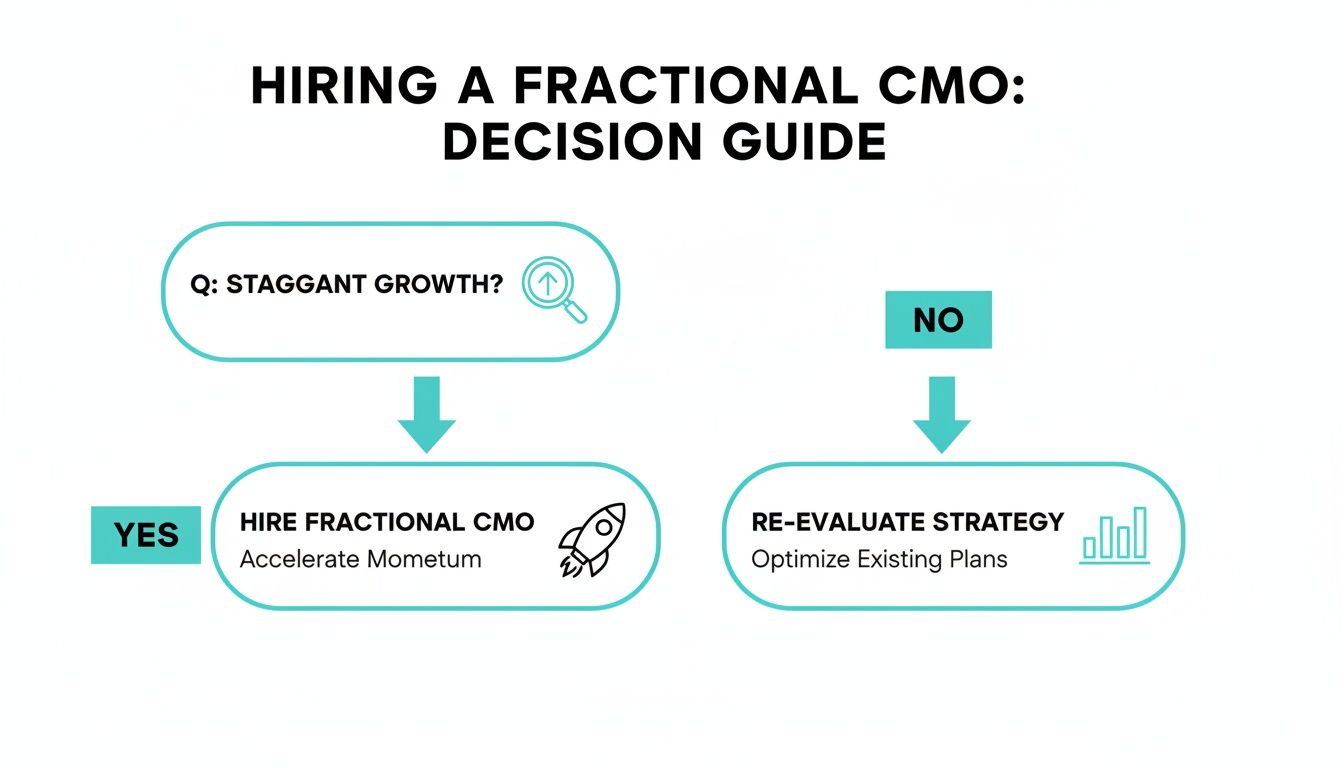
As the chart shows, hitting a growth ceiling is one of the strongest signs that you need executive-level strategy to break through.
The Smart Financial Move for Scale-Ups
The fractional CMO model has really taken off for a reason: companies want high-impact leadership without the eye-watering price tag of a full-time executive.
VC and PE-backed companies are increasingly skipping the traditional $250,000+ annual salary for a C-suite hire. Instead, they’re bringing in fractional experts who deliver the same strategic firepower for way less—often for 67% less cost, according to a recent survey. If you want to dig into the numbers, check out this 2025 statistical analysis.
How to Find and Vet the Right Fractional CMO

Okay, you see the need and you're ready to bring in some senior marketing firepower. But where do you actually find these people? Hiring the right fractional CMO can be a game-changer. Hiring the wrong one is a fast way to burn through cash and time.
Finding the perfect fit means looking past a polished resume and really digging into their track record and how they think. You're not just hiring a marketer; you're bringing on a partner who needs to get your vision and have a believable plan to help you get there.
Where to Source Top Talent
Great fractional CMOs don't really hang out on general job boards. They come from trusted networks and niche platforms where seasoned pros connect.
Your best bets for finding quality candidates are:
- Specialized Firms and Agencies: These groups are a great place to start. They've already vetted a roster of experienced leaders and can match you with someone who knows your industry inside and out.
- Your Professional Network: Tap into your connections on LinkedIn. A warm intro from one of your investors, board members, or fellow founders is worth its weight in gold.
- Industry-Specific Groups: Look for marketing leadership communities or mastermind groups focused on B2B tech or SaaS. This is where you’ll find the experts who live and breathe your world.
The search for a fractional CMO is not about finding a marketing generalist. It’s about finding a strategic operator with a proven playbook for your specific industry, business model, and growth stage. A specialist gets up to speed faster and delivers results sooner.
Once you have a shortlist of people, the real work begins. It’s time to move past their resume and see how they actually think.
Insightful Interview Questions to Ask
The interview is your chance to see how a candidate thinks on their feet. Generic questions won't get you very far. You need to ask questions that reveal their process, their leadership style, and their ability to drive real-world results. For a full checklist, see our guide on how to hire a fractional CMO.
Here are a few questions to get the conversation started:
-
“Walk me through your first 90 days. What’s your process for getting up to speed and building a plan?”
This question pulls back the curtain on how they work. A strong candidate will talk about doing audits, interviewing customers, and digging into the data—not just jumping straight to new tactics. -
“Tell me about a time a marketing strategy you owned was failing. What happened, and what did you do to fix it?”
This tests their problem-solving skills and their honesty. You're looking for an answer that's rooted in data and accountability, not just gut feelings. -
“How do you make sure marketing, sales, and the company’s bigger goals are all pulling in the same direction?”
This gets to the absolute core of the fractional CMO role. Their answer should be all about shared metrics (like pipeline and revenue), open communication, and creating a single, unified go-to-market team.
Your Questions, Answered
Even when the idea of a fractional CMO clicks, some practical questions always come up. You’re probably wondering what it costs, how they’ll plug into your team, and what the day-to-day actually looks like.
Let’s get into the nitty-gritty. Here are the most common questions founders ask when they’re thinking about this model. No fluff, just straight answers to help you decide.
What’s the Typical Investment for a Fractional CMO?
Think of it as buying senior leadership without the full-time price tag. Monthly retainers usually land somewhere between $5,000 and $15,000+, depending on the scope of work and the CMO's experience.
Compare that to a full-time hire, which can easily top $300,000 a year once you factor in salary, bonuses, and benefits. With a fractional leader, your investment is tied directly to strategic guidance and results, not just filling a 40-hour-a-week seat.
How Is This Different from a Consultant or an Agency?
It all comes down to ownership and integration. A consultant comes in to solve a specific problem and then leaves. An agency is there to execute tasks—like running your ads or managing your social media.
A fractional CMO, on the other hand, joins your leadership team. They own the entire marketing strategy, manage your people (whether they're in-house or outsourced), and are held accountable for hitting revenue goals. They’re the strategic “why” behind the work, not just the tactical “how.”
A consultant gives you a map. An agency drives the car. A fractional CMO co-pilots the entire journey—helping you pick the destination, read the terrain, and make sure the whole team gets there together.
This is the key difference. They’re not just a vendor; they’re a strategic partner who is on the hook for growth.
How Much of Their Time Do We Actually Get?
The focus is squarely on impact, not hours clocked. A typical arrangement might involve 10 to 20 hours a week, but that’s flexible and built around what your company actually needs to move forward.
That time is spent on the highest-value work:
- Leading strategy sessions that set a clear direction.
- Running efficient team meetings that unblock your people.
- Mentoring your marketing staff so they can grow into their roles.
- Digging into performance data to find out what’s really working.
- Reporting progress to the rest of the leadership team.
The whole model is designed to give you C-level direction without the C-level overhead. Every minute is spent pushing the business forward.
Ready to see how senior marketing leadership can transform your B2B tech company? Value CMO provides the strategic expertise to build and execute a growth plan that delivers measurable results. Schedule a free consultation today.