A marketing consultant is your strategic co-pilot, someone you bring in to figure out what's blocking your growth and map out a clear, actionable plan to find and win more customers. They offer a sharp, outside perspective to pinpoint what’s holding your startup back and prescribe the right marketing strategy to get things moving. This is a game-changer for B2B tech companies trying to cut through the noise of a crowded market.
Your Strategic Partner for Growth

Let's imagine you've built a fantastic product, but your sales pipeline is all over the place. One month it's booming, the next it's a ghost town. You're swamped, your team is stretched thin, and figuring out a repeatable path to growth feels like you're navigating a maze in the dark.
This is exactly where a marketing consultant steps in.
Think of them as a specialist physician for your company's go-to-market health. They don't just hand out generic advice. They start by diagnosing the root cause of your symptoms—things like a flat pipeline, low-quality leads, or a message that just isn't connecting with the right people.
Once they know the problem, they build a specific treatment plan. This isn't just a random list of tactics; it’s a cohesive strategy that connects your product directly to what your ideal customer actually needs.
A great consultant doesn't stop at the whiteboard. They roll up their sleeves and show your team how to execute the plan, giving them the clarity and momentum they need to get it done right.
This hands-on, strategic guidance is why the demand for their expertise is climbing. The global marketing consulting market, which was $31.26 billion in 2021, is on track to hit $35.68 billion by 2025. That's a 14% jump, largely because more businesses are looking for specialized help to solve tough growth problems. You can dig into the full research about marketing consulting market growth to see the trend for yourself.
What Does a Consultant Actually Do?
So, what does a marketing consultant really do day-to-day? Their job is to build the strategic foundation that makes every dollar and hour you spend on marketing count.
To make it real, here’s a quick breakdown of their core functions and what you can expect from them.
A Marketing Consultant's Core Functions at a Glance
| Area of Focus | What They Do | Typical Outcome for Your Startup |
|---|---|---|
| Strategy & Planning | Audit your current efforts, sales data, and market to find friction points. | A clear, documented Go-to-Market (GTM) strategy that gets your whole team on the same page. |
| Customer & Market | Define your Ideal Customer Profile (ICP) and clarify your unique value proposition. | A sharp message that actually resonates with buyers and sets you apart from the competition. |
| Execution & Enablement | Map out the marketing funnel, identify leaks, and build campaigns to fix them. | A more predictable pipeline with higher-quality leads and better conversion rates. |
| Team & Process | Mentor your in-house marketers, create playbooks, and introduce efficient workflows. | An upskilled team that can tackle complex marketing initiatives with confidence. |
At the end of the day, a good consultant isn't there just to run campaigns. They're there to give your B2B startup the strategic clarity and direction you need to move from being busy to being effective—achieving measurable, repeatable growth.
The Strategic Playbook a Consultant Builds for You
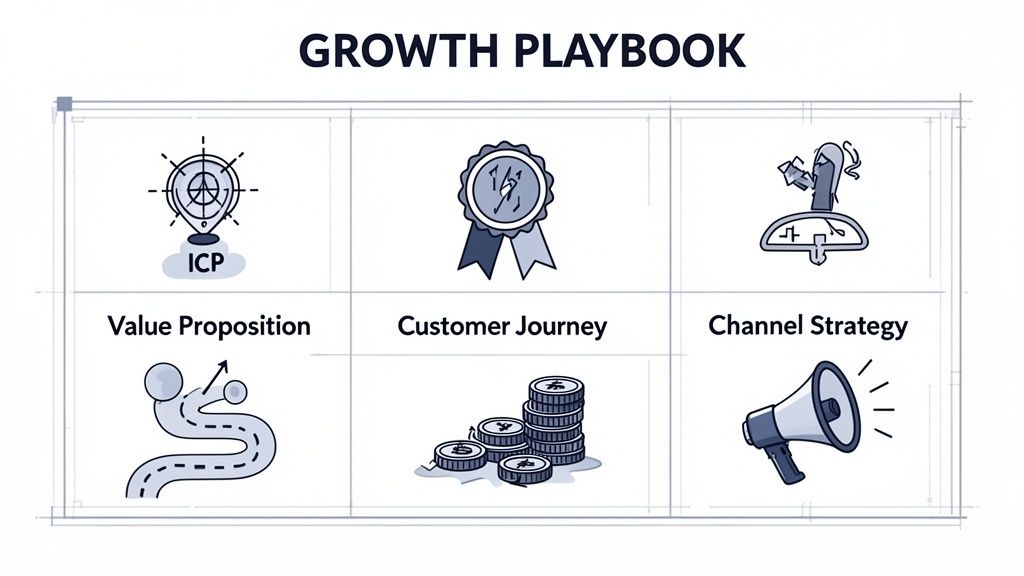
A great consultant doesn’t just show up with opinions and a fancy slide deck. They deliver a tangible, actionable playbook—a detailed blueprint for growth that shows your entire team what to build, where to focus, and how to win.
Think of it like an architect’s plan for a house. You wouldn’t start hammering nails without knowing where the walls go, right? A consultant’s playbook does the same for your marketing, making sure everyone is building from the same set of instructions.
This gets rid of the guesswork that plagues so many startups. Instead of chasing random tactics, your team gets a clear, documented path that gives them immediate clarity. The playbook becomes your single source of truth for all things growth.
Defining Your Ideal Customer and Value
The first chapter of any solid playbook is getting crystal clear on who you’re selling to and why they should care. A consultant leads a deep dive to nail down your Ideal Customer Profile (ICP). This isn't just about demographics; it’s about their real-world pain points, goals, and what makes them buy.
Once you know exactly who you're talking to, the next move is crafting a value proposition that hits home. This is your core message—the one-liner that explains how your product solves their problem better than anyone else. A consultant helps you sharpen this until it’s simple, powerful, and impossible to ignore.
Without a locked-in ICP and a sharp value prop, even the most brilliant campaigns will fall flat. A consultant makes sure this foundation is rock-solid before a single dollar is spent on ads or content.
With this foundation in place, every piece of marketing—from your website headline to a sales email—is aligned and effective. It makes your message resonate with the people most likely to become your best customers.
Mapping the Path to Purchase
Knowing your target is only half the battle. A consultant then maps out the entire customer journey, detailing every single step a prospect takes from discovering your brand to signing a contract. This process shines a light on the critical moments where you can influence their decision.
This journey map aligns your marketing and sales activities with how your buyer actually thinks and acts. It answers key questions that stop deals from leaking out of your pipeline:
- Awareness: How will new prospects even find out you exist? Is it through SEO, social media, or paid ads?
- Consideration: What info do they need to check you out? This could be case studies, webinars, or detailed product guides.
- Decision: What pushes them to choose you over a competitor? Maybe it's a free trial, a killer demo, or a clear pricing page.
Mapping this creates a cohesive experience for the buyer and a predictable process for your team. You can see how these pieces come together in a comprehensive B2B marketing strategy framework that provides the structure for sustainable growth.
Allocating Resources for Maximum Impact
Finally, the playbook gets real with budgets and channels. A consultant helps you put every marketing dollar where it will have the biggest impact. They’ll identify the most effective channels to reach your ICP—whether that’s LinkedIn ads, targeted content, or industry partnerships.
This isn’t about spending more; it’s about spending smarter. A key part of any good playbook is defining what success looks like and tracking it with proven marketing ROI measurement strategies.
By focusing resources on what works and cutting what doesn't, a consultant turns your marketing budget from an expense into a direct investment in revenue.
How Consultants Drive Demand and Digital Marketing
Once you have a solid strategic playbook, the real question is: how does a consultant actually get customers in the door? This is where they shift from architect to builder, moving from planning to the hands-on work of modern demand generation.
For B2B tech startups, this is everything. A brilliant strategy is worthless if it doesn’t fill your pipeline with qualified leads. Consultants step in to run the complex, interconnected campaigns that turn your growth plan into actual revenue.
Think of them as a player-coach. They don't just design the plays; they get on the field with your team and show them how to execute flawlessly. It’s this dual role of strategist and mentor that makes their impact so powerful.
Orchestrating Your Digital Presence
In today's market, a consultant’s digital expertise is non-negotiable. They know how to build a cohesive online presence that grabs the attention of your ideal customers. This isn’t just about posting on social media—it's about making sure you show up everywhere your buyers are looking.
This has become a core responsibility for marketing consultants, who now hold 31.6% of the market share in digital strategy. They’re the ones guiding companies through the shift to privacy-first advertising and the rise of AI, especially as signal loss from cookie phase-outs creates new challenges. The market is set to jump from $35.10 billion in 2025 to $44.16 billion by 2030, all because companies need integrated, data-driven plans to win.
Their work usually weaves together a few powerful activities:
- Search Engine Optimization (SEO): They get your website to show up when potential buyers are actively searching for the exact problem you solve, creating a sustainable flow of high-intent traffic.
- Content Marketing: They help you create genuinely useful content—blog posts, whitepapers, webinars—that answers your customers' biggest questions and positions you as a trusted expert.
- Targeted Advertising: They design and run paid ad campaigns on platforms like LinkedIn or Google, putting your message right in front of your ideal buyers.
By connecting these channels, a consultant makes sure your brand is both visible and valuable at every single step of the buyer’s journey.
Fixing the Leaky Funnel
So many startups have a "leaky funnel." They get traffic and even some leads, but very few ever turn into paying customers. A consultant is an expert at finding and fixing those leaks to get a flat sales pipeline moving again.
They start by digging into your data to see exactly where people are dropping off. Is your website messaging confusing? Are the lead forms too long? Is your sales team too slow to follow up?
A consultant’s job isn't just to pour more leads into the top of the funnel. It's to make sure the entire system is efficient, converting interest into revenue with as little waste as possible.
Once they know the problem, they implement targeted fixes. This often involves setting up practical marketing automation workflows to scale your efforts, like automated email sequences to nurture new leads or A/B testing landing pages to improve conversion rates.
This is how they turn a sporadic, unpredictable lead flow into a reliable engine for growth.
Mentoring and Empowering Your Team
Beyond running the campaigns themselves, one of the most valuable things a consultant does is mentor your team. They work right alongside your junior marketers, coaching them and building their skills so they can manage complex initiatives on their own.
This knowledge transfer is a huge win for startups. You're not just hiring a temporary campaign manager; you're investing in the long-term capabilities of your own people. A good consultant introduces proven frameworks and B2B demand generation best practices, leaving your team stronger and more self-sufficient long after they're gone.
At the end of the day, a consultant closes the gap between high-level strategy and day-to-day execution. They don’t just tell you what to do—they roll up their sleeves, show you how it’s done, and empower your team to keep the momentum going.
Choosing Your Model: Consultant vs. Agency vs. In-House
Deciding how to build out your marketing leadership is one of the most critical calls you'll make early on. Get it right, and you build momentum. Get it wrong, and you burn cash and time you don’t have.
You're essentially choosing the right tool for the job. Do you need a dedicated, full-time person who lives and breathes your culture? Or a full-service crew to handle all the doing? Or a seasoned strategist to come in, set the direction, and get you moving fast?
Each path—in-house, agency, or consultant—serves a different core need. For a B2B tech startup, where budgets are tight and speed is everything, understanding the trade-offs is non-negotiable.
The Full-Time In-House Hire
Bringing a full-time marketing leader on board means embedding someone directly into your company's DNA. They are 100% dedicated to your vision, sit in every meeting, and build deep relationships across the company. That complete immersion is their superpower.
The catch? A senior marketing executive commands a senior salary, plus benefits, equity, and a long, competitive hiring process. For a startup, that’s a massive commitment. You also run the risk of hiring a "single point of failure"—one person can't be an expert at everything. You might get a great strategist who can’t run a PPC campaign to save their life.
The Marketing Agency Model
Hiring a marketing agency is like getting an entire marketing department on retainer. You get access to a team of specialists—a content writer, a paid ads manager, a designer, you name it—all under one roof. It’s a great option if you have a clear strategy and just need more hands on deck to execute.
But there’s a downside. Agencies juggle multiple clients, which means your startup is always competing for attention. The senior expert who pitched you might hand off your account to a junior manager, and their cookie-cutter processes often struggle to keep up with a startup's need to pivot fast.
The Marketing Consultant or Fractional CMO
This is the hybrid model that’s gaining so much traction. A marketing consultant, especially a fractional CMO, gives you access to C-suite-level strategic thinking without the full-time executive price tag. They are specialists brought in to solve a specific, high-stakes problem, like building your first go-to-market strategy or fixing a leaky sales funnel.
This model is built for speed and impact. A great consultant provides the leadership to guide your junior team, helps you place the right strategic bets, and can fill a leadership void while you hunt for the perfect permanent hire. It’s the ideal fit when your biggest need is direction, not just doing more stuff.
This decision tree can help you clarify which path makes the most sense based on what you need most right now: strategy or execution.
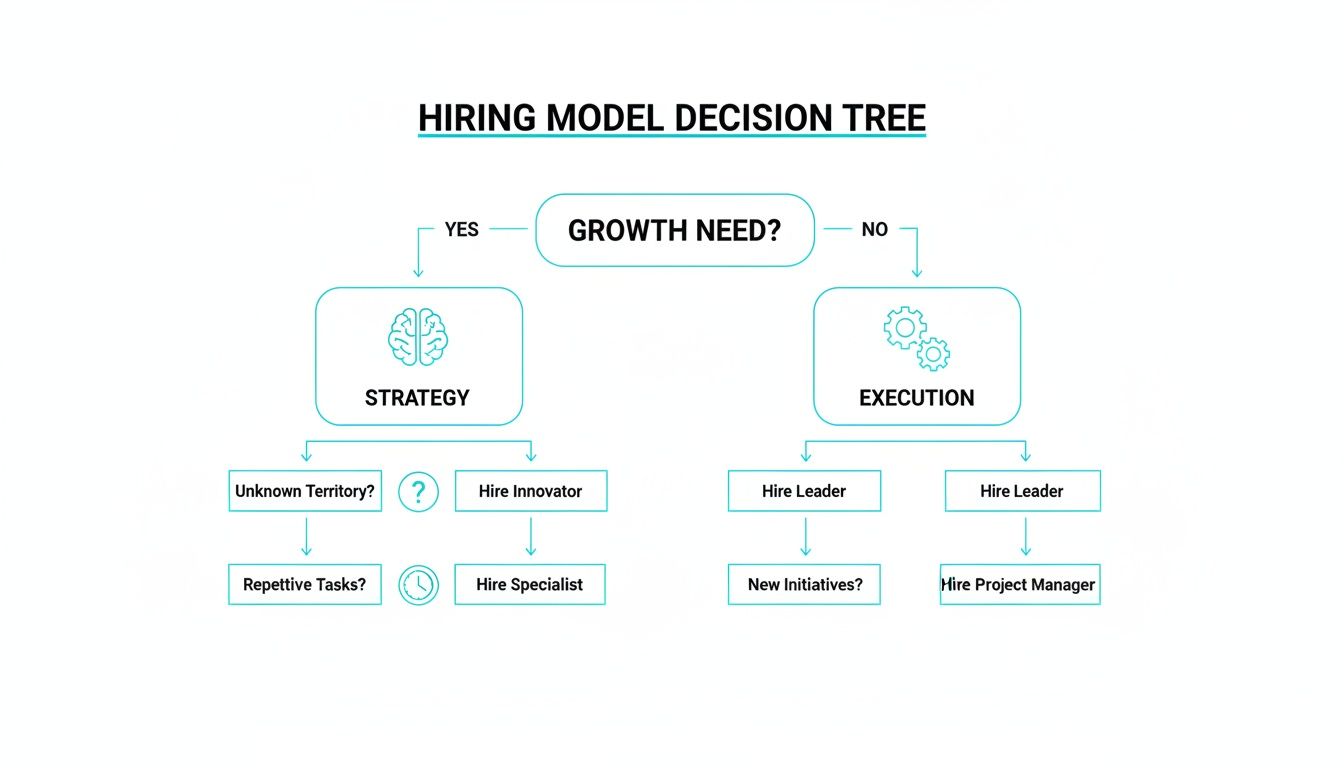
The takeaway is simple: the right model depends entirely on your most urgent business problem.
For startups, the consultant model often hits the sweet spot. It provides the strategic firepower to set the right course and mentor a lean team, making sure you’re building a marketing engine that’s both effective and scalable for the long haul.
To make the choice even clearer, here’s a side-by-side breakdown of how these models stack up.
Marketing Leadership Models Compared
| Factor | Marketing Consultant / Fractional CMO | Marketing Agency | Full-Time In-House Hire |
|---|---|---|---|
| Primary Focus | Strategic direction, problem-solving, and team mentorship. | Tactical execution across multiple channels. | Day-to-day management and cultural integration. |
| Cost | Flexible retainer, often less than a full-time salary. | Higher monthly retainer for a full team. | Full executive salary, benefits, and equity. |
| Speed to Impact | Very fast. They are hired to solve a specific problem quickly. | Slower onboarding and ramp-up time. | Longest time-to-hire and onboard. |
| Expertise | Deep, senior-level strategic experience in a specific area. | A broad team of specialists with varying experience levels. | Expertise is limited to one individual's skill set. |
So, what really sets consultants apart? They parachute in with high-level expertise exactly when you need it, giving your B2B startup the clarity and confidence to navigate those critical early growth stages without the long-term overhead.
When to Hire a Marketing Consultant
Founders always ask about the timing—is it too early, or are we already behind? The truth is, the right moment to bring in a marketing consultant isn't about hitting a specific revenue milestone. It's about spotting the warning signs that your growth engine is starting to sputter.
Think of it less like a panic button and more like a diagnostic checklist. If you find yourself nodding along to the scenarios below, it’s a pretty clear signal that a consultant has shifted from a "nice to have" to a smart investment.
Your Pipeline Is Unpredictable or Just Plain Stagnant
One month feels like a home run, the next is a ghost town. That feast-or-famine cycle is a classic sign that your go-to-market efforts aren't built on a repeatable system. You might be getting leads, but they’re inconsistent, low-quality, or coming from channels you can’t quite put your finger on.
This is exactly the problem a consultant is hired to fix. They come in, diagnose why the pipeline has flatlined, and then build the strategic scaffolding needed for a predictable flow of qualified leads. They’re there to turn randomness into reliability.
Your Marketing Team Is Busy, but Not Effective
Does your marketing team look swamped? They're cranking out blog posts, social media updates, and webinars, but you can’t draw a straight line from all that activity to actual revenue. This is a common trap for startups with junior teams. They’re great at doing tasks but lack the senior-level strategic direction to make sure their hard work actually moves the needle.
A consultant acts as a force multiplier for your existing team. They provide the high-level strategy and mentorship that helps junior marketers focus their efforts on what truly drives growth, not just on being busy.
This guidance bridges the gap between activity and results, ensuring every marketing dollar and hour is tied directly to the bottom line.
You're Gearing Up for a Critical Launch
You’re about to launch a new product, push into a new market, or announce a major funding round. These are make-or-break moments where you only get one shot at a first impression. Going in without an expert-driven marketing plan is a huge, unnecessary risk.
Hiring a consultant beforehand ensures your launch is built on a solid strategic foundation. They'll help you nail the messaging, pinpoint the right channels to create buzz, and map out a coordinated plan that maximizes impact from day one.
While high-growth consulting firms can hit an impressive 41.7% compound annual growth rate with targeted marketing, many individual consultants struggle to market themselves—a surprising 70% generate fewer than eight ideal client calls a month. This just highlights how valuable it is to find a specialist who excels at both planning and execution, especially when you need to scale fast. You can dig into more consulting industry trends at ExpertNetworkCalls.com.
Ultimately, if your board is asking for a growth plan you can't confidently produce, it’s time to call in a pro. A consultant delivers the clarity and strategic horsepower to turn that uncertainty into a clear, actionable roadmap for success.
How to Find and Hire the Right Consultant
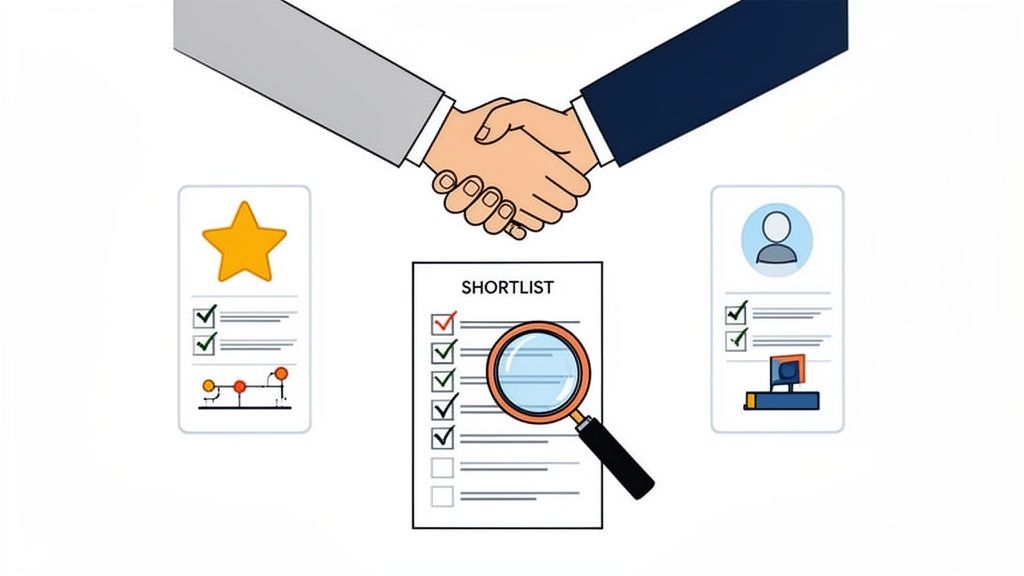
Deciding to hire a marketing consultant is the easy part. Choosing the right one is where the real work begins. Your goal isn’t to find someone with a polished resume; it's to find a true strategic partner who gets the unique pressures of a B2B tech startup.
This is all about finding a fit that goes way beyond skills on a page. You need someone with a no-fluff approach that meshes with your company culture and a deep understanding of your world. A great consultant should feel like an extension of your leadership team from day one.
Define Your Needs Before You Search
Before you even open LinkedIn, you need to know exactly what you want to achieve. Vague goals like "we need more leads" are a recipe for disappointment. Get specific. Are you trying to patch a leaky sales funnel, gear up for a product launch, or build a go-to-market plan from the ground up?
Jot down your top three to five objectives. This simple exercise gives you a clear scorecard for sizing up candidates. It turns a confusing search into a focused mission, making sure you can clearly communicate what success looks like and find someone who’s actually equipped to deliver it.
Where to Look for Top-Tier Talent
Here’s the thing: the best consultants are usually busy doing great work for clients, not marketing themselves. While professional networks like LinkedIn are an obvious starting point, the real gems often come from trusted referrals.
Here are a few places to start digging:
- Your Investor Network: VCs and angel investors have a vested interest in your success. They almost always keep a curated list of vetted consultants they recommend to their portfolio companies.
- Industry Peers: Ask other founders or leaders at non-competing B2B tech companies who they’ve worked with. A firsthand endorsement is worth its weight in gold.
- Specialized Platforms: Niche communities or platforms focused on fractional executives can be a goldmine, connecting you with seasoned pros who specialize in your exact stage and industry.
Key Questions to Ask Every Candidate
Once you’ve got a shortlist, the interview is your chance to go deeper than their case studies. You need to understand how they think, solve problems, and work with a team. Their answers will quickly tell you if they are a genuine strategist or just a tactician.
Your goal is to find a partner who will challenge your assumptions and bring a strong, evidence-based point of view to the table—not just someone who agrees with everything you say.
Prep your questions in advance to make sure you cover the essentials.
Essential Interview Questions
-
"Walk me through a time you solved a similar challenge for another B2B tech company. What was the exact problem, what was your process, and what were the measurable results?" This cuts right to the chase, testing for relevant experience and a results-first mindset.
-
"How do you define and measure success for an engagement like this? What specific KPIs would you focus on in the first 90 days?" This shows if they’re data-driven and can tie their work directly to business outcomes. No fluffy metrics allowed.
-
"Describe your approach to working with an existing, perhaps junior, marketing team. How do you handle mentorship and knowledge transfer?" This is crucial. You want to understand how they will empower your people, not just dictate tasks.
-
"What do you need from us to be successful?" A great consultant knows partnership is a two-way street. Their answer will tell you a lot about their working style and what it will really take to make the engagement a success.
Frequently Asked Questions
Thinking about bringing on a marketing consultant? Good. It's a big decision, and it’s smart to have questions. For B2B founders especially, you need to know what you’re paying for, what results to expect, and how the whole thing actually works before you sign anything. Here are the straight answers.
How Much Does a Marketing Consultant Cost?
The price tag on a consultant swings pretty widely depending on their track record, what you need them to do, and how you structure the deal. For B2B tech startups, the most common setup is a monthly retainer.
- Project-Based: Need a one-off strategic plan, like a complete go-to-market roadmap? Expect to invest somewhere between $5,000 to $15,000+.
- Monthly Retainer: For ongoing strategy, guidance, and coaching for your team, retainers usually land in the $4,000 to $10,000 per month range. That’s a fraction of the $100,000+ annual salary for a full-time senior marketer.
Think of it this way: you get senior-level brainpower without the long-term overhead of an executive salary, benefits, and equity.
What Kind of ROI Should I Expect?
Forget vanity metrics like a bump in website traffic. The ROI from a great consultant is tied directly to business results, not just marketing activity.
The real return comes from building a repeatable, scalable growth engine. You're paying for a clear strategy that fixes a flat pipeline, improves lead quality, and actually shortens your sales cycle.
Success is measured in things you can take to the bank, like a 20-30% jump in qualified leads within a single quarter or a measurable lift in your lead-to-customer conversion rate. The whole point is to build a system that keeps delivering predictable revenue long after the consultant is gone.
How Long Does a Typical Engagement Last?
Consultant engagements are built to solve a specific problem, not to last forever. They need a clear start and end date to maintain focus and drive urgency.
For most B2B startups, a typical engagement breaks down into two phases:
- Initial Strategy Phase (30-90 days): This is an intense sprint focused on digging in, diagnosing the real issues, and building an actionable roadmap. This is where the core GTM plan gets hammered out.
- Implementation & Mentorship Phase (3-6 months): From there, the consultant shifts into an oversight role—guiding your team as they execute the plan, coaching them through roadblocks, and tweaking campaigns based on what the data says.
The goal isn't to create dependency. It's to build momentum, transfer knowledge, and empower your in-house team to take the wheel and keep driving forward on their own.
Ready to build a marketing engine that drives predictable growth? Value CMO provides the senior strategic leadership B2B tech startups need to turn uncertainty into a clear, actionable plan. Get the expert guidance you need to scale.