Let’s get one thing straight: tactical vs. strategic planning isn’t just a bunch of buzzwords. Strategy is your startup's North Star—the big picture, the 'why' behind everything you do. Tactics are the boots on the ground, the specific, daily moves that get you closer to that star. Think of it like this: one is the destination; the other is the road map.
The Founder's Dilemma Balancing Daily Wins and Long-Term Vision
If you're a B2B tech founder, you know the feeling. You’re pulled in two directions at once: you have to hit this quarter’s revenue target, but you also need to build a brand that will dominate the market in three years. This constant tug-of-war is where most startups get stuck.
Lean too hard on short-term tactical wins, and you’ll find yourself on a hamster wheel of busywork that leads nowhere. You get burned out, your growth stalls, and you lose sight of the bigger prize. This isn't just a feeling; it's a measurable risk. One analysis of over 500 SaaS companies found that those with a clear strategic plan—thinking about market leadership, not just lead volume—achieved 42% higher revenue growth over three years.
Think of it this way: strategy answers the big, foundational questions. "Who are we?" "Where are we going?" It’s the unifying force that keeps everyone rowing in the same direction.
A Quick Comparison
Tactics, on the other hand, are the concrete actions that bring that vision to life. They’re the marketing campaigns, the sales cadences, and the product updates you execute day in and day out. A solid strategy ensures every single tactic has a purpose.
The greatest risk isn't taking the wrong action. It's taking the right action for the wrong reason. A clear strategy connects every tactic to the mission, so you stop wasting time and money on things that don't matter.
To make the distinction crystal clear, here’s a quick side-by-side look.
Quick Look Strategic vs Tactical Planning
| Attribute | Strategic Planning | Tactical Planning |
|---|---|---|
| Focus | Why we are doing it (The big picture) | How we are doing it (Specific actions) |
| Timeline | Long-term (1-5+ years) | Short-term (Days, weeks, months) |
| Scope | Broad, company-wide direction | Narrow, project or team-specific tasks |
| Goal | Sustainable competitive advantage | Achieving immediate, measurable targets |
Once you get this balance right, everything gets easier. A clear strategic vision makes it simple to prioritize the right tactics and make confident decisions, even when the daily fires are burning. This is exactly why exercises like building a better quarterly business review format are so powerful—they force you to connect short-term execution to your long-term goals.
Now, let's get into how to build both a powerful strategy and the effective tactics to back it up.
Strategic Planning: How to Define Your Startup's North Star
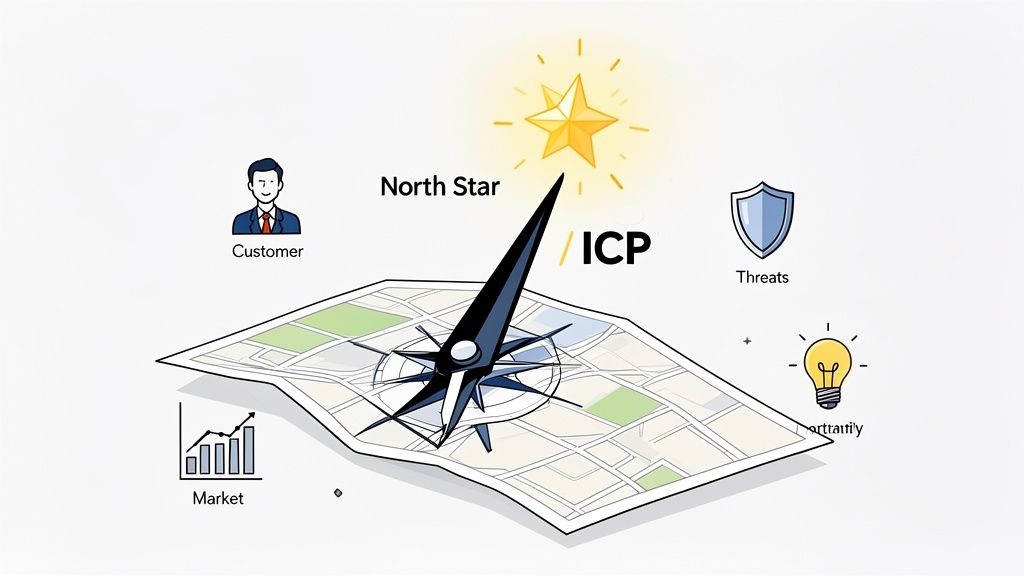
Real strategic planning is about asking the tough, foundational questions that get you thinking beyond the next quarter. It forces you to define what winning actually looks like in three to five years, not just the next 30 days.
Without that long-term clarity, your startup is just a collection of busy people executing random tasks. It's not a unified team driving toward a shared destination.
This process isn’t about creating a dusty, 100-page document nobody reads. For a B2B tech startup, it’s an active discipline of defining your North Star—that single, guiding objective that simplifies every decision. It's the blueprint that ensures every dollar and hour pushes you in the right direction.
Starting with Your Go-to-Market Strategy
Your Go-to-Market (GTM) strategy is the absolute cornerstone of your strategic plan. Think of it as your operational playbook for reaching, acquiring, and keeping customers in a crowded market. A sharp GTM answers the critical questions that prevent you from making expensive mistakes later on.
A strong GTM plan will nail down:
- Market Definition: Which specific market segment will you dominate first?
- Ideal Customer Profile (ICP): Who is your perfect customer, and what are their biggest pain points?
- Product-Market Fit: How does your solution solve your ICP's problem in a way your competitors can't touch?
- Pricing and Positioning: What is your core value proposition, and how will your pricing prove it?
- Channels: Where do your ideal buyers hang out? Which marketing and sales channels will actually reach them?
Getting this wrong is incredibly expensive. With a fuzzy ICP, you burn marketing dollars on channels your ideal buyers ignore. Without a solid value prop, your sales team can't close deals. Your GTM is the first line of defense against wasted resources.
A common failure point for startups isn't a bad product; it's an incoherent strategy. When your GTM is fuzzy, every tactical decision—from ad copy to sales scripts—is built on a shaky foundation.
Using Frameworks to See the Full Picture
To build a strategy that can withstand market shifts, you need to understand the entire landscape. This is where analytical frameworks come in—not as academic exercises, but as practical tools for spotting real opportunities and threats. They force you to look beyond your own four walls.
For instance, a SWOT analysis (Strengths, Weaknesses, Opportunities, Threats) is perfect for an internal check-up. It demands an honest look at what you do well and where you’re vulnerable. What are your unique advantages? Where could a competitor easily outflank you?
A PESTLE analysis (Political, Economic, Social, Technological, Legal, Environmental) acts as your external radar. It helps you anticipate macro-level shifts that could derail your business. Think about the sudden rise of AI—is that a technological threat to your model, or a massive opportunity to build a new competitive edge? To dig deeper into setting your long-term direction, check out this guide on strategic planning process steps for maximum business leverage.
These frameworks aren't just for brainstorming. They deliver the data-driven insights you need to make informed strategic bets. By combining an internal view (SWOT) with an external one (PESTLE), you get a panoramic view of your options. That holistic perspective is the difference between reacting to the market and actively shaping your position within it.
Tactical Planning: The Engine Fueling Your Daily Growth
If your strategy is the map showing where you want to go, tactical planning is the engine that actually gets you there, mile by mile. This is where the big-picture vision gets its hands dirty, translating into the concrete actions that fill your pipeline and drive revenue every single day.
Tactics are all about execution. They are the specific, measurable, and time-bound initiatives you run to hit a piece of a larger strategic goal. Without them, your strategy is just a PowerPoint deck—full of promise but delivering zero results.
This is the world of agility and fast feedback. Unlike a rigid, long-term strategy, good tactics have to adapt to what the market is telling you right now. It's about running experiments, learning quickly, and doubling down on what works. To really drive daily growth, you have to understand what tactical planning involves in today's fast-moving environment.
From Vision to Action: Practical Examples
So, how does a strategic objective become a tangible tactic? Let's say your strategic goal is to increase your market share in the fintech sector by 15% over the next two years. That's a great North Star, but you can't just "do" that on a Tuesday morning.
You need tactics to make it happen. Here’s what that looks like in the real world:
- Tactic 1: Launch a LinkedIn Ads campaign targeting VPs of Finance in mid-market fintech companies. The goal is to generate 25 Marketing Qualified Leads (MQLs) this quarter.
- Tactic 2: Develop and promote a case study showing how a similar fintech client boosted their efficiency, aiming for 500 downloads to drive traffic to a dedicated landing page.
- Tactic 3: A/B test the headline and call-to-action on your demo request page to lift the conversion rate by 5% within 30 days.
Notice how each tactic is specific, measurable, and has a deadline. They're small-scale projects that, when added up, build the momentum you need to hit that ambitious 15% market share goal.
A great tactic isn't just a random good idea. It's a calculated, measurable action that directly supports a strategic pillar. When every tactic has a "why," you stop wasting effort on activities that don't contribute to growth.
The Hallmarks of Effective Tactical Planning
Not all actions are created equal. It's easy to fall into the "tactical trap"—being busy with dozens of activities that feel productive but don't actually move the needle on your strategic goals. Truly effective tactical planning has a few defining traits.
It is always:
- Highly Focused: Tactics target a specific audience, channel, or metric. They are narrow by design, which makes them manageable and easy to measure.
- Data-Informed: The best tactics are born from data and produce more data. You analyze performance to decide what to do next, creating a continuous feedback loop of improvement.
- Owned and Accountable: Every tactic needs a clear owner. Whether it’s the marketing manager, a content specialist, or an SDR, someone is responsible for execution and results.
When you line up these sharp, focused tactics with your overarching strategy, something powerful happens. Random acts of marketing become a cohesive growth machine. You can start building a predictable pipeline because you know which levers to pull to get a specific result.
For B2B tech startups looking to build this kind of structure, our guide on creating a marketing roadmap template provides the framework to connect your daily actions to your long-term vision. This discipline is what turns your strategic map into a well-oiled engine for growth.
Comparing How Strategy and Tactics Truly Differ
Let's cut through the noise and put strategy and tactics side-by-side. For a B2B tech startup, getting this right isn't just an academic exercise—it’s how you spend your limited cash for maximum impact. One sets the destination; the other chooses the vehicle and maps out the turns.
When founders blur these lines, they usually end up with a collection of disjointed actions. They might run a brilliant marketing campaign (a great tactic) aimed at an audience that's completely wrong for their long-term market goals (a flawed strategy). This comparison will help you see if your efforts are actually pulling in the same direction.
Purpose: Direction vs. Action
At their core, the two serve entirely different functions. Strategic planning is all about setting the direction. It tackles the big "why" and "where" questions: Why are we even in this market? Where do we need to be in three years? The goal is to carve out a sustainable competitive advantage.
Tactical planning, on the other hand, is all about executing actions. It’s obsessed with the "how" and "when." How will we generate 50 qualified leads this quarter? When are we launching the new feature messaging? Its purpose is to hit specific, short-term targets that move the bigger strategy forward.
A winning strategy provides the clarity to say "no" to a hundred good tactical ideas to focus on the three that truly matter. It’s a filter, not a to-do list.
This distinction is crucial. An imbalance is a recipe for disaster. Tactical micromanagement can easily mask glaring strategic weaknesses. Data from Deloitte shows that companies with clear strategic roadmaps see much higher year-over-year revenue growth than those stuck in short-term tactics, especially when the market shifts. You can get more details on why balancing strategy and tactics is so important for growth.
Timescale and Scope: Vision vs. Campaigns
Another key difference is their timescale and scope. Strategic planning is long-term and broad. It looks out one to five years (or even more) and touches the entire organization—from product and engineering to sales and marketing. A strategic move, like entering a new international market, has company-wide ripple effects.
Tactical planning is short-term and narrow. Its horizon is usually measured in days, weeks, or a single quarter. The scope is tight, often limited to one team or project. Think of the marketing team's plan to boost website traffic or the sales team’s outreach sequence for a new industry.
Key Metrics: Market Share vs. Lead Velocity
How you measure success for each is also fundamentally different. The numbers for strategic success are lagging indicators that tell you about your long-term health and market position.
Strategic Metrics Include:
- Market Share: Your slice of the total sales pie in your industry.
- Customer Lifetime Value (LTV): The total revenue you expect from a single customer over time.
- Brand Equity: The perceived value of your brand in your customers' minds.
Tactical metrics, however, are leading indicators. They give you immediate feedback on what's working right now.
Tactical Metrics Include:
- Lead Velocity Rate (LVR): The month-over-month growth in qualified leads.
- Conversion Rate: The percentage of people who take a desired action, like signing up for a demo.
- Customer Acquisition Cost (CAC): The total cost to bring in one new customer.
This image breaks down the core principles of solid tactical planning, showing how it must be targeted, measurable, and agile.
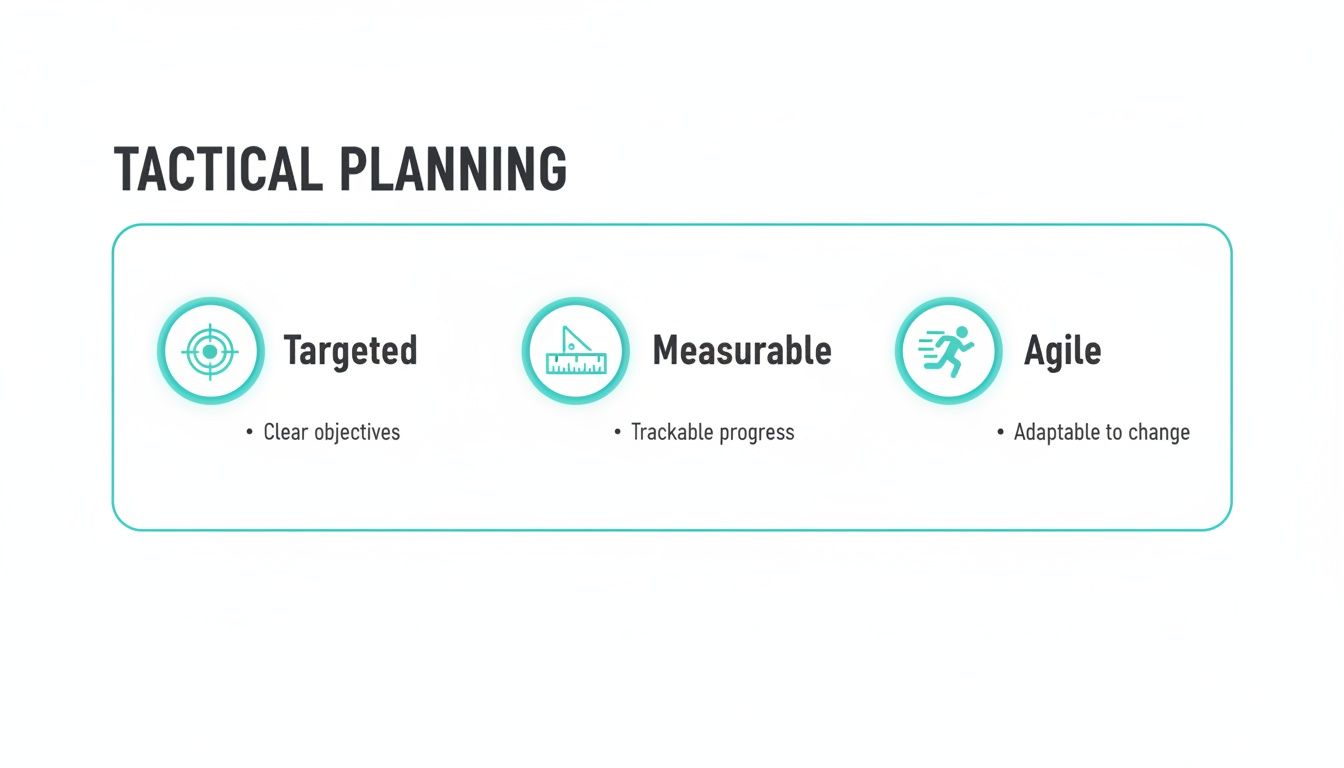
It’s a good reminder that effective tactics aren't random acts of marketing. They're precise, data-driven, and built to adapt.
Tactical vs Strategic Planning: A Detailed Breakdown
To make these differences easy to reference, here’s a clear breakdown across several key business dimensions. Use this table to audit your own planning processes and spot where you might have an imbalance.
| Dimension | Strategic Planning (The 'Why') | Tactical Planning (The 'How') |
|---|---|---|
| Primary Goal | Define a long-term competitive advantage and market position. | Execute specific, measurable actions to meet immediate targets. |
| Time Horizon | Long-term (1-5+ years) | Short-term (Days, weeks, months) |
| Scope | Broad and company-wide (e.g., entering a new market segment). | Narrow and team-specific (e.g., running a webinar campaign). |
| Ownership | C-suite and senior leadership (CEO, CMO, Board). | Department heads and team leads (Marketing Manager, Sales Director). |
| Flexibility | Stable and consistent; reviewed annually or bi-annually. | Agile and adaptable; adjusted weekly or monthly based on data. |
| Key Question | "Where are we going and why?" | "What are the exact steps to get there?" |
| Output | A Go-to-Market strategy, company vision, and multi-year roadmap. | A project plan, campaign brief, or quarterly marketing calendar. |
Having this clarity ensures that the daily grind (the tactics) is always serving the long-term vision (the strategy), preventing wasted effort and keeping the entire company aligned on what truly matters.
Recognizing When Your Startup Needs a Strategic Reset
It’s easy to get so buried in the daily grind of hitting targets that you miss the fact that your startup has drifted way off course. This is the “tactical trap”—a state of constant, frantic execution that feels productive but lacks any real, unifying direction. How do you know if you're stuck in it?
The warning signs are almost always felt before they show up on a spreadsheet. There's that nagging feeling that your teams are working incredibly hard but not gaining any meaningful traction. The energy is high, but the results are all over the map.
Diagnosing the Tactical Trap
When your startup is running without a solid strategic foundation, the symptoms will start bleeding into your core business functions. These aren't just minor growing pains; they're big red flags signaling a major disconnect between your daily actions and your long-term goals.
You might be in a tactical trap if you notice:
- An Unpredictable Sales Pipeline: One month is a blockbuster, the next is a ghost town. This revenue rollercoaster is a classic sign that your lead generation isn't tied to a consistent strategy that targets a well-defined Ideal Customer Profile (ICP).
- Disjointed Marketing Campaigns: Your team is launching a flurry of activities—webinars, ads, social posts—but they don’t tell a cohesive story. Each campaign feels like a one-off experiment, not a coordinated push to build brand equity and own a piece of the market.
- High Customer Acquisition Costs (CAC): When you lack strategic clarity, you end up throwing money at different channels just to see what sticks. This "spray and pray" approach blows up your CAC because you're not focusing your resources on the most efficient paths to your best-fit customers.
The most expensive mistake isn't a failed tactic; it's a successful tactic that leads your company in the wrong direction. Without a strategic filter, you can't tell the difference until it's too late.
Internal Misalignment and Wasted Effort
The chaos isn't just external; it ripples right through your internal teams. When strategy is missing, departments invent their own priorities, which leads to friction and duplicated work. Marketing generates leads that sales can't close, sales makes promises that product can't deliver, and everyone feels like they’re pulling in different directions.
This misalignment is a direct result of relying too heavily on tactics. Each team is busy optimizing its own short-term KPIs, but there's no shared North Star to guide their collective efforts.
The Value of an External Perspective
Realizing you need a strategic reset isn’t a sign of failure. For a founder juggling a thousand things at once, it’s actually a mark of strong leadership to admit you need an outside perspective to get back on track. Bringing in an expert isn’t about outsourcing your vision; it's about getting the dedicated focus needed to build a solid roadmap.
This is where an experienced partner can make all the difference. For startups facing this exact challenge, a fractional CMO can provide the senior-level strategic thinking needed to realign the company—without the cost and commitment of a full-time executive hire. You can learn more about how a fractional CMO bridges this leadership gap and gets growth moving again.
An expert can quickly diagnose the strategic gaps, facilitate the tough conversations, and help you build a practical, data-driven plan that reconnects your daily tactics to a powerful long-term vision. It's a capital-efficient way to get your growth engine back on track and ensure every bit of effort pushes your startup forward.
Answering Your Top Planning Questions
Even with a solid grasp of tactical vs strategic planning, founders still hit roadblocks when it comes time to execute. Let’s tackle the most common questions I hear with direct answers you can use today.
How Often Should We Review Our Strategy?
The biggest mistake I see is treating the strategic plan like a one-and-done document that gets filed away. For a B2B tech startup, your strategy has to be a living guide, not a historical artifact collecting dust.
Your core vision might hold steady for years, but the plan itself needs regular check-ins to stay sharp.
- Annual Deep Dive: Block out time once a year for a full-scale review. This is where you challenge your assumptions about the market, your ICP, and your long-term goals using the last 12 months of hard data.
- Quarterly Check-ins: Use your quarterly business reviews to see how you're tracking against strategic milestones. The goal isn’t to overhaul the strategy every 90 days, but to make sure your tactics are actually getting you there.
This rhythm keeps the big picture in focus while giving you the agility to pivot based on what the market is telling you.
We Have No Formal Plan. Where Do We Start?
It’s completely normal to feel overwhelmed by creating a plan from scratch, especially when you're pulled in a million directions just running the business. The trick is to aim for clarity, not complexity. Forget writing a 50-page manifesto.
Start by getting your leadership team in a room and answering three foundational questions:
- Who is our Ideal Customer Profile (ICP)? Get painfully specific. Name the company size, industry, and the exact buyer persona you were born to serve.
- What’s the one core problem we solve for them? Nail your value proposition in a single, powerful sentence.
- What does winning look like in three years? Set a tangible, ambitious goal, like "become the #1 solution for mid-market fintech compliance."
Answering these three questions gives you a "minimum viable strategy." It’s just enough direction to start aligning your tactical moves, turning random acts of marketing into purposeful steps forward.
If you don’t know where you’re going, any road will get you there. A simple, one-page strategic brief is far more powerful than a complex plan that no one reads.
How Do I Keep Daily Actions Aligned with Our Vision?
This is where the rubber meets the road: connecting the daily grind to the long-term dream. The best way to bridge that gap is with a clear hierarchy of goals. Every single tactical objective must ladder up to a bigger strategic pillar.
Here’s how it looks in practice:
- Strategic Goal: Increase market share by 10% in the next 18 months.
- Quarterly Tactic: Generate 50 new MQLs from our target enterprise segment.
- Weekly Action: Launch and optimize a LinkedIn ad campaign targeting that exact segment.
This simple structure makes it crystal clear how every team member’s specific tasks—no matter how small—contribute directly to the company's North Star. It turns their to-do list into a meaningful part of a much bigger mission.
Navigating the line between tactical execution and strategic vision is a defining challenge for any B2B tech founder. If you need an expert to help build a clear roadmap and get your team aligned for growth, Value CMO provides the senior marketing leadership you need without the full-time overhead. Get the strategic clarity your startup deserves.