For a B2B tech founder, thinking about the structure of your marketing department can feel like a problem for another day—something to deal with when you're bigger. But that’s a trap. Your org structure is the blueprint for growth you need right now.
Getting it right is what turns marketing from a list of random tasks into a predictable machine that generates revenue.
Why Your Marketing Structure Is Your Growth Engine
Think of your marketing team like a high-performance engine. You can have a collection of brilliant people—a great content writer here, a sharp social media person there—but without a clear structure, it’s just a pile of expensive parts on the garage floor. Individually, they’re valuable. But they can’t produce any real power until they’re assembled correctly.
An unstructured team is the source of all kinds of founder headaches. You see wasted ad spend because no one truly owns performance metrics. Your messaging feels all over the place because the product and content teams aren’t in sync. Worst of all, your best people get burned out from overlapping duties and a lack of clear direction.
From Bureaucracy to Strategic Advantage
Let's get one thing straight: a formal marketing structure isn't about creating corporate red tape. It’s about creating clarity. It’s a strategic advantage that spells out exactly who does what, what they’re responsible for, and how work gets handed off.
That clarity has a direct impact on your bottom line. When your team knows exactly what they own, work gets done faster and more efficiently. Growth stops being a mystery and starts becoming something you can actually forecast. Building this foundation requires a clear plan, a lot like the one we lay out in our marketing roadmap template.
A deliberate marketing structure doesn't just organize people—it organizes effort. It ensures that every dollar spent and every hour worked is aligned with the single goal of accelerating revenue.
The Impact of Leadership on Structure
A solid structure always starts with strong leadership at the top. This is why the Chief Marketing Officer (CMO) role has become so critical to making smart, strategic decisions. In fact, the American Marketing Association notes that one in four Fortune 500 companies now have a CMO on the executive team.
Even more telling, 57% have a senior marketing leader at the top table, which shows just how vital this function has become.
Good leadership ensures the entire department works as one cohesive unit, not a collection of siloed functions. For a practical guide on building a framework that can scale with you, check out this piece on How to Design an Organizational Structure That Fuels Growth. Remember, designing your team isn't just an HR task—it's the most important lever you have for building a sustainable growth engine.
How to Structure Your Marketing Team as You Grow
There's no magic org chart that fits every B2B tech company. The right team structure is a moving target, tied directly to your growth stage and Annual Recurring Revenue (ARR). I’ve seen it a hundred times: a startup tries to hire for a $50 million company when they’re still under $1 million. It’s a classic, cash-burning mistake.
The trick is to build the team you need right now, while keeping an eye on what’s coming next. You evolve the marketing department in phases, making sure every hire lines up with your most immediate goals. Let’s walk through the three most common stages of that journey.
Marketing Team Evolution by Company Stage
This table breaks down how your marketing team's structure, roles, and goals should shift as your revenue grows. It's a simple roadmap to guide your hiring decisions at each stage, helping you avoid common pitfalls like hiring a strategist when you need a doer, or relying on a generalist for too long.
| Company Stage (ARR) | Typical Structure | Core Roles | Primary Goal |
|---|---|---|---|
| Under $1M ARR | Founder-Led | Founder, maybe a freelancer | Find product-market fit |
| $1M – $5M ARR | First Hires | Marketing generalist ("doer") | Build foundational channels |
| $5M+ ARR | Scaling with Specialists | Demand Gen, Content, Product Marketing | Drive predictable pipeline |
As you can see, each stage has a distinct focus. You’re not just adding headcount; you’re adding specific capabilities to solve the growth challenge directly in front of you. Let's dig into what that looks like in practice.
The Founder-Led Stage (Under $1M ARR)
In the very beginning, the "marketing department" is usually just you, the founder. Your days are a chaotic mix of writing website copy, sending cold emails, posting on social media, and maybe running a few small ad experiments. It's pure hustle.
The goal here isn't to build a brand empire; it's to find product-market fit. You’re just trying to generate those first few precious leads and figure out what message actually gets a response.
The biggest mistake you can make at this stage? Hiring a senior VP of Marketing. You don't need a high-level strategist to build a ten-slide deck. You need someone in the trenches, executing. Your limited cash is better spent on experiments that prove your model.
The First Hires Stage ($1M – $5M ARR)
Once you cross that $1 million ARR mark, you can’t do it all anymore. It’s time for your first real marketing hire, and this decision is critical—it sets the tone for everything that follows.
Your first hire should almost always be a versatile marketing generalist. Look for titles like "Marketing Manager" or "Growth Marketer." This person is your Swiss Army knife. They can write a blog post, manage a social calendar, set up a basic email nurture, and pull simple reports. They need to be scrappy and obsessed with execution.
This hire isn't meant to be your long-term strategic leader. Their job is to pull the tactical work off your plate and start building the first repeatable marketing programs that bring in a steady flow of leads.
The focus shifts from just "finding what works" to "doing more of what works." You're building out your core channels and proving they can scale. Many companies at this stage get senior-level guidance through outsourced marketing solutions to help their first hire punch above their weight, without the full-time executive cost.
The Scaling Stage ($5M+ ARR)
As you push past $5 million ARR, the generalist model starts to creak and groan under the weight. The volume of work is just too much for one or two people to handle well. This is your cue to start building out specialized functions.
Your team finally begins to look like a real department, organized around specific marketing disciplines. You start bringing in specialists to own critical areas.
- Demand Generation Lead: This person is laser-focused on one thing: filling the sales pipeline. They own paid ads, SEO, and the entire strategy for creating and capturing buyer interest. You measure their success in Marketing Qualified Leads (MQLs) and pipeline value.
- Content Marketer: This role owns your company’s story. They create the blog posts, case studies, and webinars that attract your ideal customer and establish you as a thought leader.
- Product Marketing Manager: They are the vital bridge connecting product, marketing, and sales. They nail the messaging and positioning, keep an eye on competitors, and arm the sales team with the killer assets they need to close deals.
This is when a clear hierarchy really starts to pay off, creating a foundation for predictable growth where roles are clear and goals are aligned.
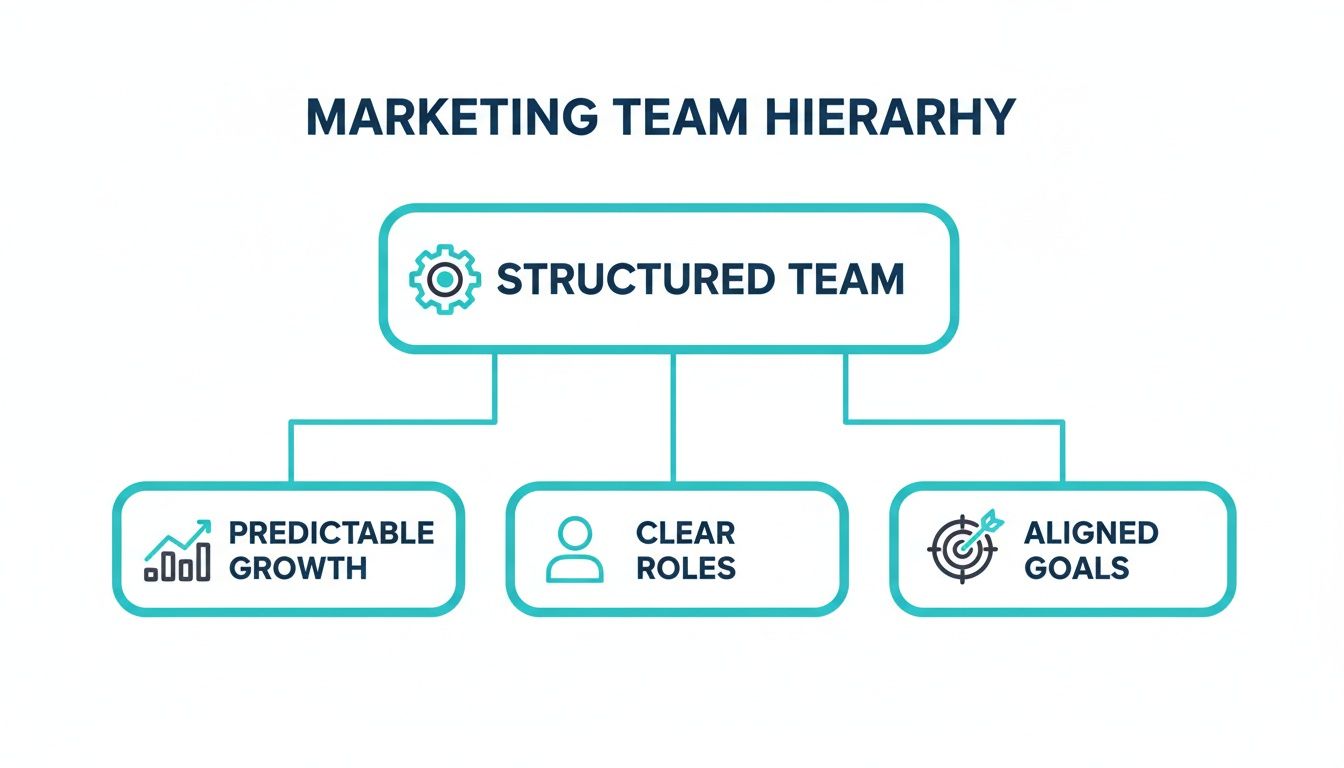
A well-defined structure isn’t about corporate bureaucracy. It's about building an engine where every part works together to drive results. At this stage, each new hire should have clear ownership and metrics, turning marketing from a purely creative function into a predictable revenue driver. Moving from one stage to the next requires a deliberate plan, not just reacting to the chaos.
Defining Key Roles in a Modern B2B Team
Knowing which team model fits your company stage is one thing; knowing exactly who to hire is another. A modern B2B marketing department isn't just a collection of job titles—it's a system of interconnected roles, each with a specific job to do.
Get these roles right, and you can write better job descriptions, set clear expectations, and build a team that actually drives revenue. Let's break down what these people really do, day-in and day-out.
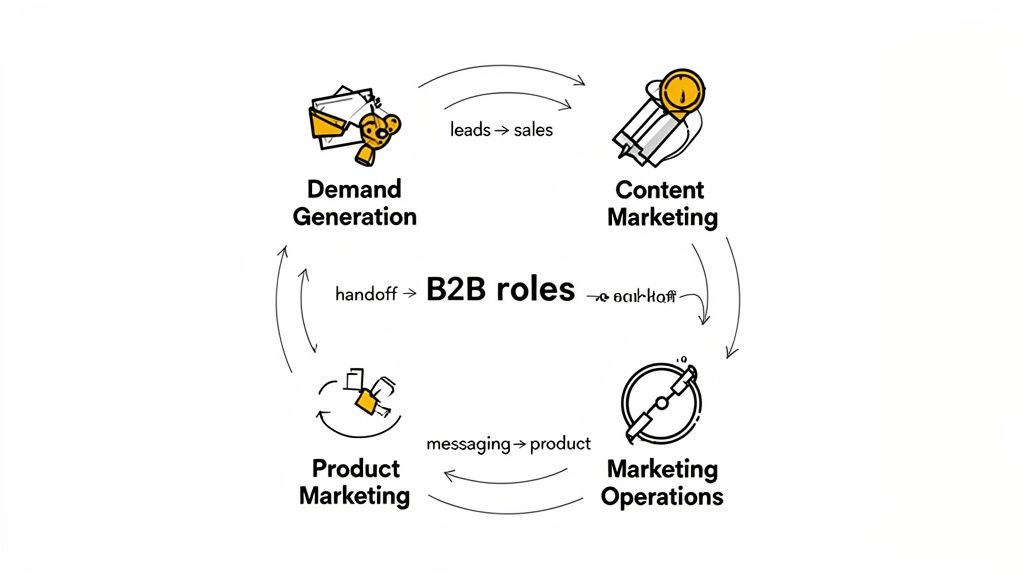
Demand Generation The Pipeline Builders
Demand Generation (Demand Gen) isn't about getting clicks or running ads for the sake of it. Their one and only job is to build a predictable revenue pipeline for the sales team. Think of them as the engine room of your marketing department—they generate the power that moves the whole ship forward.
Their world revolves around attracting, engaging, and converting prospects into qualified leads. This means they own the channels that drive a direct response, from paid search and social ads to SEO and webinars.
A Demand Gen manager's success is measured by hard numbers:
- Marketing Qualified Leads (MQLs): How many prospects have shown enough interest to be handed over to sales?
- Sales Qualified Leads (SQLs): How many of those leads does the sales team accept as worth pursuing?
- Pipeline Value: What’s the total dollar amount of sales opportunities generated from their campaigns?
The critical handoff for this team is getting those leads to sales, fast. A rock-solid Service Level Agreement (SLA) is non-negotiable here. It needs to define exactly what makes a lead "qualified" and the window sales has to follow up. Without that bridge, even the best leads go to waste.
Content Marketing The Storytellers
If Demand Gen builds the pipeline, Content Marketing fills it with the right people. This team is responsible for creating valuable, relevant content that attracts your ideal customer and establishes your company as a trusted authority. It’s not about churning out blog posts; it’s about telling a consistent story that solves your audience's biggest problems.
Content marketers are the voice of your brand. They create the assets that fuel every other marketing activity—the blog posts and case studies that drive SEO, the webinar decks, and the ebooks used in demand gen campaigns.
A great content marketer doesn’t just write. They think like a publisher, building an audience by consistently delivering value and earning trust long before a prospect is ready to buy.
Their key metrics focus on engagement and influence, like organic traffic, time on page, and conversion rates on content downloads. They work hand-in-hand with Demand Gen to make sure their stories reach the right audience and drive action. For managing specific tasks, many teams are now integrating SEO Virtual Assistants to scale content distribution and optimization without adding headcount.
Product Marketing The Translators
Product Marketing is the critical link between your product, marketing, and sales teams. They are the translators. Their job is to take the complex features of your B2B tech and turn them into a clear, compelling message that customers actually care about.
They answer the single most important question in a buyer's mind: "So what?"
This team owns the go-to-market strategy for new products and features. They run competitor analysis, define buyer personas, and develop the core positioning that the rest of the marketing team uses. They also build the sales enablement materials—battle cards, pitch decks, and one-pagers—that arm the sales team to win deals.
Marketing Operations The Architects
Finally, Marketing Operations (or "Marketing Ops") is the silent hero that makes everything else work. This function is the central nervous system of the entire department. They own the technology, processes, and data that let the team operate efficiently and prove its impact.
They are the architects of your marketing machine. They manage your marketing automation platform (like HubSpot or Marketo), keep the CRM data clean, build campaign workflows, and create the dashboards that track performance. Without a strong Marketing Ops function, your structure of a marketing department is just a plan on paper.
Their job is to make sure the team can execute flawlessly and leadership has the data it needs to make smart decisions. They own metrics like lead-to-customer conversion rates and marketing ROI, providing the visibility needed to scale predictably.
Building Your Martech Stack and Assigning Ownership
A great team structure falls apart without the right tools. But the world of marketing technology—or “Martech”—can feel like an overwhelming alphabet soup of platforms and acronyms. Getting your tech stack right isn’t about buying the most expensive software; it’s about choosing the right tools that actually help your team get the job done.
Think of your Martech stack as the central nervous system for your entire marketing department. It connects every function, moves information where it needs to go, and gives you the data to prove what’s working. Without it, your carefully designed team is just flying blind.
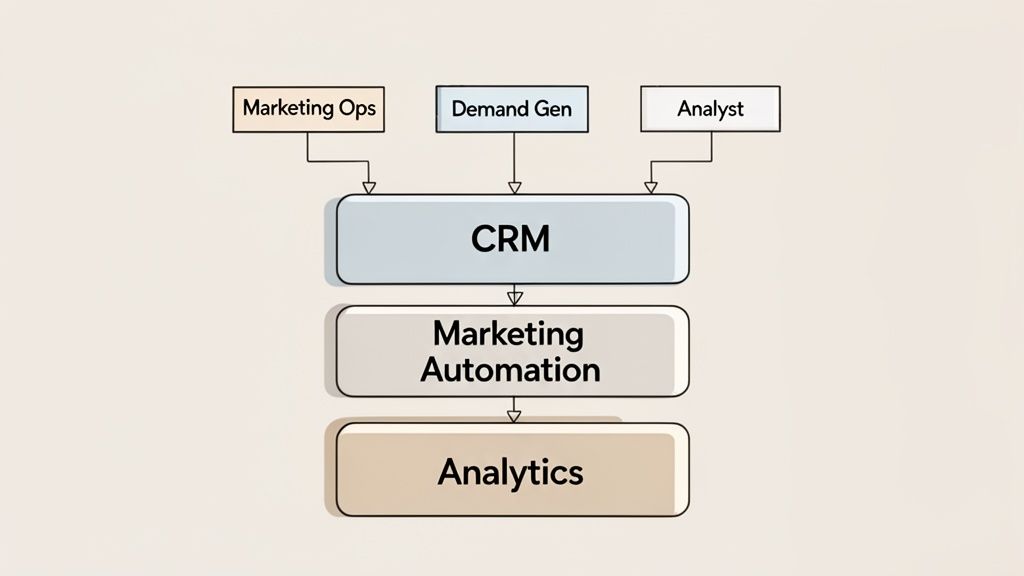
The Core Components of a B2B Tech Stack
For most B2B tech companies, a powerful but lean stack is built on three pillars. These aren’t just separate tools; they work together as a cohesive system to attract, nurture, and analyze the entire customer journey, from first click to closed deal.
-
Customer Relationship Management (CRM): This is your single source of truth for every customer and prospect. It’s where your sales and marketing teams live, tracking every interaction. A clean CRM (like HubSpot or Salesforce) is the absolute foundation of any scalable growth engine.
-
Marketing Automation Platform: This is the workhorse. It handles email campaigns, lead nurturing workflows, landing pages, and scoring. Tools like Marketo or Pardot let your team engage with prospects at scale, delivering the right message at the right time without an army of people.
-
Analytics Platform: You can't improve what you don't measure. Analytics tools like Google Analytics or Mixpanel give you the hard data on website traffic, user behavior, and campaign performance. This is how you stop guessing and start making data-driven decisions.
Nailing these three pillars is a massive first step. For a deeper look at building out your toolkit, check out our complete guide on creating effective marketing tech stacks that actually support growth.
Who Owns the Tech Stack?
Buying the software is easy. The hard part is deciding who owns it. Without clear ownership, your expensive new CRM quickly becomes a messy, unusable database that nobody trusts. This is where a simple framework like a RACI chart is a lifesaver.
A RACI chart clarifies who is Responsible for doing the work, who is Accountable for the outcome, who needs to be Consulted, and who just needs to be kept Informed. It kills confusion before it starts.
For example, who is ultimately accountable for the accuracy of your CRM data? Who is responsible for building a new email nurture in your automation tool? Assigning these duties puts an end to finger-pointing and makes sure every piece of your stack has a dedicated owner.
Operations and Demand Gen: The Key Partnership
In a modern marketing org, the partnership between Marketing Operations and Demand Generation is what makes the tech stack sing. They are the primary users and managers of these systems, and their collaboration is non-negotiable.
Here’s how the roles typically break down:
- Marketing Operations is accountable for the overall health and administration of the stack. They make sure the systems talk to each other, the data is clean, and the reporting is accurate. They own the "how."
- Demand Generation is responsible for using the tools to execute campaigns. They’re in the driver's seat building landing pages, launching ads, and creating the email workflows that generate pipeline. They own the "what."
This division of labor keeps your technical foundation solid while empowering the campaign teams to move fast. Get it wrong, and you end up with a broken system that slows you down instead of speeding you up.
When to Hire a Fractional CMO
There’s an awkward stage every startup hits. You desperately need senior-level marketing strategy, but you’re just not ready to swallow a full-time executive salary. Your team is executing, but they’re hitting a ceiling without experienced guidance to connect their work to revenue.
This is the exact moment a fractional CMO becomes your secret weapon.
This isn’t about bringing in another consultant to write a report that gathers dust. A fractional Chief Marketing Officer is a part-time executive who rolls up their sleeves, joins your leadership team, and takes ownership of your marketing strategy and results.
Recognizing the Triggers for Fractional Leadership
So, how do you know it's the right time? The signs are usually obvious if you know what to look for. Founders often feel these pain points acutely, even if they can't quite put a name to the problem.
A fractional CMO makes sense when you see one or more of these classic triggers:
- Your Pipeline Has Gone Flat: Your lead flow used to be reliable, but now it’s unpredictable or has stalled completely. The old tactics just aren't working anymore, and you need a new, cohesive strategy to reignite growth.
- Your Junior Team Needs Mentorship: You’ve hired talented, energetic marketers, but they lack the senior-level experience to build a scalable plan. They need a leader to coach them, prioritize their efforts, and connect their work to real business goals.
- A High-Stakes Launch Is on the Horizon: You have a game-changing product or feature launch coming up, and it absolutely cannot fail. You need an experienced hand to orchestrate the go-to-market strategy, from messaging to execution, ensuring maximum impact.
- You're Preparing for a Full-Time VP Hire: You plan to hire a VP of Marketing in the next 6-12 months but need to build momentum now. A fractional leader can bridge the gap, fix foundational issues, and build a high-performing function that will attract top-tier talent.
A fractional CMO steps in to provide immediate clarity, direction, and momentum. It's about getting executive-level impact without the long-term overhead of a full-time C-suite salary, which can easily exceed $250,000 plus equity.
Fractional CMO vs. Consultant vs. Agency
It's easy to lump these roles together, but they solve very different problems within the structure of a marketing department. Understanding the distinction is crucial for making the right choice.
An agency is a team of specialists you hire to execute specific tasks, like running your paid ads or managing your blog. A consultant typically provides high-level advice, delivering a strategic plan or audit before stepping away.
A fractional CMO does both. They build the strategy and lead the team to execute it.
- Ownership: They take hands-on ownership of your marketing function and its results.
- Leadership: They become a true member of your leadership team, managing your people and resources.
- Integration: They work inside your business, aligning marketing with sales, product, and finance.
Think of it this way: an agency gives you extra hands, and a consultant gives you a map. A fractional CMO gets in the car with you, grabs the wheel, and helps you drive. They are the ideal solution for founders who know they need experienced leadership to scale but want to remain capital-efficient on their journey.
Common Questions About Structuring a Marketing Team
Even with a clear roadmap in hand, a few practical questions always pop up when you start building out your marketing team. Let's get them out of the way so you can keep moving.
What’s the Right Marketing Budget?
For B2B startups in growth mode, the rule of thumb is to set aside 10-15% of your target revenue for marketing. When you're just starting out, that number might be lower and laser-focused on just proving out one or two channels.
The trick is to think of it as a direct investment in growth, not just another line item under operating expenses. Every dollar you spend should be tied to something you can actually measure, like the number of qualified leads it brings in or what it costs you to acquire a new customer (CAC).
Generalist or Specialist for Your First Hire?
For pretty much any B2B company under $5 million ARR, your first marketing hire needs to be a strategic generalist. This is your "do-it-all" Marketing Manager or Growth Marketer who’s comfortable wearing multiple hats at once.
One day they’re writing website copy, the next they're running a LinkedIn campaign, and the day after that they're digging into analytics to see what’s actually working. You only bring in the specialists—like a dedicated SEO Manager—once you’ve already proven a channel works and you’re ready to pour gas on the fire.
True alignment between marketing and sales starts with a shared definition of success. Without it, you’re just setting both teams up for frustration and missed targets.
How Do I Get Marketing and Sales Aligned?
Alignment isn't just some corporate buzzword; it's non-negotiable for growth. It all starts when both teams can agree on the exact definition of a "Marketing Qualified Lead" (MQL) and a "Sales Qualified Lead" (SQL).
Put it in writing with a Service Level Agreement (SLA). This simple document outlines what marketing promises to deliver in terms of lead volume and quality, and what sales promises to do with those leads in a specific timeframe.
Then, hold weekly or bi-weekly meetings where both teams look at the same pipeline report together. This is the bedrock of a predictable revenue engine.
Building the right structure of a marketing department is the single most important step in creating predictable growth. At Value CMO, we provide the senior marketing leadership to help B2B tech founders build teams and strategies that deliver real results. Let's build your growth engine.