

Let's be honest, building a marketing department for a B2B tech company can feel like trying to solve a puzzle in the dark. Forget those rigid, old-school org charts. Today, it’s all about creating a flexible, growth-focused engine that can actually move the needle. This guide is built from years in the trenches with founders—not just theory—and I'm going to show you exactly why a hybrid model is your secret weapon for scaling smart.
Your Blueprint for a Modern B2B Marketing Team
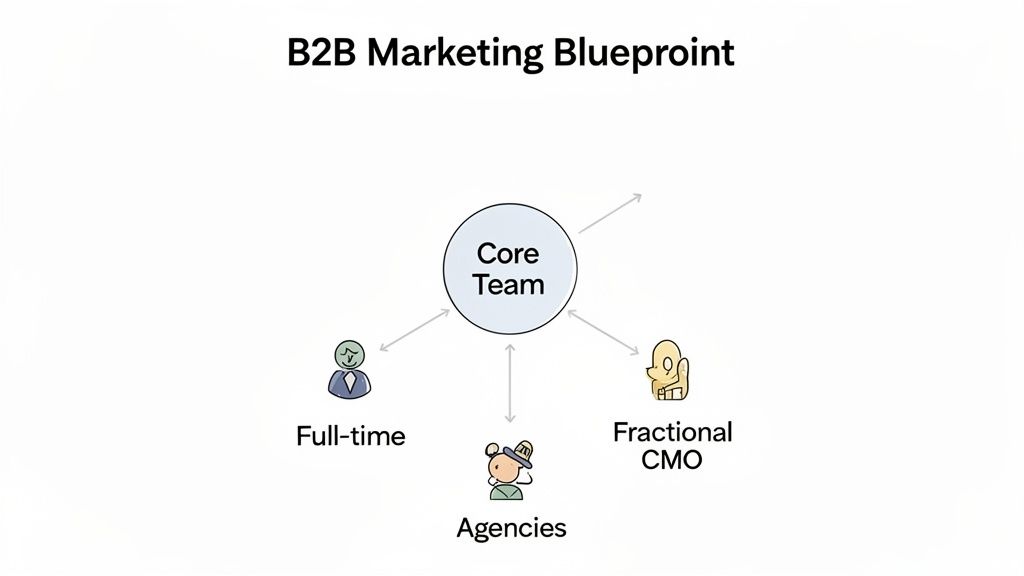
The old way of building a marketing team—just filling seats in a static org chart—is officially broken. I see founders and CEOs get stuck all the time, thinking they need a full-time specialist for every single channel. This just leads to bloated overhead, slow execution, and a team that can’t pivot when the market inevitably shifts. It's expensive and, frankly, it just doesn't work anymore.
The startups that are really winning are ditching that model for something far more fluid and powerful: a hybrid structure.
Think of it as building a high-impact engine, not just filling a department. This modern approach blends a small, core team of full-time folks with specialized fractional talent and expert agencies. It lets you tap into senior-level expertise, like a fractional CMO, without the full-time cost and commitment. This is what keeps you nimble and ready for anything.
The Power of a Hybrid Structure
So why does this model work so well for B2B tech? It’s all about getting the most bang for your buck, both in terms of efficiency and expertise. You really get the best of both worlds: dedicated internal team members who live and breathe your product, paired with outside specialists who bring deep channel knowledge and a fresh perspective.
This structure lets you:
- Access senior strategy on a budget: You can bring in a fractional CMO to guide your high-level strategy and mentor your junior team members. It’s a game-changer.
- Scale specific channels quickly: Need to launch a complex SEO or paid media campaign? A specialized agency can get you there in weeks, not months.
- Maintain a lean core team: You can keep your full-time headcount focused on high-impact roles that require deep institutional knowledge, like product marketing.
The goal isn't just to fill roles, it's to cover the critical functions across the entire buyer's journey. By structuring your team this way, you make sure every dollar you spend on marketing is tied directly to driving awareness, generating leads, and closing deals.
Covering All Your Bases
Marketing teams everywhere are feeling the pressure. Tighter budgets and the rise of AI are forcing a big structural shift, pushing this hybrid model to the forefront. To compete, modern teams now have to cover at least nine critical functions to manage the entire funnel, from content and lifecycle marketing all the way to product marketing and growth operations.
To get started, it’s helpful to map out these foundational roles and what they truly own.
Foundational Marketing Roles for B2B Tech
Here’s a look at the core functions you need to cover and the real-world metrics they should be responsible for driving.
| Role/Function | Core Responsibility | Key Metric (Example) |
|---|---|---|
| Demand Generation | Creating and capturing interest through paid and organic channels. | Marketing Qualified Leads (MQLs) |
| Content Marketing | Developing valuable stuff (blogs, guides, webinars) to attract and educate your ideal customer. | Organic Traffic / Lead Magnet Downloads |
| Product Marketing | Positioning the product, managing launches, and creating sales enablement materials that actually help. | Feature Adoption Rate / Sales Win Rate |
| Marketing Operations | Managing the martech stack, data, analytics, and all the reporting infrastructure. | Lead-to-Close Velocity / Data Accuracy |
| Lifecycle/Email | Nurturing leads and engaging customers through automated email campaigns and workflows that people actually want to open. | Email Open/Click-Through Rate |
Remember, you don't need a full-time person for each of these from day one. A single hire might cover Content and Email, while you lean on an agency for Demand Gen.
Ultimately, how you structure your marketing department should directly mirror your company's growth stage and strategic goals. Having a clear vision for your team’s design is a non-negotiable part of any effective B2B marketing strategy framework.
Making Your First Marketing Hires at the Seed Stage
So, you've got a product, a handful of early customers, and a little bit of traction. But marketing feels like this huge, expensive mystery. For a seed-stage founder, the pressure to nail marketing from the jump is intense, and the biggest question is always the same: who on earth do I hire first?
The classic mistake is trying to build out a full department overnight. An even worse one? Hiring a senior leader who’s too far removed from the hands-on work that actually needs to get done right now.
At this stage, you don’t need a department—you need a doer. The goal is to find one or two strategic people who can wear multiple hats and build momentum from day one. This isn't about finding some magical unicorn who's an expert in everything. It’s about finding someone who can execute on the 2-3 channels that will give you the most leverage, fast.
The Great Debate: The First Marketing Hire
Should you hire a content creator, a demand gen specialist, or a brand strategist? It’s the classic dilemma. A content person can build your foundation with blogs and guides. A demand gen expert can get you quick wins with paid ads. A strategist can map it all out but might not be the one getting their hands dirty.
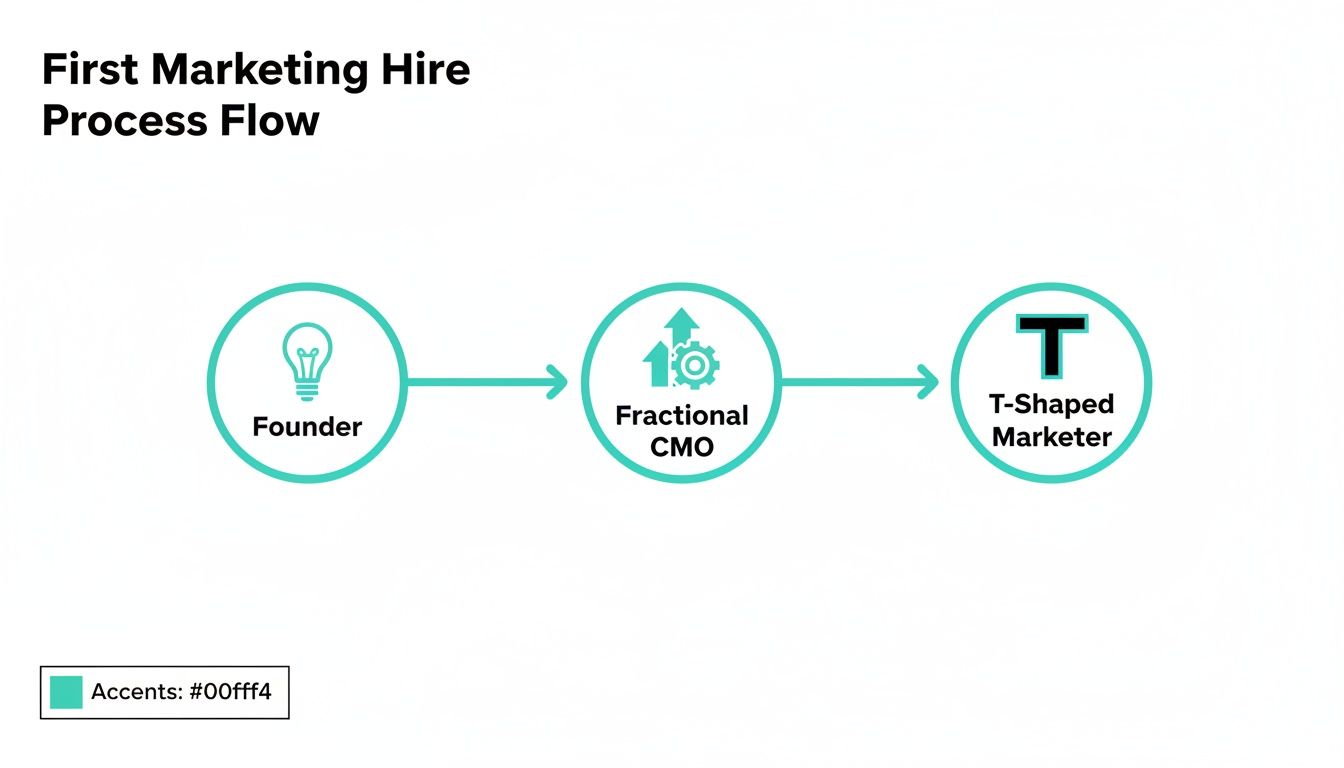
For most B2B tech startups I've worked with, the answer is a blend. You need what's known as a T-shaped marketer.
A T-shaped marketer has a broad understanding of many marketing disciplines (that’s the top of the 'T') but deep expertise in one or two critical areas (the vertical stem). For a B2B startup, that deep expertise should almost always be in content/SEO or product marketing.
Why those two? Because they build long-term, compounding assets. Great content becomes a lead-gen engine that works for you 24/7. Strong product marketing makes sure the few leads you do get actually understand what you're selling and why it matters to them.
Your first marketing hire's job is to build a small fire, not boil the ocean. They need to prove that a specific channel can work for your business before you pour more fuel on it. This kind of focus is absolutely non-negotiable.
Building Your Seed-Stage Marketing Pod
Forget complex org charts. At this stage, your marketing "team" is likely one person, maybe two, reporting directly to you, the founder. But that doesn't mean you have to fly blind on strategy. This is where a hybrid model really shines.
Your ideal seed-stage structure looks like this:
- Founder/CEO: You set the overall business vision and goals.
- Fractional CMO: This person provides the senior-level strategy, builds the marketing roadmap, and mentors your junior hire—all without the hefty full-time salary.
- T-Shaped Marketing Manager: This is your hands-on executor. This person is creating content, running email campaigns, managing social media, and reporting on the core metrics.
This trio is incredibly effective. The founder provides the vision, the fractional CMO builds the strategic blueprint, and the marketing manager gets the day-to-day work done. This model keeps your tiny team focused on activities that generate revenue, not just "staying busy." If you want to dive deeper, you can explore the benefits of bringing in a fractional CMO to provide that crucial early-stage guidance.
When you structure your marketing department this way from the very start, you’re not just hiring a person; you’re building a system. You get the strategic firepower of a seasoned executive while staying agile and capital-efficient—exactly what a startup needs to survive and thrive.
Scaling Your Team for Predictable Growth
Once you hit product-market fit, the game completely changes. The scrappy, do-it-all approach that got you here won't get you to the next level. Now, it’s all about building a machine for predictable growth, and that means swapping your marketing generalists for a team of specialists.
This is the Series A/B stage, where you stop throwing spaghetti at the wall and start building dedicated functions. Your goal is to structure your marketing department around the three pillars that actually drive revenue: Demand Generation, Product Marketing, and Content. It’s a deliberate shift from a small, reactive crew to a high-performance team where everyone knows exactly what they own.
Without this specialized structure, you hit a hard ceiling. A single T-shaped marketer gets buried, campaigns become inconsistent, and your pipeline flatlines. Specialization is the only way to scale with real intention.
From Generalists to a Specialized Core
The first step? Find the biggest bottleneck in your growth. Is your pipeline looking a little anemic? Are you struggling to explain your product's value in a way that clicks? Is your organic traffic stuck in neutral? The answers to these questions will tell you exactly who to hire first.
At this stage, your team starts to take on a more defined shape. The reporting lines become clearer, and each role has a specific, measurable impact on the business.
Here’s how to think about the three core functions:
- Demand Generation: This is your pipeline engine. This function owns the strategy and execution for landing new leads and opportunities through paid channels, SEO, and other programs. These folks live and die by the numbers.
- Product Marketing: This is the critical bridge between your product, your sales team, and the market. They’re responsible for positioning, messaging, sales enablement, and the go-to-market strategy for every new feature.
- Content Marketing: This is the fuel for your inbound machine. This team creates the valuable stuff—blogs, guides, webinars—that attracts your ideal customer and educates them through their entire buying journey.
The move to a specialized team isn't just about adding headcount; it's about creating leverage. Each new hire should unlock a new level of performance in their specific domain, freeing up everyone else to focus on what they do best.
Your First Specialist Hires
Making the right hires in the right order is absolutely crucial. You have to avoid the common scaling mistakes. Don't go hire a social media manager if your core problem is a leaky sales funnel.
This is a typical—and effective—way to structure a marketing department at this growth stage. It establishes clear reporting and functional ownership.
This structure removes ambiguity, which is essential as you scale beyond a handful of people.
Your hiring priority should focus on these key roles, in this order:
- Demand Generation Manager: This person's entire world is the pipeline. They own a number (MQLs or Sales Qualified Leads) and are responsible for hitting it. They manage the ad budget, run campaigns, and constantly optimize for conversion.
- Product Marketing Manager: This hire is your secret weapon for sales alignment. They create the battle cards, case studies, and demo scripts that help your sales team close deals more effectively. They make sure your product's value is clearly communicated at every single touchpoint.
- Content Specialist: With a demand gen engine in place, you need fuel. A dedicated content creator will consistently produce high-quality articles, guides, and assets that attract organic traffic and convert visitors into leads.
Budgeting for Headcount and Defining KPIs
As you build out the team, you need a realistic budget. A solid rule of thumb for B2B tech companies at this stage is to allocate 15-25% of your Annual Recurring Revenue (ARR) to marketing. Plan for roughly 50-60% of that budget to go directly toward headcount.
Each of these sub-teams needs its own North Star metric. This is what keeps everyone pulling in the same direction.
- Demand Gen KPI: Marketing Qualified Leads (MQLs) or Pipeline Contribution ($).
- Product Marketing KPI: Sales Win Rate or Feature Adoption Rate.
- Content Marketing KPI: Organic Traffic and Leads from Gated Content.
The marketing world is also moving quickly toward AI-native structures, where AI becomes the core infrastructure—not just a siloed experiment. In fact, a whopping 75% of CMOs are now unifying their AI strategies across all marketing functions to get better at personalization and prediction. This shift is reportedly driving a 35% uplift in engagement rates by making marketing more real-time and responsive. As you structure your team, think about how AI proficiency can be a force multiplier for each role. You can get more insights from the latest global marketing trends on marcom.com.
Building a Cross-Functional Powerhouse
As your company starts to really hit its stride and scale, the biggest threat to growth isn't a lack of marketing activity—it’s a lack of alignment.
Those functional silos you built for efficiency in the early days? They quickly become communication barriers. Sales starts complaining about lead quality, product ships features nobody asked for, and marketing feels like it’s shouting into the void. This is a classic, painful growing pain.
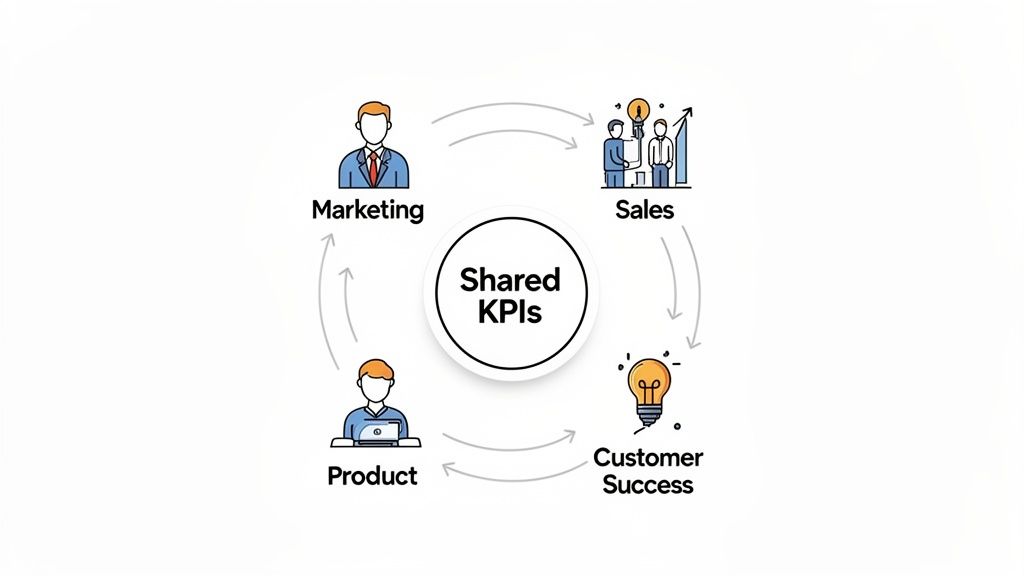
This is the stage where you have to stop thinking about a "marketing department" and start building a unified revenue team. Your marketers can't operate on an island anymore. They need to be deeply integrated with Sales, Product, and Customer Success, all working from the same playbook and looking at the same set of numbers.
The old model where marketing generates leads and just lobs them over the wall to sales is completely broken. To win, you have to deliberately structure your marketing department to be a cross-functional engine.
Moving Beyond Functional Silos
The solution isn't just more meetings or forcing people to "collaborate." It's about fundamentally redesigning your org chart around business goals, not just marketing functions. This is where advanced models like customer-focused "pods" or "squads" come into play.
Imagine a small, self-sufficient team—a pod—focused entirely on acquiring and retaining customers in a specific industry vertical. This pod isn't just marketers.
It might look something like this:
- A Marketer who owns the top-of-funnel strategy for that vertical.
- An Account Executive (AE) from the sales team.
- A Sales Development Rep (SDR) focused on outbound for those key accounts.
- A dedicated Customer Success Manager (CSM) who manages the relationship after the deal is done.
This small group operates like a mini-business inside your company. They have a shared revenue target, and they meet daily to sync up. The marketer isn’t just running ads in a vacuum; they’re building campaigns based on direct feedback from the AE about what messaging is actually landing on sales calls. It's a beautiful thing to see in action.
When you align teams to business goals instead of functions, you kill the "us vs. them" mentality. Suddenly, everyone is rowing in the same direction because they share the same finish line—revenue.
Building a Feedback Loop with Product
This structure also creates an incredibly valuable feedback loop with your product team. Marketing is often the first to hear about shifts in the market. SDRs hear objections on calls all day long. Customer Success knows exactly which features are causing churn or creating superfans.
In a siloed company, all that intelligence just dies on the vine. But in a pod structure, these insights are collected, synthesized, and fed directly back to product. This ensures your roadmap is informed by what the market is actually saying, not just internal assumptions.
The modern go-to-market playbook demands this level of agility. Today, 82% of high-performing teams actively prioritize collaboration with revenue and product because they know siloed efforts just don't cut it anymore. And with digital ad markets projected to hit $786.2 billion, you simply can’t afford to waste a single dollar on misaligned campaigns. You can find more on this in the latest global digital overview from DataReportal.
Focusing on Shared Goals and KPIs
The glue holding this entire cross-functional model together is a set of shared KPIs. Instead of measuring marketing on MQLs and sales on closed deals, the entire revenue team is measured on metrics that reflect the full customer journey.
This is a critical shift. When you structure your marketing department this way, you force a focus on what truly matters to the business.
Common shared KPIs include:
- Pipeline Velocity: How quickly are deals moving from first touch to close? This gets marketing and sales working together to remove any friction.
- Customer Acquisition Cost (CAC): What's the total, all-in cost to land a new customer, including every single marketing and sales expense?
- Customer Lifetime Value (LTV): How much revenue does a customer generate over their entire relationship with you? This aligns marketing, sales, and CS on keeping high-value accounts happy.
By adopting this structure, you’re not just building a marketing team. You’re building a growth engine where every component is synchronized to drive revenue. It's a complex move, for sure, but it's the only way to build a company that can scale predictably for years to come.
Essential Tools and Metrics for Your Modern Team
A brilliant team structure is just a blueprint; it’s the tools and data that bring it to life. Without the right tech and a clear way to measure success, even the most talented marketing team will struggle to prove its value. This is where you connect your team’s daily work to what your CEO and investors actually care about—revenue.
But let's be real, the martech world is incredibly noisy. There are literally thousands of tools, each promising to be the silver bullet for growth. The key isn't to buy more software; it’s to build a lean, integrated stack that gives you actionable insights, not just more dashboards to stare at. Similarly, you need to track metrics that tell a story about business impact, not just marketing activity.
Your Core Martech Stack
The right tools for your marketing department will evolve as you grow. What a seed-stage company needs is vastly different from a mature scale-up. The goal is to choose tools that play well together, automate the tedious work, and give you a single source of truth for all your customer data.
Here’s a practical look at the core tools you'll need at each stage of your journey.
Core Martech Stack by Company Stage
| Category | Seed Stage (Example Tools) | Growth Stage (Example Tools) | Scale-Up Stage (Example Tools) |
|---|---|---|---|
| CRM | HubSpot Starter, Pipedrive | Salesforce, HubSpot Pro/Enterprise | Salesforce, Microsoft Dynamics |
| Marketing Automation | Mailchimp, ActiveCampaign | HubSpot, Marketo | Marketo, Pardot, Eloqua |
| Analytics & BI | Google Analytics, Hotjar | Mixpanel, Looker Studio | Tableau, Looker, Segment |
| SEO & Content | Ahrefs, Semrush, Clearscope | Ahrefs, Semrush, MarketMuse | Ahrefs, Conductor, BrightEdge |
As you build out your toolkit, remember the goal is to streamline workflows and boost your team's output. To see what's out there, you can explore various digital tools that help modern teams perform better.
For a deeper dive, check out our complete guide on building effective B2B marketing tech stacks.
Moving Beyond Vanity Metrics
Likes, shares, and website traffic are nice, but they don’t pay the bills. Your leadership team and your board want to see how marketing contributes to the bottom line. This means ditching the vanity metrics and focusing on numbers that directly tie to revenue and customer growth.
Your reporting dashboard shouldn't be a data dump. It should be a concise, powerful story about your marketing engine's performance.
The most effective marketing teams are the ones that can confidently answer the question: "How did your work impact revenue this quarter?" If your metrics can't answer that, you're tracking the wrong things.
Here are the essential KPIs that truly matter:
- Marketing Qualified Leads (MQLs): The number of high-intent leads your team generates. Think of this as your top-of-funnel output.
- MQL-to-SQL Conversion Rate: The percentage of MQLs the sales team accepts as legitimate, sales-ready opportunities. This is a crucial health check on your marketing and sales alignment.
- Pipeline Contribution ($): The total dollar value of the sales pipeline generated from marketing-sourced leads. Now you’re speaking the language of the business.
- Customer Acquisition Cost (CAC): The total cost of your marketing and sales efforts to acquire a single new customer. The game is to keep this as low as possible.
- LTV:CAC Ratio: This is the ratio of a customer's lifetime value (LTV) to their acquisition cost. A healthy ratio (typically 3:1 or higher) is proof you have a sustainable business model.
By focusing on this core set of tools and metrics, you empower your team to not only execute effectively but also to demonstrate their strategic value in a clear and compelling way. It’s how you transform your marketing department from a cost center into a predictable revenue engine.
Burning Questions on Building a B2B Marketing Team
After years of building marketing teams for founders, I’ve seen the same questions trip up even the sharpest CEOs. These aren't just minor details; they're the big-picture decisions that dictate your growth trajectory. Here are my straight-up answers to the questions that come up time and time again.
When’s the Right Time to Hire a Full-Time VP of Marketing?
Hiring a VP of Marketing too early is one of the most common and expensive mistakes a startup can make. It’s a move often driven by investor pressure, not a real business need.
If you don't have a validated go-to-market motion or proven product-market fit, a six-figure leader will spend their time (and your money) just experimenting. That's a very costly way to find your footing.
The right time is usually post-Series A. You’ve found something that works, and now you need an experienced leader to pour gas on the fire and scale it. The clearest signal? When the CEO can no longer personally steer marketing and the team needs real leadership to run more complex, multi-channel plays.
Before you hit that point, a fractional CMO is almost always the smarter, more capital-efficient move. They give you the senior-level strategy to build the plan, the budget, and the initial team—setting the stage for a full-time VP to come in and execute from day one.
How Should We Structure Marketing for an ABM Strategy?
If you’re running an Account-Based Marketing (ABM) playbook, your org chart absolutely has to reflect it. The old model—where marketing lobs leads over the fence to sales—is a recipe for failure. It creates friction, kills deals, and wastes everyone's time.
Your structure needs to be all about focus and alignment.
I’m a huge advocate for creating cross-functional "pods" or "squads." Think of them as mini revenue teams, each laser-focused on a specific list of target accounts.
A typical pod looks like this:
- An Account Executive from sales.
- A Sales Development Rep (SDR) running outbound plays.
- A dedicated Marketer who owns the strategy for that account list.
The marketer still reports up to marketing leadership for best practices and career growth, but their day-to-day is spent in the trenches with their sales partners. Their KPIs are shared: pipeline and revenue from their target accounts. This setup dissolves the classic sales vs. marketing drama by design.
What’s an Ideal Marketing Budget as a Percentage of Revenue?
This is the million-dollar question, and the honest answer is, it depends. But for a high-growth B2B tech company, a good rule of thumb for your marketing budget is 15-25% of Annual Recurring Revenue (ARR). For more established companies with steadier growth, that number might settle closer to 7-12%.
But the real magic isn’t the top-line number; it’s how you break it down. I find it simplest to think in three buckets:
- People: All your salaries and benefits.
- Programs: Your working cash for ads, content, events, and agencies.
- Tools: The cost of your martech stack—your CRM, automation platform, analytics, etc.
The best way to build this is with a bottoms-up model. Don’t just pick a percentage. Start with your revenue target, figure out the pipeline you need to hit it, and then calculate what you need to invest in programs and people to make it happen.
How Does AI Change How I Should Structure My Team?
Let's be clear: AI isn't here to replace your talented marketers. It's here to make them more powerful. Think of AI as a system your people direct, not a person who takes their job. It's a massive productivity multiplier.
Your content team, for example, can now use AI to generate first drafts, conduct research, and analyze data in minutes. This frees them up to focus on what humans do best: high-level strategy, unique storytelling, and creative direction that actually connects with people.
The biggest structural change AI forces is the need for a strong Marketing Operations function much earlier than you might think. This role is your in-house expert on the entire tech stack, with AI at its core. They’re responsible for keeping data clean, automating workflows, and training the team to get the most out of these powerful new tools.
Without this role, you’ll just end up with a collection of expensive, underused software and a messy data nightmare.
At Value CMO, we bring the senior marketing leadership needed to answer these tough questions and build a revenue-focused marketing engine for B2B tech companies. We build the strategy, design the team, and lead the execution—giving you a clear path to growth without the full-time overhead. Learn more at https://valuecmo.com.