Let's get one thing straight: strategy is your game plan for winning. It’s the why and the where you're heading. Tactics are the specific, on-the-ground actions you take to make it happen—the how. The real trick is knowing the difference between building a real, lasting advantage and just ticking off a task on your to-do list.
Understanding The Core Difference

It’s way too easy to get lost in the day-to-day grind. You’re launching campaigns, firing off blog posts, and tweaking ad spend. But are all those frantic moves actually getting you closer to a bigger goal, or are they just keeping you busy? This is where the line between strategy and tactics becomes so important.
Think of it like building a house. Your strategy is the architectural blueprint. It lays out the foundation, the number of rooms, the overall style, and its ultimate purpose—to build a family home that will stand for decades.
Your tactics are the actual construction jobs: pouring the concrete, framing the walls, hooking up the plumbing, and painting the rooms.
Without the blueprint (strategy), you’d just have a chaotic pile of building materials. But a brilliant blueprint is useless without skilled builders executing the plan (tactics). You need both, but they serve completely different functions. One points the way; the other gets you there.
For a B2B tech startup, a strategy is deciding to become the recognized leader for AI-powered logistics in North America. The tactics are the specific webinar series, ABM campaigns, and content partnerships that make it happen.
To really nail this down, let’s break down the key attributes that separate these two ideas. Getting this framework right is the first step to making sure every marketing dollar and every hour spent is pushing your long-term success.
Strategy vs Tactical A Quick Comparison
Here's a simple table to keep the two concepts straight. Think of it as your cheat sheet for making sure your daily actions align with your long-term vision.
| Attribute | Strategy (The 'Why') | Tactics (The 'How') |
|---|---|---|
| Time Horizon | Long-term (3-5 years) | Short-term (months, quarters) |
| Scope | Broad and overarching | Narrow and specific |
| Focus | Achieving business objectives | Completing individual tasks |
| Flexibility | Stable but adaptable | Highly flexible and responsive |
| Example | "Become the #1 CRM for small businesses." | "Launch a Google Ads campaign targeting 'small business CRM'." |
In short, strategy sets the destination, while tactics are the individual turns you take on the map to get there. One without the other leads to either aimless wandering or a brilliant plan that never leaves the whiteboard.
Defining Your High-Impact B2B Strategy
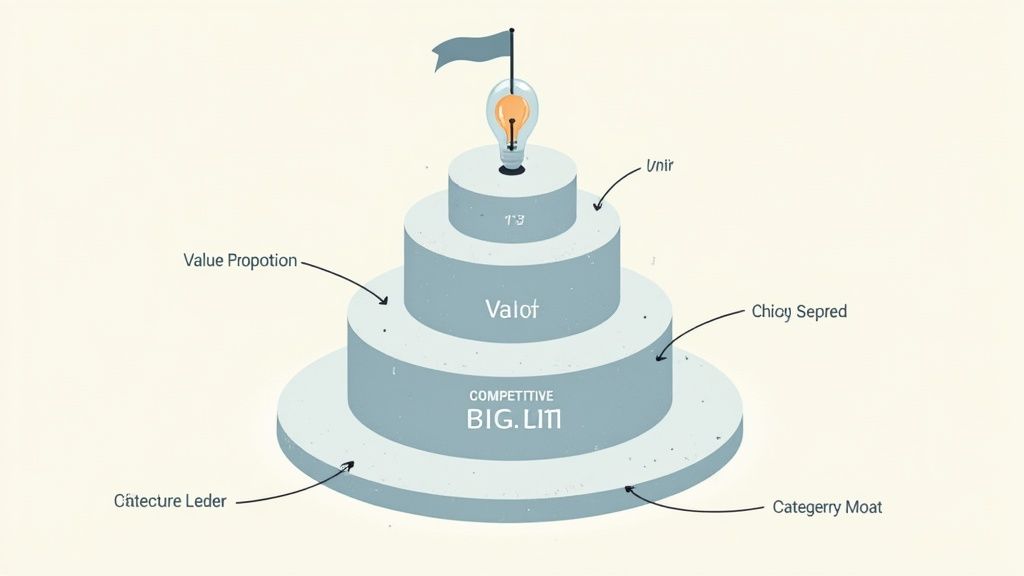
A real strategy isn’t just a goal you stick on a whiteboard. For a B2B startup, it’s the blueprint for how you win—the series of hard choices that pull you away from the competition. It’s not about trying to do everything; it’s about doing the right things better than anyone else.
This means you have to go deeper than just what you sell. You need to get brutally honest about how you create undeniable, long-term value. For B2B tech firms, that starts with a crystal-clear understanding of who you serve and the specific, high-stakes problem you solve for them. Get that right, and every other decision becomes simpler.
This is where a fractional CMO earns their keep. Their primary job is to turn those big ambitions into a concrete, actionable plan. That leadership ensures every move you make—from who you hire to what you build—lines up with your ultimate goal, whether that’s disrupting an industry or carving out a brand-new category.
The Core Components of Strategy
A solid B2B strategy is never a single statement. It's a mix of interconnected decisions that, together, build a competitive moat around your business.
Three pillars form this foundation:
- Ideal Customer Profile (ICP): Forget fuzzy personas. This is a laser-focused definition of the exact companies that get the most value from your solution—and, in turn, deliver the most value back to you.
- Unique Value Proposition: This is your core promise. It has to clearly state what makes you different, why you’re the better choice, and the specific results customers can bank on.
- Competitive Positioning: This defines your spot in the market. It’s about carving out a space—even a tiny niche—where you are the undisputed leader.
A winning strategy is fundamentally the choice of a business model—the conceptual framework defining how a company creates value and positions itself. This choice constrains the available tactical options and sets the rules of engagement in the market, making it the most critical decision a B2B startup can make.
Strategy as a Business Model Choice
When you get down to it, strategy is a conscious decision to commit to a specific business model. That framework dictates how you create and deliver value, which automatically limits the tactics that will actually work.
For instance, if your strategy is to be the low-cost leader, your tactics must revolve around efficiency and scale. But if your strategy is built on white-glove service, your tactics have to prioritize high-touch, personalized engagement. You can't mix and match. For any B2B company, building a comprehensive content marketing strategy that reflects these core business choices is non-negotiable.
That’s why a strategic pivot is so much more than a marketing tweak; it’s a fundamental shift in the business. When you change your strategy, you change the entire competitive game—not just for you, but for your rivals, too.
Mastering Tactical Execution for Real Results
If your strategy is the game plan, your tactics are the individual plays that put points on the board. These are the specific, measurable marketing actions that breathe life into your big-picture vision. Without sharp tactical execution, even the most brilliant strategy remains just an idea.
The key difference between strategy and tactics comes down to scope and immediacy. Tactics are the concrete jobs you do this week, this month, or this quarter to move the needle. For a B2B tech startup, this isn’t abstract theory—it's about getting things done.
From Blueprint to Building Blocks
Effective tactics are always a direct response to your strategic goals. They aren’t random acts of marketing. They are purposeful actions, chosen because they are the most efficient way to achieve a specific outcome outlined in your strategy.
Consider a few concrete examples:
- Launching a hyper-focused ABM campaign targeting five key enterprise accounts. This directly supports a strategy of deep market penetration.
- Producing a webinar series on AI compliance to attract high-intent leads. This aligns perfectly with a strategy to own a specific, profitable niche.
- Optimizing landing pages with A/B testing to lift conversion rates. This is a direct tactic to improve overall pipeline efficiency.
Each of these is a distinct, time-bound project with clear metrics for success. You can explore a variety of powerful B2B demand generation tactics to find the right fit, but the crucial part is that every tactic must be justifiable. If you can’t connect it back to your strategy, you probably shouldn’t be doing it.
Tactics are meant to be agile. They are your opportunity to test, learn, and adapt based on real-time market feedback. This lets you pivot quickly without abandoning your long-term strategic direction.
Aligning Actions with Long-Term Vision
Seeing this connection in the real world makes it all click. Imagine a global retailer facing declining foot traffic. Their multi-year strategy is to elevate the customer experience and boost profitability.
To make that vision a reality, they roll out specific, short-term tactics: introducing exclusive in-store discounts, deploying AI-powered checkout systems, and redesigning store layouts based on traffic analytics.
This layered approach shows how a broad strategy sets the vision, while focused tactics provide the actionable steps needed to get there.
This clear alignment ensures your daily efforts aren't just busywork. They become the building blocks that construct your long-term success, one measurable action at a time.
How Strategy and Tactics Drive Growth Together
There's an old saying in business that still holds up: strategy without tactics is just a wish, and tactics without strategy are just busywork. In B2B tech, the gap between those two is the difference between real growth and burning through your runway. Neither one works in a vacuum—they have to feed each other.
A solid strategy is the ultimate filter. It’s the gatekeeper that forces you to ask, "Does this specific action get us closer to our big-picture goal?" If your strategy is to become the undisputed authority on AI in finance, that clarity makes tactical choices much easier. You know to pour money into a deep-dive industry report (a tactic) instead of sponsoring a generic tech event (another tactic). Every dollar gets a clear job to do.
But it's not a one-way street. The daily grind of tactical execution is what sends critical, real-world data back up to the strategy, creating a powerful feedback loop.
The Tactical Feedback Loop
Let's say your strategic goal is to "own the conversation on AI in finance." You roll out a few tactics to make it happen:
- You launch a blog series breaking down practical AI use cases for investment banks.
- You run targeted LinkedIn ad campaigns promoting an ebook on regulatory compliance.
- You host a webinar with a well-known fintech influencer.
The data you get back is pure gold. You might find that blog posts about fraud detection get 10x the engagement of any other topic. Your ad campaign data might show that CTOs in mid-market firms are clicking through at a much higher rate than enterprise-level CIOs.
This tactical feedback doesn't just tell you which ads are working; it refines your entire strategy. The massive engagement around fraud detection might signal a powerful market niche you hadn't fully appreciated, prompting a strategic pivot to focus more heavily on that specific pain point.
From Action to Insight
This is how strategy and tactics actually drive growth together. The strategic vision sets the direction, but the tactical results provide clarity and proof. This is where continuous campaign optimization becomes non-negotiable—it’s the practice that keeps your tactical efforts tight and aligned with your core objectives. By paying close attention to this feedback, you can double down on what works, kill what doesn’t, and make your strategy smarter over time.
This constant refinement demands leadership that gets both the 30,000-foot view and the details on the ground. It’s a skill set companies are pouring money into. In the 2022-2023 fiscal year, spending on leadership training hit a massive $101.8 billion. That number shows a clear understanding that leaders must connect strategic vision with tactical execution to win.
Ultimately, this feedback loop is what allows a fractional CMO to not just set a course but also steer the ship through changing waters. It ensures every small move contributes to the larger journey. And, of course, you have to learn how to measure marketing ROI to prove the impact of both your strategy and tactics on the bottom line.
A Decision Framework for Founders and CMOs
For B2B startup founders and fractional CMOs, every decision is under a microscope. You’re always caught in the classic startup tug-of-war: the urgent need for this quarter’s pipeline versus the long-term goal of building a brand that can last. This is where the strategy vs. tactics battle plays out every single day.
Without a clear framework, it’s far too easy to slip into reactive mode—chasing quick wins that don’t stack up to real, long-term value. To make smarter calls, you need a simple but solid way to weigh your options. The right framework helps you decide where to invest your most precious resources: time, money, and focus.
This decision tree gives you a quick flow for sorting an initiative into the right bucket based on its goal, the action required, and how you’ll measure it.
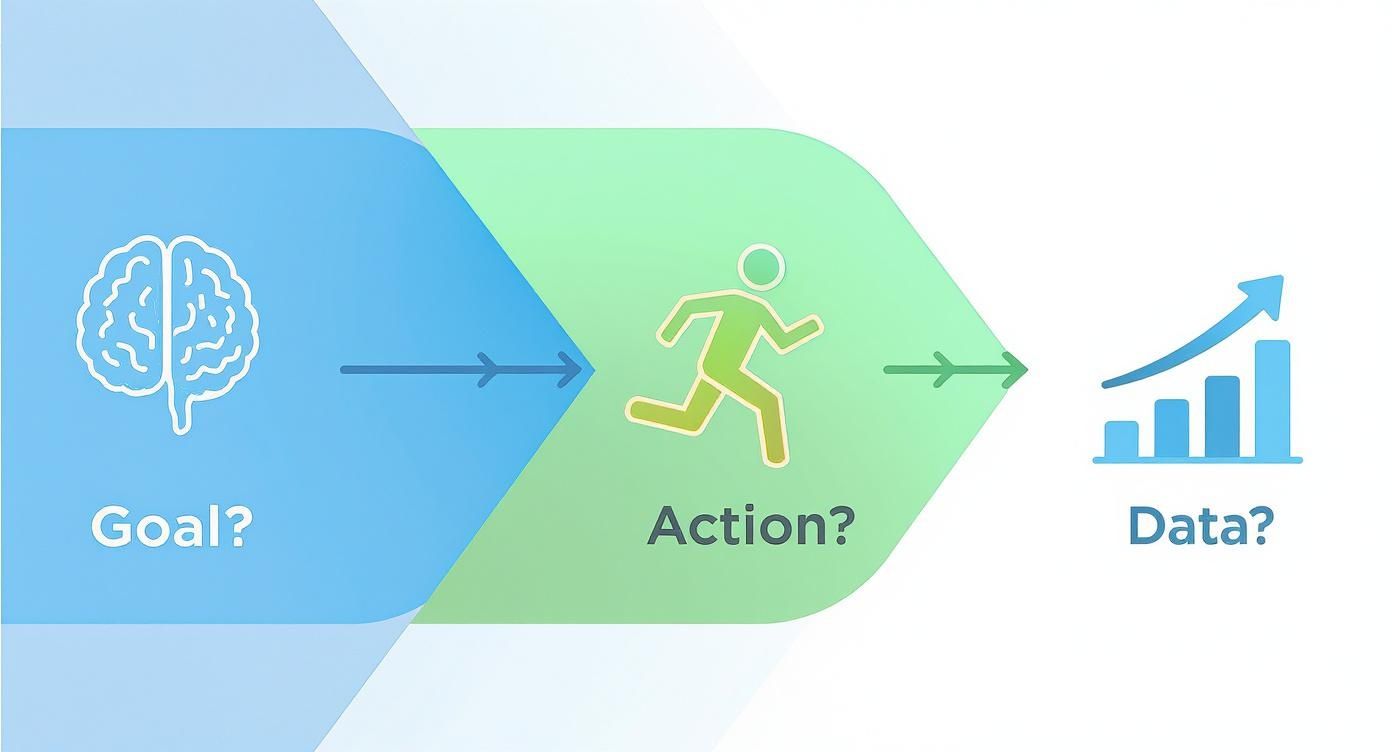
As you can see, strategic thinking starts with a big-picture goal, while tactical thinking kicks off with a specific, immediate action. It’s a gut check to see if you’re planning for the future or just putting out today's fires.
Asking the Right Questions
Before you commit to any new marketing initiative, run it through this filter. The answers will tell you pretty quickly whether you’re making a strategic investment or just executing a short-term tactic.
Strategic Questions (Building the Moat):
- Will this create a long-term competitive advantage for us?
- Does this move strengthen our brand positioning in the market?
- Will this help us own a specific category or conversation over the next 3-5 years?
- Is the main outcome brand equity, market share, or customer loyalty?
Tactical Questions (Generating Pipeline):
- Will this generate qualified leads or sales opportunities this quarter?
- Is this a direct response to a competitor’s move or a fleeting market opportunity?
- Can we measure the direct ROI of this activity within 3-6 months?
- Does this action help us hit a specific, immediate KPI like MQLs or conversion rate?
A strategic initiative is launching an industry-first research report to establish thought leadership—the payoff is long-term authority. A tactical move is promoting that report with a LinkedIn ad campaign to generate leads—the payoff is immediate pipeline.
The Strategic vs Tactical Decision Matrix
To formalize this, here's a matrix that breaks down the decision-making criteria. Use this to quickly categorize an idea and understand its primary purpose before you allocate budget or headcount.
| Decision Criteria | Strategic Focus (Long-Term Value) | Tactical Focus (Short-Term Impact) |
|---|---|---|
| Time Horizon | 1-3+ years | 0-6 months |
| Primary Goal | Build brand equity, market share, competitive moat | Generate leads, pipeline, immediate revenue |
| Key Metrics | Share of voice, brand recall, category ownership, LTV | MQLs, SQLs, CPL, pipeline velocity, ROAS |
| Risk Profile | Higher initial risk, potential for exponential returns | Lower risk, predictable and measurable returns |
| Resource Allocation | Significant investment in foundational assets (content, research) | Budget allocated to specific channels (ads, events) |
| Example | Creating a definitive industry benchmark report | Running a PPC campaign to promote the report's landing page |
This table isn't about choosing one over the other; it's about ensuring you have a healthy mix of both. Your marketing plan needs a portfolio of initiatives, just like a financial plan needs a mix of stocks and bonds.
The Impact vs. Effort Matrix
Once you’ve sorted your ideas into strategic and tactical buckets, you still need to prioritize. A simple impact versus effort matrix is one of the most powerful tools for this. Just plot your potential initiatives on a four-quadrant grid:
- High Impact, Low Effort: These are your quick wins. Do them now.
- High Impact, High Effort: These are your major strategic projects. Plan them carefully.
- Low Impact, Low Effort: These are fill-in tasks. Fit them in when you can, but don’t let them distract you.
- Low Impact, High Effort: These are time sinks. Avoid them completely.
This whole framework gives you a repeatable process for making objective decisions. It moves you from gut feelings to a structured approach, ensuring both your long-term vision and your short-term needs get the attention they deserve.
Frequently Asked Questions
Even with a clear framework, the real world of B2B marketing is messy. The lines between a long-term plan and a short-term action can blur, especially when you’re under pressure to deliver growth now.
Let’s clear up some of the most common points of confusion I hear when talking about strategy versus tactics.
Can a Tactic Ever Become a Strategy?
It’s a great question, but the short answer is no. A tactic is a single move; a strategy is the entire game plan. They operate on completely different levels.
That said, a wildly successful tactic can absolutely inspire a new strategic direction. Imagine a B2B SaaS company runs a small experiment building a free community on Slack. If that community explodes—becoming the main source of high-quality leads and product feedback—it could trigger a major strategic pivot.
The company might shift its entire business model to be community-led. The tactic (building the community) didn’t become the strategy, but its powerful results reshaped the company’s whole approach to long-term growth.
How Often Should We Review Our Marketing Strategy?
While your strategy is built for the long haul, it isn’t meant to be set in stone. Market conditions shift, competitors make moves, and new tech emerges. You have to stay agile.
A full, deep-dive strategic review should be on the calendar annually. This is where you challenge your core assumptions and make major course corrections.
But a lighter strategic check-in should happen quarterly. This isn’t about rewriting the plan. It’s about ensuring your tactics are still aligned with your goals and that your north star is still relevant.
Which Is More Important for a Startup: Strategy or Tactics?
This is the classic chicken-and-egg question. The truth is, you need both, but their importance shifts depending on your stage.
For a pre-seed or seed-stage startup, strategy is everything. Without a solid plan defining your ICP, value proposition, and market position, your tactics are just shots in the dark. You’ll burn through cash trying things that don’t connect to a bigger vision.
Once you find product-market fit and start to scale, flawless tactical execution becomes the engine of growth. Your strategy is set, and the game is all about implementing, measuring, and optimizing your tactics to build momentum. One guides, the other builds.
What Is the Biggest Mistake Companies Make with Strategy and Tactics?
The single biggest mistake is confusing activity with progress. Too many companies get so wrapped up in executing tactics that they believe they have a strategy when they really don't.
They chase the newest marketing trend—a new social platform, the latest AI tool—without a clear answer to why. This is tactical thinking disguised as a plan.
This leads to a collection of disjointed actions that don’t build on each other. You end up with wasted resources, inconsistent messaging, and a brand that never develops a real competitive edge. The real discipline is making sure every single tactic serves the master plan.
At Value CMO, we build and execute the right mix of strategy and tactics to drive sustainable growth for B2B tech startups. If you're ready to move from busywork to building a real competitive advantage, let's talk. Learn more about how our fractional CMO services can help you win your market.