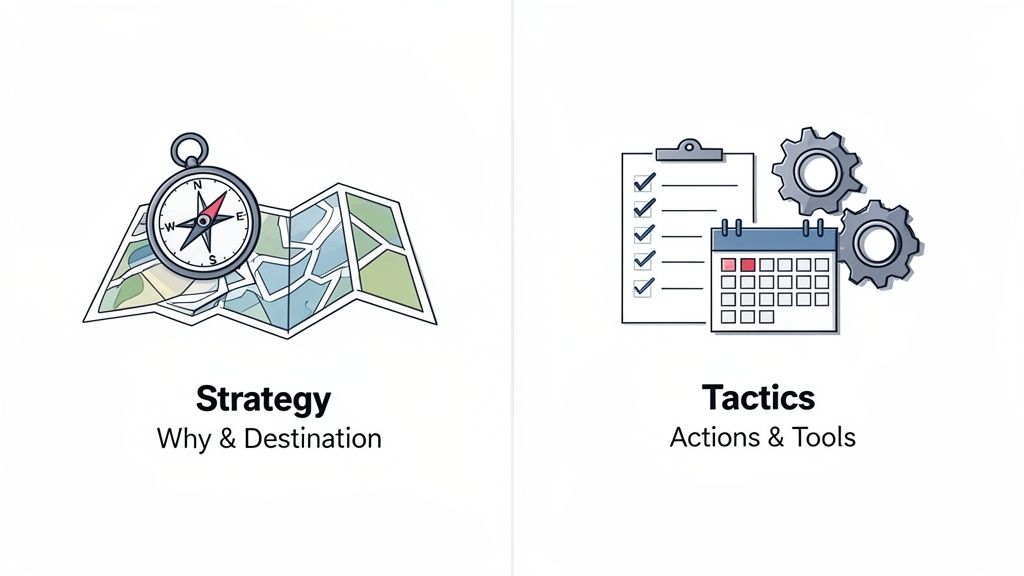
The real difference between a strategic and tactical plan comes down to a simple idea: strategy is your destination, and tactics are the specific turns you take to get there.
Strategy sets the long-term vision. It answers the big "why." Tactics are the short-term, concrete actions that answer "how" and "what." Getting these two mixed up is a classic—and costly—mistake for B2B tech founders, leading to wasted cash and a team running in circles.
The Critical Difference Between Strategy and Tactics
As a B2B tech founder, the pressure to "just do something" is enormous. You spin up a new ad campaign, sponsor a podcast, or rush out a new feature. These are all actions—tactics. Without a guiding strategy, though, they’re just isolated events, disconnected from any real purpose.
A strategic plan is your North Star. It defines your ideal customer, carves out your market position, and sets your ultimate business goal—like becoming the go-to AI analytics platform for mid-market fintechs. It’s the high-level map making sure every dollar you spend and every hour you work moves you closer to that destination. A solid strategy is one of the core B2B marketing strategy essentials for any kind of sustainable growth.
Tactical plans, on the other hand, are the specific, measurable steps on that map. They break the long journey into manageable chunks with clear owners and deadlines.
A great strategy with poor tactics will fail. A flurry of brilliant tactics without a strategy is just noise. Success happens when the two are tightly aligned.
To make this distinction painfully clear, let's break down the fundamental differences. This framework is a quick way to diagnose whether you’re thinking like a strategist or just getting lost in the tactical weeds.
Strategy vs Tactics at a Glance
This table sums up the high-level differences between strategic and tactical planning. It’s a handy reference to keep your thinking straight.
| Dimension | Strategic Plan | Tactical Plan |
|---|---|---|
| Time Horizon | Long-term (3-5 years) | Short-term (Quarterly, monthly, weekly) |
| Scope | Broad, company-wide direction | Narrow, department or project-focused |
| Purpose | Defines "where" we're going and "why" | Outlines "how" we'll get there with specific actions |
| Focus | Being different and achieving a unique market position | Being better and executing efficiently |
| Ownership | C-Suite and senior leadership | Department heads, managers, and individual contributors |
| Measurement | High-level business outcomes (e.g., market share, ARR growth) | Specific performance metrics (e.g., MQLs, conversion rates) |
Getting this table is the first step. The real challenge is avoiding the trap of prioritizing urgent tactics over important strategic thinking. A lot of founders think they're being strategic when they're actually just optimizing tasks—a critical distinction we'll get into next.
Why Most B2B Tech Startups Get This Wrong
Brilliant founders fall into the "tactics-first" trap all the time. The pressure from investors and boards for immediate results is intense, so they jump right into doing things—launching ad campaigns, shipping features, hiring fast—without a clear strategic "why" holding it all together. This isn't just a common slip-up; it's a classic story of action without direction. It always ends in wasted cash and a burnt-out team.
This flurry of disconnected activity feels productive. You're busy. Dashboards are lighting up. There's a constant buzz. But being busy isn't the same as making progress. This is exactly why getting the difference between strategic vs. tactical plans right is so critical.
The Echoes of a Cautionary Tale
We've seen this movie before. The dot-com bust of 1995–2001 is a masterclass in this mistake. Venture capital in internet companies exploded, hitting over $100 billion by 2000. Just two years later, more than 50% of those companies were either dead or sold for parts. They had aggressive tactical plans—think massive Super Bowl ads and campaigns to grab "eyeballs"—but no real strategy for making money or growing sustainably.
When the capital dried up, the companies running on tactical fumes were the first to collapse. This insightful breakdown from ClearPoint Strategy digs into how strategy (or lack thereof) played out back then.
That history lesson is more relevant than ever for today’s B2B tech startups. The pressure for quick wins pushes founders to chase vanity metrics. They mistake tactical victories, like a spike in website traffic or a jump in social media followers, for real business momentum.
Rushing into tactics without a strategy is like trying to build a house by nailing boards together randomly. You're certainly working hard, but you'll end up with a structure that can't stand on its own.
Recognizing the Symptoms of a Tactics-Heavy Approach
So, how do you know if you're stuck in the tactical weeds? The signs are usually hiding in plain sight, disguised by the illusion of constant activity. If your startup is heavy on tactics and light on strategy, a few of these painful symptoms will probably sound familiar.
A strategy-first approach forces you to ask uncomfortable but necessary questions before a single dollar is spent. Who do we serve? What unique value do we provide? What does winning actually look like in three years? Answering these is the only way to make sure your actions lead somewhere meaningful.
Here are the tell-tale signs that you're prioritizing tactics over strategy:
- A Flat or Unpredictable Pipeline: You're constantly "busy" with marketing, but your sales pipeline isn't growing consistently. Leads are low-quality, deals stall, and revenue feels completely disconnected from all your effort.
- High Customer Acquisition Costs (CAC): You're spending a fortune to land each new customer because your tactics aren't targeted. It's the equivalent of casting a wide, expensive net instead of fishing in the right pond with the right bait.
- Inability to Explain Performance: When a campaign fails, can you explain why? Without a strategic hypothesis, you can't learn from what goes wrong. You just know a tactic "didn't work," so you jump to the next shiny object, hoping for a different outcome.
A Detailed Comparison For B2B Founders
To really nail the difference between strategic and tactical plans, we have to get past the textbook definitions and into the weeds. For a B2B tech founder, this isn't just theory—it's the framework that separates steady, predictable growth from frantic, expensive chaos.
Let's break it down across five critical dimensions. Seeing them side-by-side, with real examples from the B2B SaaS world, will make the distinction stick.
Purpose and Goals
The purpose of a strategic plan is to define your company’s long-term vision. It answers the big question: “What mountain are we climbing?” For a B2B SaaS startup, a strategic goal might be: To become the undisputed market leader in AI-powered cybersecurity for the financial services industry. This is a huge, directional statement, not something you’ll tick off in a single quarter.
A tactical plan, on the other hand, is all about delivering measurable outcomes that get you closer to that vision. Its goals are specific, tangible, and tied to short-term results. The corresponding tactical goal here would be something like: Generate 50 qualified sales leads from enterprise fintech companies in Q3. It’s one concrete step on the long path to market leadership.
Time Horizon
The time horizon is one of the clearest differentiators. Strategic plans are built for the long haul, usually looking out three to five years. This long-range view lets you place bigger bets on market shifts, product development, and brand positioning without getting yanked around by short-term noise.
Tactical plans operate on a much faster clock. We’re talking quarterly sprints, monthly campaigns, and even weekly tasks. This shorter cycle is what gives your team agility—the ability to react to performance data, test new channels, and jump on immediate opportunities. The tactics you run in Q1 should directly support the annual milestones that, in turn, build toward your three-year strategic goals.
Scope and Focus
Strategy is broad. It’s about the entire direction of the company, focusing on positioning the business as a whole. It takes into account your competitive landscape, ideal customer profile, and unique value proposition. The focus is on being different and building a defensible moat around what you do.
Tactics are narrow. They are hyper-focused on executing a specific campaign or project. The scope is almost always departmental or team-specific—what the marketing team will do, what the sales team will do. Here, the focus is on being better at execution: running a more efficient ad campaign, writing more compelling copy, or improving the demo-to-close conversion rate.
A strategic plan decides which game to play and why you'll win. A tactical plan outlines the specific plays you'll run to score points in that game.
This diagram shows what happens when you have aggressive tactics but no guiding strategy—a classic path to failure.
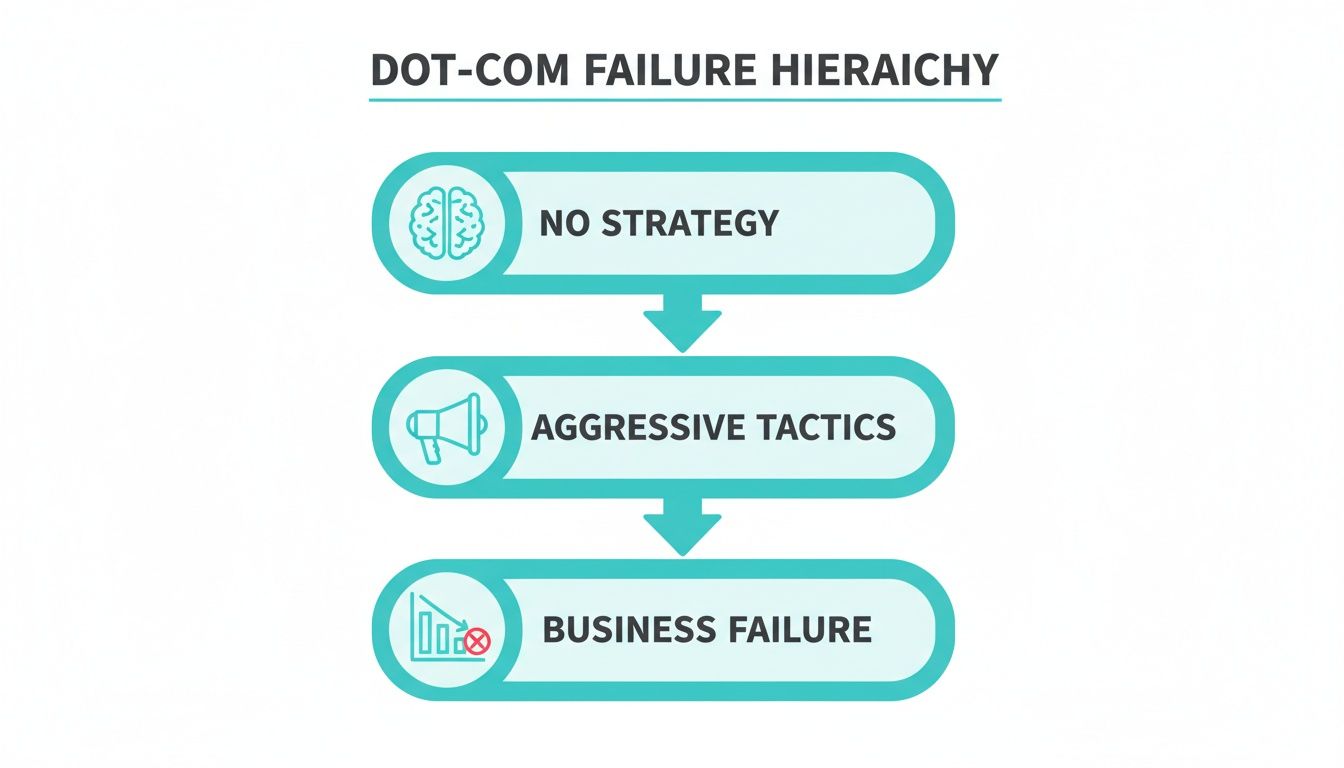
The lesson here is critical: a foundation of clear strategy is non-negotiable if you want to build something that lasts.
Ownership and Accountability
Clear ownership is everything when it comes to execution, and it’s split logically between the two plan types.
- Strategic Ownership: This belongs to the C-suite and senior leadership. The CEO, founder, and department heads are on the hook for setting the company's direction.
- Tactical Ownership: This rests with team leads, managers, and individual contributors. The Head of Demand Generation owns the MQL target; a content marketer owns the blog calendar.
This structure ensures the people closest to the work have the autonomy to execute effectively, while leadership stays focused on steering the ship.
Measurement and KPIs
Finally, how you measure success is fundamentally different for each plan. Strategic KPIs are high-level business outcomes reflecting long-term health and market position. Tactical KPIs are performance metrics that measure the efficiency and effectiveness of specific actions.
Let's put them side-by-side:
| Plan Type | Example Goal | Corresponding KPI |
|---|---|---|
| Strategic | Become the dominant platform | Market Share Growth |
| Tactical | Drive Q3 pipeline | Marketing Qualified Leads (MQLs) |
| Strategic | Build a sustainable business model | Customer Lifetime Value (LTV) |
| Tactical | Improve marketing efficiency | Cost Per Acquisition (CPA) |
Tying these two levels together isn't optional. Studies show that firms that rigorously connect strategic and tactical planning simply outperform those that don't. Organizations with a clear strategy that’s translated into tactical plans at the team level were up to 12% more likely to achieve above-median financial performance over five years.
But here’s the reality check: while 70–80% of early-stage teams can talk about their high-level growth ambitions, fewer than 30–40% actually have documented tactical roadmaps linked back to those objectives. You can discover more insights about linking planning to performance to see the data for yourself.
Translating Your Strategy Into An Actionable Roadmap
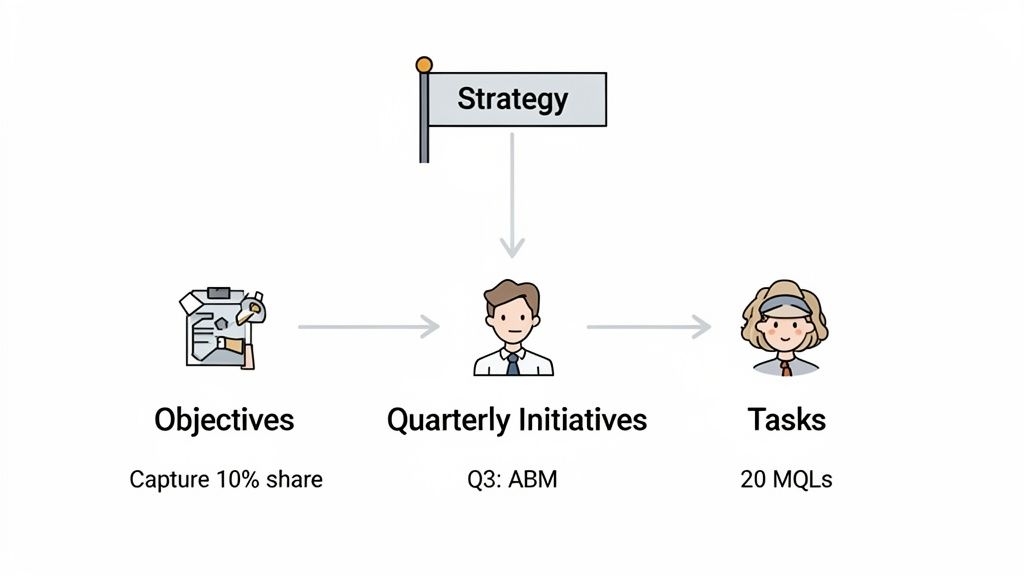
An ambitious strategy is useless if it just lives in a slide deck. It might look impressive, but it won’t generate a single lead or close a deal. The real work—and where most startups stumble—is turning that high-level vision into a detailed, actionable roadmap your team can actually execute. This is where the debate over strategic vs tactical plans moves from theory to real-world results.
This translation process is all about breaking down a huge, multi-year ambition into smaller, manageable, and measurable pieces. It’s what ensures every task, from writing a blog post to launching an ad campaign, is directly connected to a meaningful business outcome. Without that link, your team is just completing tasks, not driving the company forward.
From Big Vision To Specific Tasks
Let's walk through a real-world scenario. Imagine your high-level strategy is to become the leading AI analytics platform for mid-market fintech companies. That’s a powerful statement, but you can’t just hand it to your marketing manager and expect them to deliver. It needs to be deconstructed.
First, turn the vision into a strategic objective—a measurable goal with a clear timeline. For our example, a strong objective would be: Capture 10% market share in the mid-market fintech segment within three years.
The bridge between strategy and tactics is a clear line of sight. Every person on your team should be able to see exactly how their daily work connects to the company's biggest goals.
Now you have something concrete to work toward. The next move is to break that three-year objective into smaller, more immediate goals.
Building Quarterly Initiatives
A three-year goal is too big to tackle all at once. The only way to make real progress is by creating quarterly initiatives—major projects that move the needle on your strategic objective. For our fintech AI platform, a Q3 initiative might be: Launch a targeted account-based marketing (ABM) campaign to penetrate our top 50 target accounts.
This initiative is specific, time-bound, and directly supports the larger goal. From here, we can finally drill down into the specific tactics that will bring it to life. This is the point where strategy gets translated into a to-do list, with highly specific and assignable actions, clear owners, and success metrics.
- Tactic: Develop three case studies featuring existing fintech clients.
- Tactic: Create personalized ad creative and landing pages for the top 10 target accounts.
- Tactic: Launch a LinkedIn ad campaign targeting decision-makers at the 50 target companies.
Each of these tactics now has a clear purpose. They aren’t just random acts of marketing; they are the building blocks of a quarterly initiative designed to hit a long-term strategic objective.
A Checklist For Actionable Planning
Before you start translating your strategy, it’s worth checking out an ultimate guide to goal setting to make sure your foundational objectives are solid. Once you have that clarity, use this simple checklist to cascade your strategy into a tactical roadmap. If you're looking for a pre-built structure, you can find a helpful marketing roadmap template that puts these principles into practice.
- Define Your Strategic Pillar: What’s the one big thing you want to achieve in the next 3-5 years? (e.g., Become the market leader in a specific niche).
- Set a Measurable Objective: How will you know you've achieved it? Attach a number and a date. (e.g., Achieve $10M ARR in three years).
- Create Quarterly Initiatives: What are the 1-3 major projects you need to complete this quarter to move toward your objective? (e.g., Launch our new integration marketplace).
- List Key Tactics: What are the specific, assignable tasks required to complete each initiative? (e.g., Write API documentation, recruit 10 launch partners, create a co-marketing plan).
- Assign Ownership and KPIs: Who is responsible for each tactic, and what specific metric will define success? (e.g., Content Lead owns documentation; success is partner sign-off. Partnerships Lead owns recruitment; success is 10 signed partners).
This structured process transforms a vague ambition into a clear, step-by-step plan that connects every action to the bottom line. It’s the only way to ensure your strategy drives real, measurable growth.
How A Fractional CMO Bridges The Strategy-Tactics Gap
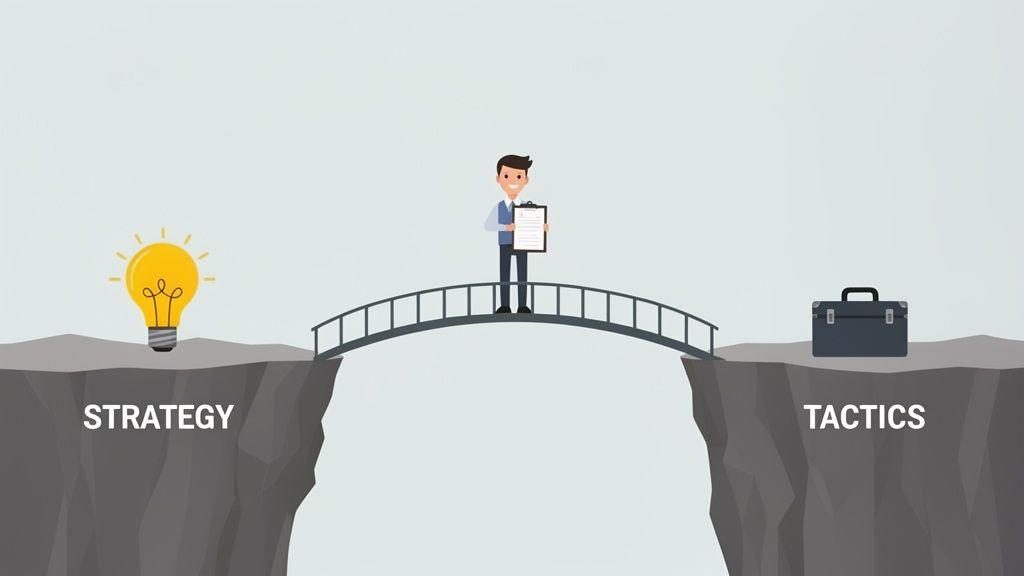
For a lean B2B tech startup, there's a huge gap between knowing you need a real strategy and actually having the senior leadership to build and execute it. It's the chasm where brilliant ideas get lost in a flurry of disconnected tactical activity. You end up with a team that’s busy but not productive, and a founder wearing way too many hats.
This is exactly where the strategic vs. tactical problem becomes a leadership challenge. Founders have the vision but often lack the bandwidth or deep marketing expertise to turn that vision into a coherent plan. A fractional CMO is purpose-built to fill this gap. They provide both the high-level strategic thinking and the practical, roll-up-your-sleeves tactical guidance that early-stage companies desperately need.
Providing The Strategic Foundation
Before a single tactic can work, a startup needs a rock-solid strategic foundation. This isn't about creating a hundred-page document that gathers dust; it's about answering the hard questions with brutal clarity. Who is our ideal customer? What's our unique spot in the market? What are our real business goals for the next three years?
A fractional CMO delivers this clarity through focused, high-impact work. A service like an 'Ignition Plan', for example, is designed to cut through the noise and deliver a clear go-to-market strategy. This process forces the tough but essential conversations to:
- Define the Ideal Customer Profile (ICP): Move from a vague idea of "who we sell to" to a data-backed profile of the perfect customer.
- Clarify the Value Proposition: Nail down exactly what makes your solution different and better in a way that clicks with your ICP.
- Set High-Level Goals: Establish measurable, long-term objectives like market share targets or ARR milestones.
This strategic work prevents the all-too-common mistake of building a marketing engine on a shaky foundation. It’s the "why" and "who" that have to come before the "what" and "how."
A fractional CMO doesn't just offer advice; they become a temporary member of your leadership team, owning the process of building the strategic framework your company will grow on.
This senior-level thinking ensures your business is pointed in the right direction before you start burning cash on tactics. You can get a better sense of the specific responsibilities by exploring what a fractional CMO does in more detail.
Driving The Tactical Execution
With a clear strategy locked in, the focus shifts to execution. This is where a lot of companies fall down—the strategy never makes it out of the boardroom and into the team's daily work. A fractional CMO’s role evolves here from strategist to hands-on leader.
Through ongoing advisory, they translate the big-picture strategy into a detailed, actionable roadmap. This is the practical work of turning ambitious goals into quarterly initiatives and weekly tasks. They provide the leadership to:
- Build the Marketing Roadmap: Create a quarter-by-quarter plan that outlines key campaigns, channel focus, and budget allocation.
- Manage Execution: Oversee the marketing team, manage vendors, and make sure projects stay on track and tied to strategic goals.
- Report on Performance: Set up the right KPIs and reporting cadence to measure what’s working, what isn’t, and why.
This hands-on leadership bridges the critical gap between planning and doing. It ensures every dollar spent on ads, every piece of content created, and every campaign launched is a deliberate step toward the company’s strategic goals. For a founder, it means getting senior marketing leadership without the cost and commitment of a full-time executive.
Common Questions About Strategic And Tactical Planning
Even with a clear framework, founders still get stuck. The theory behind strategic vs. tactical planning makes sense, but applying it in the middle of the day-to-day chaos of a startup is another story. Let's clear up some of the most common questions I hear.
These aren't just academic exercises. Getting the answers right is what separates great ideas from great businesses and helps you build a more focused, resilient, and effective company.
Can A Tactical Plan Exist Without A Strategic Plan?
Yes, but it’s like sailing without a map. You’re definitely moving, but you have no idea if you’re heading in the right direction. A tactical plan without a guiding strategy is just a random list of things to do. You can run ads, publish content, and go to events, but you have no way of knowing if they’re the right things.
Without a strategic "why," you can't prioritize your work or measure its real impact on your long-term goals. This always leads to wasted money, burned-out teams, and that awful feeling of being busy but not making any actual progress.
A strategic plan sets the destination and the guardrails. It makes sure every tactic—every dollar spent and every hour worked—is pushing the business forward toward a specific, desired outcome.
Bottom line: tactics without strategy are just expensive guesswork. You might get lucky here and there, but you’ll never build a predictable, scalable growth engine.
How Often Should We Review Our Plans?
Strategic and tactical plans operate on totally different clocks. Trying to review them on the same schedule is a classic mistake that leads to either ignoring your strategy or getting bogged down in tactical weeds.
Your strategic plan is your north star. It’s built to last. You’ll typically set it annually and then formally review it every quarter. This quarterly check-in isn't about rewriting everything; it's about pressure-testing your assumptions. Is our market the same? Is our ICP still accurate? The goal is to make sure your long-term vision is still relevant.
Your tactical plan, on the other hand, is a living document. It needs constant attention. Review it in detail every month to see how you’re tracking against KPIs. This lets you make quick pivots—doubling down on what's working and cutting what isn't—without waiting a full quarter to react.
Here’s a simple rhythm that works:
- Weekly Tactical Check-ins: Quick team huddles to review progress and clear roadblocks.
- Monthly Tactical Reviews: A deeper data dive into campaign performance and KPI results.
- Quarterly Strategic Reviews: A leadership meeting to track progress against the high-level strategy and define tactical priorities for the next 90 days.
What Are The First Steps To Create A Strategic Plan?
For a startup founder, the first strategic plan shouldn't be a 50-page binder that collects dust. It's about getting brutally honest and incredibly clear on a few core questions. If you can't fit your strategy on a single page, it’s too complicated.
Start by answering these four questions:
- Who is our ideal customer? Get painfully specific. "B2B companies" isn't an answer. "Series B fintechs in North America with 100-500 employees struggling with data compliance" is.
- What is our unique value proposition for them? What problem do you solve better than anyone else? Frame it from their perspective, not yours.
- What is our primary long-term business objective? Put a number and a date on it. For example, "Achieve $10 million in ARR in three years."
- What are the 2-3 core pillars that will get us there? These are your big bets. Maybe it’s "Dominate the enterprise financial services vertical" or "Establish market leadership through product-led growth."
Answering these questions gives you an unshakable foundation. Everything else—your marketing, sales process, and product roadmap—flows from there.
How Does AI Impact Strategic And Tactical Planning?
AI is a massive accelerator for tactics, but it is not a replacement for strategy. This is a critical distinction. You still need human insight to pick the right market, define your brand, and set the big goals. AI can't tell you which mountain to climb.
But once you know where you're going, AI supercharges the "how." It makes execution faster, smarter, and far more efficient, giving a small team the firepower to compete with much larger companies.
In marketing, AI can:
- Automate complex audience segmentation for hyper-targeted ad campaigns.
- Generate first drafts of blog posts, social copy, and emails.
- Optimize email send times and subject lines based on actual user behavior.
- Analyze huge datasets to spot trends and opportunities a human would miss.
AI handles the tactical execution with incredible speed, freeing up your team to focus on the strategic "why."
Confidently bridging the gap between strategy and execution is what separates fast-growing startups from those that stall out. If you need senior leadership to help build your strategic foundation and drive tactical execution without the full-time cost, Value CMO can help. We build the focused, data-driven roadmaps that turn vision into revenue. Learn more about our fractional CMO services.