Let's be honest, in the B2B tech world, 'winging it' with your marketing is a surefire way to burn cash and end up with a flat pipeline. The strategic marketing planning process isn't some dusty academic exercise; it's the living, breathing roadmap that brings clarity, momentum, and a scalable growth engine to your entire company. Think of it as the secret to turning random acts of marketing into a predictable revenue driver.
Why Your Startup Needs a Real Marketing Strategy
Too many founders I talk to are just tired of throwing spaghetti at the wall and seeing what sticks. You're dealing with misaligned teams, wasted ad spend, and product launches that fizzle out. This isn't just frustrating—it's the real-world cost of operating without a clear, documented strategy.
To really get why this matters, it helps to see it as part of the bigger strategic planning process that guides the whole business. This playbook is a practical guide from someone who's been in the trenches with you, designed to solve the exact problems you’re up against right now. We're ditching the abstract theory to focus on tangible outcomes.
Moving from Chaos to Clarity
Without a plan, marketing can feel like a series of disconnected activities—a blog post here, a social campaign there. A structured planning process forces you to answer the tough questions upfront: Who are we really selling to? What unique problem do we solve better than anyone else? Where can we actually find our people and win them over?
Getting this right aligns your entire company. Suddenly, your product, sales, and marketing teams are all rowing in the same direction. It all boils down to three core phases: analysis, strategy, and execution.
Here's a high-level look at how that journey unfolds, moving from a deep-dive on your own turf to owning your corner of the market.
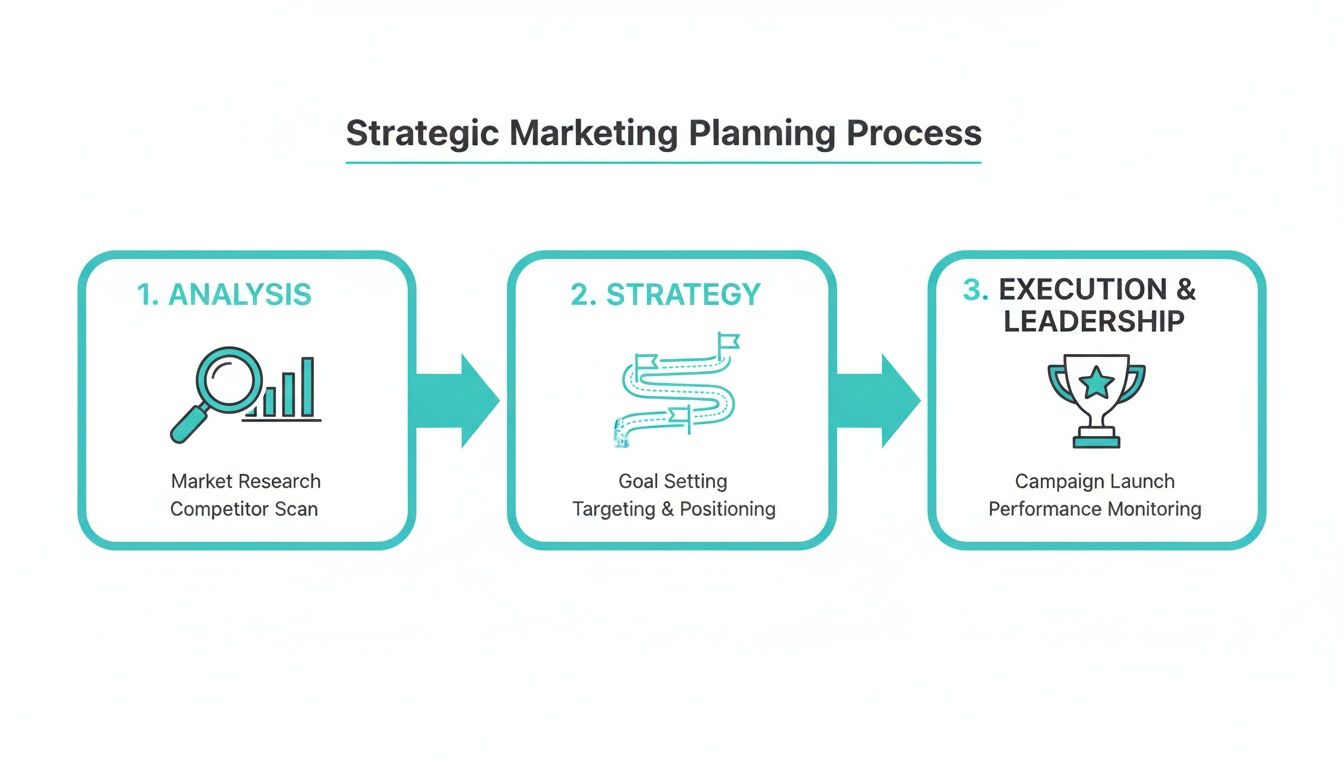
This isn’t a one-and-done event. As you can see, it's a continuous flow from deep analysis to decisive action in the market.
This table gives you a high-level look at the core phases we'll unpack, showing the journey from internal analysis to market leadership.
The Strategic Planning Journey at a Glance
| Phase | Core Objective | Key Outcome for Your Startup |
|---|---|---|
| Analysis | Uncover the truth about your market, competitors, and what you’re great at. | A crystal-clear picture of where you stand and where the real opportunities are. |
| Strategy | Define your unique position, your ideal customers, and your core message. | A focused game plan that tells your team exactly who to talk to, what to say, and where to say it. |
| Execution | Turn your strategy into a concrete action plan with clear goals and metrics. | An actionable roadmap with KPIs that directly link your marketing efforts to real revenue growth. |
Each phase builds on the last, creating a repeatable system for growth that gets smarter over time.
The Tangible Benefits of a Documented Plan
Building a formal strategy isn't about creating a document that collects dust on a shared drive. It’s about building a repeatable system for growth. The numbers don't lie: businesses with a documented strategy are 313% more likely to report success than those flying blind.
A solid plan delivers a few crucial advantages:
- Focused Resource Allocation: It stops you from spraying money across channels that don't actually reach your Ideal Customer Profile (ICP).
- Improved Team Alignment: Everyone from the CTO to the newest sales hire understands the goals and their role in hitting them.
- Measurable Results: It forces you to define the key performance indicators (KPIs) that actually matter, like pipeline velocity and customer acquisition cost (CAC), not just vanity metrics.
A great strategy is really a framework for making decisions. It tells you what not to do just as much as it tells you what to do—and that's invaluable when resources are tight.
Ultimately, this process is what transforms marketing from a cost center into a predictable revenue engine. For a deeper dive on how these pieces connect, check out our complete guide on the https://valuecmo.com/b-2-b-marketing-strategy-framework/.
Building Your Foundation with a Situational Analysis
Before you can build a growth engine, you need a solid blueprint. The very first move in any serious marketing plan is getting brutally honest about where your company stands right now. This is all about looking inward at your team and tech, and outward at the market you're trying to win.
Forget about creating a fancy presentation to impress the board. The real goal here is to build a shared understanding of reality across your leadership team. When your CTO, head of sales, and you are all operating from the same set of facts, decisions get made faster and smarter.
Ditching the Academic SWOT Analysis
You’ve seen a SWOT analysis before—Strengths, Weaknesses, Opportunities, Threats. Too often, it’s a generic classroom exercise filled with vague statements like "strong team culture" or "changing market." For a B2B tech startup, that's useless. Your analysis needs to be sharp, specific, and tied directly to how you make money.
Think of it this way: a good SWOT is your strategic compass. It forces a disciplined look at your current position, stopping you from chasing shiny objects you're not equipped to win or ignoring threats that could kill you overnight. A well-funded competitor isn't just a threat; it's a specific challenge that demands a precise counter-move, like doubling down on a niche they ignore.
Getting this analysis right is foundational. It’s the diagnostic that comes before the prescription. Rushing this stage is like a doctor prescribing meds without understanding the symptoms—it’s a recipe for failure.
Let's ground this in the real world of a B2B SaaS company. This needs to be a practical tool, not a theoretical one.
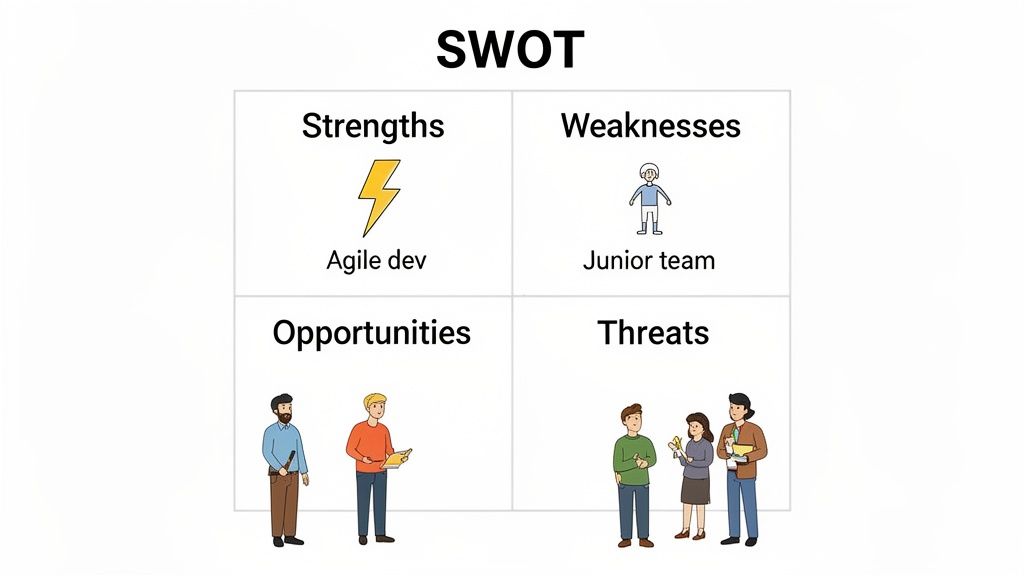
Here’s how to frame a no-fluff SWOT analysis that actually works for a tech startup:
- Strengths: What gives you an unfair advantage today? This could be a proprietary algorithm, an insanely agile dev cycle, or deep domain expertise on the founding team. For instance, if your team ships product updates in a one-week sprint while your enterprise rival takes a full quarter, that's a massive strength.
- Weaknesses: Where are you genuinely vulnerable? Be honest. Maybe you have a junior marketing team still learning the ropes, critical product gaps compared to the market leader, or a tiny budget for demand gen. Acknowledging this isn't failure; it's the first step to managing the risk.
- Opportunities: What outside forces can you exploit? This is about market shifts, not just wishful thinking. Think about a new AI trend that makes your analytics tool more valuable, a competitor's recent pricing screw-up, or a new regulation that creates an urgent need for your compliance software.
- Threats: What could realistically put you out of business? This includes direct competitors raising a huge round, a potential platform shift (like a change in a key API you depend on), or shifting customer expectations that make your solution look old news.
Connecting the Dots for Strategic Action
The real magic isn't just listing points in four boxes. It's about connecting them to find your strategic leverage. The whole point is to match your internal strengths with external opportunities.
Let's take an early-stage SaaS company that sells project management tools to creative agencies.
Their SWOT might uncover:
- Strength: An incredibly agile development cycle that lets them release new features fast based on user feedback.
- Weakness: A small sales team with zero experience closing six-figure enterprise deals.
- Opportunity: Growing frustration in the market with clunky, overpriced tools from legacy players, which people complain about constantly on social media and review sites.
- Threat: A big-name competitor just launched a "lite" version of their product targeting the exact same agencies.
By connecting these dots, a clear strategy emerges. Instead of trying to compete head-on with the competitor’s sales machine (a weakness), they can leverage their agile development (a strength) to quickly solve the customer complaints they see online (an opportunity).
Their marketing suddenly has a sharp new angle: "The most responsive PM tool for agencies." They're using their speed as a key differentiator to carve out a defensible spot in the market. This turns a simple analysis into a powerful go-to-market directive.
Phase 2: Uncover the Hard Truths with Market Research
Assumptions kill startups. Data builds empires.
Once you’ve looked in the mirror with a situational analysis, it's time to turn your gaze outward. This is where you dig into what’s really happening in your market, moving beyond gut feelings to build a strategy on a foundation of cold, hard evidence.
Rushing this phase is the single biggest mistake I see founders make. They’re so eager to build and sell that they skip the deep research, which leads to messaging that falls flat and products that solve imaginary problems. Data shows that companies who get this right avoid the pitfalls where bad customer insights derail 67% of marketing plans.
This isn’t about writing an academic paper. It's about focused, practical intelligence gathering that stops you from making expensive mistakes later.
Build a Data-Backed Ideal Customer Profile
That vague, one-paragraph persona you wrote a year ago? Ditch it. A truly useful Ideal Customer Profile (ICP) is a living document built from real data, not creative writing. It’s the compass for every single marketing and sales decision, making sure you don't waste a dollar on people who will never buy.
To get this right, you need to blend two types of data:
- The Quantitative: Dive into your CRM and analytics. Who are your best customers right now? Look for patterns in company size, industry, revenue, and location. What job titles keep showing up in the buying decision?
- The Qualitative: This is where the magic happens. Get on the phone. Talk to your customers—and even the prospects who chose a competitor. Ask open-ended questions to uncover their deepest pain points, their "aha!" moments, and the exact words they use to describe their challenges.
This mix of data transforms your ICP from a guess into a precision targeting tool. It tells you not just who to target, but how to talk to them in a way that actually connects.
Analyze Your Competitors to Find the Gaps
You don’t operate in a vacuum. A solid competitive analysis isn’t about copying your rivals; it’s about finding the gaps they’ve left wide open. The goal is to understand their playbook so you can build one they can't easily counter.
Start by mapping out your top 2-3 direct and indirect competitors. Then, get methodical.
A Practical Competitor Teardown:
- Positioning & Messaging: How do they describe themselves on their homepage? What value prop do they hammer home in their ads? Are they the "easy-to-use" option or the "powerful enterprise" solution?
- Content & SEO: What keywords are they ranking for? What topics are they owning on their blog or in webinars? Look for high-intent keywords they're ignoring or content gaps you can fill with your own expertise.
- Customer Reviews: Scour sites like G2 and Capterra. What do their customers love? More importantly, what are the most common complaints? Every one-star review is a potential opportunity.
Let's say you discover your main competitor's customers constantly complain about poor support. Boom. You now have a powerful strategic lever. You can reposition your own service to highlight your dedicated, white-glove support, turning their weakness into your core strength.
Your competitors' unhappy customers are your most valuable source of market intelligence. Their pain is your roadmap to differentiation.
Size Your Market Realistically
The final piece of this research puzzle is getting a realistic handle on your market size. Founders love throwing around massive Total Addressable Market (TAM) numbers to impress VCs, but for your marketing strategy, you need to be way more focused. A clear view of your market helps you set achievable goals and spend your budget where it counts.
To really nail this part and gain an edge, many businesses are turning to more advanced tools. To dig deeper into market trends and insights, you might consider methods like AI-powered data analysis.
By combining a razor-sharp ICP, a deep read on your competitors' playbooks, and a realistic market view, you’re arming yourself with the insights needed to build a winning plan. You can also dive deeper into this with our guide on how to define your target market.
Crafting Your Go-To-Market Strategy and Roadmap
You’ve done the research. You know the market, your customers, and your own strengths. Now it's time to turn all that homework into a real plan of attack. This is where we stop analyzing and start strategizing, building the go-to-market plan that will guide every move you make.
Frankly, this is the part where you decide exactly how you're going to win.
This isn’t about writing a 50-page document that gathers dust. It’s about making a handful of sharp, focused decisions that get your team and your budget pulling in the same direction. We're answering the big questions: What are we actually trying to achieve? Who are we selling to? How will we reach them? And what will we say when we do?
Set Objectives That Actually Drive Business Growth
Let's be blunt: vague goals like "increase brand awareness" are useless for a startup. Your marketing objectives have to be bolted directly to business outcomes. The best way I’ve found to enforce this discipline is using the SMART framework—Specific, Measurable, Achievable, Relevant, and Time-bound.
A weak, fuzzy objective sounds like this: "We need more leads this quarter."
A powerful, SMART objective sounds like this: "Increase Marketing Qualified Leads (MQLs) from our target ICP of Series A fintech companies by 30% in Q3."
See the difference? That kind of clarity is a game-changer. It gives your team a specific target to hit and a clear benchmark for success. From now on, every tactic you consider can be measured against one simple question: "Will this help us hit our MQL goal?"
Define Your B2B Tech Marketing Mix
With your objective locked in, it's time to build the engine that gets you there. This means choosing the core components of your marketing strategy—your marketing mix. For most B2B tech products, this boils down to a few critical areas.
Nail Your Value Proposition
Your value proposition is the absolute heart of your messaging. It's a clean, simple statement explaining the unique benefit you provide, who you provide it for, and why you’re hands-down better than the alternatives. It's not a fluffy tagline; it’s the core reason a customer should pay you instead of someone else.
For example, a cybersecurity startup could go from a generic message like "Advanced threat protection" to a value prop that cuts through the noise: "For IT managers at mid-sized banks, our platform is the only solution that stops ransomware in under 60 seconds without needing a dedicated security team."
Select the Right Channels
You can't be everywhere, especially with a lean budget. Your ICP research should tell you exactly where your buyers spend their time online. Stop wasting money on channels just because your competitors are there or because it's the trendy thing to do.
- For C-level outreach: A focused LinkedIn campaign targeting specific job titles and industries is far more effective than blasting out generic social media posts.
- For technical demos: Targeted webinars or short, on-demand video demos can showcase your product's power to engineering leads who need to see it in action.
- For building authority: A blog focused on solving very specific, high-value problems for your ICP will attract the right kind of organic traffic over time.
Don't chase every shiny new channel. It’s far better to dominate one or two channels where your ICP lives than to have a weak, scattered presence across ten. Focus is your superpower.
Plan Your Launch Campaigns
A launch isn't a single event; it's a coordinated campaign designed to build momentum. Whether you're launching a new product or entering a new market, your plan should orchestrate a series of activities across your chosen channels to create a concentrated impact. This includes pre-launch buzz, the launch-day announcement, and post-launch follow-up to keep the conversation going.
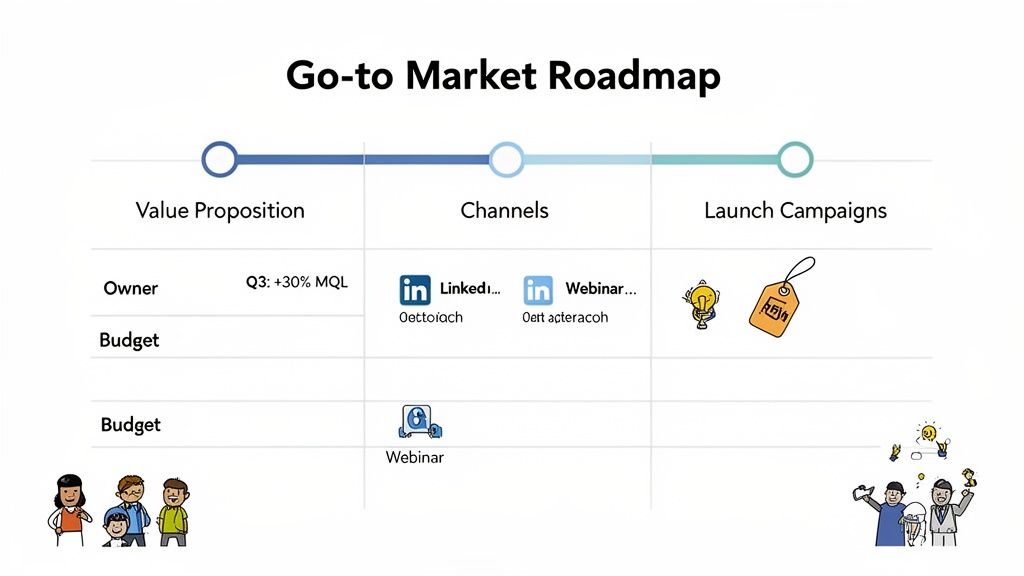
Build a Simple One-Page Marketing Roadmap
Complex strategies fail. Why? Because they're impossible to communicate and even harder to track. The fix is to distill your entire plan onto a single, easy-to-digest roadmap.
This document becomes the single source of truth for your entire company, from the board down to your newest marketing hire. It turns your abstract strategy into a clear, visual guide that outlines key initiatives, timelines, owners, and budgets. It's an incredibly powerful tool for keeping everyone aligned and focused on what truly matters each quarter.
Here's an example of what this could look like for a B2B tech company's third quarter.
Sample B2B Tech Marketing Roadmap for Q3
This is a practical example showing how strategic goals get translated into tangible actions for a single quarter. It’s not meant to be exhaustive, but to show how you can bring clarity and accountability to your plan.
| Initiative | Primary Channel(s) | Owner | Key Metric | Timeline |
|---|---|---|---|---|
| New Feature Launch | Product Hunt, Targeted Email, Webinar | Marketing Lead | 500 Demo Sign-ups | July |
| ICP Content Pillar | Blog, SEO, LinkedIn | Content Manager | 20% Increase in Organic Traffic | July-Sept |
| Competitor Take-Down Campaign | Google Ads, G2 Reviews | Demand Gen Specialist | 150 New MQLs | August |
| Partner Co-Marketing Webinar | Partner Email List, Social Media | Marketing Lead | 75 Qualified Leads | September |
Remember, this roadmap isn't set in stone. It’s an agile guide. It helps you track progress and make smart adjustments as you learn what’s working and what isn’t. With a simple, clear plan like this in hand, you’re finally ready to move from just talking about strategy to disciplined execution.
Executing and Measuring Your Marketing Performance
A brilliant strategy is worthless if it just sits in a slide deck. All the planning in the world won't move the needle until it translates into real-world action. This is where the rubber meets the road in the strategic marketing planning process—bringing your plan to life and, just as crucially, tracking what actually works.
Too many startups get this backward. They obsess over the initial plan but treat execution like an afterthought. The result? Scattered efforts and frustratingly slow growth.
The goal isn't just to launch campaigns; it's to build a predictable revenue engine. That requires a relentless focus on performance and the agility to adapt. Your plan isn't meant to be set in stone. It's a living document that should evolve as you get real feedback from the market.
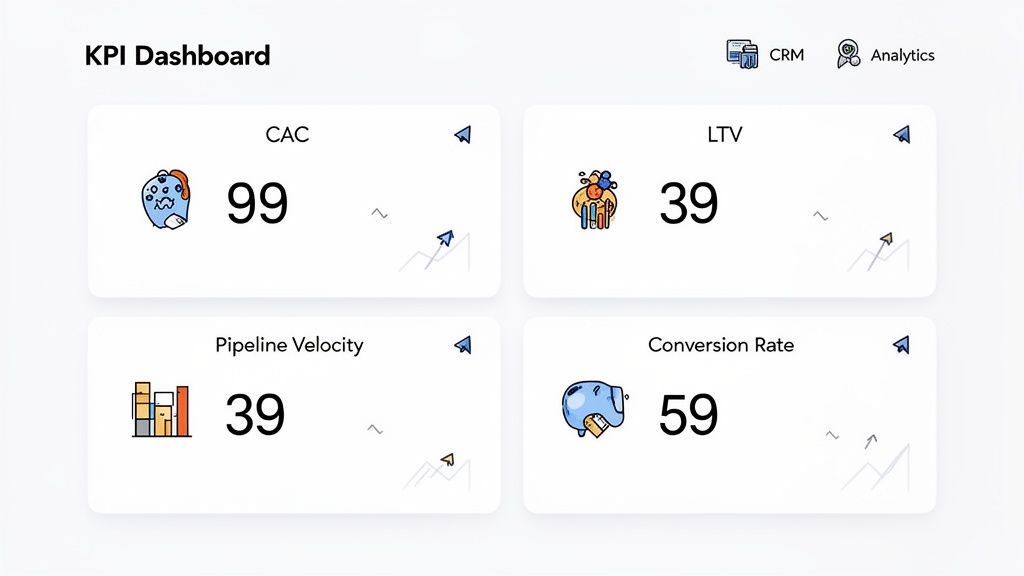
Building Your Founder-Focused KPI Dashboard
Forget vanity metrics like social media likes or impressions. As a founder, you need a dashboard that cuts through the noise and tells you one thing: is our marketing making us money? This means zeroing in on a handful of key performance indicators (KPIs) tied directly to the financial health of your business.
Your dashboard should be simple, clear, and laser-focused on what matters to a B2B tech company.
- Customer Acquisition Cost (CAC): This is your total sales and marketing spend over a set period, divided by the number of new customers you landed. It’s the single most important number for understanding the efficiency of your growth engine.
- Lifetime Value (LTV): This represents the total revenue you can expect from a single customer over their entire relationship with you. A healthy business model needs an LTV that's significantly higher than your CAC, typically by a ratio of 3:1 or more.
- Pipeline Velocity: How fast are leads moving through your sales funnel? This tells you about the health and efficiency of your entire go-to-market motion, from first touch to closed deal.
- Channel Conversion Rates: Don't just track overall leads. You need to know which channels—organic search, LinkedIn ads, webinars—are delivering the high-quality leads that actually turn into paying customers.
The point of a KPI dashboard isn't just to report numbers; it's to drive decisions. If a channel has a sky-high CAC and a pathetic conversion rate, you now have the data to confidently cut the spend and reallocate those dollars to a channel that’s actually working.
Selecting a Lean and Effective Martech Stack
For an early-stage startup, the world of marketing technology can feel overwhelming—and expensive. The key is to start lean. Focus only on the tools that solve an immediate, critical problem. You don't need a massive, enterprise-level stack to execute a powerful strategy.
Start with the essentials that will feed your KPI dashboard.
- CRM (Customer Relationship Management): This is non-negotiable. A tool like HubSpot or Salesforce acts as the central nervous system for all your customer data, tracking every interaction from the first marketing touch to the final sale.
- Marketing Automation: Platforms like Marketo or Pardot let you nurture leads at scale, automate email campaigns, and score leads based on their engagement.
- Analytics: Google Analytics is the baseline for understanding your website traffic and user behavior. As you scale, you might add tools for more advanced funnel analysis or heat mapping.
The goal is a tech stack that provides clarity, not complexity. Resist the temptation to add new tools just because they're trendy. Every piece of software should have a clear purpose tied directly to executing your plan and measuring its success.
Creating a Feedback Loop with Monthly Reviews
The single most important habit for successful execution is the monthly marketing review. This is a dedicated meeting where you and your team step back from the day-to-day tactics to analyze performance against the goals you set in your roadmap.
This meeting isn't for excuses; it's for learning. By regularly reviewing what’s working and what isn’t, you create a powerful feedback loop. This process of consistent analysis and iteration is what transforms marketing from a series of hopeful bets into a systematic, data-driven growth machine. To get a better handle on this, you can learn more about how to measure your marketing ROI in our detailed guide.
Have Questions About Strategic Marketing Planning? Good.
Even the most airtight playbook runs into real-world questions. When you're in the startup trenches, moving a million miles an hour, it's fair to wonder how a formal strategic marketing planning process fits in.
Let’s tackle a few of the most common questions we hear from founders when they decide to trade random tactics for a focused growth engine. These aren't textbook answers—they come directly from our experience helping B2B tech companies get this right.
How Often Should We Revisit Our Marketing Plan?
A strategic plan should never be a "set it and forget it" document collecting dust on a server. Think of it as a living guide for your business. We recommend a full-blown strategic review annually. This is your chance to zoom way out and challenge your core assumptions about the market, your positioning, and your long-term goals.
But the real work happens in shorter sprints. You absolutely need to run quarterly check-ins to measure performance against your roadmap and make smart adjustments. If a channel isn't hitting its numbers, you pivot. If a surprise competitor shows up or your product team ships a major update, the plan needs a fresh look—immediately.
The goal here is agility, not rigidity. Your plan is the compass that keeps you heading north, but it isn't a turn-by-turn map. It’s a tool for making smart, fast decisions, not a rulebook that holds you back.
What Is the Biggest Mistake Founders Make in This Process?
Easy. The single most common—and costly—mistake is skipping the deep research phase. It’s so tempting to jump straight to the sexy stuff: launching ad campaigns, churning out blog posts, or building a new website. But if you do that without a data-backed understanding of your Ideal Customer Profile (ICP) and what competitors are doing, you're just lighting money on fire.
This rush to execute leads to wasted ad spend on the wrong channels, a flood of low-quality leads that drive your sales team crazy, and messaging that completely misses your buyers' actual pain points. An unstoppable strategy is built on insight, not assumptions.
Can a Small Team with a Limited Budget Actually Execute a Real Strategic Plan?
Absolutely. In fact, for a small team, a strategic plan is more critical, not less.
When you have limited resources, you can't afford to waste a single dollar or an hour of someone's time on stuff that doesn't move the needle. Strategy isn’t about having a massive budget; it's about being brutally efficient with the budget you have.
A solid plan gives you the discipline to say "no" to the million distracting shiny objects that pop up every week. It empowers you to focus every ounce of effort on the few channels with the highest potential for ROI. You don't need a huge team to do customer interviews, define your ICP, or map out a focused plan. You just need discipline.
How Do I Get My Whole Team Aligned with the Marketing Plan?
Alignment doesn't happen by sending out a single "Here's the plan!" email. You build it by pulling key people into the process from the very beginning. The situational analysis phase is the perfect time to get direct input from your heads of sales, product, and customer success.
When people feel like they helped build the strategy, they take ownership of the outcome.
Once the plan is set, share the one-page roadmap and the KPI dashboard everywhere. That kind of transparency makes sure everyone knows the goals and can see exactly how their day-to-day work connects to the company's growth.
Navigating the strategic marketing planning process can feel like a heavy lift, but it’s the only reliable way to build a predictable growth engine. At Value CMO, we bring the senior marketing leadership B2B tech startups need to build and execute these plans—without the full-time overhead.
If you're ready to move from random acts of marketing to a focused strategy that actually delivers, learn how Value CMO can help.