Strategic marketing consulting is the high-level thinking that makes sure every marketing dollar you spend pushes your company toward predictable growth. It’s not about just running ads or posting on social media; it’s the architectural blueprint that connects what your marketing team does every day to your biggest business goals, giving your B2B tech startup a clear path forward.
Your Blueprint for Predictable Growth
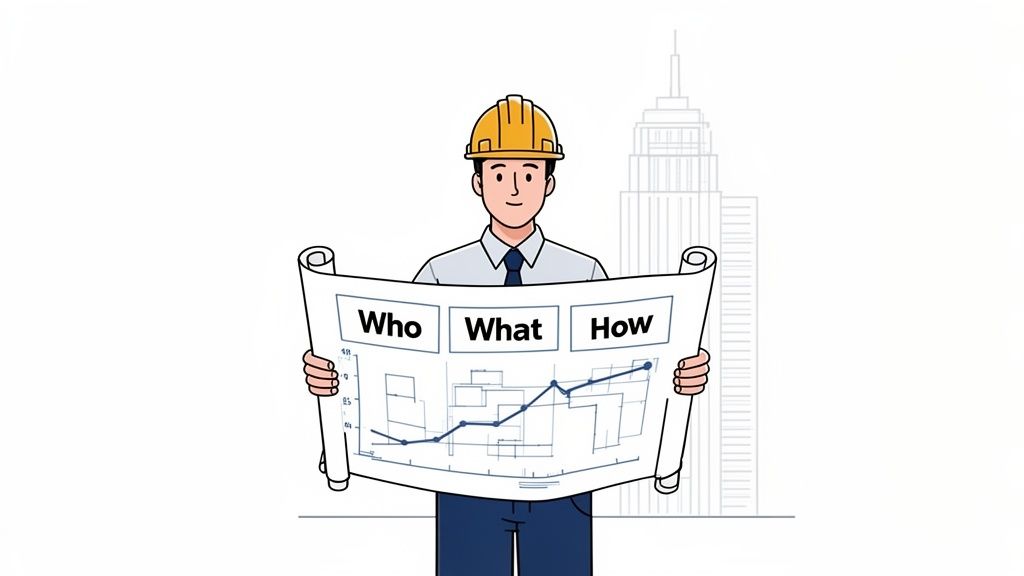
Have you ever tried building a skyscraper without a blueprint? You could have the best construction crew on the planet, but they’d just be guessing where to pour the foundation and place the steel beams. The result? An unstable mess that’s guaranteed to come crashing down.
That’s exactly what happens when tech founders throw money at marketing tactics—SEO, content, paid ads—without a solid strategy. You might get a few lucky breaks, but you won't build the sustainable, scalable engine you need for the long haul.
The Architect vs. The Builder
Strategic marketing consulting gives you that essential blueprint. It defines the foundational pillars of your growth before you spend a single dollar on tactics. The easiest way to think about it is the difference between an architect and a builder:
- The Architect (Strategic Consultant): They design the whole structure. They figure out who the building is for (your ideal customer), its main purpose (your value proposition), and the smartest way to put it all together (your go-to-market plan).
- The Builder (Tactical Marketer): This is the person who takes that blueprint and makes it real. This is your in-house team or agency—the folks building the walls, installing the windows, and wiring the electricity. They handle the day-to-day execution.
A consultant’s main job is to help you nail down the answers to three critical questions that become the bedrock of your marketing.
"A strategy, even a flawed one, can be improved. A series of tactics without a strategy is just a list of things to do."
Answering the Core Questions
Good strategic marketing consulting doesn't get lost in the weeds of campaign metrics. It stays focused on the big picture to create clarity and get everyone on the same page. The whole practice really boils down to defining:
- The 'Who' (Your Ideal Customer Profile): This means getting way more specific than just vague demographics. It's about building a data-driven profile of the exact companies and people who feel the most pain that your product solves.
- The 'What' (Your Value Proposition): This is where you nail down exactly how your product solves that pain in a way your competitors can't. This becomes the soul of all your messaging.
- The 'How' (Your Go-to-Market Plan): This involves creating a detailed roadmap that outlines the specific channels, budget, and activities you'll need to reach your 'who' with your 'what'—without wasting time or money.
To really get it, it helps to understand the broader strategic planning process, which is the foundation for any solid consulting work. This structured approach is why the global marketing consulting market is expected to jump by USD 40.7 billion between 2024 and 2029, growing at a CAGR of 4.5%.
North America is leading the charge, driven by companies that need an expert guide for their strategy and customer analytics. For B2B tech founders like you, this isn't just another service—it’s the engine for predictable revenue and the kind of confidence that gets investors excited.
How Consultants Solve Your Toughest Growth Problems
Every founder knows that sinking feeling. The sales pipeline that was humming along suddenly goes quiet. A major product launch, the one you bet the farm on, lands with a thud. Your sharp but junior team is looking to you for a strategic plan you just don't have the time to create.
These aren’t small bumps in the road. They’re serious risks that can stall your company's momentum, and they are exactly the kind of tangled, late-night problems where a strategic marketing consultant does their best work.
From Symptoms to Diagnosis
Picture a B2B SaaS startup. They’re burning through their ad budget and the sales team is busy, but deals aren't closing. The pipeline is clogged with low-quality leads, and the marketing message feels scattered. It's a classic case of frantic activity that isn’t moving the revenue needle.
This is where a consultant acts less like a marketer and more like a diagnostician. Instead of just prescribing more ads—which is just treating the symptom—they dig for the root cause.
A consultant’s real value isn't just in having answers; it's in asking the right questions to find the one thing holding your business back.
They go straight to the fundamentals. Is the Ideal Customer Profile (ICP) off? Are you targeting companies that can't actually afford your solution or don't really feel the pain point you solve? Is the Go-to-Market (GTM) strategy aimed at the wrong channels? Does your messaging completely miss the mark on what makes you different?
Often, the problem isn’t a lack of effort—it’s a lack of a clear, unified strategy. A consultant brings an objective, outside view to spot the disconnects your internal team is just too close to see. They’re the ones who connect the dots between a weak message and a leaky pipeline.
The Right Prescription for Growth
Once the real problem is diagnosed, a strategic marketing consultant lays out a clear path forward. This isn’t a vague recommendation; it's a concrete action plan designed for your specific growth hurdle. Consultants often implement proven lead generation best practices to get clients moving in the right direction.
Here are a few common scenarios where this becomes a game-changer:
- Bridging the Leadership Gap: You need senior marketing leadership now but aren't ready to hire a full-time, six-figure executive. A consultant or fractional CMO can step in immediately, providing the high-level strategy and direction to get the engine running.
- Mentoring a Promising Team: You have a smart, hungry marketing team, but they lack senior-level experience. A consultant can act as a coach, leveling up their skills and guiding them from just doing tasks to thinking strategically.
- Securing the Next Funding Round: Investors don't fund tactics; they fund a believable growth story. A consultant helps you build and articulate a data-driven marketing strategy that proves you have a scalable, repeatable engine for acquiring customers—which is essential for closing that next round.
Ultimately, bringing in a strategic partner is about trading uncertainty for a clear, actionable roadmap. They turn complex growth challenges from insurmountable roadblocks into a series of manageable steps. For a founder, that kind of clarity isn't just helpful—it's how you build momentum and win.
Choosing Your Consulting Engagement Model
So, you know you need strategic help. The next question is always, "What does that help actually look like?" Strategic marketing consulting isn't a one-size-fits-all service. It's a spectrum of options, each built for different company stages, budgets, and the immediate problems you're trying to solve.
Figuring out which path to take can feel like a lot, but it really just boils down to finding the right mix of strategic leadership, hands-on help, and cost. For a B2B tech founder, this is a critical choice. Get it right, and you build a sustainable growth engine. Get it wrong, and you'll burn through cash with little to show for it.
The Three Core Models
Most consulting gigs fall into one of three buckets. Each one is designed to solve a specific type of problem founders face. Getting your head around the differences is the first step to making a smart call that lines up with your business goals.
Let's break them down:
- The Project-Based Consultant: This is your specialist, the surgeon you bring in for a very specific, short-term job. Think of them for things like building a go-to-market plan for a new product launch or completely overhauling your ideal customer profile. They deliver a clear, defined outcome, and then they're done.
- The Traditional Agency: An agency is an external team of doers. They're great at executing tactics at scale—running your SEO, creating content, or managing paid ad campaigns. While they're solid for cranking out work, they often don't provide the deep, embedded strategic leadership a startup desperately needs.
- The Fractional CMO: This model gives you a seasoned marketing executive who joins your leadership team, just on a part-time or "fractional" basis. They don’t just write the strategy; they own it, manage the team (or help you build one), and are held accountable for hitting real business numbers.
This decision tree can help you map your current growth problem to the right solution.
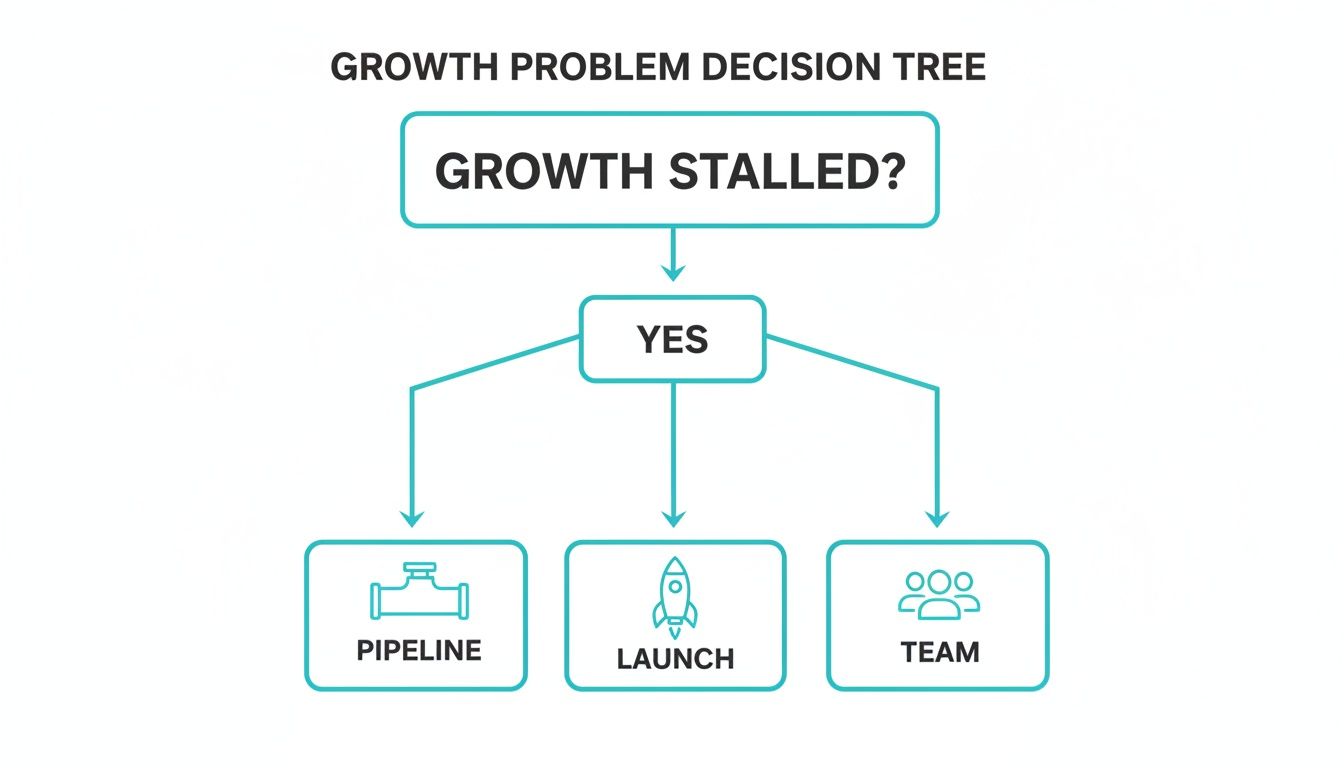
As you can see, stalled growth usually points back to a handful of core issues, and each one suggests a different kind of partnership.
Why Fractional Leadership Is Gaining Ground
For a huge number of B2B tech startups, the fractional CMO model just plain works. It offers the high-level strategic mind of a true executive without the $300k+ salary and long-term commitment of a full-time hire. This isn't just about getting advice; it's about getting leadership.
A project consultant gives you a map. An agency drives the car. A fractional CMO helps you design the map, gets in the car with you, and makes sure you reach the destination.
Because they’re embedded in your company, they develop a deep understanding of your product, your culture, and your unique challenges. They aren't just dropping off a PowerPoint and disappearing; they are in the trenches with you, calling audibles and mentoring your team. You can dive deeper into how a fractional CMO blends strategy with day-to-day execution.
This agile, leadership-first approach is why the high-growth marketing consulting sector is seeing an incredible 41.7% compound annual growth rate. These firms are growing 4.4 times faster than their peers because they adapt to exactly what clients need to win.
Fractional CMO vs. Traditional Agency vs. Project Consultant
To make the choice even clearer, here's a side-by-side comparison to help you see which model fits your startup's stage, budget, and needs right now.
| Attribute | Fractional CMO | Traditional Marketing Agency | Project-Based Consultant |
|---|---|---|---|
| Primary Role | Strategic leadership & execution ownership | Tactical execution & campaign management | Specialized, one-time deliverables |
| Best For | Startups needing senior marketing leadership without the full-time cost | Companies needing to scale specific, well-defined marketing activities | Teams with a clear, short-term strategic gap (e.g., GTM plan) |
| Engagement | Long-term, integrated part of the leadership team | Retainer or project-based, external team | Short-term, fixed scope and timeline |
| Cost | $7k – $15k+ per month (part-time) | $5k – $25k+ per month | $10k – $50k+ per project |
| Accountability | Accountable for business outcomes (pipeline, revenue) | Accountable for channel metrics (traffic, leads) | Accountable for project completion |
| Key Benefit | C-suite strategy and hands-on leadership at a fraction of the cost | Access to a team of tactical specialists | Deep expertise for a specific, defined problem |
Ultimately, picking the right partner comes down to being honest with yourself about your biggest need. Do you need a one-off blueprint? A team to run the plays? Or an experienced coach to design the playbook and lead the team to victory? Your answer points directly to the right model for your company.
What You Actually Get From a Strategic Consultant
"Strategy" is a great word for a whiteboard session, but it doesn't mean much until it becomes something your team can actually use. When you hire a strategic marketing consultant, you’re not just buying advice. You’re paying for concrete outputs that turn all that ambiguity into an action plan.
This is where the big ideas—the diagnosis and the blueprint—become real documents that guide every move your team makes. It’s about shifting from "what if?" to "here's how," with specific deliverables tied directly to business results.
So let’s get down to brass tacks. What should you actually expect to get for your money?
The Foundational Deliverables
A good consultant doesn't just talk; they build the core assets that become your marketing team's source of truth. While every project is different, a few non-negotiable deliverables form the bedrock of any solid strategy.
You should walk away with:
- A Detailed Go-to-Market (GTM) Strategy: This is the master plan. It spells out exactly which markets to target, the messaging that will hit home, and the sequence of moves you'll need to win market share.
- A Mapped Ideal Customer Profile (ICP): This is way more than a simple persona. It's a data-driven breakdown of the perfect companies for your product, complete with firmographics, pain points, and buying triggers.
- A Data-Driven Growth Roadmap: This document turns the GTM strategy into a timeline with quarterly goals, key initiatives, and clear owners. It's your step-by-step guide.
- A Comprehensive Channel and Budget Plan: This tells you exactly where your marketing dollars will go and why. It allocates resources to the highest-impact channels and sets clear expectations for what you'll get in return.
These aren't just files in a folder; they're decision-making tools. They get everyone from sales to product on the same page about who you're selling to and how you plan to win them over. You can see more on what a marketing consultant does to create these assets.
Measuring What Truly Matters
Deliverables are only half the story. The other, arguably more important part, is accountability. A great strategic partner insists on being measured by the same numbers you are—the ones that directly impact the health of the business. Vanity metrics like social media likes or website traffic are nice, but they don't pay the bills.
A consultant who talks about clicks and impressions is a tactician. A strategic partner talks about pipeline, revenue, and the cost to acquire a customer. Their focus is on business outcomes, not just marketing activity.
This focus on real results is a big deal. The strategic consulting sector commands a massive 32% share of the total consulting market, which hit around USD 370 billion in the U.S. alone by 2023. As companies wrestle with complex market shifts, the demand for measurable, high-stakes guidance just keeps growing.
Key Performance Indicators That Drive Accountability
To hold your consultant accountable, you need to agree on the right Key Performance Indicators (KPIs) from day one. These are the numbers that prove the strategy is actually working.
Here are the KPIs that truly matter for a B2B tech startup:
- Customer Acquisition Cost (CAC): The total cost of sales and marketing to land one new customer. The main goal of any strategy is to make this number as efficient as possible.
- Lead-to-Customer Conversion Rate: What percentage of leads from marketing actually become paying customers? This metric reveals the quality of your leads and the health of your sales funnel.
- Pipeline Velocity: How fast do leads move through your sales pipeline, from their first contact to a closed deal? A great strategy speeds this up and shortens your sales cycle.
- Marketing-Sourced Revenue: What percentage of new revenue can you tie directly to marketing's efforts? This is the ultimate bottom-line number for the marketing team.
By focusing on these deliverables and KPIs, you turn the engagement from a simple expense into a strategic investment. You get a clear plan, a way to measure its success, and a partner who is just as obsessed with your growth as you are.
A Checklist for Choosing the Right Partner
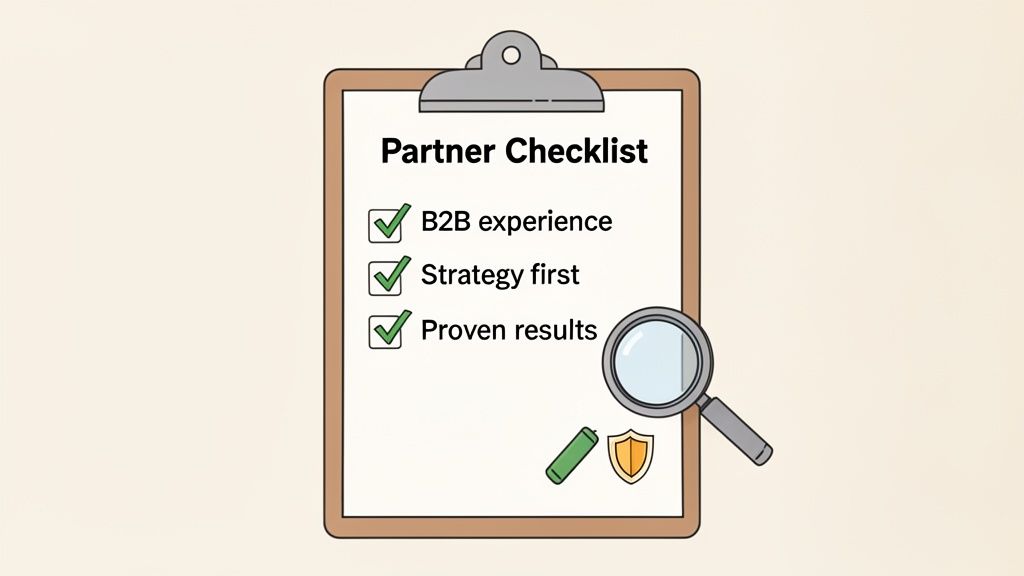
Picking a strategic marketing partner is one of the biggest calls you'll make as a B2B tech founder. This isn’t about hiring just another vendor. It's about letting someone into your inner circle who can seriously change your company's growth path.
A great partner gets you to product-market fit and predictable revenue faster. The wrong one will burn cash and time you just don't have. This decision is too important for a gut feeling; you need a real, structured process.
To help you skip the common mistakes, I’ve put together a checklist I use myself. Use it to vet potential consultants and make a smart choice that actually sets you up to win.
Vetting Core Competencies
Before you even book a discovery call, you need to screen for the non-negotiables. A consultant's background tells you everything about the kind of results you can expect. Don't compromise on these basics.
Your first pass should confirm they have:
- Deep B2B Tech Experience: The SaaS world has its own language, sales cycles, and buyer habits. Someone who mostly works with B2C or non-tech companies is going to miss the details that matter.
- A Strategy-Before-Tactics Mindset: Look for a partner who obsesses over your ICP and GTM plan before they even mention a single marketing channel. If they jump straight to SEO or ads, they’re a tactician, not a strategist.
- A Transparent Process: They should be able to clearly walk you through their methodology. Ask them what the first 90 days look like. It should sound like a structured plan, not a bunch of vague promises.
- A Track Record of Measurable Results: Case studies are fine, but get specific. Look for proof they’ve actually moved the needle on KPIs like pipeline growth, customer acquisition cost (CAC), and marketing-sourced revenue for companies like yours.
A consultant's real value isn't measured by the documents they deliver. It’s measured by the business outcomes they help you achieve. Focus on partners who speak the language of revenue, not just reports.
Asking the Right Questions
Once a consultant passes that first screen, it’s time to dig deeper. The questions you ask will reveal how they really think and solve problems. A great consultant will welcome tough questions and give you thoughtful, specific answers.
Here are a few sharp questions to guide your calls:
- "How do you align marketing strategy with our product roadmap and sales goals?"
This one tests if they can think across the entire company and make sure marketing isn’t just off in its own world. - "Walk me through a time you fixed a flat or low-quality pipeline for a B2B tech company like ours."
This forces them out of theory and into the real world. You’ll hear their actual problem-solving process with an example you can relate to. - "What is your approach to mentoring and upskilling a junior marketing team?"
For a lot of startups, a key benefit is leadership. This question reveals if they're a genuine coach or just a taskmaster who will leave when the contract is up. - "How do you measure success, and what specific KPIs will you hold yourself accountable for?"
Their answer should go way beyond traffic and leads. They need to be focused on the business metrics that matter to you and your investors.
This framework puts you in control of the conversation. By using this checklist, you cut through the sales pitch and get to the core of what a partner can actually deliver for your business.
Answering Your Top Questions About Consulting
Even after you see the value, hiring a strategic marketing consultant brings up some practical questions. And that makes sense. You're putting your time, budget, and trust in a new partner, so you want to be completely sure.
This section tackles the most common questions we get from B2B tech founders. My goal is to give you direct, no-fluff answers so you can move forward with total confidence.
How Soon Can I Expect to See Results?
This is always the first question, and it's a fair one. While a few quick tactical fixes might give you a temporary bump in website traffic, real strategic work is about building a foundation for growth that lasts.
The first 30-60 days are all about deep discovery, digging into your data, and shaping the strategy. The immediate result here isn't a flood of new leads, but something far more valuable: clarity. You’ll finally get your entire leadership team on the same page, all working from a single, data-backed plan.
You'll start to see tangible results—like real pipeline and revenue—within 90-180 days as we roll out the new strategy and it starts to gain traction.
A great consultant won't make you wait six months to see progress. They'll define clear leading indicators—like a higher Marketing Qualified Lead (MQL) to Sales Qualified Lead (SQL) conversion rate—that prove the strategy is working long before the revenue impact is fully realized.
These early signals are everything. They prove you're attracting the right people and that your message is hitting home, which builds confidence in the plan. You should also have a clear framework for how to measure marketing ROI, which is the ultimate test of any strategy's success.
Is My Startup Too Early for This?
There's a common myth that strategy is a luxury only big, established companies can afford. The truth is, getting your strategy right from day one is one of the biggest advantages an early-stage startup can have.
Think of it this way: a big corporation can burn a few million on a failed marketing campaign and survive. As a founder, you can't afford to waste a few thousand.
Bringing in a strategic marketing consultant early on, even for a short-term project, stops you from burning through your limited cash on the wrong channels or chasing the wrong customers. It sets your go-to-market plan on a solid foundation, not guesswork.
And modern engagement models make this totally accessible:
- Fractional CMOs give you C-suite thinking without the C-suite cost, making them perfect for pre-seed, seed, and Series A companies.
- Project-based work can deliver a high-impact GTM strategy in just a few weeks, giving your lean team a clear playbook to execute.
Starting early isn't about spending more. It’s about spending smarter and building momentum right from the start.
What Is the Difference Between a Consultant and a Fractional CMO?
This is a great question. The terms get thrown around a lot, but the roles are actually quite different. The key distinctions are integration and accountability.
A traditional strategic marketing consultant is like an architect you hire to design a blueprint. They come in for a specific project, use their expertise to create a strategic plan or solve a problem, hand over their recommendations, and then their job is done. They give you the map.
A fractional CMO, on the other hand, is like hiring that architect to also oversee the entire construction project. They become an embedded, part-time member of your leadership team. They don't just build the strategy; they also:
- Own its execution by managing the entire marketing function.
- Mentor and lead your junior team members.
- Report to the board and other stakeholders.
- Are held accountable for hitting growth targets and business KPIs.
So, which one is right for you? It really just depends on what you need. If you have a strong marketing leader who just needs a strategic blueprint, a project-based consultant is a great fit. But if you need both the strategy and the senior leadership to drive it, a fractional CMO is the answer.
At Value CMO, we specialize in providing that embedded strategic leadership for B2B tech startups. We don't just deliver a plan; we join your team to own the results and build a growth engine that lasts. If you're ready to trade uncertainty for a clear, actionable path to revenue, let's talk. https://valuecmo.com