A strategic marketing consultation is the bridge between just doing marketing and actually getting predictable business growth. It’s an expert-led process that lines up every marketing dollar and hour with your biggest business goals, giving you a clear roadmap to a bigger bottom line.
In short, it’s what turns scattered tactics into a cohesive, data-driven revenue machine.
Is Your Marketing Running on Guesswork?

For a lot of B2B tech founders, marketing feels like flying blind. You’re pouring money into campaigns, showing up at events, and pushing out content, but the results feel completely disconnected from actual sales. This kind of tactical chaos almost always leads to a stalled pipeline, a burned-out budget, and a nagging sense of "why isn't this working?"
It's like being a pilot trying to land in a storm without your instruments. You’re just reacting to the turbulence instead of following a clear flight path. You know exactly where you want to go, but you don't have the reliable data and guidance system to get there safely and on time.
This is where a strategic marketing consultation becomes your essential navigation system.
Your Path from Chaos to Clarity
A consultation gives you the clarity, direction, and data-backed plan you need for predictable growth. It shifts your entire focus from just "doing marketing" to building a repeatable engine that generates qualified leads and helps your sales team close deals.
This is exactly why smart founders are bringing in specialized expertise—like a fractional CMO—instead of rushing into a premature and costly full-time hire. They know they need a solid strategy first, and then the tactics will follow.
This disciplined approach is tightly linked to amazing revenue performance. High-growth firms, those growing at 20% or more each year, hit a median growth rate of 41.7%. That makes them 4.4x faster than their peers, largely because they’ve nailed their strategic marketing. You can explore the research on high-growth marketing strategies to see the data for yourself.
A strategic marketing consultation isn't about adding more to your to-do list. It's about making sure the few things you do are the right ones, aimed at the right people, with the right message.
This foundational work ensures every dollar and hour you invest in marketing delivers a real, measurable return. It transforms guesswork into a reliable growth system and gives you the blueprint for a go-to-market plan built to last.
It's easy to get lost in the day-to-day grind and miss the bigger picture. The table below outlines a few common symptoms that tell you it might be time for some outside guidance.
Signs You Need Strategic Marketing Guidance
| Symptom | What It Looks Like | How Strategic Consultation Helps |
|---|---|---|
| Flat or Unpredictable Pipeline | Revenue growth has stalled out. Leads are inconsistent, and you can't forecast next quarter with any confidence. | Builds a demand generation engine with clear, measurable inputs and outputs for a predictable flow of leads. |
| High Customer Acquisition Cost (CAC) | You're spending a ton to acquire each new customer, and the ROI on marketing campaigns feels low or is a total mystery. | Pinpoints your most profitable channels and ideal customer profile (ICP), focusing your budget where it will actually deliver the best return. |
| Sales and Marketing Are Misaligned | The sales team complains about lead quality, while marketing feels their hard work isn't being valued or followed up on properly. | Creates a single go-to-market plan with shared goals, clear definitions (like MQLs and SQLs), and accountability for everyone. |
| You're "Doing a Bit of Everything" | Your team is active on LinkedIn, running some ads, writing blogs, but nothing feels connected or like it's making a real impact. | Develops a focused strategy that prioritizes the 2-3 initiatives that will drive 80% of your results. |
| Struggling to Differentiate | You find it hard to explain what makes your solution truly different and better than the half-dozen other guys in your space. | Defines and sharpens your positioning and messaging so it really connects with your target buyers and makes you stand out in a crowded market. |
If any of these sound familiar, don't worry—they're incredibly common and, more importantly, totally solvable. The key is to stop reacting and start building a strategic foundation.
What Is Strategic Marketing Consultation, Really?
Let’s cut through the jargon for a minute. A strategic marketing consultation isn't about buying a list of tactics or a slick new social media plan. It’s about hiring an architect to design the blueprint for your company's growth before you ever lay a single brick.
This is the high-level planning that makes sure everything you do is built on a solid foundation, not just hopeful guesswork.
Think of it like this: you wouldn't build a house by just buying a pile of lumber and telling a crew to "start building." You’d start with a detailed plan that considers the land, the materials, the budget, and who's going to live there. This is what a strategic consultation does for your business—it creates a clear, deliberate plan for how you’ll win over customers.
The Core Components of Your Growth Blueprint
A real strategic engagement goes way beyond surface-level advice. It digs into the foundational pieces that actually drive predictable revenue. It’s a structured process, not a loose brainstorming session.
The whole point is to answer the most critical questions about your business:
- Who is your Ideal Customer Profile (ICP)? This is so much more than a job title. It means doing the research to understand their specific pain points, their day-to-day work, and the exact triggers that send them looking for a solution like yours.
- What is your real value proposition? This is about crafting a message that doesn’t just list features. It has to clearly spell out how you solve a critical business problem better than anyone else. This is how you stand out.
- What does the customer journey actually look like? We need to map every single touchpoint—from the first moment a prospect even realizes they have a problem to the day they become a loyal fan. This map shows you exactly where your marketing is working and where it’s falling flat.
This process isn't about finding a "silver bullet" tactic. It's about building a sustainable system where every marketing activity—from a single blog post to a major ad campaign—is perfectly aligned with your core business goals.
Ultimately, the goal is a data-informed growth roadmap. This isn't some static document that gathers dust. It's a living plan that prioritizes the specific channels, campaigns, and messages that will deliver the highest return on your investment.
When you get this high-level strategy right, every tactical decision you make later becomes simpler and way more effective. To really understand what this involves, it's helpful to see how it connects to related fields, like marketing brand consulting, which often zeroes in on the messaging and positioning parts of the overall strategy.
What to Expect from a Strategic Engagement
Signing up for a strategic marketing consultation can feel a bit like hiring an architect. You know you need a plan before you start building, but the process of creating that blueprint can seem a little fuzzy. It’s not a black box, though. A good engagement is a transparent, collaborative process designed to give you total clarity and a concrete plan of attack.
It all kicks off with discovery. This means deep conversations with you, your co-founders, sales leaders, and maybe a key engineer or two. The goal here is simple: to understand the business from every angle—your vision, your current roadblocks, and what winning actually looks like for you.
This isn't just about marketing theory; it's about grounding the strategy in your company's reality. And more founders are catching on. The global marketing consulting market is expected to hit $35.68 billion by 2025, with North America leading the charge. It’s a clear signal that sharp leaders see this kind of guidance as a core investment, not a luxury. You can dig into the numbers in the full marketing consulting market report.
From Insights to Action
After the initial deep dive, the real analytical work begins. This is where we stress-test assumptions with hard data. We'll conduct a thorough market review, size up your top competitors, and lock down your Ideal Customer Profile (ICP). This usually involves workshops with your team to get everyone aligned on a single, razor-sharp definition of who you're selling to and why they should care.
Every step has a purpose. We run stakeholder interviews to pull out that crucial institutional knowledge that lives in people's heads. We analyze the market to find the unique gap only you can fill. And we validate your ICP to make sure every marketing dollar is aimed squarely at the right target.
This all comes together in a logical flow, building a powerful go-to-market plan piece by piece.
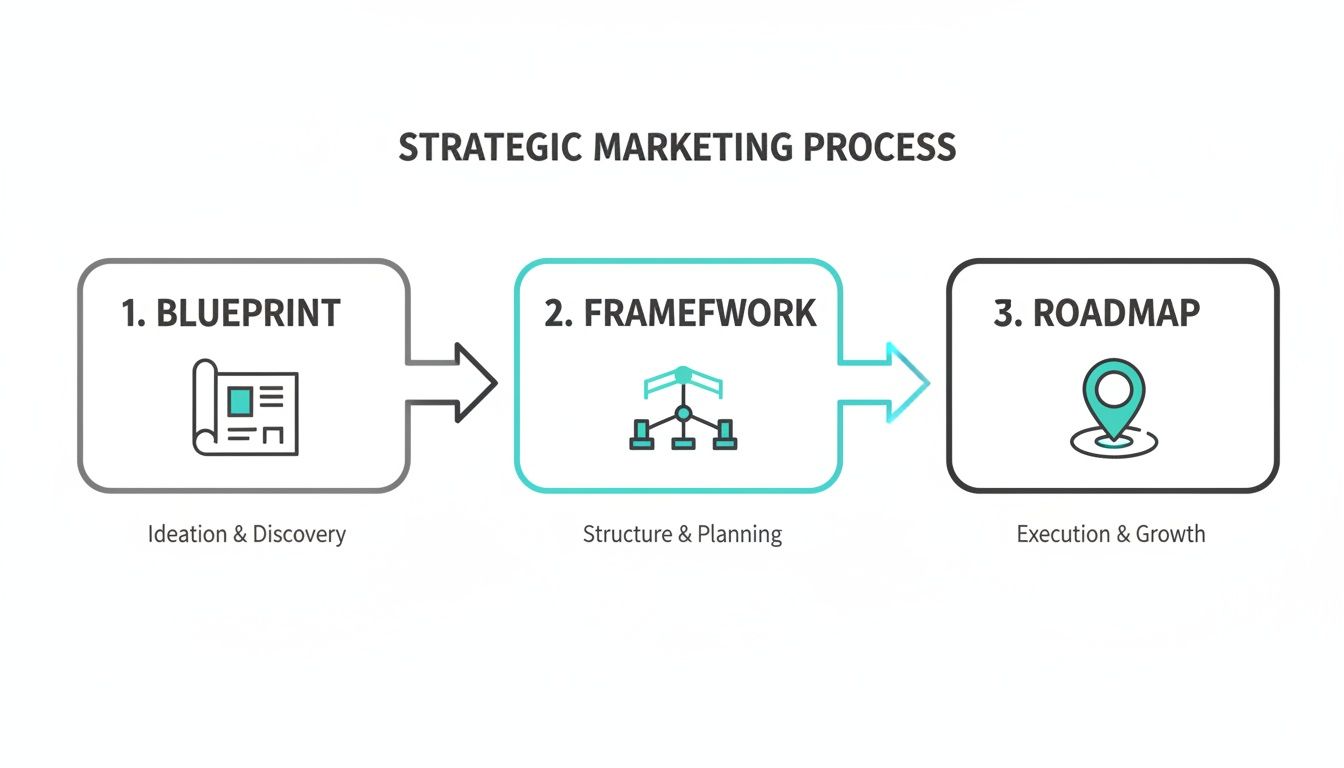
This simple progression—from a foundational Blueprint to a structured Framework and finally an actionable Roadmap—makes sure nothing gets missed.
Finding the Right Fit for Your Stage
Not every B2B tech company needs the same thing. A great strategic partner will have flexible options that fit your immediate needs and budget. You don't have to sign up for a massive, long-term project to get huge value.
Different models are built for different goals:
- Ignition Plan: Think of this as a focused, 2-4 week sprint. It’s designed to give you rapid clarity on your ICP, core messaging, and the highest-priority channels to focus on first. It's perfect for early-stage startups that need a solid foundation, fast.
- Alignment Sprint: This is a more comprehensive 6-8 week engagement designed to get your entire leadership team on the same page. The output is a detailed go-to-market strategy, a complete messaging framework, and a 90-day execution plan.
The right engagement isn't about the consultant's process; it's about solving your most pressing strategic problem. Whether you need a quick diagnostic or a complete overhaul, the goal is to provide exactly what you need to move forward with confidence and speed.
The Actionable Plan You Walk Away With

A top-tier strategic marketing consultation doesn't stop with a slide deck full of ideas. It ends with concrete assets you can put to work the very next day. This isn't about fuzzy promises of "growth"—it's about getting the exact tools and plans you need to build a predictable revenue engine.
Think of it like getting construction documents from an architect. You don't just get a pretty sketch of a house. You get the detailed blueprints, the electrical schematics, and a phased construction schedule. That's what a valuable consultation should deliver: the documents that guide how you actually get things done.
The Tangible Assets You Should Expect
The deliverables are the real product. They’re what turn high-level strategy into on-the-ground reality. At a bare minimum, your plan should give you the core components needed to kick off your go-to-market efforts.
First, you should walk away with a crystal-clear Ideal Customer Profile (ICP). This is a deeply researched document that digs way past surface-level demographics, detailing the real pains, motivations, and buying triggers of your best-fit customers.
This gets paired with a powerful Messaging Framework. This arms your entire team with the exact language to use across your website, sales decks, and marketing campaigns, making sure everyone is telling the same compelling story.
The real power of a strategic marketing consultation lies in creating alignment. When your whole team is working from the same playbook—targeting the same customer with the same message—every marketing dollar becomes exponentially more effective.
From Blueprint To Execution
With a clear target and message locked in, the next step is the action plan. This usually takes the form of a prioritized 90-day Growth Roadmap. It’s a document that kills the "what should we do next?" paralysis by outlining the specific initiatives, channels, and experiments to focus on for the quarter.
If you want to see how the pieces of a plan like this fit together, you can start with a solid marketing roadmap template.
Finally, the plan has to define how you'll measure success with metrics that actually matter to the business. Forget vanity numbers like likes and shares. A strong plan hones in on:
- Customer Acquisition Cost (CAC): How much you spend to land a new customer.
- Lifetime Value (LTV): The total revenue a customer brings in over their time with you.
- Marketing-Sourced Revenue: The actual sales dollars directly tied back to marketing efforts.
A comprehensive plan should also be a powerful tool for your sales team. To connect your new strategy directly to sales execution, explore these actionable sales enablement best practices and maximize the impact of every lead your plan generates. These assets ensure you don't just have a plan; you have a system for growth.
How to Choose the Right Strategic Partner
Finding the right consultant is one of the most critical calls you’ll make for your B2B tech startup. A great partner can put you on the fast track to growth, while a poor fit will burn cash and kill your momentum. The trick is to look past the slick sales deck and find genuine, battle-tested expertise.
You’re not just hiring a consultant; you’re looking for a strategic partner who gets the unique pressures of the B2B tech world. They should operate more like a coach than a vendor, focused on giving your team the know-how and tools to win long after they're gone.
Vetting for True Strategic Depth
Plenty of agencies and freelancers will talk a big game about strategy but only deliver tactics. A true strategic partner is obsessed with the “why” before they even touch the “what.” They’ll push back on your request for a new ad campaign until they’ve helped you lock down your Ideal Customer Profile (ICP) and messaging.
Here’s what to look for when you're evaluating a partner for your strategic marketing consultation:
- Proven B2B Tech Track Record: You need someone with specific wins at companies at your stage and in your industry. A consultant who mostly helps local dentists just won't understand the long game of a SaaS sales cycle.
- A Strategy-First Methodology: Their process should be crystal clear: discovery, research, and planning always come first. If they jump straight into talking about channels and tactics, it’s a massive red flag.
- A Coaching and Empowerment Mindset: The best consultants work to make themselves obsolete. They should be focused on building systems and transferring knowledge to your team, not creating a forever-retainer.
A consultant's job is to deliver a plan that works. A strategic partner's job is to deliver a plan and ensure your team has the skills and confidence to execute it brilliantly.
Essential Questions to Ask
To cut through the noise, you need to ask the right questions. These questions force potential partners to drop the jargon and show you their practical experience and how they actually operate.
Show up to the conversation prepared with a list that includes:
- "How do you measure the success of your strategies?" Their answer should be all about business metrics like pipeline growth, Customer Acquisition Cost (CAC), and marketing-sourced revenue—not vanity numbers like traffic or likes.
- "Can you share an anonymized roadmap you've built for a company at our stage?" This lets you see the real-world output of their work. You can immediately judge its quality and depth.
- "What's your process for aligning sales and marketing teams?" This is non-negotiable in B2B tech. A solid answer will detail workshops, shared goal-setting, and building a service-level agreement (SLA) between the teams.
Finding the right person with this level of expertise can be tough, which is why many founders look at different models. To see one of the most effective approaches, you can explore the option to hire a fractional CMO and bring that senior leadership in on a part-time basis.
Understanding the Cost and ROI of Strategy
Let's get straight to the two questions every founder asks: What does it cost, and what’s the return?
A strategic marketing consultation isn't just another line item on a spreadsheet. Think of it as a direct investment in predictable growth.
This mindset is becoming standard practice. It’s part of a massive strategy consulting boom, a market on track to hit around $91.38 billion by 2025. As boards and investors demand more data-backed revenue, founders are turning to specialists who blend senior-level judgment with sharp analytics to find the smartest path to growth. You can see the data on the strategic consulting market's growth for yourself.
Typical Investment Structures and Ranges
Pricing for this kind of engagement usually falls into a couple of clear models. A project-based fee for a focused effort like an Ignition Plan or Alignment Sprint might land between $15,000 to $35,000. The goal here is to deliver a complete, actionable GTM strategy in a matter of weeks.
For ongoing leadership, a longer-term fractional model is common, typically ranging from $7,000 to $15,000 per month. This gives you continuous guidance from a seasoned expert as you put the plan into action.
The most expensive marketing you can do is unfocused marketing. A strategic consultation prevents wasted spend by ensuring every dollar is aimed at the right target with the right message, turning your budget into a high-performance asset.
The Real Return on Your Investment
So, what does this investment actually buy you? The return isn't just about getting more leads. It’s about building a more efficient, profitable, and scalable business.
The ROI from a solid strategy shows up in critical business metrics:
- A Lower Customer Acquisition Cost (CAC): When you zero in on your Ideal Customer Profile, you stop wasting money on channels and audiences that were never going to convert anyway.
- Shorter Sales Cycles: Marketing starts delivering truly qualified leads who already understand your value. Your sales team can close deals faster because a lot of the heavy lifting has already been done.
- Avoiding a Bad Hire: A failed senior marketing hire can easily cost you $200,000+ in salary, severance, and lost opportunities. A strategic engagement validates your GTM plan for a fraction of that cost and risk.
Ultimately, the goal is to build a repeatable system for growth, not just run a few campaigns. Our guide on how to measure marketing ROI can help you set up the right tracking for these key metrics from day one.
A Few Final Questions
Even with a clear plan, it's smart to have a few questions before you commit. Most B2B tech founders I talk to ask the same things when they're weighing their options. Here are some straight answers to help you decide with confidence.
"Are We Too Early for This?"
This is the big one. The short answer? Almost never. In fact, getting the strategy right before you start scaling is the single most powerful move you can make.
It’s about building your go-to-market foundation before you pour the concrete. Doing this work early prevents a ton of costly mistakes down the road and makes sure your first marketing hires have a clear playbook from day one.
"How Much of My Team's Time Will This Take?"
I get it—everyone is already stretched thin. A good consulting engagement is designed to be efficient, not another full-time job for you or your team.
You can expect a few focused hours upfront for discovery workshops and interviews. After that, the interruptions are minimal. The consultant does the heavy lifting, taking your team's knowledge and turning it into a real, actionable plan.
A strategic marketing consultation isn't another project for you to manage. It's a process designed to save you time by killing the guesswork and focusing your team on what actually drives growth.
"How Is This Different from Just Hiring an Agency?"
This is a crucial distinction. Think of it like building a house.
- A consultant is the architect. They draw the blueprint, defining the who, what, and why of your entire go-to-market strategy.
- An agency is the general contractor and their crew. They are the builders who execute on the plan—running the ad campaigns, writing the content, and managing your social channels.
Starting with strategy first means that when you do hire an agency or an in-house marketer, you're not asking them to build the plane while flying it. You're handing them a validated, clear-eyed plan for success.
Ready to build a revenue engine on a foundation of strategy, not guesswork? Value CMO provides the senior B2B tech marketing leadership you need without the full-time overhead. Get the clarity and actionable roadmap to drive predictable growth. Learn more about our fractional CMO services.