The Chief Marketing Officer role isn't about catchy ads and slogans anymore, especially in the tough world of B2B tech. Today’s CMO is a growth architect, someone who blends sharp strategy with hard data to build a predictable revenue engine. The job has ballooned way beyond just managing the brand—it’s now about owning the entire customer journey, from their very first click to the moment they renew.
The B2B Tech CMO's Evolving Playbook

Not that long ago, marketing was seen as the "arts and crafts" department, focused mostly on making things look pretty. Brand is still incredibly important, of course, but the modern B2B tech CMO has a much bigger, more accountable job. They are now at the very heart of the company's growth engine.
This means the CMO is now deep in territory that used to be walled off. They don’t just generate demand; they dig into how customers behave, help shape the product roadmap, and build the tech stack needed to measure every single touchpoint. It’s a huge shift from being a brand storyteller to a business strategist who uses storytelling as just one of many tools to bring in revenue.
The modern CMO is less of a megaphone and more of a magnet. Their goal isn’t just to shout the loudest, but to build something that pulls the right customers in and keeps them close for their entire journey.
A Strategic Partner in Growth
This isn't just a gut feeling; the data backs it up. Today's CMO is expected to own marketing analytics, revenue growth, and market-entry strategies right alongside classic duties like advertising. This insight comes straight from The CMO Survey, which has been tracking a massive shift in what's expected from marketing leaders. You can dig into the full findings to see how the CMO role is becoming more strategic.
For founders and CEOs of ambitious startups, really getting this new playbook is non-negotiable. The right marketing leader isn't just carrying out someone else's vision; they're a key partner in building it. They're the one in the room who has to answer the tough questions that steer the company's direction:
- Who is our ideal customer, really? What specific, painful problem do we solve for them?
- How do we stop relying on random acts of marketing and build a pipeline we can count on?
- Which channels will actually give us the best bang for our buck?
- How do we prove—with actual data—that marketing is directly helping sales and bringing in revenue?
To make this crystal clear, I've broken down the core functions of a modern B2B tech CMO into a simple table. Think of these as the primary domains a great marketing leader must own to drive real growth.
Core CMO Functions in B2B Tech at a Glance
| Core Function | Primary Goal | Key Activities |
|---|---|---|
| Strategy & Planning | Define the go-to-market plan and align marketing with business goals. | ICP/persona development, positioning & messaging, competitive analysis, budgeting. |
| Demand Generation | Build a predictable pipeline of qualified leads for the sales team. | SEO/SEM, content marketing, paid media, ABM, email marketing, webinars. |
| Brand & Comms | Create a memorable brand that stands out and builds trust in the market. | Brand identity, PR, social media, analyst relations, thought leadership content. |
| Product Marketing | Bridge the gap between product features and customer value. | Go-to-market launches, sales enablement materials, pricing strategy, case studies. |
| Data & Analytics | Measure what matters and connect marketing activities directly to revenue. | Attribution modeling, dashboard creation (e.g., HubSpot), funnel analysis, ROI reporting. |
| Martech & Ops | Build an efficient, scalable marketing technology stack. | CRM management, marketing automation setup, data integration, process optimization. |
| Team Leadership | Hire, mentor, and lead a high-performing marketing organization. | Org design, recruiting, performance management, fostering a data-driven culture. |
Each of these pillars is crucial. A weakness in one area can throw the entire marketing effort off course, which is why the role is so demanding—and so incredibly valuable when you get it right.
The Seven Pillars of CMO Leadership
To really get what a modern Chief Marketing Officer does, don't think of it as one job. Think of it as a blend of seven distinct leadership roles. A great CMO doesn't just master one or two; they build a system where all seven work together beautifully.
This is the blueprint for creating a marketing engine that drives real, scalable growth.
Let's break down these seven core pillars. Each one is a critical piece of the puzzle that separates a true strategic leader from a tactical manager who's just running campaigns.
1. Strategic Vision and Planning
Everything starts here. Before a single ad is bought or a single email is sent, the CMO has to answer the big questions: Where are we going as a business, and how is marketing going to get us there?
This isn't about fluffy brainstorming sessions. It’s about building a data-backed go-to-market strategy that connects the company's big-picture goals—like hitting $10M in ARR or breaking into a new industry—to concrete marketing plays. They figure out the Ideal Customer Profile (ICP), map out the competitive battlefield, and set the budget. Without this clarity, marketing is just a bunch of disconnected tasks going nowhere fast.
2. Demand Generation
Once the strategy is locked in, it’s time to build the engine that feeds the sales team. Demand generation is the CMO’s promise to create a predictable, scalable pipeline of qualified leads. It’s how marketing answers the ultimate question from the CEO: "How are you helping us make money?"
This pillar covers a whole range of activities, all designed to attract, engage, and convert potential customers. It’s a mix of art and science that includes things like:
- Content Marketing: Creating genuinely useful blogs, webinars, and guides that pull in the right audience.
- Paid Media: Running laser-focused ad campaigns on platforms like LinkedIn or Google to reach specific buyers at just the right time.
- SEO: Making sure the company shows up when potential customers are actively searching for solutions.
- Account-Based Marketing (ABM): Focusing marketing and sales firepower on a specific list of high-value target accounts.
Think of demand generation as building a sophisticated irrigation system for the business. Instead of waiting for rain (random leads), the CMO builds channels that consistently deliver water (qualified opportunities) exactly where it's needed.
3. Brand and Positioning
While demand gen is about driving action now, brand is the long game. It's how the market feels about you—your reputation, your voice, and the promise you make to customers. A strong brand makes every single part of demand generation easier and cheaper.
The CMO owns this story. They're responsible for making the company not just known, but known for the right things. This means crafting a compelling narrative, developing a unique visual identity, and making sure every touchpoint—from the website copy to a sales deck—feels consistent and builds trust. In a crowded B2B tech market, a memorable brand is one of your most powerful weapons.
4. Product Marketing
Product marketing is the critical bridge between what your product does and why your customers should care. You can have the most brilliant product in the world, but if nobody understands why it matters, it will fail. The CMO oversees this function to make sure new features and products land with maximum impact.
This is all about translating technical specs into clear customer benefits, creating sales enablement materials that actually help reps close deals, and funneling market feedback to the product team to help them decide what to build next. It’s a deeply collaborative role that ensures the company isn't just building cool tech, but building solutions that solve real-world problems for a specific market.
The other pillars—Data & Analytics, MarTech, and Team Leadership—are the operational backbone that makes all of this work. They’re the systems and people that turn a great strategy into measurable results.
Leading the Charge in Data and Technology
Modern marketing isn't run on gut feelings anymore. It's a high-stakes operation powered by data and made possible by the right technology. The best CMOs today are part data scientist and part technologist, running a sophisticated growth "mission control" for the company. They don't just sign off on campaigns; they design and master the marketing technology (MarTech) stack that makes everything measurable, scalable, and predictable.
Think of your MarTech stack as the central nervous system of your entire marketing department. It’s the collection of tools—your CRM, automation platform, analytics dashboards, and more—that have to work together without a hitch. The CMO’s job is to be the chief architect of this system, making sure it captures the right signals and gives the team a clear, real-time picture of what’s actually working.
But this isn't about collecting numbers just for the sake of having them. The real skill is turning that raw data into insights that can guide the entire business.
From Data Points to Strategic Direction
A modern CMO is a storyteller who uses data to paint a picture of the customer and the market. They live in their dashboards, using analytics to answer tough questions and, most importantly, prove marketing’s return on investment (ROI) to the board.
For instance, a CMO might spot that leads from a specific webinar series are converting to paying customers at a 2x higher rate than any other channel. That single insight immediately sparks a few smart moves:
- Double down on what's working by putting more resources and budget into that webinar program.
- Analyze the content of that successful series to figure out what messaging is hitting home, then use it to shape blog posts and ad campaigns.
- Share these findings with the sales team, giving them powerful talking points for their follow-up conversations.
This is how data stops being a passive report and becomes an active driver of growth. As technology leaders, CMOs are also constantly checking out new tools, like the top marketing automation platforms, to make their teams more efficient. This whole discipline of managing the tech stack, data flows, and processes is known as marketing operations. It's a critical function, and you can get a deeper dive in our guide on what marketing operations is.
The AI Revolution in the CMO's Toolkit
Lately, artificial intelligence has become the cornerstone of this data-first approach. AI isn't just a buzzword; it’s a seriously powerful tool that helps CMOs analyze massive datasets, predict what customers will do next, and automate personalized campaigns at a scale that was impossible just a few years ago.
The global AI marketing market is on track to double from $20 billion in 2022 to $40 billion by the end of 2025. Companies using AI in their marketing see conversion rates jump by 25% while cutting customer acquisition costs by up to 37%. Discover more insights about the impact of AI on marketing.
A savvy CMO uses AI to sharpen their team’s focus, automating the repetitive grunt work so marketers can spend their time on high-level strategy and creative thinking. This blend of human insight and machine intelligence is what really defines the modern chief marketing officer role.
How the CMO Role Adapts to Company Growth
The title “Chief Marketing Officer” doesn’t really tell you much on its own. It’s a static label for a job that’s constantly in motion, changing shape as a company grows. A CMO steering a 10-person startup through choppy, unknown waters has a completely different mission than one leading a 200-person scale-up.
The title is the same, but the day-to-day work, the core priorities, and what "success" looks like are worlds apart.
This is a critical lesson for founders. Hiring a scale-up CMO for your seed-stage company is like bringing in a naval admiral to captain a small speedboat. The skills are impressive but totally wrong for the vessel. You’ll just burn cash, frustrate a great leader, and stall your momentum.
The Seed Stage: The Scrappy Generalist
In the early days, everything boils down to one goal: find product-market fit. The first marketing leader—whether they have the CMO title or not—is a hands-on generalist. Think of them as a player-coach, not a distant strategist.
Their job isn't to build a perfect brand or a massive team. It’s to run fast, cheap experiments that uncover a repeatable way to get customers.
This person is deep in the weeds. They’re writing website copy one minute and running a few small Google ads the next. They’re on the phone with your first ten users, trying to figure out what messaging actually connects. Success isn’t measured on a complex dashboard; it’s about the raw, vital signs, like your first few sign-ups and real, unfiltered customer feedback.
The Growth Stage: The Engine Builder
Once you’ve found product-market fit, the game changes completely. Now, the company is entering the growth stage, and the CMO’s role shifts from scrappy experiments to building a scalable growth engine. The goal is no longer just finding customers but creating predictable, repeatable systems for generating demand.
This leader’s job becomes less about doing and more about designing. They start hiring specialists—experts in demand gen, content, and product marketing. They become obsessed with metrics, building out the MarTech stack to track the entire funnel and prove marketing’s direct contribution to revenue.
At this stage, the CMO is an architect, not just a builder. They are designing the blueprints for a marketing machine that can scale from $1 million to $10 million in ARR and beyond, making sure the processes are just as important as the campaigns themselves.
The Mature Stage: The Market Leader
For a mature company, the challenges shift again. The goal is no longer just building the engine; it's about defending market share and expanding into new territories. The CMO now becomes a true C-suite executive, focused on building a brand moat, expanding into new markets, and driving efficiency.
This is where long-term brand building becomes the top priority. The CMO is thinking about competitive positioning, public relations, and how to solidify the company's reputation as the market leader. They manage a larger, more specialized team and a significant budget, with a laser focus on optimizing every dollar for maximum ROI. At this level, the role is highly strategic, directly influencing corporate strategy and driving long-term enterprise value.
This timeline shows how quickly technology, especially AI, is accelerating the CMO's evolution and raising the stakes.
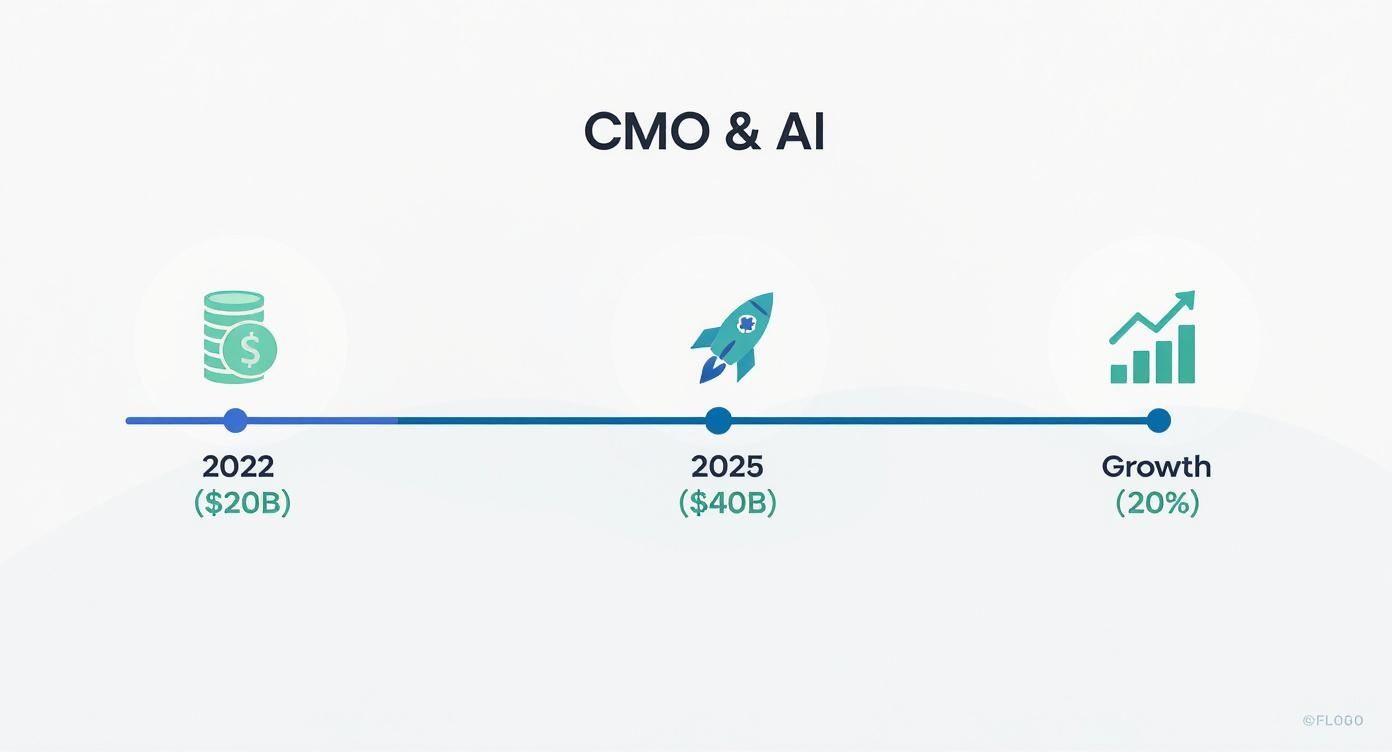
The data speaks for itself: the AI marketing market is set to double in just three years. This isn't just a trend; it's a powerful tailwind pushing every modern CMO to become a technology and data expert just to keep up.
To make this evolution even clearer, here’s a breakdown of how a CMO's priorities shift at each stage.
CMO Priorities by Company Stage
| Company Stage | Primary Focus | Typical Team Structure | Key Metric |
|---|---|---|---|
| Seed Stage | Product-Market Fit & Early Traction | Founder or a single marketing generalist | Initial user sign-ups, positive feedback |
| Growth Stage | Building a Scalable Growth Engine | Small team of specialists (Demand Gen, Content, PMM) | Marketing Qualified Leads (MQLs), Pipeline Velocity |
| Mature Stage | Market Leadership & Brand Defense | Larger, specialized team with functional directors | Market Share, Customer Lifetime Value (LTV), Brand Recall |
Knowing which stage you're in helps you define exactly what you need from a marketing leader—and avoid that costly mismatch between their skills and your company’s real needs.
Building a High-Performance Marketing Team
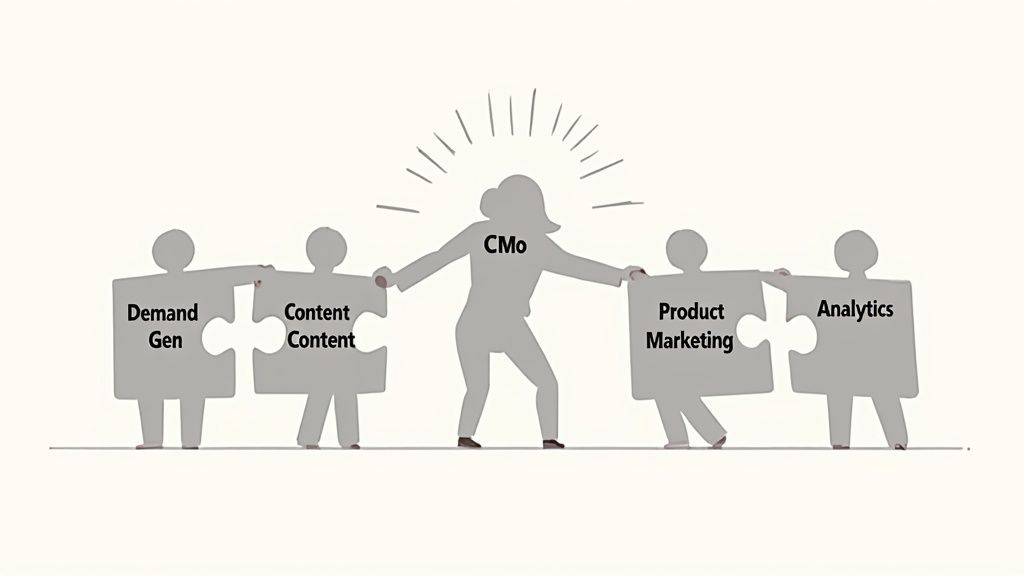
A CMO’s grandest strategy is only as good as the team making it happen. This is why one of the most vital roles of chief marketing officer is that of an organizational architect. They don’t just manage marketers; they design and build a department that can turn a vision into measurable results.
This process starts with a clear blueprint for the team's structure. A great CMO understands that there's no single "best" model. The right design depends entirely on the company's stage, its goals, and the specific market challenges it’s up against.
Designing the Marketing Organization
The most common starting point for a B2B tech company is a functional structure. Here, the team is organized by expertise, creating clear centers of excellence where people can go deep in their respective domains.
- Demand Generation: This group is laser-focused on building the sales pipeline through channels like SEO, paid media, and email marketing. They own the MQL and SQL numbers.
- Content Marketing: These are the storytellers. They’re responsible for creating the blogs, whitepapers, and videos that attract and educate your target audience.
- Product Marketing: This team acts as the crucial bridge to the product, handling go-to-market launches and creating the sales enablement materials that help reps close deals.
As the company scales, some CMOs shift toward more agile models, like cross-functional "pods" or "squads" dedicated to a specific mission, such as launching in a new market. Our guide on building the right B2B marketing team structure offers a deeper look into these different models and how to choose the right one for you.
But no matter what the org chart looks like, a CMO's ability to spot and fill talent gaps is what truly defines their success as a leader.
The real job of a CMO isn't just to lead a team, but to build one. They are constantly looking at skill sets, figuring out future needs, and recruiting people who can lift the entire organization's capabilities.
This leadership role is also becoming increasingly prominent and stable. As of 2024, the average tenure for a Fortune 500 CMO is 4.3 years. Far from being a sign of instability, this reflects the role's growing influence; a full 65% of CMOs who leave their positions are either promoted to more senior roles or move to another high-profile CMO job.
Even better, with women now holding 53% of CMO roles, the position is a real bright spot for gender diversity in the C-suite. You can explore the full 2025 Spencer Stuart CMO tenure study for more details on these leadership trends.
The Fractional CMO for Smart Startup Growth
What do you do when you need a CMO’s brain, but don’t have a CMO’s budget?
It’s a classic B2B tech startup dilemma. You’ve got a solid product and a scrappy team, but you’re missing the senior marketing leader who knows how to build a predictable growth engine. You feel stuck.
This is exactly where the Fractional CMO comes in. Think of it as a modern, flexible way to get executive-level marketing expertise without the six-figure salary and long-term commitment. You get the architect to design the blueprint and oversee construction, but you don’t have to pay them to live on-site.
Strategy on Demand
A real Fractional CMO isn't a consultant who just drops off a slide deck and disappears. They become a part-time member of your leadership team. They roll up their sleeves, own the marketing plan, define the KPIs, and actively mentor your junior marketers.
This model is a game-changer in a few specific, high-stakes situations:
- Building the Foundation: You need to set up your first real marketing strategy, tech stack, and budget, but you're not ready for a full-time VP hire.
- Prepping for Funding: You have to show investors a clear, data-driven plan for how you’ll acquire customers efficiently and scale.
- Bridging a Leadership Gap: A marketing leader just left, and you can’t afford to lose momentum while you spend months searching for the perfect replacement.
The core value of a Fractional CMO is speed to results. They’ve already made the mistakes you’re about to make, and they bring years of pattern recognition to solve your exact growth challenges. They help you build a marketing function that delivers measurable outcomes, faster.
For most startups, this is the most sensible way to fill a critical leadership void. You hire for the specific strategic thinking you need right now, accelerating growth without breaking the bank.
You can dig deeper into what a Fractional CMO is and see exactly how the model works.
Common Questions About the CMO Role
Figuring out the C-suite can feel like untangling alphabet soup. Founders often ask me how the CMO role fits in, especially when compared to a VP of Marketing or a Head of Growth. Let's clear that up.
So, when do you actually need a CMO? Early on, you need a hands-on “player-coach”—someone who can get in the trenches, test channels, and find that first spark of traction. The strategic Chief Marketing Officer title really comes into play when you hit the growth stage. That’s when you need someone who can build a scalable, repeatable marketing engine, not just run a few campaigns.
Key Skills and Success Metrics
A great B2B tech CMO needs more than just marketing chops. They need serious business acumen, data literacy, and the ability to lead a team that’s constantly changing and growing.
And forget vanity metrics like website traffic or social media followers. A modern CMO's success is tied directly to the bottom line. You should be looking at hard numbers like:
- Pipeline Contribution: What percentage of new sales opportunities did marketing actually bring in?
- Customer Acquisition Cost (CAC): How much are we spending to land each new customer? Is that number going down?
- Return on Marketing Investment (ROMI): For every dollar we put into marketing, how many are we getting back?
Is the CMO role going extinct? You see headlines pop up about this every so often, but the truth is it's an evolution, not an extinction. The core need for strategic marketing leadership isn't going anywhere—it’s just that the responsibilities are getting redistributed or the title is changing to reflect a heavier focus on revenue.
This debate often includes the idea of a 'CMO dying job', especially when big companies make changes. It really just highlights the shift from old-school brand management to a data-driven, revenue-accountable executive role.
Ready to bridge your marketing leadership gap with proven expertise? At Value CMO, we provide B2B tech startups with the strategic guidance needed to build a revenue-focused marketing engine without the full-time overhead. Learn more about our fractional CMO services.