So, what exactly is a part-time chief marketing officer? Imagine getting a senior marketing executive to lend their strategic leadership to your company, but on a fractional basis. They typically work a set number of hours each week or month.
This model is a real game-changer for businesses, especially B2B tech startups and scale-ups. It gives you access to top-tier marketing expertise without the hefty price tag and long-term commitment of a full-time C-suite salary. It’s the perfect solution for companies that need high-level strategy but don’t necessarily need someone executing tasks 40 hours a week.
The Rise of Agile Marketing Leadership

Are you struggling to scale your marketing because you just don't have the budget for a full-time executive? You’re not alone. This is a classic growing pain for founders. You find yourself juggling big-picture strategy and day-to-day execution, knowing you need expert guidance but balking at the six-figure cost of a C-suite hire.
It’s the ultimate catch-22: you need expert marketing to grow, but you need to grow to afford an expert marketer.
This is exactly where the part-time chief marketing officer comes in—not as a temporary band-aid, but as a powerful strategic partner.
Why Agile Leadership Matters Now
In today’s fast-moving market, being agile is everything. The traditional route of hiring a full-time executive can be slow and incredibly expensive, often taking months just to find the right person. A part-time CMO offers a much more nimble approach.
Think of it as getting access to a top-tier marketing brain precisely when you need it most. They can drop in, quickly figure out what's wrong, build a strategic roadmap, and guide your team—all without the lengthy onboarding process and high overhead.
A part-time CMO acts as both an architect and a general contractor for your marketing. They design the strategic blueprint and then oversee the crew to make sure everything is built to spec, on time, and within budget.
This fractional model gives you that perfect blend of expert oversight and flexibility that startups and scale-ups need to navigate challenges and jump on opportunities. It allows you to:
- Access Expertise On-Demand: Tap into years of senior-level experience without committing to a full-time salary, benefits, and equity package.
- Move Faster: Get a strategic plan in place and start executing in weeks, not months. This creates immediate momentum.
- Stay Lean: Put your capital to better use by paying only for the strategic guidance you actually need.
Ultimately, bringing on a part-time CMO is about more than just filling a gap in your org chart. It's a deliberate choice to build a more resilient, adaptable, and cost-effective marketing engine. This approach ensures your marketing efforts are guided by proven expertise from the get-go, setting you up for sustainable growth.
What a Part-Time CMO Actually Delivers

Let's cut through the buzzwords and get real about what a part-time chief marketing officer actually does. Their value isn't measured in hours clocked, but in the real results they drive for your business. They don't just hand you a plan; they build the engine that powers predictable growth.
Think of it this way: your marketing is a construction project. A part-time CMO is both the architect who designs the strategic blueprint and the general contractor who makes sure the job gets done right. They own the outcome.
This model makes a ton of sense when you look at the C-suite today. Executive roles are changing fast. The average tenure for a full-time CMO has dropped to just 3.3 years, making it one of the shakiest leadership positions out there. It's no wonder that nearly 25% of businesses are turning to fractional leaders for expert guidance without the long-term risk.
The Three Pillars of CMO Delivery
So what are you actually paying for? The work of a great part-time CMO rests on three core pillars. This is what separates them from a consultant who just gives advice or a freelancer who just executes tasks.
- Strategic Direction: This is the "why" behind every dollar you spend. They’ll define your position in the market, nail down your ideal customer profile, map out the competitive landscape, and build a go-to-market strategy that’s rooted in data, not guesswork.
- Team Enablement: A good part-time CMO is a force multiplier. They mentor your junior marketers, optimize your team structure, spot skill gaps, and help you find the right agencies or freelancers to fill them. They build up your team's capability.
- Performance Management: They establish the KPIs that actually matter to the business. Forget vanity metrics. They build a reporting dashboard that connects marketing activity directly to revenue, proving ROI and keeping everyone accountable.
This high-level oversight is everything. By focusing on these pillars, they create a framework that empowers your team to execute with confidence and clarity. You can learn more about the core roles of a chief marketing officer in our detailed guide.
The real value of a part-time CMO isn't in executing daily tasks themselves. It's in building the engine, teaching your team how to run it, and providing the map that shows everyone where to go.
From Blueprint to Reality
Okay, what does this look like day-to-day? A part-time CMO turns abstract goals into real, concrete deliverables. First, they create the strategic blueprint—defining your audience, messaging, channels, and budget. This isn't just some static document; it's a living roadmap for your entire team.
Then, they step into the general contractor role. They oversee the "crew"—your internal team, agencies, and vendors—to make sure the work gets done. They ensure campaigns launch on time, content aligns with the strategy, and everyone is pulling in the same direction.
For example, instead of just saying "we need more leads," a part-time CMO will:
- Define exactly what a qualified lead looks like for your sales team.
- Build a multi-channel plan to attract those leads (like SEO, paid ads, or content).
- Implement the right marketing automation tools to nurture prospects effectively.
- Create a reporting system to track cost per acquisition and conversion rates.
This hands-on leadership ensures the strategy doesn't just collect dust on a shelf. Their job is to bridge the gap between the big-picture vision and the on-the-ground execution, creating a marketing function that drives measurable, sustainable growth.
Choosing Between a Full-Time and Part-Time CMO
Deciding on marketing leadership isn't about finding the "best" option—it's about finding the right fit for your business right now. The choice between a full-time executive and a part-time CMO comes down to your company's stage, budget, and what you really need to accomplish in the next year. It's a strategic call that demands an honest look at where you're at.
Think of it like this: a full-time CMO is like buying a tour bus. It's a massive investment built for a long, steady journey with a big crew on board. A part-time CMO is more like calling a high-end rideshare—you get an expert driver with a premium vehicle for a specific leg of the trip, exactly when you need it, without the long-term costs of ownership.
Each model serves a totally different purpose. Picking the wrong one can be a very expensive mistake.
Speed to Impact vs. Deep Integration
One of the biggest differences is how quickly you'll see results. A part-time CMO is built for speed. They are strategic specialists who come in, diagnose problems, build a focused roadmap, and launch "quick win" campaigns, often within a few weeks. Their job is to provide immediate direction and get the engine running.
A full-time CMO, on the other hand, is hired for deep operational integration. Their first few months are usually spent learning the company culture, building internal relationships, and getting into the weeds of every department. This is crucial for long-term, enterprise growth, but it can feel painfully slow for a startup that needs results yesterday.
This decision also impacts how you work with other partners. Beyond just a CMO, many companies also need specialized B2B Marketing Agency services for specific campaigns where deep, tactical expertise is a must.
The Trade-Offs in Cost and Commitment
Let's get straight to the most obvious factor: the money. A full-time CMO is a huge financial commitment. You're not just paying a six-figure salary; you're also on the hook for benefits, bonuses, equity, and all the other overhead that comes with it. For an early-stage company, that can eat up a massive chunk of your cash.
A part-time chief marketing officer works on a fractional model. You get the same C-suite brainpower for a fraction of the cost, paying only for the strategic oversight you actually need. This frees up your budget for what really matters: executing the marketing campaigns that drive revenue.
The real question isn't "Can we afford a full-time CMO?" It's "Is a full-time salary the best use of our marketing capital at this stage?" For many, the answer is a hard no.
This flexibility goes beyond just the price tag. The commitment is shorter and far more adaptable. If your needs change, you can scale the engagement up or down without the HR headaches of hiring or firing a full-time executive. If you're looking for flexible ways to build out your marketing function, exploring different forms of outsourced marketing can provide even more options.
A Clear Comparison for Your Business Stage
To make this decision easier, here’s a simple breakdown of the key differences. This table should help you see which model fits your company's current reality.
Full-Time CMO vs. Part-Time CMO Key Differences
| Factor | Full-Time CMO | Part-Time Chief Marketing Officer |
|---|---|---|
| Ideal Company Stage | Established scale-up or enterprise with a large marketing team and complex operational needs. | Startup or growing business needing strategic direction without the full-time cost. |
| Cost Commitment | High: Full C-suite salary, benefits, equity, and long-term contract. | Moderate: Retainer-based fee, paying only for the required hours. No long-term overhead. |
| Primary Focus | Deep operational management, team building, and long-term cultural integration. | High-level strategy, quick-win execution, and mentoring the existing team. |
| Speed to Impact | Slower: Typically requires 3-6 months for full integration and strategic rollout. | Faster: Designed to deliver a strategic plan and initial results within the first 90 days. |
| Scalability | Less flexible; a long-term hire designed for steady, multi-year growth plans. | Highly flexible; engagement can be scaled or concluded as business needs evolve. |
Ultimately, picking the right marketing leader is about being honest about your immediate priorities. If you need someone to manage a big team and embed themselves in daily operations for years to come, a full-time hire is the way to go. But if you need top-tier strategic guidance now to fix a flat pipeline or launch a new product, a part-time chief marketing officer is the smarter, more agile path forward.
Your First 90 Days with a Part-Time CMO
Hiring a part-time chief marketing officer is a big move. So, it’s completely natural to ask, "Okay, so what happens now?" The first three months aren't about finding a single silver bullet. It's about building a solid foundation for growth that actually lasts. Think of it as a structured journey designed to deliver real value right from the start.
Imagine you're building a high-performance race car. The first month is the diagnostic phase—popping the hood, checking every wire, and really understanding the engine. The second month is all about mapping out the race strategy and making critical upgrades. The final month? That's when you hit the track, start gathering data, and begin fine-tuning for peak performance.
To make sure things get off to a great start, clear expectations are everything. A practical guide to 90-day reviews and goal setting can be super helpful here, as it gets everyone on the same page about what success actually looks like.
The First 30 Days: Discovery and Diagnosis
The first month is all about deep immersion. A great part-time CMO doesn't just walk in with a generic playbook; they start by listening and learning. Their mission is to understand your business from the inside out—its history, its pain points, and its biggest ambitions.
But this isn't a passive process. They'll be running a series of fact-finding missions to get a complete, unvarnished picture of your marketing landscape.
Key activities during this phase usually include:
- Stakeholder Interviews: They'll sit down with you, your head of sales, your product lead, and other key players. The goal is to hear different perspectives on what’s working, what’s broken, and what’s been tried before.
- Competitive and Market Analysis: This is a deep dive into your competitors' strategies. They’ll pinpoint their strengths, their weaknesses, and—most importantly—the gaps in the market you can own.
- Tech Stack and Funnel Audit: They'll get under the hood of your current marketing tech, from your CRM to your analytics tools, to find out where leads are leaking from your funnel.
This foundational work is everything. It makes sure the strategy they build next is grounded in your company's reality, not just a bunch of assumptions.
The Next 30 Days: Strategy and Quick Wins
With a solid understanding of your business, the focus in month two shifts from discovery to direction. This is where all the insights from the first 30 days get translated into a clear, actionable marketing plan. It’s all about turning "what we know" into "what we need to do."
The goal of month two isn't just to create a document that sits on a shelf. It's to build a shared roadmap, define what winning looks like, and generate immediate momentum that gets the entire team excited and aligned.
During this phase, your part-time CMO will:
- Develop the Core Marketing Strategy: This means defining your go-to-market plan, getting crystal clear on your ideal customer profile (ICP), and sharpening your brand messaging so it cuts through the noise.
- Establish Core KPIs: They will lock in the key performance indicators that actually matter for business growth, shifting the team away from vanity metrics and toward goals that impact revenue.
- Launch Quick-Win Initiatives: They'll identify and kick off one or two high-impact, low-effort campaigns. This isn't about hitting a home run on day one; it's about getting points on the board and building positive momentum.
The infographic below shows how the need for marketing leadership changes as a company grows, highlighting the exact moment a strategic hire like this becomes critical.
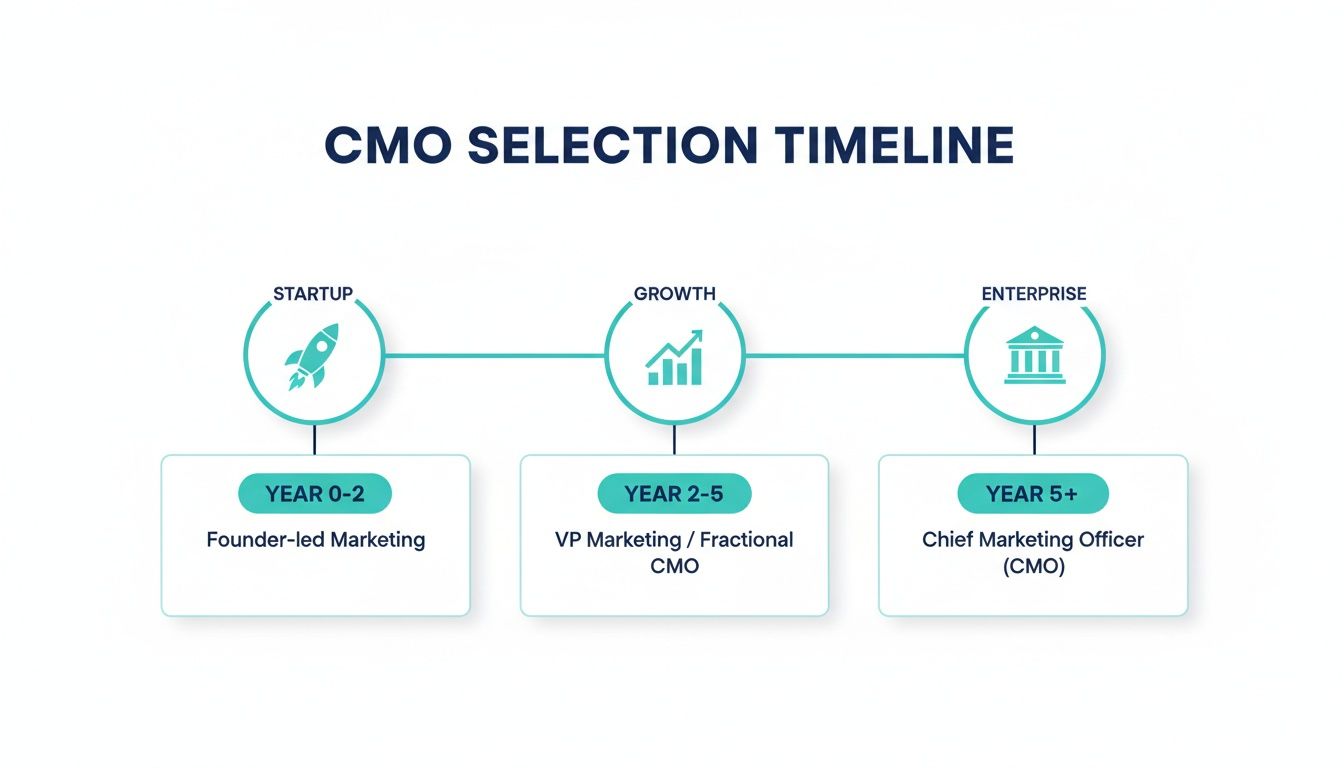
As you can see, once a company moves from the startup phase to the scale-up stage, the need for structured, strategic leadership becomes impossible to ignore if you want to keep growing.
The Final 30 Days: Implementation and Mentorship
The last 30 days of this initial period are all about execution and empowerment. The strategy is set, the goals are clear, and now it's time to build the operational rhythm that drives long-term success. Your part-time CMO shifts from being the architect to being a hands-on coach.
This period is crucial for making sure the plan actually works in the real world. It's about embedding the new strategy into your team's day-to-day work and setting up systems for accountability. They’ll focus on rolling out the plan, mentoring your team, and building the reporting dashboards that give everyone visibility into what's working.
This is also when they help refine your B2B marketing team structure to support the new strategy, making sure the right people are in the right seats. By the end of 90 days, you won't just have a plan—you'll have a functioning marketing engine, a more capable team, and a clear view of the road ahead.
How to Find and Hire the Right Marketing Leader
Let's get one thing straight: finding a real marketing leader isn't about posting a job description and waiting for the resumes to roll in. A true strategic partner—the kind who can actually move the needle on growth—is almost never hanging out on traditional job boards. To find top-tier talent, you have to go where they are.
This means you need to shift your search to specialized networks and boutique consultancies that live and breathe fractional executive talent. These firms have already done the heavy lifting. They've vetted the candidates, checked their track records, and can connect you with proven leaders who have delivered results in companies just like yours. It’s the difference between fishing in the open ocean and a well-stocked pond.
And this isn't just a startup trend. Many Fortune 500 companies are operating without a full-time enterprise CMO, choosing instead to tap into flexible talent for high-impact strategic projects. Research from Spencer Stuart on the evolution of marketing leadership shows that while C-suite marketing roles are common, the average tenure is just over four years. This churn fuels a deep pool of experienced leaders who prefer the fractional model, creating a huge opportunity for businesses ready to hire a part-time chief marketing officer.
Asking Questions That Reveal True Strategic Depth
Once you have a shortlist, the interview is where the real work begins. Your goal isn't to quiz them on tactical marketing knowledge—it's to see how they think. You need to get past the generic interview fluff and dig into how they tackle complex, messy business challenges.
Frame your questions around your specific problems and constraints. This forces them to think like a business owner, not just a marketer, and it will quickly separate the true strategists from the tacticians who just follow a playbook.
Here are a few questions I use to test for strategic depth:
- "Describe how you would build a marketing engine from the ground up on our current budget. What would you prioritize in the first 90 days, and what would you deliberately ignore?" This cuts right to their ability to make tough choices with limited resources.
- "Walk me through a time you had to get buy-in from a skeptical leadership team. What data did you use, and how did you frame the argument?" This uncovers their skills in communication and influence—critical for getting things done.
- "How do you ensure accountability and maintain momentum when you're not involved in the day-to-day operations?" For a part-time role, this is everything. It tests their ability to build systems and lead from a distance.
Evaluating Case Studies and References Like a Pro
A candidate’s past work is your best predictor of future success, but only if you know how to read between the lines. A flashy case study looks nice, but the real story is in the details. Don't just take impressive numbers at face value; get curious about the how and the why behind them.
Look for experience that genuinely maps to your business challenges. If you're a B2B SaaS company trying to crack enterprise accounts, a CMO whose background is entirely in D2C e-commerce probably isn't the right fit, no matter how great their results look on paper.
A great part-time CMO doesn’t just show you what they did; they explain why they did it. Look for the strategic thinking behind the execution, not just the impressive vanity metrics.
Finally, when you check references, go deeper than the standard questions. Instead of asking, "Did you enjoy working with them?" you'll get far more valuable insight by asking something more specific.
Powerful Reference Check Questions:
- Under what specific circumstances did they perform at their absolute best?
- What kind of support did they need from you to be successful?
- If you could hire them again for a new project, what kind of project would it be?
These questions give you a much clearer picture of what it takes to set your new CMO up for success. They help you find a leader who isn't just qualified, but is the right strategic partner to help you grow.
Answering Your Questions About Part-Time CMOs
Making the decision to bring on a new leader is a big step. It's totally normal to have a few questions, even after seeing all the benefits. You want to be absolutely sure a part-time chief marketing officer is the right move for your company right now.
This section is here to tackle the most common questions and concerns we hear from founders and CEOs. My goal is simple: give you clear, straight-up answers so you can move forward with confidence. Let's get any lingering doubts out of the way.
How Much Does a Part-Time CMO Cost?
Let's get right to it—the money question. While rates vary based on experience and the scope of work, a part-time CMO engagement is almost always a monthly retainer. This keeps your costs predictable and ensures you have consistent access to your marketing leader.
Most retainers for an experienced part-time chief marketing officer are a fraction of what a full-time executive would cost. Remember, a full-time CMO salary often starts well into six figures before you even touch bonuses, equity, and benefits. The fractional model strips all that overhead away.
The real win here isn't just the lower cost, it's the higher ROI. You’re putting your capital directly into strategic value—leadership, planning, and oversight—not just paying for someone to be present 40 hours a week.
This retainer structure lets you budget effectively while getting the exact senior-level guidance you need to grow. It turns a massive fixed cost into a smart, flexible operational expense.
What Is the Typical Weekly Time Commitment?
Another great question is how much time the CMO will actually be spending with your team. The beauty of this model is its flexibility, but most engagements settle into a common rhythm.
A typical part-time chief marketing officer commits between 10 to 20 hours per week. This is the sweet spot—enough time to drive strategy, lead key meetings, mentor your team, and stay plugged into the business without getting dragged into minor daily tasks.
Here’s a common breakdown of that time:
- Strategic Planning Sessions: Dedicated time with the leadership team to review progress, adjust goals, and map out what’s next.
- Team Leadership: Running the marketing meeting, providing clear direction, and removing roadblocks for the team.
- One-on-One Mentoring: Coaching up your junior marketers, building their skills and confidence.
- Asynchronous Work: Reviewing analytics, giving feedback on creative, and refining the strategic roadmap behind the scenes.
This structure ensures they’re not just an advisor, but a truly integrated and impactful member of your leadership team, just on a part-time schedule.
How Does a Part-Time Leader Integrate with Our Culture?
This is a fantastic question because culture is everything. How can someone who isn’t in the office 40 hours a week really get your company's DNA? The answer is simple: they have to be intentional about it.
A great part-time CMO makes cultural integration a top priority in their first 30 days. They don’t just learn your products; they learn your people, your communication style, and your values. They do this by showing up—in the all-hands meeting, a virtual coffee chat, or a product demo.
Their job is to become a champion for your culture within the marketing function. They make sure your brand's voice and values shine through in every campaign, every piece of content, and every customer touchpoint. And because they have an outside perspective, they can often spot cultural disconnects an internal hire might miss.
When Is the Ideal Time to Hire One?
Timing is everything. Hire too early, and you might not have the resources to execute on the strategy. Hire too late, and you’ve already burned time and cash on marketing efforts that went nowhere.
The ideal time to bring on a part-time chief marketing officer is when you hit a specific inflection point. You’ve found product-market fit and have some early traction, but growth has started to flatten out. The founder-led marketing that got you here isn't enough to get you to the next level.
Look for these signals:
- Your customer acquisition cost (CAC) is climbing, and you're not sure why.
- Your marketing team is busy, but you can't draw a straight line from their activity to revenue.
- You need to launch a new product or enter a new market but lack a credible strategic plan.
- You're gearing up for your next funding round and need a predictable growth story for investors.
If any of that sounds familiar, you're probably at the perfect stage. A part-time leader can step in with the structure, strategy, and leadership to break through that plateau and ignite your next phase of growth.
Ready to see how senior marketing leadership can transform your B2B tech company? Value CMO provides fractional CMO services that deliver clarity, build momentum, and drive measurable results without the full-time overhead. Book a discovery call today and let’s build your growth engine.