
As a B2B tech founder, you’re supposed to be an expert in everything—product, sales, fundraising, and somehow, marketing. But let's be real, you can't be. Outsourcing digital marketing isn't just about cutting costs anymore; it's a strategic lever smart founders pull to get senior-level expertise on tap and punch above their weight class, all without the burn rate of a full-time team.
Why Smart B2B Founders Outsource Digital Marketing
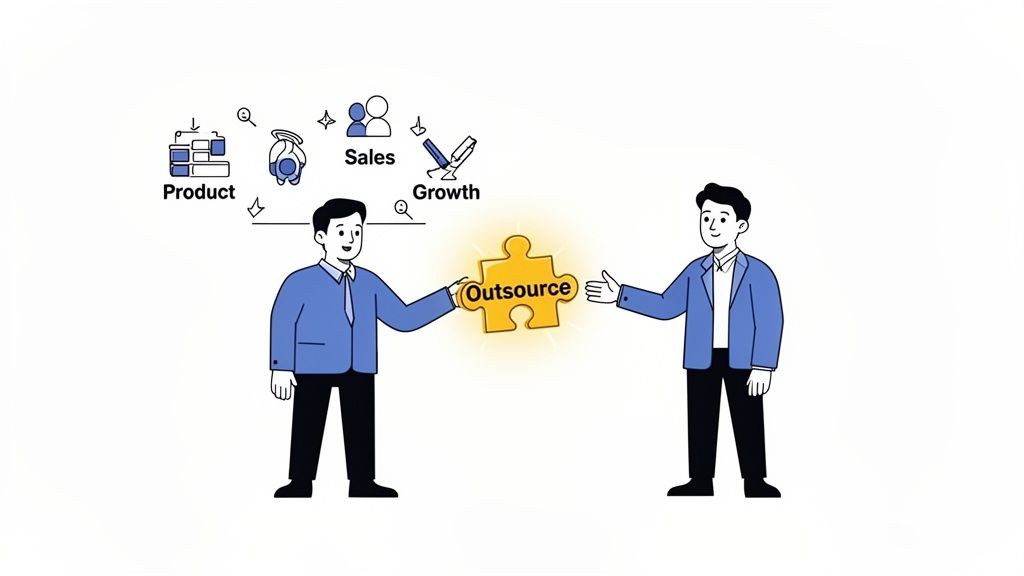
The pressure to show traction is immense. You're heads-down building a product, trying to close those first crucial deals, and convincing investors you're the next big thing. The last thing you have time for is figuring out the nuances of Google's latest algorithm update.
This is exactly where outsourcing flips from a budget line-item to a growth engine. It’s about surgically inserting expertise precisely where you need it, right when you need it.
Bridge the Critical Expertise Gap Instantly
Modern marketing is a minefield of specializations. You don't just need "a marketer." You need an SEO expert, a PPC strategist, a content guru, and a marketing automation whiz—all of whom get the unique challenges of B2B tech.
Trying to hire for all these roles is painfully slow and expensive. Outsourcing gives you immediate access to a team that's already solved your exact problems for companies just like yours. You get to skip the six-month hiring dance and get your growth engine fired up in weeks.
The market backs this up. The global digital marketing outsourcing space is already a USD 25.4 billion market, projected to skyrocket to USD 74.76 billion by 2034. That’s not just a trend; it's a fundamental shift in how startups build to win.
Drive Efficiency and Focus on What Matters
Every hour you spend wrestling with a Google Ads campaign is an hour you’re not spending on your product or talking to customers. Outsourcing frees you and your core team up to focus on the mission.
For a founder, the goal isn't to do marketing; it's to drive revenue. A good outsourced partner takes ownership of the tactics, freeing you to focus on high-level strategy and growth.
This focus translates directly into financial efficiency. Here’s how:
- Access premium tools: You get the benefits of enterprise-level software like SEMrush or HubSpot without footing the bill for pricey annual licenses.
- Convert fixed costs to variable costs: Instead of a full-time salary and benefits, you pay for specific outcomes and can scale your investment up or down as needed.
- Improve capital efficiency: This is a game-changer for startups. You're paying for results, not headcount, which is critical when you're figuring out how to reduce customer acquisition cost.
Ultimately, outsourcing your marketing is a strategic decision to buy three things: speed, expertise, and focus. It lets you compete with much larger players by leveraging specialized talent without the financial drag, turning your marketing function into a scalable asset from day one.
Finding Your Ideal Outsourcing Partner Model
Once you’ve decided to outsource, the next big question is: who do you hire? The options can feel overwhelming, and picking the wrong model is like trying to fit a square peg in a round hole. It’s frustrating, inefficient, and just won’t work. The key isn’t finding the "best" partner, but the best fit for your B2B tech startup's current stage, budget, and strategic needs.
This is a decision more founders are making. A striking 26% of businesses plan to outsource some digital marketing in the next 12 months, largely because they need specialized skills in areas like generative AI and marketing automation. Let's be honest, your junior team can't master everything, and you don't have time to.
Let's break down the four main ways you can partner up.
The Specialist Freelancer: Your Tactical Ace
Think of a freelancer as a precision tool. You bring them in for a specific, well-defined mission with a clear start and end. They have deep, focused expertise, and your job is to point them at the target.
A classic example? Let's say your site’s core web vitals are a mess, and you have a product launch in three months. Your in-house team is great at content but doesn't live and breathe schema markup. Hiring a technical SEO freelancer for a three-month contract gets you exactly the expertise you need, right when you need it, with no long-term overhead.
- Best For: Short-term projects needing a niche skill (e.g., technical SEO, LinkedIn Ads management, landing page copywriting).
- Budget Impact: Usually cheaper than an agency. Billed hourly or per project.
- Founder Involvement: High. You are the project manager. You'll write the brief, manage the timeline, and make sure their work fits into the big picture.
The Full-Service Digital Marketing Agency
Hiring an agency is like getting an entire marketing department on demand. You get a team of specialists—strategists, writers, designers, ad managers—all coordinated by an account manager, all under one roof.
An agency is the right call when you need to run a multi-channel campaign but don't have the internal bandwidth. Imagine launching a new SaaS feature that needs a coordinated push across content marketing, paid social, and email nurturing. An agency can build and run that entire machine for you.
When you're looking at different options, researching alternatives to creative outsourcing platforms can give you a better feel for the sheer variety of specialized services out there.
Agencies are built for execution at scale. They shine when you have a clear strategy but need the horsepower to implement it consistently across multiple channels.
Managed Services: The Focused Solution Provider
Managed services sit neatly between a freelancer and an agency. They don’t run your whole strategy, but they own a specific, ongoing marketing function. Think of it as a productized service.
Content creation is a perfect use case. You know you need four solid blog posts and two case studies every single month to feed your funnel, but you don't have the writers. A managed content service delivers that predictable, high-quality output for a flat monthly fee. It’s a content machine you don’t have to manage day-to-day.
The Fractional CMO: Your Strategic Quarterback
A fractional CMO isn’t there to execute tasks. They’re there to provide senior-level strategic leadership. This is your move when marketing feels disjointed, the pipeline has gone flat, and your junior team is just spinning its wheels.
If you’re asking questions like, "Who is our actual ideal customer?" or "What's our go-to-market plan for the next 12 months?"—you need a fractional CMO. They don't just run the plays; they write the playbook. They’ll build your roadmap, mentor your team, manage the budget, and hold everyone accountable for results, all for a fraction of a full-time executive's salary.
Comparing Digital Marketing Outsourcing Models
To make it simple, here's a quick comparison to help you match the right partner model to your startup's needs, budget, and how hands-on you want to be with strategy.
| Model | Best For | Typical Cost Structure | Level of Strategic Input |
|---|---|---|---|
| Freelancer | Specific, short-term tactical projects | Hourly or Project-Based Fee | Low (Execution-focused) |
| Agency | Multi-channel campaign execution at scale | Monthly Retainer, % of Ad Spend | Medium (Executes your strategy) |
| Managed Service | Ongoing, single-function execution | Flat Monthly Subscription | Low (Delivers a specific output) |
| Fractional CMO | High-level strategy, team leadership & planning | Monthly Retainer (Part-time) | High (Defines your strategy) |
Ultimately, the right choice comes down to a simple question: are you solving a task problem, an execution problem, or a strategy problem? Your answer points you directly to the right partner.
How to Find and Vet the Right Marketing Partner
Picking the right marketing partner is one of the most important calls you'll make. This isn’t just about finding someone who can "do marketing"—it's about finding a growth partner who gets the unique pressures and metrics of a B2B tech company. Get it wrong, and you’ll burn cash and time. And as a founder, you don't have either to spare.
Forget the generic advice like "check their portfolio." To really vet a partner, you have to dig deeper and ask questions that reveal their strategic thinking and operational discipline. The goal is to find a team that speaks your language—the language of CAC, LTV, and pipeline velocity.
This decision tree is a great starting point. It helps you visualize the first big choice: are you trying to solve a strategy problem or an execution problem?
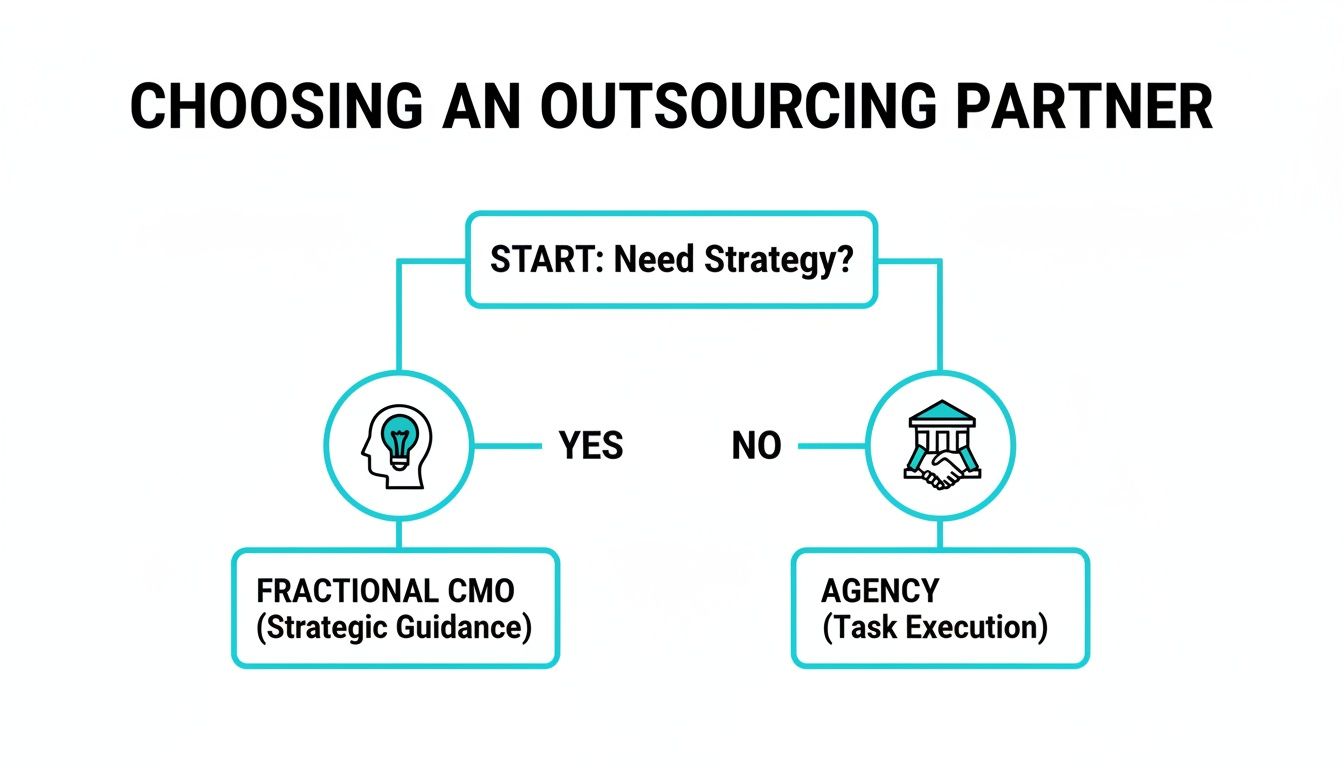
As the flowchart shows, there's a key fork in the road. A need for high-level strategy usually points you toward a fractional CMO, while a need for pure execution power leans toward an agency.
Going Beyond the Standard Vetting Questions
Anyone can show you a glossy case study. Your job is to poke holes in it and see what’s really underneath. Instead of just asking what they did, ask how and why they did it.
Here are a few questions that cut right to the chase:
- "Walk me through a time you inherited a flat pipeline for a B2B SaaS company like ours. What were the first 90 days like, and what specific levers did you pull to restart growth?" This question gets right at their diagnostic process and ability to prioritize under pressure.
- "How do you plug into a client's existing sales and analytics stack? Give me an example of how you've used data from a client's CRM to shape your marketing strategy." This uncovers their technical skill and whether they think about the full revenue funnel, not just their own silo.
- "Describe your process for building out an Ideal Customer Profile (ICP). How do you validate it beyond just looking at our current customer list?" A great partner will talk about qualitative interviews, competitive analysis, and market data—not just internal assumptions.
It's also worth asking about their toolkit and familiarity with leading influencer marketing tools to make sure they have the tech to manage your campaigns efficiently.
A partner’s value isn't just in the work they produce; it's in the strategic clarity they bring to your business. Their answers should sound less like a sales pitch and more like a strategy session.
The B2B Tech Vetting Checklist
When you’re talking to potential partners, measure them against criteria that actually matter for a company like yours. Deep industry experience and tech-savviness are completely non-negotiable.
Key Evaluation Criteria:
- Demonstrable B2B Tech Experience: Have they worked with companies at your stage (seed, Series A) and in your specific niche? A B2C e-commerce agency won't understand the long sales cycles and complex buying committees common in B2B.
- Tech Stack Proficiency: Are they comfortable with your tools, whether it's HubSpot, Salesforce, or Marketo? A partner who can hit the ground running with your existing stack will deliver value much, much faster.
- Metric Fluency: Do they lead with vanity metrics like "impressions" and "likes," or do they immediately jump to business outcomes like Marketing Qualified Leads (MQLs), Sales Qualified Leads (SQLs), and pipeline velocity? You want the latter.
- Strategic vs. Tactical Mindset: Are they just order-takers, or are they strategic thinkers? A true partner will challenge your assumptions and bring fresh ideas to the table. This is especially true if you plan to hire a fractional CMO, who is expected to provide that high-level leadership.
Understanding Different Pricing Models
Pricing isn't just a number. It reflects a partner's business model and how they value their services. Getting your head around these structures helps you find the best fit for your goals and budget.
- Monthly Retainer: This is the most common model you'll see for agencies and fractional CMOs. It gives you a predictable monthly cost for an agreed-upon scope of work. It’s best for ongoing, strategic partnerships where you need consistent support.
- Project-Based Fee: This is ideal for well-defined, one-off projects like a website redesign or an in-depth SEO audit. You simply pay a flat fee for a specific deliverable.
- Performance-Based: In this model, the partner's pay is tied directly to results, like a percentage of ad spend or a fee per qualified lead. It sounds great, but be careful. Make sure the metrics you track are tied directly to revenue, so you don't end up rewarding the wrong activities.
Choosing the right partner is an investment, plain and simple. Take the time to do your homework. The right team won't just execute tasks; they'll become a genuine extension of your company, driving real growth and helping you build a scalable revenue engine.
Building a Partnership That Actually Drives Growth
You’ve signed the contract. Now the real work begins. This is the moment you shift from evaluating a vendor to building a genuine growth partnership.
A strong start sets the tone for everything—communication, accountability, and the results you'll see in the months ahead. Those first 30 days are critical. This isn't about micromanaging; it's about building a shared foundation of trust and clarity from day one.
Kicking Off the Right Way
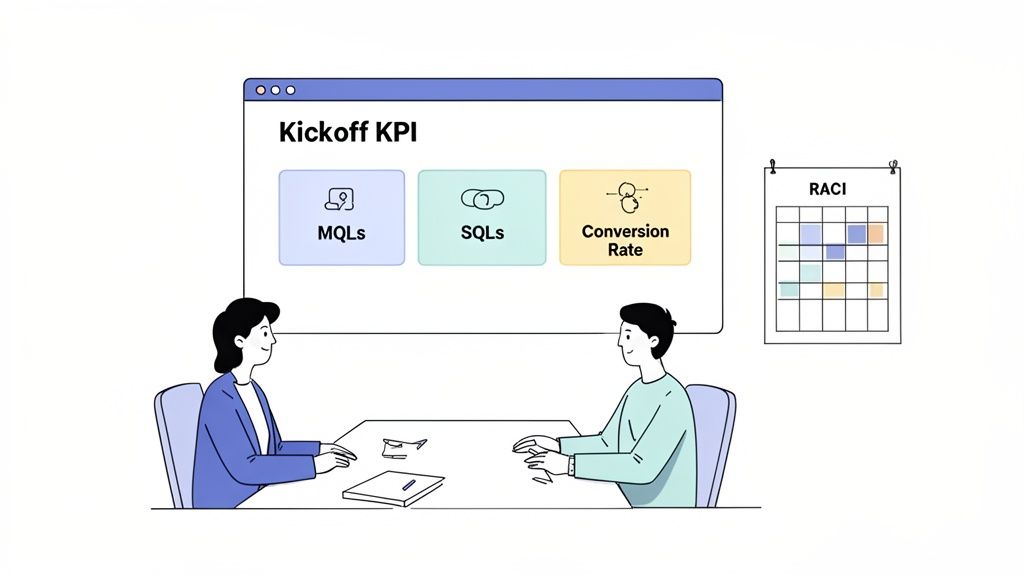
That first kickoff meeting is your launchpad. The goal is to move past the sales pitch and get deep into the operational weeds. Make sure everyone who will touch the project is in that meeting—your product lead, their content strategist, your sales rep, their ads manager. Everyone.
This is where you nail down the immediate 90-day goals. Don't leave without a crystal-clear understanding of the top one or two priorities. Is it fixing a leaky funnel, generating qualified demos, or gearing up for a product launch?
Your new partner is an expert in marketing, but you are the expert on your business. The kickoff is where you merge that knowledge. Over-communicate your product's nuances, your customers' pain points, and the competitive pressures you face.
To keep the momentum going, set up dedicated communication channels right away. A shared Slack or Microsoft Teams channel is non-negotiable for quick check-ins. It stops important conversations from getting buried in email and makes everyone feel like one cohesive team.
Defining Who Does What (and Avoiding Chaos)
Ambiguity is the enemy of progress. The single best tool to kill confusion is a RACI chart. This simple matrix clarifies who is Responsible, Accountable, Consulted, and Informed for every key marketing task.
Let’s say you’re creating a new ebook:
- Responsible: The outsourced partner's content writer drafts the copy.
- Accountable: Your internal Head of Product owns the final sign-off for technical accuracy.
- Consulted: Your sales team provides input on customer questions the ebook should answer.
- Informed: Your entire marketing team gets a heads-up when the ebook goes live.
This simple exercise prevents bottlenecks before they happen. It turns vague ideas about workflow into a documented process anyone can follow.
Your Shared Dashboard: The Single Source of Truth
Your partnership will live and die by the metrics you track. Don't wait a month to figure out your KPIs; build a shared performance dashboard from the very beginning. For a B2B tech founder, this dashboard has to move beyond vanity metrics and tie directly to revenue.
This dashboard isn't just a report; it's your command center. It should be the first thing you review in every weekly or bi-weekly meeting.
A good dashboard tells a story about what’s working and what isn’t. Here’s a sample structure focusing on what truly matters for B2B tech growth.
A Sample B2B Tech KPI Dashboard
| Metric Category | Key Performance Indicator (KPI) | Why It Matters | Reporting Cadence |
|---|---|---|---|
| Top of Funnel | Website Traffic (by channel) | Shows which channels are driving initial interest and brand awareness. | Weekly |
| Lead Generation | Marketing Qualified Leads (MQLs) | Measures the volume of leads meeting your fit and engagement criteria. | Weekly |
| Lead Quality | MQL-to-SQL Conversion Rate | A critical health check on lead quality and sales/marketing alignment. | Weekly |
| Sales Pipeline | Sales Qualified Leads (SQLs) | Tracks how many leads the sales team accepts as legitimate opportunities. | Weekly |
| Pipeline Health | Pipeline Velocity | How quickly deals move from first touch to closed-won. Faster is better. | Monthly |
| Revenue Impact | Customer Acquisition Cost (CAC) | Your core efficiency metric. How much does it cost to win a new customer? | Monthly |
| Overall ROI | Marketing-Sourced Revenue | The ultimate metric: How much revenue is marketing directly generating? | Monthly/Quarterly |
This dashboard ensures every conversation is grounded in data. It keeps both teams focused on the end goal: predictable, scalable revenue growth.
The right reporting cadence is just as important. I recommend a weekly tactical sync to review campaign performance and a monthly strategic review to discuss higher-level trends and plan the quarter ahead. This rhythm keeps you aligned on both the short-term execution and the long-term vision.
What Real-World Results Should You Expect?
Let's cut to the chase. Strategy and process are great, but what you really want to know is: does outsourcing actually move the needle on revenue?
When you find the right partner, the results aren't just small bumps in your metrics. They can be transformative.
We're talking about more than just theory here. The right partnership gives you access to specialized talent and premium martech that most startups simply can't afford in-house. This combination is what fuels a powerful ROI.
Take the DTC brand Inkbox, for example. They managed a 1.5x higher CTR while slashing their cost per acquisition by a staggering 86%. Another company, Spearmint Love, hit an incredible 38x return on ad spend (ROAS).
These wins are often accelerated by an agency's access to advanced AI and analytics tools. In fact, 52% of U.S. marketing pros say they see major efficiency gains from the AI their outsourced partners bring to the table. You can read the full research about these marketing findings if you want to dig deeper.
These aren't vanity metrics. They're real dollars saved and real revenue in the bank.
Scenarios B2B Tech Founders Will Recognize
To make this tangible, let’s walk through a few common situations where outsourcing provides a clear, powerful solution. These are stories we see play out time and again with B2B tech startups.
Scenario 1: The Scale-Up with a Stalled Engine
You've got a Series A SaaS company with a solid product. You even have a small, hardworking junior marketing team. The problem? Lead generation has completely flatlined. You're doing "a little bit of everything," but nothing is producing predictable, high-quality demos for sales.
- The Solution: You bring in a fractional CMO. The focus immediately shifts from random acts of marketing to a targeted strategy. They help you define a razor-sharp Ideal Customer Profile (ICP), build a multi-channel demand gen plan around LinkedIn Ads and SEO, and mentor your internal team on execution.
- The Result: Within 90 days, Marketing Qualified Leads (MQLs) are up 40%. More importantly, the MQL-to-SQL conversion rate doubles because the leads are a much better fit. Sales finally has the at-bats they need to hit their numbers.
Scenario 2: The Early-Stage Startup Needing a Go-To-Market Plan
Your early-stage, product-led startup is about to launch its beta. The founders are brilliant engineers, but they have zero marketing expertise. They're asking fundamental questions like, "Who are we even selling to?" and "How do we make our first sales?"
An outsourced partner can provide the go-to-market playbook that founders don't have the time or experience to write themselves, turning a great product into a viable business.
- The Solution: The founders engage an agency that specializes in B2B tech launches. The agency runs customer discovery interviews, sharpens the core value proposition, and builds a lean launch plan focused on product-led growth tactics and building an initial community.
- The Result: The beta launch isn't a shot in the dark. It’s a strategic, focused effort that attracts the right early adopters, generates crucial user feedback, and provides the initial traction needed for the next funding round. Being able to demonstrate these wins is critical, which is why every founder needs to learn how to measure marketing ROI from day one.
These examples show that outsourcing isn't just about offloading tasks. It’s about injecting the right expertise at the right time to solve a specific business problem—whether that's restarting a stalled growth engine or building one from scratch.
Common Pitfalls and How to Steer Clear of Them
Even the best-laid plans can go sideways. When you outsource your marketing, knowing the common tripwires isn’t about being cynical—it’s about being prepared. A few smart moves upfront can be the difference between a frustrating waste of money and a true growth partnership.
The good news? Most failures aren't random. They follow predictable patterns, and once you see them, you can build a framework to sidestep them completely.
Misaligned Expectations and Vague Goals
This is the #1 reason outsourced relationships sour. It happens when you think you’re hiring a team to "drive revenue," but they think their job is to "increase website traffic." Both sides believe they’re doing their job, yet no one is happy. The scoreboard looks terrible.
The fix is straightforward but non-negotiable: co-create a detailed 90-day plan during onboarding. Don't settle for high-level goals. Get granular.
- Define clear milestones: "Increase marketing-qualified leads (MQLs) by 15% in Q1."
- Specify key deliverables: "Publish four SEO-optimized blog posts per month, targeting long-tail keywords."
- Assign ownership: "Your team is responsible for ad creative and copy; our team provides final approval within 48 hours."
This document becomes your shared compass. It makes sure everyone is rowing in the same direction from day one.
Poor Communication and Reporting Cadence
Another classic mistake is letting communication devolve into chaotic email threads and missed updates. When you don’t know what your partner is working on or what results they’re seeing, trust erodes fast. You start to wonder what you're even paying for.
The remedy is to lock in a non-negotiable communication rhythm from the start. This isn't about micromanagement; it's about creating consistent touchpoints for alignment and accountability.
A weekly tactical sync is essential. This should be a 30-minute, data-driven meeting to review the past week’s performance, troubleshoot roadblocks, and confirm priorities for the coming week. No fluff, just focus.
This regular check-in, paired with a shared dashboard you can access anytime, eliminates surprises. It builds a culture of transparency where challenges are addressed openly and successes are celebrated together. This simple habit is what turns a vendor relationship into a genuine partnership and makes your outsourcing digital marketing efforts pay off.
Common Questions B2B Tech Founders Ask About Outsourcing
Even with the best plans, you probably have a few lingering questions. When founders are on the verge of outsourcing their marketing, a few key concerns almost always pop up. Let's tackle them head-on.
How Much Should We Budget for Outsourced Marketing?
There’s no magic number here. The real question isn't about cost—it's about ROI.
A cheap freelancer might feel like a quick win, but if they're just executing tasks without a strategic lens, your growth will eventually flatline. You get what you pay for.
In contrast, a fractional CMO or a specialized agency costs more upfront but delivers strategic value that can 10x your return. They don't just check off a to-do list; they build a scalable growth engine. The right investment is the one that drives the biggest business impact, period.
When Is the Right Time to Start Outsourcing?
The sweet spot is right after you've hit product-market fit but before your growth stalls out. You have a product that solves a real problem, but you don't have the senior marketing firepower to scale customer acquisition.
Watch for these triggers:
- Your pipeline has gone completely quiet.
- You're prepping for a product launch and need a go-to-market strategy that actually works.
- The founding team is spending more time tinkering with marketing than on product and vision.
Can I Outsource If I Already Have an In-House Team?
Absolutely. In fact, this hybrid model is one of the most powerful ways to scale.
An outsourced expert provides the senior-level strategic leadership your junior team is missing. They’re not there to replace anyone; they’re there to make your existing team better.
They can mentor your team, fill critical skill gaps (like performance marketing or marketing automation), and ensure your people are focused on high-impact work. This approach multiplies the talent you already have, turning a small team into a high-performance growth machine.
Ready to build a marketing engine that drives real results? At Value CMO, we provide B2B tech founders with the senior-level strategic leadership needed to scale, without the full-time overhead. Book a call to build your growth roadmap.