So, you're thinking about outsourcing your marketing. It’s the move many founders make when they realize building an in-house team is a massive undertaking—a slow, expensive distraction from focusing on your product and landing those first crucial customers.
You have to find the right people, get them trained up, and hope they all click. It’s a lot.
This is where outsourced marketing flips the script. Forget thinking of it as just handing off tasks. It’s more like calling in a specialized strike team whose only job is to drive your growth. For a lot of B2B tech companies, this isn't just a temporary fix; it's a core part of how they build momentum and scale effectively.
What Is Outsourced Marketing and Why Does It Matter?

The idea is simple: instead of owning all your marketing resources, you get access to them on demand. This model lets you tap into a whole range of skills that would be nearly impossible to hire for internally, especially when you're just starting out.
An outsourced partner brings immediate firepower to the table.
Gaining a Strategic Advantage
Imagine instantly having experts ready to go in critical areas like:
- High-Level Strategy: Nailing down your go-to-market plan and market positioning.
- Digital Execution: Running the SEO, paid ads, and content campaigns that actually generate leads.
- Creative Services: Designing visuals that pop and writing copy that converts.
- Tech & Ops: Managing your martech stack and making sense of all the analytics.
This is especially true when it comes to implementing complex demand generation strategies. An expert team can execute with a level of precision that a single in-house marketing generalist just can't match.
More Than Just a Cheaper Option
While saving money is a nice perk, the real win here is agility and access to A-list talent. The market gets it. The global outsourcing industry is on track to blow past $400 billion in 2025. And a huge slice of that—around 72% of the contract value—is for specialized tech and IT skills.
By outsourcing, you gain the flexibility to ramp marketing up or down based on funding rounds, product launches, or market shifts—without the headache of hiring and firing.
This isn’t about hiring a contractor to tick boxes off a list. A true outsourced marketing relationship is a strategic partnership. It’s about bringing in a team that plugs directly into your goals, challenges your assumptions with an outside perspective, and uncovers growth opportunities you might have missed.
If you're curious how this differs from other advisory roles, our guide on what marketing consulting is breaks it down further.
Finding Your Ideal Outsourced Marketing Model
Choosing how to outsource your marketing feels a lot like deciding how to build a house. You know you need help, but the options are dizzying. Do you hire a big-picture architect, a general contractor to run the whole show, a few specialist tradespeople, or just buy a pre-fabricated kit? Each one works, but only one is the right fit for where you are right now.
Making the right call boils down to three things: your startup's current stage, your budget, and what you absolutely need to get done. Let's break down the four main ways to do this so you can pick the one that will actually build a foundation for growth.
The Strategic Architect: Fractional CMO
A Fractional Chief Marketing Officer (CMO) is your strategic architect. This isn't about someone banging out daily tasks; it’s about getting C-suite leadership and a proven growth plan without the full-time executive salary. A Fractional CMO plugs into your leadership team to sharpen your go-to-market strategy, build a marketing roadmap, and make sure every dollar you spend is working for you.
This model is a game-changer for early-stage startups that might have a junior person or a freelancer handling execution but have zero senior-level direction. They’re the ones who answer the big, expensive questions: Who is our real customer? Which channels will actually move the needle? How do we prove any of this is working?
- Best For: Startups that need senior strategic guidance, a clear marketing roadmap, and leadership for a junior team.
- Typical Cost: Monthly retainer, which is a fraction of a full-time executive's salary.
- Key Advantage: You get executive-level strategy and experience that would otherwise be completely out of reach.
If you think this high-impact approach might be for you, our detailed guide on the role of a fractional CMO dives deeper into how they drive real growth.
The General Contractor: Marketing Agency
Think of a marketing agency as your full-service general contractor. They show up with an entire crew of specialists—SEO analysts, PPC managers, content writers, designers—all under one roof. You hand them your goals, and they manage the whole project, from the blueprint to the final inspection.
Agencies are a solid choice when you need a wide range of marketing done for you and just want a single point of contact. They handle everything, which is a massive relief for founders who can't be project managers. The trade-off? This full-service model usually comes with a bigger price tag and can sometimes feel less personal than other options.
An agency's biggest advantage is the sheer breadth of skills you get instantly. One contract can give you access to a team of ten specialists—something that would take you months and a huge budget to hire internally.
The Specialist Subcontractors: Freelancers and Contractors
Freelancers and independent contractors are your go-to subcontractors—the expert electricians, plumbers, and carpenters of the marketing world. Need a brilliant copywriter to nail your website's messaging? A Google Ads pro to fix your campaigns? An SEO expert to get you on page one? You hire them for just that job.
This approach gives you incredible flexibility and direct access to top-tier talent for specific projects. It's often the most cost-effective way to get high-quality work done. The catch is the management overhead. Juggling multiple freelancers, making sure they talk to each other, and keeping everyone pointed in the same direction? That’s all on you.
This works best when you have a crystal-clear, well-defined project and someone internally who can manage it. Hiring a writer for four blog posts a month is simple. Hiring five different freelancers to launch a multi-channel product campaign is a coordination nightmare waiting to happen.
The Pre-Fabricated Toolkit: Marketing-as-a-Service (MaaS)
Marketing-as-a-Service (MaaS) is the new kid on the block, and it works like a pre-fabricated toolkit. These platforms bundle technology with a set menu of services or deliverables for a flat monthly fee. A MaaS provider might offer a package with a specific number of social media posts, one email newsletter, and a monthly report, for example.
MaaS is built for predictability and efficiency, making it a decent fit for businesses with standardized, repeatable marketing tasks. It takes the guesswork out of budgeting. The downside is that it's often rigid. The solutions are formulaic and might not be flexible enough for a startup's ever-changing priorities or unique challenges. It’s generally better for tactical execution than for a deep strategic partnership.
Comparing Outsourced Marketing Models
To make the choice clearer, here’s a side-by-side look at the four models. Think about your immediate needs, long-term goals, and how much hands-on involvement you want to have.
| Model | Best For | Typical Cost Structure | Key Advantage | Potential Drawback |
|---|---|---|---|---|
| Fractional CMO | Startups needing strategy, leadership, and a clear roadmap without the C-suite cost. | Monthly Retainer | Executive-level expertise for a fraction of the cost. | Not focused on day-to-day task execution. |
| Marketing Agency | Companies needing a wide range of services managed by a single, all-in-one team. | Monthly Retainer or Project Fees | Access to a full team of specialists under one contract. | Higher cost and can be less agile or personal. |
| Freelancers | Businesses with specific, well-defined projects needing expert execution. | Per-Project, Hourly, or Retainer | Cost-effective access to specialized top-tier talent. | High management overhead for you. |
| MaaS | Companies with standardized, repeatable tasks who value budget predictability. | Recurring Subscription | Predictable costs and clear, pre-defined deliverables. | Inflexible, "one-size-fits-all" approach. |
Ultimately, there's no single "best" model—only the one that's best for you. Use this breakdown to match your company's needs with the right kind of support to fuel your next stage of growth.
The Real Benefits and Hidden Risks for Tech Startups
For a B2B tech startup, outsourcing marketing isn't just about handing off tasks. It's a strategic bet on hitting your growth targets faster. Pick the right partner, and it's like injecting your company with a shot of adrenaline—instant experience and execution power.
But get it wrong? You'll just drain your runway with very little to show for it.
Let's skip the generic pros-and-cons lists and get real about what this decision means for a founder trying to scale.
The Upside: An Instant Competitive Edge
The most immediate win is getting senior-level strategic thinking without the C-suite price tag. A seasoned marketing partner has been here before. They’ve tackled the same growth problems you’re facing with dozens of other tech companies and bring proven playbooks to the table.
This translates into some very real advantages:
- Agility to Scale: Your marketing engine can grow or shrink right alongside your funding. Just closed a seed round? Scale up. Need to tighten the belt? Scale back. That kind of flexibility is almost impossible to build with a full-time in-house team.
- Access to Specialized Skills: One day you need a marketing automation pro, the next an SEO wizard. Outsourcing gives you a whole roster of specialists on demand, filling critical skill gaps that would take you months to hire for.
- Speed to Market: An external team shows up ready to go. They skip the internal learning curve and office politics, letting you launch campaigns and test ideas far faster than you could on your own.
For tech startups, this is where it gets interesting. Outsourced partners often bring sophisticated strategies that deliver outsized returns, like the high ROI potential of retargeting campaigns. When experts run these advanced plays, your marketing spend quickly becomes a powerful revenue engine.
This decision tree helps you visualize if you need high-level strategy, hands-on execution, or a mix of both.
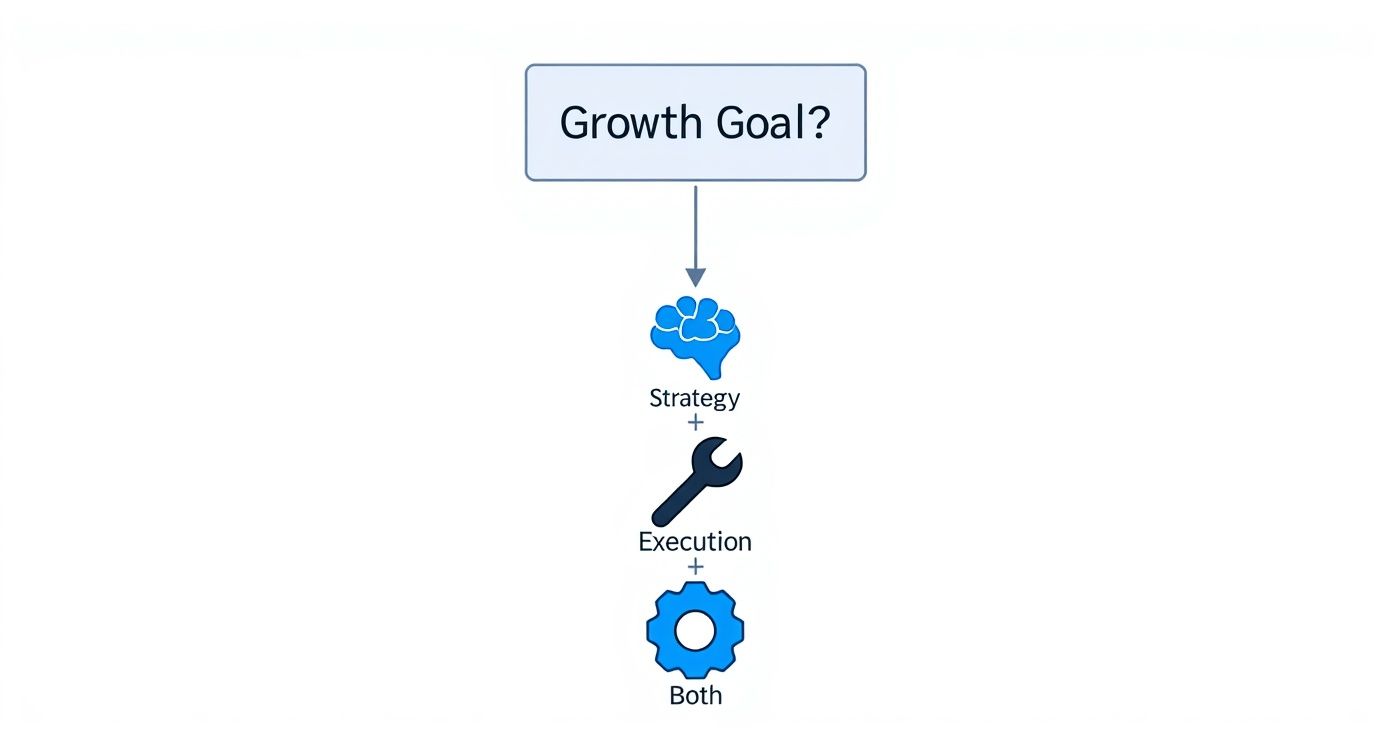
The flowchart makes it clear: your specific growth goal should dictate the path you take, helping you avoid paying for services you don’t actually need.
The Hidden Risks: Navigating the Pitfalls
Of course, it’s not all smooth sailing. Outsourcing marketing comes with its own set of traps you have to manage proactively. This is where promising partnerships fall apart.
The biggest danger in outsourcing isn't that the work won't get done; it's that the wrong work gets done. Misalignment on strategy or brand can burn through your budget without moving the needle on your actual business goals.
Keep an eye out for these potential landmines:
- Diluted Brand Voice: An outside team might not intuitively get the nuances of your company culture and voice. Without a serious onboarding process and crystal-clear brand guidelines, your messaging can become generic and lose its personality fast.
- Communication Hurdles: You are not their only client. A good external team is juggling multiple priorities, and communication can sometimes lag. You absolutely must establish a clear rhythm of check-ins, reporting, and a single point of contact.
- Hidden Costs and Misaligned Incentives: The cheapest option is almost never the best one. Some partners will try to lock you into rigid contracts or focus on vanity metrics (like website traffic) instead of what really matters—qualified leads and revenue. A poorly structured deal can cost you far more in missed opportunities than the monthly retainer.
Ultimately, choosing to outsource your marketing is a calculated risk. Find a partner who operates like a true extension of your team, and the benefits are enormous. But you have to go in with your eyes wide open, ready to manage the relationship with the same care you would an internal hire.
How to Choose the Right Marketing Partner
Choosing an outsourced marketing partner is a high-stakes decision. Let's be honest, it has to be. You’re not just hiring another vendor; you're trusting them with a piece of your company's future.
Get it right, and you pour fuel on the fire. Get it wrong, and you burn through precious runway with almost nothing to show for it.
The key is to look past the slick sales pitch and dig into what a potential partner actually delivers. A great website and a polished proposal are just table stakes. The real difference is found in their experience, their strategic thinking, and the cold, hard proof of their past performance.
Verify Their B2B Tech Experience
First things first: your partner absolutely must live and breathe B2B tech. The world of selling complex software to discerning buyers is a completely different universe from e-commerce or local services. A partner who doesn’t get that will waste your time and money on tactics that just fall flat with your audience.
You need a team that gets the nuances of long sales cycles, multi-touch attribution, and how to talk to technical decision-makers. They should be fluent in your world—talking about ideal customer profiles (ICPs), marketing qualified leads (MQLs), and pipeline contribution.
Ask them direct questions to see if they walk the walk:
- Industry Focus: "What percentage of your clients are B2B tech or SaaS companies?"
- Proven Results: "Can you show me case studies from companies at a similar stage to ours, facing similar growth challenges?"
- Team Expertise: "Who on your team will actually work on our account, and what’s their specific background in B2B tech marketing?"
A partner with deep industry experience won’t just execute tasks. They’ll bring proven playbooks and valuable market insights right to your doorstep.
Assess Their Strategic Depth
This is the most common mistake I see founders make: hiring a purely tactical team when what they desperately need is a strategic partner. A task-focused agency might be great at running Google Ads or writing blog posts, but they won’t help you figure out if those are the right things to be doing in the first place.
A true partner challenges your assumptions. They don't just ask for a list of deliverables; they start by asking about your business goals, revenue targets, and biggest growth obstacles. Their first conversation should be about strategy, not just execution.
Look for a partner who can draw a straight line from marketing activities to business outcomes. They should be able to build a cohesive plan where every piece of content, every ad campaign, and every email has a clear purpose in moving a customer through their buying journey.
Dig Into the Proof
Talk is cheap. Any agency can promise the moon, but a great partner can prove they’ve delivered it before. This is where you have to go beyond the surface-level testimonials and get into the nitty-gritty.
When you’re looking at case studies or talking to their references, ask questions that reveal how they really operate:
- Measuring Success: "How do you define success beyond vanity metrics like traffic? Show me reports that track leads, pipeline, and real ROI."
- Handling Failure: "Walk me through a campaign that didn't go as planned. What did you learn, and how did you pivot?"
- Client Collaboration: "What does your communication and reporting rhythm look like? How do you make sure your team is aligned with our internal goals?"
Their answers will tell you everything. A partner who can talk openly about their wins and their learnings is one you can trust. They get that marketing is a process of testing and iterating, not waving a magic wand. At the end of the day, you're looking for a team that is just as invested in your growth as you are.
Setting Your Partnership Up for Success
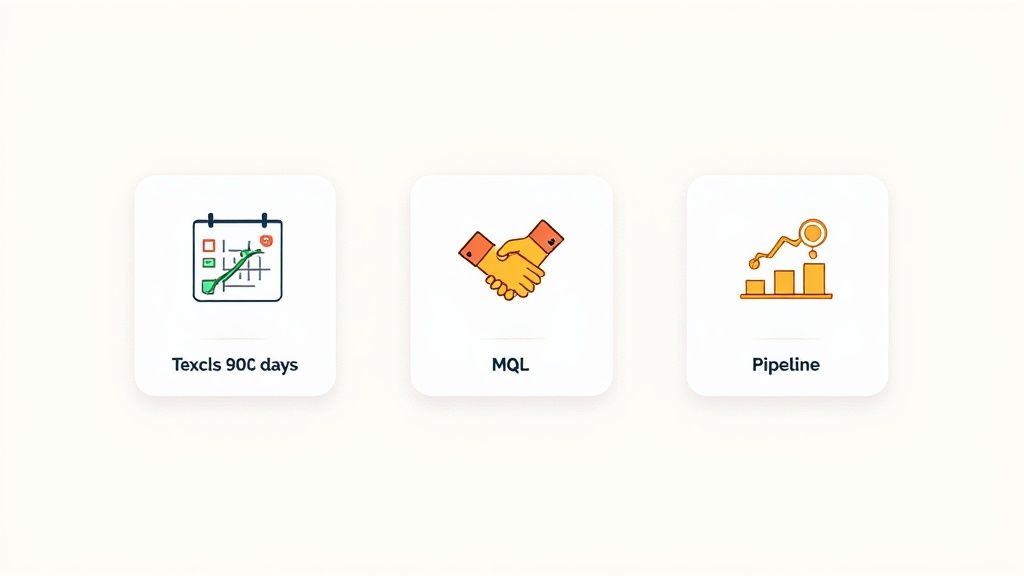
You’ve signed the contract with your new marketing partner. Now the real work begins. The success of this relationship isn’t sealed with a signature; it’s forged in the first 90 days.
This initial period is all about building a rock-solid foundation. It’s a time for deep immersion, setting crystal-clear expectations, and establishing a communication rhythm that keeps everyone on the same page. Treat this phase with the same seriousness you would an internal executive hire.
Building a Bulletproof Onboarding Process
A great outsourced partner will take the lead on onboarding, but your active participation is non-negotiable. They can't become an extension of your team if they're kept at arm's length.
A structured onboarding plan should feel like a strategic deep dive, not just a series of introductory calls. The whole point is to transfer critical knowledge and agree on what a "win" actually looks like.
Key pieces of a successful onboarding include:
- Deep Brand Immersion: This goes way beyond handing over a logo file. Share your mission, vision, brand voice, and competitive landscape. Give them access to past campaigns—both the wins and the failures.
- Knowledge Transfer Sessions: Get your partner on calls with key stakeholders, like your head of sales and product lead. They need to get inside the head of your ideal customer, understand the problems you solve, and learn the nuances of your sales cycle.
- Defining Communication Rhythms: Set a clear cadence for meetings, reports, and day-to-day chats. A weekly sync call, a shared Slack channel, and a monthly strategic review is a great place to start.
- Setting Clear Expectations: Jointly agree on what you'll accomplish in the first 30, 60, and 90 days. This creates early momentum and builds confidence on both sides.
Think of this onboarding period as a joint investment. The more you put into educating your partner upfront, the faster they'll be able to deliver the results you hired them for.
Measuring What Actually Matters
Once you’re up and running, the focus shifts to performance. It’s easy to get lost in a sea of "vanity metrics"—like social media impressions or website traffic. They feel good, but they don't tell you if your marketing is actually working.
True success is measured by business impact. You need a Key Performance Indicator (KPI) framework that ties every marketing activity directly to revenue. This isn't just about accountability; it’s about making smarter decisions with your budget. The growing reliance on outsourced marketing reflects this push for clear outcomes. In fact, the global market for outsourced sales and marketing services, valued at $2.71 billion in 2024, is expected to expand to $4.21 billion by 2034.
Your KPI dashboard should move beyond surface-level data. It needs to show the numbers your CEO and investors actually care about.
Your core outsourced marketing KPIs should include:
- Marketing Qualified Leads (MQLs): How many leads are hitting a pre-defined threshold of engagement and are ready for the sales team?
- Sales Pipeline Contribution: How much potential revenue has marketing sourced or influenced?
- Customer Acquisition Cost (CAC): What is the total cost of marketing and sales to acquire a new customer?
- Lead-to-Customer Conversion Rate: What percentage of leads are ultimately turning into paying customers?
Tracking these numbers gives you a clear, honest picture of your performance. For a deeper look at building a results-focused framework, our guide on how to measure marketing ROI provides a step-by-step approach. By setting up your partnership for success with a strong onboarding process and a meaningful KPI framework, you transform your outsourced marketing from an expense into a predictable engine for growth.
Common Outsourced Marketing Pricing Models
When you decide to bring in an outside marketing partner, one of the first conversations you'll have is about money. It can feel confusing. Different partners use different terms and structures, but it all boils down to three common models.
Once you know them, you can budget effectively and pick a partner whose financial incentives are wired directly to yours.
Think of it like this: are you paying for someone's time, a specific finished product, or a guaranteed result? Each model answers that question differently. Getting it right is how you turn marketing spend into a predictable growth engine.
The Predictable Retainer Model
The retainer model is the most common setup you’ll see, especially with agencies and fractional CMOs. You pay a fixed fee every month for an agreed-upon scope of work, access to their team, and ongoing strategic input. It’s like putting a specialized marketing department on your payroll, but without the long-term overhead.
This model is built for long-term partnerships. The predictable cost makes budgeting a breeze, and it lets your partner go deep—truly understanding your business, planning ahead, and constantly tweaking campaigns for better results. The key here is to make sure that scope of work is crystal clear so there are no surprises.
The Clear-Cut Project-Based Model
Next up is project-based pricing. This is exactly what it sounds like. You pay a single flat fee for a specific, well-defined deliverable with a clear start and end date. It's the perfect model for one-off initiatives where the scope is easy to contain.
Common examples include:
- Building a new website.
- Developing a go-to-market strategy.
- Creating a series of lead-generation ebooks.
This approach is great for its clarity. You know exactly what you’re getting and exactly what it will cost, which kills the risk of surprise invoices. The main drawback? It’s not designed for the kind of ongoing, iterative work that drives sustained growth.
The Results-Driven Performance-Based Model
Finally, there's the performance-based model. Here, a chunk of your partner's pay is tied directly to hitting specific, measurable KPIs. This might look like a lower base retainer plus a bonus for hitting a certain number of qualified leads, a target customer acquisition cost, or a specific revenue goal.
This model creates powerful alignment. When your partner only gets paid well if you succeed, everyone is intensely focused on the metrics that actually matter. It's the ultimate "skin in the game" arrangement.
But this model needs rock-solid tracking and total agreement on what defines a win. It works best for channels where the line between activity and outcome is direct—think paid ads—rather than long-term plays like SEO or content marketing.
Interestingly, what companies choose to outsource shifts over time. While about 40% of marketers outsourced content in 2019, that number dipped to 30% in 2020, even as the broader outsourcing trend keeps climbing. You can explore more outsourcing statistics on ExplodingTopics.com to see how the landscape changes year to year.
Common Questions About Outsourced Marketing
Even when you’ve got a plan, handing over the reins can bring up a few nagging questions. Let’s tackle the ones that come up most often for founders so you can move forward without any second-guessing.
How Much Should a Tech Startup Budget for This?
There’s no magic number, but here’s a solid rule of thumb: B2B startups should plan to invest 10-20% of their desired revenue growth back into marketing.
For some, that might look like $3,000-$5,000 a month for a few specialized freelancers. For others, it’s closer to $10,000-$25,000+ per month for a full-service agency or a Fractional CMO who can run the entire show.
The smartest way to set a budget is to work backward from your goals. Figure out what success actually looks like—say, 20 qualified demos a month—and have potential partners build a realistic plan to hit that number.
Can an Outsourced Team Really Get Our Business?
Fair question. They won't be in your daily stand-ups, but the best partners have a battle-tested onboarding process to get up to speed on your product, your customers, and where you fit in the market.
Their biggest advantage is objectivity. They see your business the way a customer does, without the internal bias that can creep in over time.
Success comes down to one thing: treating them like a true partner, not just another vendor. Give them open access to your team and your data, and they’ll become a genuine extension of your company.
What's the Biggest Mistake Startups Make When Outsourcing?
Easy. The most common pitfall is outsourcing the work without an internal strategy locked in.
Handing your marketing over with a vague request like "we need more leads" is a recipe for wasted time and money. A partner is there to build on your vision and execute it, not define your company for you.
The best results happen when a founder knows exactly who they’re selling to, what makes their product a must-have, and what a "win" looks like on a dashboard. An outsourced team’s job is to take that clarity and build the expert engine to make it happen.
At Value CMO, we build the marketing roadmap that turns your business goals into measurable revenue. If you need senior strategic leadership without the full-time overhead, let's talk about building your growth engine.