
So, what’s the big deal with a "marketing tech stack"?
Think of it as your team's entire software arsenal—all the tools you rely on to dream up campaigns, actually get them out the door, manage all the moving parts, and figure out what’s really working. But this isn't just a random pile of subscriptions. A real stack is more like a symphony orchestra, where every instrument is chosen because it plays perfectly with the others. This integrated system is what helps modern B2B SaaS companies find their groove and really start to grow.
What Is a Marketing Tech Stack Anyway?
Imagine your marketing team is the pit crew for a Formula 1 race. The driver—let's call them your sales team—gets all the glory, but everyone knows the race is often won or lost in the pits. The crew’s success hinges on having the right tools ready to go: air guns, jacks, diagnostic computers. More importantly, everything has to work in perfect harmony to get that car back on the track in a matter of seconds.
Your marketing tech stack is that pit crew’s toolkit. It’s the carefully chosen software that lets your team operate with speed, precision, and a whole lot of smarts. Just like a pit crew wouldn’t show up with a rusty wrench, a modern marketing team can’t get by with a bunch of disconnected, outdated tools.
More Than Just a Pile of Software
It's so easy to fall into the trap of collecting shiny new tools every time you see one. But a true marketing tech stack is engineered, not just collected. The goal is to build a powerful engine for growth where every single part has a job and talks seamlessly to the others.
A well-designed stack helps your team:
- Actually understand your customers: By pulling all your data into one place, you get a full picture of who your audience is and what they care about.
- Create personalized experiences: You can finally deliver the right message to the right person at exactly the right moment.
- Automate the boring stuff: This frees up your team to focus on the big-picture strategy and creative ideas that really move the needle.
- Prove marketing's ROI: It’s what connects the dots between that blog post you published and the deal that just closed.
A great marketing tech stack isn’t about how many logos you can cram onto a slide. It’s about how that software works together to make your entire marketing operation smarter, faster, and more effective. It turns marketing from a cost center into a predictable revenue engine.
The number of tools out there is honestly mind-boggling. The 2025 Marketing Technology Landscape now includes an incredible 15,384 different solutions—that's a 100-fold increase since 2011. This explosion points to a major shift, with more AI-native platforms and cloud data warehouses becoming the bedrock of modern stacks. The full 2025 martech report is worth a look to see just how much things are changing.
Understanding the Core Layers of Your Stack
A high-performing martech stack isn't just a random assortment of software. It's a thoughtfully engineered system, with each tool playing a specific role. Think of it like building a house: you pour the foundation before you put up the frame, and you put up the frame before you start picking out paint colors. Each layer supports the next.
Let's break down the essential pieces, from the ground up, to see how they all fit together. This isn't about hoarding logos; it's about building a machine where every part has a purpose and works in harmony with the others.
The goal is to move from a pile of disconnected tools to a single, cohesive unit that shares data and powers your entire go-to-market engine.
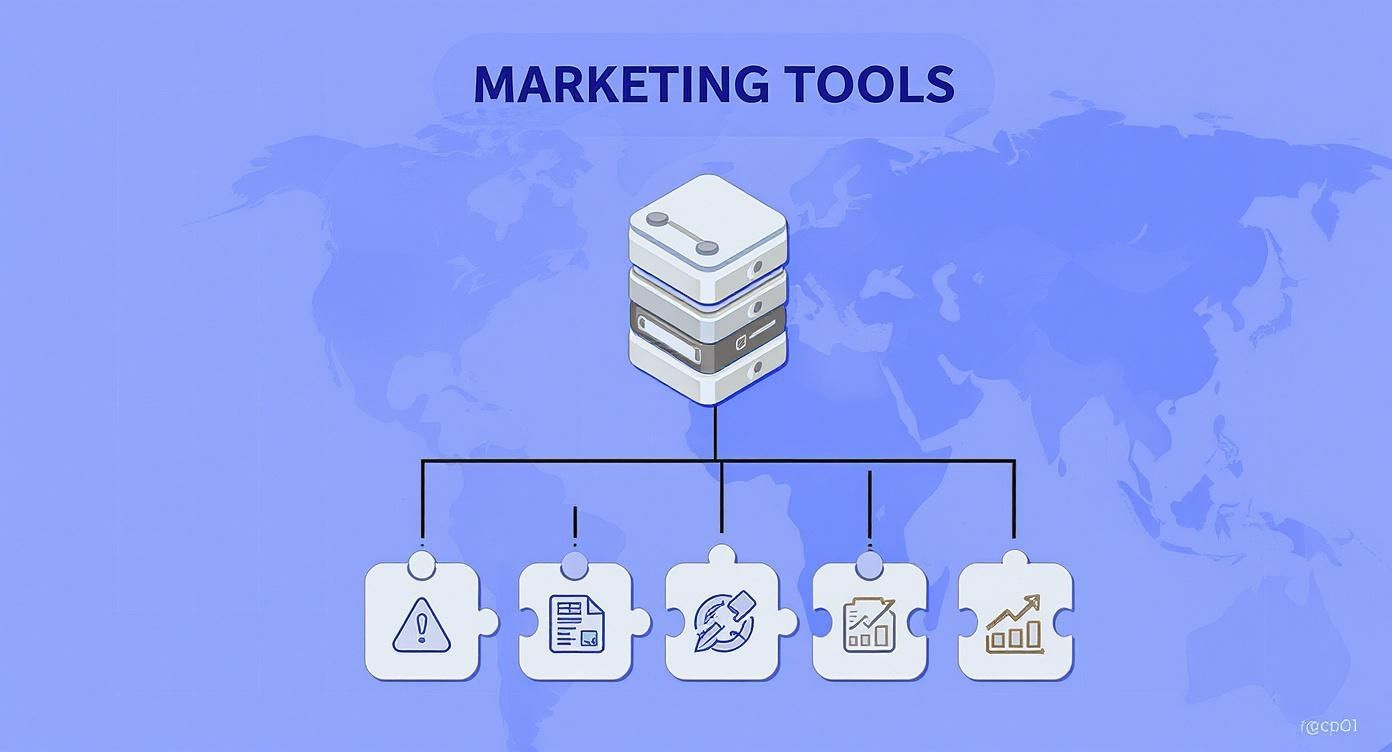
This interconnected approach is what separates a true "stack" from a messy folder of software subscriptions that just creates data silos and kills efficiency.
To get this right, you need to understand the four main layers that make up a modern B2B SaaS stack.
Below is a quick look at these layers, what they do, and some of the go-to tools you’ll find in each.
Key Layers of a B2B Marketing Tech Stack
| Stack Layer | Primary Function | Example Tools |
|---|---|---|
| Data Layer | The "single source of truth." Gathers, unifies, and manages all your customer data. | Salesforce, HubSpot, Segment, Clearbit |
| Activation Layer | The "action taker." Uses that unified data to automate campaigns, nurture leads, and send messages. | Marketo, Pardot (MCAE), ActiveCampaign |
| Engagement Layer | The "front door." These are the channels you use to attract, engage, and convert your audience. | Google Ads, LinkedIn Ads, WordPress, Sprout Social |
| Insights Layer | The "scoreboard." Measures how your campaigns are doing, analyzes user behavior, and proves ROI. | Google Analytics, Tableau, Hotjar, Looker |
Each of these layers is vital. A stack without a solid data layer is built on sand. One without an activation layer has a brain but no arms or legs. Let's dig into each one.
The Foundation: Your Data Layer
Everything starts here. The data layer is the concrete foundation of your marketing house. Its one and only job is to collect, clean, and manage all the information you have on your prospects and customers. If this layer is a mess, everything you build on top of it is going to be wobbly.
The two mainstays of the data layer are:
- Customer Relationship Management (CRM): This is your system of record for sales activity, customer chats, and contact info. Think of it as the shared address book for your sales and marketing teams. Salesforce and HubSpot are the big players here.
- Customer Data Platform (CDP): A CDP takes things a step further. While a CRM tracks known interactions (like emails and calls), a CDP pulls in anonymous behavioral data from your site, app, and other sources to build a truly 360-degree customer profile. It answers the question: "Who is this person, and what have they actually done across every channel?"
This foundational layer is the central nervous system for your whole operation. Every other tool plugs in here to either pull data out or push new information in, making sure everyone is working from the same playbook.
The Action Taker: Your Activation Layer
Once your data is clean and organized, you need tools to actually do something with it. That’s the job of your activation layer—the framework and electrical wiring of your house. These platforms take the rich data from your CRM and CDP and use it to run campaigns and automate conversations at scale.
This is where insight turns into action. If your data layer flags a prospect who visited your pricing page three times this week, your activation layer is what automatically enrolls them in a targeted email sequence.
Key tools in the activation layer include:
- Marketing Automation Platforms: Tools like Marketo or Pardot are the heavy lifters. They handle complex email workflows, lead scoring, and nurturing programs that tell sales which leads are ready for a conversation.
- Email Marketing Software: For less complex needs, like newsletters or one-off announcements, platforms like Mailchimp or ConvertKit get the job done.
The Face of Your Brand: Your Engagement Layer
Now that the foundation and framework are in place, it's time to build the parts of the house people actually see and interact with. The engagement layer is made up of the channels and platforms you use to get in front of your audience and draw them into your world.
These are the front doors to your business. They’re responsible for generating awareness, driving traffic, and starting conversations. Managing these channels efficiently is a core function of marketing operations, making sure your message is consistent and every dollar is well spent.
This layer includes tools like:
- Advertising Platforms: Google Ads, LinkedIn Ads, and other social advertising platforms.
- Social Media Management: Tools like Sprout Social or Buffer that help you schedule content and keep an eye on brand mentions.
- Content Management System (CMS): Your website or blog, almost always powered by a platform like WordPress, is the central hub for all your engagement efforts.
The Scoreboard: Your Insights Layer
Finally, with everything built and running, you need a way to tell if it’s actually working. The insights layer is your scoreboard. These tools track performance, analyze results, and help you connect your marketing spend to actual revenue. Without this layer, you’re just guessing.
This is what answers the big questions: Which campaigns are really driving pipeline? Where are people dropping off on our website? Did that big product launch even move the needle?
Essential tools for insights are:
- Web Analytics: Google Analytics is the non-negotiable standard for tracking site traffic and user behavior.
- Business Intelligence (BI) Tools: Platforms like Tableau or Looker pull data from multiple sources into visual dashboards, giving leadership a clear, simple view of how things are going.
- Behavioral Analytics: Tools like Hotjar or Microsoft Clarity give you heatmaps and session recordings so you can see exactly how users are interacting with your pages.
How to Design Your Ideal Martech Stack
Building a powerful martech stack isn't about collecting the trendiest tools on the market. That's a reactive, "shiny object" way of thinking that leads straight to a wasted budget and disconnected data. A great stack starts with strategy, long before you ever look at a single pricing page.
Your go-to-market (GTM) strategy is the blueprint. You can't pick the right software until you’re crystal clear on who you're selling to, what problem you solve for them, and how you plan to reach them. That clarity dictates every single choice that comes next.
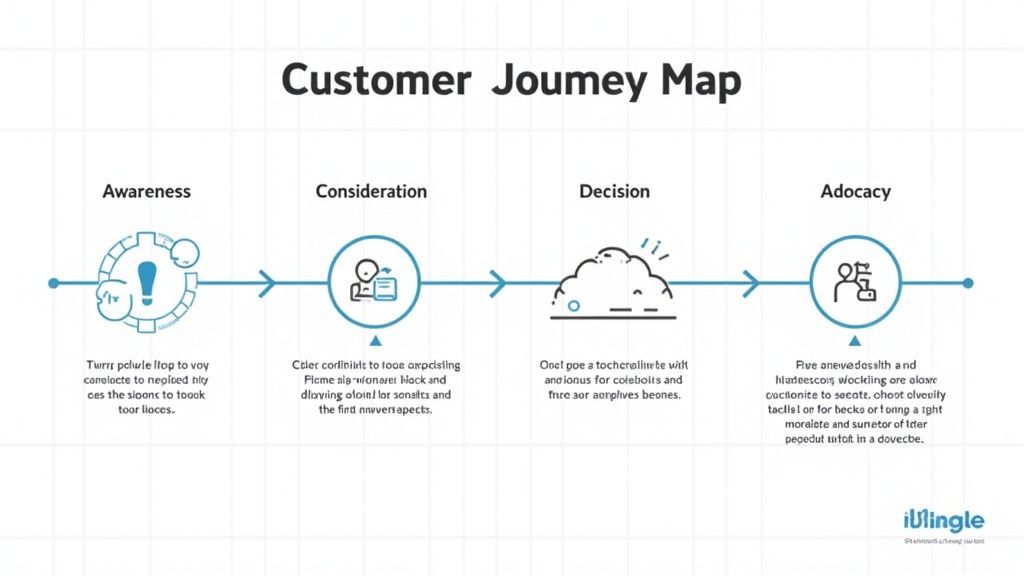
Once your strategy is locked in, the real work begins: mapping your customer's journey. This is where you move from big-picture goals to the nitty-gritty details, making sure every tool you buy has a specific job to do.
Start with the Customer Journey
Think of the customer journey as a roadmap. It details every single touchpoint a prospect has with your company, from the first blog post they read to the day they become a huge fan of your brand.
By sketching this out, you can pinpoint the exact moments where technology can make things smoother, deliver a better experience, or give you the insights you're currently missing.
For each stage, you need to ask some tough questions:
- What is the customer trying to do here? (e.g., learn about different solutions, compare vendors, convince their boss to buy)
- What is our marketing goal at this stage? (e.g., build brand awareness, generate a qualified lead, close the deal)
- What do we need to know about our performance? (e.g., Which channels are actually driving awareness? What content is most persuasive when they're considering their options?)
- What manual work is slowing us down? (e.g., updating lead statuses by hand, sending one-off follow-up emails)
The answers to these questions shine a big, bright light on the gaps in your process. And those gaps are exactly where your martech tools are supposed to fit.
Identify Your Core Functional Needs
With a journey map in hand, you can translate those gaps into specific technology needs. This simple step moves you from a vague wish—"we need a marketing automation tool"—to a concrete business requirement: "we need a tool that scores leads based on their website behavior and syncs that score to our CRM in real-time."
Let's walk through a typical B2B SaaS journey to see how this plays out:
- Awareness Stage: How do prospects discover you even exist? Your needs here might include SEO tools to understand what people are searching for, social media management platforms to share your content, and ad platforms to run paid campaigns.
- Consideration Stage: How do you educate and nurture them? This is where you’ll need a solid CMS for your blog, an email marketing platform for targeted nurture sequences, and webinar software for live demos.
- Decision Stage: How do you help them pull the trigger? A CRM is absolutely essential for tracking deals. You might also want conversation intelligence tools to analyze sales calls or proposal software to make the contract process easier.
- Advocacy Stage: How do you turn happy customers into die-hard fans? This could involve survey tools to get feedback or customer marketing platforms to manage referral and review programs.
By grounding your tech decisions in the customer journey, you make sure that every tool you buy directly supports a business goal. This proactive approach stops you from ending up with a collection of expensive, underused "shiny objects."
This customer-first way of thinking completely changes how you build your marketing tech stack. You're no longer just buying software; you're designing a purpose-built engine to get and keep customers more efficiently. Getting this foundation right makes the next step—picking vendors—so much clearer and more focused.
Choosing the Right Vendors for Your Stack
Once your strategy is mapped out, it's time to step into the wild, crowded world of martech vendors. Picking the right software partners can feel like a huge task, but it's a decision that will shape your team’s daily work and results for years to come. It's easy to get distracted by flashy feature lists, but the real value is hiding in the details.
A tool’s ability to plug into your existing systems is a must-have. If a new platform can’t talk to your CRM or analytics tools, you’re just building another data silo—the exact problem a good stack is supposed to fix. You also need to think about the future. The tool that works for a ten-person startup might completely fall apart at a 100-person company. You need partners that can grow with you.
All-in-One Suite vs. Best-of-Breed Stack
One of the first big debates you'll face is whether to go with an all-in-one suite (like HubSpot) or a “best-of-breed” approach where you pick the top tool for each specific job. An all-in-one platform offers simplicity and a single point of contact, which is a huge plus for smaller teams. Everything is built to work together right out of the box.
On the other hand, a best-of-breed stack gives you incredible flexibility and power. You get to hand-pick the absolute best solution for every single need, creating a custom-built engine that’s perfectly tuned to your strategy. When building your stack, checking out the top data enrichment companies can show you how specialized tools can give you a serious competitive edge.
The trend is pretty clear: 86% of CMOs now prefer a best-of-breed, modular approach to their marketing tech. This strategy allows them to be more agile, letting them swap tools in and out as their needs change.
Key Evaluation Criteria for Vendors
To avoid the pain of buyer’s remorse, create a simple scorecard to grade potential vendors against your most important needs. This forces you to make a data-driven decision, not just go with your gut after a slick demo.
Your evaluation has to go beyond the sales pitch and dig into what it’s really like to be a customer.
Don't just evaluate the software; evaluate the partnership. A vendor’s customer support, training, and product roadmap are just as important as the features they offer today. A great tool with terrible support is a recipe for frustration.
Here are a few essential things to put on your scorecard:
- Integration Capabilities: Does it have native integrations with your core tools (especially your CRM)? If not, does it have a solid, well-documented API?
- Customer Support: What are their support channels (phone, email, chat)? Do they guarantee response times? Look for real customer reviews that talk about their support quality.
- Scalability and Performance: Can the platform handle a huge spike in data and user activity without slowing to a crawl?
- Total Cost of Ownership (TCO): Look past the sticker price. Factor in implementation fees, training costs, and any required add-ons to understand the true investment.
- User Experience (UX): Is the interface intuitive? A powerful tool that no one on your team wants to use is basically worthless.
Ultimately, picking the right vendors is about finding partners that fit both your needs today and your vision for the future. With so many specialized technologies popping up—including the many excellent AI marketing automation tools available—a thoughtful approach to picking vendors will pay off for years to come.
Real-World Examples of Marketing Tech Stacks
Theory is a great starting point, but the real magic happens when you see how marketing tech stacks actually work in the wild. A stack isn't just a shopping list of software; it's a custom-built engine designed to power a specific go-to-market strategy. The tools an early-stage startup needs are a world away from what a global enterprise requires.
Let's walk through three different blueprints. We'll look at the tools, but more importantly, we'll unpack the why—the strategic thinking behind each choice and how they all work together to hit a business goal. Think of these as adaptable playbooks for your own company.
The Lean Startup Stack for Product-Led Growth
An early-stage B2B SaaS company running a product-led growth (PLG) model has one job: get users into the product fast and let the experience do the selling. Their martech stack has to be lean, affordable, and laser-focused on user behavior and automated onboarding. There’s no room for clunky, enterprise-grade software.
This stack is all about being nimble and creating a tight feedback loop between the product and marketing channels.
- Core Hub: A lightweight CRM like the free tier of HubSpot is perfect. It’s the central nervous system for tracking users as they sign up and move toward becoming paying customers.
- Behavioral Analytics: A tool like Mixpanel or Amplitude is non-negotiable. It tells you what users are actually doing inside the product—which features they love, where they get stuck, and what actions lead to an upgrade.
- User Messaging: An in-app messaging tool like Intercom is key for sending automated onboarding tips, feature announcements, and upgrade nudges based on the behavior you're tracking in Mixpanel.
- Web Analytics: Google Analytics provides the basic view of website traffic and what paths lead to a free sign-up.
The strategy is simple: product usage data drives every marketing touchpoint. The whole setup is designed for a seamless, self-service journey from sign-up to paid customer with very little human intervention.
The Mid-Market Stack for Account-Based Marketing
Now, let's switch gears to a mid-market company running an account-based marketing (ABM) strategy. Their goal isn't attracting thousands of individual users; it's about landing and growing a specific list of high-value accounts. Their martech stack needs to be much more robust, built to identify, engage, and measure influence within these key companies.
The global martech market is exploding, projected to rocket from $6.65 billion in 2024 to $15.58 billion by 2030. This growth is fueled by companies in this exact mid-market segment getting serious about their stacks. One study even found that the combination of HubSpot, LinkedIn Ads, and Google Analytics is used by 28.5% of mid-market companies, forming a powerful 'trifecta' for modern B2B marketing. You can find more insights into the B2B martech stacks of 2025 to see how these trends are playing out.
Here’s what their stack might look like:
- Core Hub: Salesforce is often the CRM of choice, providing a powerful system for managing complex accounts, contacts, and opportunities.
- Marketing Automation: A platform like Marketo or HubSpot Marketing Hub (Pro/Enterprise) is crucial for building sophisticated nurture programs targeted at different people within an account.
- ABM & Intent Data: A tool like 6sense or Demandbase is the secret sauce. It tells them which of their target accounts are actively researching solutions like theirs, letting sales and marketing focus their firepower where it will count.
- Ad Platform: LinkedIn Ads is the undisputed king of B2B. It’s used to run hyper-targeted campaigns aimed directly at decision-makers within their named accounts.
- Conversation Intelligence: A tool like Gong or Chorus.ai records and analyzes sales calls, giving marketing priceless insights into the exact pain points and language their target buyers use.
This stack is all about orchestrating a tight-knit play between sales and marketing. Intent data from 6sense tells them who to target, LinkedIn Ads gets the message in front of them, and Marketo nurtures them until they're ready for a sales conversation—all tracked in Salesforce.
The Enterprise Stack for Global Scale
Finally, an enterprise-level company operates on a whole different level of complexity. They’re juggling multiple product lines, serving global regions, and navigating strict data privacy rules. Their stack isn't just about campaigns; it's built for power, scalability, and deep business intelligence.
For an enterprise, the marketing tech stack is less about a collection of tools and more about creating a unified data ecosystem. The focus shifts from campaign execution to governance, attribution, and forging a single source of truth for a massive organization.
- Data Foundation: A Customer Data Platform (CDP) like Segment becomes the central nervous system. It pulls customer data from dozens of sources (web, mobile, support tickets, POS systems) and sends clean, unified profiles to every other tool in the stack.
- Business Intelligence (BI): Tools like Tableau or Looker sit on top of the CDP and CRM, pulling data from across the business to create sophisticated dashboards for the C-suite on pipeline, revenue attribution, and market penetration.
- Project Management & DAM: A robust work management tool like Asana or Jira is needed to coordinate complex campaigns across huge, distributed teams. A Digital Asset Management (DAM) system is also a must-have for managing thousands of approved creative assets.
This enterprise stack is designed for control and insight at scale. The CDP makes sure data is consistent everywhere, the BI tools give executives the 30,000-foot view, and the project management systems keep the global marketing machine humming along.
To make these differences even clearer, here's a side-by-side look at how these GTM motions translate into specific tool choices.
Sample Martech Stacks by GTM Strategy
| Tool Category | Startup (PLG Focus) | Mid-Market (ABM Focus) | Enterprise (Scale Focus) |
|---|---|---|---|
| CRM | HubSpot (Free/Starter) | Salesforce, HubSpot (Pro) | Salesforce, Microsoft Dynamics |
| Analytics | Mixpanel, Google Analytics | Google Analytics, Hotjar | Adobe Analytics, Looker, Tableau |
| Automation | Intercom, Customer.io | Marketo, HubSpot, Pardot | Eloqua, Marketo, Braze |
| Data Platform | (Not a priority) | (Emerging need) | Segment, Tealium, mParticle |
| Ad Tooling | Google Ads, LinkedIn Ads | LinkedIn Ads, 6sense, RollWorks | Demandbase, Google Marketing Platform |
| Creative/Content | Canva, Webflow | Figma, Webflow, Vidyard | Adobe Creative Cloud, Asana, DAM |
| Integrations | Zapier | Zapier, Workato | MuleSoft, Custom APIs |
These are just blueprints, of course. The right stack is the one that directly supports your strategy, grows with your team, and ultimately, helps you hit your revenue goals faster and more efficiently.
Measuring the ROI of Your Martech Investment
Your marketing tech stack isn’t just a collection of software; it’s a serious financial investment. To justify that spend, you have to be able to show leadership a clear return. Proving its value means moving beyond vanity metrics and connecting your technology directly to bottom-line business outcomes.
This all starts with having some ground rules. Without them, you get messy data, low user adoption, and chaos—making it impossible to measure anything accurately. Every single tool in your stack needs a dedicated owner who is responsible for its health, usage, and data quality.
Connecting Tech to Tangible Business Outcomes
The ultimate goal is to shift marketing from being seen as a cost center into a proven revenue driver. This means translating what your software does into dollars and cents. Instead of just reporting on email open rates, you need to show how your automation platform is actually shortening the sales cycle.
Your marketing tech stack should directly influence the metrics your CEO and CFO actually care about. The right dashboards will tell a powerful story of efficiency and growth.
- Lower Customer Acquisition Cost (CAC): Your tools should make every dollar you spend on acquisition go further. An ABM platform, for example, helps you focus your budget on high-value accounts instead of just spraying and praying.
- Higher Customer Lifetime Value (LTV): A CDP lets you create personalized customer experiences. A marketing automation tool can power targeted upsell campaigns. Together, they increase retention and drive more revenue from existing customers.
- Shorter Sales Cycles: Lead scoring and real-time alerts from your marketing automation platform help sales prioritize the hottest leads first, speeding up their journey from prospect to paying customer.
The most effective way to prove ROI is to show how automation and better data are replacing costly, time-consuming manual work. When you can show that your stack saves the team 40 hours per month on manual data entry, you’re speaking the language of business impact.
To nail down the numbers, it’s a good idea to understand how automated processes stack up against the old way of doing things. For instance, you could compare the ROI of CRM automation versus manual data entry to quantify the efficiency gains in a language your finance team will appreciate.
Building Dashboards That Communicate Value
Once you’re tracking the right metrics, you have to present them in a way that leadership can understand at a glance. Don’t just throw raw numbers at them. Build dashboards that tell a story, connecting your team’s daily activities to high-level financial results.
Your ROI dashboard should be a central source of truth that shows how your marketing tech stack is performing. If you're struggling to connect the dots, our guide on how to measure marketing ROI provides a detailed framework for tracking what really matters.
Focus your reporting on a few core areas:
- Efficiency Gains: How many hours of manual work has automation saved? What's the dollar value of that saved time?
- Pipeline Velocity: Has the time it takes to move a lead from MQL to closed-won gone down since you brought in your new tools?
- Campaign Influence: What percentage of revenue can be directly or indirectly tied back to marketing campaigns powered by your stack?
By consistently reporting on these business-focused metrics, you shift the conversation from software costs to investment returns. You prove that your marketing tech stack isn't an expense—it's the engine powering predictable, scalable growth for the whole company.
Martech Stack FAQs
Diving into the world of marketing tech can feel overwhelming. It’s a complex space, but nailing the fundamentals can radically improve your team’s speed and impact. Let’s tackle a few of the most common questions that pop up when people are building and managing a software toolkit.
Think of these as the practical, real-world answers to the hurdles you'll face. The goal is to build a stack that works for you, not against you.
How Do I Start Building a Stack on a Small Budget?
Starting small isn't just possible—it's the smart move. You don’t need a huge budget to build an effective martech stack. The trick is to be ruthless with your priorities and lean on the powerful free and low-cost tools that are out there.
Focus on the absolute essentials that solve your biggest headache right now.
- Foundation First: Get your contacts organized with a free CRM like HubSpot. A single source of truth for customer data is non-negotiable, even in the early days.
- Essential Analytics: Install Google Analytics and a behavioral analytics tool. These are your eyes and ears—they show you how people find your site and what they do once they get there.
- Lean Content & Social: Use a free or cheap CMS like WordPress for your blog. Pair it with a tool like Buffer or the free tier of Canva for social scheduling and basic design.
The goal isn't to buy everything at once. It's to solve your most pressing problem with the most efficient tool possible. As you grow and generate revenue, you can reinvest in more powerful software to tackle the next bottleneck.
When Is the Right Time to Switch a Tool?
Switching software is a heavy lift, so it’s not a decision to take lightly. It’s time to seriously consider a change when your current tool is actively holding you back and creating more problems than it solves.
Watch for these clear warning signs:
- It Can't Scale: Your business is growing, but your software is creaking under the pressure. If performance is tanking or you’re constantly hitting data limits, you need a tool built for your next stage of growth.
- It Lacks Critical Integrations: You’ve brought in a new core system (like a CRM), but a key tool in your stack can't talk to it. This creates data silos and manual work, completely defeating the purpose of having an integrated stack.
- The Team Hates Using It: A powerful tool nobody uses is just expensive shelfware. If your team finds the UI clunky, confusing, or slow, their productivity will drop, and you’ll never see an ROI.
How Do I Ensure My Team Actually Uses the New Software?
Adoption is everything. The most elegant martech stack on earth is worthless if your team won’t touch it. Driving adoption takes a thoughtful approach that goes way beyond just sending out login credentials.
First, involve your team in the selection process. People are far more likely to get behind a tool they had a say in choosing. Next, assign a clear "owner" for each platform—a go-to expert who can answer questions and champion its use. Finally, make training an ongoing priority, focusing on how the tool solves specific, real-world problems your team faces every single day.
Building and optimizing a marketing tech stack is a continuous journey. If you need expert guidance to align your tools with your GTM strategy, Value CMO provides the fractional leadership to build a growth engine that delivers real results. Learn how we can help you accelerate your pipeline.