Stop guessing what your marketing team should look like. A modern marketing teams structure isn't some rigid org chart you pull from a textbook; it's a living, breathing framework designed to do one thing: connect every single marketing activity directly to revenue.
The right structure is all about where your company is on its journey. It has to evolve, growing from a single, do-it-all marketer into specialized, data-driven teams as your company scales.
Your Blueprint for a Revenue-Focused Marketing Team
Think of this as a practical playbook for tech founders who need a clear path to building a marketing function that actually drives the business forward. We're skipping the abstract theories and getting straight to the specific roles, structures, and strategies that actually work at each stage of a company's growth.
Forget the siloed departments of the past. Today's best teams are nimble, data-informed, and built to adapt on the fly. This is all about making smart, strategic calls that tie your team's design to your biggest business goals.
Why Structure Matters More Than Ever
In the early days, "marketing" might just be you hammering away on a LinkedIn account. But as you grow, an intentional structure becomes non-negotiable. Without it, you're just signing up for chaotic execution, wasted cash, and a team that’s busy but not actually being productive.
A well-designed marketing teams structure creates clarity and focus. It ensures every role has a real purpose and every task supports the bigger mission. This alignment is the heart and soul of any successful growth engine. For a deeper dive on this, our guide on developing a https://valuecmo.com/b-2-b-marketing-strategy-framework/ provides the context you need to align your team's efforts with your business goals.
The Building Blocks of a Modern Team
The goal here isn't just to fill seats. It's to build a tight-knit unit that gets results. As you start sketching out your blueprint, it's a good idea to understand the fundamentals of how to build high-performing teams, which gets into the human dynamics that make any structure successful.
Here’s a quick look at what we'll cover:
- Making Your First Hire: Nailing the key skills you need in that crucial first marketer.
- Scaling with Specialists: Knowing when it's time to bring in dedicated pros for SEO, content, and demand gen.
- Designing for Growth: Structuring your team to go from a scrappy startup to a global force.
The ultimate goal is to create a marketing organization that is not a cost center, but a predictable and scalable revenue driver. Every decision you make about your team's structure should be viewed through that lens.
Finding Your Footing in the Early Stages
In the very beginning, your marketing "team" is probably just you—a founder with a laptop and a whole lot of hustle. The focus is singular: find that elusive product-market fit. But once you have that initial traction, that flicker of demand, it's time to bring in your first dedicated marketing hire.
This is a make-or-break moment.
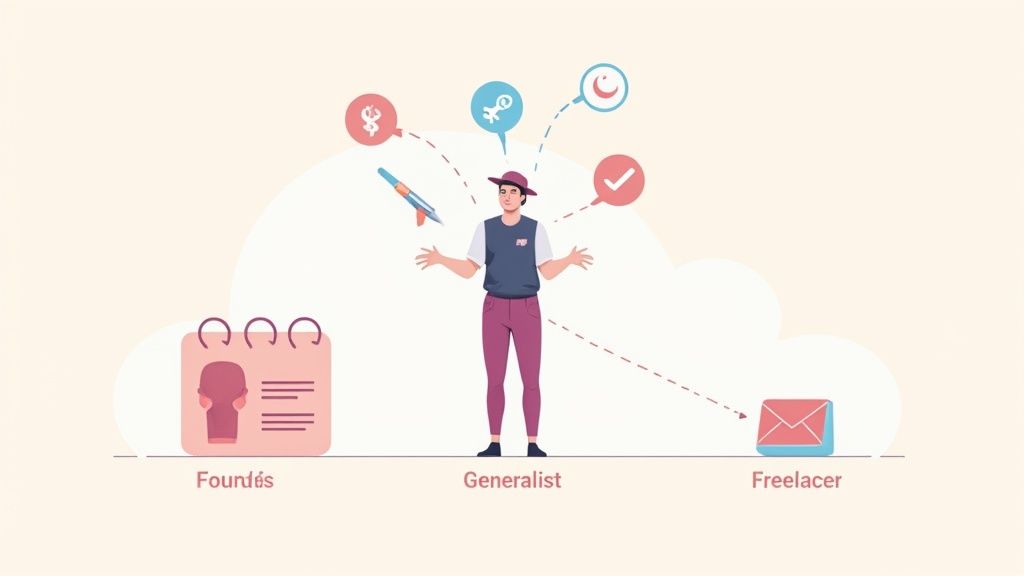
So, who do you hire? Forget the hyper-specialized SEO guru or the paid ads wizard for now. Your first hire needs to be a Marketing Generalist—a versatile player who can wear multiple hats and isn't afraid to get their hands dirty. Think of them as a marketing Swiss Army knife.
This person is your foundation. They'll be the one writing your first blog posts, getting your social media presence off the ground, setting up basic email campaigns, and dipping their toes into SEO. They're less about deep expertise in one area and more about having broad shoulders to carry a lot of different tasks well.
The Profile of Your First Marketing Hire
Finding the right generalist is more about mindset and adaptability than a specific resume. You're looking for a "doer"—someone curious, resourceful, and who thrives in a slightly chaotic environment where priorities can shift daily. They need to be comfortable experimenting, measuring what happened, and learning on the fly.
Here’s what to look for in your ideal candidate:
- T-Shaped Skills: They have a solid grasp of multiple marketing channels (the top of the "T") but might have slightly deeper experience in one or two areas, like content creation or community management.
- Strong Writing Chops: Clear, compelling writing is non-negotiable. They'll be crafting everything from website copy to sales emails, and their ability to communicate your value is critical.
- A Bias for Action: In an early-stage startup, momentum is everything. You need someone who executes quickly, learns from the results, and iterates without needing constant hand-holding.
- Data Curiosity: They don't need to be a data scientist, but they should be comfortable digging into Google Analytics to figure out what's working and what's not.
Startups with 1-10 employees often rely on just one or two of these versatile players. It's an ultra-lean approach, but these small teams are absolutely essential for managing both strategy and execution across all channels within a tight budget.
Before we move on, let's look at how this role fits into the first couple of funding stages.
Your First Marketing Hires by Funding Stage
The table below breaks down what your marketing team might look like as you move from Seed to Series A. It shows how the focus shifts from finding initial traction to building a repeatable growth engine.
| Stage | Team Size | Key Roles | Primary Focus | Core KPIs |
|---|---|---|---|---|
| Seed | 1-2 | Marketing Generalist, Freelancers (Design, SEO) | Product-market fit, generating first leads, brand awareness | Website Traffic, MQLs, Social Engagement, First 100 Customers |
| Series A | 2-5 | Head of Marketing, Content Marketer, Demand Gen Specialist | Building repeatable channels, scaling lead gen, creating a content engine | Pipeline Value, SQLs, Cost per Acquisition (CPA), Conversion Rates |
As you can see, the team evolves from a single "doer" to a small, more specialized group focused on predictable growth.
Using Freelancers and Fractional Help to Stay Agile
Even the best generalist can't do it all. That's where strategic outsourcing comes in. Instead of hiring full-time specialists you don't need yet, you can plug specific skill gaps with freelancers.
A common mistake is trying to hire a senior strategist for an individual contributor's salary. A much better move is to hire a great generalist for execution and supplement their work with specialized contractors for things like graphic design, technical SEO audits, or video production.
This hybrid model keeps your burn rate low while giving you access to top-tier talent on demand. It lets your generalist focus on core activities while experts handle specialized projects.
Another smart move is bringing in strategic oversight without the commitment of a full-time executive. If you need high-level marketing strategy but aren't ready for a six-figure salary, you should explore the benefits of a fractional CMO to guide your early efforts. This gives you C-suite-level thinking on a startup-friendly budget, helping you build a solid foundation for the growth to come.
Scaling Your Demand Generation Engine for Growth
So, you’ve hit product-market fit. The early wins are on the board, and you can feel you’re onto something big. This is the moment to pour fuel on the fire and build a predictable revenue engine. But doing that requires a major shift in your marketing teams structure, moving away from adaptable generalists and toward focused specialists.
The scrappy, do-it-all approach got you here, but it won’t get you to the next level. To scale, you need to build a machine. That means creating dedicated roles that own specific parts of the customer journey, making every effort deliberate, measurable, and repeatable. It's about designing a team for efficient, predictable growth.
From Generalist to Specialist: The Big Transition
Once your company hits this inflection point, the solo Marketing Generalist becomes a bottleneck. They simply can’t go deep enough on every channel to truly optimize performance. This is where specialization becomes your secret weapon.
Instead of one person juggling everything, you’ll start building out the core pillars of a modern marketing function.
- Demand Generation: This is the engine room, totally focused on creating a predictable pipeline of qualified leads.
- Content Marketing: The voice of your company, responsible for assets that attract, educate, and convert your ideal customers.
- Product Marketing: The critical bridge between your product and the market, making sure your message lands and your sales team is armed to win.
This isn’t just about adding headcount; it’s a strategic redesign of how marketing operates. It’s about creating deep expertise and clear ownership where it matters most.
Assembling Your Growth Stage Marketing Team
Building out this specialized team means hiring for specific roles that map to your new structure. Your goal is a small team of experts who can go deep in their respective domains. A typical 5-10 person team at this stage is built for precision.
Here are the key roles you need to hire:
- Demand Generation Manager: This person owns the lead number. Period. They manage campaigns across paid search, paid social, and email with a relentless focus on MQLs, SQLs, and pipeline.
- Content Marketing Manager: More than a writer, this person is a strategist. They own the content calendar, manage blog production, create lead magnets like ebooks and webinars, and work hand-in-glove with SEO to drive organic traffic.
- SEO Specialist: This role is laser-focused on getting you found on Google. They handle everything from keyword research and on-page optimization to technical SEO and link building, turning your website into an inbound lead machine.
- Product Marketing Manager: This person becomes the expert on your customer and the competitive landscape. They craft positioning, create sales collateral like case studies and datasheets, and manage product launches for maximum impact.
The real magic happens when these specialists stop working in silos and start operating as a cohesive unit. A great Content Manager doesn't just write; they create assets that the Demand Gen Manager uses in campaigns, which are informed by the Product Marketer's customer insights.
This interconnected approach is everything. To see how these pieces fit together, our guide on B2B demand generation best practices provides a detailed look at building a cohesive strategy.
The Power of the Pod Structure
As you grow, one of the most effective ways to stay agile is by organizing your specialists into "pods." A pod is just a small, cross-functional team that owns a specific goal. For example, you might create an "Inbound Lead Pod" dedicated to converting website traffic into pipeline.
This pod could include:
- The SEO Specialist to drive organic traffic.
- The Content Marketing Manager to create the blog posts and landing pages.
- The Demand Generation Manager to run retargeting ads and nurture the leads.
This structure absolutely demolishes departmental walls, forcing collaboration and shared ownership over a key business metric. The team wins or loses together, which creates incredible focus and accelerates learning. This is how you build a marketing teams structure that isn't just an org chart—it's a dynamic framework for getting results.
Structuring a Global Enterprise Marketing Organization
When you cross the chasm from a scrappy growth-stage company to a global enterprise, the marketing team you built starts to feel the strain. Suddenly, you're not just running a few campaigns; you're juggling multiple product lines, catering to entirely different international markets, and managing a headcount that’s ballooned.
That agile, pod-based structure that got you here? It needs to evolve. What comes next is a more sophisticated, specialized organization designed for scale, stability, and predictability.
This is where the marketing function truly comes into its own, becoming a central pillar of the business. The leadership structure solidifies with a Chief Marketing Officer (CMO) at the helm. Reporting up to the CMO are Vice Presidents (VPs) who own major functional areas like Demand Generation, Brand, and sometimes Regional Marketing.
At this scale, you can’t afford to have roles that blur at the edges. Clarity and deep functional expertise become the currency of success.
The Rise of Specialized Leadership Tiers
Beneath the VPs, another layer of Directors emerges to lead specific, high-impact teams. These are the leaders who own the day-to-day execution and strategy for critical channels. An enterprise org chart isn't just bigger; it's deeper, with clear lines of authority and responsibility.
You’ll see a CMO leading a team of Division Leaders—think an SEO Director, Paid Media Director, Brand Director, and maybe even an Analytics & AI Director. This core group is supported by VPs for Global or Regional Marketing (like EMEA or APAC), a Director of Marketing Operations, a Head of Content, and multi-member teams for SEO, PPC, and social media. If you want to dive deeper into these frameworks, MarketerHire offers more insights on complex digital marketing team structures.
This level of specialization allows for mastery. Your SEO Director is no longer just thinking about keywords; they’re building a global organic traffic strategy. Your Paid Media Director is managing multi-million dollar budgets across dozens of platforms and regions, optimizing for incredibly nuanced customer journeys.
Marketing Operations: The Central Nervous System
One of the biggest shifts in an enterprise marketing teams structure is the formal arrival of Marketing Operations (MOPs). At smaller companies, MOPs is often a shared hat or one person's side project. In an enterprise, it becomes the indispensable central nervous system of the entire marketing organization.
The MOPs team is the glue holding everything together. They are responsible for:
- The MarTech Stack: Managing and integrating the complex web of technologies, from your marketing automation platform and CRM to analytics tools and ABM software.
- Data and Analytics: Ensuring data hygiene, building the dashboards, and providing the measurement framework that tells everyone what’s working and what isn’t.
- Process and Workflow: Standardizing how campaigns are launched, leads are managed, and budgets are tracked to ensure efficiency and consistency at scale.
Without a strong MOPs function, an enterprise marketing team grinds to a halt. They are the guardians of your data, the architects of your tech stack, and the enablers of scalable, repeatable marketing programs.
This hierarchy shows how specialized roles like demand gen and content eventually report up to a central leader, creating clear lines of ownership.
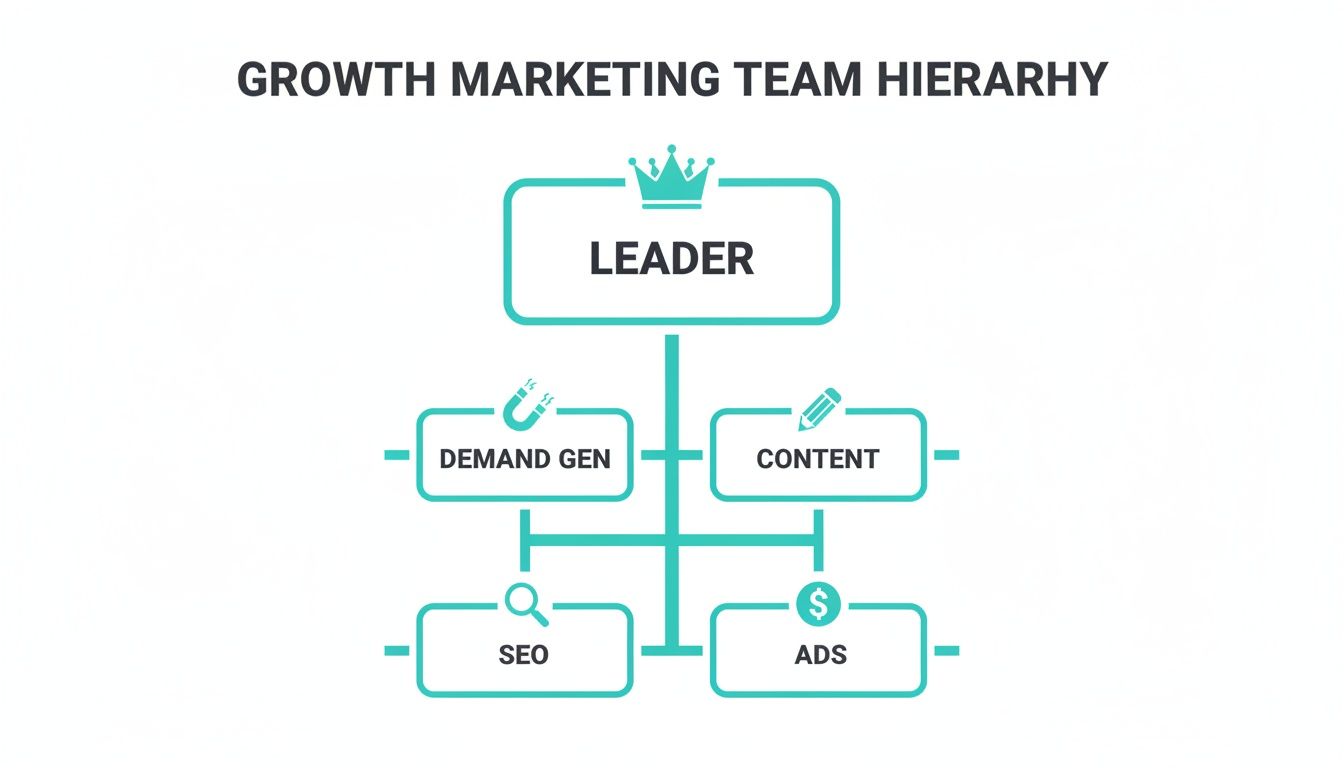
This model reinforces the core principle of an enterprise structure: a clear chain of command with specialized teams executing distinct functions like SEO and paid ads under a unified strategy.
Maintaining Agility in a Large Organization
A common fear among founders is that scaling to an enterprise structure means becoming slow and bureaucratic. It's a valid concern, but it's not inevitable. The key is building a framework that encourages communication and collaboration across these specialized teams, not just within them.
Modern enterprises stay nimble by:
- Establishing Cross-Functional Centers of Excellence (CoEs): These are groups of experts from different teams (e.g., SEO, content, product marketing) who meet to share best practices and tackle specific challenges.
- Adopting an Agile Marketing Framework: Using sprints and stand-ups, borrowed from software development, to manage complex projects and adapt quickly to market feedback.
- Investing in Internal Communication: Making sure the Brand team's narrative is understood by the Demand Gen team, and that Product Marketing's insights are shared with the Content team.
The goal isn't to recreate the scrappy chaos of a startup. It's to build a robust, scalable marketing teams structure that can execute complex global campaigns with precision—while still being able to pivot when a new opportunity emerges. This balance of structure and flexibility is the hallmark of a world-class enterprise marketing organization.
Building a Modern Hybrid Team with AI
The old playbook of a fully in-house marketing team is collecting dust. The smartest marketing teams structure today is a hybrid one, blending a core group of in-house strategic thinkers with a flexible network of outside specialists. This isn't just a trend; it's a strategic necessity in a market that changes by the quarter.
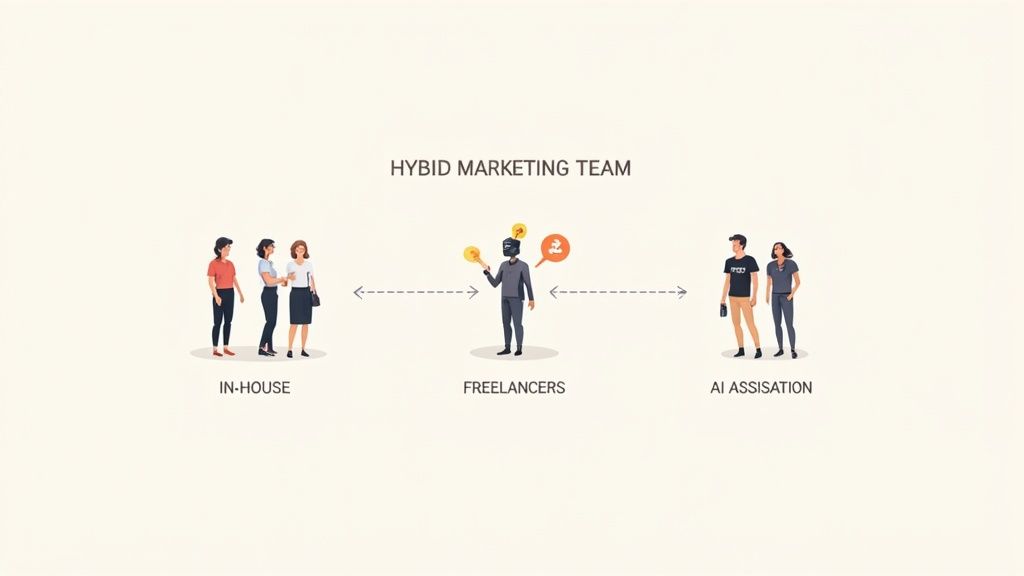
This modern setup lets you bring in deep expertise on demand—think AI and automation—without the hefty price tag of another senior salary. It’s about being smart with your capital. You keep the brand DNA and core strategy in-house while outsourcing execution to build a machine that’s both scalable and cost-efficient.
The Strategic Shift to Hybrid Teams
Hybrid teams are fast becoming the default setting for good reason. It’s a move away from the clunky, old-school model where in-house people did the thinking, agencies did the executing, and freelancers just picked up the overflow.
This shift directly tackles today’s biggest headaches: the shortage of talent in niche areas like AI, the sky-high cost of senior hires, and the breakneck speed of platform changes. If you want to dig into the numbers, you can discover more insights about the 2025 marketing team shifts.
This model isn't just about saving money; it's about agility. When a new channel explodes or a new AI tool changes the game, a hybrid team can bring in a specialized contractor tomorrow. You don't have to spend six months trying to hire a full-time expert.
AI Isn’t Replacing Your Team—It’s Supercharging It
The talk around AI in marketing is usually framed by fear. Will it replace us? The reality is far more interesting. AI isn't here to take jobs; it’s here to augment your best people, turning good marketers into great ones.
It automates the tedious, soul-crushing tasks that kill creativity, freeing up your team for the high-level strategic work that actually moves the needle.
Think about it this way:
- Content Ideation: AI can chew through search trends and competitor content to spit out hundreds of solid blog ideas in minutes. Your content manager can then focus on crafting the perfect narrative.
- First Drafts: Generative AI can produce a decent first draft of ad copy, social posts, or an email sequence, cutting the initial writing time by 70-80%.
- Data Analysis: Instead of getting lost in spreadsheets for hours, your team can use AI to instantly spot performance trends, identify the best audience segments, and get solid recommendations for what to do next.
AI handles the "what" and the "how," freeing up your team to focus on the "why." It automates the mechanics of marketing so your people can apply human judgment, creativity, and strategic thinking where it matters most.
This creates a "superpowered" marketing function where a small, sharp team can deliver the output of a much larger one. For any team looking to get more efficient, exploring AI automation strategies is no longer optional—it's essential.
Deciding What to Keep In-House vs. Outsource
A successful hybrid team comes down to one thing: making smart calls on what to keep close and what to hand off. The rule of thumb is simple. Protect your core strategic advantages and outsource tasks that are highly specialized, repetitive, or require skills you don't need on the payroll 40 hours a week.
Here’s a practical guide for making those calls.
In-House vs. Outsourced Marketing Functions
Deciding where to draw the line between your core team and external partners is critical. This table breaks down common marketing functions to help you build a balanced, high-performance hybrid model.
| Marketing Function | Best Kept In-House | Ideal to Outsource | Key Consideration |
|---|---|---|---|
| Brand & Strategy | Yes | No | Your brand voice, positioning, and core marketing strategy are the heart of your company. This must be owned internally. |
| Product Marketing | Yes | No | Deep product knowledge and customer intimacy are non-negotiable. This function must live and breathe your product. |
| Content Strategy | Yes | Execution | Keep the strategy (topics, themes, calendar) in-house, but outsource the creation of articles, ebooks, or case studies to freelance writers. |
| Technical SEO | No | Yes | Technical audits and complex site migrations are project-based. Outsource to a specialist agency or freelancer for maximum impact. |
| Graphic Design | No | Yes | Unless you have a constant, high-volume need, it's more efficient to use freelancers or a subscription service for design work. |
| Paid Media Mgmt | Both | Yes | You can outsource the day-to-day campaign management, but an in-house lead should oversee budget, strategy, and performance. |
Ultimately, this hybrid marketing teams structure, amplified by AI, is the blueprint for the future. It’s scalable, cost-effective, and incredibly resilient—giving you the agility to adapt to whatever the market throws your way.
Common Questions on Structuring Your Marketing Team
As you start mapping out your marketing team's evolution, a few questions always seem to pop up. You’re not the first founder to wonder about the perfect headcount ratio or the right moment to bring in a senior leader. Getting these calls right can be the difference between stalling out and hitting your next growth target.
Let's tackle some of the most common questions tech leaders face when building their teams. I'll give you clear, actionable advice to help you move forward with confidence.
What Is the Ideal Marketing to Sales Headcount Ratio?
This is the million-dollar question, and the honest-to-goodness answer is: it depends. There’s no universal magic number, but I can give you a solid benchmark.
For most high-growth B2B tech companies, a 1:3 ratio of marketing to sales is a great starting point. In the very early days, when your sales team is small and scrappy and doing tons of outbound, it might look more like 1:5.
But as your marketing engine matures and starts pumping out a steady stream of quality inbound leads, that ratio will naturally shift. It’s not uncommon to see it tighten up to 1:2. The biggest factor here is your go-to-market motion. An inbound-heavy strategy demands more marketing muscle. An all-in, enterprise sales-led model? Your headcount will always lean more toward sales.
When Should I Hire a Fractional CMO?
A fractional CMO can be an absolute game-changer for early-stage companies. It’s the perfect move when you desperately need C-suite strategic thinking but can't justify a full-time executive salary just yet.
Think of them as your strategic architects. They’ll build your initial roadmap, set up foundational processes, and help you hire your first one or two marketers. They get the plane off the ground.
You should start seriously considering a full-time Director or VP of Marketing once you have a team of 3-5 people in place. At that point, you need dedicated, day-to-day leadership to manage the team, own a real revenue number, and drive execution.
The full-time leader takes the controls once the plane is in the air and flying steady.
How Does ABM Change My Team Structure?
Switching to an account-based marketing (ABM) strategy isn’t just a tactical shift—it requires you to fundamentally rethink how your team is organized. An effective ABM structure is all about demolishing the silos between marketing and sales.
The pod model is hands-down the best way to do this.
A typical ABM pod looks something like this:
- A dedicated ABM Manager who acts as the quarterback, orchestrating the entire play.
- A Content Marketer focused on creating personalized assets for your target accounts.
- A Digital Marketing Specialist who runs hyper-targeted ad campaigns and digital experiences.
This small, focused marketing pod is then paired directly with a specific group of Account Executives (AEs) and Sales Development Reps (SDRs). This tight-knit structure ensures everyone is aiming at the same targets, speaking the same language, and—most importantly—measured by the same metrics, like target account engagement and pipeline.
Building the right marketing teams structure is a critical step in scaling your B2B tech company. If you need expert guidance to design your team, build a revenue-focused strategy, or bridge a leadership gap, Value CMO provides the senior marketing leadership you need without the full-time overhead. Let’s build your growth engine together.