Think of your marketing team structure as the blueprint that defines roles, workflows, and decisions in your department. Choose the right setup, and you’ll swap chaos for smooth collaboration—and give your growth engine a serious boost. In fact, over 70% of startups report faster campaign launches after they’ve reorganized their teams.
Why Structure Matters For Marketing Teams
If you’re a B2B tech founder, hiring marketers can feel like building a puzzle without the picture on the box. You end up with generalists wearing too many hats, and budgets are so tight it’s tough to bring in specialists. The result? Silos pop up, handoffs get messy, and campaigns slow to a crawl.
In this guide, we’ll walk through six battle-tested models—functional, product, pods, hub-and-spoke, matrix, and hybrid agency-in-house. You’ll weigh speed versus deep expertise, see startup versus scale-up criteria, and dive into real-world examples to inform your next reorg.
- Generalists juggling 10+ tasks at once
- Silos that stall approvals
- Overlapping responsibilities triggering duplicate work
- Decisions dragging out when ownership isn’t clear
Common Marketing Team Challenges
Imagine your marketing crew as a busy restaurant kitchen. At first, everyone pitches in on every dish. But once orders stack up, you need dedicated stations—prep, grill, plating—to keep service flowing.
That same logic applies here. A functional team feels like those kitchen stations, each focusing on one skill. Pods are more like a food truck squad—everyone pitching in on every step, from prep to delivery.
Let’s break it down:
Key Insight: The right marketing team structure can cut campaign launch time by up to 30% and boost cross-team communication.
Next up, we’ll unpack each model in detail—complete with sample org charts, role overviews, and hiring pointers for B2B tech environments. Later, we’ll tackle KPI alignment and tool recommendations tailored to your chosen structure. Follow this roadmap and you’ll sidestep common pitfalls, building a marketing engine that scales as you grow.
What You’ll Learn
Here’s what’s coming up:
- Functional teams with clear roles and strong specialization
- Product teams dedicated to a single offering
- Pods that unite creative, analytics, and execution
- Hub-and-spoke setups where a central core supports specialized branches
- Matrix structures with dual reporting for ultimate flexibility
- Hybrid agency-in-house squads acting like an internal creative studio
Understanding Common Marketing Team Structures
Think of picking a team structure as organizing a kitchen before dinner service. You need clear stations, smooth handoffs, and the ability to roll with sudden orders. Get it right, and campaigns flow; get it wrong, and everything backs up.
Below, we unpack six common models—functional, product/segment, pods, hub-and-spoke, matrix, and hybrid in-house agency—to help B2B tech startups and scale-ups find their sweet spot.
Key Metaphors For Each Model
Think of each structure like a different foodie scenario:
- Functional Teams feel like a fine-dining kitchen with dedicated stations for SEO, content, and performance. Each specialist hones one craft, keeping quality tight but demanding tight coordination.
- Product/Segment Teams resemble a café centered on its signature dish. The crew owns that recipe end-to-end—deep expertise but possible duplication across offerings.
- Pods are like a food truck crew handling everything from menus to money. Designers, copywriters, analysts, and sales pros collaborate side by side for lightning-fast campaigns.
- Hub-And-Spoke setups mirror a central commissary supplying satellite kitchens. Core strategists define the menu, then local teams adapt it to regional tastes.
- Matrix Structures feel like pop-up events where chefs answer to both a head chef and an event planner. Flexible, but you need clear rules to avoid confusion.
- Hybrid In-House Agencies act like an internal studio. They blend agency workflows with deep product know-how, delivering high-impact campaigns in-house.
Infographic Of Structure Trade-Offs
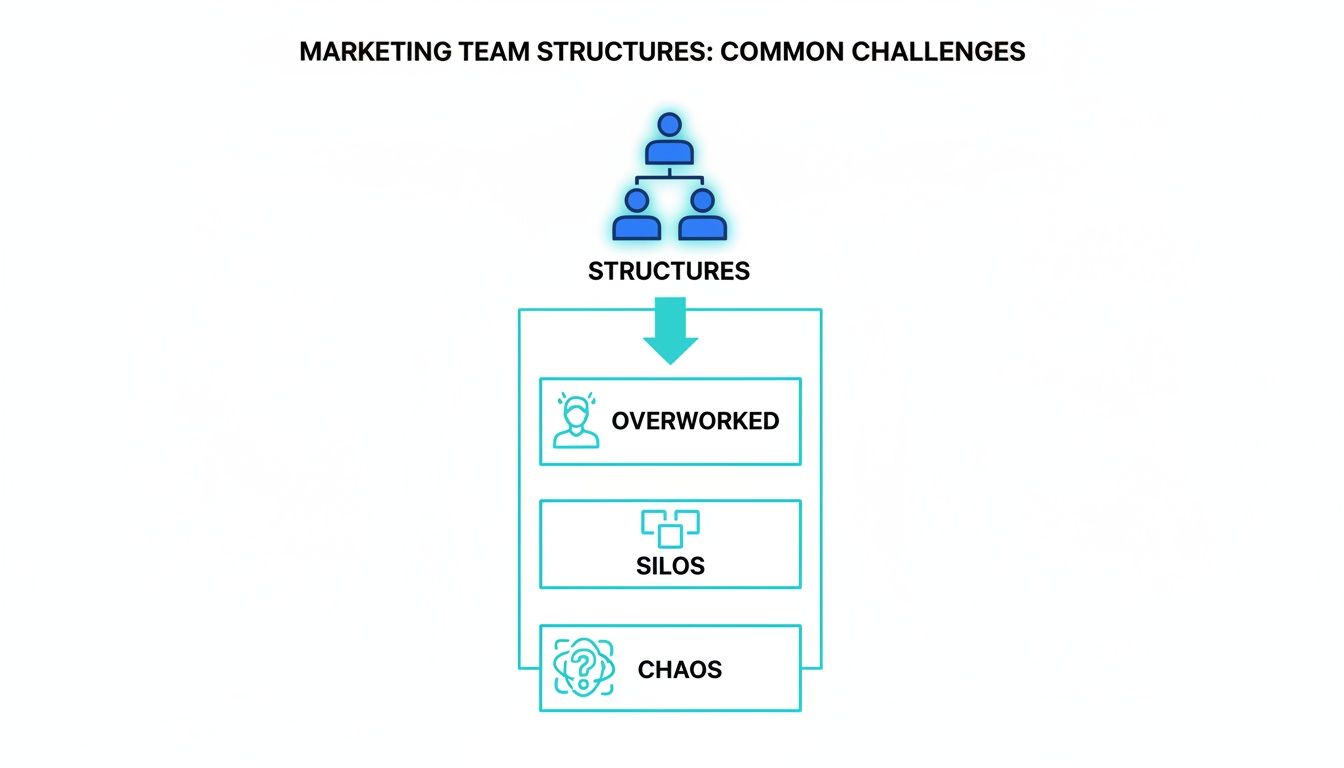
This graphic highlights how each arrangement handles workload spikes, silo risks, and handoff complexity.
Common Marketing Team Structures Comparison
Here’s a side-by-side look at how these six setups stack up on team size, focus, and ideal scenarios in B2B tech.
| Structure | Description | Typical Team Size | Best For |
|---|---|---|---|
| Functional | Specialized groups by skill area | 5–15 | Lean startups needing deep expertise |
| Product/Segment | End-to-end teams owning each product or customer group | 8–20 | Firms with multiple offerings |
| Pods | Cross-functional squads owning full campaign lifecycle | 6–12 | Agile environments demanding speed |
| Hub-And-Spoke | Central strategy hub with regional or segment branches | 10–25 | Scale-ups expanding into new markets |
| Matrix | Dual reporting across function and product dimensions | 20–35 | Complex portfolios requiring fluid resourcing |
| Hybrid In-House Agency | Internal studio delivering agency-style creative projects | 7–15 | Brands craving creative intensity and context |
Use this table to eyeball which model aligns with your headcount and growth plan. Piloting a single pod or product team can surface challenges early and keep momentum high.
Sizing Insight: Once marketing headcount passes about 30, many B2B tech companies introduce formal layers—often at a 1:4 ratio of managers to executors. For more on evolving your structure, check out FloowiTalent’s Marketing Org Structures Guide.
Tips For Selecting The Right Structure
- Start with your pain points: Are handoffs slowing you down or analytics stuck in silos?
- Map products and segments to decide where dedicated teams make sense.
- Balance budget and speed: Smaller squads often rely on multifunctional generalists.
- Always pilot before a full rollout—collect feedback and tweak roles to avoid disruption.
Next, we’ll dive into the playbook for choosing and rolling out these models in your organization.
Comparing Trade-Offs for B2B Tech Startups and Scaleups
In the early days of a B2B tech startup, scrappiness is your secret weapon. A small crew juggles strategy, execution, and reporting all at once. But when you shift into scale-up mode, you need a new game plan. Suddenly, more moving parts call for clearer roles and tighter processes.
Take NovaTech, for instance. They kicked off with a classic functional setup—one person owns paid ads, another cranks out content. Three months in, they pivoted to outcome-driven pods. The result? Campaigns launched faster and team morale jumped.
Pods are like a well-rehearsed band: each specialist handles drums, bass, and vocals—covering every track on the album. Scale-ups often favor a matrix design, filing resources by both function and product line to keep hires in check.
| Aspect | Startup | Scaleup |
|---|---|---|
| Team Size | 2–10 | 15–50 |
| Resource Flexibility | High | Moderate |
| Decision Speed | Lightning Fast | Structured |
| Risk Tolerance | High | Lower |
Startup Versus Scaleup Challenges
Pre-product-market-fit startups prize speed and learning over formality.
- Balancing generalist flexibility with specialist depth can stretch a tiny headcount.
- Rapid iteration often outpaces solid documentation.
- Lean budgets leave little room for error—and increase burnout risk.
Scale-ups wrestle with a different beast: multiple products, new markets, and bigger budgets. They need structure to avoid duplicating work.
“Moving to pods cut our go-to-market time in half and kept creativity high,” says the VP of Marketing at CrispTech.
Common Pitfalls for Startups and Scaleups
- Siloed analytics can stall decisions by 15+ days.
- Generalists juggling 10+ tasks risk losing focus.
- Overlapping campaign requests from different pods lead to missed deadlines.
Spotting and fixing these issues early saves you friction as your team grows.
Pods in Action
NovaTech’s pivot is far from a one-off story. Since 2019—and accelerating into 2025—marketing orgs have been ditching rigid silos. Agile, customer-journey squads (pods) unify creative, data, performance, and product expertise under one roof.
A lot of teams report a 20–40% drop in campaign delivery times once they adopt outcome-based pods. Learn more in Incremental’s 2025 Marketing Team Report.
Each squad:
- Owns the entire campaign lifecycle
- Manages budgets, assets, and messaging
- Iterates based on real-time feedback
Functional Vs. Pods Vs. Matrix
| Structure | Strengths | Trade-Offs |
|---|---|---|
| Functional | Clear specialization and efficient focus | Slow handoffs; siloed communication |
| Pods | Faster delivery; end-to-end ownership | Requires mature cross-functional skills |
| Matrix | Flexible resource allocation | Dual reporting can confuse priorities |
When Matrix Structures Shine and Falter
Matrix designs help scale-ups share talent—analysts, designers, and more—across multiple product lines without constant rehires.
- Shared resources can boost efficiency by up to 25%.
- Conflicting priorities pop up if roles aren’t crystal-clear.
- Regular syncs and RACI charts help keep everyone on the same page.
By defining escalation paths and documenting responsibilities, you stay nimble instead of chaotic.
Decision Guidelines for Your Stage
- Choose pods when speed is your north star and teams can self-organize.
- Stick to a functional model if deep expertise and a tight budget are non-negotiable.
- Adopt a matrix when you juggle multiple products but want to avoid constant hiring.
Every organization’s journey is unique. But understanding these trade-offs lets you pilot the right structure. Test small squads, measure outcomes, then iterate before scaling.
How To Choose The Right Marketing Team Structure
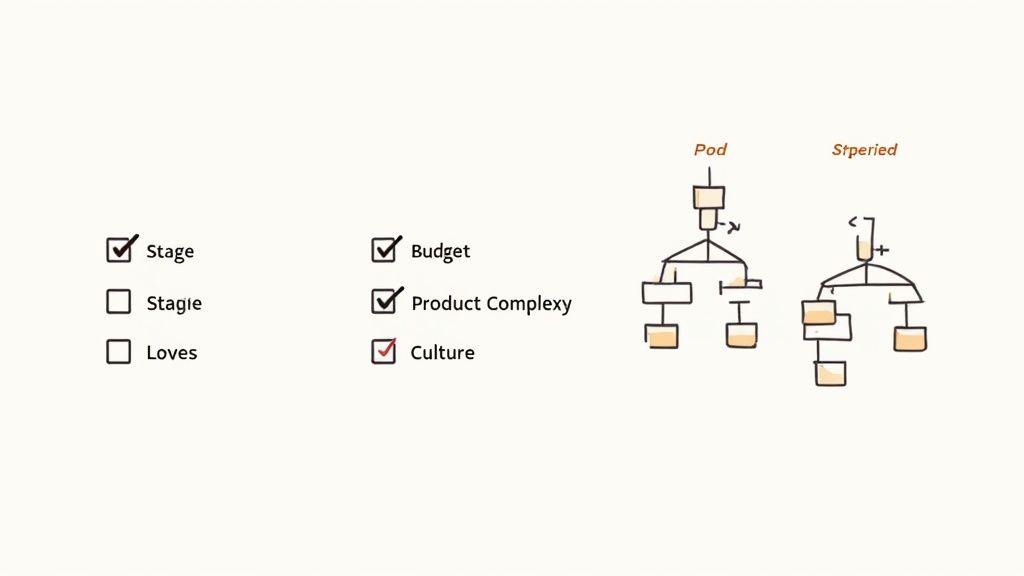
Let’s make this easy. Choosing the right marketing setup starts with an honest look at where you are—and where you want to go. Misaligned teams slow campaigns and drain budgets.
Our framework walks you through five critical criteria—Stage, Budget, Culture, Complexity, and Priorities—using a diagnostic checklist to score your needs for speed, specialization, and cross-team coordination.
- Stage Classification: Pre-product-market fit, hyper-growth, or enterprise?
- Budget Capacity: Can you afford specialists or should you lean on contractors?
- Cultural Fit: Do people thrive in small, autonomous pods or under a central leader?
- Product Complexity: One offering or many lines—this drives product-focused squads versus broad functions.
- Coordination Demand: How many handoffs happen? That decides between functional, matrix, or integrated teams.
Assess Stage And Budget
First, plot your current headcount against runway and goals. Startups under 10 marketers often sprint with pods or functional teams because fewer layers mean faster decisions.
Once you hit around 15 marketers, many scale-ups shift to matrix or hub-and-spoke to manage multiple products without chaos.
| Model | Headcount Range | Best Use |
|---|---|---|
| Functional | 3–10 | Deep expertise on tight budgets |
| Pods | 5–12 | Rapid, autonomous campaigns |
| Matrix | 15–30 | Managing multiple product lines |
Map Current To Target Roles
Next, sketch your org chart. A 12-person functional team might include a head of SEO, content lead, performance manager, and two channel specialists.
By contrast, an eight-person pod brings together designer, analyst, copywriter, and growth manager under one leader—everyone shares goals and moves quickly.
- Audit existing roles and note core responsibilities.
- Identify gaps between today’s team and your ideal structure.
- Reassign or recruit to fill those mission-critical spots.
Calculate Spans Of Control
Healthy spans of control give teams autonomy without leaving them adrift. Aim for one manager per 4 executors to keep approvals quick and oversight effective.
Push spans too wide, and bottlenecks stall launches. Make them too narrow, and you’ll bloat headcount.
“When we tightened our managerial span to one-to-four, campaign approvals moved 35% faster,” shares a fractional CMO partnering with B2B tech teams.
Watch for common pitfalls:
- Handoff Delays slowing down launches
- Role Overload burning out generalists
- Duplicate Efforts repeating work
- Visibility Gaps hiding key metrics
Plug leaks by mapping processes, setting clear ownership, and reviewing spans every quarter. For more on interim leadership or fractional models, check our guide on hiring a fractional CMO.
Best Practices For Structure Choice
Run a pilot before you flip the switch. Test your new model with one team, collect feedback, and adjust roles.
- Hold monthly check-ins to tweak spans and responsibilities.
- Use RACI charts to clarify decision rights and workflows.
Plan Next Steps
Loop in HR and finance. Host a workshop to socialize the structure, lock in budgets, and agree on timelines.
- Pilot on a small team first.
- Gather and document feedback for full rollout.
Transition Steps For Marketing Reorganization
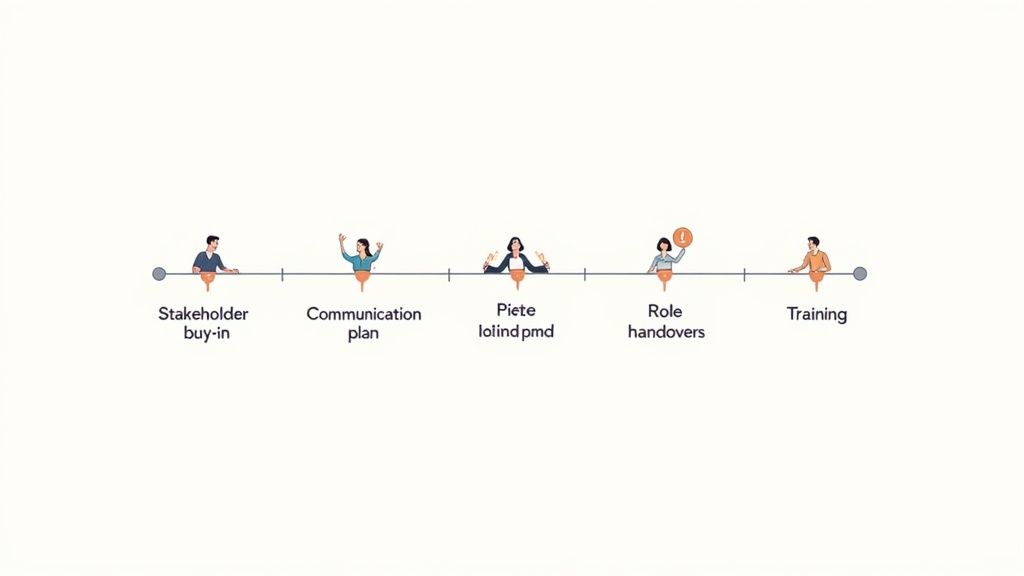
Reorganizing a marketing team is like steering a ship through changing currents. It takes a clear plan and genuine care for your crew. To keep campaigns on track, involve people early and lay out a step-by-step map. No one should be left guessing when roles or priorities shift.
Secure Stakeholder Buy In
First, spot the champions and the skeptics. You want both on board before you move any pieces.
Run short, focused workshops to nail down goals and answer tough questions. This builds the momentum you need.
Key actions include:
- Identify decision makers and informal influencers to rally support
- Craft a brief benefits summary for executives to sign off on
- Surface risks and arm leaders with clear talking points
When stakeholders feel heard, they become your strongest allies.
Craft Transparent Communication Plans
Set up a regular update rhythm that reaches every corner of the team—email blasts, town halls, quick huddles.
Consistent messaging stops rumors in their tracks and keeps energy high during changes.
Your communication blueprint should cover:
- Cadence and format tailored to each group
- Milestone updates keyed to major dates
- Built-in feedback loops for questions and concerns
Open forums and frequent check-ins mean fewer surprises when roles realign.
Launch A Pilot Pod
Treat your first group as a sandbox. Pick a cross-functional pod of 5–7 people with a clear mission.
Run the pilot for 8–12 weeks, measure results, then adjust before a full-scale rollout.
In this test run, focus on:
- Defining success criteria for each task stream
- Appointing a single point of contact to speed approvals
- Tracking progress with weekly stand-ups and simple dashboards
A small pilot surfaces hidden snags and delivers quick wins to boost confidence.
Define Role Handoffs Clearly
Every handoff needs to be precise—imagine a perfect baton pass in a relay race. Document who does what, when, and how.
A basic RACI chart works wonders here.
Don’t skip these steps:
- List critical deliverables and deadlines for each handoff
- Provide updated playbooks and training materials
- Pair new role-holders with mentors or “buddies”
When responsibilities are spelled out, nothing falls through the cracks.
Deliver Targeted Training
New structures often come with new tools. Offer short, focused workshops instead of marathon seminars.
Combine on-demand tutorials with live Q&A sessions to match different learning styles.
Core training topics might include:
- Navigating new reporting dashboards and metrics
- Using updated collaboration platforms
- Role-specific skills like campaign setup or data analysis
Ongoing coaching keeps momentum high and builds confidence in each new role.
Monitor Measure And Refine
Once you launch, don’t just walk away. Use surveys and dashboards for real-time feedback and tweaks.
Hold regular retrospectives to celebrate wins and identify areas to improve.
Recommended metrics:
- Reduction in campaign delivery time
- Employee satisfaction scores post-reorg
- Percentage of milestones hit on schedule
Iterate quickly on what works before scaling to the rest of the team.
“A structured pilot helped us uncover hidden dependencies and reduced downtime by 25%,” recalls a fractional CMO partner.
By following these steps, you’ll keep disruption to a minimum and maintain forward momentum. Empathy and structure go hand in hand.
Check out our guide on Outsourced Marketing solutions to learn how external support can ease transitions.
Key Steps And Timelines
| Step | Focus Area | Duration |
|---|---|---|
| Stakeholder Buy In | Secure Alignment | 1–2 Weeks |
| Communication Plan | Transparency | 2–3 Weeks |
| Pilot Pod Launch | Test & Learn | 8–12 Weeks |
| Role Handoffs | Accountability | 1 Week |
| Targeted Training | Skill Readiness | 2–4 Weeks |
Use this timeline to set realistic expectations. Adjust each phase based on your company’s size and complexity.
Aligning KPIs And Selecting Marketing Tools
Picking a team structure isn’t enough—you also need to tie every role back to a performance metric that fuels growth and retention.
For example, a dedicated SEO function might own organic traffic targets, while a pod could focus on campaign ROI benchmarks.
Key Metrics to Track:
- Revenue Per User: Dollars earned per customer
- Retention Lift: Improvement in churn rates over time
- Campaign ROI: Net return divided by spend
- Cost Per Acquisition: Efficiency of your budget
- Lead-to-Customer Conversion Rate: Health of your funnel
Governance adds the guardrails that keep your toolset lean and your data reliable.
Governance Models
- Centralized Ownership: A core team handles all purchases, upgrades, and training.
- Decentralized Adoption: Pods choose and test new platforms within defined guardrails.
- Hybrid Approach: A vetted core stack sits alongside sandbox environments for experimentation.
With governance in place, you can match tools to your structure and KPI goals.
Tools And Metrics For Marketing Teams
Below is a quick reference comparing major categories of marketing tools, sample platforms, and the primary metrics each supports.
| Tool Category | Example Tools | Key Metrics Tracked |
|---|---|---|
| Automation | HubSpot, Marketo, Pardot | Leads generated, workflow completions |
| Analytics | Google Analytics, Amplitude | User behavior, retention rate |
| Campaign Ops | Asana, Trello, Monday.com | Task completion, time to launch |
Use this table to align tool categories with the metrics your structure demands and to compare vendor strengths side by side.
Next Steps To Choose The Right Tools
- Audit Current Capabilities
Document existing tools, dashboards, and processes. - Map Metrics To Roles
Assign a primary KPI owner for each metric and platform. - Pilot New Platforms
Roll out one automation or analytics tool in a small pod before wider deployment.
For a deeper overview of vendor options, explore our full rundown of marketing tech stacks.
Scaling Measurement Across Pods
Growing B2B tech scale-ups often juggle multiple pods—each with its own reporting quirks. It’s like tuning instruments in a band so they play in perfect harmony.
AlphaScale discovered every squad had a different definition of “active user.” They fixed it by enforcing a single analytics schema across teams.
BetaGrowth went further: each pod got its own sandbox instance of the BI tool, then synced dashboards via an automated pipeline weekly.
“After standardizing metrics across squads, we saw a 30% drop in reporting discrepancies and faster decision cycles,” says a VP of Marketing at AlphaScale.
Maintaining consistent definitions frees pods to innovate without compromising data quality.
Best Practices for Consistency:
- Align metric definitions in a shared data dictionary
- Automate data pulls for weekly dashboards
- Conduct quarterly metric audits to catch drift
Fractional CMOs often spearhead these efforts, ensuring KPI frameworks match team capacity. Establishing clear KPI ownership and the right toolchain empowers growth and drives data-backed decisions.
FAQs About Marketing Team Structures
Picking the right marketing setup can feel like solving a puzzle. In this FAQ, we tackle the most common questions from B2B tech startups and scale-ups about structuring—and restructuring—their teams.
- Which structure works best when you’re a two-person startup on a shoestring budget?
- How do you move from a classic functional team into outcome-driven pods?
- What should a fractional CMO tackle first when they step in?
- Which metrics reveal true squad-level performance?
When your entire marketing team is just two folks, simplicity wins. A mini-pod or functional duo—one person owning content or product marketing, the other running demand gen—lets you launch campaigns fast without extra handoffs or red tape.
As you expand to four or six people, pods start to shine. By weaving together creative, analytics, and execution into cross-functional squads, you give each group everything it needs to own projects from concept through launch.
Tips For Evolving To Pods
When a fractional CMO joins, they usually jump into three big gaps: strategy, process, and people. They’ll:
- Map out your go-to-market roadmap and spell out who hands off what
- Coach existing team members through the shift in roles
- Lock in the right tools and ensure your KPI framework matches team capacity
“Engaging a fractional CMO cut our time to market by 30%,” recalls a startup CEO.
Instead of getting bogged down in daily tasks, a fractional CMO focuses on high-impact areas—defining key playbooks and smoothing out organizational wrinkles.
Measuring squad performance starts with clear, outcome-oriented goals. Track metrics like campaign ROI, lead velocity, and customer acquisition cost at the squad level. Use weekly dashboards and monthly retrospectives to keep everyone honest and agile.
| Metric | Why It Matters |
|---|---|
| Campaign ROI | Measures net return on spend |
| Lead Velocity | Tracks growth in qualified leads |
| Customer Acquisition Cost | Shows efficiency of your budget |
This snapshot helps squads zero in on the activities that drive the biggest impact.
Resources For Further Learning
Dive into our detailed playbooks for step-by-step guidance on:
- Designing your team structure
- Aligning KPIs with roles
- Selecting the right martech tools
Bookmark this page and come back whenever you’re ready to level up.
Quick Tips For Structuring
- Start Small: Pilot a single pod or function before rolling out company-wide.
- Communicate Often: Share quick updates rather than waiting for big monthly presentations.
- Review Quarterly: Revisit spans, roles, and priorities as your business shifts.
These reminders keep your team adaptive, even as your headcount—and ambitions—grow.
Ready to get expert marketing leadership? Contact Value CMO at valuecmo.com