So, what exactly is a marketing roadmap template? Think of it as your visual, strategic blueprint—the game plan that lays out your marketing goals, the big moves you'll make to hit them, and when it's all going to happen. It’s so much more than another to-do list. It's the high-level guide that connects your team's daily grind to the company's biggest objectives, making sure everyone is pulling in the same direction.
Moving Beyond the Basic Marketing Plan
Let's be honest, another generic marketing plan gathering dust on a shared drive isn't going to move the needle. In the breakneck world of B2B tech, you need a living, breathing guide—not some static document that's outdated the moment you hit 'save.' This is where a dynamic marketing roadmap becomes your most valuable player. It turns abstract goals into an actionable playbook.

For startups trying to break out of that reactive, "fire-fighting" mode, this tool is a secret weapon. It’s the critical link between your long-term vision and the day-to-day work of running campaigns, creating content, and managing channels.
The Problem with Static Plans
Traditional marketing plans often fall flat because they’re just too rigid. They get written once a year, filed away, and are almost immediately irrelevant as market conditions, customer needs, and business priorities inevitably shift. This leads to a set of problems I see all the time in growing tech companies:
- Misaligned Teams: Sales is chasing one thing, marketing is focused on another, and product is building for a third. Everyone's working hard, but they aren't working together toward the same immediate goals.
- Wasted Budgets: Money gets spread thin across too many "good ideas" because there's no clear framework for prioritizing what will actually move the needle.
- Missed Opportunities: Without a forward-looking view, you can't get ahead of market trends or properly prep for a key product launch. The result? Rushed, ineffective campaigns.
A well-crafted marketing roadmap template provides the structure to avoid these exact pitfalls. It’s all about building a predictable engine for revenue so you can scale with confidence.
Your roadmap forces you to make tough choices. It shifts the conversation from "what could we do?" to "what should we do right now to hit our goals?" That kind of focus is everything for an early-stage company.
Bridging Strategy and Execution
The real magic of a roadmap is how it connects high-level strategy with ground-level tactics. It visualizes how and when your strategic goals will actually get done through specific, concrete initiatives. If you want to dig deeper into this, check out our guide on the difference between marketing strategy and tactics.
This clarity is more important than ever. The sheer volume of information can be paralyzing. In fact, marketing teams are now using 230% more data per query than they did in 2020, with analytics platforms spitting out massive datasets. A roadmap template gives you the framework you need to make sense of all that data, helping you prioritize without getting lost in the noise.
Ultimately, a roadmap isn't just a document; it’s a communication tool. It ensures every stakeholder, from the CEO down to the newest marketing hire, understands the plan, their role in it, and exactly how their work ladders up to the company's success.
Building Your Roadmap's Strategic Foundation
Before you ever drag a campaign block onto a calendar, you need a rock-solid foundation. This isn't about setting vague, feel-good goals. It's about getting brutally honest about where your B2B tech startup is today and where it absolutely needs to be next quarter and next year.
A great marketing roadmap template is only as good as the strategic thinking you pour into it first.
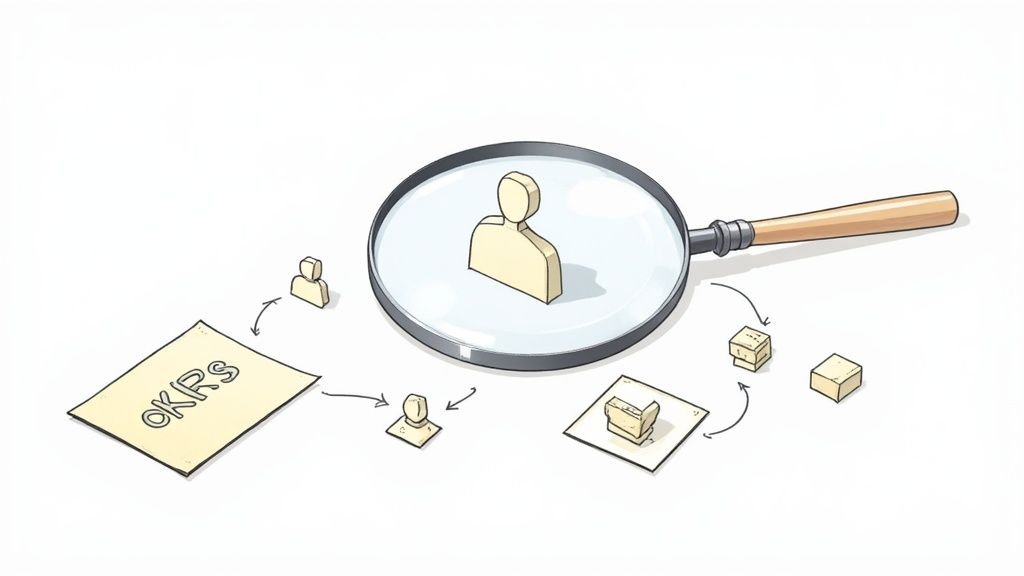
This foundational work is what uncovers the "why" behind your entire strategy. It’s the difference between a roadmap that actually drives growth and one that just documents busywork.
From Business Goals to Marketing Action
Your marketing goals can't exist in a vacuum. They have to directly support the company's high-level business objectives. If the CEO's goal is to increase Annual Recurring Revenue (ARR) by 40%, your marketing goal can't be "get more Twitter followers." It just doesn't connect.
A powerful way to forge this link is by using Objectives and Key Results (OKRs). The Objective is the big, ambitious goal (like, "Become the go-to solution for mid-market fintech companies"). The Key Results are the measurable outcomes that prove you're getting there (e.g., "Generate 150 new MQLs from the fintech sector per quarter").
This translation is where strategy gets real. It forces every planned activity to tie back to a tangible business result.
To make this crystal clear, here’s how we map high-level business objectives to the KPIs marketing will own.
Translating Business Goals into Marketing KPIs
This table shows how you can break down a big company goal into something your marketing team can actually execute against and measure.
| Business Objective | Marketing Goal | Primary KPI | Example Metric |
|---|---|---|---|
| Increase ARR by 40% | Drive high-quality pipeline | Marketing Qualified Leads (MQLs) | 150 new MQLs/quarter |
| Improve customer retention | Increase product adoption | Active Feature Usage | 25% increase in adoption of a key feature |
| Enter a new market segment | Build brand awareness in Segment X | Share of Voice (SOV) | Achieve 10% SOV in target publications |
| Shorten the sales cycle | Arm sales with better assets | Content-Influenced Pipeline | $500k in pipeline influenced by case studies |
See how each marketing metric ladders up? That's the connection you're aiming for. It makes your work defensible and clearly valuable to the rest of the business.
Defining Your Ideal Customer Profile
Once you know what you need to achieve, the next obvious question is: for whom?
You can't build an effective marketing roadmap without a crystal-clear understanding of your Ideal Customer Profile (ICP). This goes way beyond basic firmographics like company size or industry. We're talking about the deep stuff. What are their biggest professional frustrations? What does a "win" look like in their role? What tools are already open in their browser tabs?
For a deeper dive, understanding how to create buyer personas gives you a structured way to capture these human insights.
Without a sharp ICP, you’re just guessing. You'll end up:
- Wasting ad spend on audiences that will never convert.
- Creating content that solves problems your ideal buyers don't have.
- Building a product for the wrong user entirely.
To really nail this, grab an ideal customer profile template and populate it with real data from sales calls, customer interviews, and product analytics. The more specific you get, the more potent your roadmap becomes.
Think of your ICP as a filter for every single decision. If an idea doesn't directly serve your ideal customer, it doesn't belong on the roadmap. It's that simple.
Mapping the Actual Customer Journey
Finally, how do these ideal customers actually buy? The old-school linear funnel—Awareness, Consideration, Decision—is a nice model, but it rarely reflects the messy reality of a B2B tech purchase.
The real journey is a chaotic mix of Google searches, peer recommendations on LinkedIn, G2 review comparisons, and internal committee meetings. Your job is to map out this real-world path to find the moments where your marketing can have the most impact.
Start by asking these questions:
- Trigger: What pain point or event kicks off their search for a solution like yours?
- Discovery: Where do they go first? A search engine? A trusted community? Who do they ask for advice?
- Evaluation: How do they compare options? What content (like a case study or ROI calculator) do they need to build a business case internally?
- Decision: Who is the final economic buyer, and what do they need to see to sign off?
When you understand these key moments, your marketing roadmap template becomes a tool for delivering the right message in the right channel at the exact right time. You’ll be plotting campaigns that meet buyers where they are, not where your funnel diagram says they should be. This strategic foundation makes every other step—from channel selection to content creation—infinitely smarter and more effective.
Mapping Your Channels, Campaigns, and Content
Now for the fun part. You’ve got your goals locked in, and you know exactly who you’re talking to. It’s time to decide how and where you’re going to reach them. This is where strategy hits the pavement—turning your ICP and revenue targets into real, day-to-day marketing.
The single biggest mistake I see B2B tech startups make is trying to be everywhere at once. A little LinkedIn here, a few Google Ads there, a random blog post. It's a classic case of activity over impact. A solid roadmap forces you to stop spraying and praying and instead focus your firepower where it counts.
Choosing Your Core Channels Wisely
Instead of chasing every shiny new platform, pick one or two primary channels where your ICP actually hangs out when they’re looking for solutions. For most B2B tech companies, that means some combination of inbound and outbound.
Think about your customer journey map. When the problem they’re facing becomes urgent, where do they go first?
- A search engine? Then SEO and content marketing need to be a core pillar. Your roadmap should be packed with initiatives like keyword deep dives, building out pillar pages, and creating topic clusters that nail your ICP’s biggest questions.
- A professional network? For almost everyone in tech, LinkedIn is the digital water cooler. A smart roadmap here would mix organic posts from company leaders, hyper-targeted thought leadership ads, and maybe some direct outreach.
- Peer recommendations? This screams community or event marketing. You might sponsor a niche industry podcast or host a series of exclusive roundtables for your ideal buyers.
Once you’ve nailed your primary channels, you can layer in supporting ones. Email marketing, for instance, is the perfect wingman to nurture leads you pull in from SEO or LinkedIn, keeping the conversation warm.
Designing Integrated Campaigns
Channels are just the delivery system. The real work happens when you build integrated campaigns that tell one cohesive story across all of them. A campaign isn’t a random collection of tasks; it’s a coordinated push designed to achieve a single, specific goal.
Let’s get practical with an example.
Scenario: A B2B SaaS Launch
Imagine a SaaS startup is about to launch a new AI-powered analytics feature for finance teams. Their goal is to generate 50 qualified demos in Q1.
A weak roadmap just says, "Launch new feature." A strong one breaks it down into a multi-channel, multi-week campaign:
1. Pre-Launch (The Teaser)
- Channel: LinkedIn
- Activity: The CEO drops a poll asking about the biggest headaches in financial reporting. It gets people talking and validates the problem you’re solving.
- Content: A short, unlisted video from the Head of Product giving a sneak peek of the new UI.
2. Launch Week (The Big Push)
- Channel: SEO/Blog
- Activity: Publish a 2,500-word monster of a pillar page: "The Ultimate Guide to AI in Financial Forecasting." This becomes a long-term lead magnet.
- Content: The official launch blog post, complete with a customer quote and a hard-to-miss CTA to book a demo.
3. Post-Launch (Nurture & Convert)
- Channel: Email Marketing
- Activity: Send a three-part email series to everyone who downloaded a related guide in the last six months.
- Content: Email one announces the feature. Email two shares a mini-case study. Email three offers a limited-time "strategy session" with an in-house expert.
See how every action builds on the last? That’s an integrated campaign. It creates momentum and makes sure your ICP sees a consistent, valuable message, no matter where they look.
Mapping Content to the Buyer’s Journey
The final piece of the puzzle is the content itself. Every blog post, webinar, and case study needs a clear job to do: move your ideal customer one step closer to buying.
This is where you connect your content calendar directly back to your strategy.
- Top of Funnel (Awareness): This is all about the problem, not your product. It’s educational content that helps prospects better understand their challenges. Think blog posts, original research, and industry trend reports.
- Middle of Funnel (Consideration): Now you can start talking about your solution as a real option. This is the perfect place for webinars, in-depth ebooks, and honest competitor comparison guides.
- Bottom of Funnel (Decision): Here, it’s all about building trust and proving you’re the best choice. Case studies, customer testimonials, and free trial onboarding guides are your heavy hitters.
A great roadmap doesn't just list content titles. It connects each asset to a specific campaign goal and a particular stage in the buyer's journey, ensuring you're creating content that converts, not just content that fills a calendar.
For a deeper dive into this, check out our complete guide on B2B content marketing best practices. When you map your channels, campaigns, and content together, your roadmap becomes more than a timeline—it’s a playbook for predictable growth.
Allocating Resources and Setting Realistic Timelines
An ambitious marketing roadmap is inspiring, but without the fuel—people, time, and money—it's just a wish list. This is where your grand vision meets the hard reality of the budget. It’s all about making the tough calls that turn your plans into a practical, achievable playbook for growth.
Getting this part right is what separates the roadmaps that actually drive results from the ones that just collect dust on a hard drive.
Building Your Marketing Budget From the Ground Up
Whether you’re a scrappy seed-stage startup or a well-funded scale-up, the principles are the same. You need a clear, defensible plan that ties every dollar spent back to a specific goal. Guesswork won't fly when the CEO asks where the money is going.
Start with your primary channels and planned campaigns. For each major initiative on your roadmap, break down what it’s actually going to cost:
- Technology & Tools: This is your marketing automation platform, CRM, SEO tools, analytics software, and any other tech you need to get the job done.
- Paid Media: List your projected ad spend for each channel, like LinkedIn Ads, Google Ads, or sponsored content programs.
- Content & Creative: Do you need freelance writers, graphic designers, or video production help? Factor in those costs now, not later.
- People: This isn't just about salaries. Think about training, professional development, and any specialized contractors you might need for a specific project.
Once you have your channels and campaigns mapped, figuring out how to optimize your ad budget allocation is the key to maximizing ROI and hitting your deadlines. You want to be absolutely sure you’re putting money where it will have the greatest impact.
Mapping Team Capacity and Skills
Your budget is only half of the resource equation. The other, arguably more important part, is your team's time and expertise. A classic mistake is creating a roadmap that would require a team twice your size to actually execute. Don't fall into that trap.
To avoid this, run a simple skills and capacity audit. List out the key initiatives from your roadmap for the next quarter. Then, map them against your current team members and what they’re good at.
You might quickly find that your content marketer is already at 100% capacity with the blog and email newsletters, leaving zero time for that new LinkedIn thought leadership campaign you planned. Spotting this bottleneck now lets you make a strategic choice: delay the LinkedIn push, hire a freelancer, or reprioritize the content marketer's workload?
This isn't about micromanaging. It's about setting your team up to win.
This flow shows how you can logically move from picking channels to defining the campaigns and content needed to fuel them.
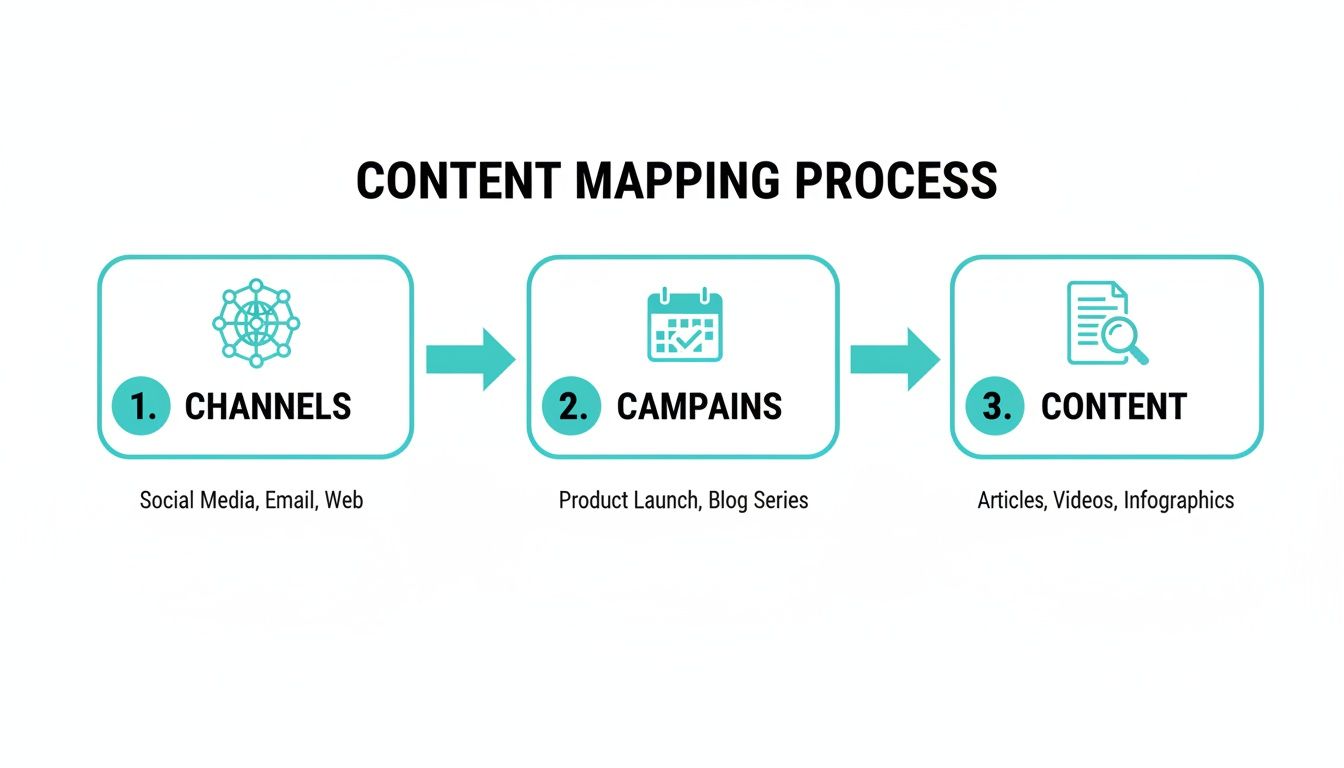
This kind of structured thinking is essential before you can accurately attach budgets and timelines to anything.
Creating Clarity with a RACI Chart
As teams grow, roles can start to blur. That leads to confusion, duplicated work, and dropped balls. Who actually owns the webinar program? Who needs to give the final sign-off on ad copy?
A RACI chart is a simple but incredibly powerful tool for bringing absolute clarity to these questions.
RACI stands for:
- Responsible: The person who does the work.
- Accountable: The one person who owns the outcome.
- Consulted: People who provide input or expertise.
- Informed: People who just need to be kept in the loop.
By defining these roles upfront for each major initiative on your roadmap, you eliminate ambiguity and empower your team to move faster. Everyone knows exactly what's expected of them.
Visualizing Your Timeline
Finally, it’s time to pull it all together into a visual timeline. Your marketing roadmap template should make it dead simple to see what’s happening, when it's happening, and who's on point for it. You don't need fancy, expensive software for this—a spreadsheet or a tool like Trello or Asana works just fine.
The key is to include these five things for every initiative:
- Initiative/Campaign Name: The high-level project.
- Owner: The single person who is accountable.
- Timeline: Clear start and end dates.
- Key Milestones: The major checkpoints along the way.
- Dependencies: Make it obvious if one task can't start until another is finished.
This visual timeline becomes the single source of truth for your team. It keeps everyone aligned, makes dependencies crystal clear, and turns your high-level strategy into a concrete, week-by-week execution plan.
Bringing Your Marketing Roadmap to Life
Okay, your marketing roadmap is built. The strategy feels right, the budget is locked in, and the timeline looks clean. But a roadmap is just a document until you breathe life into it. The real magic happens when it stops being a static plan and becomes the central nervous system for your team's daily and weekly rhythm.
This is where the rubber meets the road. Implementation is less about the document itself and more about the conversations, decisions, and actions it kicks into gear.
Choosing the Right Home for Your Roadmap
One of the first practical steps is figuring out where this plan will live. It’s tempting to hunt for the most feature-packed software, but that's usually a mistake. The best tool isn't the most complex one; it's the one your team will actually open and use every single day.
For an early-stage B2B tech startup, simplicity is your best friend. You can build a surprisingly powerful marketing roadmap template with tools you probably already pay for.
- Google Sheets or Airtable: These are popular for a reason. They're incredibly flexible, a breeze to share, and perfect for juggling timelines, budgets, and RACI charts all in one spot.
- Asana or Trello: If your team thinks visually and loves a good Kanban board, these are excellent. You can turn each major initiative into a card, assign owners, set deadlines, and watch things move from "To Do" to "Done."
Don't overcomplicate it. A simple, well-kept spreadsheet that everyone gets is a thousand times better than a slick project management tool that no one ever updates.
Securing Stakeholder Buy-In and Alignment
A roadmap that only the marketing team sees is destined to fail. Its most important job is to be a communication tool that gets everyone—from the product team and sales reps to the CEO—on the same page about what marketing is doing and why it matters.
Getting genuine buy-in is more than just a single presentation. It's about creating a culture of transparency where the roadmap is a shared guide, not a secret marketing document.
Kick things off with a meeting where you walk all key stakeholders through the plan. But don't just show them a timeline. Connect every single initiative back to the big-picture business goals you agreed on at the start. This shows you’re not just running campaigns for the sake of being busy; you’re executing a plan designed to push the whole company forward.
A roadmap isn't a weapon to defend your budget; it's a bridge to connect your team's work to the company's success. When sales sees how your content plan directly enables them, they become your biggest advocates.
Establishing a Rhythm for Review and Adaptation
Now for the most critical part: your roadmap is never a "set it and forget it" document. The market will shift, campaign results will roll in, and new opportunities will pop up out of nowhere. A static roadmap is an outdated roadmap. The only way to make it a living document is to build a consistent rhythm for review and iteration.
This isn't about making chaotic changes all the time. It's about a disciplined process for looking at the data, celebrating what’s working, and having the courage to pivot away from what isn't.
Monthly Tactical Check-ins
- Purpose: Review performance against the KPIs for your active campaigns.
- Agenda: Look at the hard numbers. Did that LinkedIn campaign hit its MQL target? Is the blog driving the right kind of traffic? This is where you make small adjustments—tweaking ad copy, shifting a bit of budget, or pushing back a low-priority task.
Quarterly Strategic Reviews
- Purpose: To zoom out and gut-check the high-level strategy.
- Agenda: Are your core assumptions still holding up? Is your ICP still accurate? Are you still playing in the right channels? This is where you make bigger calls, like doubling down on a successful channel for the next quarter or killing a larger initiative that isn’t delivering ROI.
This two-tiered review process creates the perfect balance. It gives you the agility to react to real-time data every month while keeping your long-term strategy stable and focused every quarter. By making this rhythm a non-negotiable part of how you operate, you turn your roadmap from a simple plan into a powerful engine for learning and growth.
Common Questions About Marketing Roadmaps
Once you start using a marketing roadmap, a few questions almost always pop up. It’s one thing to build the map, but it’s another to live with it day-to-day. Let's dig into the most common sticking points I see and get you some clear, practical advice.
How Often Should I Update My Marketing Roadmap?
This is the big one. And no, the answer isn’t "constantly."
I tell my clients to think of their roadmap in two layers. The top layer is your high-level strategic direction—your core goals, the ICP you're targeting, and the big-bet channels you’re investing in. This part only needs a review quarterly. That’s the right cadence to make sure your marketing efforts are still locked in with the broader company objectives, which can definitely shift.
The second layer is all tactical. This is where your specific campaigns, content drops, and day-to-day activities live. This part of the roadmap needs a fresh look monthly. It's an agile way to react to performance data, jump on new opportunities, and adjust to market shifts without getting knocked off course. You’re being responsive, not just reactive.
Your roadmap is a living document, not a stone tablet. Regular updates aren't about changing direction all the time. They're about making smart, data-informed adjustments based on what's actually happening in the real world.
What Is the Difference Between a Marketing Plan and a Roadmap?
It’s easy to mix these two up, but knowing the difference is critical for getting your team on the same page.
A marketing plan is the big, foundational strategy document. It’s where you lay out all your research, audience analysis, competitive intel, and high-level thinking. It answers the fundamental 'what' and 'why' questions. Honestly, it's often text-heavy and sets the stage for everything that follows.
A marketing roadmap, on the other hand, is the visual, operational tool showing how and when you'll execute that plan. It takes all that great strategy and translates it into a clear timeline of specific initiatives, who owns what, and when it’s due. The roadmap is your team’s daily guide for getting things done.
- Plan: The blueprint—all the deep thinking and research.
- Roadmap: The construction schedule—the actionable timeline for building it.
You need both, but you live in the roadmap.
What Are the Best Free Tools for Creating a Marketing Roadmap?
You absolutely do not need expensive, complicated software to build a great roadmap. In fact, for most B2B tech startups, starting simple is the only way to go. The best tool is always the one your team will actually use.
Here are a couple of my go-to free options:
- Google Sheets or Airtable: These are the unsung heroes of roadmap management. They’re incredibly flexible for creating shareable timelines, tracking your budget, and even mapping out a simple RACI chart, all in one place everyone can access.
- Trello or Asana (Free Tiers): If your team is more visual and loves a good Kanban board, the free versions of these tools are fantastic. You can turn campaigns into cards, assign owners, set deadlines, and drag them from "To Do" to "Done."
Focus on nailing the process first. A well-organized spreadsheet that everyone on the team understands and keeps updated is infinitely more valuable than a fancy software license that just collects digital dust. You can always upgrade to a more powerful tool once you outgrow the simple stuff.
Ready to build a roadmap that aligns your team and accelerates growth? At Value CMO, we specialize in crafting practical, no-fluff marketing strategies for B2B tech startups. We don't just hand you a template; we partner with you to build and execute a plan that delivers measurable results.
Learn how Value CMO can help you build a predictable growth engine.