Let's get straight to it: outsourced marketing is simply when you bring in outside experts to handle some or all of your marketing. For a B2B startup founder, it’s a total power play. You get instant access to specialized talent and can hit the accelerator on growth without the sticker shock and slow ramp-up of hiring a full-time team.
Why Startups Are Outsourcing Marketing for Growth
As a founder, you're already spinning a million plates—product, fundraising, you name it. Trying to build a marketing engine from the ground up feels like another mountain to climb, especially when you’re short on time and cash. This is exactly where outsourced marketing stops being a "nice to have" and becomes your strategic weapon.
This isn't just about handing off tasks. It’s about getting an immediate edge. Instead of spending months hunting for the right person, you can plug in a team of pros who already have a playbook that works.
The Modern Growth Dilemma
Today's B2B world demands a whole roster of specialized skills you’ll almost never find in just one person. You need people who know their way around complex channels and can deliver results you can actually see on a dashboard.
- Skill Gaps: Do you have in-house experts ready to go on SEO, paid ads, content strategy, and marketing automation? An outsourced partner brings that entire squad to the table on day one.
- Speed to Market: Every day you wait to build a pipeline is a day your competitors gain ground. Outsourcing lets you get campaigns live and start generating leads in weeks, not quarters.
- Budget Efficiency: You get a full team of specialists for what you might pay a single senior hire. That means no hefty salaries, benefits, or overhead.
And this isn't some niche trend; it's accelerating fast. The global market for outsourced sales and marketing hit $28.65 billion in 2022 and is on track to nearly double by 2030, with North America leading the pack. You can read the full research on global sales outsourcing trends to see just how much momentum is behind this shift.
When you partner with an external team, you're not just delegating work. You're buying speed, expertise, and a proven playbook. That frees you up to focus on what you're best at—building a killer product—while they focus on building your customer base.
Choosing Your Outsourcing Partnership Model
Once you’ve decided to bring in outside help, the next question is simple: what kind of help do you actually need? Not all partnerships are built the same. Picking the right model is like choosing the right tool for the job—you wouldn't use a sledgehammer to hang a picture frame.
Think of it as building a custom support system around your startup's specific needs. Let's break down the most common ways to partner with external experts so you can find the perfect fit.
The outsourced marketing world is already a massive playing field, and it's only getting bigger.
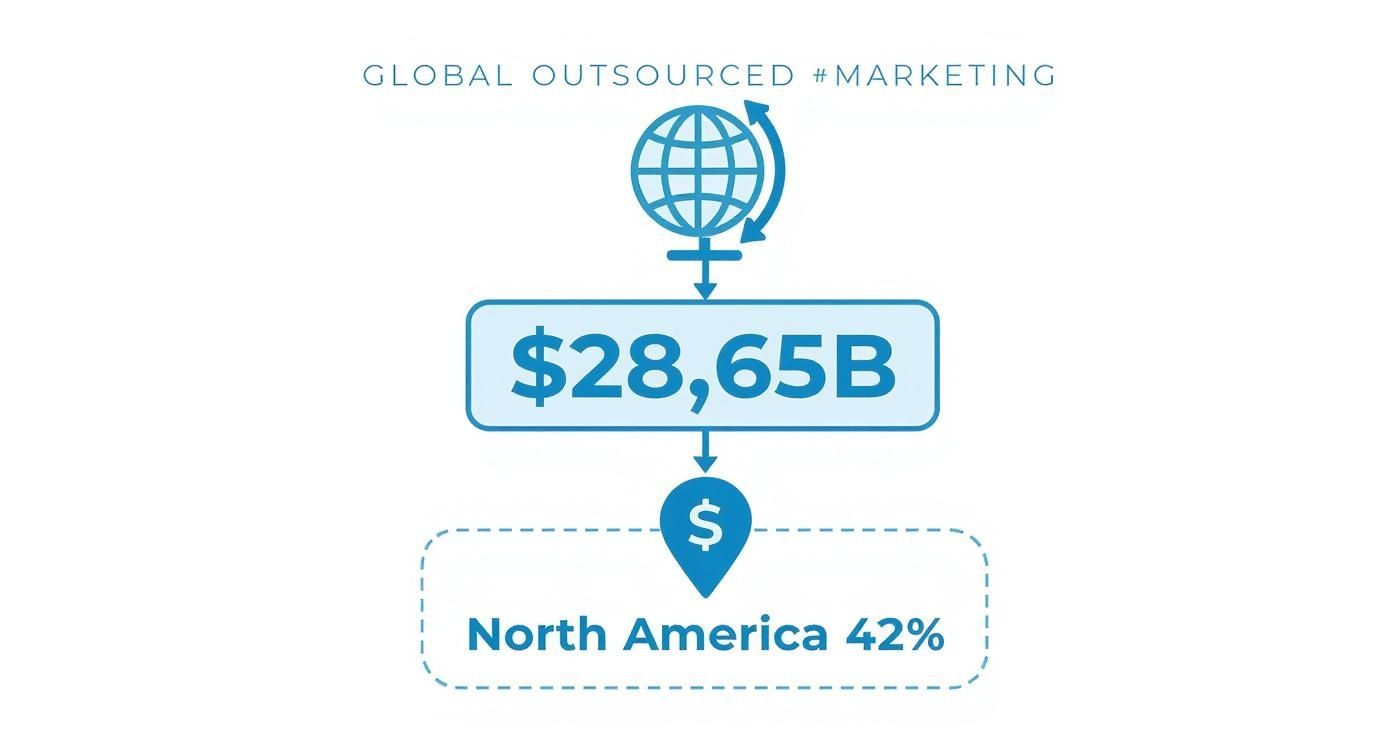
The market is already valued at $28.65 billion, with North America leading the charge, accounting for a whopping 42% of that spend. Clearly, this isn't a fringe tactic; it's a core growth strategy.
To help you navigate this landscape, here's a quick comparison of the main engagement models B2B tech startups use.
Comparing Outsourced Marketing Models
| Engagement Model | Best For | Typical Cost Structure | Key Advantage |
|---|---|---|---|
| Fractional CMO | Startups needing strategy & leadership | Monthly retainer for set hours/days | Executive-level guidance without the C-suite salary. |
| Full-Service Agency | Scale-ups needing broad execution | Monthly retainer or % of ad spend | One-stop-shop for all marketing channels. |
| Specialized Retainer | Teams with a specific skill gap (e.g., SEO) | Fixed monthly fee for a defined scope | Deep, focused expertise in one critical area. |
| Project-Based Work | Companies with a one-off need (e.g., website) | Fixed fee per project | Clear scope, defined timeline, and predictable cost. |
Each model solves a different problem. Let's dig into the specifics so you can see which one aligns with your immediate goals.
The Fractional CMO: Your Strategic Coach
A Fractional Chief Marketing Officer (CMO) is less of a "doer" and more of a "thinker." Imagine hiring an experienced head coach who comes in for a set number of hours each week to design the playbook, train the players, and call the shots from the sideline. They're not running every drill, but they make sure the team is moving in the right direction.
This model is a lifesaver for early-stage startups that have a small, junior team (or no team at all) but desperately need high-level strategic guidance. A Fractional CMO helps with the heavy lifting: defining your market position, building a go-to-market strategy, and setting up your first marketing budget and KPIs. You get years of executive experience without the hefty price tag of a full-time C-suite hire.
The Full-Service Agency: Your Entire Marketing Department
Hiring a full-service agency is like getting an entire marketing department on demand. You’re not just hiring a coach; you're getting the whole roster—strategists, copywriters, designers, SEO specialists, and paid ad managers—all working in sync.
This is a great fit for scale-ups with an established product and a solid budget who need to execute across multiple channels at once. An agency can run your blog, manage your social media, launch complex ad campaigns, and overhaul your website, all under one roof. The main advantage is the sheer breadth of skills and coordinated execution. The trade-off? It usually comes with a higher price tag and can sometimes feel less integrated than an in-house team.
An agency's biggest value-add is access to a wide array of specialists. Instead of you trying to find, vet, and manage a half-dozen individual freelancers, the agency does it for you, delivering a cohesive, multi-channel strategy from a single point of contact.
The Specialized Retainer: Your Expert Subscription
What if you have a strong overall strategy but a glaring weakness in one specific area, like SEO or PR? That’s where a specialized retainer comes in. Think of it as a subscription to a team of experts who are absolute masters of a single craft.
You're not outsourcing everything, just the one piece you can't handle internally. For instance, you might hire an SEO firm on a monthly retainer to build your organic search presence or a content agency to produce a steady stream of high-quality blog posts. This model gives you deep expertise exactly where you need it most, making it a super effective for startups looking to dominate a specific channel.
Project-Based Work: Your Specialist for a Single Mission
Sometimes, you don't need an ongoing commitment. You just need a specific job done, and done well. Project-based work is like hiring a specialist contractor for a single mission, like building a new website, creating an animated explainer video, or developing a launch campaign for a new feature.
The scope, timeline, and cost are all locked in upfront. Once the project is complete, the engagement ends. This is the most flexible and often most affordable option, ideal for startups with tight budgets and clearly defined, short-term needs. It’s perfect for plugging a temporary gap or tackling a one-off initiative that your current team doesn't have the bandwidth or skills to handle.
Deciding Between In-house and Outsourced Marketing
This is the moment of truth. You know the models, you see the potential, but now you have to make the call: hire your first marketer or bring in a partner? Forget the generic pro-con lists. This is about making a smart, strategic choice for your startup right now, based on real-world pressures.
The decision boils down to a handful of core factors: your immediate needs, your budget runway, and how fast you need to see results. There isn't a single "right" answer, but there's definitely a right answer for you.
When to Outsource Your Marketing
Think of outsourcing as calling in a special operations team. They arrive with all their own gear, a proven strategy, and the ability to execute a specific mission right away. You should lean toward outsourced marketing when you’re facing one of these situations.
- You Need Specialized Skills Yesterday: Need to spin up a complex Google Ads campaign or fix a technical SEO disaster? You don’t have six months to hire and train someone. Outsourcing gives you instant access to deep, channel-specific expertise.
- Your Primary Need is Execution: You have a clear idea of what needs doing—writing blog posts, running ad campaigns, building email sequences—but your team is already stretched thin. An outsourced partner can take your strategy and just run with it, freeing you up.
- You're Testing a New Channel: Want to find out if LinkedIn ads can work for your B2B startup? An outsourced specialist can design and run a tight pilot program, giving you clean data to make a go/no-go decision without the commitment of a full-time hire.
This isn't just a startup trend; it's a massive global shift. The business process outsourcing market is projected to hit $525 billion by 2030. With 66% of American businesses already outsourcing some functions and 80% planning to do more, it's clear that companies are choosing flexibility and expertise. You can learn more about how businesses are expanding their outsourcing practices and why this model is becoming standard operating procedure.
When to Hire an In-House Marketer
Hiring in-house is like planting a tree. It takes more time and resources upfront, but over the long term, it grows deep roots into your company culture and product. You should prioritize an in-house hire in these scenarios.
- Your Product is a Beast: If your marketing requires a deeply nuanced, almost developer-level understanding of your tech, an in-house person is invaluable. They live and breathe your product every day in a way that's nearly impossible for an external partner to replicate.
- You Need a Strategic Owner: When your biggest need isn’t just getting tasks done but having someone at the table who owns the entire marketing vision, an in-house leader is the answer. They become the single point of accountability for long-term growth.
- Your Brand Voice is Everything: If your brand is quirky, highly specific, and central to your identity, an internal marketer becomes its truest champion. They're immersed in the culture and can ensure every tweet, email, and ad feels authentic.
The core question is this: Is your biggest bottleneck a lack of specific skills and hands on keyboards (outsource), or is it a lack of deep product knowledge and strategic ownership (in-house)?
A Practical Decision Framework
Still on the fence? Map your primary need against your timeline with this simple framework. It cuts right to the chase.
| If Your Primary Need Is… | And Your Timeline Is… | Your Best Bet Is… |
|---|---|---|
| High-Level Strategy & Leadership | Long-Term (12+ months) | Hire In-House (e.g., VP of Marketing) |
| Hands-On Channel Execution | Immediate (Next 30-90 days) | Outsource (e.g., Specialized Agency) |
| Deep Product Storytelling | Ongoing | Hire In-House (e.g., Product Marketer) |
| Broad Multi-Channel Support | Mid-Term (6-12 months) | Outsource (e.g., Full-Service Agency) |
Ultimately, this isn't a permanent choice. Many startups begin with an outsourced partner to build initial momentum, then bring in a full-time leader once the marketing engine is humming. The key is to solve your most pressing problem today.
How to Find and Vet the Right Marketing Partner

Choosing the wrong marketing partner is more than just a bad investment; it’s a direct hit to your momentum. A poor fit can burn through your precious cash, set your growth back by months, and leave you with a mess to clean up.
But getting it right? That feels like adding a co-founder who’s a marketing savant.
This is your playbook for making the right choice. We’ll skip the fluff and focus on what truly matters for B2B tech companies: finding a partner who operates like a true extension of your team. It's about looking beyond slick presentations to find a team that's genuinely obsessed with your success.
Look for Niche Experience and Proven Results
Generalists are everywhere. You need a specialist. The best partners have deep, hands-on experience in your specific sandbox—B2B tech. They understand your buyers, know the channels that work, and speak your language.
When you’re vetting potential partners, dig into their track record. Don’t just ask for case studies; ask for stories.
- Industry Fit: Have they worked with other B2B SaaS or tech companies at your stage? A team that gets results for e-commerce brands might not understand the long sales cycles of enterprise software.
- Proof of Performance: Ask them to walk you through a campaign for a similar client. What were the goals? What were the actual results? Focus on metrics that matter, like qualified leads and pipeline growth, not just website traffic.
Spotting the Red Flags Early
Knowing what to look for is only half the battle. You also need to know what to avoid. Some warning signs are subtle, while others are blaring alarms. Keep your eyes open for these common red flags during your initial conversations.
Red Flag #1: Vague Promises and a "Secret Sauce"
If a potential partner guarantees you #1 rankings on Google or talks about their "proprietary secret sauce" without explaining their process, be wary. Great marketing isn't magic; it's a combination of proven strategy, disciplined execution, and transparent reporting.
Other red flags include a cookie-cutter approach that doesn’t feel customized to your business or a heavy focus on vanity metrics like social media followers instead of bottom-line impact. If they can’t clearly explain how their work will generate leads and revenue, it’s time to move on.
The Litmus Test: A Checklist of Tough Questions
Your discovery calls are your opportunity to go deep. Don't be afraid to ask tough, specific questions that force them to move beyond their sales pitch. Here are a few to get you started:
- Who will actually be working on my account? You want to know about the day-to-day team, not just the senior person selling you the contract.
- How do you measure success for a client like me? This reveals if they're aligned with your business goals (like MQLs and CAC) or just their own activity metrics.
- What does your onboarding process look like? A great partner will have a structured 30-day plan to get up to speed on your brand, product, and customers.
- Can you describe a time when a campaign failed? Their answer will show you how they handle setbacks and what they learned from the experience.
Finding the right team for your marketing outsourced needs is a critical step. For B2B companies, understanding the specialized services offered by potential partners, such as comprehensive B2B SEO consulting strategies, is vital for making an informed decision.
Ultimately, you're looking for an outsourced marketing service that feels less like a vendor and more like a dedicated part of your growth engine.
What to Expect: Deliverables, KPIs, and Budgets
Let's get down to the brass tacks. When you outsource marketing, you're not just buying a list of activities—you're buying outcomes. But to get the right outcomes, you have to be crystal clear on what gets delivered, how success is measured, and what it’s all going to cost you.
Getting this right from day one is non-negotiable. It’s the difference between a partnership that moves the needle and one that just spins its wheels. Clarity here prevents nasty surprises and makes sure everyone is rowing in the same direction.
From Activities to Tangible Deliverables
Every outsourced engagement should produce concrete assets and reports. Think of deliverables as the physical proof of the work you're paying for. While the specifics will vary, they absolutely must tie back to your strategic goals.
Vague promises are a massive red flag. A good partner will tell you exactly what you’ll get, whether it's weekly or monthly.
- For SEO: You should see a comprehensive keyword research report, a technical site audit with a prioritized action plan, monthly link-building updates, and dashboards showing real movement in organic traffic and keyword rankings.
- For Content Marketing: Expect a strategic content calendar, fully drafted blog posts (ready for you to review), lead magnets like whitepapers or checklists, and performance reports tracking page views, time on page, and conversions.
- For Paid Media: This means ad copy and creative variations for A/B testing, landing page mockups, weekly campaign reports detailing clicks and conversions, and a monthly summary of your return on ad spend (ROAS).
Connecting Work to What Investors Actually Care About
Deliverables are just one piece of the puzzle. The real value in marketing outsourced comes from translating those activities into Key Performance Indicators (KPIs) that matter to your business and your investors. Vanity metrics like social media likes are fine, but they don't pay the bills.
Your partner should be obsessed with the numbers that fill your pipeline and grow revenue. This is how you spot the task-doers from the true growth partners.
The most critical shift in thinking is from "What did you do?" to "What impact did your work have?" A great partner connects every deliverable—every blog post, every ad campaign—directly to a meaningful business KPI.
Focus on KPIs that show real progress toward acquiring and keeping customers. For instance:
- Marketing Qualified Leads (MQLs): The raw number of high-intent leads generated from all your marketing efforts.
- Sales Qualified Leads (SQLs): The number of MQLs deemed good enough to be handed over to the sales team.
- Lead-to-Customer Conversion Rate: What percentage of those leads actually end up becoming paying customers?
- Customer Acquisition Cost (CAC): The total cost of sales and marketing to land one new customer.
- Marketing ROI: The revenue generated from marketing compared to the cost. This is the ultimate yardstick. To dig deeper, our guide on how to measure marketing ROI offers a complete breakdown.
Demystifying the Budget Question
Finally, let's talk money. Pricing for outsourced marketing can seem all over the place, but it generally falls into predictable buckets based on the engagement model and scope. Knowing these benchmarks helps you budget effectively and spot a proposal that’s out of line.
Below is a table illustrating some realistic monthly pricing ranges B2B startups can expect to see.
Sample Outsourced Marketing Pricing for B2B Startups
| Service Model | Typical Monthly Cost Range | Common KPIs Tracked |
|---|---|---|
| Fractional CMO | $5,000 – $15,000+ | MQLs, CAC, Pipeline Velocity |
| Full-Service Agency | $10,000 – $25,000+ | MQLs, SQLs, Cost per Lead |
| Specialized Retainer | $3,000 – $10,000 | Channel-specific metrics (e.g., Organic Traffic, ROAS) |
| Project-Based Work | $5,000 – $50,000+ (Fixed Fee) | Project completion, initial performance metrics |
These aren't hard-and-fast rules, but they give you a solid starting point for your budget talks. The key is to find a partner who offers a transparent pricing structure that’s tied directly to the value and results they plan to deliver. A solid proposal should clearly connect the cost to specific deliverables and the KPIs they’re designed to improve.
Your Onboarding and Integration Playbook
You’ve signed the contract. Now the real work begins. The first 30 days of any marketing outsourced partnership are everything—they set the tone, establish the workflow, and build the foundation for what's to come. A sloppy start creates friction that can drag on for months, but a smooth integration feels like your new partner has been part of the team all along.
This isn’t about scheduling endless meetings or drowning your new team in old documents. It's about a focused, intentional process that gets everyone aligned and moving fast. Think of it as building the operating system for your collaboration. A strong start means your new team can start delivering value, not just asking questions.
The Kickoff Meeting That Actually Matters
The first official step is the kickoff meeting, but it needs to have a purpose. This meeting is your chance to move beyond the proposal and get everyone locked in on the immediate 90-day goals. It’s less about the high-level vision and more about agreeing on the tangible first moves.
Keep the agenda tight and action-oriented. Introduce the key players from both sides, nail down the primary business objectives marketing will support, and confirm the top priorities for the first quarter. The goal? Everyone leaves the room knowing exactly what they’re responsible for and what success looks like in the short term.
Your kickoff meeting should end with absolute clarity on the "first three plays" you're going to run together. This focus builds immediate momentum and prevents the team from getting lost in a sea of possibilities.
Building a Frictionless Knowledge Transfer
Your new partner needs access to your company’s brain, but a messy "document dump" will only slow them down. You need a structured knowledge transfer. Set up a shared folder with all the crucial assets and information, organized into clean subfolders.
This central hub should include:
- Brand Essentials: Drop in your logo files, brand style guide, messaging docs, and a few examples of past content you love (and hate).
- Customer Insights: Share your ideal customer profiles (ICPs), buyer personas, and any voice-of-customer data from surveys or interviews.
- Tool Access: Grant the necessary permissions for your key marketing tools—your website CMS, analytics platform, and any marketing automation software you’re already using.
Establishing Your Communication Rhythm
Finally, you need to lock in a clear and predictable communication cadence. A well-defined rhythm stops the endless back-and-forth emails and keeps everyone in sync without constant interruptions. Agree on a simple structure that works for everyone.
For most partnerships, this is all you need:
- Daily Communication: A dedicated Slack channel or Asana project is perfect for quick questions and daily updates.
- Weekly Check-ins: Hold a 30-minute tactical sync each week. Review progress against goals, call out blockers, and plan the upcoming week’s moves.
- Monthly Reporting: Schedule a more strategic monthly review to dig into performance data, discuss what you’re learning, and adjust the plan for the next month.
This playbook builds a foundation of trust and clarity, turning a new vendor into a true strategic partner from day one.
Common Questions About Outsourced Marketing
Even the sharpest B2B founders have questions when it comes to bringing on a marketing partner. So here are the straight-up answers to the ones we hear most often. No fluff, just the clarity you need to make the right call.
How do I keep our brand voice consistent?
This is a big one, and it’s a totally valid concern. Your voice is your identity.
The key is a rock-solid brand guide that lays out your voice, tone, and core messaging. You'll want to run your new partner through it in a dedicated brand immersion session during that first week. It gets them up to speed fast.
Beyond that, pick one person on your team to be the final brand checkpoint. Clear, consistent feedback is what turns a good outsourced team into a great one. They’ll quickly start to sound like a natural extension of your brand, not a bolt-on.
What's the typical time commitment from my team?
Plan to be more hands-on at the beginning. For the first month, you should budget about 5-8 hours a week for kickoff meetings, strategy sessions, and initial content reviews. This front-loaded investment is critical for setting the partnership up for success.
After that initial ramp-up, things get much leaner. A well-oiled partnership should only need 2-4 hours per week from your point of contact. This time is usually spent on weekly check-ins and giving the final nod on new content. A great partner respects your time—their job is to reduce your workload, not add to it.
A successful partnership is built on efficiency. The goal of an outsourced team is to give you leverage, freeing up your time to focus on product and customers, not to create more meetings.
How soon can we expect to see results?
It really depends on where you're putting your chips.
If you’re running paid ad campaigns, you can see data and even leads start trickling in within the first 30 to 60 days. It’s the fastest way to get a signal from the market.
But for the long game—things like SEO and content marketing—it takes more time to build real momentum. You’ll start to see a significant impact in about 4 to 6 months. Any good partner will give you a clear 30-60-90 day roadmap so you always know what’s coming and can track progress every step of the way.
At Value CMO, we plug strategic marketing leadership into B2B tech startups to build predictable growth engines. We turn your vision into a practical, data-driven plan and then run the execution, delivering results without the cost of a full-time hire.
Ready to build momentum? Learn more about our fractional CMO services at valuecmo.com.