As a B2B tech founder, you're wearing a thousand different hats. The thought of building an entire marketing engine from the ground up? It's enough to make your head spin.
For many, the strategic move that finally unlocks growth is when you decide to get some help by outsourcing. It shifts that heavy burden from your shoulders to a team of experts, giving you the horsepower you need to compete without the crippling overhead of a full-time team.
Is Outsourced Marketing Right for Your B2B Startup?
You’ve built a brilliant product. You probably even landed your first few customers through sheer force of will and your personal network. But that kind of founder-led hustle only scales so far.
Eventually, you hit a wall. This is the moment when outsourcing your marketing becomes less of a "nice-to-have" and more of a "we-need-this-now."
The signs are usually there long before the panic sets in. Maybe your sales team is grumbling about a lack of good leads. Or perhaps you’re struggling to explain what you do in a way that cuts through the noise of a crowded market. You know you need to be doing more—more content, more SEO, more demand generation—but you just don't have the time or the specialized skills on your small team.
Beyond Just Saving Time
While handing off tasks is a huge relief, the real value of outsourced marketing runs much deeper. It’s about getting your hands on strategic advantages that are difficult, if not impossible, to build internally overnight.
Think about these common scenarios for B2B tech startups:
- Accelerated Market Entry: You need to launch a new feature or break into a new market, but you can’t afford to wait six months to hire and train a team. An outsourced partner can get a go-to-market plan up and running almost immediately.
- Access to Niche Skills: Your product needs someone who deeply understands SEO for enterprise software or account-based marketing (ABM) for the fintech space. Instead of a unicorn hunt for that perfect full-time hire, you get instant access to a team with that specific experience.
- An Objective Point of View: Being so close to your product can create blind spots. An external partner brings a fresh, unbiased perspective on your positioning, messaging, and overall strategy.
The most powerful shift happens when you move from just "doing marketing" to building a predictable growth engine. Outsourcing provides the framework, accountability, and expertise to make that happen a whole lot faster.
Establishing Accountability for Growth
Ultimately, bringing in an external team is about making someone accountable for results. You’re not just paying for a list of activities; you’re investing in outcomes.
A great outsourced partner works with well-defined KPIs tied directly to your business goals, like generating a specific number of Marketing Qualified Leads (MQLs) or bringing down your Customer Acquisition Cost (CAC).
To get a clearer picture of how an external team can plug into your day-to-day, it helps to understand what a marketing firm does. This isn't about giving up control—it's about gaining the right kind of control over your growth.
Choosing Your Outsourcing Model
Once you’ve decided outsourcing is the right move, the real work begins. Who do you actually hire? This isn't just about finding someone to "do marketing" for you; it's about picking the right partner for where you are right now.
Not all partners are created equal. The model you choose—whether it’s a fractional CMO, a full-service agency, or a freelance specialist—will shape your budget, your day-to-day involvement, and, of course, your results.
Think of it like picking a vehicle for a trip. You wouldn't enter a scooter in the Indy 500, and you wouldn't take a race car on a cross-country camping trip. Each one is built for a different purpose.
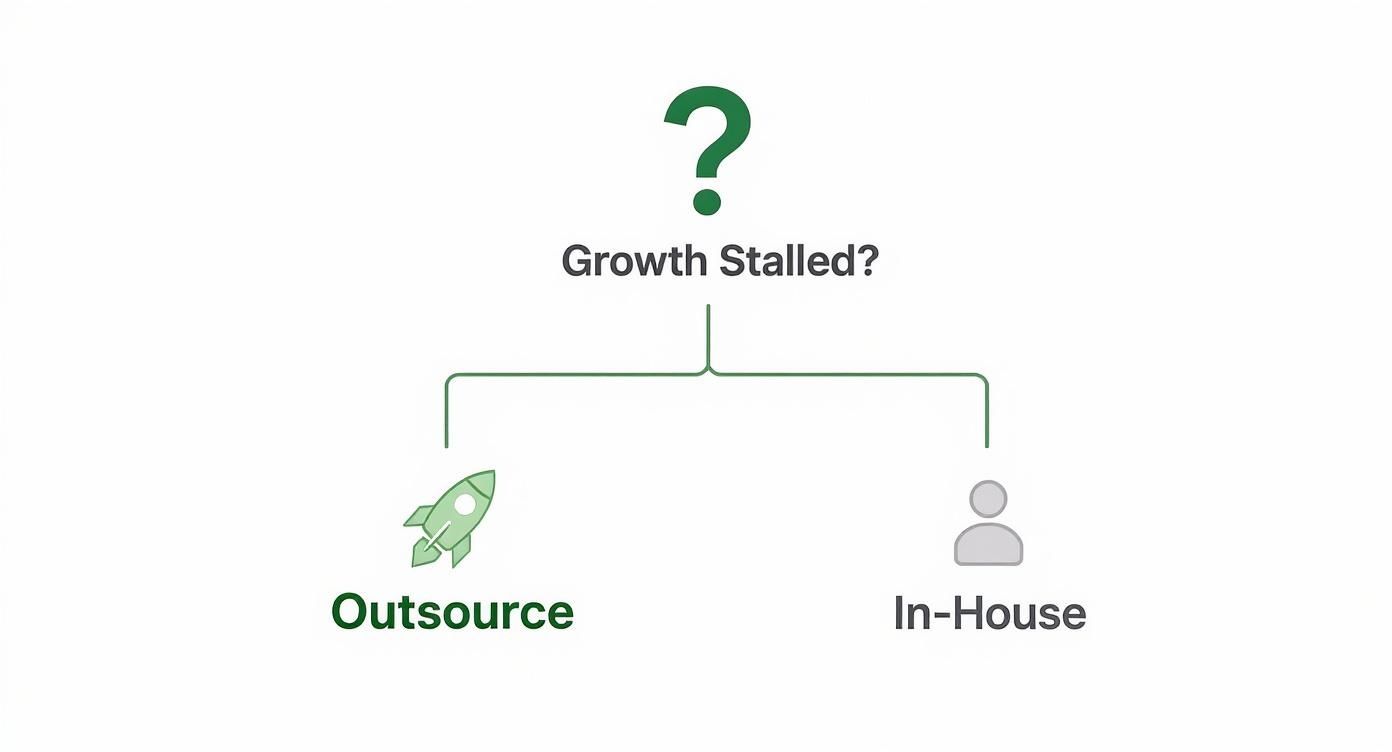
This decision tree nails that first fork in the road. When growth stalls, you either build the capability inside your company or you bring in outside experts to light the fuse.
The Strategic Leader: Fractional CMO
A Fractional Chief Marketing Officer (CMO) is your outsourced marketing brain. This isn't the person you hire to write daily social media posts. You bring in a fractional CMO when you have a capable but junior team that’s spinning its wheels, or when you, the founder, can no longer juggle being the CEO and the head of marketing.
They are perfect for:
- Setting the Go-To-Market Strategy: They figure out who you should target, what you should be saying, and which channels will actually deliver a return.
- Building the Marketing Roadmap: They create the whole plan, from how to spend your budget to which campaigns to prioritize, making sure every single activity ties back to your revenue goals.
- Mentoring Your Team: A good fractional CMO levels up your existing marketing coordinator or specialist, giving them the senior leadership you can’t yet afford full-time.
A fractional CMO provides the "why" and the "what," helping you build a sustainable marketing function before you commit to a six-figure executive salary.
This model is a lifesaver for early-stage B2B tech startups that need senior-level thinking but don't have the budget for a full-time C-suite hire. If you feel like your team is just "doing stuff" without a clear, cohesive plan, this is often the right first move.
You can explore the different ways a Fractional CMO service provides this crucial strategic direction.
The Execution Engine: Marketing Agency
While a fractional CMO sets the strategy, a marketing agency is your dedicated execution engine. Think of them as a full team of specialists on-demand—content writers, SEO experts, paid media managers, and designers, all under one roof.
You turn to an agency when you have a clear strategy but lack the internal horsepower to get it all done. Let's say you know you need to publish four blog posts, run a LinkedIn ad campaign, and fix your technical SEO every month, but your one-person marketing team is completely swamped. This is where an agency shines.
Agencies are built to deliver on a defined scope of work, consistently and professionally. It’s no surprise that 78% of businesses report seeing a positive ROI within just six months of hiring one. Their real value is in providing a diverse skillset and reliable output, turning your strategic plan into tangible marketing activities that generate leads and build your brand.
Creating Your Outsourced Marketing Playbook
Jumping into a partnership without a clear plan is like starting a road trip with no map. You’ll burn a lot of fuel and probably end up somewhere you never intended to be. Before you even think about hiring an external team, you need to build your playbook.
This playbook becomes your single source of truth. It defines what success looks like, sets clear boundaries, and gives both you and your future partner the clarity needed to hit the ground running. It’s the foundational work that prevents wasted time, budget overruns, and frustrating misalignments down the road.

Without this clarity, you risk hiring a team to solve the wrong problems. They might be amazing at running social media ads when what you really need is foundational SEO to capture existing demand.
Crafting a Precise Scope of Work
First up in your playbook is a detailed Scope of Work (SOW). This document is your best defense against "scope creep"—that dreaded scenario where small, unplanned requests slowly pile up until the original project is completely unrecognizable.
Your SOW has to be specific. Don't just say "improve SEO." Get granular and spell out exactly what that means.
- Deliverables: "Publish four 1,500-word, keyword-optimized blog posts per month on topics related to B2B fintech compliance."
- Activities: "Conduct a full technical SEO audit in the first 30 days and implement all priority fixes."
- Exclusions: "This SOW does not include paid media management or social media content creation."
This level of detail makes sure everyone is on the same page about what is—and what isn't—part of the deal. It protects both you and your partner from future misunderstandings.
Defining KPIs That Actually Matter
Next, you have to define how you'll measure success. Forget vanity metrics like social media followers or website traffic without context. Your Key Performance Indicators (KPIs) must tie directly to tangible business outcomes.
The goal isn't just to be busy; it's to be effective. Your KPIs are the bridge between your partner's marketing activities and your company's revenue goals.
Focus on the metrics your CEO and investors actually care about. For a B2B tech startup, these almost always include:
- Marketing Qualified Leads (MQLs): The raw count of high-intent leads generated.
- Sales Qualified Leads (SQLs): How many of those MQLs the sales team accepts as legitimate opportunities.
- Pipeline Value: The total dollar amount of new sales opportunities created from marketing efforts.
- Customer Acquisition Cost (CAC): The all-in cost to acquire a new customer.
Agreeing on these KPIs before you sign a contract ensures your partner is laser-focused on driving growth, not just checking off tasks on a to-do list.
Building Your Request for Proposal Checklist
With your SOW and KPIs locked in, you’re ready to build a Request for Proposal (RFP). This isn’t just a glorified job description; it’s a tool to systematically evaluate potential partners and see who really gets it. Your RFP should ask tough questions that reveal a partner’s true capabilities.
You need to include questions that force them to go beyond a generic sales pitch. For instance, ask them to describe their process for getting up to speed on a complex B2B product, or to provide a case study from a company at a similar growth stage to yours. A solid partner will have clear, confident answers that come from real-world experience.
How to Find and Vet the Right Marketing Partner
https://www.youtube.com/embed/XqszykgJ3VE
Your success with an outsourced partner really just comes down to the people you hire. Finding the right one isn't about a lucky Google search; it's a methodical process that cuts through the noise and slick sales pitches.
Forget starting with a broad search. The best partners almost always come from trusted networks. Tap into your industry-specific Slack communities, ask other founders in your niche for a referral, or check with your VC investors—they usually keep a roster of proven marketing experts on hand. And while you're at it, get familiar with the different types of providers out there, including specialized directories of Marketing SaaS Companies.
Digging Deeper Than the Sales Pitch
Once you’ve got a shortlist, the real work begins. It’s easy to get distracted by a polished proposal, but you need to focus on what actually matters: Do they get your business?
A great partner won’t just pitch their services. They’ll dig in with probing questions about your Ideal Customer Profile (ICP), your competitors, and your long-term business goals. That’s your first signal they’re thinking strategy, not just tactics.
The trend toward outsourcing is real. Over 50% of U.S. companies now hand off key marketing functions like digital, content, and SEO to outside specialists. This gives you more options, but it also means you have to be way more discerning to find the signal in the noise.
A partner’s ability to articulate your product’s value proposition back to you is a powerful indicator. If they can’t explain what you do in simple terms, they’ll never be able to market it effectively.
Asking the Tough Questions
Case studies and references are table stakes, but you need to push past the surface-level questions. When you get on the phone with a potential partner’s former clients, get specific.
Ask questions that reveal how they operate under pressure:
- "Can you walk me through a time when a campaign missed its target? How did they communicate that to you, and what was the plan to pivot?"
- "How autonomous was their team? Did you have to constantly manage their tasks, or did they proactively drive the strategy forward?"
- "What did their reporting look like? Did you feel you had a clear, real-time handle on the ROI they were generating?"
This isn’t about finding a partner who’s never failed. It's about finding out how they handle adversity. How a team navigates the messy middle is far more telling than their highlight reel. When you need this caliber of strategic leadership and accountability, you might consider a fractional CMO. You can learn more about how to hire a fractional CMO to fill that critical gap.
Don't Overlook Cultural Fit
Finally, don’t blow past cultural fit. This is a partnership, and you’ll be talking to these people every day.
Do they share your sense of urgency? Is their communication style direct and transparent? A mismatch in how you work can create friction that grinds even the most brilliant strategy to a halt. At the end of the day, choose a team you genuinely want in the trenches with you.
Onboarding and Managing Your Outsourced Team
You’ve signed the contract and approved the proposal. Now the real work begins.
The success of your outsourced marketing partnership isn’t sealed with the agreement; it’s forged in the day-to-day operations that follow. A strong start is everything. You can't just hand over the keys and expect your new partner to hit the ground running.
A structured onboarding plan is critical to get them up to speed on your product, brand voice, and internal processes. This isn't just about sharing a login; it's a full-on knowledge transfer.

This initial phase sets the tone for the entire relationship. Schedule deep-dive sessions with your product lead, give them access to customer call recordings, and share your brand guidelines. The faster they can think like an insider, the faster you’ll see meaningful results.
Establishing a Communication Rhythm
Clear communication is the lifeblood of any successful outsourced partnership. You need a practical rhythm that keeps everyone aligned without bogging them down in endless meetings. The key is to separate tactical check-ins from strategic reviews.
- Weekly Check-ins (Tactical): These should be quick, 30-minute stand-ups focused on progress, roadblocks, and what’s next. You’ll review campaign metrics from the past week and lock in priorities for the week ahead.
- Monthly or Bi-Monthly Reviews (Strategic): This is a longer, more in-depth meeting. Here, you zoom out to review performance against your core KPIs like MQLs and pipeline value. It’s the time to discuss what’s working, what isn’t, and make strategic pivots.
This two-tiered approach keeps you connected on the details while reserving dedicated time to steer the ship. It also helps define the appropriate B2B marketing team structure and roles between your internal staff and the external partner. Priorities can shift, too. For instance, between 2019 and 2020, the percentage of professionals outsourcing content marketing dropped from 40% to 30%, showing how strategies evolve. You can find more data on outsourcing trends at Exploding Topics.
Clarifying MarTech and Data Ownership
One of the most overlooked—and potentially contentious—parts of outsourcing is the tech stack. Who owns the tools and, more importantly, the data? Settle this upfront to avoid major headaches down the road.
You are renting the team, not their technology. Your company should always own the core platforms and the data within them.
This is non-negotiable. Your HubSpot or Pardot instance, your Google Analytics account, and your CRM data belong to you. Your partner should get administrative access, but the ownership must remain in-house.
Imagine parting ways with an agency after a year, only to discover they set up Google Analytics under their own account. All your historical website data is gone. A clear handoff plan, documented from day one, ensures that if the partnership ends, you retain all the assets, data, and institutional knowledge they helped build. This is foundational to a productive relationship.
A Few Common Questions Before You Sign
Even with a solid plan, a few practical questions always come up right before you pull the trigger on a new marketing partner. Let's tackle the big ones I hear from B2B tech founders all the time.
How Much Is This Going to Cost Me?
This is always the first question, and the honest answer is: it depends. The cost swings pretty wildly based on the model you pick and how much work you're handing over.
- A freelance contractor for a specific job, like writing a few blog posts a month, might run you a few hundred to a few thousand dollars.
- A full-service B2B marketing agency retainer can be anywhere from $5,000 to $25,000+ a month, depending on what they're doing for you.
- A Fractional CMO focused on high-level strategy usually comes in on a retainer between $4,000 and $10,000 per month.
The trick is to think of this as an investment in your growth, not just another line item on the P&L. Going for the cheapest option rarely gets you the best return. It’s a trend we see everywhere; the outsourced sales services market, for example, hit $2.71 billion in 2024 and is expected to climb to $4.21 billion by 2034. You can dig deeper into these global sales outsourcing trends on Activated Scale.
How Can I Be Sure They'll "Get" My Complex Product?
This is a totally fair concern for any founder who has poured their life into a technical product. The best partners have this figured out and build an intensive discovery process right into their onboarding.
Look for firms that already live in your world—whether that's enterprise SaaS, fintech, or HealthTech. Here's a great litmus test for the vetting process: ask them to explain your product and its value proposition back to you. How quickly they grasp the core concepts will tell you a lot about their quality.
A great outsourced marketing partner doesn't just wait for you to feed them information. They jump into your world headfirst, digging through your docs, watching your demos, and talking to your customers until they're a true extension of your team.
What’s the Biggest Mistake Founders Make When They Outsource?
Hands down, the most common and costly mistake is thinking you can "set it and forget it." Outsourcing your marketing is a partnership, not a magic black box that runs on its own.
The founders who get the best results are the ones who stay plugged in. They show up for the weekly meetings, give clear and timely feedback, and treat their external team with the same respect as their in-house people. The other huge pitfall is failing to agree on what success looks like from day one. Without clear metrics, you're almost guaranteed to end up frustrated.
If you're looking for senior marketing leadership to build and execute a growth strategy without the full-time cost, Value CMO provides the fractional expertise B2B tech startups need to scale. Learn more about how we can build your marketing engine at https://valuecmo.com.