
Let's be honest: building a B2B tech marketing team can feel like a high-stakes puzzle. Who do you hire first? A generalist? A niche specialist? An expensive VP?
Make the wrong move and you’ll burn through precious time and capital. That’s why picking the right marketing department structure is one of the most critical decisions a founder can make.
Your B2B Marketing Team Is More Than an Org Chart
The generic 'growth hacker' approach rarely works for B2B tech. Real, sustainable growth isn't about finding one magic trick; it's about building a predictable engine. This guide is here to cut through that noise.
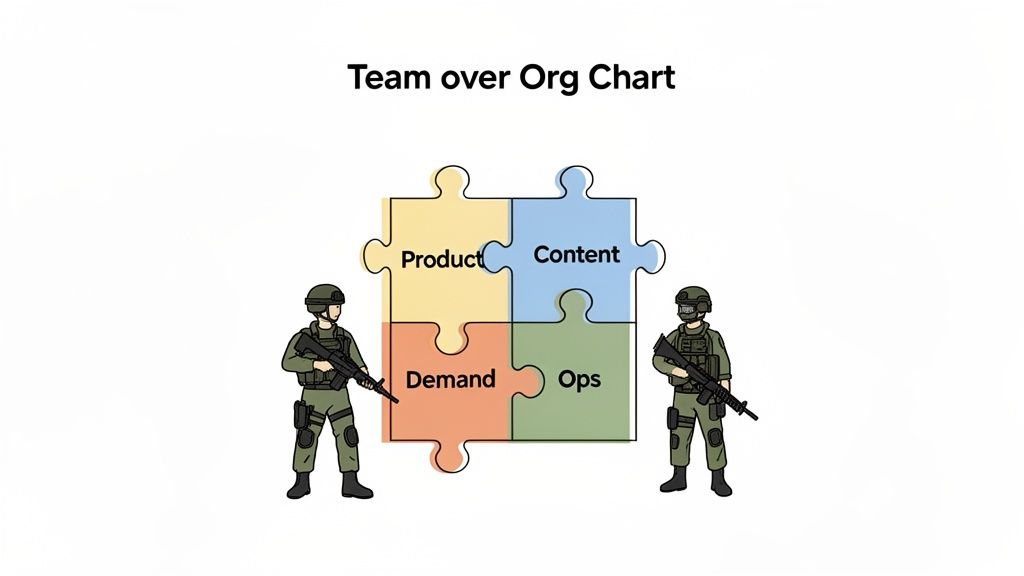
We’re going to walk you through how to align your marketing structure with your company's growth stage—from a scrappy startup to a scaling enterprise. Think of it less like filling boxes on an org chart and more like assembling a special ops team.
Each person has a clear, strategic role designed to hit specific revenue goals. It’s the key to avoiding the chaos so many founders get stuck in.
The Foundation of a High-Performing Team
A well-designed structure does a lot more than just define who reports to whom. It creates clarity, drives collaboration, and directly impacts your bottom line. An effective org design helps you:
- Improve Efficiency: When everyone knows their role and how it connects to the bigger picture, work gets done faster with less friction.
- Boost Morale: Clear roles and responsibilities reduce confusion and burnout, creating a more motivated and focused team.
- Enable Scalability: The right framework allows your team to grow without breaking, adapting as your company hits its next stage.
Ultimately, your marketing structure is the blueprint for your growth engine. It dictates how information flows, how decisions get made, and how quickly you can respond to the market.
Beyond the chart, a winning B2B marketing team is defined by its strategic chops. That means nailing the core skills, like those detailed in these B2B Email Marketing Best Practices.
A solid structure is also the only way to get marketing and sales working in lockstep. To see just how crucial that relationship is, check out our guide on how to align sales and marketing. A misaligned team creates silos and leaves money on the table—a problem this guide will help you solve for good.
The Three Core Marketing Department Structures
Every marketing team has a structure, whether you designed it on purpose or it just… happened. But getting intentional about your org chart is the first step toward building a team that doesn't just complete tasks, but actually drives business growth.
Think of these models less as rigid hierarchies and more as different ways to organize a professional kitchen—each one built for a specific menu and scale. We can break down most marketing department structures into three main models: Functional, Divisional, and Matrix. Each has its own flavor, perfect for different company sizes, goals, and market demands.
Let’s dig in.
The Functional Structure: The Classic French Brigade
The Functional structure is the most common starting point. It's simple and intuitive: you organize your team by expertise. All the content writers report to a content lead, all the SEO specialists are on one team, and the demand gen experts work together.
This is your classic French kitchen brigade. You have a saucier who has mastered sauces, a pâtissier who owns pastries, and a garde manger who handles all the cold dishes. Each chef is a deep specialist in their craft, reporting up to the executive chef (your VP of Marketing). The whole point of this model is to build deep skills and make each function incredibly efficient.
- Best For: Startups and small businesses that need to build strong, foundational expertise in core marketing disciplines like SEO, content, and paid ads.
- Key Advantage: You create centers of excellence. Team members learn directly from other experts in their field, sharpening their skills and establishing best practices.
- Common Challenge: This model is notorious for creating silos. The content team might not talk to the SEO team, which means you get disjointed campaigns and tons of missed opportunities.
Key Takeaway: The Functional model is all about building depth. It’s a powerful way to get really, really good at the fundamentals of marketing.
The Divisional Structure: The Multi-Brand Ghost Kitchen
Next up, we have the Divisional structure. Instead of grouping people by what they do, this model creates smaller, self-sufficient marketing teams dedicated to a specific product line, market segment, or geographic region.
Picture a modern ghost kitchen that runs several restaurant brands out of one location. There’s a dedicated crew for the pizza brand, another for the taco brand, and a third for the salad concept. Each mini-team has its own marketer, designer, and campaign manager laser-focused on their brand’s success.
This structure allows for intense focus. If you're a SaaS company with separate products for enterprise and SMB customers, a divisional model ensures each audience gets marketing that actually speaks to them. As the folks at HubSpot point out, this approach is especially effective when you have deep knowledge of specific market segments.
The Matrix Structure: The Flexible Food Truck
Finally, we have the Matrix structure, a hybrid that blends both the Functional and Divisional approaches. In this setup, an employee reports to two managers: a functional manager (like the Head of Content) and a project or divisional manager (like the Product Marketing Lead for a new launch).
It’s like a versatile food truck crew. The grill master (a functional expert) might work on the burger special one day and the grilled chicken sandwich the next, reporting to whoever is managing that day’s menu (the project lead). It’s a model built for flexibility and sharing talent across teams.
- Best For: Larger, more complex organizations that juggle multiple products and projects at the same time and need to share specialized talent efficiently.
- Key Advantage: Resources get used wisely. A single, highly-skilled SEO expert can contribute to multiple product launches without being permanently stuck in one division.
- Common Challenge: The dual-reporting lines can create confusion and turf wars over priorities if communication isn't crystal clear.
To help you decide which model fits your business, here's a quick side-by-side comparison.
Comparing Marketing Department Structures
| Structure Type | Core Principle | Best For | Key Advantage | Common Challenge |
|---|---|---|---|---|
| Functional | Organize by expertise (SEO, Content, etc.) | Startups & SMBs | Deep skill development | Silos and poor collaboration |
| Divisional | Organize by product, market, or region | Companies with diverse offerings | Intense market focus & alignment | Duplication of roles & costs |
| Matrix | Hybrid of Functional & Divisional | Large, complex enterprises | Efficient use of shared talent | Confusion from dual reporting |
Ultimately, there’s no single “best” structure. The right choice depends entirely on your company’s stage, goals, and the complexity of the market you operate in. The key is to pick a model that lets your team move fast, collaborate effectively, and stay focused on driving revenue.
Mapping Your Structure to Your Growth Stage
Your company isn't static, so why should your marketing team be? The structure that works wonders for a 10-person startup will absolutely crumble under the weight of a 100-person scale-up. The real secret is matching your org chart to your company’s current reality and its next big goal.
Choosing the right structure isn't a permanent fix. It's about picking the right tool for the job at hand. Think of it as a strategic playbook that evolves with you, making sure your team is always set up to win the next play, not the last one.
The timeline below shows how different marketing structures naturally map to a company's journey, from its scrappy early days to becoming a market leader.
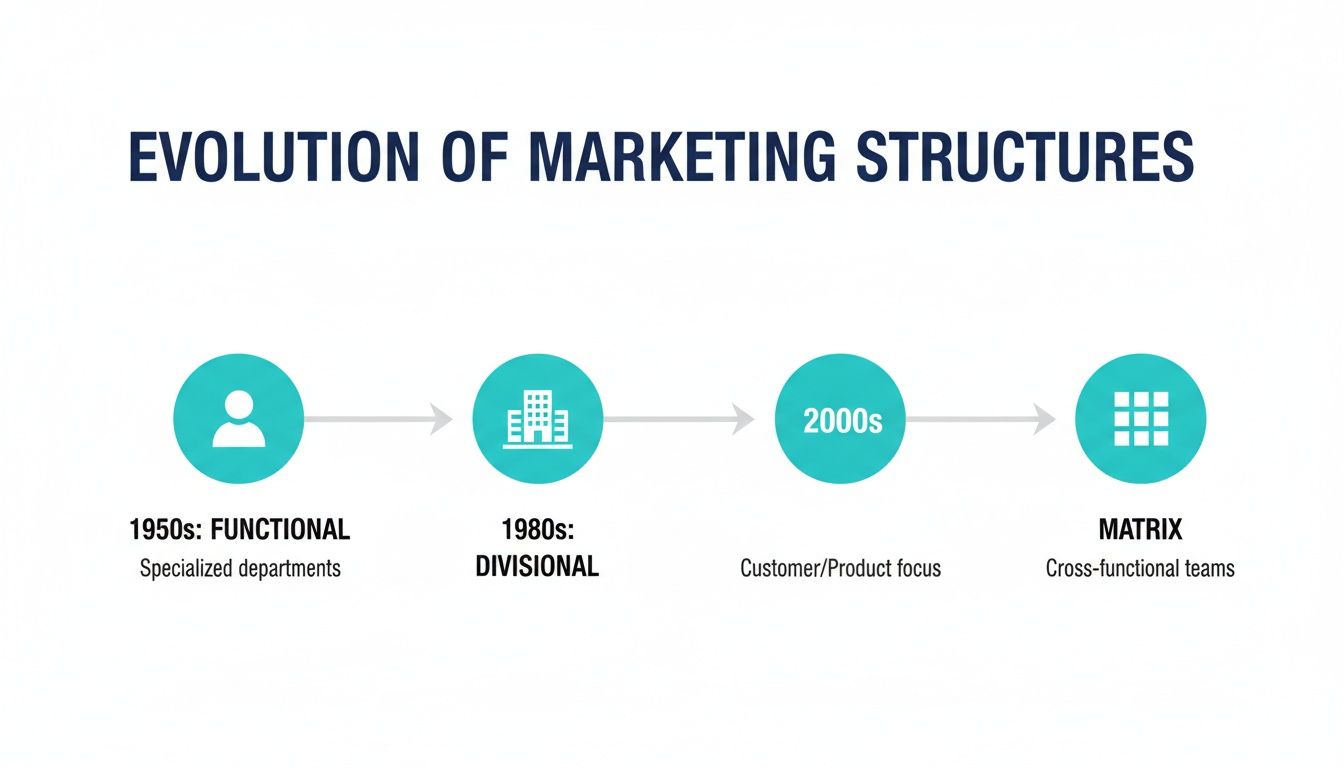
This visual shows the natural progression from simple, skill-based teams to more complex models built to handle a diverse mix of products and projects.
The Startup Stage (Seed/Series A)
In the beginning, your only mission is survival and validation. You have to find product-market fit and build a sales process that actually works more than once. Your marketing team needs to be lean, fast, and completely focused on getting stuff done.
A Functional structure is your best friend here. With a tiny team of one to five marketers, you need specialists who can ship work fast. Your first hire should be a T-shaped marketer—someone with broad knowledge across many areas but deep expertise in one or two critical channels, like content or demand gen.
- Team Size: 1-5 people
- Critical Hires: A versatile T-shaped marketer, quickly followed by specialists in content and demand generation.
- Primary KPIs: Website traffic, marketing qualified leads (MQLs), and early customer acquisition cost (CAC). The entire goal is to generate initial traction and learn what works.
The Scale-Up Stage (Series B/C)
Once you nail product-market fit, the game completely changes. Now, it's all about building a predictable growth engine and pouring gas on what works. Your marketing team has to get more specialized to handle the increase in complexity and volume.
This is where the pure Functional model starts to show its cracks. You might start pulling in elements of a Divisional structure by creating dedicated pods for different products or market segments. You're shifting from a team of generalists to a true department of experts.
At the scale-up stage, your goal shifts from finding a working model to scaling it. This demands specialization in roles like Marketing Operations to manage your growing tech stack and Product Marketing to sharpen your competitive edge.
Your hiring priorities have to shift to include roles that build the infrastructure for growth.
- Team Size: 10-25+ people
- Critical Hires: Marketing Operations Manager, Product Marketer, and specialized channel owners (e.g., SEO Manager, Paid Acquisition Specialist).
- Primary KPIs: Sales qualified leads (SQLs), pipeline velocity, and the customer lifetime value (LTV) to CAC ratio. The focus is now on efficient, repeatable growth.
The Enterprise Stage (Established Company)
At the enterprise level, you’re juggling multiple product lines, global markets, and a ton of complexity. Your marketing department has to support this scale while somehow staying agile.
A Matrix structure often becomes a necessity. This hybrid model lets functional experts (like a content strategist) support multiple product lines or regional teams. This setup prevents you from hiring the same role over and over while making sure deep expertise gets shared across the entire organization. The focus is on global strategy, brand consistency, and market penetration.
- Team Size: 50-100+ people
- Critical Hires: Director of Global Campaigns, Regional Marketing Managers, Data Analysts, and Brand Managers.
- Primary KPIs: Market share, brand equity, revenue attribution, and regional pipeline targets. The objective is market leadership and operational excellence.
The Key Players on a Modern B2B Marketing Team
Let's move from theory to the real world and talk about the people who actually make your growth engine run. Building the right team isn’t about hiring a generic “Digital Marketer.” A truly effective B2B marketing department is built on four essential pillars, each with a distinct and critical mission.
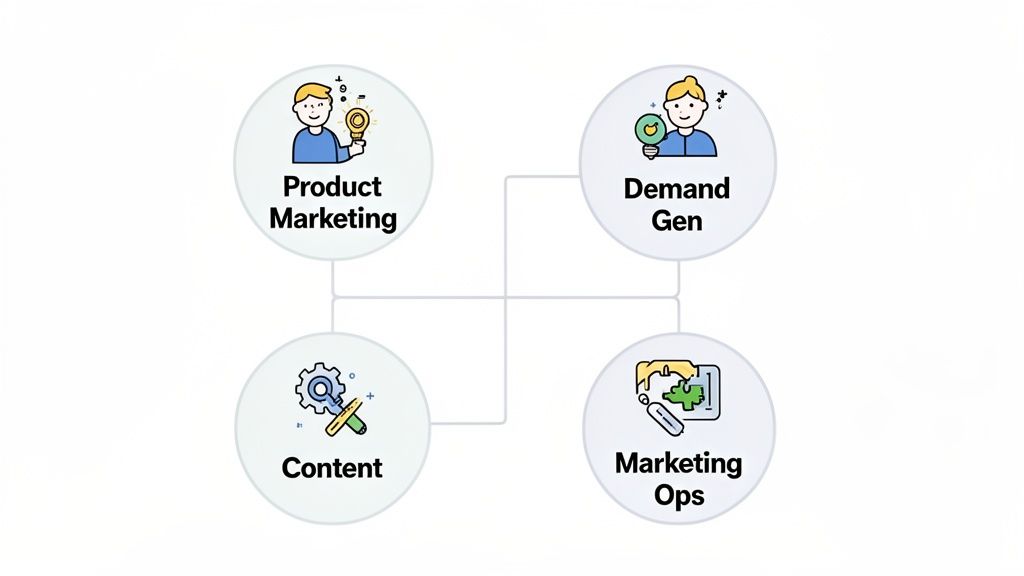
These aren’t just job descriptions; they're the functional heart of your go-to-market strategy. Nailing how they work together is the secret to creating a hiring plan that actually makes sense for your stage of growth.
The Four Core Marketing Functions
Think of these roles as a special ops team. Each member brings a unique skill set, but they’re all relentlessly focused on one thing: driving revenue.
-
Product Marketing (The Voice of the Customer): This function owns the narrative. Product marketers live at the intersection of product, sales, and marketing, and their job is to translate complex features into clear value propositions that your Ideal Customer Profile (ICP) actually cares about. They arm the sales team with battle cards, nail down your positioning, and make sure the whole company is speaking the same language.
-
Demand Generation (The Pipeline Builder): If Product Marketing creates the message, Demand Gen gets that message in front of the right eyeballs. This team is laser-focused on creating a qualified pipeline for sales. They run the channels—SEO, paid ads, webinars, email—and live and die by metrics like MQLs, SQLs, and ultimately, revenue.
-
Content Marketing (The Storyteller): This role is the fuel for your entire marketing engine. They’re the ones creating the blog posts, white papers, case studies, and videos that pull your audience in and teach them something valuable. They work hand-in-hand with Demand Gen to create assets for campaigns and with Product Marketing to turn dry features into compelling stories.
-
Marketing Operations (The Systems Guru): This is the unsung hero of any marketing team that wants to scale. Marketing Ops builds and maintains your tech stack—the CRM, marketing automation, and analytics tools. They keep the data clean, the processes efficient, and the campaigns measurable. As you grow, this role becomes absolutely essential. Want to go deeper? Check out our guide on what marketing operations is and why it's so critical.
A classic mistake is hiring for these roles out of order. Without strong Product Marketing, your Demand Gen team will just burn cash on the wrong message. Without Marketing Ops, you’re flying blind and can't prove what’s actually working.
Building Your Team Strategically
Knowing these functions helps you map out a smart hiring plan. Early on, a founder or a versatile T-shaped marketer might wear all four hats. As you scale, you’ll bring in specialists for each function, creating a much more powerful and effective marketing department.
This structured approach is especially vital for growing B2B tech companies. The data shows a huge concentration of entry-level talent, with these roles making up 33% of all marketing positions. But for scale-ups, the real challenge is the scarcity of experienced VPs and C-level leaders who can provide strategic guidance during those critical growth spurts. Discover more insights about the marketing industry talent landscape from the AMA. This talent gap is exactly why building your team with a clear structure in mind is non-negotiable for long-term success.
How to Evolve Your Marketing Structure Without Breaking It
Restructuring your marketing team feels a lot like changing an airplane’s engine mid-flight. It takes precision, a steady hand, and a solid plan to avoid a nosedive.
Shifting your org design—say, from a Functional model to a Matrix—isn't just about shuffling boxes on a chart. It’s a delicate process that messes with real people, their daily workflows, and the company's momentum. Get it wrong, and you'll tank morale, kill productivity, and watch your best talent walk out the door.
But if you approach it thoughtfully, you can minimize the disruption. The goal is to make the change feel like a smart, necessary evolution, not a chaotic shake-up nobody asked for.
Create a Clear Transition Plan
The single biggest mistake I see leaders make here is under-communicating. Your team needs to understand the why behind the change. Are you doing this to support a new product launch? To finally break down silos that are killing speed? To push into a new market? You have to be radically transparent about the business reasons driving the decision.
Ambiguity is the enemy of change. When people don't have a clear picture of what's happening and why, they fill in the blanks—and almost always assume the worst. Over-communication is always, always better than radio silence.
A smooth transition hinges on mapping out the new rules of engagement. This is where optimizing marketing workflow management becomes critical. You have to define exactly how information will flow, who makes what decisions, and how projects get from A to B in the new system.
Manage the Human Element
Let’s be honest: change is stressful. The first thing you need to do is acknowledge that and show you're there to support the team. It is absolutely crucial to address how this shift impacts individual career paths and day-to-day responsibilities.
Follow these steps to keep trust and momentum on your side:
- Redefine Roles and Responsibilities Immediately: Don't leave people guessing. Clearly lay out new reporting lines, updated job descriptions, and how success will be measured. Nobody should be left wondering what their job is or who they report to after the announcement.
- Update Workflows and Tools: Make sure your project management software, Slack channels, and meeting cadences actually reflect the new structure. Trying to jam old processes into a new model is a recipe for failure.
- Offer Support and Training: Invest in your people. This means providing coaching for newly minted managers and skills training for team members whose roles are shifting.
Sometimes, the smartest move is bringing in an experienced guide to help you navigate the turn. For companies dealing with rapid growth, exploring outsourced marketing leadership can provide the strategic oversight you need to evolve without stumbling. A seasoned expert has done this before and can help you build the right marketing department structure for whatever's next.
Common Questions About Building Marketing Teams
As you start to put your team together, the questions start piling up. It's one thing to have a great product; it's another to build the marketing department structure that can actually sell it. It’s easy to get bogged down.
Let's cut through the noise and tackle the real-world hurdles that come up in boardrooms and founder meetings when the conversation shifts from product to pipeline. Getting these right can save you months of headaches and wasted cash.
When Is the Right Time to Hire My First Marketing Leader?
The short answer: right after you've found early product-market fit, but just before the CEO is drowning in marketing tasks. If generating leads feels like random acts of marketing instead of a repeatable process, that's your cue.
For most B2B startups, this moment hits around the Series A funding stage. But a full-time VP of Marketing is a serious commitment. Many founders start with a fractional CMO to bring in senior-level strategy and build the foundation. This lets you test the waters before making a permanent executive hire.
How Should Our Marketing Team Change if We Add a New Product?
Launching a new product is a classic stress test for your marketing structure. If you're running a simple Functional team, where everyone is grouped by skill (one content team, one demand gen team), it will quickly become a bottleneck. The content team, for example, is suddenly forced to split its attention, starving both your core product and the new launch.
This is the perfect trigger to evolve. You could shift to a Divisional model with dedicated marketing pods for each product line. Or, you could try a Matrix structure where functional experts—like your SEO or content lead—support multiple products as shared resources. The goal is to give the new product the focused attention it needs to succeed.
What Is the Difference Between Demand Generation and Lead Generation?
This is a critical distinction, and it shapes your entire team's purpose.
Lead generation is a tactic. It’s hyper-focused on one thing: getting a prospect's contact info, usually through a form on a landing page. It's a single, specific action.
Demand generation, on the other hand, is the whole strategy. It’s the top-of-funnel content that gets your name out there, the mid-funnel education that builds trust, and everything in between that makes buyers want to talk to you. A modern, revenue-focused marketing team is built around this bigger, more powerful goal.
How Do We Structure Our Team to Incorporate AI?
Don't just hire an "AI specialist" and hope for the best. The smart move is to weave AI skills into your existing roles, making everyone more efficient.
- Content Team: Your content folks should be using AI for brainstorming, creating first drafts, and summarizing research. It's a powerful assistant, not a replacement.
- Demand Gen Team: They can use AI for ad copy variations, audience segmentation, and digging into predictive analytics to find opportunities.
- Marketing Ops: This role is your anchor. They should own the process of vetting, implementing, and training the team on new AI tools, ensuring everyone uses them effectively and securely.
Ready to build a marketing department structure that actually drives revenue? The team at Value CMO provides fractional CMO services to help B2B tech companies clarify their strategy, build a high-performing team, and accelerate growth without the cost of a full-time executive. Get the strategic leadership your startup needs.