Your marketing department’s organizational structure is the framework that spells out who does what, who reports to whom, and how all the moving parts work together to hit your business goals. For a B2B startup, getting this right isn't just a nice-to-have—it's the blueprint for your growth engine, and it dictates how fast and efficiently you can bring in customers and scale.
Why Your Marketing Structure Is Your Startup's Blueprint for Growth
Let's be real: making an org chart can feel like a chore. It’s easy to write it off as a box-drawing exercise for a corporate giant, not a lean startup that needs to move fast. But for a B2B tech company, that couldn't be more wrong. Your marketing structure isn't just about reporting lines; it's the operational DNA of your go-to-market strategy.
Think about building a high-performance race car. You wouldn't just toss a bunch of parts together and hope for the best, right? You'd engineer the chassis, engine, and drivetrain to work in perfect harmony. Every piece has a specific job, all designed to maximize speed and efficiency.
An undefined or poorly designed marketing department organizational structure does the exact opposite. It creates friction and waste, leading straight to:
- Wasted Ad Spend: Without clear ownership, you might have different people running conflicting campaigns or hitting the same audience with mixed messages. It's chaos.
- Team Burnout: Generalists get stretched thin trying to do everything, while specialists don't have the strategic direction they need to focus on what actually moves the needle.
- A Stagnant Pipeline: Your efforts become fragmented, and you fail to build the consistent, predictable flow of leads that both investors and sales teams are looking for.
This guide will walk you through designing the right structure for your startup's specific stage, turning that potential chaos into a lean, effective marketing machine. The first step is understanding the difference between high-level planning and day-to-day execution; you can learn more about how strategy vs. tactical work fits into your org chart in our detailed article.
From Chaos to Clarity
Getting your structure right from the start prevents a lot of expensive headaches down the road. It makes sure that as you invest in people and programs, every dollar and every hour is tied to a clear objective. It’s all about building a system where accountability is clear, collaboration is seamless, and results are measurable.
A well-designed marketing organization doesn't just execute tasks; it builds momentum. It creates a system where big-picture goals are translated into coordinated actions, turning marketing from a cost center into a predictable revenue driver.
We'll show you how to build the right team at the right time. This usually starts with foundational leadership—like a fractional CMO—to ensure every move is strategic from day one, long before a full-time executive salary makes sense. This approach gives you the blueprint you need to build a marketing function that scales as you grow.
Decoding the Blueprints of Common Marketing Org Structures
Picking a marketing structure feels a lot like choosing the blueprint for a house. You wouldn't use the same plans for a small cabin as you would for a sprawling mansion, and the same logic applies to your B2B startup. The org chart you design has to fit your current size, your immediate goals, and the market you're trying to win.
Forget the dry, academic definitions. Let's break down the most common marketing frameworks with simple analogies to see how they actually work in the wild. This will give you a mental toolkit to map out the best path for your own team.
A solid structure is the foundation for growth. It’s what turns your strategy into reality, and that reality into revenue.

This visual gets to the heart of it: structure isn’t an afterthought. It’s the bridge connecting your big-picture vision to real-world results.
Comparing Common Marketing Department Structures
To help you choose the right model, here’s a quick-reference table that boils down the key differences between the most common structures. Think of it as a cheat sheet for matching a blueprint to your specific stage and goals.
| Structure Model | Best For | Key Advantage | Potential Pitfall |
|---|---|---|---|
| Functional | Early to mid-stage startups with a single core product. | Fosters deep channel expertise and efficiency. | Can create knowledge silos between teams. |
| Product-Led | Companies with multiple distinct product lines or user bases. | Unbeatable product knowledge and alignment with R&D. | Risk of duplicated roles and brand inconsistencies. |
| Centralized | Nearly all B2B startups, especially pre-PMF. | Ensures a single source of truth for brand and strategy. | Can be less agile for regional or highly diverse markets. |
| Matrix | Large, mature companies running complex, cross-functional projects. | Excellent for collaboration and knowledge sharing. | Dual reporting lines can cause confusion and friction. |
Each of these models has its place. The key is to pick the one that solves for your current reality, not the company you hope to be in five years. Let's dig into the details.
The Functional Structure: The Master Craftspeople
Think of the functional structure as a workshop full of master craftspeople. You have your SEO expert, your content writer, your paid ads specialist, and your social media manager. Each person is a deep expert in their specific domain, and they all report up to a single marketing leader—like a VP of Marketing or a fractional CMO.
This model is the most common for a reason. It builds deep expertise and offers clear career paths.
- Best For: Early-stage to mid-stage B2B startups with a single core product and a focused target market. It’s perfect when you need to build foundational marketing channels with high-quality execution.
- Pros: Fosters deep skill development, creates clear lines of reporting, and is highly efficient for specialized tasks.
- Cons: Can easily lead to silos where the content team has no idea what the demand gen team is doing. Cross-functional work requires a deliberate, proactive effort from leadership.
The Product-Led Structure: The Dedicated Pit Crew
Now, imagine your company sells several distinct products. A product-led structure works like having a dedicated pit crew for each one. Every product line gets its own small, self-contained marketing team responsible for its go-to-market strategy, from launch to lead generation.
This structure puts marketers right alongside product managers and engineers, creating tight-knit units obsessed with a single offering.
- Best For: B2B tech companies with a diverse portfolio of products that serve different customer segments or industries.
- Pros: Unbeatable product knowledge and tight alignment between marketing and product development. It allows for highly tailored campaigns for specific user bases.
- Cons: Can lead to duplicated roles (multiple content marketers, for example) and potential brand inconsistencies across products if not managed carefully.
Centralized vs. Decentralized Structures: The Command Center vs. The Field Agents
The idea of a centralized structure is pretty straightforward—most, if not all, marketing functions report into a single headquarters or a "center of excellence." This central team dictates strategy, owns the brand, and deploys campaigns. A decentralized model, by contrast, empowers regional offices or business units to run their own marketing.
While a decentralized approach might sound more agile, the industry trend is moving decisively in the other direction. Recent Gartner data reveals that about 60% of marketing organizations have centralized some or all of their functions into one unified team. Fully decentralized models are now considered "nearly nonexistent" as companies push for brand consistency and operational efficiency.
For a B2B startup, a centralized structure is almost always the right call. It ensures a single source of truth for your brand, messaging, and go-to-market strategy—which is non-negotiable when you’re trying to establish a clear identity in the market.
The Matrix Structure: The Collaborative Squad
Finally, we have the matrix structure. This is a more complex, hybrid model where an employee reports to both a functional leader (like a Head of Content) and a project or product leader. It’s like being part of a home department but also getting assigned to a special mission squad.
This structure is built for high-level collaboration, breaking down the silos that can plague a purely functional model. But its dual-reporting lines can create chaos if not managed with extreme clarity.
- Best For: Larger, more mature companies running complex, cross-functional projects that require input from many different specialists.
- Pros: Excellent for collaboration and sharing knowledge across the organization. It's flexible and can adapt to changing project needs.
- Cons: Can create confusion over priorities and accountability. The "two bosses" problem is a very real source of friction and burnout for employees.
As you weigh these blueprints, it’s also smart to consider how external resources fit in. Exploring strategies for engaging a marketing agency can show you how to build a flexible extension of your in-house team without adding permanent headcount.
Your First Hires: Building the Team from Seed to Series A
Knowing the theoretical blueprints for a marketing team is one thing. Actually building it, person by person, is another thing entirely.
For a founder, it can feel like a high-stakes guessing game. Who do you hire first? When is the right time to bring on a specialist? Making the wrong call doesn't just waste money—it burns precious time you simply don't have.
This is your practical, stage-by-stage guide to building your marketing team from the ground up. We'll move from your first crucial hire in the pre-seed and seed stages to the specialized roles you'll need as you approach Series A. The goal is to align your hires with your startup's maturity, ensuring every new person adds immediate, tangible value.

This is the classic journey for B2B startups. It's a path from broad, versatile talent to deep, focused expertise, all guided by smart, strategic leadership.
The Pre-Seed and Seed Stage: Your First Marketing Hire
In the very early days, marketing isn't about building a department. It’s about finding one person who can do a little bit of everything. Your goal is initial traction, message testing, and learning what resonates with your first customers. You need a doer, not a delegator.
This is the era of the Marketing Generalist. Think of them as a Swiss Army knife. They're not a world-class expert in any single channel, but they're capable and resourceful enough to get things moving across several fronts.
Their world might include:
- Writing website copy and blog posts.
- Managing a small social media presence.
- Setting up and running simple email campaigns.
- Coordinating with freelancers for design or content.
- Gathering customer feedback to sharpen the messaging.
The biggest mistake founders make here is hiring a senior, strategic leader like a VP of Marketing too early. You don't have a team for them to lead or a budget for them to manage. You need someone who loves getting their hands dirty.
The Fractional CMO: Your Strategic Co-Pilot
While your generalist is handling the day-to-day execution, you still have a massive strategic gap. Who is defining the ideal customer profile? Who is building the go-to-market plan and deciding which channels to attack first? This is where a Fractional CMO becomes a game-changer.
A Fractional CMO provides the senior-level strategic direction needed to make those first few hires the right ones. They build the marketing roadmap, set the KPIs, and ensure your lean team is focused on activities that actually drive growth—long before you can justify a full-time VP of Marketing salary.
They act as your part-time executive, translating your business goals into a coherent marketing strategy. This leadership is what makes sure your generalist isn't just busy, but productive. If you're considering this path, our guide on how to hire a fractional CMO breaks down exactly what to look for.
The Post-Seed Stage: Building Your Foundation
Once you've secured seed funding and have some initial product-market fit, it’s time to double down on what’s working. Your focus shifts from pure experimentation to building a predictable engine for growth. This is when you bring in your first specialists to build out foundational channels.
The two most common and impactful hires at this stage are:
- Content & SEO Specialist: This person is your storyteller and organic growth engine. Their job is to create valuable content that attracts your target audience through search, establishing your brand as a credible authority. They own the blog, SEO strategy, and long-form content like ebooks or white papers.
- Demand Generation Manager: If the Content Specialist builds the magnet, the Demand Gen Manager distributes it. This role is squarely focused on filling the sales pipeline. They manage paid channels (like LinkedIn or Google Ads), run webinar programs, and optimize the entire lead capture and nurture process.
This is a pivotal moment. You’re moving from a one-person-band to a more functional structure, building pillars of expertise that will support the company's next phase of growth.
The Series A Stage: Scaling with Specialists
By the time you're approaching a Series A round, you have a working marketing engine and the data to prove it. Now, the game is about scale. Your hiring priorities shift toward adding specialists who can optimize and expand your proven channels—and potentially add new ones.
At this point, your department starts to look more layered. You might add roles like:
- Product Marketing Manager: To sharpen your messaging, manage product launches, and create sales enablement materials.
- Marketing Operations Specialist: To manage your tech stack, automate processes, and ensure your data is clean and actionable.
- Social Media or Community Manager: To build a dedicated following and drive real engagement on key platforms.
Interestingly, even as you scale, marketing remains a surprisingly lean function. Research shows marketing teams account for only about 5% of total headcount at the average B2B company. As companies grow, the structure also gets more senior-heavy; at companies over $50M in ARR, roughly 75% of marketers hold a manager title or above, according to the 2023 State of B2B Marketing Teams report.
This just goes to show how important it is to hire experienced leaders and specialists as you grow, rather than just adding junior headcount. Your org structure has to evolve to support this shift toward strategic depth.
How Marketing and Sales Should Actually Work Together
An org chart is just a diagram on a slide until people know who makes the final call. Without clear reporting lines and decision rights, even the most logical marketing department organizational structure creates friction, confusion, and stalled projects. This is where the rubber meets the road—turning boxes and lines into a smooth, fast-moving go-to-market engine.
This is especially true at the messy intersection of Marketing and Sales. For decades, these two teams often operated in separate silos, with different leaders, different goals, and a healthy dose of mutual suspicion. Sales would complain about lead quality, while marketing would point to low conversion rates. Sound familiar?
Luckily, that old model is finally breaking down.
The Rise of the Unified Revenue Team
The most powerful trend in modern B2B startups is uniting Marketing and Sales under a single leader. Whether you call this person a Chief Revenue Officer (CRO), a VP of Growth, or a Go-to-Market (GTM) Leader, the principle is the same: one person owns the entire customer journey, from first touch to final sale.
This isn't just a cosmetic change; it's a fundamental shift in strategy. When both teams report to the same leader, they are forced to share the same overarching goal—revenue. Finger-pointing becomes pointless because everyone is on the same team, working from the same playbook.
This trend is rapidly becoming the standard. A 2024 study found that nearly two-thirds of B2B companies now have marketing and sales reporting to the same leader. It's a clear signal that the siloed past is over, and an integrated go-to-market organization is the future. For B2B tech founders, this has massive implications for team design. You can explore the complete research on GTM alignment for a deeper dive.
Uniting Marketing and Sales under one roof transforms the conversation from "my leads vs. your quota" to "our pipeline and our revenue." It’s the single most effective structural change a B2B startup can make to eliminate friction and accelerate growth.
This unified approach ensures marketing initiatives are directly tied to sales outcomes, and sales feedback is systematically funneled back into marketing campaigns. It just works.
Who Owns What? A Simple Framework
Even with a unified leader, you still need clarity on day-to-day decisions. Who has the final say on a new campaign budget? Who approves the messaging for a product launch? Ambiguity here is a recipe for delays and internal conflict.
A simple yet brutally effective way to define ownership is the RACI framework, which stands for Responsible, Accountable, Consulted, and Informed.
Let's break it down with a practical example: launching a new webinar campaign.
- Responsible: This is the person doing the work. For our webinar, the Demand Generation Manager is responsible for setting up the landing page, running the ads, and coordinating the logistics.
- Accountable: This is the person who ultimately owns the outcome and has the final say. There should only be one accountable person. In this case, the Head of Marketing is accountable for the webinar’s success and budget.
- Consulted: These are the folks whose input you need before a decision is made. The Head of Sales and the lead Account Executive should be consulted on the webinar topic and target audience to make sure it aligns with what they're seeing in the field.
- Informed: These are the people you keep in the loop after a decision has been made. The rest of the sales team and the product marketing manager need to be informed about the webinar date, topic, and a summary of the leads generated.
By mapping out these roles for key projects, you replace guesswork with a clear system. It empowers your team to act decisively because everyone understands their part. This simple framework prevents silos from ever forming, allowing your entire go-to-market team to operate with the speed and clarity needed to win.
Connecting Your Org Structure to KPIs and Technology
Your org chart isn’t just a diagram of who reports to whom. It’s a machine built to hit specific numbers. Think of it like a car engine: its design determines whether it’s built for raw horsepower, incredible torque, or gas-sipping efficiency. In the same way, your team’s structure directly dictates the metrics you’ll track and the technology you’ll need.
The two are completely intertwined.
Your structure naturally creates focus. A team organized by function will obsess over channel-specific metrics. Your SEO lead lives and breathes organic traffic and keyword rankings. Your paid media manager is dialed in on cost-per-lead (CPL) and return on ad spend (ROAS).
This isn’t a flaw—it's a feature. It’s what happens when you design for deep, specialized expertise. But a different structure will point your team toward a completely different scoreboard.
How Structure Defines Your Scoreboard
A growth-led team, for instance, is playing a totally different game. Because they sit at the intersection of marketing and product, they zero in on user-centric metrics. Their key performance indicators (KPIs) aren't about channels; they're about user behavior.
- Activation Rate: How many new sign-ups are taking that first critical action?
- User Retention: Are people sticking around after week one? Week four?
- Feature Adoption: Is that new feature we launched getting used, or is it collecting digital dust?
No matter the model, understanding core business metrics is what aligns everyone's efforts. Knowing how to calculate Customer Lifetime Value (CLV) helps the whole team connect their daily work to long-term impact. The structure you choose is essentially a declaration of which numbers matter most.
Your org chart is a strategic bet on which metrics will drive the most growth. It dictates not just what you measure, but what your team obsesses over every single day.
Getting this right is critical. A misaligned structure leads to teams optimizing for vanity metrics that don't actually move the needle on revenue. When you consciously choose a structure, you're also choosing your primary KPIs.
Aligning Your Tech Stack with Your Team Design
This brings us to technology. Your Martech stack shouldn't be a random collection of cool tools. It should be a direct reflection of your team’s design and the KPIs they own.
A highly centralized, functional team often gets the most from a powerful, all-in-one marketing automation platform. This becomes the single source of truth, letting a marketing ops lead manage data, campaigns, and reporting across all the specialists. It’s built for a top-down view of performance.
On the other hand, a decentralized or product-led structure demands a more flexible, specialized set of tools. Each pod or product team might need its own analytics tool or customer messaging platform tailored to its unique user base. Here, the focus is on agility and empowerment at the team level, not centralized command and control. For a deeper dive, check out our guide on building effective marketing tech stacks.
Ultimately, you’re aiming for a seamless loop. The right marketing department organizational structure clarifies your most important KPIs, and the right technology makes it easy to track and act on them. This alignment ensures you get a real, measurable return from your investments in both people and platforms.
Visualizing Your B2B Startup Org Chart
Theory is one thing, but seeing a marketing department organizational structure on paper makes it real. Let's look at two common org charts that show how a B2B startup’s marketing team actually looks in the wild. These examples make it easy to see how roles and reporting lines have to change as you grow.
The first visual is for a lean startup, and the second shows a scaling SaaS company.
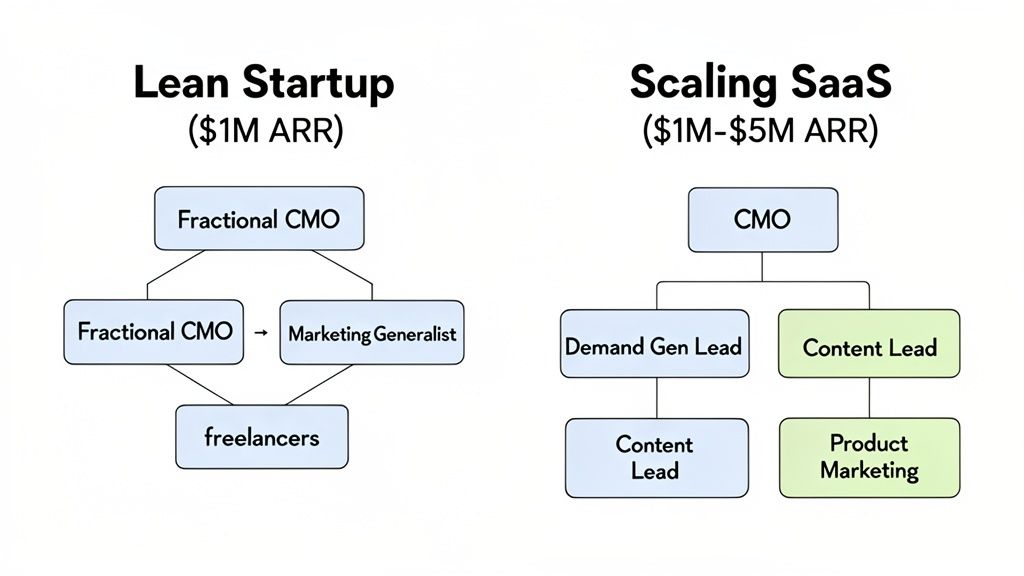
This side-by-side view clearly shows the move from a scrappy, versatile team to a more specialized, functional structure once a company finds its footing and starts to scale. Let’s break down each model.
The Lean Startup Model (Under $1M ARR)
In the early days, agility and cash efficiency are everything. The structure is simple and built for execution. A fractional CMO provides the high-level strategy that a full-time executive would, but without the six-figure price tag.
- Fractional CMO: Sets the strategy, owns the budget, and mentors the in-house team without the full-time cost.
- Marketing Generalist: The go-to "doer" who handles day-to-day work like content creation, social media, and email campaigns. They’re a Swiss Army knife.
- Freelancers: Specialized experts—like a graphic designer or an SEO consultant—are brought in for specific projects to keep overhead low.
This setup keeps the team lean and focused. It gives the startup room to test different channels and figure out what works before committing to a big, permanent headcount.
The Scaling SaaS Model ($1M – $5M ARR)
Once a company hits the scaling phase, the marketing org chart needs to evolve to support predictable growth. This is where a functional model really starts to shine, with dedicated leads owning the key parts of the marketing engine.
This shift from a generalist to a specialized team is a huge growth milestone. It marks the transition from finding what works to scaling what works, with dedicated owners for each key marketing function.
The team now has clear leaders for each core area:
- Head of Marketing: Provides full-time leadership and owns the overall marketing-sourced revenue number.
- Demand Generation Lead: Focuses exclusively on filling the sales pipeline through paid channels, webinars, and lead nurturing.
- Content Marketing Lead: Owns the content strategy, SEO, and brand storytelling to build a powerful organic growth engine.
- Product Marketing Lead: Acts as the bridge between the product and sales teams, creating killer messaging and sales enablement materials.
You've got the blueprints. Now, let's get into the questions I hear most often from founders when they're actually trying to put the pieces together. This is where theory meets reality, and getting these details right can be the difference between a high-performing team and a costly misstep.
When Should I Hire a Full-Time VP of Marketing?
This is the big one, and the timing is everything. A fractional CMO is the perfect play for early-stage startups. You get senior-level strategy to build the foundation and get the team pointed in the right direction, all without the full-time executive price tag.
You’re ready for a full-time VP of Marketing when the job becomes about managing a growing team of specialists and scaling multiple channels that are already proven. This hire is for when you need a dedicated leader in the trenches every day, owning a significant revenue number. That inflection point usually hits around Series A or B, when the sheer complexity and scale demand a constant, in-house strategic presence.
How Does a PLG Model Change the Marketing Structure?
A product-led growth (PLG) model changes the entire game. In a traditional company, marketing, product, and engineering can sometimes operate in different zip codes. In a PLG company, silos are a death sentence. The marketing org has to be fused with the product and engineering teams.
This usually looks like a "Growth" team or a "Matrix" structure where roles are fluid. You'll see titles like:
- Product Marketing Manager: They live inside the product, focused on user onboarding, feature announcements, and in-app messaging that drives adoption.
- Growth Marketer: Their entire world is running experiments to improve activation rates, reduce churn, and find friction points in the user journey.
- Community Manager: Their job is to turn your user base into a volunteer army of advocates and a source of product feedback.
In a PLG model, marketing's scoreboard looks completely different. You stop obsessing over MQLs and start tracking product-focused goals like user sign-ups, activation rates, and feature adoption. Marketing isn't just promoting the product; it becomes part of the product experience itself.
What Is the Biggest Mistake Founders Make Building Their First Team?
The single biggest and most expensive mistake I see is hiring a senior, strategic leader like a VP way too early. It happens all the time. A founder knows they need marketing firepower, so they hire for the role they think they’ll need in two years, not the one they need right now.
The result? You have a highly-paid executive doing junior-level work because there’s no team to lead and no proven strategy to scale yet. It's a massive waste of cash and talent.
The smarter, more capital-efficient path is to start with a versatile "doer"—a generalist who can actually execute—and pair them with a fractional CMO who provides the strategy. This way, your spend is perfectly aligned with your immediate needs, and you get both execution and expert guidance from day one.
Ready to build your marketing team with expert guidance? The team at Value CMO provides the senior strategic leadership you need to define your marketing department organizational structure, make the right hires, and build a growth engine that delivers real results. Get the fractional CMO support your B2B startup deserves.