Think of a marketing automation consultancy as a strategic partner, not just another IT vendor. They’re here to help you build a predictable revenue engine, not just mess around with your software settings. It's all about moving beyond a basic tool setup to actually designing and running the entire system that nurtures your leads, gets sales and marketing on the same page, and, most importantly, drives scalable growth.
Simply put, their job is to turn your marketing tech into a measurable, automated asset that actually makes you money.
Knowing When You Need a Marketing Automation Consultancy

As a B2B tech founder, you've definitely heard the promises of automation—more leads, better conversions, seamless growth. The reality, though, often looks like a tangled mess of expensive software, a frustrated team, and a pipeline that’s stubbornly flat. That DIY approach that got you this far is starting to feel like a growth ceiling.
This isn't just a hunch; it's a super common turning point for startups. The global marketing automation market is exploding, projected to hit $15.58 billion by 2030. This isn't just a game for big corporations; a whopping 91% of organizations say they're seeing a rising demand for automation in every department, with marketing leading the way. For a lean startup, this is a huge opportunity to compete without a massive team. You can find more on these eye-opening stats at emailvendorselection.com.
The Telltale Signs You've Outgrown DIY Automation
So, when is it really time to call in an expert? The signals are usually pretty clear once you know what to look for. It’s less about the software itself and more about the strategic gaps that start showing up as your business tries to scale.
You’re likely hitting a wall if your team is dealing with these all-too-common headaches:
- Your sales funnel is leaky. You’re generating leads, but they seem to vanish somewhere between a demo request and a sales call. Good prospects are slipping through the cracks because the follow-up is manual, inconsistent, or just not happening at all.
- The team is buried in busywork. Your marketers are spending more time exporting CSVs, manually cleaning up contact lists, and wrestling with disconnected tools than they are on actual strategy. Creativity gets completely suffocated by repetitive, low-impact tasks.
- Your data is a black box. You own powerful tools but can't confidently answer basic questions like, "Which marketing channel gives us the highest-quality leads?" or "What's our average lead-to-customer conversion time?" Without clear data, you're just guessing.
The real cost of poor automation isn't the software subscription. It’s the missed revenue from qualified leads you failed to nurture and all the strategic opportunities your team never had time to chase.
If these scenarios sound painfully familiar, it’s a strong sign that a lack of strategic automation is your real bottleneck. You don't need more tools; you need a system that works together. A marketing automation consultancy doesn't just configure software—they build the revenue engine that powers predictable growth, freeing your team to focus on what they do best.
How to Vet and Choose the Right Automation Partner
Finding the right marketing automation consultancy isn’t about picking the biggest name from a Google search. It’s about finding a partner who genuinely gets the specific challenges you're facing as a B2B tech startup and, just as important, your current stage of growth. You have to look past the slick sales pitches to find a team that feels like an extension of your own.
The real goal is to find someone who already speaks your language—they understand your Ideal Customer Profile (ICP), have hands-on experience with your tech stack, and have a proven track record with companies just like yours. They should be able to hit the ground running.
Beyond the Pitch Deck: Core Competencies to Assess
Before you even book a call, it's time to do a little homework. A truly great consultancy leaves a trail of evidence that proves their expertise. I always focus my initial research on three key areas to quickly shortlist the best candidates.
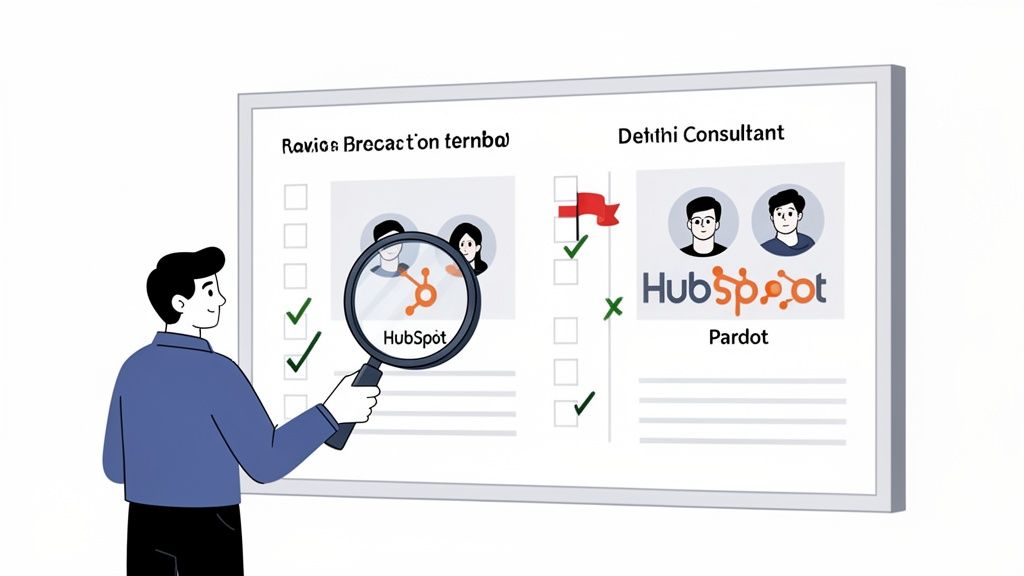
- Platform-Specific Experience: Do they specialize in your marketing automation platform, whether that's HubSpot, Marketo, or Pardot? Generalists can be risky. You need an expert who knows the quirks and advanced features of your exact tools inside and out.
- Industry and Stage Alignment: Dig into their case studies. Have they actually worked with other B2B SaaS companies at your revenue stage? The strategy for a seed-stage startup is worlds apart from the plan for a Series C company. Make sure they've been there before.
- Strategic vs. Tactical Focus: Is their content all about "5 ways to use X feature," or are they talking about connecting automation to real business outcomes like pipeline velocity and customer acquisition cost? You want a strategist, not just a button-pusher.
Review sites like Clutch are a great starting point. They let you see verified experience and filter by focus area, budget, and client reviews, giving you a third-party view of how they really perform.
As you're vetting potential partners, you should also get a feel for their know-how with different social media automation tools to make sure they can manage your entire digital presence, not just email.
Sharp Questions to Reveal True Expertise
Once you're on a call, your questions need to uncover their thinking process. Forget the softballs like, "What's your process?" Get specific and challenge them to think on their feet. How they answer will tell you everything you need to know about whether they're a true partner or just another vendor. For a deeper dive on available platforms, check out our guide on AI marketing automation tools.
Here are a few questions I always use to cut through the noise:
- "Walk me through a time you inherited a messy tech stack from a company like ours. What were the first three things you fixed and why?" This tests their diagnostic skills and their ability to prioritize what really matters.
- "Our biggest goal is reducing our lead-to-MQL conversion time. How would you use automation to tackle that specific problem in the first 90 days?" This forces them to move from vague theories to a concrete, time-bound plan.
- "How do you measure the ROI of your engagements? Can you share an anonymized example of a report you'd provide?" This immediately shows how committed they are to accountability and business outcomes, not just vanity metrics.
A huge red flag for me is a "one-size-fits-all" methodology. If they jump straight to recommending tools without deeply understanding your business goals, sales process, and customer journey, they’re more interested in selling you a service than in your success. A great partner diagnoses before they prescribe.
Defining a Scope That Drives Real Results
A great consultancy engagement always starts with a rock-solid scope of work. Vague goals like "fix our flat pipeline" are the fastest way to blow your budget and end up disappointed. It's a classic founder mistake, and it's totally avoidable.
The real goal here is to turn your broad business objectives into specific, measurable deliverables. This simple step forces everyone to be on the same page from day one, ensuring you and your consultant share the exact same definition of success. You’re not just buying their time; you're investing in a tangible outcome.
From Vague Goals to Concrete Deliverables
Let's get practical. A common request I hear is, "Our lead nurturing is broken." An experienced consultant will immediately dig in to find out what "broken" actually means. Is it low open rates? No conversions from your emails? Leads going cold after a week?
Instead of a generic goal, a strong scope gets hyper-specific. That vague pipeline problem could be translated into sharp, measurable deliverables like these:
- Objective: Increase lead-to-opportunity conversion rates.
- Deliverable: We'll implement a lead scoring model in HubSpot that flags sales-ready leads, with the goal of increasing Marketing Qualified Leads (MQLs) by 20% within 90 days.
- Objective: Improve prospect engagement and meeting rates.
- Deliverable: We'll design and launch a three-part email nurture sequence for demo request leads, targeting a 15% increase in meeting bookings within the first 60 days.
See the difference? This level of clarity kills any ambiguity and gives everyone a clear target to aim for.
Structuring Your Statement of Work
Your Statement of Work (SOW) is the project's blueprint. It’s not just a formality—it’s the single most critical tool for managing expectations and holding everyone accountable. A well-built SOW should feel like a shared game plan that protects both you and the consultant.
Think of the SOW as your mutual agreement on what ‘done’ looks like. It should detail not just what will be delivered, but how and when. This simple document is your best defense against misunderstandings down the road.
A clear SOW always includes a few key components:
- Key Milestones and Timelines: Break the project into logical phases. Think: Phase 1: Audit & Discovery, Phase 2: Implementation, Phase 3: Testing & Optimization. Put deadlines on each phase to keep things moving.
- Specific Deliverables: List every single tangible output. This could be anything from a documented lead scoring system to a new campaign performance dashboard. Don't leave anything up to interpretation.
- Communication Rhythm: Define how often you’ll connect. A weekly 30-minute status call and a monthly performance report is a common, effective cadence. This ensures you're always aligned and can course-correct quickly if needed.
A clear scope transforms the project from a vague service into a results-driven partnership. The upfront work you do here is the most important step in making sure your investment actually pays off.
A clear scope translates your business needs into actionable tasks for the consultancy. The table below provides a sample framework for a typical 3-month engagement with a B2B SaaS startup focused on building its initial marketing automation engine.
Sample Engagement Scope for a B2B SaaS Startup
| Phase | Key Activities | Deliverables | Timeline |
|---|---|---|---|
| Phase 1: Discovery & Strategy | – Technical audit of current martech stack – Stakeholder interviews (Sales & Marketing) – ICP & persona refinement workshop – Lead lifecycle mapping |
– Martech audit report with recommendations – Documented lead lifecycle stages & definitions – Finalized lead scoring framework |
Weeks 1-2 |
| Phase 2: Implementation | – HubSpot configuration & data cleanup – Build and implement lead scoring model – Develop 2 core email nurture sequences – Create landing page & form templates |
– A fully configured HubSpot instance – Live lead scoring in the CRM – Two active email nurture campaigns – Reusable asset templates |
Weeks 3-8 |
| Phase 3: Activation & Handover | – A/B testing of nurture email subject lines – Train marketing & sales teams on new processes – Build initial performance dashboards – Create documentation & process playbooks |
– A/B test results summary – 2 team training sessions (recorded) – Live marketing performance dashboard – A final handover playbook |
Weeks 9-12 |
This structure provides a clear roadmap, defines what "done" looks like for each stage, and keeps both teams accountable to a shared timeline.
Your Roadmap for a Successful Kickoff and Implementation
Once the contract is signed, the real work begins. A structured, efficient kickoff isn’t just a formality—it's the foundation for the entire engagement. This is where you set the tone, build momentum, and turn your new consultant into a genuine extension of your team.
Getting this initial phase right is crucial. It’s all about creating alignment from day one, getting the right systems access sorted out, and establishing a shared vision of what success actually looks like.
Kicking Off the Right Way
That first official meeting is your best chance to get every key stakeholder on the same page. And I don't just mean your marketing folks. Make sure your head of sales is in that room. Why? Because a great automation strategy lives or dies by sales and marketing alignment, and that collaboration has to start right here.
During this session, you'll want to nail down these essentials:
- Finalize a Single Point of Contact: Pick one person on your team to be the main liaison. This is non-negotiable. It prevents mixed signals and gives the consultant a clear go-to for approvals and quick questions.
- Secure System Access: Get them secure access to your CRM, analytics platforms, and any other marketing tools they need. Delays here are the number one reason projects stall before they even get started.
- Reconfirm Project Goals: Do a quick recap of the high-level goals from the SOW. This simple step reinforces the "why" behind the project and gets everyone rowing in the same direction.
A productive kickoff isn't a deep dive into the technical weeds. It's about setting up clear lines of communication and making sure everyone, especially sales, understands their role in making this a win.
The Discovery and Audit Phase
With the kickoff done, your consultant will shift into discovery mode and start a technical audit. This is their chance to get under the hood of your current tech stack and processes. Their goal is to find what they need without derailing your team's day-to-day work. A seasoned pro will give you a clear checklist of what they need, minimizing the back-and-forth.
This phase is where the initial plan gets validated against reality. They'll be digging into your data quality, existing workflows, and campaign history to make sure the SOW is still the right path forward. If you're looking to get a jumpstart, you can learn more about how to implement marketing automation to better prepare for this stage.
A solid scoping process breaks the project down into three core components: the goals, the deliverables, and how you'll measure success.
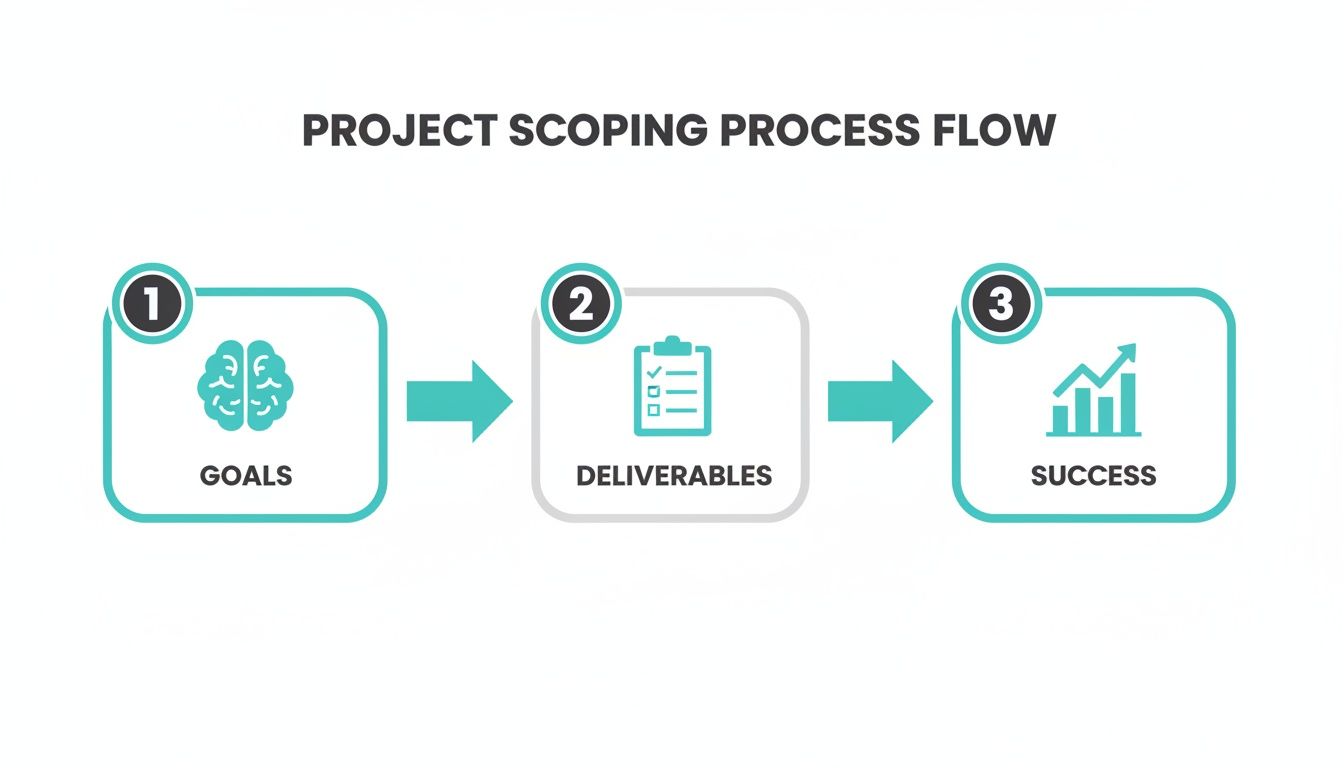
This kind of roadmap ensures every task is tied to a real business outcome. It’s the best defense against scope creep and keeps the project laser-focused on results.
Building Momentum with Quick Wins
Any major implementation, whether it's a CRM migration or building out a new nurture program, should be broken down into smaller chunks. You should be looking for a few quick wins inside the first 30-45 days. This could be as simple as launching a basic lead scoring model or getting a single, high-impact nurture email live.
These early successes are vital. They show immediate value to your leadership, build confidence in the consultant, and get your own team excited about the project. That initial momentum creates a positive feedback loop that helps power the engagement through the more complex phases to come.
Measuring Success and Building Lasting Capability
Signing the contract and kicking off the project feels like you've crossed the finish line. But you haven't. The real value from a marketing automation consultancy shows up after the initial build—when you start measuring the impact and ensuring your team can run with it long after they're gone.
So, how do you know if this big investment is actually paying off? It starts by ignoring vanity metrics like email open rates and focusing on what truly moves the needle in B2B tech.
Identifying KPIs That Actually Matter
For founders, the only metrics that matter are the ones tied directly to revenue and the health of your pipeline. A good consultant will help you build dashboards that tell a clear, simple story, focusing on a handful of powerful Key Performance Indicators (KPIs).
Here are the essentials you absolutely have to track:
- Pipeline Velocity: How fast are leads moving from their first touch to a closed deal? Smart automation should dramatically speed this up by making sure no lead ever goes cold.
- Customer Acquisition Cost (CAC): As your marketing engine gets more efficient, your CAC should start to trend down. This is a direct measure of the project's financial impact.
- MQL-to-SQL Conversion Rate: This is the ultimate test of your sales and marketing alignment. If this conversion rate is climbing, it means marketing is delivering higher-quality leads that sales can actually close.
The goal isn’t just to automate tasks; it’s to build a predictable system for growth. If your KPIs aren't improving, the project isn't a success, no matter how slick the new workflows look.
Of course, getting your automation right also means digging into the technical details. Solid email deliverability guides are crucial for ensuring your messages even land in the inbox. For a broader look at connecting spend to results, our guide on how to measure marketing ROI provides a more complete framework.
The Handover: Turning a Project into an Asset
The final—and arguably most important—phase of any consultancy engagement is the handover. This is where a great consultant proves their worth by empowering your team to own the new system, not just use it. A temporary fix is a waste of money; this needs to become a permanent capability for your team.
A successful handover isn't a single meeting. It’s a structured process that should always include:
- Thorough Documentation: Clear, concise playbooks for every major workflow and process. No jargon, please.
- Hands-On Team Training: Live training sessions (always recorded) where your team can ask questions and run through real-world scenarios.
- A Phased Roll-Off: The consultant should remain available for a few weeks post-handover to answer questions and troubleshoot. This ensures a smooth, confident transition.
This investment in training is non-negotiable. When done right, marketing automation delivers an exceptional return, with businesses earning an average of $5.44 for every $1 invested. It’s a game-changer for B2B tech founders, as companies using automation see revenues jump by 34% on average through better conversion rates and customer retention.
Ultimately, the best marketing automation consultancy works with one goal in mind: to make themselves obsolete. They build the system, train your people, and hand you the keys to a powerful growth engine that your team can run and scale for years to come.
A Few Final Questions
Hiring a marketing automation consultancy is a big move, and it's smart to have questions. Here are some of the things B2B tech founders often ask us before taking the leap.
Freelancer vs. Consultancy: What's the Real Difference?
This question comes up a lot because the lines can seem blurry. Think of it this way:
A freelance consultant is usually a single expert who is amazing at a specific platform (like HubSpot) or a particular task (like building email campaigns). They're the perfect choice when you have a well-defined, tactical project ready to go.
A marketing automation consultancy, on the other hand, brings a much broader, strategic lens to the table. You're not just hiring a pair of hands; you're hiring a senior leader or a small, focused team. They're there to help you map out your entire go-to-market strategy, get sales and marketing rowing in the same direction, and own the growth roadmap.
For a founder staring down a strategic roadblock—like a pipeline that’s gone flat or leads that never seem to close—a consultancy is almost always the right fit.
How Much Should I Expect to Invest?
This is the big one, and the honest answer is: it varies. The cost really depends on the scope of work, but here’s a rough guide to the different engagement models you’ll likely see.
- A smaller, tactical project—like a full technical audit or spinning up a few lead nurture sequences—might run you $5,000 to $15,000.
- For a more comprehensive build, like architecting your entire automation system from the ground up, you could be looking at $25,000 to $75,000 or more.
- Many consultancies also offer fractional services on a monthly retainer, which usually land somewhere between $7,000 and $20,000.
The key isn't the upfront number but the potential return. A great partner will build a business case that clearly shows how their fee will be dwarfed by the revenue generated from a smarter, more efficient growth engine.
How Do I Get My Team Ready for This?
How you prep your team internally can make or break the entire engagement. Getting this right from the start is absolutely critical.
First, you have to get everyone bought into the why. This isn't about pointing fingers at what's broken; it's about making a strategic investment to help everyone win and accelerate the company's growth. Frame it that way.
Second, you absolutely must assign a single point of contact inside your company to be the main liaison. This is non-negotiable. It cuts out confusion, speeds up decisions, and keeps the project moving forward.
Finally, be prepared to open the doors. The consultant will need access to your CRM, analytics platforms, and—most importantly—dedicated time with key people on your team. The more collaborative and open your team is, the faster you'll see results.
Ready to build a predictable revenue engine without the overhead of a full-time hire? Value CMO provides the senior marketing leadership B2B tech startups need to fix flat pipelines, align sales and marketing, and scale efficiently. Learn more about how our fractional CMO services can accelerate your growth.