Let's be honest: Marketing analytics consulting is all about turning your confusing marketing data into a clear roadmap for making more money. It’s for you, the B2B tech founder who’s tired of pouring cash into campaigns without really knowing what’s working.
What Is Marketing Analytics Consulting, Really?
Imagine you're trying to fly a plane with a foggy windshield and a broken dashboard. You can hear the engine roaring—you know you're spending money—but you have no clue if you're gaining altitude, heading in the right direction, or about to fly straight into a mountain. It sounds crazy, but this is how a surprising number of B2B tech startups run their marketing.
Marketing analytics consulting is like having an expert co-pilot who comes in and clears that fog. This isn't about someone handing you a stack of charts and graphs to decipher on your own. A real consultant translates the raw data from all your different systems into a single, reliable flight plan for growing your revenue.
Moving Beyond Vanity Metrics
So many teams get stuck chasing "vanity metrics"—you know the ones, like website clicks, social media likes, or email open rates. These numbers feel good, but they don't answer the tough questions that keep founders like you up at night:
- Which of our marketing dollars are actually making a difference?
- How do we find more customers who look just like our best ones?
- Is our pipeline growing fast enough to actually hit our quarterly targets?
- Where are we losing potential customers before they even talk to sales?
Answering these questions means you have to connect the dots between your CRM, your ad platforms, and your website data. This is exactly where a marketing analytics consultant shines. They build that single source of truth so you can finally see what's driving your business forward.
A marketing analytics consultant is like a financial advisor for your growth strategy. Instead of advising you on stocks and bonds, they show you where to invest your time, budget, and team resources for the highest possible returns.
Let’s be crystal clear about the shift this creates. It moves your entire marketing operation from a place of guessing and hoping to one of confident, predictable growth.
The Shift From Guesswork to Growth
| Business Function | Before Consulting (The Fog of Uncertainty) | After Consulting (Data-Driven Clarity) |
|---|---|---|
| Budgeting | Spending based on gut feel and last year's plan. | Allocating budget to proven, high-ROI channels. |
| Campaigns | Launching broad campaigns hoping something sticks. | Targeting specific ICP segments with personalized plays. |
| Reporting | Sharing disconnected vanity metrics (clicks, likes). | Reporting on pipeline velocity, CAC, and sourced revenue. |
| Sales Handoffs | Sending over any lead that fills out a form. | Qualifying leads based on behavior and intent signals. |
| Strategy | Chasing the latest marketing trends. | Making decisions based on a unified view of the customer journey. |
This table isn't just some theoretical exercise; it represents a fundamental change in how a business operates. It makes every marketing dollar and every hour your team works accountable to the bottom line.
A Growing Need for Expert Guidance
This move from guesswork to a data-backed strategy is becoming essential for survival, not just a nice-to-have. The global marketing consulting market is on a tear, projected to hit $35,678.9 million by 2025.
This explosive growth tells us there's a huge need for expert guidance, especially for B2B tech companies. As 84% of buyers plan tech upgrades while dealing with their own internal staffing gaps, analytics consulting becomes a powerful way to plug those holes and accelerate your pipeline—all without the cost and delay of a full-time hire. You can get a deeper understanding of the marketing consulting landscape and see these dynamics in play for yourself.
At the end of the day, marketing analytics consulting gives you the clarity and confidence to make smarter, faster decisions. It’s all about replacing assumptions with evidence and making sure every single marketing dollar is pulling its weight to drive real business results.
What a Marketing Analytics Consultant Actually Does
So, what really happens when you bring in a marketing analytics consultant? It’s not about making prettier charts. It’s about building a reliable growth engine for your business, piece by piece, and connecting your marketing spend to actual revenue.
Think of them as a data architect. You wouldn’t build a skyscraper on a shaky plot of land, right? In the same way, you can’t build predictable growth on scattered, unreliable data. A consultant’s first job is always to build that solid foundation.
Building Your Single Source of Truth
Most B2B startups have data living in a dozen different places—your CRM, Google Ads, LinkedIn, website analytics, maybe a billing system. Each tool tells you a tiny part of the story, but no one has the full picture. This is where the consultant rolls up their sleeves and gets to work.
They start by connecting these disconnected tools into a single, unified source of truth. The goal is simple: no more arguments in meetings over whose numbers are right. Everyone from sales to marketing to the CEO is looking at the same trusted data, which means you can all make smarter decisions, faster.
This is the journey they guide you on—from total chaos to strategic clarity.
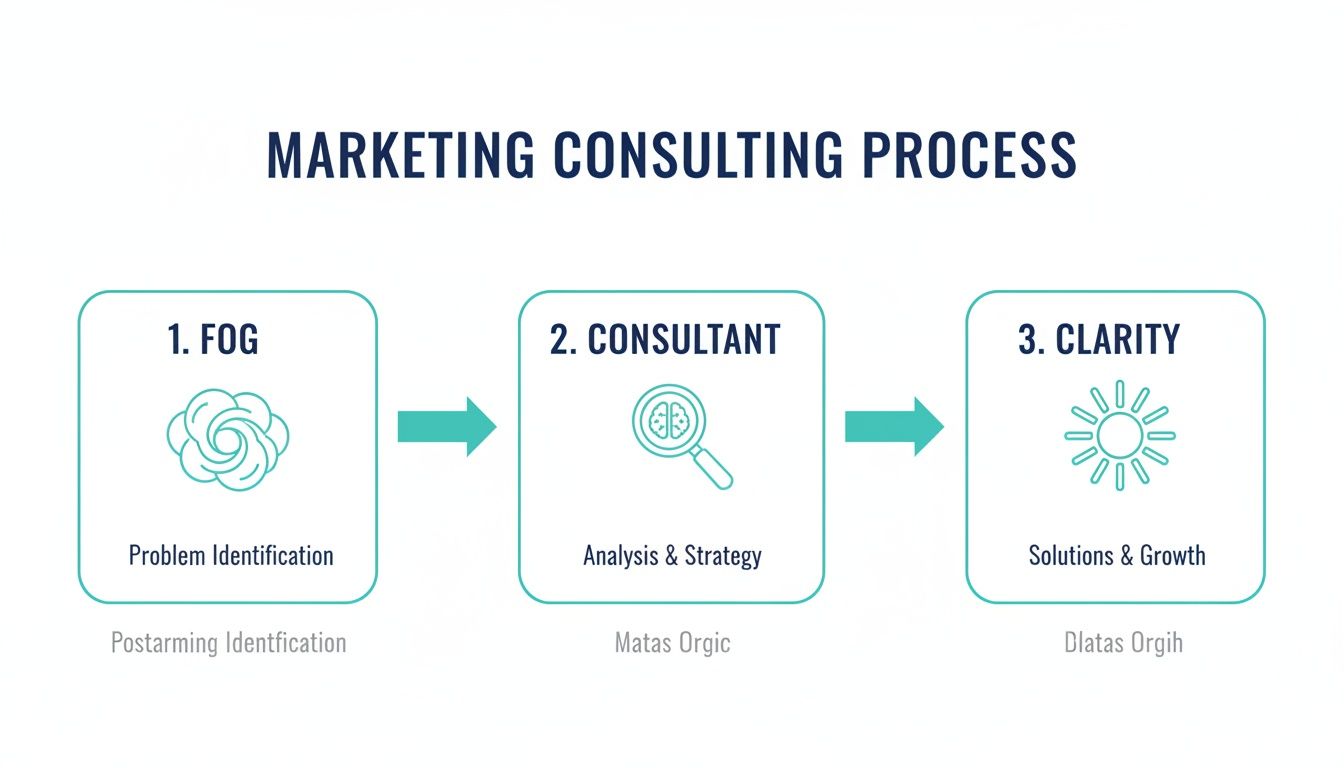
They take your business from a state of foggy uncertainty, apply their expertise, and get you to a place of clear, actionable insight. Once that foundation is poured and set, the real strategic fun begins.
From Data to Decisions
With clean, centralized data, a consultant can start turning it into a real strategic asset. Their work usually focuses on a few key areas that directly impact your revenue and efficiency.
- Developing Attribution Models: They help you move beyond simplistic "last-click" thinking. Instead, they build models that map the entire customer journey, showing you how different channels work together to land a customer. If you want to go deeper, here's a good primer on what multi-touch attribution is and why it matters so much.
- Creating CEO-Ready Dashboards: Forget overwhelming spreadsheets. A good consultant designs custom dashboards that give you and your leadership a real-time pulse on the business, focusing only on the metrics that actually matter, like pipeline velocity and customer acquisition cost (CAC).
- Forecasting and Segmentation: They use your historical data to forecast the sales pipeline, helping you set realistic revenue targets. They also pinpoint your most profitable customer segments so you can stop wasting your budget and focus it where it’ll have the biggest impact.
- Optimizing Your Martech Stack: Consultants audit your existing tools to make sure you're not paying for features you don't use. They’ll recommend tech that improves efficiency and gives you better data, often saving you money in the process.
This kind of hands-on work is becoming absolutely critical. While 63% of marketers are now using generative AI, a shocking 31% are still not satisfied with their data unification. That gap is a massive opportunity for consultants to fix flat pipelines, especially when you consider that 83% of sales teams using AI are already reporting revenue growth.
A consultant’s real job is to make the complex simple. They translate messy, disconnected data into a clear story about what’s working, what isn’t, and where your biggest growth opportunities are hiding in plain sight.
Ultimately, a marketing analytics consultant brings the technical skill and strategic oversight needed to turn your data from a confusing mess into your most powerful asset for driving predictable growth.
Finding the Right Engagement Model for Your Startup
Hiring a marketing analytics consultant doesn't mean locking into some massive, year-long contract. For B2B tech startups like yours, flexibility is everything. The best consulting partnerships offer models that fit your stage, your budget, and the exact problem you need to solve right now.
The goal is to find that sweet spot between going it alone and hiring another full-time executive. Think of it like this: you don't need a sledgehammer to hang a picture, and you don't need a permanent C-suite salary when a focused expert can get you unstuck in a matter of weeks.
The Fractional CMO for Ongoing Leadership
When you need consistent, senior-level strategic direction but just aren't ready for a full-time executive, the Fractional CMO model is a perfect fit. This isn't just a consultant who pops in and out; it's a part-time leader who truly embeds with your team, providing steady oversight and mentorship.
They own your marketing strategy, from budget allocation and campaign planning to team development. This model is ideal when you have a junior marketing team that needs guidance or when you, the founder, are still wearing the marketing hat and desperately need to hand it off. A fractional leader keeps your growth plan on track, month after month.
The Project-Based Sprint for Urgent Challenges
Sometimes you don't need a long-term leader. You need an expert to fix one specific, high-stakes problem—and you need it done fast. That’s where a Project-Based Sprint comes in. It’s a short, intense engagement with a crystal-clear scope and a fixed outcome.
This model is built for tackling urgent jobs like:
- Plugging a leaky funnel: Pinpointing where leads are dropping off and shipping fixes to boost your conversion rates.
- Prepping for a product launch: Building the data foundation to track launch success and measure early traction.
- Cleaning up messy data: Overhauling your CRM and analytics tools to create a single source of truth before a big growth push.
A sprint delivers a tangible win in a matter of weeks, giving you immediate ROI without the long-term commitment. It’s the perfect way to get expert firepower for a critical business need.
The right engagement model aligns the consultant's expertise directly with your most pressing business problem. It’s all about getting the exact support you need, precisely when you need it, without paying for anything you don't.
The Advisory Retainer for On-Demand Expertise
What if your team is solid, but you occasionally need a senior expert to act as a strategic sounding board? An Advisory Retainer gives you on-demand access to a high-level consultant for brainstorming, second opinions, and quick gut-checks.
This is the most flexible and cost-effective option out there. You might use your hours to review a new campaign strategy, get feedback on a board deck, or gut-check a major tech investment. It’s like having an experienced marketing leader on speed dial, giving you the confidence to make better decisions without the overhead of a larger engagement.
Focusing on the Metrics That Drive Revenue
A great marketing analytics consultant is a filter. They help you tune out the deafening noise of vanity metrics—clicks, impressions, follower counts—and zero in on the numbers that actually grow your business. It's so easy to get distracted by stats that look good on a slide but don't pay the bills. The real goal is to draw a straight line from every marketing dollar you spend to a financial result.
For B2B tech startups, that means looking past the top of the funnel and measuring what really defines a healthy, scalable company. This is where a consultant’s experience is invaluable. They help you build a dashboard that tells a clear story about revenue growth, not just website traffic. They shift the entire conversation from, "How many leads did we get?" to, "How much qualified pipeline did we generate, and how fast is it closing?"
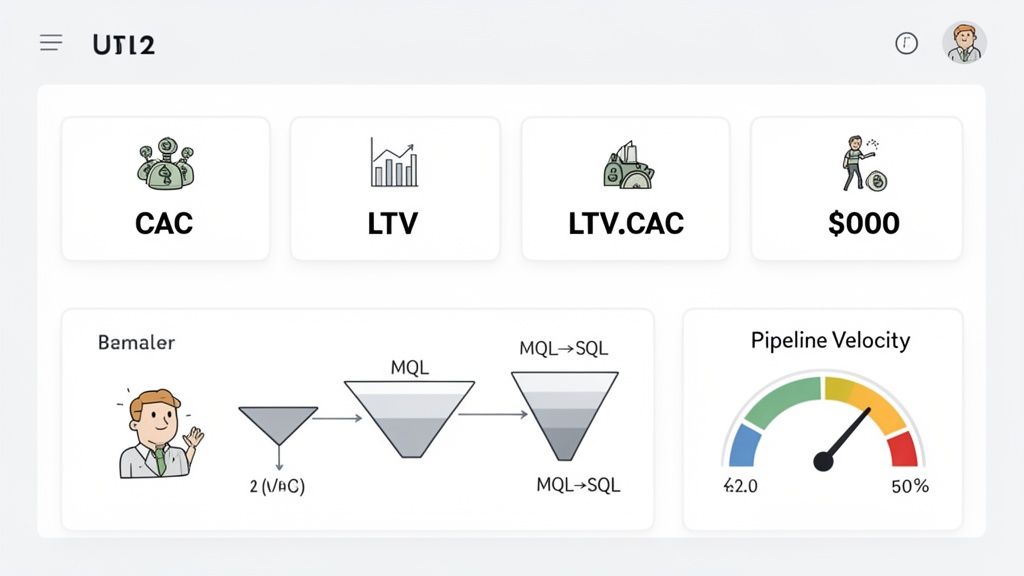
The two most important numbers for any subscription-based business are Lifetime Value (LTV) and Customer Acquisition Cost (CAC). LTV tells you the total revenue you can expect from a single customer over their lifetime with you. CAC is what you spent in sales and marketing to get them. Simple, right?
The magic is in the ratio. The LTV:CAC ratio is the ultimate health check for your growth engine. A healthy ratio—typically 3:1 or higher for SaaS—proves you have a viable business where customers are worth far more than they cost to acquire. A good consultant helps you calculate these figures accurately (it’s often harder than it looks) and then gets to work on improving that ratio.
Key Performance Indicators That Really Matter
Beyond LTV:CAC, a handful of other KPIs paint the full picture of your marketing’s impact on the bottom line. A solid marketing analytics engagement will laser-focus on these.
- MQL-to-SQL Conversion Rate: This measures how good your leads really are. A low rate is a huge red flag that there’s a disconnect between marketing and sales—marketing is sending over leads who just aren't ready to buy.
- Pipeline Velocity: This isn't just about how many deals are in your pipeline; it's about how fast they move from first touch to closed-won. Improving velocity means you're shortening the sales cycle and pulling revenue in faster.
- Multi-Touch Attribution: This moves you beyond last-click thinking. It shows you all the marketing touchpoints—the blog post they read, the webinar they attended, the ad they clicked—that influenced a deal, which helps you allocate your budget way more intelligently.
To keep all this straight, consultants often rely on a clean setup using a UTM builder tool. This makes sure every click can be traced back to its source, giving you the clean data you need for accurate attribution.
Your marketing dashboard shouldn't be a data dump. It should be a curated set of vital signs that tells you, at a glance, whether your growth strategy is working and where the biggest opportunities for improvement lie.
This focus on business-critical metrics is what separates the data-driven teams from everyone else. Consider this: while 71% of sales leaders report budget increases, a staggering 84% of reps missed quota last year. That’s a massive gap between spending and results—a gap that expert analytics can close. By focusing on what truly matters, you ensure your marketing spend is an investment, not an expense.
Ultimately, a marketing analytics consultant gives you the framework and the discipline to hold every dollar accountable. If you want to go deeper, check out our guide on how to measure marketing ROI for a closer look at these concepts.
How to Choose the Right Analytics Partner
Hiring a marketing analytics consultant can be a massive win for your B2B startup. But choose the wrong one, and it becomes a costly, frustrating misstep. You're not just looking for someone who can build a pretty dashboard; you need a strategic partner who gets your specific corner of the tech world.
Think about it like this: you wouldn't hire a real estate lawyer to handle patent law, would you? Same deal here. You need an analytics partner with real, proven experience in the B2B SaaS ecosystem. The right consultant already speaks your language and understands the quirks of your go-to-market motion, whether you're product-led, sales-led, or a hybrid of the two.
Vetting for Technical and Strategic Depth
First things first, any potential partner has to have the technical chops to connect your systems and build a solid data foundation. That's non-negotiable. But their real value comes from turning that data into strategic advice that actually grows the business. You want someone who moves past simple reporting and gives you actionable recommendations.
A huge part of this is making sure they’re fluent in modern data practices. For example, a great partner will know the Best Marketing Analytics Tools to build a stack that can scale with you. This shows they’re not just analyzing the past but building a system for your future. If you need more on this, our post on designing powerful marketing tech stacks is a great resource.
When you're talking to them, listen closely to how they frame their work. Do they focus on metrics that matter, like pipeline velocity and LTV:CAC, or do they get hung up on surface-level stats?
A great analytics partner doesn't just deliver data; they deliver clarity. They should be able to take a complex set of numbers and tell you a simple story about what to do next to grow your business.
Asking for Proof of Impact
Talk is cheap. The best way to vet a consultant is to see their track record. Don’t be afraid to ask for specific, anonymized case studies that show a clear "before and after" picture.
You're looking for measurable impact that lines up with your own goals:
- Reduced Customer Acquisition Cost (CAC): Ask for a real example where they found wasted ad spend and reallocated the budget, making the growth engine more efficient.
- Accelerated Pipeline Growth: Inquire about a time they diagnosed a bottleneck between marketing and sales that led to a higher MQL-to-SQL conversion rate.
- Improved LTV:CAC Ratio: Look for stories where their insights helped a company zero in on higher-value customers, boosting long-term profitability.
These examples prove they can connect their analytics work directly to financial outcomes. And that’s the whole point.
Assessing for Cultural Fit and Mentorship
Finally, remember this person will be an extension of your leadership team. Beyond their technical skills, you need someone who clicks with your company culture. Can they explain complex ideas in a simple, direct way to people who aren’t data nerds?
Look for a partner who sees themselves as more than just a service provider—they should be a mentor to your team. A great consultant elevates the data literacy of your entire organization. They should leave your team smarter and more self-sufficient than they found them. This mix of technical skill, strategic insight, and cultural fit is the mark of a truly valuable analytics partner.
Your Consultant Evaluation Checklist
Use this scorecard to compare potential marketing analytics partners and find the best fit for your startup's needs.
| Criteria | What to Look For | Potential Red Flags |
|---|---|---|
| B2B Tech Experience | Specific examples from companies with similar business models (e.g., PLG, sales-led). | Vague industry experience; mostly B2C or non-tech examples. |
| Strategic Insight | Connects analytics directly to revenue goals like pipeline growth and CAC reduction. | Focuses on vanity metrics (clicks, impressions) instead of business impact. |
| Technical Proficiency | Fluent in modern data stacks (e.g., Segment, HubSpot, Salesforce, BI tools). | Relies on outdated methods or a very limited, inflexible toolset. |
| Proven Impact | Provides clear "before and after" case studies with measurable financial outcomes. | Offers generic testimonials without specific numbers or results. |
| Communication Style | Explains complex topics clearly to non-technical stakeholders. | Uses excessive jargon; struggles to simplify concepts for a broad audience. |
| Mentorship Approach | Aims to upskill your internal team and build sustainable processes. | Acts as a "black box" provider, keeping knowledge and processes to themselves. |
| Cultural Fit | Aligns with your company's pace, values, and communication norms. | Feels like an outsider; communication is slow, difficult, or misaligned. |
Finding the right partner is less about a perfect resume and more about finding a true extension of your team. This checklist helps you look past the sales pitch and focus on the qualities that drive real, sustainable growth.
Seeing the Real-World Impact on Growth
Theory is great, but for a B2B tech startup, results are the only thing that actually matters. This is where marketing analytics consulting really proves its worth—turning data points into dollars and cents. The right partner doesn’t just build dashboards; they change the trajectory of your business.
Let’s move past the abstract and look at what this looks like on the ground. These are real-world stories of how expert analytics guidance helps founders break through the growth plateaus that stall even the most promising companies. Each one follows a simple but powerful arc: a painful problem, a data-driven solution, and a game-changing result.
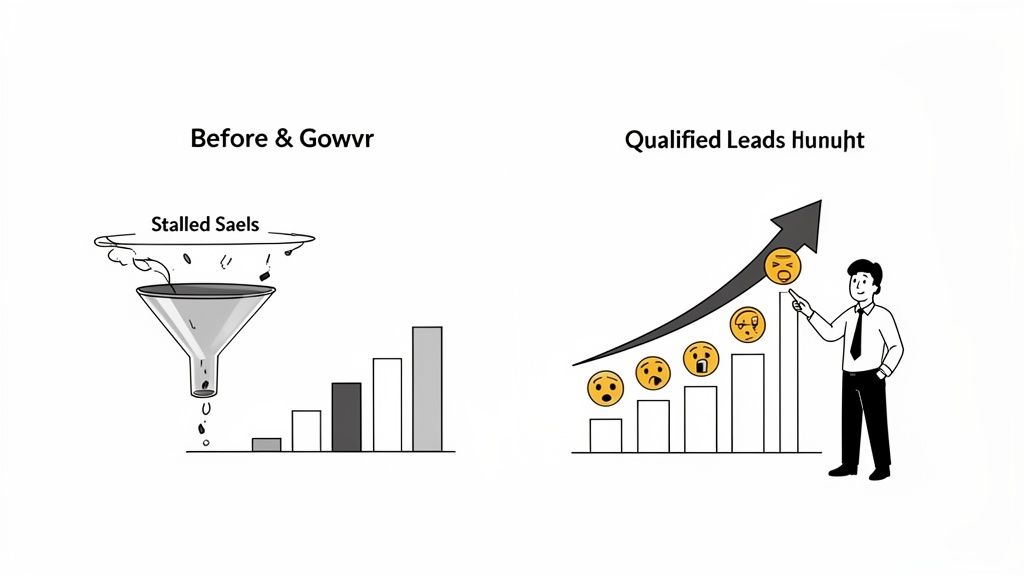
Case Study: The Stalled Pipeline
The Problem: A promising SaaS company was generating a steady stream of marketing qualified leads (MQLs), but their sales pipeline was stubbornly flat. The marketing team felt they were hitting their numbers, but the sales team was frustrated, complaining about low-quality leads. Tensions were high, and nobody could pinpoint the real issue.
The Solution: An analytics consultant came in to diagnose the disconnect. By integrating the company’s CRM with their marketing automation platform, they created a single, unified view of the entire lead lifecycle. The data immediately exposed a critical flaw: over 70% of MQLs were being disqualified by sales without a single follow-up.
It wasn't a lead quality issue; it was a broken handoff process. The consultant helped implement lead scoring and an automated workflow that assigned high-intent leads directly to sales reps’ calendars, guaranteeing a fast response.
The Result: Within a single quarter, the MQL-to-SQL conversion rate more than doubled. This one data-driven fix created a 40% jump in qualified sales opportunities, reigniting pipeline growth and getting sales and marketing aligned around shared, visible metrics.
These scenarios are incredibly common. Startups often have all the right ingredients for growth but are held back by invisible bottlenecks in their processes. A consultant provides the outside perspective and data-driven proof needed to find and fix them.
Case Study: The Black Hole of Ad Spend
The Problem: Another B2B tech startup was burning through its ad budget with little to show for it. They were running campaigns on LinkedIn, Google Ads, and in industry publications but had no real clue which ones were actually driving revenue. Their customer acquisition cost (CAC) was climbing, putting their runway at risk.
The Solution: The consultant audited their entire ad spend and attribution setup. By implementing proper campaign tracking and connecting ad platform data directly to CRM revenue data, they built a multi-touch attribution model. This model uncovered a startling truth: one industry publication, which ate up 25% of the ad budget, hadn't sourced a single closed-won deal in six months.
The Result: Armed with this undeniable data, the startup immediately pulled that wasted spend and reallocated it to their top-performing channels—mostly LinkedIn and targeted search campaigns. The impact was almost immediate. In just two months, they slashed their overall customer acquisition cost by 30% while increasing their volume of high-quality leads. It wasn't just about saving money; it made their entire growth engine more efficient and predictable.
Common Questions About Marketing Analytics Consulting
Even after seeing the upside, bringing in a marketing analytics consultant can feel like a big leap. Founders always have practical questions about how it all works, what it costs, and what to expect on day one. Here are some straight answers to the things we hear most often from B2B tech leaders.
How Much Does Marketing Analytics Consulting Cost?
This is always the first question, and the honest answer is: it really depends. The price tag is tied directly to the engagement model you choose. A quick, project-based sprint to plug a leaky sales funnel is going to cost less than having a fractional CMO embedded with your leadership team for months.
Most consultants offer a few ways to work together:
- Project-Based: A fixed price for a specific outcome, like building a new attribution model. This can range from a few thousand dollars to tens of thousands.
- Monthly Retainer: An ongoing fee for consistent strategic input and execution support. Rates are based on the time and seniority required.
- Advisory: A lower-cost retainer that gives you on-demand access to an expert for guidance and a second opinion on your strategy.
The right way to think about this is as an investment, not a cost. A good consultant should deliver a return that dwarfs their fee by fixing expensive problems (like wasted ad spend) and cranking up revenue-driving metrics (like pipeline velocity).
How Long Until We See Results?
You won't be waiting a year to see if it's working. While building a full-blown, data-driven marketing engine is a long game, you should absolutely expect to see real progress and some quick wins within the first 30 to 60 days.
The first wins usually come from spotting the low-hanging fruit—obvious data gaps or broken processes that are easy to fix. For example, a consultant might immediately find a clunky handoff between marketing and sales. Fixing that one thing can instantly improve lead conversion rates. Building sophisticated dashboards takes longer, but the initial sprint is all about generating momentum and proving value right out of the gate.
The goal of a good marketing analytics consultant isn't just to hand you a final report months down the road. It's to generate incremental value from day one, building confidence and driving measurable improvements with each step.
Do I Need to Hire a Full Team First?
Nope. In fact, bringing on a consultant before you scale the team is one of the smartest moves you can make. A consultant helps you build the right data foundation and strategic roadmap first.
This ensures that when you do start hiring, you’re plugging people into an efficient, data-driven system—not a chaotic one. A consultant can also help you define the exact roles you need to hire for next, which helps you avoid expensive mis-hires.
Ready to stop guessing and start growing with a clear, data-driven strategy? Value CMO provides the senior marketing leadership B2B tech startups need to build a predictable revenue engine. Learn more about how we can help clarify your path to growth.