
So, what on earth is a marketing plan, really? At its heart, it's just about figuring out who you're selling to, setting some crystal-clear goals, getting to know your competition, and then sketching out your strategy, budget, and how you'll measure the whole thing.
For a B2B tech startup, this isn't some dusty corporate document you write once and forget. Think of it as your strategic playbook for building a predictable revenue engine in a seriously cutthroat market.
Why a Marketing Plan Is Your Startup's Growth Engine
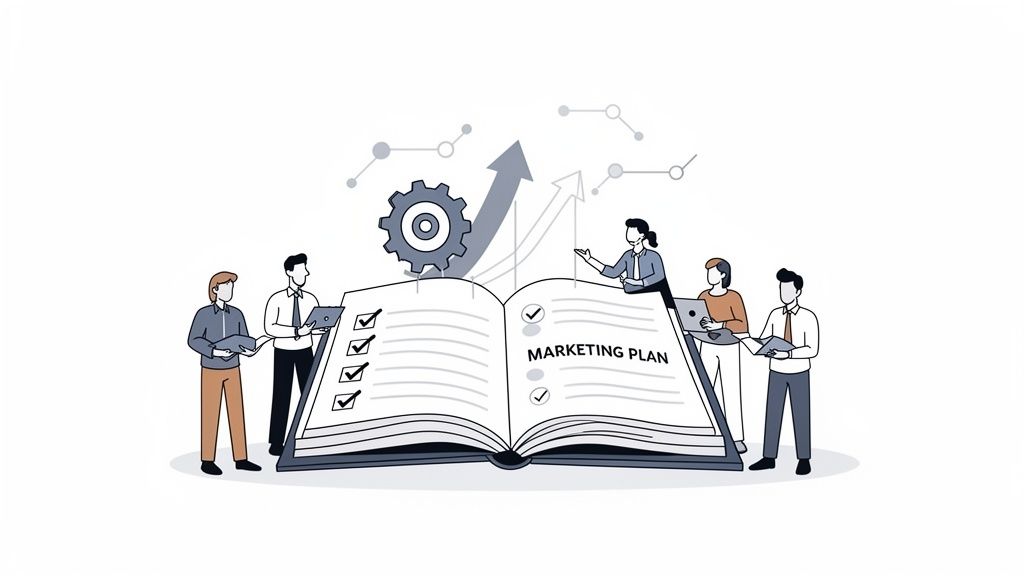
Let's be honest. The phrase "marketing plan" probably makes you think of some theoretical exercise that has zero to do with the daily grind of building a business. That’s a dangerous way to think.
An actionable plan is your single most critical asset. It's the map that keeps you from wasting precious cash and time on what I call "random acts of marketing." It’s the difference between disciplined growth and just feeling busy.
The Real Costs of 'Winging It'
Without a plan, startups make the same painful mistakes over and over. They burn through ad spend on campaigns that never convert, create content for an audience of one, and end up with a sales pipeline that's gone completely cold. The result? Confusing messaging and a frustrated team.
A well-crafted plan forces you to answer the tough questions before you spend a single dime:
- Who are we actually selling to?
- Why should they pick us over anyone else?
- What specific results do we need to hit this quarter?
- How will we measure success and hold ourselves accountable?
This process turns marketing from a cost center into a predictable revenue driver. It gets your sales, product, and marketing teams aligned and rowing in the same direction. And for founders, that kind of clarity is non-negotiable for building investor confidence.
Your marketing plan is the tool that makes every dollar you spend work overtime. It’s not about restricting creativity; it's about channeling that creativity toward activities that directly impact the bottom line.
From Theory to Tangible Results
Thinking strategically isn't just a "nice to have"—the data proves it's essential. Today, more than 75% of B2B enterprises operate with a formal marketing plan.
Why? Because it works. Businesses with a documented strategy see deal-closing rates jump by up to 67% when sales and marketing are in sync. Even better, companies that get good at lead nurturing—a key outcome of a solid plan—generate 50% more sales-ready leads at a 33% lower cost.
Ultimately, a marketing plan is about building a repeatable system for growth. It’s the "why" behind every "how," setting the stage for every tactical decision you'll make down the line. To see how this fits into a bigger picture, check out our B2B marketing strategy framework.
Defining Your Ideal Customer and Market Position
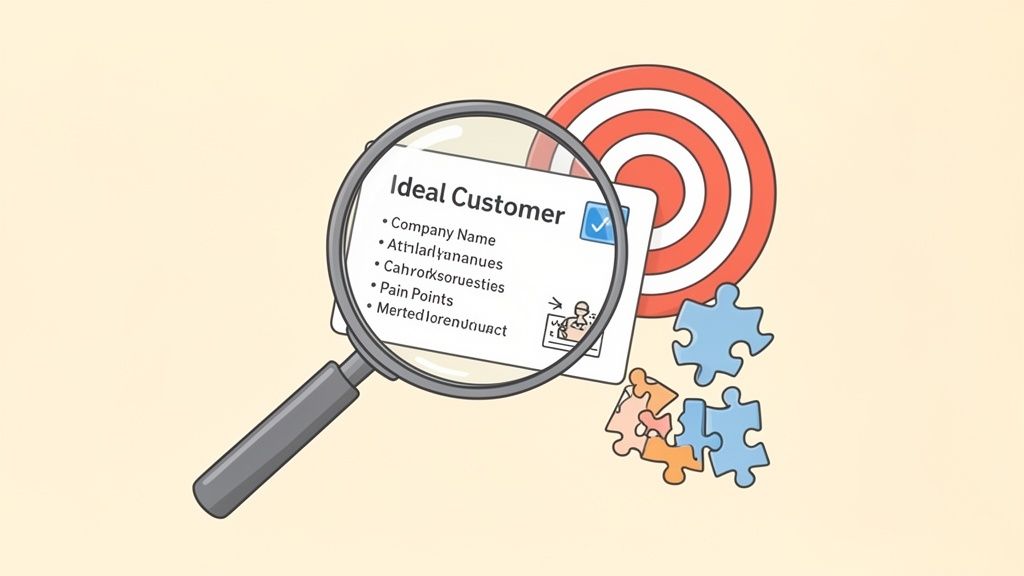
Before you write a single line of copy or spend a dollar on ads, you need to be crystal clear on two things: who you're selling to and why you’re their only real choice. This is the bedrock of any marketing plan that actually works.
It’s also the part most startups skip in their rush to get to the tactics.
Ignoring this step is a recipe for generic messaging that resonates with no one and campaigns that burn cash without bringing in qualified leads. The goal here isn't to create some fuzzy, outdated persona. It's to define your Ideal Customer Profile (ICP) with surgical precision.
Pinpointing Your Ideal Customer Profile
An ICP isn't just a description of a person. For B2B, it’s a non-negotiable list of firmographic and behavioral traits that signal a perfect-fit company. These are the accounts that will get the most value from your product, prove the most profitable, and stick around for the long haul.
Forget "Marketing Mary." Instead, focus on the specific company attributes that scream "high-potential lead." Dig into your existing customer data (if you have any) or do some serious market research to answer these questions:
- Company Size: What's the sweet spot for employee count or ARR? Are you built for a 50-person scale-up or a 500-person enterprise?
- Industry/Vertical: Which specific industries feel the pain you solve most acutely? Don't just say "tech"—get granular. Is it FinTech, HealthTech, or B2B SaaS for logistics?
- Technology Stack: What other software do your best customers already use? Knowing they’re on HubSpot or Salesforce can be a powerful targeting signal.
- Pain Points & Triggers: What specific problem keeps their CFO up at night? Did a new regulation just pass that makes your solution urgent?
This level of detail turns your marketing from a shotgun blast into a laser-guided missile. If you want to go deeper on this, our guide on how to create buyer personas breaks down the process.
Carving Out Your Market Position
Once you know exactly who you're talking to, the next question is what to say. This is your positioning—your unique place in the market and, more importantly, in the mind of your ideal customer. In a noisy B2B tech world, being a "good" solution isn't enough. You have to be the obvious choice for your specific ICP.
Powerful positioning answers one simple question for your ideal customer: "Why should I choose you over every other option, including doing nothing at all?"
Your positioning isn't just a tagline you stick on your homepage. It's the core message that informs your website copy, your sales decks, your ad creative—everything. It’s the thread that makes your brand instantly recognizable and relevant to the right people.
A strong value proposition is the heart of great positioning. It has to clearly and concisely articulate three things:
- Relevance: How you solve your customer's specific problem.
- Quantified Value: The tangible results they can expect (e.g., "cut reporting time by 30%").
- Unique Differentiation: Why you’re the only one who can deliver that value.
To really nail this down, check out this ultimate positioning guide for content marketing success. Getting this strategic work right up front will multiply the effectiveness of every single marketing activity you execute later on.
Setting Marketing Objectives That Drive Revenue
Your CEO wants growth. Simple enough, right? But what does "growth" actually look like for the marketing team day-to-day? This is where a great plan separates itself from a mediocre one: turning the big, abstract vision of "more sales" into concrete, measurable actions.
A marketing plan with fuzzy goals like "increase brand awareness" is doomed from the start. We need to speak the language of the business, and that language is revenue. Let's say the board sets a goal to "Increase annual recurring revenue (ARR) by $1.2M." That's the destination, but it doesn't tell a marketer how to start the car.
The marketing objective is the bridge. It translates that number into something your team can own, like: "Generate 100 new sales-qualified leads (SQLs) per month at a target cost of $250 each." Now that is a target you can build a strategy around.
From Business Goals to Marketing KPIs
The trick is to work backward. Start with the company's finish line and trace it all the way back to your team's starting line. Doing this creates a bulletproof link between marketing activities and revenue, which is exactly what your leadership team needs to see to keep investing in your plan.
Here’s a look at how to map those high-level business needs to marketing KPIs that actually mean something for a B2B tech company.
Mapping Business Goals to Marketing KPIs
This table shows how to translate common B2B tech business objectives into specific, measurable marketing KPIs to track progress effectively.
| Business Goal | Marketing Objective | Primary KPI | Secondary KPI |
|---|---|---|---|
| Increase New Customer Acquisition by 20% | Generate 400 Marketing Qualified Leads (MQLs) per quarter. | MQL Volume | Cost per MQL |
| Improve Sales Pipeline Efficiency | Achieve a 25% MQL-to-SQL conversion rate. | MQL-to-SQL Conversion Rate | Sales Cycle Length |
| Reduce Customer Acquisition Cost (CAC) by 15% | Lower CAC from $5,000 to $4,250 by end of year. | Customer Acquisition Cost (CAC) | Channel-Specific Conversion Rates |
| Establish Market Leadership in a New Niche | Increase organic search traffic for "niche keyword" by 50% in 6 months. | Organic Keyword Rankings | Branded Search Volume |
A simple framework like this turns vague requests into a clear marketing dashboard. It ensures your team isn't just busy—they're busy working on what truly matters to the business.
Choosing Metrics That Actually Matter
In B2B tech, not all metrics are created equal. It's easy to get distracted by vanity metrics like social media likes or total website visits. They feel good, but they often have zero impact on the bottom line. You have to focus on the KPIs that measure a prospect's journey through the sales funnel.
Here are the heavy hitters every B2B marketer should have on their radar:
- Marketing Qualified Leads (MQLs): A prospect who has engaged enough with your marketing to be considered a potential customer. This is your team's primary output.
- Sales Qualified Leads (SQLs): An MQL that the sales team has vetted and accepted as a real opportunity. This metric is the critical handshake between marketing and sales.
- MQL-to-SQL Conversion Rate: The percentage of your MQLs that turn into SQLs. If this number is low, it’s a huge red flag signaling a disconnect between who marketing is attracting and who sales actually wants to talk to.
- Customer Acquisition Cost (CAC): Your total sales and marketing spend divided by the number of new customers acquired. This is the ultimate efficiency metric.
- Pipeline Velocity: How fast leads move through your sales pipeline, from first touch to closed-won. Faster velocity means a healthier, more efficient revenue engine.
Your marketing objectives are only as good as the KPIs you use to measure them. Choose metrics that tell a story about revenue, not just activity.
By anchoring your plan in these revenue-centric KPIs, you're not just creating a document; you're building a growth machine. Each objective becomes a lever you can pull, directly tied to the financial health of the business. This clarity transforms marketing from a perceived cost center into an undeniable driver of scalable, predictable growth.
Choosing Your Demand Generation Channels
You’ve got your revenue goals locked in. Now it’s time to build the engine that actually hits those numbers. This is where your demand generation and channel strategy comes into play, and it’s surprisingly easy to get wrong.
The biggest mistake I see is getting distracted by the latest, shiniest marketing trend. A rock-solid plan is built on a much simpler principle: fish where the fish are.
Instead of chasing every new platform, your marketing plan has to be ruthless about focusing on the channels where your Ideal Customer Profile (ICP) already hangs out. Are they senior devs buried in niche Slack communities? Are they VPs of Finance who only trust what Gartner says? Or are they founders scrolling through LinkedIn looking for insights from other leaders?
Answering those questions first will stop you from blowing your budget on channels that feel busy but generate zero real results.
Balancing Inbound and Outbound Tactics
A powerful demand gen strategy isn't a one-trick pony. It’s a system where multiple channels work together to create momentum. For a B2B tech startup, that almost always means a smart mix of inbound and outbound marketing.
- Inbound Marketing: This is all about attracting customers by creating genuinely valuable content and experiences. Think SEO-driven blog posts, practical webinars, and helpful guides. It's a long-term play, but it builds your brand as a trusted authority and creates a sustainable pipeline.
- Outbound Marketing: This is where you proactively reach out to potential customers. In B2B, this could be highly targeted email outreach, thoughtful LinkedIn connection requests, or focused account-based marketing (ABM) campaigns aimed at a shortlist of dream-fit companies.
The real magic happens when these two approaches support each other. Your inbound content can warm up prospects so that when your outbound team finally reaches out, the conversation is ten times more effective.
Selecting Your Core Channels
So, where do you even start? The key is to not try to be everywhere at once. A smart marketing plan identifies just two or three core channels to master first, based directly on your ICP research.
Let's say your ICP is a Head of HR at a mid-market tech company. Your primary channels might look like this:
- LinkedIn: Run targeted ads, publish thought leadership content from your CEO, and get active in relevant industry groups.
- SEO & Content Marketing: Write in-depth articles that answer the exact questions your ICP is typing into Google, like "how to improve employee retention in tech."
- Targeted Webinars: Team up with a known influencer in the HR space to host a webinar on a hot-button topic, driving high-quality sign-ups.
This focused approach makes sure your limited resources are concentrated where they'll make the biggest dent. For any growing B2B tech company, figuring out how to generate B2B leads is the absolute cornerstone of your strategy.
Build a System, Not Just a Series of Campaigns
Here’s the most critical part of this section in your marketing plan: you need to think beyond individual campaigns. Your goal is to design a cohesive system that moves prospects from being vaguely aware of their problem to being ready for a sales call. That’s the true essence of demand generation.
It means mapping out the entire customer journey and aligning your channel activities to each stage, from awareness to consideration to decision.
Your channel strategy shouldn't be a list of disconnected tactics. It should be a thoughtful, integrated system designed to nurture prospects at every step, making your marketing efforts both efficient and scalable.
The data backs this up. While 72% of marketing budgets now go to digital channels, the execution is often sloppy. For instance, only a shocking 17% of marketers consistently A/B test their landing pages. That's a huge missed opportunity when you realize businesses with 40 or more optimized landing pages generate 12 times more leads than those with just a few.
These numbers prove it’s not just about choosing channels, but mastering the execution within them.
Ultimately, a strong channel strategy gives your team clarity. It tells them exactly where to focus their energy and budget to attract the right customers and guide them effectively toward a purchase. For a deeper look at this, check out our guide on B2B demand generation best practices.
Creating Your Budget and 90-Day Roadmap
A plan without a budget is just a wish. And a strategy without a timeline is a recipe for going nowhere fast. This is where we get relentlessly practical, turning all that strategic work into a tangible, day-by-day execution plan. We’re talking money, tools, and a clear path forward for your first 90 days.
This isn’t about some vague wish list or overly ambitious goals. It’s about creating immediate momentum, grabbing some quick wins to build confidence, and laying the foundation for long-term, sustainable growth.
Building a Realistic Marketing Budget
For a B2B tech startup, the marketing budget isn't just a line item; it's the fuel for your growth engine. Getting it right means being strategic, not just frugal. A common rule of thumb for early-stage companies is to peg the marketing spend to a percentage of their target annual recurring revenue (ARR), often somewhere between 7-12%.
But a much better way to do it is to build your budget from the ground up, based on the objectives you’ve already set. This is called objective-based budgeting. If you know you need to generate 100 SQLs per quarter and your target cost per SQL is $250, you can start to build a real-world budget that directly ties every dollar spent to a result.
Your budget should be broken down into three core buckets:
- Team: Salaries for your in-house marketers or retainers for freelancers and fractional support. This is almost always the biggest chunk of your budget.
- Tools (Martech Stack): The software you need to execute your plan—think CRM, marketing automation, analytics platforms, and SEO tools.
- Program Spend: The money for your actual marketing activities. This covers your ad spend on LinkedIn, content creation costs, webinar platform fees, and event sponsorships.
Your Lean B2B Martech Stack
You don't need a sprawling, enterprise-level martech stack to get started. The goal is to choose a few powerful, well-integrated tools that solve your immediate problems without breaking the bank. A solid starter stack covers the essentials:
- CRM (Customer Relationship Management): This is your single source of truth for all customer data. HubSpot's free CRM is a fantastic starting point for most startups.
- Marketing Automation & Email: You need a way to nurture leads at scale. Platforms like Mailchimp or ActiveCampaign offer powerful automation features that are accessible for small teams.
- Analytics: You can't improve what you don't measure. Google Analytics is non-negotiable for web traffic, and a tool like Hotjar can provide incredible insights into user behavior on your site.
A common mistake is over-investing in complex tools before you have a clear strategy for using them. Start lean, master the fundamentals, and only add new tools when you have a specific, validated need.
This is a great visual for how your demand generation efforts guide prospects through their buying journey—a process your budget and roadmap must support.
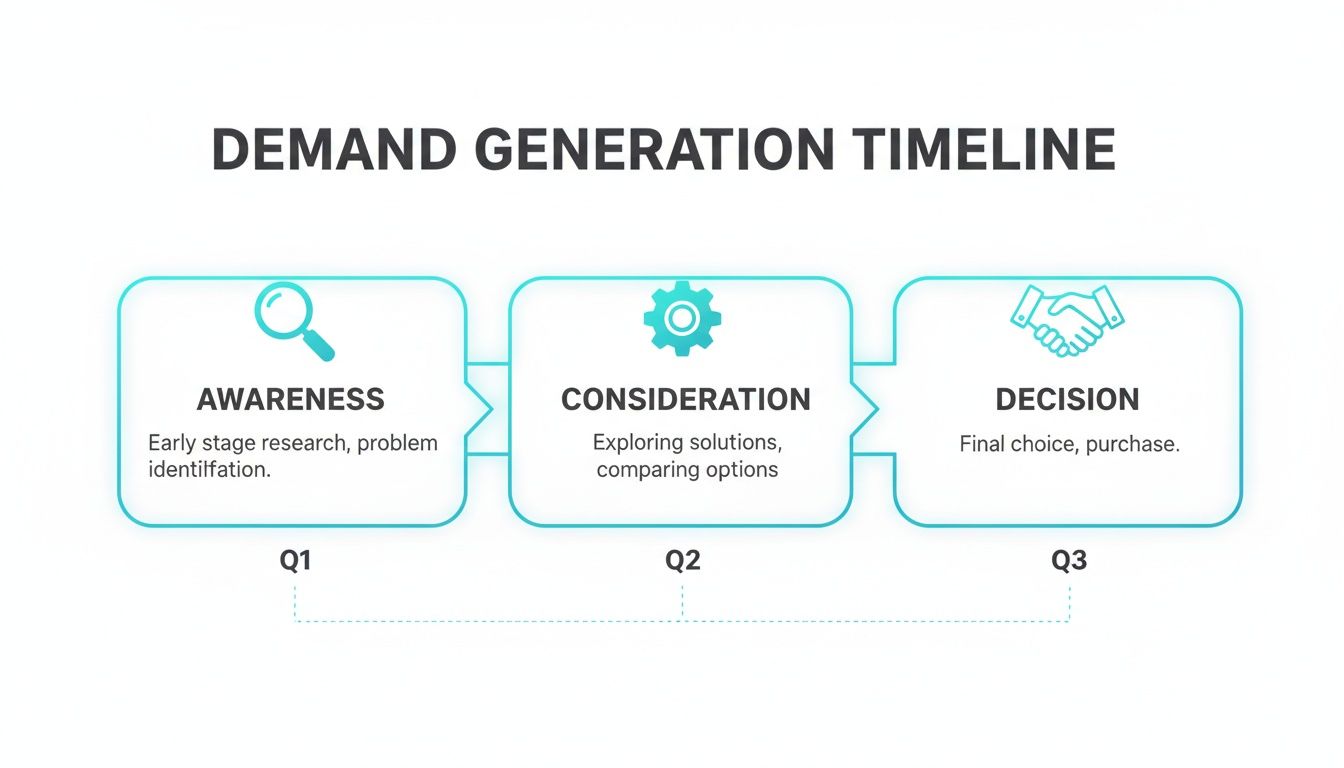
It highlights that a successful plan requires a mix of tactics to engage buyers at every stage, from initial awareness right through to the final purchase decision.
Your Actionable 90-Day Roadmap
The first 90 days are all about building momentum. A 30/60/90-day plan is the perfect tool for this because it breaks down ambitious goals into manageable, bite-sized chunks. It forces you to prioritize and keeps the entire team focused on what matters right now.
Here’s a sample structure for a B2B tech startup’s first quarter:
Phase 1: The First 30 Days (Foundation & Quick Wins)
The goal here is to get the essentials locked down and score an early victory to build confidence.
- Key Priority: Finalize ICP, positioning, and core messaging.
- Deliverable: Launch one high-value, SEO-optimized blog post addressing a key customer pain point.
- Owner: Marketing Lead.
Phase 2: Days 31-60 (Build & Engage)
Now you start building your content engine and engaging your target audience more directly.
- Key Priority: Launch a lead nurturing email sequence.
- Deliverable: Host your first educational webinar targeting your ICP.
- Owner: Content Specialist.
Phase 3: Days 61-90 (Optimize & Scale)
With the foundational pieces in place, you can start using data to sharpen your efforts and test new channels.
- Key Priority: Analyze initial campaign performance and optimize.
- Deliverable: Launch a small, targeted LinkedIn ad campaign to your core ICP.
- Owner: Demand Gen Manager.
This roadmap isn't just a to-do list; it’s a commitment to disciplined execution. And it pays off. Companies that excel at lead nurturing through structured plans generate 50% more sales-ready leads at a 33% lower cost. This matters, because with 80% of new leads never converting to sales, a thoughtful nurturing plan is essential for maximizing ROI. If you're curious, you can find more stats on why nurturing is so critical by reviewing the latest marketing insights.
Common Questions About Marketing Plans
Even with the best template, you're going to hit a few roadblocks. It happens every time. Here are the questions I hear most often from B2B tech founders and marketers when they're building their first real plan.
How Often Should I Update My Marketing Plan?
A marketing plan is a living document, not a stone tablet. For a B2B tech company moving at startup speed, you need to be reviewing it quarterly.
Think of it this way: your annual plan sets the big-picture direction—the North Star. But the quarterly reviews are where you get tactical. You’ll dig into the performance data, see what's actually driving pipeline, and have the guts to kill what isn’t. This rhythm keeps you agile enough to hit your growth targets in the real world.
What Is the Biggest Mistake Startups Make?
Easy. They fall in love with tactics before they've even finished their strategy. I've seen countless founders jump straight into "we need to run LinkedIn ads" or "let's post on X three times a day" without having solid answers to the most important questions.
If you don't have a razor-sharp Ideal Customer Profile (ICP), crystal-clear positioning, and measurable goals, every dollar you spend on tactics is a gamble. You have to nail the 'who,' 'why,' and 'what' before you ever touch the 'how.' Get that foundation right, and every tactical decision becomes ten times easier and more effective.
The tactical execution of a marketing plan is only as good as the strategic thinking that precedes it. A flawed strategy guarantees wasted time and money, no matter how well you execute the campaigns.
Can I Create a Marketing Plan with a Small Budget?
Of course. In fact, that's when you need one the most. A tight budget forces you to be ruthless with your focus, and a solid plan is the tool that makes it possible.
With limited cash, your plan will naturally steer you toward low-cost, high-impact channels. Think disciplined SEO and content marketing, targeted outreach to a small list of perfect-fit accounts, or building a genuine community. It's your roadmap for making smart, calculated bets instead of spraying money at expensive channels and hoping for the best.
At Value CMO, we build and run these kinds of practical, no-fluff marketing plans for B2B tech companies. If you need senior marketing leadership to drive growth without the full-time overhead, we should talk. See how our fractional CMO services can help you build a predictable revenue engine.