

So, what is marketing ROI, really? At its heart, it’s the financial return you get from your marketing efforts compared to what you spent. The classic formula is (Net Profit – Marketing Cost) / Marketing Cost. This simple calculation tells you how much revenue each dollar you spend on marketing is actually generating.
This isn't just an accounting exercise. It's the first real step in shifting marketing from a line-item expense to a predictable revenue driver.
Why Measuring Marketing ROI Is So Important

Let's be honest, marketing can sometimes feel like shouting into the void. You launch campaigns, create content, and run ads, but what’s actually working? Measuring ROI is how you trade that uncertainty for cold, hard confidence.
We're going way beyond the textbook definition here. Tracking your Return on Investment is probably the most critical habit any modern marketer can build. It’s not just about justifying your budget to the CFO; it's about making smarter, data-backed decisions that fuel real growth.
Turning Data Into Decisions
Consistent ROI measurement is the difference between guessing and knowing. It’s as simple as that.
When you get good at measuring marketing ROI, you gain the clarity to see which channels are your cash cows and which are just draining resources. This lets you double down on what works and cut the dead weight.
For example, you might discover your paid search ads are delivering a 5:1 ROI, while your last trade show appearance barely broke even. That insight alone can reshape your entire budget strategy for the next quarter.
Proving Marketing's Value
Ultimately, tracking ROI helps you prove that marketing is a powerful revenue engine, not just a cost center. The conversation changes completely when you can walk into a meeting and say, "For every $1 we spent on content marketing last quarter, we generated $4 in revenue."
That's how you build credibility. That's how you secure the resources needed to scale your efforts.
By measuring ROI, you're not just reporting on the past; you're building a predictable roadmap for future growth. It allows you to forecast with greater accuracy and set realistic goals that align directly with the company's financial objectives.
This data-first approach unlocks a few key advantages:
- Smarter Budget Allocation: You can confidently shift funds to your highest-performing channels and campaigns. No more guesswork.
- Deeper Customer Insights: Understanding ROI helps you nail down the true cost of acquiring a new customer—a vital business metric. We have a whole guide on how to reduce customer acquisition cost if you want to dive deeper.
- Better Strategic Planning: You can finally make long-term decisions based on historical performance, not just a gut feeling.
If you want a full breakdown of the technical side, this is an excellent guide on how to measure marketing ROI in your tech stack. Mastering this process builds a measurement mindset that will guide every decision you make from here on out.
Building Your ROI Measurement Toolkit
Before you can calculate anything, you need to gather the right ingredients. Think of it like baking a cake; without the right flour, sugar, and eggs, you’ll just end up with a mess. The foundational recipe is that classic formula you've probably seen a hundred times: (Net Profit – Marketing Cost) / Marketing Cost.
But knowing the formula is just the start. The real skill is in knowing exactly what goes into each side of that equation. This is where a lot of well-intentioned marketers get tripped up, and they end up with numbers that don’t tell the true story of their impact.
Defining Your Marketing Costs
First, let's unpack "Marketing Cost." This is way more than just your ad spend. For an honest ROI calculation, you have to account for every single dollar that contributes to your marketing efforts.
This includes both direct and indirect expenses:
- Ad Spend: The money you're pushing directly into platforms like Google Ads, LinkedIn, or Meta.
- Team Salaries: The full compensation package for your in-house marketing team, including benefits and payroll taxes.
- Agency and Contractor Fees: The cost of any external partners, from your SEO agency to freelance writers.
- Tool Subscriptions: Those monthly or annual fees for your martech stack—your CRM, automation tools, and analytics software.
Overlooking these costs will artificially inflate your ROI, giving you a false sense of success. Totaling them up gives you an accurate picture of your true investment.
Separating Signal from Noise
With your costs defined, the next step is to focus on the performance metrics that actually matter. It’s incredibly easy to get distracted by vanity metrics—numbers like social media followers or website traffic that look good on a chart but don't tie directly to revenue.
Instead, your toolkit should be laser-focused on the vital signs that impact the bottom line. These are the numbers that show real business growth and are non-negotiable in any serious conversation about measuring marketing ROI.
The most effective marketers aren’t the ones with the biggest follower counts; they’re the ones who can draw a straight line from their activities to the company’s bank account. This means prioritizing metrics that translate directly to revenue.
To get a clear picture of your marketing's financial impact, you need a handful of core metrics at your fingertips. These aren't just nice-to-haves; they are the essential inputs for any credible ROI calculation. They help you connect marketing spend to actual business outcomes.
Essential Metrics for ROI Calculation
| Metric | What It Measures | Why It's Important for ROI |
|---|---|---|
| Customer Lifetime Value (CLTV) | The total revenue you can expect from a single customer account over their entire relationship with your company. | CLTV tells you what a customer is worth, helping you justify how much you can afford to spend to acquire them. |
| Customer Acquisition Cost (CAC) | The total cost of acquiring a new customer, including all marketing and sales expenses involved in the process. | This is the "cost" side of the ROI equation. A rising CAC without a corresponding rise in CLTV signals trouble. |
| Lead-to-Customer Conversion Rate | The percentage of leads that actually become paying customers. | A high conversion rate means your marketing spend is efficient; a low one means you're leaking money somewhere in the funnel. |
Tracking these metrics gives you the clarity needed to make smarter budget decisions and prove your team's value in a language the C-suite understands: dollars and cents.
The demand for this level of precision is only growing. The Global Advertising Effectiveness & ROI Measurement market is projected to reach $16.4 billion by 2034, driven by brands that need clear, real-time insights. Analysis shows that top advertisers have already increased their median profit ROI from 1.9:1 in 2017 to 2.5:1 in 2024, proving the value of rigorous measurement. You can discover more insights about this growing market trend at USD Analytics.
Choosing the Right Marketing Attribution Model
This is where measuring marketing ROI starts to get tricky. Let’s say a customer sees your new sneaker ad on Instagram, clicks a Google search ad a week later, and finally pulls the trigger after getting a promotional email.
So, who gets the credit?
This is the core question of marketing attribution—the art and science of assigning value to the different touchpoints a customer interacts with on their way to a purchase. Getting this right is everything. It determines which channels you think are driving revenue, which dictates where you put your money next.
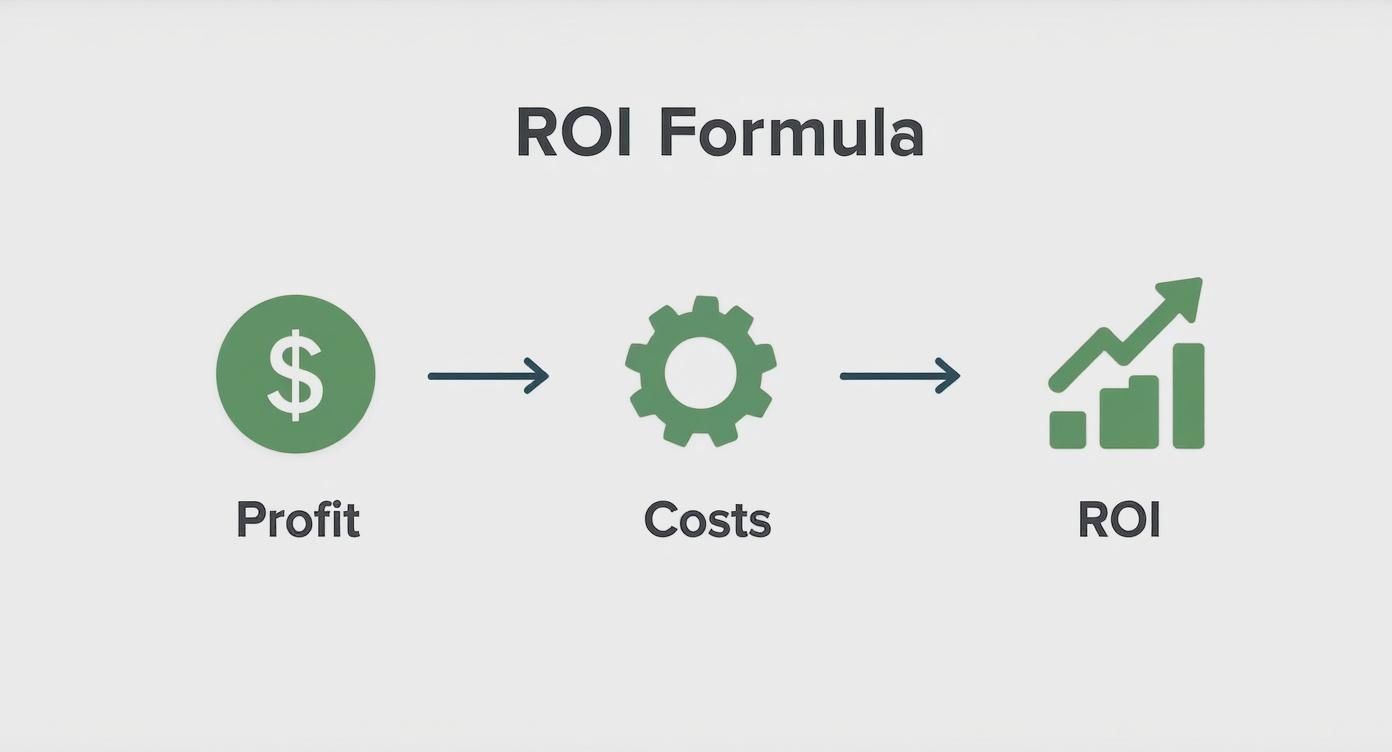
As you can see, profit and costs are the inputs, but your attribution model is what tells you which marketing efforts are actually generating that profit.
Common Attribution Models Explained
Let's stick with our sneaker example. A customer named Alex buys the shoes after hitting three touchpoints: an Instagram ad (first touch), a Google ad (middle touch), and an email campaign (last touch).
Here’s how different models would divvy up the credit for that sale:
- First-Click Attribution: This model gives 100% of the credit to the very first touchpoint—the Instagram ad. It’s simple and helps you see what’s kicking off the customer journey.
- Last-Click Attribution: The email campaign gets 100% of the credit because it was the final click before the sale. It’s easy to track but dangerously oversimplifies things, giving all the glory to the final step.
- Linear Attribution: This model is the diplomat, splitting credit equally. The Instagram ad, Google ad, and email each get 33.3%. It acknowledges every touchpoint, but it wrongly assumes they all had the same level of impact.
- Time-Decay Attribution: Here, the touchpoints closest to the conversion get more weight. The email would get the most credit, the Google ad less, and the Instagram ad the least. This is a much more realistic model for B2B or any business with a longer sales cycle.
The goal isn’t to find one “perfect” model that works forever. It’s about understanding the unique story your data is telling and choosing a model that best reflects your customer’s typical buying journey.
How to Select the Right Model for Your Business
So, which one should you use? The answer lives in your business goals and sales cycle.
A Last-Click model might be "good enough" for an e-commerce brand selling low-cost items with a short, simple path to purchase. But for a B2B company with a six-month sales process involving multiple decision-makers, that model is practically useless. You'd get far more accurate insights from a Time-Decay or a custom multi-touch model. To sharpen your approach here, it’s worth reviewing these B2B demand generation best practices.
The entire industry is moving toward more sophisticated measurement. A 2025 survey found that 73% of businesses now require ROI tracking for all campaigns. Advanced predictive models using AI are now achieving 67% greater accuracy in forecasting results. In one real-world case, a beverage company discovered its podcast ads drove 22% more conversions than their old last-click models ever showed them, proving just how much revenue you might be leaving on the table with outdated methods.
Advanced Techniques for Deeper ROI Insights
Once you have attribution models dialed in and a good handle on your basic ROI, it’s time to ask bigger, tougher questions. Standard ROI formulas are great for telling you if you’re heading in the right direction, but they often don't explain the why behind the numbers or prove that a specific campaign truly caused a sale.
This is where you graduate from simple measurement to real strategic analysis. We're talking about techniques that help you see the entire marketing ecosystem at play, not just one neat-and-tidy customer journey.
Two powerful methods stand out when you need these deeper insights: Marketing Mix Modeling (MMM) and Incrementality Testing.
Getting the 30,000-Foot View with Marketing Mix Modeling
Think of Marketing Mix Modeling (MMM) as your strategic command center. Instead of zooming in on individual clicks and conversions, MMM uses statistical analysis to see how all your marketing channels—both online and offline—work together to drive sales over time.
It’s built to answer the big, C-suite questions:
- How much did our TV advertising really contribute to online sales last quarter?
- Where is the point of diminishing returns for our paid search budget?
- How do outside forces like seasonality or economic shifts affect our performance?
This top-down approach is perfect for understanding the combined effect of everything you’re doing. Measuring marketing ROI is still a huge challenge, but it's the number one priority for most businesses. In 2025, 63% of marketers rank ROI as their most important metric, yet 41% admit they still can’t measure performance effectively across every channel.
This is where advanced methods are changing the game. Already, 49% of marketers use MMM, and 47% plan to spend even more on it next year. Learn more about these marketing statistics on HubSpot. And if you want to move beyond just reporting on the past and start forecasting the future, you'll want to dive into predictive and prescriptive analytics.
Proving Cause-and-Effect with Incrementality Testing
If MMM gives you the big picture, Incrementality Testing is your on-the-ground tool for proving causation. It answers the one question that keeps marketers up at night: "Did this campaign cause a sale, or was it just another touchpoint for a customer who would have bought from us anyway?"
How does it work? You create a control group (people who don't see your ad) and a test group (people who do). By comparing the conversion rates between the two, you isolate the true "lift" your campaign delivered.
Example in Action: A retail brand wants to know if a new TikTok ad campaign is actually worth the money. They run a test where one group of users in a specific region sees the ads, while a similar control group in another region sees nothing. After two weeks, if the test group had a 15% higher purchase rate, that 15% is the incremental impact—the direct result of the TikTok campaign.
This approach cuts through all the noise from other channels and attribution models. It gives you a clean, definitive answer on whether your ad spend is generating new business or just taking credit for it. It's the ultimate way to prove the incremental value of your work.
Choosing Your Measurement Technique
Deciding between standard ROI, MMM, and incrementality isn't an either/or choice; it's about using the right tool for the job. Each one answers a different kind of question.
| Technique | Best For | Key Question It Answers | Common Use Case |
|---|---|---|---|
| Standard ROI Calculation | Quick, directional feedback on individual campaigns. | "Did this specific channel or campaign generate a positive return?" | Comparing the direct performance of two different Google Ads campaigns. |
| Marketing Mix Modeling | High-level strategic planning and budget allocation across all channels. | "How do all my marketing efforts (online & offline) impact sales over the long term?" | Deciding how to split next year's budget between TV, digital, and print. |
| Incrementality Testing | Proving the direct, causal impact of a specific channel or campaign. | "Did this ad cause new sales, or would they have happened anyway?" | Justifying the budget for a new awareness campaign on a platform like TikTok. |
Ultimately, a mature marketing organization uses a combination of these techniques. You'll rely on standard ROI for day-to-day optimization, turn to MMM for annual planning, and deploy incrementality tests to validate your big bets.
Tools and Tech That Simplify ROI Tracking
Measuring marketing ROI doesn’t mean you have to be chained to a monstrous spreadsheet for the rest of your career (though you can absolutely start there!). The right tech stack turns this process from a manual headache into an automated, insightful system.
Let’s look at the tools that make this manageable. The good news? Many of the essentials are probably already in your marketing stack. The key isn't buying more software, but making sure what you have is configured to track conversions and revenue properly.
The Foundational Tools You Already Use
Your core tech stack—specifically your analytics platform and CRM—is the backbone of any serious effort to measure marketing ROI. These are the tools that connect your spending to actual customer actions.
For most businesses, that conversation starts with Google Analytics. It’s the go-to for figuring out how users find and interact with your website. By setting up specific goals, like form submissions or demo requests, you can assign a value to those conversions and see which channels are actually driving them.
Here’s a look at a standard Google Analytics dashboard, showing traffic sources and user engagement.

This view highlights not just where your traffic comes from, but how engaged those visitors are—giving you early clues into the quality of each channel.
Your Customer Relationship Management (CRM) platform, like HubSpot or Salesforce, is the other half of the equation. This is where leads become revenue. Integrating it with your analytics platform creates a closed-loop system that can trace a customer from their first click all the way to a closed deal.
Specialized Platforms for Deeper Insights
While your core stack gets you far, specialized tools can provide a much clearer picture, especially when you’re dealing with a complex customer journey. This is where multi-touch attribution and data visualization platforms come into play.
-
Multi-Touch Attribution Tools: Platforms like Ruler Analytics are built to solve the attribution puzzle. They connect anonymous website visits to specific leads in your CRM, giving you a complete view of every touchpoint that influenced a sale. This is a game-changer for businesses with longer sales cycles where first- or last-click models just don’t cut it.
-
Data Visualization Software: Tools like Tableau or Google Looker Studio pull data from all your different sources—analytics, CRM, ad platforms—into one unified dashboard. Instead of logging into five different apps, you get a single, clear view of your performance. It makes spotting trends and reporting on ROI infinitely easier.
The goal isn't to create a complex, overwhelming tech stack. It's about choosing tools that automate data collection, giving you back precious time to analyze the numbers and make smarter strategic decisions.
Ultimately, a well-chosen set of tools does more than just track numbers; it builds a foundation for scalable growth. Many of these tools are also essential when you're ready to implement marketing automation and act on the insights you've gathered.
Your Top Marketing ROI Questions, Answered
Even with solid formulas in hand, a few questions always pop up when it's time to actually measure marketing ROI. These are the practical, real-world roadblocks that appear after you move past the textbook definitions.
Let's tackle the most common ones I hear from marketers. Think of this as your quick-reference guide for those moments in a team meeting when you need to explain your results with confidence.
How Often Should I Measure Marketing ROI?
There's no magic number here. The right frequency depends entirely on your sales cycle—you have to match your reporting rhythm to your customer's buying rhythm.
For a fast-moving e-commerce store running daily ads, a weekly check-in is non-negotiable. Waiting a month to find out a campaign is tanking is a luxury you can't afford.
But for a B2B company with a six-month sales cycle, a weekly report would be nothing but noise. Looking at the numbers monthly or quarterly makes far more sense.
The key isn't the frequency—it's the consistency. Pick a schedule that aligns with your business and stick to it. This is how you spot real trends and avoid reacting to random data blips.
A good rule of thumb? Do a high-level monthly review to monitor key trends, and a much deeper, more strategic quarterly review to shape your budget and plans for the next period.
What Is a Good Marketing ROI?
Everyone wants that one perfect number, but the truth is, a “good” ROI is completely dependent on your industry, your channels, and your profit margins. What's exceptional for one company might be a disaster for another.
Still, if you need a benchmark, a 5:1 ratio—$5 in revenue for every $1 spent—is often cited as a solid target. A 10:1 ratio is considered top-tier.
But context is everything. A 2:1 ROI might feel weak for a low-margin product, but it could be a massive win for a high-margin SaaS subscription with a huge lifetime value.
Instead of chasing a universal benchmark, focus on two things:
- Beating your own numbers. Is this quarter's ROI better than last quarter's? That's progress.
- Comparing your own channels. This shows you where your most profitable marketing efforts are happening right now.
How Do I Measure ROI for Content Marketing or SEO?
This is the big one. Long-game strategies like SEO and content marketing rarely lead to an immediate sale, making a simple ROI calculation feel impossible. Their impact builds over months, sometimes years.
The key is to connect the dots. You have to track a combination of metrics that show clear progress toward a sale and link the content someone consumed to the revenue they eventually generated.
For SEO, you should be tracking things like:
- Growth in organic traffic to your high-value commercial pages.
- Better rankings for keywords with obvious buying intent.
- Actual conversions from organic search, like demo requests or trial sign-ups.
For content marketing, you can assign real value by:
- Tracking leads that come from content downloads (like an ebook or whitepaper).
- Following where those leads go in your sales funnel.
- Connecting your analytics to your CRM to see which of those content-driven leads became paying customers.
It's more work, absolutely. But it's the only way to prove the financial impact of these powerful, long-term channels.
At Value CMO, we help B2B tech startups move beyond guesswork and build data-driven marketing engines that deliver measurable results. If you're ready to clarify your strategy and prove the financial impact of your marketing, let's connect.