Trying to sell to everyone is the fastest way for a B2B tech startup to burn through cash and morale. You have a limited runway and even less time to waste chasing leads that will never, ever close.
This is why figuring out your target market isn't just a fluffy marketing exercise—it's a core business strategy that dictates who you build for, who you market to, and who you sell to.
Stop Selling to Everyone and Define Your Target Market
Let's forget the academic theories for a minute. This guide is all about building the practical foundation for your entire go-to-market plan. Getting razor-sharp on your audience influences everything that actually matters:
- Your product messaging: How you talk about your solution so it hits on a very specific set of problems.
- The content you create: What blog posts, whitepapers, and webinars you build to attract genuinely qualified buyers.
- Your sales outreach: Who your team contacts and what they say to actually get a response.
A tight focus stops you from pouring time and money down the drain on the wrong people.
From "Target Market" to a High-Impact Ideal Customer Profile
So, what’s the difference between a fuzzy "target market" and a sharp "Ideal Customer Profile" (ICP)? It’s all about being able to take action. Most founders get stuck thinking in broad strokes, like "mid-sized tech companies." That’s a start, but you can’t build a sales playbook on that.
The real magic happens when you drill down to an Ideal Customer Profile (ICP).
An ICP is a hyper-specific definition of the exact company that gets massive value from your product and is profitable for you to acquire and serve. Think of it as a living document based on real data, not just boardroom daydreams.
| Attribute | Target Market (Broad) | Ideal Customer Profile (Specific) |
|---|---|---|
| Description | A wide group of potential customers with shared characteristics. | A detailed portrait of the perfect-fit customer company. |
| Scope | General and high-level (e.g., "SaaS companies"). | Granular and detailed (e.g., "Series B FinTechs"). |
| Actionability | Difficult to target directly; requires more filtering. | Immediately actionable for sales and marketing campaigns. |
| Example | Healthcare providers in the US. | US-based private orthopedic clinics with 3-5 locations and using Athenahealth EMR. |
This table shows the shift from a vague idea to a concrete plan. The ICP gives your team a clear "who" to focus on.
Your ICP isn't just a description of who you sell to; it's a strategic filter for every decision you make. It tells you which deals to chase, which feature requests to prioritize, and which marketing channels to pour money into.
Let’s make this real. Instead of targeting all software companies, a focused ICP might look like this:
Series A to B cybersecurity firms in North America with 50-200 employees who use HubSpot and are actively hiring security engineers.
See the difference? That level of detail is a roadmap. It tells you where to find them (LinkedIn), what tech to look for (BuiltWith), and what pain points to mention (hiring challenges).
This guide is your playbook for moving from fuzzy concepts to a data-backed definition of the customers who desperately need what you're selling. This is how you stop wasting resources and start winning the right deals.
Build Your Foundation with Market Segmentation
Before you can land that perfect customer, you have to map the entire playing field. Think of market segmentation as drawing that detailed map. It's the process of breaking down a massive, messy market into smaller, well-defined groups of companies that look and act alike. This isn't about getting lost in spreadsheets; it's about building an evidence-based picture of where your best opportunities are hiding.
For a B2B tech startup, this has to go way deeper than basic demographics. You need to slice and dice the market using data that actually signals a company's need for your solution. Forget vague categories. It’s time to get specific.
The Core Pillars of B2B Segmentation
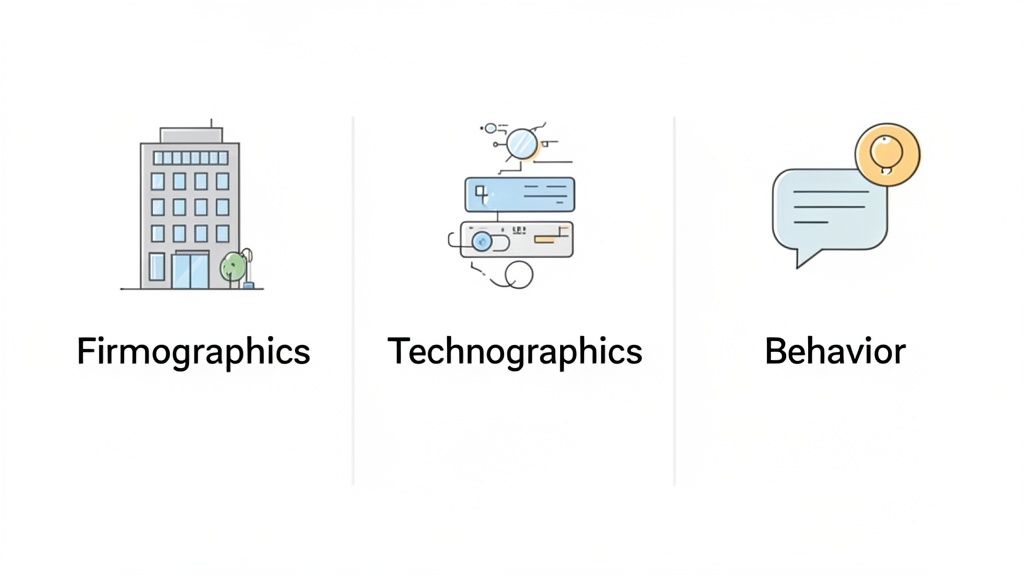
To build a useful map, you need to look at the market through three distinct lenses. Each one adds a crucial layer of detail, helping you move from a huge, undefined ocean of prospects to a handful of high-potential ponds.
-
Firmographics: This is your foundational layer. It covers the hard facts about a company: its industry, annual revenue, employee count, and where it’s located. This data lets you immediately filter out companies that are just too big, too small, or in the wrong business to ever be a good fit.
-
Technographics: Here's where it gets interesting for tech companies. Technographics tell you what technologies a company already uses. Knowing what’s in their tech stack—like their CRM, marketing automation software, or cloud provider—is a massive clue about their technical maturity and potential integration needs.
-
Behavioral Signals: This layer tells you what companies are doing. Are they hiring for certain roles? Did they just land a new round of funding? Are they expanding into new territories? These actions are often flashing neon signs for a pressing need or fresh budget that you can solve for.
The real goal of segmentation isn't just to describe the market. It's to find pockets of opportunity where a specific, expensive problem is felt most acutely. When you combine firmographics, technographics, and behavioral data, you get the complete picture.
Finding Overlooked Data Sources
So, where do you dig up all this information without breaking the bank? You'd be surprised how much is out there if you know where to look. You don’t need a fancy data science team to get started.
You can uncover a goldmine of insights from these practical sources:
- LinkedIn Sales Navigator: This tool is indispensable for filtering companies by size, industry, location, and even recent hiring activity. It’s perfect for building highly specific lists of target accounts to analyze.
- Competitor Analysis Tools: Platforms like Semrush or Ahrefs can show you who is linking to your competitors and what kind of companies are interacting with their content. It's a backdoor way to see who already finds their value proposition interesting.
- Public Financial Filings: For any publicly traded company, their annual (10-K) and quarterly (10-Q) reports are treasure troves. They spell out strategic priorities, challenges, and investments—giving you direct insight into their biggest pain points.
By pulling data from these sources, you can start building a rich, multi-layered view of different market segments. This turns abstract research into a tangible list of potential customer groups, each with its own distinct profile. This segmentation work is also a crucial first step before you learn how to create buyer personas for the actual people inside those companies.
Spotting High-Potential Segments Globally
Your segmentation data should also steer your geographic focus. Instead of guessing, you can use industry growth rates by region to prioritize where to concentrate your go-to-market efforts for the biggest wins.
For example, global IT spending forecasts point to massive opportunities in specific regions. The European IT market is predicted to grow by a solid 11.1% to hit $1.43 trillion in 2026, partly fueled by the demand for region-specific AI platforms.
Meanwhile, India's IT spending is on track to jump 10.6% to $176.3 billion, cementing its role as a global transformation hub. The Middle East & North Africa (MENA) region is also becoming a tech powerhouse, with spending expected to grow 8.9% to $169 billion.
These numbers make it clear: understanding where the growth is happening can help you lock in on a target market with huge revenue potential.
Uncover Real Insights by Talking to Customers
Your data can tell you what is happening, but it almost never tells you why. A segmentation analysis might point you to "Series B FinTechs," but it won't tell you about the VP of Engineering's daily headaches or what finally made her hunt for a new solution.
For that, you have to talk to actual people. This is where your Ideal Customer Profile stops being a spreadsheet row and starts becoming a real person with stories, motivations, and pain points.
Forget stiff, scripted sales calls. This is about genuine discovery, one human conversation at a time.
The Human-First Approach to Customer Interviews
The goal here isn't to sell; it's to learn. You're searching for the unvarnished truth about their world, and the only way to get it is by being genuinely curious.
Your mission is to understand their reality. What’s their day actually like? What internal politics are they dealing with? Who holds the purse strings, and what does that person care about? These qualitative insights are pure gold.
To really get to the good stuff, you need to master UX research interview questions that peel back the layers. Open-ended questions are your best friend—they invite stories, not just yes/no answers.
Here are a few powerful conversation starters:
- "Walk me through how you currently handle [the problem your product solves]." This unpacks their existing process, tools, and all the messy workarounds.
- "What's the most frustrating part of that for you?" This question cuts straight to their pain.
- "If you could wave a magic wand and change anything about this, what would it be?" This reveals their dream state and what they really want.
- "Tell me about the last time you went looking for a new tool. What was that process like?" This sheds light on their buying journey and what they value in a solution.
You're not interrogating them; you're having a conversation. Listen more than you talk. When they say something interesting, lean in with, "Tell me more about that."
Who to Talk To and How to Reach Them
It’s crucial to talk to everyone involved in the buying decision. Their priorities can be wildly different, and you need to understand each perspective.
The Key Players to Interview
- The End-User: This is the person who will live in your product every day. They care about usability, features, and anything that makes their job less painful.
- The Economic Buyer: This is the budget holder, usually a VP or C-level exec. They think in terms of ROI, strategic fit, and business impact.
- The Champion: This is your internal ally who gets the value and will sell your solution for you. They need the business case and hard numbers to convince everyone else.
Getting these people on a call takes a personal touch. A generic email blast won't cut it. Do your homework, show you understand their world, and make it clear you’re seeking their expertise, not just trying to make a sale.
Validating Your Findings with Surveys
Interviews give you depth; surveys give you breadth. After a few insightful conversations, you'll start spotting patterns. Surveys are the perfect tool to see if those patterns hold up across a bigger audience.
The classic mistake is sending out a massive, complicated survey that no one has time to finish. Keep it short, sharp, and focused. You're just trying to confirm the hypotheses you built from your interviews.
Here’s how to build a quick, effective validation survey:
- Keep it focused: Don't ask everything. Center the survey around the 2-3 key assumptions you need to test, like the severity of a pain point or the importance of a certain feature.
- Use multiple-choice: Make it easy for people to answer fast. Use scales (e.g., "On a scale of 1-5, how critical is this?") and options you pulled directly from your interview notes.
- Include one open-ended question: End with an optional question like, "Is there anything else we should know about [the problem]?" You'd be surprised what gems pop up here.
By combining the deep "why" from interviews with the quantitative "what" from surveys, you build a solid, evidence-backed picture of your target market. That clarity is the foundation for everything that comes next.
Create and Prioritize Your Ideal Customer Profile
You’ve done the hard work of segmentation research and customer conversations. Now it's time to connect the dots. You're sitting on a pile of raw materials—firmographics, interview notes, survey data. The goal now is to turn all that abstract information into a documented, actionable Ideal Customer Profile (ICP).
Think of your ICP as the blueprint for your entire go-to-market strategy. It’s far more than just a list of company attributes. A strong ICP is a living document that gets into the heads of your best customers: what they struggle with daily, what their goals are, and even where they hang out online to get information. When it’s done right, your marketing, sales, and product teams are all aiming at the exact same target.
The process is pretty straightforward: outreach opens the door, interviews give you the qualitative story, and validation surveys back it up with hard data.
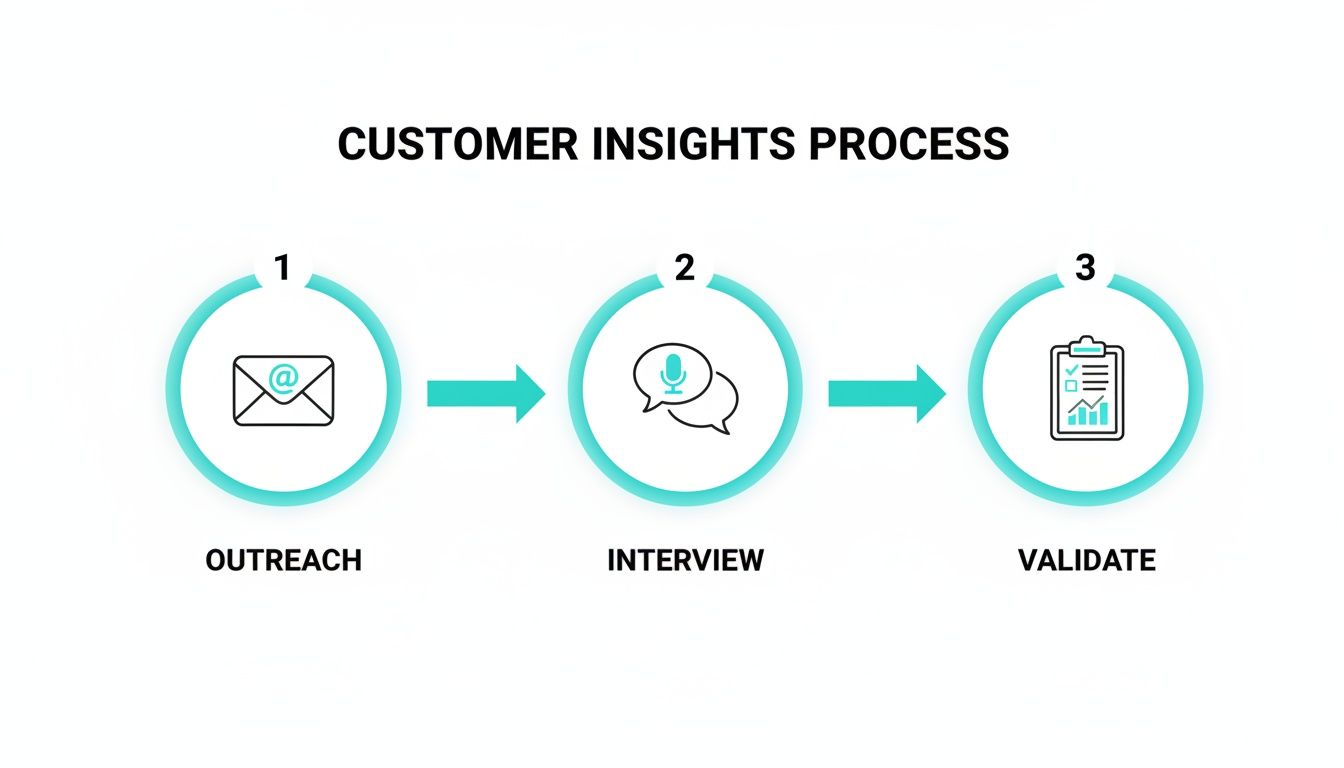
This simple loop ensures your hunches from conversations are grounded in reality, leading to an ICP you can actually bet on.
Building Your ICP Document
Your final ICP document should be a one-page snapshot that anyone on your team can grasp in under a minute. It’s not a 20-page report; it’s a practical tool.
While you can build your own, starting with a solid ideal customer profile template helps make sure you don't miss anything critical.
Here’s what absolutely needs to be in there:
- Firmographics: Industry, company size (by employees or revenue), geography, and funding stage.
- Technographics: What key software do they already use? (e.g., CRM, cloud provider, marketing automation).
- Key Persona & Job Title: Who’s your champion? The economic buyer? The end-user?
- Pains & Challenges: What specific, costly problems are they dealing with? Use the exact words you heard in your interviews.
- Goals & Desired Outcomes: What does a "win" look like for them, both for their career and for the company?
- Watering Holes: Where do they learn? Pinpoint the specific blogs, podcasts, conferences, or LinkedIn groups they trust.
Prioritizing Your Potential ICPs
It’s not unusual to come out of this process with a few promising ICPs. But as a startup, you can’t afford to chase them all at once. You need to place one, high-conviction bet.
This is where a simple prioritization matrix becomes your best friend. It’s a tool that forces you to score your potential ICPs against the factors that actually matter for early-stage growth. It takes emotion and gut feel out of the equation and replaces them with a data-informed ranking.
A prioritization matrix isn't about finding the 'perfect' customer forever. It's about finding the customer who gives you the highest probability of winning right now, with the team and resources you have today.
The Prioritization Matrix in Action
Set up a simple table and score each potential ICP (e.g., Series B FinTech vs. Enterprise Healthcare) from 1-5 on criteria like these:
| Criteria | Description |
|---|---|
| Market Size (TAM) | How big is the total addressable market for this segment? |
| Budget Availability | Do they have a dedicated budget for solutions like yours? |
| Urgency of Pain | How critical and immediate is the problem you solve for them? |
| Ease of Access | How easy is it for your team to actually reach the decision-makers? |
| Strategic Fit | How well does this segment align with your long-term company vision? |
Once you tally the scores, the segment with the highest number is your beachhead market. This isn't just about picking a target; it's about making a deliberate choice to focus your limited startup resources where they’ll have the biggest impact.
Broader market trends also play a role here. For example, there's a huge efficiency gap opening up between AI-native startups and traditional companies. Recent data shows AI-native startups generate an average of $3.48M in revenue per employee—a massive 5.7x advantage over the $610K for traditional SaaS companies.
This tells you that forward-thinking buyers are actively looking for vendors who can deliver serious ROI with AI. You have to decide: is your ICP an AI-first company that already gets it, or a more traditional enterprise that you'll need to educate on the value?
Turn Your ICP into a Go-To-Market Strategy
Let's be blunt: an Ideal Customer Profile sitting in a Google Doc is worthless. All that research, those interviews, and the data crunching mean nothing until you put it to work. This is where the rubber meets the road—translating your hard-won clarity into a focused, efficient go-to-market (GTM) plan.
Think of your ICP as a strategic filter for the entire company. It simplifies every decision, from which features to build next to where you should invest your limited marketing dollars. When you know exactly who you're building for and selling to, you stop wasting resources and start creating real momentum.
Shape Your Messaging to Resonate
Your website copy and sales emails are often the first handshake. Your ICP gives you the cheat codes to make it a firm one.
Instead of generic fluff like "our platform drives efficiency," you can get surgically specific. If your ICP is a VP of Sales at a Series B FinTech, you need to speak their language, and fast.
Take a look at this headline pivot:
- Before ICP: "The All-in-One Sales Intelligence Platform"
- After ICP: "Stop Losing FinTech Deals. Get the Competitive Intel Your Reps Need to Close."
See the difference? The second one doesn't just describe a product; it hits on a specific pain point for a specific person in a specific industry. It shows you get their world, which builds instant trust.
Your ICP tells you what your customers care about. Use their exact words from your interviews in your messaging. If they kept saying they're "drowning in compliance paperwork," that's your headline right there.
Personalize Your Sales and Marketing Outreach
Generic outreach is a one-way ticket to the trash folder. Personalized outreach gets replies. It's that simple. Your ICP is the raw material for outreach that feels like it was written just for them.
When your sales team knows the ICP's common challenges, daily frustrations, and career goals, they can craft emails that are impossible to ignore. They can reference an industry trend, mention a competitor, or highlight a feature that solves a problem unique to that role.
For B2B tech startups, this also means getting found by the right people. A key part of your GTM is implementing smart B2B SEO strategies that attract qualified leads who are already searching for solutions like yours.
Build a Content Roadmap That Answers Their Questions
Your ICP’s "watering holes"—the blogs they read, the podcasts they listen to—tell you where to show up. The ICP itself tells you what to say when you get there.
Build your content roadmap by answering the burning questions your ideal customers are typing into Google.
- What are their biggest unsolved problems at work?
- What are they trying to learn to get that next promotion?
- What industry shifts are keeping them up at night?
Each blog post, webinar, or whitepaper should be a direct answer to one of these questions. You'll stop sounding like a vendor and start looking like a trusted expert, which is a much better place to be. For a deeper dive, check out our guide on building a complete B2B go-to-market strategy from the ground up.
This also means understanding who is actually signing the checks these days. The buying committee has changed. By 2025, a staggering 59% of B2B tech buyers will be Millennials, and nearly a third of them are already the lead decision-maker. This isn't just a generational shift; it’s a fundamental change in how deals get done. These buyers expect a seamless, digital-first experience, and you need to deliver it.
Got Questions? Let's Talk Strategy.
Even with a perfect plan on paper, defining your target market in the real world gets messy. Founders run into the same tricky questions all the time. Let's tackle the big ones head-on with some practical, no-fluff advice.
What If I Have Multiple Potential Target Markets?
First, that's a good problem to have. It means you see opportunity. But for an early-stage startup, focus is your only superpower. Chasing two rabbits at once is a surefire way to catch neither. The goal here isn't to keep your options open; it's to make a deliberate, data-backed choice on where to plant your flag first.
Pull out that prioritization matrix we talked about. This isn't just a thought exercise. It's a tool to force a decision. Score each potential market against the hard truths:
- Market Size
- Budget Availability
- Urgency of Pain
- Strategic Fit
Be brutally honest. Where do you really have the highest probability of winning right now?
It’s far better to completely dominate a small, well-defined niche and expand from that beachhead than to be a tiny, irrelevant player in a massive market. Pick one, go all-in, and use what you learn to plot your next move.
How Often Should I Revisit My Ideal Customer Profile?
Your ICP is a living document, not a stone tablet. Markets shift, competitors pivot, and customer needs evolve. Your understanding has to keep pace.
The right cadence really depends on your stage:
- Early Stage (Pre-Product-Market Fit): Look at it quarterly. You're in a rapid learning phase. Every sales call, demo, and lost deal is fresh data that can sharpen your ICP.
- Growth Stage (Repeatable Sales Process): You can shift to a semi-annual or annual review. You have more stability now, so these reviews become more about spotting macro trends or mapping out expansion opportunities.
Beyond the calendar, certain events should trigger an immediate ICP review. Did sales efficiency just tank? Are you launching a major new product? Pushing into a new country? Did a competitor make a big move? Stay agile.
Is It a Problem If My Target Market Is "Too Niche"?
For a B2B tech startup, a niche market isn't a problem—it's a massive strategic advantage. Spreading yourself thin across a broad market is a recipe for getting drowned out by bigger, better-funded players.
A tight niche is your secret weapon. It gives you incredible precision.
You can dial in your product features, your website copy, and your sales outreach with a focus that generic competitors can't possibly match. This is how you become known as the solution for that one specific problem.
The real question isn't whether the niche is too small, but whether it's viable. Can this specific group of customers actually support your revenue goals? A quick back-of-the-napkin calculation will tell you.
(Total # of Companies in Niche) x (Your Average Annual Contract Value) = Total Addressable Market
If that number works for your business plan, then a niche focus isn't just safe; it's the smartest path to getting traction. Dominating a small pond is how you build the strength to eventually take on the ocean.
Defining your target market is the most critical strategic work you'll do. But turning that definition into a focused, revenue-generating machine takes senior leadership. Value CMO provides the fractional CMO expertise to bridge the gap between strategy and execution, helping you build a data-driven growth roadmap without the cost of a full-time executive. If you're ready to stop guessing and start winning, see how we can help at https://valuecmo.com.