To create a value proposition that truly connects, you first need to get why so many fall flat. Think of a great one as a clear, simple promise of the value a customer gets from you. It’s the one message that cuts through all the noise.
Ultimately, it has to answer the one question every potential customer is asking: "Why should I buy from you and not your competitor?"
Why Most Value Propositions Fail to Connect

Let's be honest—most value propositions are completely forgettable. They’re often generic, jargon-filled statements that sound impressive in a boardroom but mean absolutely nothing to a potential customer. For a B2B tech startup, that’s a fatal mistake.
Your value proposition isn’t just a slick marketing tagline; it's the very foundation of your entire plan to win over the market. It’s the promise that your solution solves a specific, painful problem better than anyone else. When it fails to connect, your whole sales and marketing engine just sputters.
The Disconnect Between Features and Value
The most common trap I see is companies focusing on what their product does instead of what their product achieves for the customer. It's easy to get excited about your own tech—and you should be! But listing features like "AI-powered analytics" or "real-time data synchronization" just doesn't land.
Here’s the thing: people don't buy features. They buy outcomes.
They’re asking themselves questions like:
- How will this make my team's life easier?
- How does this help us stop wasting money?
- How will this give us an edge over our competition?
This is where the 'value gap' comes in—that huge canyon between what you think your solution is worth and what your customer actually believes it's worth. Learning the strategies for closing the value gap is a game-changer. When your message finally clicks with their real-world needs, they start to listen.
Speaking a Different Language
Another massive pitfall is using your internal jargon. Phrases that are common around your office—like "synergistic platforms" or "optimizing workflows"—are often totally meaningless to your target audience. A powerful value proposition uses the customer's own language to describe their problems and your solution.
Key Takeaway: Your value proposition needs to be so clear that a complete outsider understands what you do in under five seconds. If you have to explain it, it’s already failed.
Getting this right is more important than ever. The market for services that help companies define their value proposition is growing at a compound annual growth rate of roughly 10%. This isn't just a marketing trend; it shows how vital these statements are for both winning customers and proving you have real market traction.
Your goal isn't just to describe your product. It's to articulate its tangible, undeniable impact on a customer's business.
It’s the difference between saying, "We sell cloud-based project management software," and "We help construction managers finish projects on time and 15% under budget." One is a description; the other is a compelling reason to have a conversation. Nail this, and your ideal customer goes from being a passive browser to an active lead who thinks, "Finally, someone who gets it. Tell me more."
Uncovering Your Customer's Real Problems
The best value propositions aren’t dreamed up in a conference room. They’re discovered out in the wild, by listening—really listening—to the people you want to serve. This is the detective work that separates a wild guess from a message that hits home every single time.
Forget your assumptions. It’s time to dig into the real, often unspoken, problems your customers are wrestling with day in and day out. This isn’t just about collecting data; it's about building your entire message on a foundation of genuine empathy.
Go Beyond Surface-Level Answers
The first step is simple: talk to actual people. But just asking, "What are your pain points?" will only get you generic, rehearsed answers. You have to go deeper to understand the why behind their challenges.
The real goal here is to uncover their ‘jobs to be done’—the actual progress they’re trying to make in their work life. A project manager doesn't just "want a new tool"; she wants to stop having those agonizing conversations with her boss about blown budgets and missed deadlines. That's the real job she's hiring a solution for.
Learning how to conduct effective user interviews is non-negotiable. These conversations are a goldmine for the exact language, frustrations, and goals that will become the bedrock of your messaging.
Become a Digital Detective
You don't always need a formal interview to learn what’s broken. Your own data streams are packed with clues, just waiting for you to connect the dots.
Start digging into these places right away:
- Support Tickets: What problems keep popping up? Look for patterns in how customers describe their frustrations. Phrases like "we can't figure out how to…" or "it's taking way too long to…" are flashing red lights signaling a real pain.
- Sales Call Recordings: Listen to how prospects talk about their current setup and what finally pushed them to look for something better. Pay close attention to the moments when they say, "What we're doing now just isn't working because…"
- Online Reviews (Yours and Competitors'): What do people love? What makes them furious? Sites like G2 or Capterra are filled with brutally honest feedback that points directly to what customers actually value.
This detective work helps you build a crystal-clear picture of your customer’s world. To make this information actionable, you need to organize it. This is where creating detailed customer profiles becomes essential. A well-defined profile ensures your value proposition speaks directly to the right person. If you're starting from scratch, you can learn more about how to create buyer personas to guide this process.
Analyze Your Competitors' Blind Spots
Studying your competition isn't about copying them. It’s about finding the gaps they leave wide open for you. Look at their websites, ads, and content not just for what they say, but for what they don’t say.
Ask yourself these questions:
- Who are they obviously talking to?
- What’s the main benefit they’re hammering home?
- Are they stuck talking about features, or are they selling outcomes?
- What kind of customer are they probably ignoring?
You'll often find a competitor is laser-focused on one thing, like being the cheapest, while completely ignoring another, like offering amazing support or a dead-simple user experience.
Key Insight: The gaps in your competitor's messaging are your opportunities. If they're all shouting about speed, maybe your angle is reliability. If they're all chasing enterprise giants, perhaps your sweet spot is serving the mid-market with a solution that just works.
By combining direct customer conversations, smart data analysis, and a sharp eye on the competitive landscape, you gather all the raw materials for a killer value proposition. You're no longer guessing what people want. You're building a message based on what you know they need, framed in the exact words they use to describe it.
Crafting Your Message with the Value Proposition Canvas
So you've done the hard work—the interviews, the competitor deep dives, the data analysis. Now you're sitting on a pile of raw insights. How do you turn all that research into a message that actually connects with people?
This is where you shift from analysis to creation. And one of the most effective tools I've seen for this job is the Value Proposition Canvas.
Think of the canvas as a bridge. On one side, you have your customer's reality—their jobs, frustrations, and goals. On the other, you have your product. The canvas forces you to build a direct, logical connection between the two, making sure your value prop is grounded in real-world needs, not just your own assumptions.
This is why all that upfront research is so critical. It fuels the entire exercise.
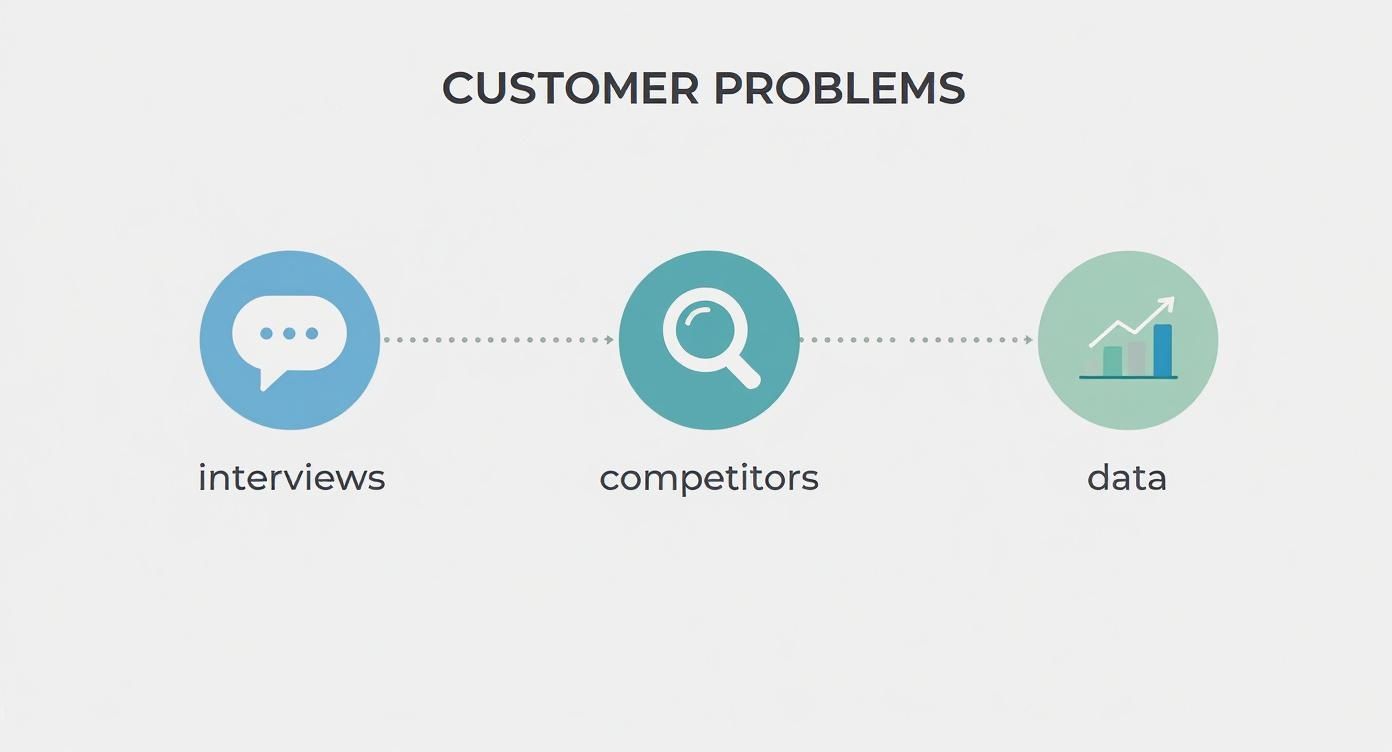
Without solid insights from interviews, competitor intel, and your own data, the canvas is just a guessing game. With them, it becomes a powerful tool for finding clarity.
Deconstructing the Canvas
The canvas is split into two parts: the Customer Profile (the circle on the right) and the Value Map (the square on the left). The goal is to make them fit together perfectly.
The Customer Profile (Their World)
This side is all about empathy. You need to map out what's really happening in your customer's day-to-day life at work.
- Customer Jobs: What is your customer actually trying to get done? Think beyond the obvious tasks. A "job" for a project manager isn't just "manage projects." It's "present a compelling business case to my leadership team" or "avoid looking unprepared in a client meeting."
- Pains: What are the roadblocks, frustrations, and risks they run into? This could be anything that annoys them before, during, or after a job. A classic pain is "spending hours manually formatting reports that still look unprofessional."
- Gains: What outcomes are they looking for? This isn't just the absence of pain. Gains are the desired benefits, from the essential stuff to the unexpected delights, like "gaining the confidence of my superiors with data-backed insights."
Pro Tip: When you're filling out the customer side, use their exact words. Pull direct quotes from your interview notes and support tickets. This keeps you honest and ensures your final message resonates because it’s literally their language.
The Value Map (Your Solution)
Now it’s time to connect your product directly to the customer profile you just built.
- Products & Services: This is the easy part—a simple list of what you offer.
- Pain Relievers: How, specifically, do your product's features get rid of the pains you identified? Get concrete. If their pain is wasted time, your pain reliever is "automating report generation in under 60 seconds."
- Gain Creators: How does your product help customers achieve the gains they want? If they want to look smart in front of their boss, your gain creator is "providing beautiful, presentation-ready charts that make complex data easy to understand."
The Value Proposition Canvas is a fantastic framework for structuring this thinking. It makes sure you're building your message around what your customer truly cares about, not just the features you're excited about.
Here’s a simple table to break down the canvas components and the core questions you should be asking for each.
Value Proposition Canvas Breakdown
| Canvas Element | What It Is | Key Question to Ask |
|---|---|---|
| Customer Jobs | The tasks, problems, or needs your customer is trying to satisfy. | What is my customer really trying to accomplish? |
| Pains | The negative emotions, risks, and obstacles related to the jobs. | What frustrates or blocks my customer from getting the job done? |
| Gains | The positive outcomes and benefits the customer desires. | What would make my customer's life easier or more successful? |
| Products & Services | The things you offer to help your customer. | What specific features or offerings do we have? |
| Pain Relievers | How your product specifically alleviates customer pains. | How do our features directly solve their biggest frustrations? |
| Gain Creators | How your product produces outcomes your customers want. | How do we deliver the specific benefits they're looking for? |
By methodically filling this out, you move from a loose collection of ideas to a tightly structured argument for why your product is the best solution for a very specific set of problems.
A Real-World B2B Tech Example
Let's make this real. Imagine you're a B2B SaaS startup with a project management tool built for architectural firms. After doing your research, your canvas might start to look something like this.
- Their Job: Managing multiple client projects, coordinating with engineers and contractors, and keeping clients in the loop.
- Their Pains: "We waste hours tracking down the latest blueprint version." And, "Client communication is a mess of emails and phone calls, leading to mistakes."
- Their Gains: "I want to look organized and in control during client meetings." Plus, "I wish I could prevent costly rework from miscommunication."
Now, you map your product directly to that reality.
- Your Solution: You have a centralized project dashboard.
- Your Pain Reliever: Version control with a single source of truth for all documents. No more hunting for the right file.
- Your Gain Creator: A branded client portal that gives clients real-time progress updates, building trust and making your firm look incredibly professional.
Suddenly, the message crystallizes.
It's not about "cloud-based collaboration." It’s about "ending costly rework" and "keeping clients happy with a professional, transparent process." That’s how you transform research into a powerful statement. The canvas isn't just another worksheet; it's a clarity machine.
Testing and Refining Your Message in the Real World
Let's be blunt: a value proposition is just a well-researched guess until you've battle-tested it with actual customers. You can have the slickest canvas and the sharpest insights, but if the message doesn't make a prospect lean in and say, "Tell me more," it's just a document gathering dust.
This is where the rubber meets the road. The real work is in the cycle of testing, learning, and refining that turns a good value prop into an unstoppable one. The goal isn't to get it perfect on the first try; it’s to build momentum.
Low-Cost Ways to Validate Your Message
You don’t need a massive budget to find out what resonates. In fact, some of the best ways to test your message are quick, cheap, and can give you clear signals in a matter of days.
The trick is to treat your different value prop angles as competing ideas and let the data pick the winner.
A few practical ways to get started:
- Landing Page A/B Tests: Create two versions of a landing page. Each should have a different headline and sub-headline reflecting your value prop ideas. Drive a small amount of targeted ad traffic to both and see which one gets more demo requests or newsletter signups.
- Email Subject Line Tests: Got an email list? It's a goldmine for this. Send the same email content to two segments of your list, but change the subject line to test your two main value prop messages. The one with the higher open rate is a strong signal of what grabs attention.
- Social Media Ad Variations: Run simple, low-budget ads on platforms like LinkedIn. Test different ad copy based on your value props and measure which one generates more clicks. This gives you direct feedback from your ideal audience.
These tests tell you the "what"—which message is performing better. But to really understand why, you need to dig deeper.
Gathering the 'Why' Behind the Data
Numbers tell you what’s happening, but talking to people gives you the real color and context. It’s where you hear the nuance in a customer’s voice or see that flicker of understanding (or confusion) on their face. This feedback is priceless.
A "smoke test" is a powerful way to do this before you’ve even built out a feature. Just create a simple landing page that describes a new benefit tied to your value proposition and add a "Notify Me When It's Ready" button. How many people sign up is a direct measure of interest before you write a single line of code.
This is a critical step in finding true product-market fit in the AI era, as it validates demand with almost zero engineering investment.
Key Takeaway: Testing isn't just about finding a winner. It's about understanding why it's winning. Does it solve a more urgent problem? Is the language clearer? Is the promised outcome just more desirable?
Refining Based on Real Conversations
The best, most unfiltered feedback comes from simply talking to people. Every sales demo, customer onboarding call, and support ticket is a chance to test and refine your message.
When you're on a call, try a new way of describing your value. Watch their reaction. Do they nod along, or do their eyes glaze over? Do they ask smart follow-up questions, or do they try to change the subject? These are your guideposts.
This continuous loop—testing with data, listening in conversations, and tweaking the words you use—is what makes a great value proposition. It’s a living statement, not a static one etched in stone.
Embedding Your Value Proposition Across Your Business
You’ve tested and sharpened your value proposition. That's fantastic. But its work has just begun.
If that killer sentence only lives on a marketing slide or in a forgotten strategy doc, it’s not actually doing its job. A truly powerful value proposition has to be the heartbeat of your entire company, shaping every single interaction a customer has with your brand.
This is where you shift from saying what your value is to delivering it consistently. It's about turning your core message into a shared reality for your team and a reliable experience for your customers. When every touchpoint reinforces the same promise, you build the kind of trust that makes a brand feel solid and dependable.
Arming Your Sales Team with the Right Story
Your sales team is on the front line, translating your value proposition into conversations that win deals. Just handing them a one-sentence statement and wishing them luck is a recipe for disaster. They need to be equipped to bring that value to life.
That means turning your core message into practical, conversational tools:
- Actionable Talking Points: Don’t just give them the "what," give them the "how." For example, if your value prop is "We help finance teams close their books 50% faster," a talking point would be, "Ask them about the last time they had to work a weekend to close the quarter. Then you can show them exactly how our automation feature eliminates that manual reconciliation."
- Discovery Questions: Give them questions that uncover the specific pains your value prop solves. This lets them naturally introduce your solution as the perfect answer, not just another product pitch.
- Battle Cards: Build simple one-pagers that map your value prop against each key competitor. This helps them articulate your unique advantages with confidence when the pressure is on.
When your sales team truly gets the value proposition, they stop selling features and start solving problems. The whole dynamic of the conversation changes.
Weaving Your Message into Every Customer Touchpoint
A consistent experience is built when your value proposition shows up everywhere. It needs to be the common thread that connects every stage of the customer journey, making your promise feel real and tangible from the very first click.
Think about how it can shape these key areas:
- Your Website Homepage: The headline should be a direct reflection of your value prop. Slack is a master of this, with messages like "Made for people. Built for productivity." It’s a direct promise of a better way to work.
- Product Onboarding: Does the initial user experience immediately deliver on a core promise? If you promise simplicity, the first five minutes inside the product better feel incredibly simple.
- Customer Support Interactions: Your support team’s goal isn’t just to close tickets; it's to reinforce your value. If you promise reliability, their communication should be dependably fast, empathetic, and effective.
When every department—from marketing to product to customer success—operates from the same playbook, the customer feels it. This alignment is a core pillar of a successful go-to-market strategy and a key differentiator that competitors find difficult to copy.
This holistic approach is central to creating a coherent customer journey. For a deeper look into how all these pieces fit together, our guide on building a B2B marketing strategy framework offers a comprehensive view of aligning your entire business around a central message to drive long-term, sustainable growth.
Tying Your Proposition to Modern Customer Values
Value propositions used to be simple: faster, cheaper, more efficient. Not anymore. Today’s buyers, even in B2B, are making decisions with their hearts and minds. They want to partner with companies that share their values, turning ideas like sustainability and social responsibility into serious differentiators.
This shift adds a powerful, human dimension to your value prop. A real commitment to environmental or social good isn't just a nice story for your "About Us" page. It’s a strategic asset that attracts both thoughtful customers and top-tier talent who want their work to mean something more.
Don't Just Greenwash It
Authenticity is everything here. Slapping a green logo on your website is lazy and, frankly, it often backfires. This isn’t about “greenwashing.” It’s about finding the genuine connection between what your company does, what it stands for, and what your customers actually care about.
A logistics software company, for example, could build its value prop around optimizing routes to cut fuel consumption. The primary benefit is obvious: cost savings for the client. But a huge secondary benefit is a verifiable reduction in carbon emissions—a clear win for their bottom line and their sustainability reports.
When your value is tied to a shared purpose, customer relationships feel less transactional. They become true partnerships, which builds much deeper loyalty.
This isn't just a hunch; the data backs it up. Recent IBM research found that nearly 60% of consumers are willing to change their buying habits to reduce environmental impact. And another study shows 55% will pay more for products from environmentally responsible brands. For a deeper dive on this, check out the full analysis on Kadence.com.
Weaving these modern values into your pitch isn’t about pretending to be something you're not. It’s about clearly articulating the positive impact your business already has—or could have. This adds a compelling, non-negotiable layer to your value proposition, making you the obvious choice for forward-thinking partners.
Common Questions About Value Props
Even with a great framework, a few practical questions always come up. Let's tackle the ones I hear most often from B2B tech founders and marketers trying to lock in their core message.
How Do I Stand Out in a Saturated Market?
When it feels like you and ten competitors are all yelling the same thing, the winning move is to whisper something different to the right people. Forget being better; be different.
Instead of claiming your software is "faster," maybe it's the only one that offers white-glove onboarding for non-technical teams. That's a real differentiator that speaks to a specific fear.
Find a niche pain point your competitors are ignoring. They might all be chasing huge enterprise clients, leaving a massive opening for you to become the go-to solution for a specific, underserved group. Differentiation isn’t always about a revolutionary feature. More often, it's about a unique focus.
What If I Serve Multiple Customer Segments?
This is a classic startup problem. The biggest mistake is creating one vague value proposition that tries to be everything to everyone. A message built to please everybody ends up resonating with nobody.
The fix? Develop a core value prop that hits the universal benefit of your product. Then, create specific variations for each segment you serve.
Imagine your project management tool helps both marketing agencies and construction firms. The core value is project clarity, but the messaging needs to be tailored:
- For Agencies: "Keep creative projects on track and clients in the loop, without the chaos."
- For Construction: "Eliminate costly rework and stay on schedule with a single source of truth for every job site."
See the difference? Same core value, but the language speaks directly to each segment's unique world.
Your value proposition is a living, breathing statement. It's not a "set it and forget it" task. As markets shift and customers evolve, the most successful companies are the ones that are constantly listening and refining their core promise to stay relevant.
At Value CMO, we live and breathe these challenges. We provide the senior marketing leadership to clarify your message, define your ideal customer, and build a growth roadmap that actually works. Learn how our fractional CMO services can bring focus and momentum to your go-to-market strategy.