So, you're thinking about bringing on a fractional CMO. It’s a smart move—you get C-suite marketing leadership in your corner without the full-time executive price tag. This is usually the right call when growth has stalled, your marketing efforts feel all over the place, or your junior team is spinning its wheels and really needs a seasoned guide.
Is It The Right Time to Hire a Fractional CMO?

Let's be real—hiring any leadership role feels like a huge commitment, especially when you're a founder steering a B2B tech startup. The idea of bringing in a senior marketer can feel a little daunting. Questions about cost, fit, and timing immediately pop up. You’re probably asking yourself if you’re big enough, if the budget can stretch, or if you even need that level of expertise right now.
Those are all the right questions to be asking. But the decision to hire a fractional CMO gets a lot clearer when you start noticing specific growing pains that tactical hires or agencies just can’t fix. It’s less about your company's size and more about the complexity of the challenges you're facing.
Common Pains That Signal a Need for Change
If your marketing feels more reactive than strategic, you’re not alone. Lots of startups kick things off with a whatever-works approach that gets the job done early on. But that same approach eventually becomes a major roadblock to scalable growth.
Here are a few tell-tale signs that it might be time to bring in strategic leadership:
- Your Growth Has Plateaued: The pipeline is flat, leads aren't converting, and you’re not sure which levers to pull to get the engine running again. Something’s broken, but you can’t quite put your finger on the root cause.
- Your Junior Team is Overwhelmed: You’ve got a talented team of marketers, but they lack a senior guide to set priorities, build a cohesive plan, and connect their daily work to the bigger business goals. They're burning out without a clear strategic north star.
- Your GTM Strategy Isn't Clicking: Marketing and sales feel like they're on different planets. The messaging is all over the place, your Ideal Customer Profile (ICP) is a little blurry, and every new campaign feels like a shot in the dark.
- You're Preparing for a Major Milestone: You're gearing up for the next funding round, a big product launch, or expanding into a new market. These moments demand confident, experienced leadership to make sure marketing drives real success, not just busywork.
The decision to hire a fractional CMO isn’t just about plugging a hole; it’s about injecting strategic clarity and momentum right when you need it most. It's a proactive move to build a sustainable growth engine, not just a temporary fix for a leaky funnel.
The Rise of Fractional Leadership
This shift toward on-demand expertise is quickly becoming the go-to strategy for capital-efficient startups. The fractional CMO market is on track to hit $2.8 billion by 2027, with demand jumping 68% year-over-year.
For B2B tech companies, this isn't just a trend; it's a strategic advantage. A full-time CMO can cost $250,000+ per year, while a fractional leader provides that same senior guidance for a fraction of the cost—typically $5,000–$10,000 per month.
If you want to dig deeper, you can explore the full fractional CMO meaning and what the role really entails. At the end of the day, hiring a fractional CMO is about getting top-tier talent in a way that aligns perfectly with your budget and immediate needs.
Defining the Mission Before You Start the Search
Before you even think about posting a job description, you need a crystal-clear mission. Jumping straight into interviews without a defined strategy is like setting sail without a map—you’ll be busy, but you won't get where you need to go. The very first step is to spell out exactly what winning looks like in six or twelve months.
This isn’t about vague goals like “increase brand awareness.” It’s about tangible, outcome-focused objectives that plug directly into your company's revenue and growth targets. A great fractional CMO thrives on concrete challenges, not fuzzy aspirations.
From Business Goals to Marketing KPIs
Your high-level business goals are the starting point. Let’s say your main objective is to increase annual recurring revenue (ARR) by 40%. A strategic marketing leader will know exactly how to translate that big number into a specific, measurable marketing mission.
What does that look like in practice?
- If your problem is a leaky sales funnel: The mission could be to improve the lead-to-customer conversion rate from 1.5% to 3% within nine months. This means digging into the entire funnel, from top to bottom.
- If you’re launching a new AI-driven product: The mission is a successful go-to-market launch, defined by snagging 50 pilot customers and generating $250,000 in pipeline within the first six months.
- If your pipeline has gone cold: The mission might be to double Marketing Qualified Leads (MQLs) from 200 to 400 per quarter while holding the line on cost per acquisition (CPA).
A well-defined mission acts as a North Star for your engagement. It makes sure that both you and your fractional CMO are perfectly aligned on what success looks like from day one.
This level of clarity stops misalignment before it can start and ensures every marketing dollar gets spent with purpose. When you're defining this mission, a true leader will stress the importance of understanding marketing intelligence to inform strategy. It's how you move from guesswork to smart, calculated moves.
Sharpen Your Ideal Customer Profile
You can’t hit a target you can’t see. A fuzzy idea of your customer leads to scattered messaging, wasted ad spend, and a sales team drowning in junk leads. Defining—or refining—your Ideal Customer Profile (ICP) is non-negotiable before you bring in a marketing leader.
An effective ICP is more than just basic demographics. It’s a living document that captures the psychographics, pain points, and buying triggers of your absolute best customers.
Just look at the difference for a B2B SaaS company selling project management software:
Weak ICP:
"We sell to project managers in mid-sized tech companies."
Strong ICP:
"We sell to VPs of Engineering at Series B to D SaaS companies with 100-500 employees. They're struggling with a lack of visibility across multiple dev sprints, which leads to missed deadlines and budget overruns. They value tools that integrate seamlessly with Jira and Slack and are measured on their ability to improve team velocity and ship products on time."
That second example gives a fractional CMO a clear target. They know who to talk to, what problems to solve in their messaging, and where to find them. This focus is what turns marketing from a cost center into a predictable revenue engine. Get this right upfront, and you empower your future leader to build a strategy that attracts not just more leads, but the right ones.
How to Find and Vet True Marketing Leaders
Finding a great fractional CMO isn't like posting a job on LinkedIn and waiting for the applications to roll in. True strategic leaders aren't actively looking for jobs; they're busy driving results. Sourcing them requires a much more intentional, network-driven approach.
Think of it less like traditional recruiting and more like scouting for a key player. The best candidates are almost always found through trusted communities, specialized firms, and word-of-mouth referrals from people you respect.
Where to Source Strategic Talent
Forget the massive job boards. Your ideal candidate is likely hanging out in circles where B2B tech founders and executives already are. They're busy solving problems, not scrolling through listings.
Here are the most effective places to start your search:
- Your Professional Network: This is always the best place to start. Ask your investors, board members, and fellow founders for introductions to marketing leaders they’ve worked with and trust. A warm referral is worth its weight in gold.
- Niche Communities: Look into private Slack or LinkedIn groups dedicated to B2B marketing, SaaS growth, or your specific industry. These are places where top performers share what they know, and you can get a feel for who really understands your world.
- Specialized Fractional Firms: Companies that specialize in placing fractional executives have already done a lot of the vetting for you. They have a roster of proven leaders and can match you with someone who has direct experience with your business model and growth stage.
The mission you defined in the last step—your objectives, ICP, and KPIs—is your North Star for this search.
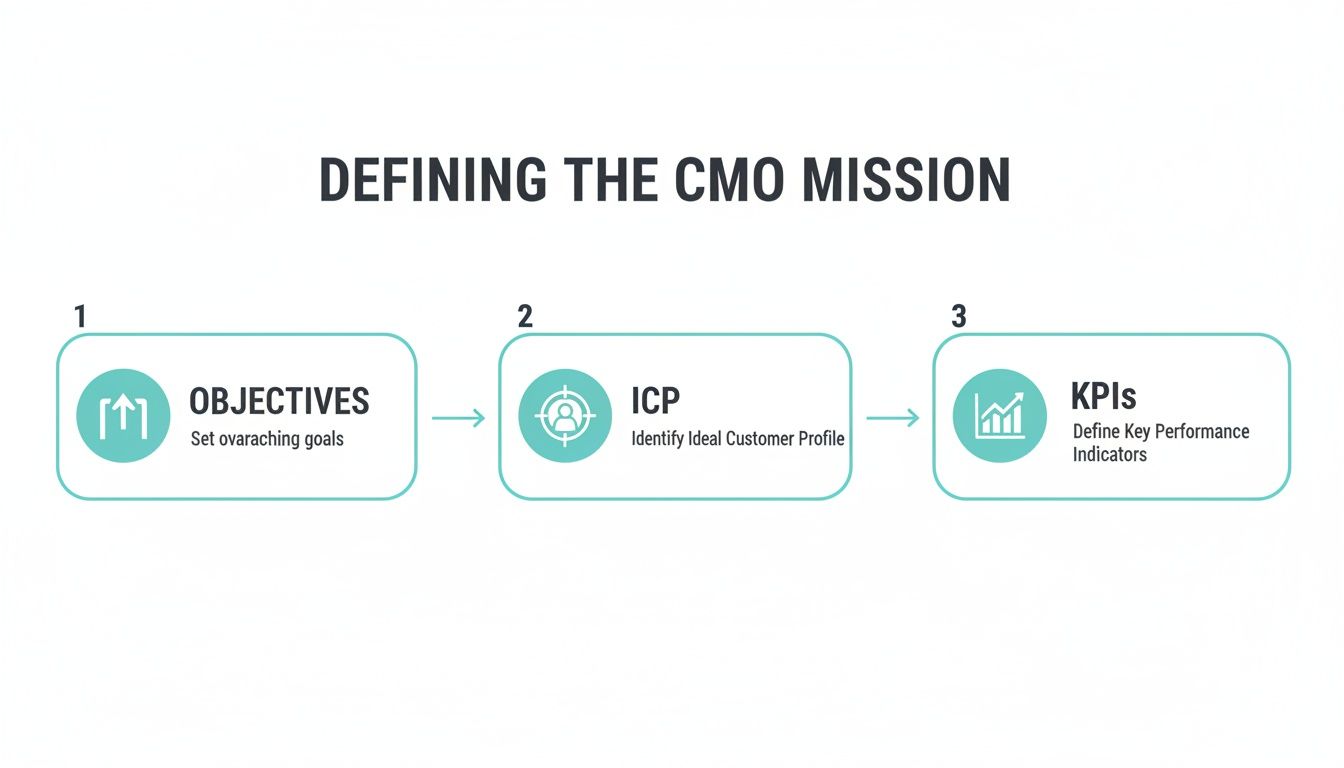
This simple framework ensures you’re hunting for a leader who connects high-level business goals to the specific metrics that actually drive growth.
Vetting for Strategy Over Tactics
Once you have a shortlist, the real work begins. Your goal is to separate a genuine strategist—someone who builds growth engines—from a consultant who just delivers a plan and walks away.
A true fractional CMO thinks like a business owner. They should be obsessed with your unit economics, sales cycle, and customer lifetime value, connecting every marketing action back to revenue.
A tactician will tell you what they did: "We ran a webinar series."
A strategist will tell you why they did it, what the outcome was, and how it impacted the business: "We ran a webinar series to shorten the sales cycle for our enterprise ICP, which resulted in a 15% faster deal velocity and $300k in new pipeline."
Decoding Portfolios and Case Studies
Don't just glance at their portfolio; really dig into it. You need to find hard evidence that they’ve solved problems just like yours in a B2B tech context. A portfolio full of B2C e-commerce projects won't translate to your SaaS go-to-market challenges.
This checklist helps you systematically evaluate each candidate's experience. Use it to screen portfolios and guide your interview questions.
Fractional CMO Candidate Vetting Checklist
| Evaluation Area | What to Look For (Green Flags) | Potential Red Flags |
|---|---|---|
| Business Outcomes | Metrics tied to revenue: pipeline growth, CAC reduction, LTV increase. | Focus on vanity metrics: impressions, clicks, MQL volume. |
| Industry Fit | Case studies with similar business models (e.g., usage-based SaaS, enterprise sales). | Experience is primarily in B2C, e-commerce, or non-tech industries. |
| Strategic Role | Language like "developed the GTM strategy," "built the demand model," "led the pivot." | Language like "managed the campaign," "executed the plan," "coordinated the launch." |
| Financial Acumen | Speaks fluently about unit economics, payback periods, and contribution margin. | Can't connect marketing spend to clear financial returns or business impact. |
| Problem-Solving | Explains the why behind their decisions and what they learned from failures. | Describes projects as a simple list of tactics without strategic context. |
This checklist isn't about finding someone who ticks every single box. It's about finding a partner who has a clear track record of turning strategy into real business growth.
For a deeper dive, our complete guide on how to hire a fractional CMO offers more detailed frameworks to help you make the perfect choice.
Interview Questions That Reveal Strategic Depth
This is where the rubber meets the road. The interview is your chance to see if the polished resume and slick case studies belong to a real strategist or just someone who talks a good game. You're trying to find a leader who builds growth engines, not a consultant who just hands you a plan and walks away.
Forget tired questions like, "What's your biggest weakness?" Those only get you rehearsed, useless answers. To really dig into a candidate's strategic mind, you have to put them in the hot seat with real-world problems and see how they think on their feet.
Moving Beyond the Standard Script
Your goal isn't to test their knowledge of marketing acronyms. It's to see their thought process in action—how they handle ambiguity and connect big-picture strategy to the actual work that needs to get done. You need prompts that force them to diagnose a problem, cook up a plan, and make some tough calls.
A truly great candidate will lean into these challenges. They'll ask smart, clarifying questions, think out loud, and show you they have a structured way of attacking problems. This is how you spot someone who has actually lived strategy, not just read about it in a book.
Questions That Uncover Strategic Thinking
Ditch the script and jump into scenarios that look and feel like the actual job. These questions are designed to test their diagnostic skills, financial savvy, and leadership instincts all at once.
-
The Diagnostic Challenge: "Here's a simplified, anonymized look at our marketing funnel data for the last six months. Walk me through your initial take. What jumps out? What are the first three questions you'd ask my team?"
-
The First 90 Days Simulation: "Let's say you start today. Our number one goal is to boost our qualified pipeline by 50% in the next six months. Give me the rundown of your first 90 days. What are your priorities for week one, month one, and the first quarter?"
-
The Budget Allocation Test: "You've got a hypothetical marketing budget of $100,000 for the quarter. Knowing we're a B2B SaaS company targeting mid-market, how would you split that across channels, team, and tech? Walk me through your thinking."
These kinds of questions don't have a single right answer. They're designed to reveal how a candidate thinks, operates, and solves problems. You'll see pretty quickly if they are data-driven, customer-obsessed, and commercially-minded.
A top-tier fractional CMO won't give you a perfect, polished answer right away. They'll ask smart follow-up questions, make reasoned assumptions, and talk you through their framework for finding the answer. That process is far more valuable than the answer itself.
Probing for Leadership and Resilience
A fractional CMO's job is as much about leadership and influence as it is about marketing smarts. They need to be able to coach your junior team, manage expectations with the leadership team, and navigate the inevitable bumps in the road.
Here are a few questions to see if they have the right stuff:
- On Failure and Learning: "Tell me about a marketing strategy you championed that completely flopped. Why did it fail, and what was the single biggest lesson you took away from it?"
- On Team Building: "You’ll be leading a small team of less experienced marketers. What's your approach to mentoring them and helping them level up their skills?"
- On Saying No: "Imagine I'm the CEO and I come to you with a 'brilliant idea' for a flashy Super Bowl ad that has nothing to do with our strategy. How do you handle that conversation?"
If a candidate gets defensive talking about failure or seems unwilling to push back, they might not have the resilience and leadership you need. You're looking for humility, self-awareness, and a clear focus on business results, not just on making the CEO happy. When you hire a fractional CMO, you're hiring a partner who should be comfortable challenging ideas with data and solid reasoning.
Red Flags to Watch For in the Interview
Knowing what to look for is only half the battle; you also need to know what to avoid. Certain tells in an interview can signal a bad fit long before you make an offer.
Keep an eye out for these warning signs:
- Buzzword Overload: They drop jargon and acronyms without explaining the concepts or connecting them back to your business. This is often a smokescreen for a shallow understanding.
- The Perfect Track Record: They can't—or won't—talk about a time they messed up. This points to a lack of self-awareness or an unwillingness to take smart risks.
- A "One-Size-Fits-All" Approach: Their plan for your company sounds suspiciously like a generic playbook they've used everywhere else, with no real thought given to your unique customers, market, or business model.
- Zero Curiosity: They don't ask you sharp, insightful questions about your business, your customers, or your team. A great strategist is always curious and knows to listen before they start prescribing solutions.
Structuring the Engagement Contracts and Pricing
Once you've found a candidate who feels like the right strategic partner, it's time to make it official. This is where you translate great conversations into a concrete plan, complete with clear expectations, deliverables, and the dollars-and-cents of it all.
Getting the contract and pricing model right is non-negotiable for a healthy partnership. Think of it as the operating system for your collaboration. A solid agreement prevents crossed wires, aligns incentives, and gives you a clear way to measure success. It’s what separates a frustrating, murky engagement from a transparent, results-focused one.
Choosing the Right Engagement Model
Fractional CMOs aren’t a one-size-fits-all service. The best ones offer flexible engagement models designed to match your company's specific needs and maturity stage. The goal is to get the right level of strategic horsepower without paying for overhead you don't need.
You'll generally run into three common structures:
- Monthly Retainer: This is the go-to model for ongoing strategic leadership. You pay a flat monthly fee for a set number of hours or, more effectively, a defined scope of work. It’s perfect when you need consistent guidance on strategy, team mentorship, and program oversight.
- Project-Based: Got a specific, time-bound initiative? Think a product launch, a full rebrand, or building a go-to-market strategy from scratch. A project-based fee makes the most sense here. You agree on a fixed price for a crystal-clear set of deliverables and a timeline.
- Advisory Retainer: This is a lighter-touch model, great for very early-stage startups or founders who just need a strategic sounding board. The CMO gives you high-level guidance through regular calls and check-ins but isn't deep in the day-to-day execution.
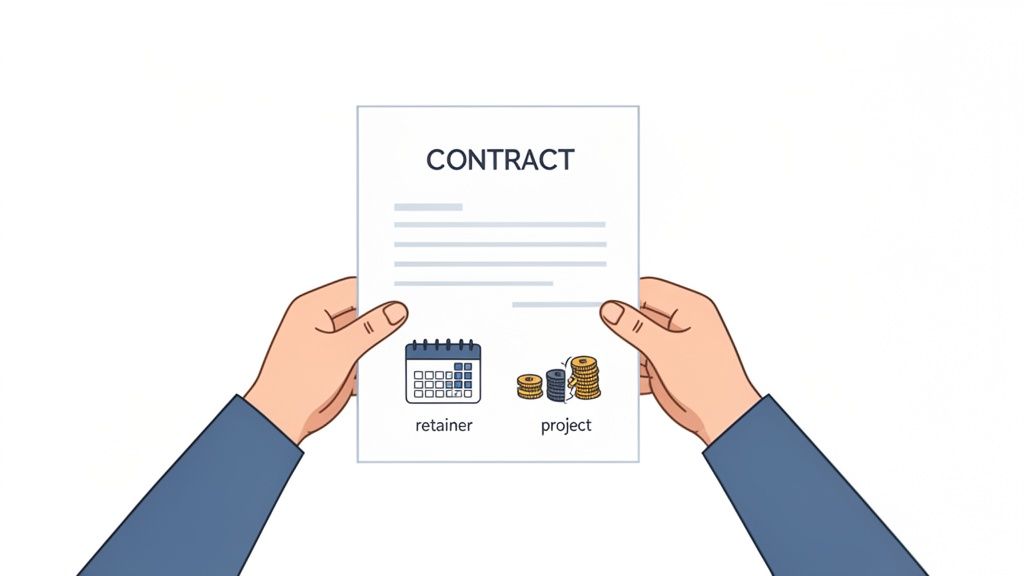
The right model comes down to your immediate goals. A retainer builds long-term strategic muscle, while a project tackles a specific, urgent business problem. Don't hesitate to ask about a hybrid approach that fits your unique situation.
Demystifying Pricing and Value
Here’s the thing: when you hire a fractional CMO, you're not just buying hours—you're investing in outcomes. This is about driving revenue, not just trimming costs.
In fact, companies with fractional CMOs have seen 29% higher revenue growth and a 3x improvement in marketing ROI. The right engagement structure helps you get there by tying what you pay to real business growth.
To make sure you’re getting the most from this investment, you have to know your numbers inside and out. Our guide on marketing budget allocation best practices can help you build the right financial framework for the engagement.
Key Terms to Include in Your Contract
Your contract is more than a legal document; it’s the blueprint for your partnership. A good agreement leaves zero room for misinterpretation. When you're mastering contracting with suppliers like a fractional CMO, every detail matters.
Make sure your agreement clearly nails down these essentials:
- Scope of Work (SOW): This is the heart of the contract. It needs to detail the specific responsibilities, deliverables, and objectives the CMO is accountable for. Get granular here to avoid scope creep later.
- Communication Protocols: How often will you meet? What's the expected response time for emails? Defining these norms upfront keeps the collaboration smooth and frustration-free.
- Performance Metrics (KPIs): Go back to the mission you defined earlier. The contract should list the exact key performance indicators that will be used to measure whether this engagement is a success.
- Termination Clause: A clear exit strategy is just smart business for both sides. The clause should specify the notice period and the terms for ending the engagement if things aren't working out.
- Confidentiality and IP: This is standard but absolutely critical. This section protects your business information and clarifies who owns any intellectual property created during the engagement.
Common Questions When Hiring a Fractional CMO
Even after you've found the right person and hammered out the contract, a few questions are bound to pop up. That’s perfectly normal. Bringing on a fractional CMO is a big move, and it's smart to think through how this new partnership will actually play out day-to-day.
Let's walk through some of the most common questions I hear from founders at this final stage. Getting these sorted out now will help you kick things off with confidence and set everyone up for a win right from the start.
How Quickly Should I Expect to See Results?
This is the big one, and the honest answer is: it really depends on where you're starting from. A fractional CMO isn't a magic wand, but they are absolutely an accelerator. You should feel an immediate impact in terms of clarity, direction, and strategic focus within the first 30 days.
During that initial month, a great fractional CMO is in full diagnostic mode—digging into the data, talking to your team and customers, and building a prioritized roadmap.
Here’s a realistic timeline for tangible results:
- First 30 Days: Expect a complete diagnostic, a clear strategic roadmap, and a handful of "quick wins" to get some momentum going.
- 30-90 Days: The new strategy starts to take hold. You should see improvements in foundational metrics like lead quality, funnel conversion rates, or messaging clarity. This is the "engine-building" phase.
- 90+ Days: This is where you begin to see a measurable impact on bigger business outcomes—things like pipeline growth, customer acquisition cost (CAC), and marketing-sourced revenue.
Remember, the goal isn't just a quick sugar rush; it's about building sustainable growth. A fractional CMO builds the engine, tunes it, and then teaches your team how to keep it running smoothly. The early work is all about getting those foundations right for long-term success.
How Do They Integrate with My Existing Team?
Bringing an outside leader into an established team can feel tricky, but any seasoned fractional CMO has navigated this dozens of times. Their job is to be a leader and a mentor—not a disruptor who steps on toes. A good one makes your existing team better, period.
From day one, their job is to:
- Listen and Learn: They'll spend a ton of time upfront understanding your team’s strengths, weaknesses, and how they get work done today.
- Provide Strategic Direction: They give your team the "why" behind the "what," connecting daily tasks to the bigger business goals. This is incredibly empowering for junior marketers and helps them grow.
- Unblock and Empower: A huge part of their role is simply removing roadblocks. That could be getting a budget approved, helping select the right martech, or having the authority to kill projects that just aren't working.
The integration is a success when your team feels supported and energized, not micromanaged. A great fractional leader elevates the entire marketing function.
How Do We Measure the ROI of This Engagement?
Measuring the return on your investment starts with the mission you defined before you even started looking. The KPIs you both agreed on in the contract? That's your primary scorecard.
Your fractional CMO should be obsessed with tracking and reporting on these metrics. The reporting shouldn't be a fluffy slide deck filled with vanity numbers; it needs to be a clear, data-driven story that connects marketing activity directly to business outcomes.
You should be looking at reports that clearly show progress on metrics like:
- Pipeline Velocity: Are leads moving through the funnel faster?
- Customer Acquisition Cost (CAC): Is it getting cheaper to acquire new customers?
- Marketing-Sourced Revenue: How much actual revenue can you tie directly back to marketing's efforts?
When you hire a fractional CMO, you’re investing in a revenue driver. They need to be able to show you—clearly and consistently—how their strategic guidance is turning your marketing spend into profitable growth. If you can’t see the financial impact, the engagement isn't working.
Ready to bring in senior marketing leadership that drives real growth? Value CMO provides B2B tech startups with experienced, on-demand CMOs who build and execute focused, data-driven marketing roadmaps.