A go-to-market strategy isn't just another plan; it's your actual roadmap for finding those first crucial customers and carving out a real competitive edge. Think of it less like a static document you file away and more like your launch playbook.

Why Most Startup Go To Market Plans Fail
Let's be real for a second. The typical go-to-market plan is a 50-page slide deck that gets presented once, tucked away in a folder, and never sees the light of day again. It feels like you're doing something productive, but it's really just an academic exercise that falls apart the moment it meets the real world.
And this is where most startups go completely sideways.
They build in a bubble, totally convinced they know what their customers want. They cook up a “perfect” plan based on hunches and assumptions instead of cold, hard evidence. The result is almost always the same: a pile of burned cash, a team that's lost its spark, and a massive missed opportunity.
The Real Cost of a Bad Launch
A flawed launch isn't just a little stumble; for a young company, it can be a fatal blow.
The fallout goes way beyond a few disappointing numbers on a dashboard. A failed go-to-market push incinerates your most precious resource—time. Every dollar you spend on the wrong marketing channel or every week you sink into messaging that doesn't land is a week you can't ever get back. This is how promising products with tons of potential die on the vine. You can see just how easily these mistakes happen by looking at these common B2B marketing fails, which almost always start with a shaky GTM foundation.
The human cost is just as high. Nothing sucks the energy out of a team faster than pouring their hearts into a launch that lands with a thud. Morale plummets, momentum grinds to a halt, and your best people start quietly updating their LinkedIn profiles.
A Better Approach: Momentum Over Perfection
This guide is for founders living in the beautiful chaos of startup life. We’re tossing out the rigid, theoretical GTM model and swapping it for a practical, sprint-based framework that actually works.
The goal here isn't a flawless plan. It’s about building forward momentum by learning fast and taking focused, decisive action.
A great go-to-market strategy is less about having all the answers upfront and more about building a system to find the right answers quickly.
We're going to zero in on the four pillars that actually drive a successful launch for B2B tech startups:
- Radical Alignment: Getting your entire leadership team on the exact same page about who you're selling to and why they should care—down to the very words you'll use.
- Smart Validation: Testing your messaging, channels, and pricing with low-cost experiments before you start writing the big checks.
- Phased Roadmap: Breaking your launch into bite-sized sprints—pre-launch, launch, and post-launch—to de-risk the whole process and stack up compounding wins.
- Intelligent Measurement: Building a simple dashboard to track the handful of metrics that truly matter, so you can double down on what’s working and kill what isn’t.
Aligning Your Team and Defining Your Ideal Customer
Before you even dream about ad spend, content calendars, or sales emails, your first and most critical move is radical team alignment. A strong go-to-market strategy doesn’t kick off with a marketing plan; it starts with a shared understanding across your entire leadership team.
Product, engineering, sales, and marketing absolutely have to be working from the same playbook, aiming at the exact same target.
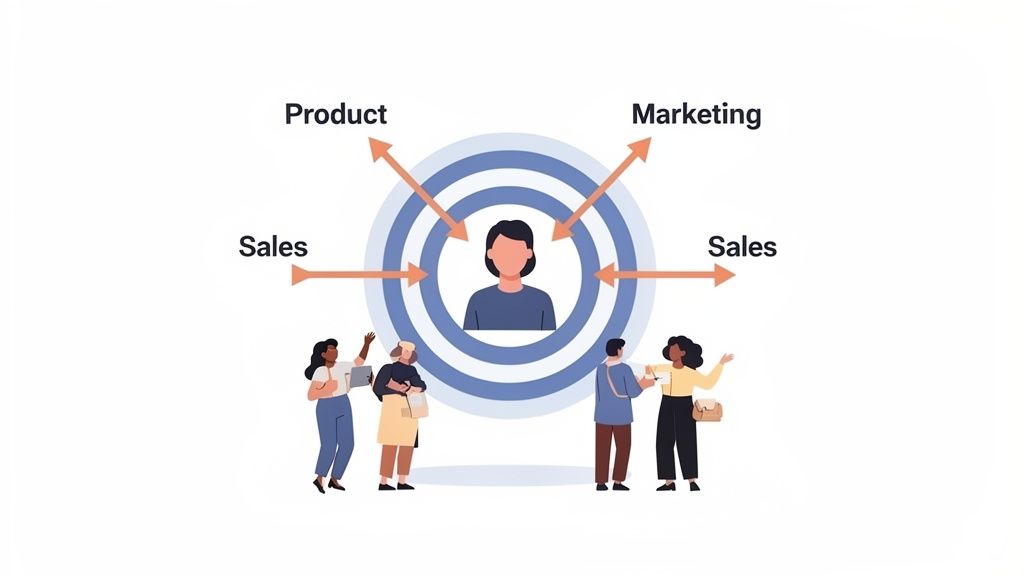
This isn’t about a one-and-done meeting. It’s about building a “shared brain” for the company—a single, unified vision of who you serve and why they should give a damn.
When your Head of Product and Head of Sales can both describe your ideal customer using the exact same words, you’ve struck gold. This initial clarity is the firewall that protects you from wasting money, chasing leads who will never buy, and building features nobody wants.
Without it, you get silos. Marketing generates leads that sales can't close. Sales promises features that product can't build. Everyone is working their tails off, but they’re all pulling in different directions. The whole thing is inefficient and incredibly expensive.
Moving Beyond Basic Demographics
The foundation of this alignment is your Ideal Customer Profile (ICP). But let's be crystal clear: a real ICP is so much more than a list of stats like company size, industry, or employee count. That's just the starting line.
A powerful ICP digs into the human stuff—the psychographics, the motivations, and the frustrations that actually drive people to buy. You need to know your customer so well that you can describe their problems better than they can.
A great ICP isn't a document you create; it's a deep understanding you cultivate. It’s the difference between saying "We sell to mid-sized tech companies" and "We sell to VPs of Engineering at Series B fintechs who are losing sleep over developer productivity and compliance risks."
To get there, your leadership team needs to sit down together and hammer out the answers to some tough questions.
- Pain Points: What is the specific, burning pain that keeps them up at night? What happens if they don't solve this problem?
- Triggers: What event or shift inside their company makes them start looking for a solution like yours right now?
- Desired Outcomes: What does success look like for them, both professionally and personally, after using your product?
- Jobs to Be Done: What functional "job" are they hiring your product to do? Think about it this way: people don’t buy a drill; they buy a hole in the wall.
This isn't just a box-checking exercise; it’s a strategic must-do. The data paints a clear picture: this kind of disciplined planning is directly linked to launch success. Companies that actually formalize their go-to-market approach and define their ICP see way better outcomes.
Structured GTM frameworks are associated with roughly 10% higher success rates and revenue growth up to 3 times greater than their peers who wing it. This upfront work directly cuts down on wasted ad spend and makes your conversions more efficient, making your launch far more capital-efficient.
Facilitating the ICP Conversation
Getting everyone in a room to build this shared understanding is everything. Your goal is to guide a structured conversation that takes you from broad assumptions to specific, actionable insights.
Here’s a simple framework to lead that chat.
Kickstart Your ICP Workshop with These Prompts:
- Who feels the pain most acutely? Pinpoint the exact role or department that lives with the problem you solve every single day.
- Who holds the budget? Identify the economic buyer who has the power to sign on the dotted line.
- What does their day look like? Map out their responsibilities, the tools they use, and the meetings they have to sit through.
- Where do they get their information? List the blogs, podcasts, newsletters, and communities they actually trust. This is your future channel list.
- What are their biggest objections? Brainstorm every single reason they might say "no" to your solution.
Writing down these answers creates a living, breathing profile that should guide every single decision you make, from the words on your website to the features on your product roadmap.
For a more detailed guide and a practical framework, you can grab an ideal customer profile template to structure this process effectively. This isn't just about dodging mistakes; it's about building a predictable engine for growth from day one.
Crafting a Message That Actually Resonates
You’ve nailed down your Ideal Customer Profile (ICP). Awesome. Now comes the part where most founders trip up: turning that knowledge into a message that actually gets a response.
A solid go-to-market strategy lives or dies right here. This is the bridge between knowing who you’re talking to and knowing what to say to make them stop, listen, and actually care.
So many startups lead with features, spewing technical jargon because they're in love with their own product. Newsflash: your customers aren't. They don't buy features; they buy solutions. They buy a better, less stressful, more profitable version of their future. Your job is to paint that picture for them.
From Features To Benefits
Here’s a simple way to think about it: A feature is what your product does. A benefit is what your customer gets. That’s it.
Your messaging has to live entirely in the world of benefits. Don't say, "Our platform uses a proprietary AI algorithm." Instead, say, "Our platform cuts invoicing errors by 90%, so you get paid faster and stop wasting weekends fixing mistakes."
See the difference? One is a boring technical detail. The other is a career-making outcome.
To get there, list your top three to five features. For each one, ask yourself the most important question in marketing: "So what?"
- Feature: Real-time data synchronization. So what?
- Benefit: The whole team is always working from the most current info, which means no more costly rework. So what?
- Value Prop: We guarantee project accuracy so you can deliver on time and on budget, every single time.
This exercise is non-negotiable. It forces you to stop speaking your language and start speaking your customer’s.
Building Your Core Message
Once you've mapped out your benefits, you can build your core value proposition. This is your single, compelling promise. It needs to instantly answer the question every prospect is thinking: "Why should I care about you over everyone else?"
A great value prop is sharp, specific, and laser-focused on the pain you solve. It's not a fluffy slogan like "We empower businesses." It’s a direct hit like, "We're the only compliance automation platform for fintechs that cuts audit prep time from three weeks to two days."
Your message isn't validated until a stranger is willing to give you their time or money based on it. Until then, it’s just a hypothesis.
Now it's time to get that hypothesis out of your office and see if it has a pulse.
Low-Cost Validation Before You Scale
The fastest way to torch your runway is to build a massive campaign on top of an unproven message. Just don't do it. Before you spend big, you need to validate your positioning with cheap, fast experiments designed for one thing: learning.
The goal here isn't to close deals; it's to gather hard proof of what works.
Simple Validation Tests You Can Run This Week:
- LinkedIn Messaging: Write two different connection requests—one for each value prop you're testing. Send 50 of each to your ICPs. Track the reply rates. The winner will be obvious.
- Landing Page Variations: Spin up two simple landing pages. One can push speed, the other cost savings. Drive a tiny amount of traffic—say, $200 in ads—to both. Which one gets more sign-ups?
- Cold Email: Pick 20 target accounts. Send personalized emails testing different pain points in the subject line and opening sentence. Your only goal is to see which version books more meetings.
These tests are all about collecting data. And to really dial things in over time, consistent A/B testing should become a core part of how you operate.
Tackling The Pricing Puzzle
Right alongside your messaging, you have to validate your price. This isn't something you figure out later; pricing is a critical part of your positioning. Get it wrong, and you could kill your launch before it even gets off the ground.
Start by looking at what your competitors charge. This gives you a ballpark, but do not just copy them. Instead, anchor your price to the value you deliver. If your solution saves a client $50,000 a year, a $5,000 price tag suddenly feels like a steal.
You don't need a public pricing page right away. Use your early sales calls as a testing ground. Present different packages and just watch their reaction. You're looking for that sweet spot where the price feels fair for the value you're providing—a true win-win for you and your first customers.
Building Your Phased Launch Roadmap
Trying to pull off a massive, "big-bang" launch is one of the quickest ways for a startup to light its funding on fire. It's a high-risk, high-stress gamble that leaves zero room for error or learning.
A much smarter approach? Think like a product manager—build, measure, learn, and iterate.
Instead of one giant leap, we'll break your launch into a series of focused, manageable sprints. This phased roadmap is designed to build momentum, de-risk the process, and let you make smart decisions based on real-world data, not just what you think will happen. The goal here is to stack small wins that add up over time.
This simple loop—define, test, validate—is the heart of the entire process. You’ll run this play over and over again.
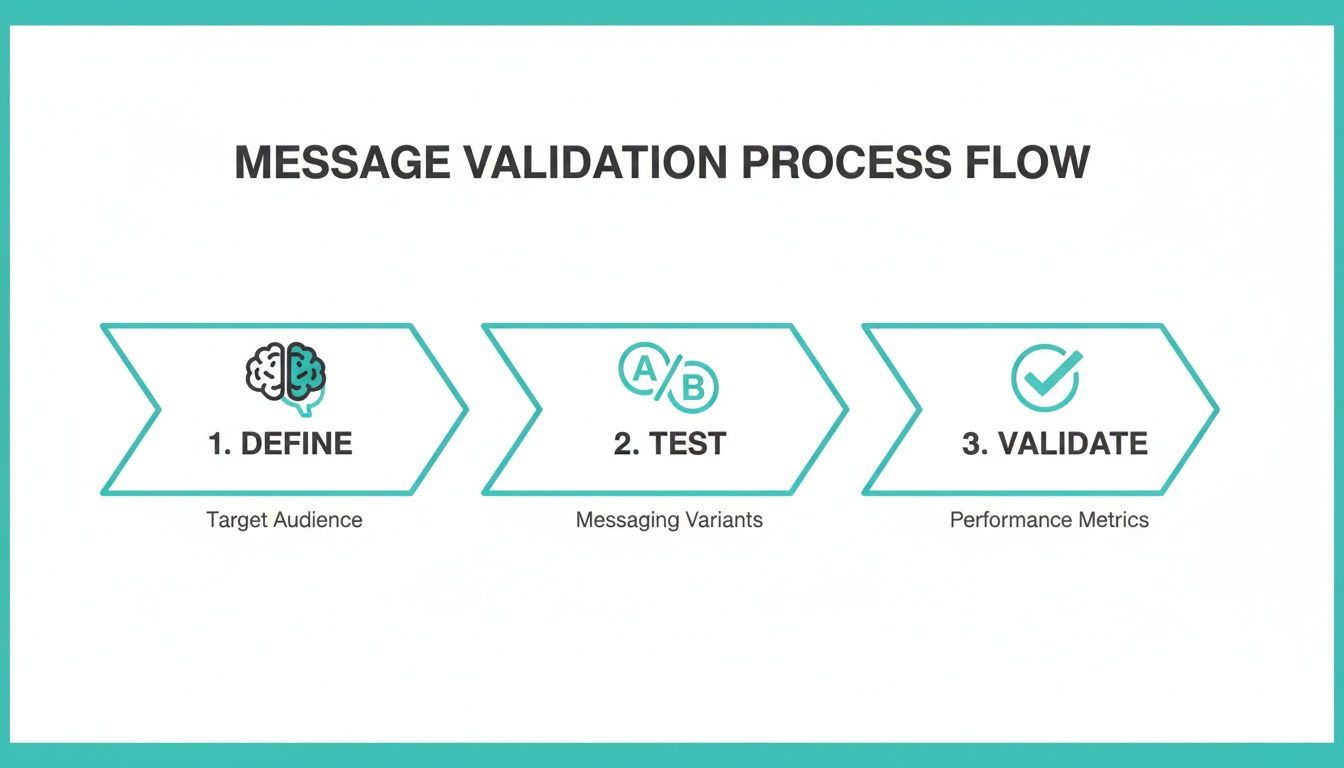
Each phase of the roadmap follows this rhythm, making sure your plan stays grounded in what customers actually want, not what you think they want.
The Pre-Launch Phase: Building Anticipation
The pre-launch phase is all about warming up the engine. Your main goal here is to build an initial audience and see if people are actually interested before your product is even widely available. This isn't about shouting from the rooftops; it's about focused, quiet execution.
Think of it as recruiting your "first tribe" of potential fans. You're just looking for early signs that you're on the right track.
Your Pre-Launch Checklist:
- Create a "Coming Soon" Landing Page: This is your home base. It needs a crystal-clear value prop and a single, obvious call to action to join a waitlist or ask for early access. No clutter.
- Secure Your First Beta Users: Manually reach out to 10-20 companies straight from your Ideal Customer Profile list. Offer them free, early access in exchange for painfully honest feedback and a future testimonial.
- Start Seeding Content: Begin sharing your point of view on one or two social channels where your ICP actually hangs out (like LinkedIn or a specific Substack). This isn't about selling; it's about starting conversations and showing you know your stuff.
The pre-launch isn't about making a big splash. It’s about creating ripples. The feedback you get from your first handful of beta users is infinitely more valuable than traffic from a thousand anonymous visitors.
The Launch Phase: Focused Execution
Now it’s time to open the doors. But "launch" doesn't mean you flip on every marketing channel you can think of. It means you execute with surgical precision on the one or two channels you've already identified as having the most promise.
If your validation tests showed LinkedIn outreach was a winner, you double down on it. If a specific niche community responded well, you go all-in there. The key here is focus. Spreading your limited resources too thin is a recipe for getting lost in the noise.
Your main goals here are to drive those first sign-ups, gather powerful testimonials, and generate your first case studies. These pieces of social proof are the fuel for your next phase of growth.
The Post-Launch Phase: Analyze and Amplify
Your launch isn't a one-day party; it's the starting line for a continuous process. The post-launch phase is where the real work of building a scalable growth engine begins. It’s a cycle of looking at the data, learning what's truly working, and then amplifying your successes.
During this time, you should be obsessively tracking a handful of key metrics.
- Conversion Rate: What percentage of visitors or leads are actually turning into active users or paying customers?
- Customer Acquisition Cost (CAC): How much are you spending to get one new customer through each specific channel?
- User Engagement: Are people actually using your product? Where are they getting value, and where are they getting stuck?
The data tells the story. Your job is to listen and act. If one channel is delivering customers with a low CAC and high engagement, it's time to pour more resources into it. If another is just generating pretty numbers but no real business, it's time to cut it loose.
This ruthless prioritization is how lean startups outmaneuver their larger competitors and build a GTM strategy that actually gets results.
Using Automation And AI To Accelerate Growth
For a lean startup, doing everything by hand isn't just slow—it's a direct threat to your survival. Your go-to-market strategy has to be built for leverage, allowing a small, focused team to punch way above its weight. This is where automation and AI stop being a "nice-to-have" and become a core part of how you get things done.
This isn't about chasing the latest AI shiny object. It's about building a practical, repeatable system that frees up your team’s brainpower for the stuff that actually moves the needle, like closing deals and talking to customers.
The goal is simple: automate the predictable so you can dominate the unpredictable.
Practical AI And Automation Plays
Let’s get specific. Instead of thinking you need to hire three more sales reps, what if you could build an automated engine that does the heavy lifting? That would let one person manage the entire process, from outreach to qualification.
Here are a few high-impact examples I've seen work time and again:
- Content Ideation and Creation: Use AI tools to see what your competitors are writing about, find keyword gaps, and spit out detailed outlines for blog posts or social updates. This turns a week-long research project into a 30-minute task.
- Targeted Lead List Generation: Stop manually scraping LinkedIn. Use AI-powered sales intelligence platforms to build hyper-targeted lists of your ICP based on real-time signals, like a company's recent funding round, a key new hire, or the tech they just started using.
- Automated Nurture Sequences: The second a lead downloads your ebook or signs up for a webinar, they should drop right into an automated email sequence. This engine works 24/7 to educate them, build trust, and qualify their interest—all without anyone lifting a finger.
For startups ready to get practical, exploring the right toolkit is key. Check out the 12 Best AI SEO Tools to Dominate Search to find platforms that can give your GTM a serious edge.
The Essential GTM Tech Stack For Startups
You do not need a massive, enterprise-grade tech stack. In fact, that's a recipe for disaster—too much cost, too much complexity. The real key is to start with a few flexible, affordable tools that solve today's problems and can grow with you.
Your foundational GTM stack really only needs three things:
- A Lightweight CRM: This is your single source of truth for every customer interaction. Don't overcomplicate it. A tool like HubSpot's free CRM or Pipedrive is more than enough to track deals, manage contacts, and keep your sales process from turning into complete chaos.
- A Marketing Automation Platform: This is the engine that powers your nurture sequences, email campaigns, and lead scoring. Many CRMs have this built-in, but dedicated tools can offer more firepower. For a clear-headed approach, this step-by-step guide on how to implement marketing automation lays out the entire process.
- Analytics and Measurement Tools: You have to know what's working. Google Analytics is non-negotiable for web traffic, but also look at tools that give you heatmaps or session recordings. They help you see why users are doing what they're doing.
Choose tools that are 80% right for your needs today, not 100% right for a future you can't predict. The cost of complexity is far higher than the cost of switching tools later on.
This lean approach is exactly how a small, smart team can outmaneuver bigger, better-funded competitors. You're not trying to match their budget; you're trying to beat them with speed and efficiency.
A Few Common GTM Questions, Answered
Even with a solid roadmap, you're bound to have questions. Building a go-to-market strategy from scratch always brings up a few tricky spots. Let's walk through the most common ones I hear from founders so you can make these calls with more confidence.
How Much Should We Actually Budget for This?
This is the big one, and the honest-to-goodness answer is: it depends. You’ll hear benchmarks thrown around, like setting aside 40% to 60% of your seed or Series A funding for your GTM. But that's a blunt instrument. A much smarter way to think about it is budgeting by milestone.
Let’s break it down into two phases.
- Your Validation Budget: Start small and scrappy. Put aside a tight budget of maybe $5,000 to $15,000 with a single goal: find one repeatable marketing channel and nail your messaging. The mission here is to learn, not to scale.
- Your Scaling Budget: Once you’ve proven a channel can bring in customers at a healthy Customer Acquisition Cost (CAC), then you can open up the checkbook. Now you have a reason to pour fuel on the fire, because you know where the fire actually is.
This approach keeps you disciplined. It ties every dollar you spend directly to results and stops you from burning cash on things that might work. Your budget becomes a reaction to success, not a blind bet.
When Should We Hire a Full-Time Marketing Lead?
Hiring your first marketing VP is a huge commitment, and getting the timing right is critical. Jump the gun, and you're paying a senior salary for someone to run a strategy that doesn't exist yet. Wait too long, and you, the founder, become the bottleneck holding back growth.
For most early-stage companies, a fractional CMO is the perfect bridge. You get the high-level strategic thinking you need to build the foundation—ICP, messaging, tech stack, and those first channel tests—without the full-time cost and commitment.
The right time to bring in a full-time marketing leader is after your GTM strategy is validated. That means you have a predictable stream of leads coming from at least one or two proven channels.
At that point, you need an operator—someone to manage the day-to-day, optimize what’s working, and start building out the team. Think of it this way: the fractional expert designs and builds the engine; your first full-time hire is the one who runs it and tunes it for scale.
What Are the Biggest GTM Mistakes B2B Startups Make?
I’ve seen dozens of startups go through this process, and a few painful—and expensive—mistakes pop up again and again. Just knowing what they are is half the battle.
The absolute worst error is trying to scale a marketing channel before you have product-market fit. Founders see a few good-looking metrics, get excited, and dump money into ads or content. But if the core product isn't quite right or the messaging is off, they’re just pouring water into a leaky bucket. Churn goes through the roof, and the cash is gone.
Another classic blunder is failing to get sales and marketing on the same page from day one. When those teams operate in their own little worlds, you get friction. You get finger-pointing. And you get a whole lot of wasted leads and lost deals.
Finally, too many startups get lazy with their Ideal Customer Profile. They keep it vague, hoping to appeal to everyone. The result? Their messaging resonates with no one. It’s the equivalent of shouting into a hurricane and hoping someone hears you.
Ready to build a go-to-market strategy that actually drives revenue? Value CMO provides the senior marketing leadership B2B tech startups need to clarify their strategy, align their teams, and build a predictable growth engine—all without the cost of a full-time executive. Get the expert guidance you need to accelerate your launch at https://valuecmo.com.