A go-to-market strategy for a SaaS business is your complete game plan for launching a product and getting it into the hands of the right people. Think of it less like a dry checklist and more like a living playbook that gets your product, marketing, sales, and customer success teams all singing from the same hymn sheet. It’s the single source of truth for who you're helping, what you're saying, and how you're going to sell.
This strategic alignment is what separates the SaaS companies that scale predictably from the ones that just throw spaghetti at the wall hoping something sticks.
What a Modern SaaS GTM Strategy Actually Looks Like

Let's cut through the jargon. At its core, a go-to-market (GTM) strategy is your business's story. It’s the narrative that explains exactly how your unique solution finds its way to the people who are desperate for it. Forget about those dusty, static slide decks you build once and then forget. A modern SaaS GTM is a dynamic system built for one thing: driving predictable revenue.
This isn't a one-off project. It's a continuous cycle of learning, testing, and adapting to what the market tells you. For a deeper dive into the nuts and bolts, this comprehensive guide to go-to-market strategy is a great starting point. The goal is to build an engine for sustainable growth, not just a map for a single trip.
The Four Pillars of a Strong GTM Plan
I like to think of a GTM strategy as a structure held up by four core pillars. When these are solid and working together, your business has a clear path forward. But if one is weak, the whole thing starts to feel wobbly.
- Market & ICP Definition: This answers the most fundamental question: "Who are we actually helping?" This goes way beyond basic demographics. It’s about deeply understanding the pain points, goals, and day-to-day realities of your Ideal Customer Profile (ICP).
- Value Proposition & Positioning: This clarifies, "Why should they choose us over anyone else?" It’s all about articulating your unique value in a way that truly resonates with your ICP, making you the obvious choice in a sea of competitors.
- Pricing & Packaging: This is where you figure out, "How will we capture the value we create?" Your pricing needs to directly reflect the value you deliver while also aligning with how your target market is used to buying software.
- Channels & Sales Motion: This defines, "How will people find us and buy from us?" This covers the specific marketing channels you'll use to build awareness and the sales process that efficiently turns interested prospects into happy, paying customers.
To make this even clearer, here’s a quick breakdown of how these pillars fit together.
Core GTM Strategy Components at a Glance
| Component | The Core Question It Answers |
|---|---|
| Market & ICP Definition | Who are we actually helping with our product? |
| Value Proposition & Positioning | Why should they choose us over the competition? |
| Pricing & Packaging | How will we capture the value we're creating for them? |
| Channels & Sales Motion | How will they find us, and how will they buy from us? |
Nailing these four areas ensures every team is working from the same playbook.
A structured GTM plan does more than just organize your launch; it tightens execution across every customer-facing team. When marketing, sales, and product are operating from the same playbook, you reduce customer acquisition costs, increase lead velocity, and build a foundation for sustainable scale.
Finding Your People Through a Human-Centered ICP

Every solid go-to-market strategy for SaaS hinges on a single, make-or-break question: who are we really helping?
Get this wrong, and every dollar you spend on marketing and sales is a shot in the dark. Get it right, and your entire GTM plan just clicks into place. This is where we stop talking about abstract markets and start building an Ideal Customer Profile (ICP) that feels like a real person.
Too many founders define their ICP with vague firmographics like “mid-market tech companies in North America.” That’s not a profile; it's a phone book. A powerful ICP digs into the human element—the world from their perspective.
What keeps them up at night? What does a huge 'win' look like in their specific role? And most importantly, how does your SaaS product become their secret weapon for achieving that win?
Beyond Demographics to Daily Realities
Building an ICP that actually works means uncovering the real motivations, pains, and goals that drive your future customers. This isn't about guessing in a conference room; it's about gathering real-world intelligence.
It’s the difference between targeting a "Marketing Manager" and targeting "Jen, a Marketing Manager at a Series B startup who's overwhelmed by manual reporting and terrified of presenting inaccurate data to her CEO." See the difference?
Here are a few practical ways to get inside their heads:
- Analyze Your First Ten Customers: If you have them, your first users are a goldmine. Look for common threads in their industry, company size, the specific problem they hired you to solve, and the exact language they used to describe it.
- Conduct "Jobs-to-be-Done" Interviews: This framework shifts the focus from who the customer is to what they are trying to accomplish. Ask open-ended questions like, "Tell me about the last time you struggled with [the problem your SaaS solves]." Then just listen.
- Listen to Sales and Support Calls: Your customer-facing teams hear the unfiltered voice of the market every single day. They know the objections, the pain points, and the "aha!" moments that lead to a sale.
An ICP is more than a targeting filter for your ad campaigns. It's a strategic compass that should guide your product roadmap, your messaging, your pricing, and your sales motion. When you know exactly who you're building for, difficult decisions become surprisingly clear.
Differentiating the User, the Buyer, and the Champion
In B2B SaaS, you're almost never selling to a single person. A successful sale means navigating a buying committee with very different priorities. Mistaking the daily user for the budget-holder is a common and costly error.
Understanding these key players is vital for mapping out the market you can realistically win.
- The User: This is the person who will be in your software every day. Their primary concern is functionality and ease of use. Does your product make their job easier or harder?
- The Buyer: This individual holds the budget and signs the contract. They care about ROI, security, and how your solution aligns with broader business objectives. They might never even log into your platform.
- The Champion: This is your internal advocate. They're often a user or team lead who feels the pain most acutely and is willing to stick their neck out to bring your solution into the organization. Your primary marketing goal is to find and empower this person.
Once you have a handle on these roles, you can start building out a complete picture. If you're looking for a structured way to pull this all together, our guide on crafting an Ideal Customer Profile template is a fantastic starting point. It helps you organize your findings into an actionable document your entire team can actually use.
This human-centered approach ensures your go-to-market strategy for SaaS is built on a foundation of genuine customer understanding, not just abstract data points.
Crafting Your Message and Value Proposition
Once you know exactly who you're talking to—that laser-focused ICP we just defined—it's time to figure out what to say. This is where your GTM strategy shifts from research to creativity. It’s all about crafting a value proposition that cuts through the noise and actually connects with a real human.
So many B2B SaaS companies fall into the trap of selling features. They lead with the "what" of their product—"we offer AI-driven analytics dashboards" or "our platform has 150+ integrations." But here's the thing: your ideal customer doesn't buy features. They buy a better version of themselves.
Your messaging has to make a clear, compelling case for why your product matters right now. It needs to draw a straight line from your solution to an urgent pain point or a deeply desired outcome your ICP is trying to solve today.
From Features to Feelings and Outcomes
Think about the SaaS brands that have really broken through. Slack doesn’t just sell "a real-time messaging platform." They sell a more productive, less email-choked workday. Miro isn’t selling "an online collaborative whiteboard." They’re selling the feeling of being in the same room with your team, sparking ideas from anywhere.
That shift from features to outcomes is everything.
Here’s a great way to stress-test your own messaging: can your sales reps explain why a customer should buy this, and why now, in under 20 seconds without listing a single feature?
- Feature: "Our software automates invoicing."
- Benefit: "You get paid faster and spend less time chasing down clients."
- Outcome: "You can reinvest an extra 10 hours a week back into growing your business instead of getting bogged down in admin."
That's the journey. Your messaging has to move from the technical to the tangible and, finally, to the transformational. A solid pitch deck is often the final product of a well-honed value proposition. Learning from a successful SaaS bootstrapping strategy that hit major ARR milestones can show you exactly what resonates with investors and early customers.
A Simple Framework for Testing Your Message
You don’t need a massive budget to see if your messaging works. Before you pour a single dollar into a marketing campaign, you have to make sure your value proposition actually lands.
Your first draft of messaging is almost always wrong. The goal isn't to be perfect out of the gate; it's to create a testable hypothesis and let your ICP tell you what’s right. Getting this feedback early is the cheapest and fastest way to find a message that sticks.
Start small and be methodical.
- Craft 2-3 Messaging Pillars: Based on your ICP's pain points, develop a few core value statements. One might be about speed ("cut reporting time in half"), another on cost savings ("reduce software spend by 30%"), and a third on team alignment ("get everyone on the same page").
- Test with Friendly Fire: Run your messaging by your sales and customer success teams first. Seriously. If they wouldn't feel confident using it on a call, your customers definitely won't buy it. Their feedback is a critical first filter.
- Run Micro-Campaigns: Use these pillars as hooks in small-scale tests. We're talking a few hundred dollars in LinkedIn ads or a targeted cold email sequence to a small list. Measure engagement signals like click-through rates, but pay closer attention to demo conversion rates. The message that books more meetings is your winner.
This iterative process ensures your go-to-market strategy for SaaS is built on proven communication, not just what you think sounds good internally. For a more structured approach, our detailed guide on how to create a value proposition that truly connects can help you nail down the tangible outcomes that make your solution the only logical choice.
Choosing Your Growth Engine and Sales Motion
You’ve got your ideal customer nailed down and a message that resonates. Now for the million-dollar question: how will people actually find and buy your product? This is where you pick your growth engine, the core model that will drive every single customer you acquire. It's a foundational choice that shapes your product, your team, and your budget.
It all boils down to one simple thing: does your product sell itself, or does it need a human conversation to get a deal across the line? Your answer points you toward one of a few key paths.
Product-Led vs. Sales-Led Growth
The two heavyweight champs in SaaS growth are Product-Led Growth (PLG) and Sales-Led Growth (SLG). Most companies blend them eventually, but you almost always have to master one first.
-
Product-Led Growth (PLG): Here, the product does the heavy lifting. Think of tools like Calendly or Dropbox. Users sign up, get value, and upgrade to a paid plan without ever speaking to a person. This motion only works if your product is intuitive and delivers an "aha!" moment fast.
-
Sales-Led Growth (SLG): In this classic B2B model, a sales team is non-negotiable. They find, educate, and guide prospects through a complex buying journey. This is the only way to go for software with a high price tag, a complicated setup, or a long sales cycle. Think Salesforce or Workday.
Choosing your path isn't about chasing trends. It's a direct reflection of your product's complexity and your ICP’s buying habits. A simple, low-cost tool for small teams is a natural fit for PLG. A sophisticated enterprise compliance platform absolutely requires an SLG motion.
A huge mistake I see founders make is trying to force a PLG motion onto a product that isn’t built for it. If a user can’t get to a meaningful win in their first session, a self-serve model is just a recipe for high churn and frustration, not growth.
The data backs this up. A ChartMogul analysis of nearly 2,500 SaaS companies found that the fastest-growing B2B players hit 1,000 subscribers in just 11 months—less than half the median time of 24 months. The difference? The winners often had lower-priced, self-serve products where a sales team would just add friction.
Picking Your Primary Demand Generation Channels
Once you've picked your engine, you need to fuel it. This is where demand generation comes in, but the key is focus. Don't try to be everywhere at once. Your goal is to find one or two primary channels you can absolutely own before you expand.
Your channel strategy should flow directly from your ICP and price point. Where do your ideal customers hang out online? How do they research new tools?
This decision tree helps visualize whether you should lead with your product's features or its bigger-picture benefits—a crucial messaging choice that impacts your channel strategy.
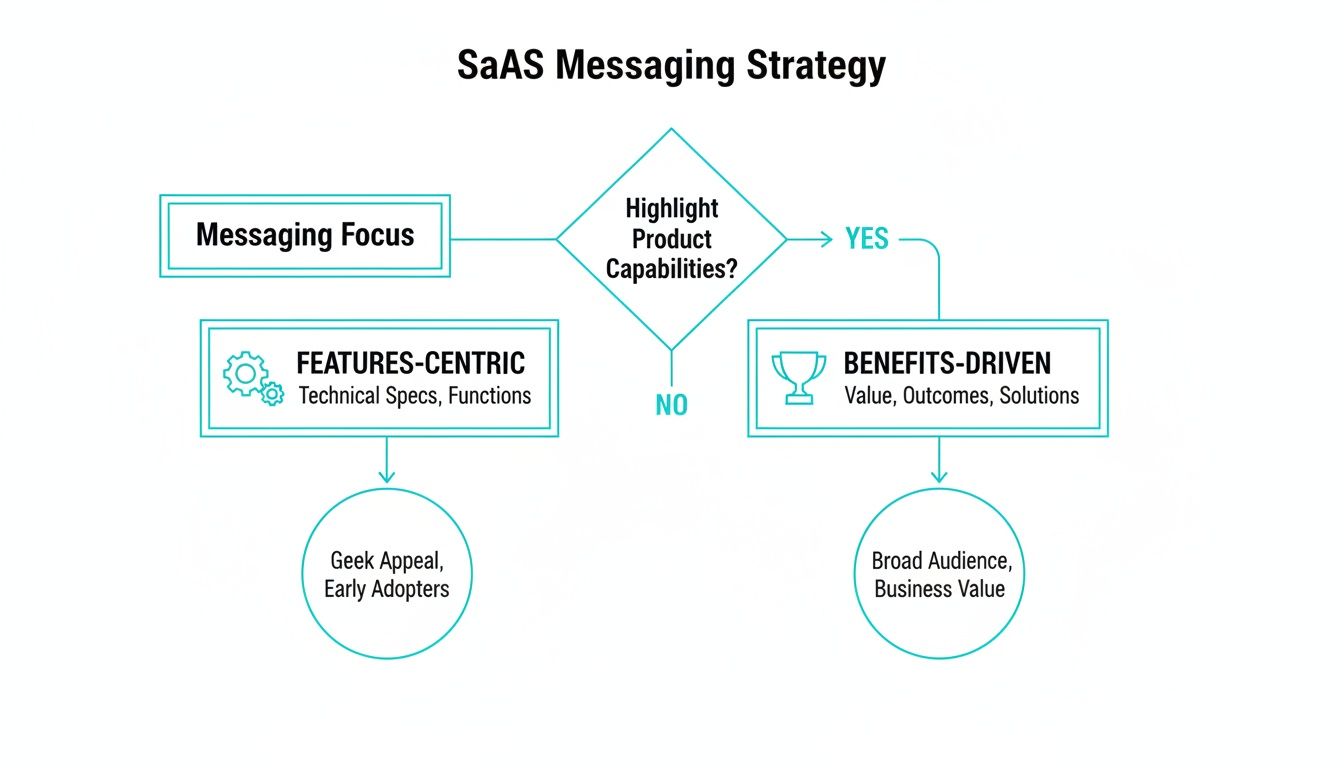
As the visual shows, a feature-heavy message is perfect for technical buyers who want to know how it works. A benefit-driven approach is what you need to persuade strategic decision-makers who care about the why.
Here’s a quick rundown of common channels and where they shine:
-
Content & SEO: This is the long game, perfect for products that solve problems people are actively Googling. It works beautifully for both PLG and SLG because it builds trust and attracts high-intent traffic. If your ICP does their homework online, SEO has to be on your radar.
-
Paid Acquisition (Search & Social): Need to spark demand now? If you have a good handle on your customer acquisition cost (CAC) and lifetime value (LTV), paid channels are a powerful way to get in front of niche audiences on platforms like LinkedIn or Google.
-
Partnerships & Ecosystems: This is all about tapping into other companies' audiences. Think integrations with tools your customers already use or co-marketing with businesses serving the same ICP. It's a killer way to borrow credibility and reach established communities.
-
Outbound Sales: For high-ticket, complex deals (the SLG playbook), a direct outbound motion is almost always essential. This means your Sales Development Reps (SDRs) are hitting the phones, emails, and LinkedIn to book meetings with key accounts.
Your go to market strategy for SaaS is only as strong as its weakest link. You have to align your product, your growth model, and your acquisition channels into one cohesive system. Pick the motion that fits your product’s DNA, then pour your resources into the channels that connect you directly with the people who need you most.
Measuring What Matters for Sustainable Growth
A go-to-market strategy without the right metrics is just an expensive guess. You can feel busy, you can launch campaigns, and you can generate noise, but you have no idea if any of it is actually building a sustainable business.
Forget the sprawling dashboards with dozens of vanity metrics. We're going to cut through the clutter and focus on the handful of numbers that truly diagnose the health of your GTM engine. This is about knowing, with confidence, whether your growth is efficient and repeatable.
There’s a reason the top-performing companies are religious about this. Industry analyses consistently show that companies with a documented GTM framework and strict metric discipline achieve 10% higher success rates and up to 3x greater revenue growth. SaaS businesses that obsess over their unit economics routinely outgrow their competitors by 20–30%. You can see more data on how structured GTM frameworks drive growth on salesmate.io.
The Three Bedrock SaaS Metrics
While you could track a hundred different data points, your GTM success really hinges on three core concepts. Get these right, and you'll have a crystal-clear view of your business.
-
Customer Acquisition Cost (CAC): This is the total cost of your sales and marketing machine to land a single new customer. It’s the ultimate report card for your GTM efficiency.
-
Lifetime Value (LTV): This is the total revenue you can reasonably expect from one customer over their entire time with you. It tells you what a customer is actually worth.
-
Net Revenue Retention (NRR): This one is a game-changer. NRR measures revenue growth from your existing customers, factoring in upgrades, cross-sells, and churn. It shows you if your product is sticky and if you're successfully expanding accounts.
The magic isn't in looking at these numbers in isolation; it’s about their relationship. A healthy, scalable SaaS model is built on a simple ratio: LTV should be at least 3x your CAC. If you're spending $1 to acquire a customer who will only ever be worth $1, you have a problem.
Building Your Basic GTM Dashboard
You don't need a fancy BI platform to get started. A simple spreadsheet or a basic dashboard in your CRM can serve as your single source of truth. The goal is clarity and honesty, not complexity.
Here's how to think about the core of your GTM dashboard.
Key SaaS Metric Formulas
| Metric | Simple Formula | What It Tells You |
|---|---|---|
| CAC | (Total Sales & Marketing Spend) / (Number of New Customers Acquired) | How much it costs to win a new customer. |
| LTV | (Average Revenue Per Account) / (Customer Churn Rate) | The total value a customer brings to your business over time. |
| NRR | ((Starting MRR + Expansion – Churn) / Starting MRR) x 100 | Whether your existing customer base is a growth engine or a leaky bucket. |
These formulas are your starting point for a data-driven go to market strategy for SaaS. They take the emotion and guesswork out of the equation and give you hard numbers to steer the ship.
If you want to go a level deeper, we’ve put together a full guide that breaks down the nuances. You can read more about the SaaS metrics that matter for your business for a more advanced perspective.
Your dashboard should give you an immediate, at-a-glance read on performance. Is CAC creeping up month after month? Your acquisition channels are losing steam. Is NRR below 100%? You have a retention issue that needs to be your top priority.
This data-first mindset turns your GTM plan from a static document into a living, breathing system. It helps you spot trouble early, double down on what’s working, and build a growth model that can actually last.
Your First 90 Days From Plan to Launch
Theory is one thing, but execution is what separates a strategy doc from actual revenue. A SaaS go-to-market plan isn't meant to sit on a shelf; it’s about doing the work. This is where we turn all that foundational research on your ICP, messaging, and channels into a focused, get-it-done 90-day launch roadmap.
Think of this as a flexible framework, not a rigid set of instructions. The goal here is to build momentum, learn fast, and pivot based on what the market is actually telling you.
Month 1: The Foundation Phase (Days 1-30)
Your first 30 days are all about getting your house in order before the launch. This month isn't about making a big marketing splash. It’s about making sure the structural integrity of your GTM plan is sound—the final gut-check before you start burning cash and resources.
By the end of this phase, everyone on the team should have absolute clarity and be fully aligned.
- Finalize Your ICP and Messaging: The time for debate is over. Lock in your Tier 1 Ideal Customer Profile and the core value prop. Every single person on the GTM team should be able to recite this in their sleep.
- Set Up Your Tech Stack: Get your CRM, analytics tools, and marketing automation platforms configured and talking to each other. You can't measure what you don't track.
- Create Your Initial Content Assets: Develop the bare-bones assets you need to go live. This might be a high-converting landing page, a one-page sales slick, and a short email nurture sequence.
Month 2: The Launch and Learn Phase (Days 31-60)
With the foundation poured, it's go time. This is when you activate your chosen channels and start generating your first leads. This phase is all about executing with precision, collecting that initial data, and absorbing your first real feedback from the market. Don’t aim for perfection; aim to learn.
Your primary objective is to validate your core assumptions with actual, living prospects.
This is not about boiling the ocean. Pick one or two primary channels and execute them well. Trying to be everywhere at once is a recipe for mediocrity and a wasted budget. The goal is signal, not noise.
For instance, if you’re betting on SEO, this is when your first cluster of blog posts goes live. If you’re running paid ads on LinkedIn, your first campaigns launch with a small, tightly controlled budget.
Month 3: The Iterate and Optimize Phase (Days 61-90)
The final 30 days of your initial launch are all about analysis and iteration. You should now have a small but incredibly valuable dataset on what’s hitting and what’s missing. It’s time to double down on what’s working and cut the dead weight.
This is the point where your go-to-market strategy stops being a static plan and becomes a living, breathing system.
- Analyze Early Campaign Data: Get into your dashboard. Which ad copy has the highest click-through rate? Which email subject lines are actually getting opened? Where are people dropping off in the funnel?
- Gather Customer and Sales Feedback: Talk to your sales team and, if you can, your very first customers. What messaging resonates on calls? What objections keep popping up? This qualitative feedback is pure gold.
- Refine and Plan for the Next 90 Days: Use what you’ve learned to adjust your messaging, targeting, and channel mix. These insights will help you build a much smarter, more informed plan for the next quarter.
SaaS GTM Strategy FAQs
Building and launching a SaaS product always kicks up a ton of questions. Let's tackle a few of the most common ones I hear from founders and marketing leaders.
How Should My GTM Strategy Adapt as My Company Grows?
Your first Go-to-Market strategy is all about one thing: finding product-market fit. As you scale, the mission changes to market penetration and expansion, and your playbook has to change with it.
Early on, you're probably relying on scrappy, direct outreach—maybe even founder-led sales. That's great for getting your first customers. But later, your strategy needs to layer in more scalable channels like SEO, paid acquisition, and partnerships.
The key is to let your customer data tell you where to go next.
- From Founder-Led to a Real Sales Team: At the start, founders are the sales team. As you grow, you have to take that "magic" and codify it into a repeatable sales motion that a dedicated team can execute without you.
- From a Single Channel to Multi-Channel: You might get your first traction by absolutely dominating one channel. But real growth comes from layering in new, complementary channels to diversify your lead flow and start reaching different segments of your market.
How Do I Measure the Success of a New Launch?
Hold off on popping the champagne just because you hit a revenue number. For the first 90 days, a successful launch isn't just about profit; it's about getting clear signals and validating your core assumptions.
A successful launch tells you one of two things: either you were right about your market, or you've gathered enough clean data to know exactly how to pivot. Honestly, both are huge wins.
You need to look for the leading indicators that prove your GTM thesis is sound. Are you booking demos with people who perfectly match your ICP? Is your new messaging actually resonating on sales calls?
A critical metric to watch is your MQL-to-SQL conversion rate. If marketing-qualified leads are consistently turning into real, sales-qualified conversations, you know your targeting and messaging are hitting the mark.
When Should I Pivot If My Strategy Isn't Working?
Pivoting is a big move. Don't do it based on a gut feeling or a single bad week. You pivot when the data shows a clear, consistent, and painful disconnect between your strategy and how the market is responding.
For example, if you're a few months in and your Customer Acquisition Cost (CAC) is still miles higher than your Lifetime Value (LTV), something is fundamentally broken. That's a data-driven reason to rethink things.
Another massive red flag is consistent feedback from the sales team. If they keep telling you that leads don't get the value prop or are a terrible fit for the product, listen to them. That’s a clear sign your ICP definition or your messaging needs a major overhaul, not just a minor tweak.
A robust go-to-market plan has a lot of moving parts. If you need senior marketing leadership to bring clarity to your strategy and build a data-driven roadmap for growth, Value CMO delivers fractional expertise without the full-time overhead. Get in touch with us today.