You've poured your heart and soul into building an incredible product, but now you're at the starting line, and the path from launch to revenue feels a bit like guesswork. Don't worry, that's a common blind spot for B2B tech founders. You've got a brilliant idea, but what you need now is a map for the market.
A go-to-market consultant is that strategic co-pilot. They're the expert who clears the fog, charts a direct course to your first wave of customers, and helps you build a machine for sustainable growth.
Your Launch Co-Pilot for Navigating Early Growth
Think of a GTM consultant as an expert Sherpa for your startup’s big climb. They know the terrain of market entry like the back of their hand, see the hidden pitfalls before you fall into them, and bring the right gear to get you to the summit—market leadership—without wasting precious time or money.
Instead of burning through cash on months of trial and error, you get a seasoned guide who has made this exact journey dozens of times before.
This isn’t just about getting a one-off plan; it’s about building a repeatable growth engine. The demand for this kind of expertise is exploding. One industry report projects the global marketing consulting market will jump by USD 40.7 billion between 2024 and 2029. That surge shows a massive shift: companies of all sizes are ditching guesswork for data-driven strategies to win in crowded markets.
The Fractional CMO Advantage
For most early-stage B2B tech startups, hiring a full-time, six-figure Chief Marketing Officer is a non-starter. This is where a fractional CMO completely changes the game. You get the C-suite strategic thinking and hands-on leadership you desperately need without the long-term cost of a full-time executive.
This model is built for founders who need to move fast. It delivers:
- Speed to Impact: An experienced consultant can diagnose problems and start shipping solutions in weeks, not quarters.
- Objective Expertise: They bring a fresh, outside perspective, free from internal politics and focused purely on hitting your numbers.
- Team Mentorship: They act as a senior leader for your junior team members, leveling up their skills and teaching them how to execute effectively.
As your launch co-pilot, a GTM consultant rolls out proven B2B customer acquisition strategies, making sure your team is laser-focused on the channels and tactics that will actually move the needle.
Firms like Value CMO build their practice around creating a data-driven growth roadmap—a core deliverable for any serious GTM consultant. This screenshot nails a key point: it's all about moving from a strategic plan on paper to tangible execution. The right consultant doesn't just theorize; they get in the trenches, build the machine, and help you run it.
What Go To Market Consultants Actually Deliver
It’s easy to talk about "strategy," but what does a go-to-market consultant actually do? Let's forget the abstract theories and boardroom PowerPoints for a minute. Their real value is in delivering tangible results that build a predictable, scalable revenue engine for your B2B tech startup.
Think of them as both the architect and the general contractor for your growth machine. You’ve built the core product, but they bring the blueprints, tools, and crew to construct the entire system around it—from finding your first customers to keeping them happy and expanding their accounts.
They don’t just hand you a plan and walk away. The best go-to-market consultants roll up their sleeves and get into the weeds with you, turning high-level goals into day-to-day execution.
From Discovery To A Data-Driven Roadmap
The first step is always a deep dive. A great consultant starts by embedding themselves in your business, talking to founders, developers, and your first few customers. They act like a detective, piecing together clues to figure out what’s working, what isn’t, and where the biggest opportunities are hiding.
This leads to their first major deliverable: a crystal-clear Ideal Customer Profile (ICP). They go way beyond generic descriptions to define exactly who feels the pain your product solves most acutely. They pinpoint the specific roles, company sizes, and industries that represent your fastest path to revenue.
With a sharp ICP in hand, they build out your market positioning. This isn't just a fluffy tagline; it's the core story that separates you from the competition. They answer the critical question, "Why you?" so your sales and marketing teams have a compelling story to rally behind.
A consultant’s core job is to replace assumptions with data. They turn your founder's intuition into a structured growth roadmap where every action is tied to a measurable outcome. This ensures your limited resources are invested, not just spent.
Building The Growth Engine Piece By Piece
Once the strategy is set, the real work begins. A GTM consultant’s main job is execution, and they focus on building the infrastructure for sustainable growth. This is where you really see their hands-on value.
To give you a clearer picture, here’s a breakdown of the core services a GTM consultant typically provides and the business impact you can expect.
| Core Service Area | What They Deliver | Business Outcome |
|---|---|---|
| Market Research & ICP Definition | A detailed Ideal Customer Profile, competitor analysis, and market segmentation report. | Focuses all your efforts on high-value targets, reducing wasted ad spend and sales cycles. |
| Positioning & Messaging | A clear value proposition, messaging framework, and key talking points for sales and marketing. | Differentiates you from competitors and ensures a consistent, compelling story across all channels. |
| Demand Generation Strategy | A multi-channel plan (e.g., SEO, paid ads, ABM) with defined KPIs and campaign roadmaps. | Creates a predictable flow of qualified leads into your sales pipeline. |
| Sales & Marketing Alignment | A Service Level Agreement (SLA), a defined lead handoff process, and shared dashboards. | Eliminates friction between teams, improves lead conversion rates, and shortens the sales cycle. |
| Tech Stack & Operations | Recommendations and implementation support for your CRM, marketing automation, and analytics tools. | Provides the data infrastructure needed to track ROI and make informed decisions. |
As you can see, their work directly connects strategic planning to the operational nuts and bolts you need for growth.
Orchestrating Sales and Marketing Alignment
Ultimately, one of a consultant’s biggest contributions is creating a unified growth motion. The go-to-market consulting industry has shown incredible resilience, with strategy consulting accounting for 32% of a market that hit $160 billion before 2020 and continues to expand. Why? Because effective GTM requires getting separate teams to pull in the same direction.
This diagram shows how a GTM consultant acts as the critical bridge between your vision and your end customer.
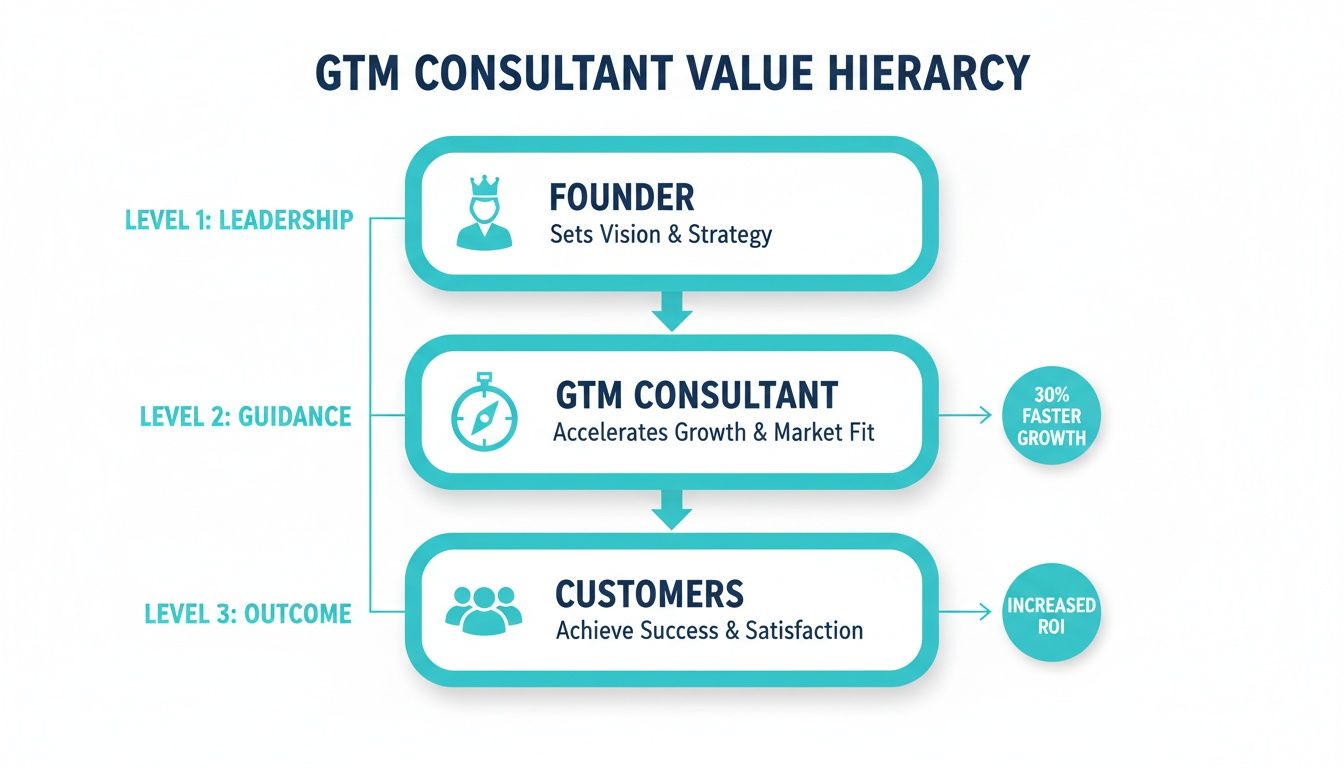
They break down silos, ensuring marketing and sales work from the same playbook, target the same ICP, and use the same messaging. The best consultants show your teams how to orchestrate a unified Go-To-Market strategy that makes the entire growth engine more efficient. For a deeper dive, check out our own take on a modern B2B go-to-market strategy.
Knowing When It's Time to Hire a GTM Consultant
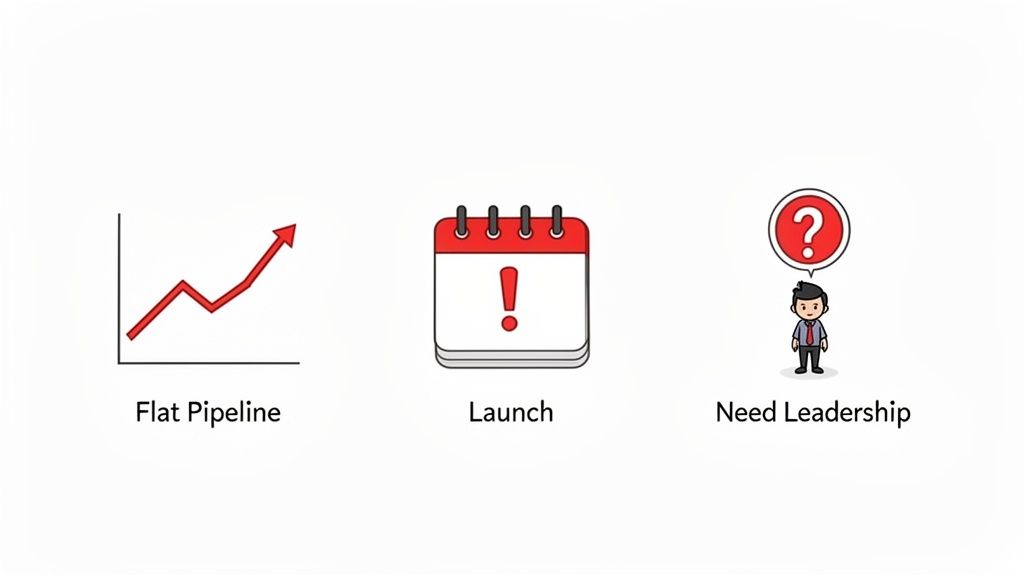
Timing is everything in a startup. Hire a consultant too early, and you burn precious cash. Wait too long, and you risk making costly mistakes that kill your momentum right when you should be hitting the gas.
Recognizing the right moment isn't about having a crystal ball—it's about spotting the red flags. Think of it like driving a high-performance car. At first, you can handle it. But when the engine starts sputtering or you're heading into a hairpin turn at high speed, you need an expert mechanic, fast. A go to market consultant is that specialist for your business.
So, how do you know when it’s time to make the call? The signs are usually pretty clear. They show up as bottlenecks, missed targets, and that nagging feeling that you’re working incredibly hard but just spinning your wheels.
Your Sales Pipeline Is Unpredictable or Stalled
This is the big one. Your pipeline looks more like a rollercoaster than a steady climb. Maybe you had a great first wave of sales from your personal network, but now that well is dry. Or maybe the pipeline is full of leads, but nothing ever seems to close.
This is a classic symptom of a broken or non-existent growth engine. It means your team is likely running on guesswork, chasing any lead that moves without a clear, repeatable process for qualifying, nurturing, and converting them into customers.
An expert GTM consultant steps in to diagnose the problem. They bring an objective eye and a proven playbook to turn a chaotic sales process into a predictable revenue machine, often boosting win rates by as much as 23% by aligning your strategy with real market opportunities.
They’ll help you define what a "good" lead actually is and then build a system that consistently finds more of them. The goal isn't just sporadic wins; it's a scalable process you can count on month after month.
You're Launching a New Product or Entering a New Market
Walking into a new arena without a map is a recipe for disaster. Whether you’re launching your first product, a major new feature, or expanding into a new industry, the stakes are sky-high. A botched launch can burn through your runway and do serious damage to your brand’s reputation.
This is the perfect time to bring in go to market consultants. They’ve navigated these waters before and can help you steer clear of the common icebergs.
They bring critical expertise to the table, including:
- Market Validation: Making sure there’s a real, paying audience for what you've built before you go all-in.
- Competitive Positioning: Carving out a unique space for your product so you don’t get drowned out by the noise.
- Launch Planning: Building a detailed, cross-functional plan to ensure your launch makes the biggest possible impact on day one.
Your Junior Marketing Team Needs Senior Leadership
You’ve hired smart, hungry, and talented junior marketers. They’re fantastic at executing tasks, but they don’t have the strategic experience to build and lead a comprehensive growth plan. This leaves you, the founder, playing the role of de facto marketing director—a job you simply don't have time for.
A fractional CMO or GTM consultant is the ideal solution here. They provide the senior leadership and mentorship your team needs to thrive, bridging the gap until you’re ready to hire a full-time VP of Marketing.
They don’t just give orders from on high. A good consultant coaches your team, levels up their skills, and installs the processes they need to succeed long after the engagement is over.
How GTM Consultants Work (and What They Cost)
So, you're thinking a go-to-market consultant might be the right move. The next question is obvious: how does this actually work, and what’s it going to cost?
Bringing in an expert can feel like a big step, but the good news is that these engagements are built for flexibility. This is especially true for B2B tech startups where cash flow is king. You don't use a sledgehammer to hang a picture, and you don't need a multi-year commitment when a focused project will get the job done.
The key is matching the engagement to your specific challenge, timeline, and budget. Let's break down the common structures so you can find the perfect fit.
The consulting world is booming because businesses need this kind of specialized expertise on demand. North America's consulting market alone generates nearly USD 100 billion in fees, and the global market is projected to hit $371.04 billion by 2025. Founders are clearly tapping into this talent pool to scale faster and leaner. You can discover more statistics about the consulting industry to see just how mainstream this approach has become.
Short-Term Project Engagements
This is the most straightforward model. You have a specific, well-defined problem, and you hire a consultant for a surgical strike—a focused, time-bound effort with a clear deliverable.
- Best For: Crafting a product launch plan, refreshing your ICP and messaging, running a competitive analysis, or auditing your martech stack.
- Pros: The scope is fixed, the cost is predictable, and there's a clear end date. It's perfect for getting expert help on a single, high-priority task without a long-term commitment.
- Cons: The work is limited to the initial scope. If the project uncovers deeper strategic issues, you’ll need to kick off a new engagement.
Monthly Retainer Agreements
A monthly retainer is your best bet when you need ongoing strategic guidance but aren't ready for a full-time executive. You're essentially buying a block of a consultant's time and brainpower each month.
This setup gives you continuous access to a senior-level thinker who can help you navigate challenges as they pop up, gut-check campaign ideas, and keep your growth strategy on track. It’s a great balance between flexibility and consistent support.
A retainer ensures your go-to-market strategy doesn’t just sit on a shelf. The consultant becomes an active partner, helping you adapt to market feedback and ensuring your team stays focused on the right priorities month after month.
The Fractional Leadership Model
The fractional model is quickly becoming the standard for B2B tech startups, and for good reason. A fractional CMO acts as a part-time member of your leadership team, delivering both high-level strategy and hands-on execution oversight for a "fraction" of a full-time executive's salary.
This is the perfect play for founders who need to bridge the gap before hiring a full-time VP of Marketing. It's also ideal for startups with a junior team that needs senior-level mentorship to really perform. You get the C-suite brainpower you need for critical growth stages without the hefty salary and equity package. To see how this works, you can explore the benefits of bringing in outsourced marketing leadership.
Choosing the right model comes down to your immediate needs and long-term goals. A project is great for a quick win, while a fractional leader is built for sustained growth.
Comparing GTM Consultant Engagement Models
To help you decide, here’s a quick breakdown of how these three common models stack up against each other. Think about your budget, timeline, and the depth of strategic involvement you need.
| Model | Best For | Typical Duration | Pricing Structure |
|---|---|---|---|
| Project-Based | Solving a specific, one-time problem with a clear deliverable (e.g., a launch plan or messaging framework). | 1-3 months | Fixed Fee |
| Monthly Retainer | Needing ongoing strategic advice, coaching, and a reliable sounding board for your internal team. | 3-12 months | Monthly Fee |
| Fractional Leadership | Requiring both strategic leadership and hands-on oversight to drive growth and mentor a team. | 6-18+ months | Monthly Fee (higher tier) |
The right choice depends entirely on your situation. If you have a single burning fire to put out, a project is your answer. If you need a long-term strategic partner to help you navigate the entire journey, a fractional leader is the way to go.
How to Choose the Right Go To Market Consultant
Hiring a go-to-market consultant is one of the most important partnership decisions a B2B tech founder will ever make. Get it right, and you'll accelerate growth, sidestep costly mistakes, and build a scalable revenue engine. Get it wrong, and you can burn through precious runway with nothing to show for it but a fancy slide deck.
This isn't about finding someone with a prestigious name on their resume. It’s about finding a partner who fits your specific stage, industry, and culture—a doer, not just a talker, who will get in the trenches with you.
Look for Specialization, Not Generalization
Your first filter should always be industry focus. A consultant who claims to serve every vertical from healthcare to e-commerce simply won't have the deep, nuanced understanding of B2B SaaS you need. Their advice will be generic when you need it to be razor-sharp.
Zero in on consultants who live and breathe your world. They should speak your language, already know your buyer personas, and understand the competitive landscape without needing a three-week discovery project.
- Deep B2B Tech Experience: Have they worked with companies at your exact stage (seed, Series A, etc.) and with your business model (e.g., PLG, enterprise sales)?
- Proven SaaS Playbooks: Can they show you specific examples of growing MRR, lowering CAC, or improving pipeline velocity for other SaaS companies?
- Relevant Network: A great consultant brings a network of potential partners, vendors, and even talent that can add immediate value.
Prioritize Action Over Theory
Too many consultants excel at creating beautiful, 100-page strategy documents that are theoretically brilliant but practically useless. They diagnose the problem perfectly but offer no realistic path to a solution. You don’t need another theorist; you need an operator.
During your interviews, press them for specifics on execution. A great consultant will focus less on abstract frameworks and more on the nitty-gritty of getting things done. If you're curious about what this kind of hands-on partnership looks like, you can learn more about what is marketing consulting and how it translates to real-world action.
The single most important trait in a GTM consultant is a bias for action. They should be obsessed with shipping projects, testing ideas, and getting tangible results in the first 30 days, not just planning for the first quarter.
Essential Interview Questions to Ask
To separate the operators from the theorists, you have to ask the right questions. Go beyond their polished case studies and dig into their process, their philosophy, and how they handle things when they go sideways.
Here are a few critical questions to add to your list:
- Walk me through your plan for the first 30 days. This reveals if they focus on quick wins and building momentum or if they get bogged down in endless analysis.
- How do you measure success in your engagements? Look for answers tied to hard business metrics like pipeline generated, sales cycle length, and conversion rates—not vanity metrics like website traffic.
- Tell me about a time an engagement didn't go as planned. What went wrong, and how did you fix it? This question tests for honesty, adaptability, and real-world problem-solving skills.
- How do you approach mentoring and upskilling our junior team members? Their answer will show if they are a true partner invested in leveling up your team or just a temporary hired gun.
By focusing on deep specialization, a bias for action, and asking these tough questions, you can confidently find the right go-to-market consultant to help you scale.
What to Expect in the First 90 Days
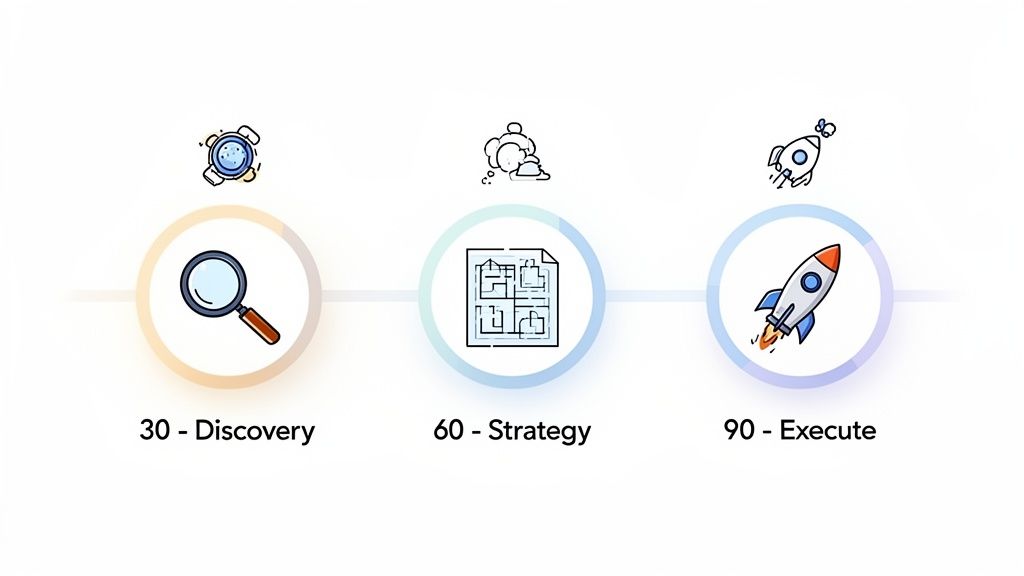
Hiring a GTM consultant isn’t about waiting six months for a dense strategy deck. It’s about getting traction—fast. The first 90 days are a sprint designed to build momentum, clarify your direction, and start putting points on the board.
Think of it as three distinct phases: deep immersion, strategic architecture, and disciplined execution. Each one builds on the last, and here’s what that looks like in the real world.
Phase 1: The First 30 Days of Discovery and Quick Wins
Month one is all about absorption and alignment. A great go-to-market consultant becomes a sponge, soaking up everything about your business, your customers, and your market. They don’t just read your slide decks; they get on calls with your founders, engineers, and your first few customers to hear it firsthand.
The goal here is to replace assumptions with validated insights. That means digging into your data, interviewing key players, and sizing up the competition.
Key activities during this phase include:
- Stakeholder Alignment Workshops: Getting everyone from product to sales in a room to agree on what winning looks like.
- Deep Customer Interviews: Talking directly to your best (and worst) customers to uncover the real problems your product solves.
- Initial Tech Stack Audit: A quick review of your marketing and sales tools to spot gaps and easy fixes.
- Scoring Early Wins: Identifying the low-hanging fruit—like patching a leaky funnel or launching a simple retargeting campaign—to build immediate trust and momentum.
By day 30, you won't just have a smarter consultant. You’ll have a unified team and early proof that the engagement is already paying off.
Phase 2: Building the Strategic Foundation in Days 31-60
With a solid grasp of your business, the consultant switches from discovery to architecture. This is where they build the scaffolding for your growth engine. All the raw insights from Phase 1 get translated into a concrete, actionable plan.
This isn’t some theoretical exercise. It’s about making clear, data-backed decisions on the core components of your go-to-market motion.
The second month is where strategy takes shape. The consultant defines your growth roadmap, sharpens your messaging, and sets up the analytics needed to measure every part of the plan. This transforms your marketing from a cost center into a predictable revenue driver.
Key milestones for this period involve:
- Finalizing the Ideal Customer Profile (ICP): Moving from a vague idea to a hyper-specific definition of who your best customer is, what they care about, and where to find them.
- Crafting the Core Messaging Framework: Developing the key value props and talking points that will actually connect with your ICP.
- Defining the Growth Roadmap: Outlining the specific channels, campaigns, and initiatives for the next six months, complete with KPIs.
- Setting Up Core Analytics: Implementing the tracking and dashboards needed to measure what matters, like pipeline velocity and customer acquisition cost.
Phase 3: Execution and Optimization in Days 61-90
The final phase is all about execution. The strategy is set, the infrastructure is in place—now it’s time to launch campaigns and start generating demand. The consultant’s role shifts from architect to hands-on project manager and coach.
They work shoulder-to-shoulder with your team to get campaigns live, analyze the first wave of data, and start optimizing based on what the market is telling you. This is where a repeatable growth process starts to take hold.
The focus here is on building a rhythm of execution and learning. It’s about turning the plan into a living, breathing operation that consistently produces results, not just a series of one-off tactics.
A Few Common Questions About GTM Consultants
Bringing on a go-to-market consultant is a big move. You’re committing real capital and trusting an outsider with your growth. It’s only natural to have questions. Here are the straight-up answers to what B2B tech founders usually ask.
How is a Fractional CMO Different from a Marketing Agency?
This one’s crucial. A fractional CMO is a senior-level strategist who plugs into your leadership team. They’re there to build the entire GTM plan from the ground up, coach your people, and own the results. Think of them as working in the business with you.
An agency, on the other hand, is an executor you hire to handle specific jobs—like running paid ads, doing SEO, or creating content. They work on the business, usually following a strategy you’ve already set. The fractional CMO figures out the 'why' and the 'what'; an agency typically handles the 'how' for a specific channel. For a startup needing a solid foundation and leadership, the fractional CMO is the right first move.
What Kind of ROI Can I Expect?
The real return here is measured in two things: speed and avoided disasters. Instead of burning six to nine months and a huge chunk of your runway on trial-and-error, a consultant gets you on the right track, faster.
The ROI isn’t just about the leads you generate. It's about preventing the catastrophic mistakes—like targeting the wrong market, blowing cash on channels that don’t work, or hiring the wrong people—that can sink a startup. That alone can save you hundreds of thousands.
A few clear ROI markers you’ll see on the dashboard include:
- A shorter sales cycle from the first touch to a signed deal.
- Higher conversion rates from lead to customer.
- A lower customer acquisition cost (CAC).
- A reliable, predictable revenue pipeline.
Can a GTM Consultant Work with Our Existing Junior Marketing Team?
Absolutely. In fact, that’s one of their most valuable roles. An experienced GTM consultant or fractional CMO provides the senior-level direction and mentorship that junior marketers need to level up and execute with confidence.
They’ll coach your team on proven frameworks, set clear priorities, and show them what 'good' looks like. It’s how you turn a few individual contributors into a genuine marketing engine. This is a massive win for founders who’ve hired promising talent but lack the senior leadership to guide them.
Are Go-To-Market Consultants Only for Early-Stage Startups?
Not at all. While they’re a lifeline for early-stage companies trying to find their footing, go to market consultants are just as critical for scale-ups hitting a new set of challenges.
A more mature company might bring in a consultant to tackle a specific inflection point. Maybe they’re launching a major new product, breaking into a new market, trying to fix stalled growth, or moving upmarket to chase enterprise deals. Any B2B tech company facing a big strategic shift can get immense value from a consultant’s focused, outside expertise.
Ready to build a GTM strategy that delivers predictable revenue? Value CMO provides the fractional CMO leadership B2B tech startups need to scale without the full-time overhead. Get your custom growth plan today.