Think of a go-to-market consultancy as the architect for your B2B tech startup’s revenue engine. They’re not just drawing up plans; they’re designing the whole system that connects your brilliant product to the customers who desperately need it, helping you sidestep the costly mistakes that sink so many early-stage companies.
What they really deliver is a repeatable framework for growth by making sure your product, marketing, and sales teams are all pulling in the same direction.
Your Startup’s Blueprint for Revenue
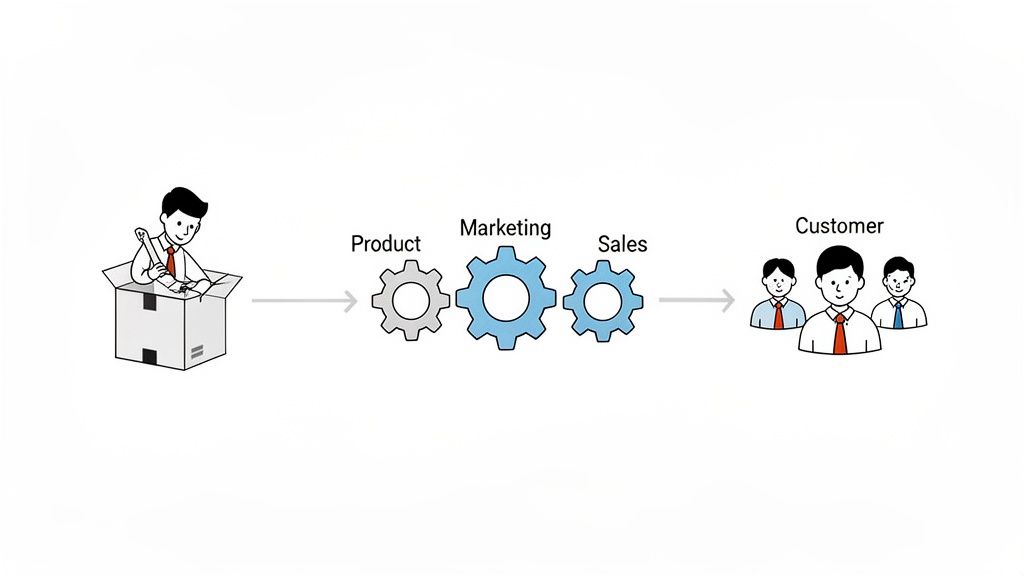
You wouldn’t build a house without a blueprint, right? Even with the best materials and a skilled crew, you’d end up with a mess—crooked walls, rooms that don’t connect, and a budget that’s completely shot. For a B2B tech startup, launching a product without a solid Go-To-Market (GTM) strategy is pretty much the same gamble.
A go to market consultancy hands you that essential blueprint. They do more than just cook up a single marketing campaign; they engineer a holistic, interconnected system built from the ground up to generate predictable revenue. Their job is to help you answer the most critical questions your business is facing.
At its heart, a go-to-market consultancy helps you define and, more importantly, execute a comprehensive Go To Market strategy framework. This isn't about lofty theories; it's about a practical, actionable plan to win your market.
Beyond Buzzwords: What a GTM Consultant Actually Does
So, what does this look like day-to-day? A GTM consultant cuts through the jargon to solve the painful, real-world problems that keep founders staring at the ceiling at 3 AM. They specialize in turning that feeling of ambiguity into a clear path forward.
Their work is all about creating tight alignment across the three pillars of your business:
- Product: Making sure your features and value proposition hit the market’s most urgent pain points head-on.
- Marketing: Nailing the message and picking the right channels to attract, educate, and convert your ideal buyers.
- Sales: Arming your sales team with the right tools, process, and messaging to close deals efficiently.
By getting these three functions in sync, a consultant helps you dodge the classic startup killers: wasted cash and burned-out teams chasing the wrong goals.
Solving the Toughest B2B Tech Challenges
For B2B tech startups, the stakes couldn't be higher. A fumbled launch or a flat pipeline can be a death sentence. A go to market consultancy gets brought in to fix these specific, high-impact issues.
A go-to-market consultant doesn’t just hand you a 50-page slide deck and walk away. They roll up their sleeves, help you execute, and measure the results. Their entire focus is turning strategy into tangible outcomes like pipeline growth, market traction, and scalable revenue.
This is a world away from general business advice or traditional marketing consulting, which might focus on a single channel or campaign. A GTM expert owns the entire commercial engine, from the first touch to the closed deal.
They tackle problems like:
- A Stagnant Sales Pipeline: They figure out why leads are stalling out and build a machine to pump a steady flow of qualified opportunities your way.
- Product Launch Uncertainty: They validate your target market and map out a precise launch plan to make a splash, not a thud.
- Ideal Customer Confusion: They help you move from a vague persona to a data-backed Ideal Customer Profile (ICP) that informs every single decision you make.
Ultimately, a go to market consultancy gives founders the two things they need most: clarity and focus. They provide a direct, battle-tested path to revenue, helping you find product-market fit faster and build a growth machine that actually lasts.
Core Services That Drive Sustainable Growth
A go-to-market consultancy doesn’t just hand you a dense PowerPoint and wish you luck. They roll up their sleeves and help build your revenue engine, piece by piece. These aren't abstract theories but focused projects designed to inject clarity, alignment, and momentum into your startup. The whole point is to turn a smart strategy into real results, like a healthy pipeline and serious market traction.
This kind of operational firepower is becoming non-negotiable. The demand for sharp marketing consulting is booming, with the global market set to jump from $35.10 billion in 2025 to $44.16 billion by 2030. That surge isn't just noise; it’s a signal that B2B tech companies need experts who can build efficient growth models that actually work.
The Ignition Plan: Creating Market Clarity
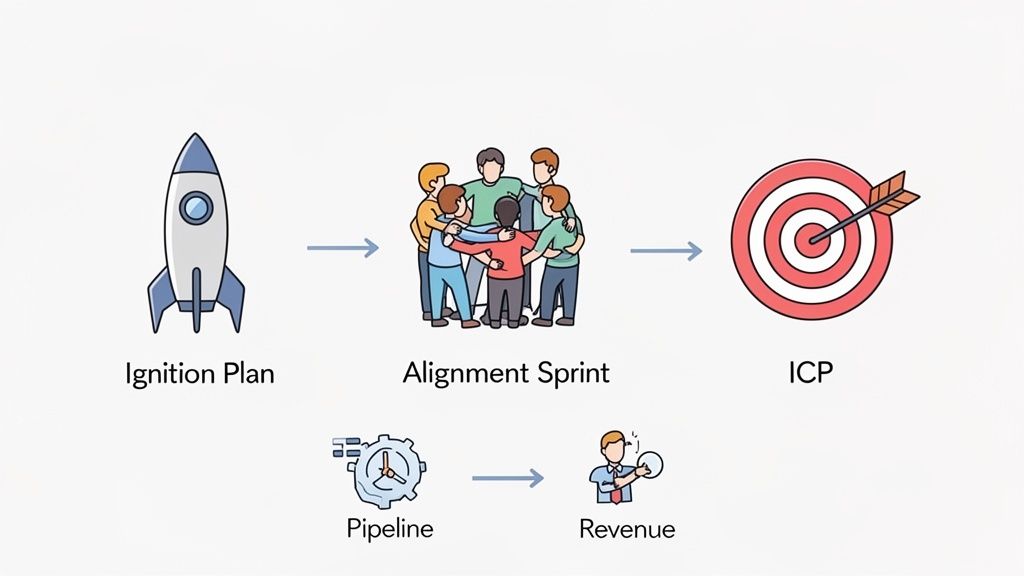
The first step is always answering the hardest questions with confidence. An Ignition Plan is a fast, high-impact engagement designed to build a solid strategic foundation. It’s the diagnostic phase where a consultant dives deep into your business to define—and validate—your core growth drivers.
Think of it as the geological survey before you build a skyscraper. You have to know you’re building on solid ground. This plan typically delivers:
- Ideal Customer Profile (ICP) Validation: We help you move from a vague persona to a data-backed profile of the exact customer who gets the most value from your product and is easiest to sell to.
- A Compelling Value Proposition: We’ll help you craft a clear, powerful message that answers the only question that matters: "Why should your ideal customer choose you over anyone else?"
- Initial Channel Strategy: We pinpoint the most promising marketing and sales channels to reach your ICP so you can stop wasting your budget on guesswork.
The Alignment Sprint: Uniting Your Team
Once you have a clear plan, the next challenge is getting everyone—from the CEO to the newest marketer—rowing in the same direction. An Alignment Sprint is a workshop-style service that unites your entire organization around the new strategy. Misalignment is a silent killer for startups, causing teams to work at cross-purposes and burn through cash.
The single biggest benefit of an Alignment Sprint is focus. It forces the difficult conversations and drives consensus, making sure every dollar spent and every hour worked is dedicated to acquiring the right customers through the right channels.
This sprint solidifies the Ideal Customer Profile (ICP) across every department. Sales knows exactly who to call, marketing knows what message will resonate, and product knows whose feedback to prioritize. Getting everyone on the same page is crucial for finding efficient strategies to lower your Customer Acquisition Cost.
The CMO Accelerator: Building the Growth Roadmap
With clarity and alignment locked in, it’s time to execute. This is where a go to market consultancy shifts from strategist to hands-on leader. A CMO Accelerator engagement provides end-to-end strategic leadership to build and run your growth engine. It’s all about turning the "what" and "why" into a detailed "how."
This service involves creating a data-driven growth roadmap that lays out priorities, budgets, and KPIs for the next 6-12 months. It’s not just a document; it includes hands-on setup of marketing automation, AI tools, and sales processes. If you want to dig deeper, our guide on crafting a winning B2B go-to-market strategy is a great place to start. This kind of hands-on guidance ensures your startup not only has a world-class plan but also the execution muscle to make it a reality.
Spotting the Red Flags: When to Call in a GTM Consultant
Knowing the right time to bring in a go-to-market consultancy can be tough. It’s not about admitting defeat; it’s a strategic move to parachute in senior expertise exactly when and where you need it most. The signs are usually hiding in plain sight, often disguised as the normal growing pains of a startup.
But don’t mistake them for minor headaches. These are symptoms of a deep-seated strategic gap. If you ignore them, they can grind even the most promising B2B tech company to a halt.
Let's walk through the classic scenarios that should set off alarm bells.
Your Pipeline Is a Rollercoaster
One month, the team is celebrating a flood of new leads. The next? Crickets. This feast-or-famine cycle is a dead giveaway that you don't have a repeatable, scalable engine for generating demand. You might have an amazing product, but a pipeline built on hope is no way to grow a business.
An unpredictable pipeline almost always points to bigger problems:
- You have a blurry Ideal Customer Profile (ICP): Your team is basically throwing spaghetti at the wall, burning cash on leads that were never going to convert anyway.
- You're on the wrong channels: The money you're pouring into marketing isn't actually reaching the people who need your solution.
- Your funnel is leaking: You know leads are dropping off somewhere between "hello" and "closed-won," but you don't have the data to find the holes and patch them.
A go-to-market consultancy comes in, diagnoses these root causes, and then builds the machine that delivers a steady, predictable flow of qualified opportunities.
Your Brilliant Product Isn't Selling Itself
You built something genuinely innovative. Your engineers are obsessed with it, and your first few customers are raving. But when it comes to consistently winning new business, you’re hitting a brick wall. The market just doesn’t seem to “get it.”
This is a painful, all-too-common reality for tech founders. It means there’s a massive disconnect between your product’s features and what the market actually values. A consultant’s job is to bridge that chasm, translating complex tech into a simple, powerful value proposition that solves a real-world business problem.
You're too close to your own product. An external GTM expert brings an objective, market-focused perspective to articulate its value in a way that makes customers say, "I need that," instead of, "What does that do?"
Your Big Launch Keeps Getting Pushed Back
Is your next major product launch perpetually "just a few weeks away"? This kind of strategic paralysis usually comes from a deep sense of uncertainty. You’re second-guessing everything—the target audience, the pricing, the core message. Every week you delay, you lose momentum and give competitors a chance to catch up.
A go-to-market consultancy is the catalyst here. They break through the indecision with a launch plan backed by data, not just gut feelings. They validate your assumptions, lay out a clear roadmap, and give your team the confidence to execute a launch that makes a splash, not a fizzle.
Your Junior Team Needs Senior Leadership
You’ve got a fantastic team of smart, hungry marketers who are great at getting things done. They can run social campaigns, write blog posts, and manage your ad spend. But without a seasoned strategist steering the ship, their efforts feel disconnected and scattered.
This isn't a knock on your team; it's a leadership gap. A GTM consultant provides that crucial layer of senior oversight. They build the overarching strategy and mentor your team at the same time, making sure every dollar and every hour is aimed at a single, clear goal. They turn a collection of random tactics into a powerful, unified growth machine.
Comparing Your Options: GTM Consultant vs. Other Hires
As a founder, you're at a familiar crossroads. You need to grow, but the path forward feels foggy. You know you need senior-level strategic muscle to clear the way, but what's the right move? Hiring a go-to-market consultancy is one option, but you're also weighing a full-time VP, a marketing agency, or a fractional CMO.
This isn't just about budget. It's a strategic call that will shape your company's trajectory for the next 12-18 months. Each path offers a different blend of speed, cost, strategic depth, and flexibility. Let's break down the real-world trade-offs so you can make the right decision for your B2B tech startup.
Sometimes, a simple flowchart can clarify your thinking, especially when the pipeline hits a wall.
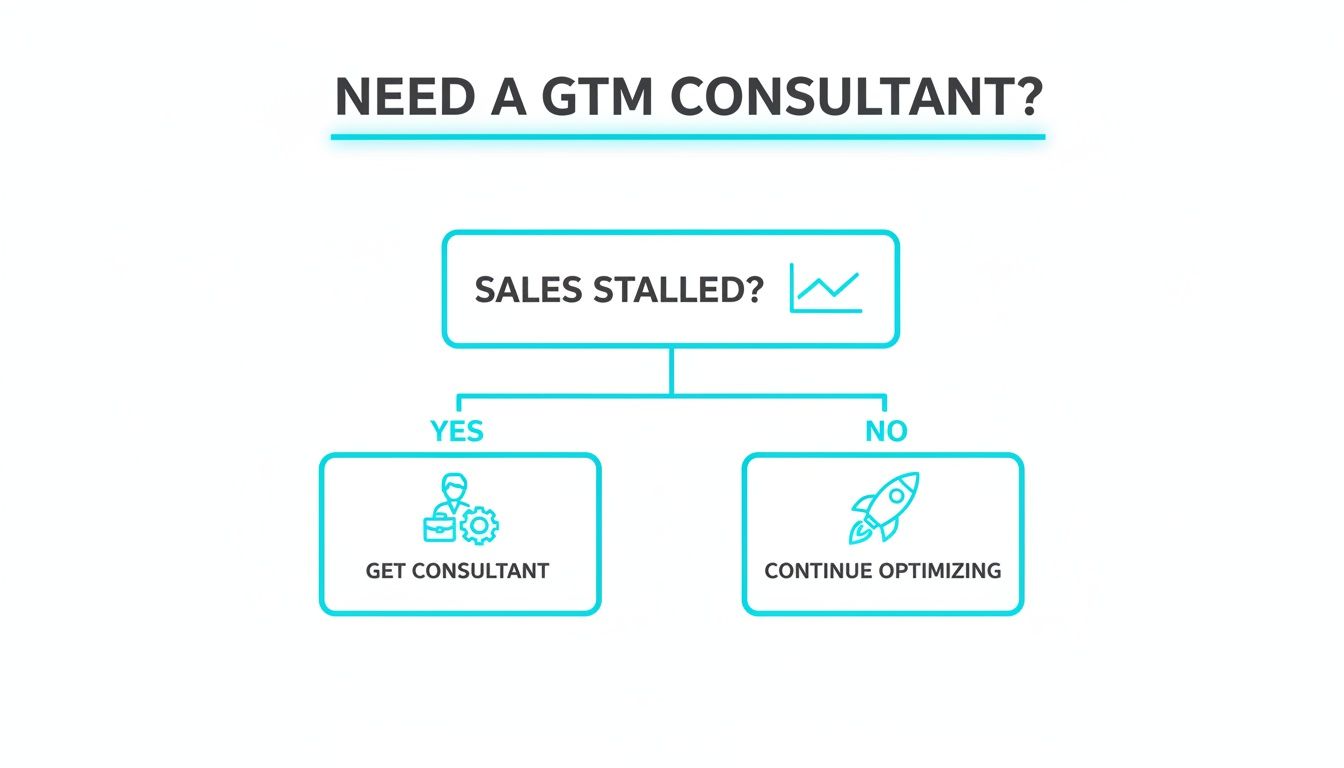
As the chart shows, stalled sales are often the trigger. It’s a clear signal that an outside perspective from a strategic partner is needed to diagnose the root problem and build a new growth engine.
The GTM Consultant: The Strategic Hybrid
Think of a go-to-market consultancy as a Special Forces unit for your revenue engine. They drop in, assess the terrain, create a high-impact plan, and help you execute with speed and precision. They blend C-level strategy with the hands-on work needed to get it done.
Their biggest advantages are immediacy and focus. You get an expert strategist on day one, completely sidestepping the painful six-month executive search. They’re built to solve specific, acute problems—a flat pipeline, a messy product launch, entering a new market—and deliver a clear roadmap without the long-term overhead of a full-time salary.
The Full-Time Hire: Deep Integration
Hiring a full-time VP of Marketing or CMO promises deep, long-term ownership. This person will live and breathe your business, building relationships across every department and taking full responsibility for the marketing function for years to come. It's the traditional path for a reason—it works, but only when you're truly ready for it.
For an early-stage startup, however, the downsides are huge. The hiring process is slow and expensive, and a bad hire can easily set you back a year or more. A senior executive also tends to focus on team building and high-level management, not the in-the-weeds execution you probably need right now.
A go-to-market consultancy delivers the strategic thinking of a seasoned CMO without the six-figure salary, equity, and benefits package. They're built for speed and impact, making them ideal when you need to fix a problem and build momentum quickly.
The Marketing Agency: The Execution Engine
Marketing agencies are fantastic at execution. Need someone to run Google Ads, manage social media, or produce a steady stream of blog posts? An agency brings a team of specialists and established processes to handle those tactical jobs.
The gap, almost always, is strategic leadership. Most agencies are order-takers; they’ll execute the plan you give them. If your strategy is flawed or nonexistent, you’re just paying them to execute the wrong plan faster. A GTM consultancy does the opposite: they build the strategy first, then help you manage the execution, whether it’s with your internal team or by helping you select the right agency.
The Fractional CMO: The Part-Time Leader
A fractional CMO is another compelling option, offering part-time senior leadership. This role often overlaps with a GTM consultancy, but the focus can be different. A fractional CMO typically embeds with your team for a longer period, acting as a part-time member of your leadership team to provide ongoing guidance and mentorship. You can learn more in our guide on when to hire a fractional CMO.
The choice often comes down to scope. A go-to-market consultancy is usually brought in for a specific, project-based outcome—like an "Ignition Plan" or an "Alignment Sprint"—designed to solve a defined GTM challenge. A fractional CMO provides more continuous, generalized marketing leadership over a longer horizon.
To make the right call, it helps to see these options side-by-side. I've put together a table comparing the four main paths for getting strategic marketing leadership.
GTM Consultancy vs. Alternatives: A Founder's Guide
This table breaks down the four main options for strategic marketing leadership to help you make the best decision for your startup's stage and budget.
| Attribute | GTM Consultancy | In-House Hire (VP/CMO) | Marketing Agency | Fractional CMO |
|---|---|---|---|---|
| Primary Focus | Strategic Problem-Solving | Long-Term Ownership | Tactical Execution | Ongoing Leadership |
| Speed to Impact | High (days to weeks) | Low (6-9 months) | Medium (weeks to months) | High (weeks) |
| Cost | Project-based fee | High salary + equity | Monthly retainer | Monthly retainer |
| Strategic Depth | Very High (specialized) | High (company-specific) | Low (channel-specific) | High (broad) |
| Flexibility | High (project scope) | Low (full-time role) | Medium (SOW-based) | High (part-time) |
| Best For | Fixing a specific GTM issue | Scaling a proven model | Executing a defined plan | Needing leadership on a budget |
Ultimately, there's no single "best" answer—only the right fit for your current situation. If you have a well-defined strategy and just need more hands, an agency is a great choice. If you're ready to invest in long-term leadership, a full-time hire makes sense. But if you have an urgent, complex growth problem that needs immediate, expert strategic intervention, a go-to-market consultancy is often the fastest and most effective path forward.
How to Choose the Right GTM Partner for Your Startup
Picking a go-to-market consultancy is a high-stakes bet. You’re not just hiring a vendor; you’re trusting an outsider with your startup’s future. The wrong partner burns cash and wastes time—two things no founder can afford to lose. The right one, however, is a force multiplier, giving you the strategic clarity and operational muscle to finally scale.
The trick is to look past the slick slide decks and dig into what really counts. You need a partner who gets the unique pressures of the B2B tech world and can deliver a pipeline, not just pretty PowerPoints. This is about finding an expert who can turn high-level strategy into predictable revenue.
And you're not alone in making this call. The global marketing consulting market, which covers these critical GTM services, is rocketing toward $35.7 billion by 2025. A huge piece of that is coming from North America, where the market is set to jump from $12.4 billion in 2021 to over $14.1 billion. Why? Because tech hubs are full of startups that need sharp GTM guidance to nail their ideal customer profile (ICP) and build a growth roadmap without the massive overhead of a full-time hire. You can get more details in this marketing consulting market report.
Your Evaluation Checklist for a GTM Consultancy
To cut through the noise, you need a simple framework that zeroes in on fit, experience, and what success actually looks like. Here's a checklist to guide your conversations and keep you focused.
1. Scrutinize Their B2B Tech Experience
Generic marketing experience won't cut it. Your business is complicated, and your consultant needs to be able to hit the ground running on day one.
- Industry-Specific Case Studies: Ask them to walk you through a real-world example. How did they help a B2B tech company like yours fix a specific problem, like a stalled pipeline or a messy product launch?
- Founder-Level Fluency: Do they speak your language? They should be comfortable talking about CAC, LTV, and product-led growth with real depth, not just repeating buzzwords.
- Relevant Tech Stack Knowledge: A great GTM consultant knows the modern marketing and sales toolkit inside and out—from CRMs and automation platforms to the latest analytics tools.
2. Focus Relentlessly on Measurable Outcomes
Success here isn't about vanity metrics like clicks or impressions. It's about tangible business impact.
The single most important question to ask is: "How do you measure your own success?" The right answer will always tie back to your business goals—pipeline generated, sales cycles shortened, or revenue booked. Anything else is a massive red flag.
Be direct. Ask them to define the KPIs they’d use to measure the project. A real partner will welcome that conversation and work with you to set clear, outcome-driven goals from the get-go.
3. Assess Their Engagement Model for Flexibility
Startups pivot. Priorities change overnight. A rigid, one-size-fits-all consulting package is a setup for failure.
- Hands-On vs. Hands-Off: Get clear on their role. Are they pure strategists, or will they roll up their sleeves and help execute? The best partners do both.
- Project-Based vs. Retainer: Look for flexible models. Things like an "Ignition Plan" or an "Alignment Sprint" are designed to deliver specific outcomes without locking you into a long-term contract you might not need.
- Team Integration: How will they work with your people? A good consultant acts as a coach and mentor, leveling up your team’s skills instead of just handing down a to-do list.
Critical Questions to Ask Potential Partners
Once you've vetted their background and approach, it's time to ask the questions that reveal how they really think and operate under pressure.
- Walk me through a time you revived a flat pipeline for a company at our stage. What were the first three things you actually did?
- How do you balance the high-level strategy work with the hands-on execution needed to get things done?
- What’s your process for getting up to speed on our product, our customers, and our market before you even think about recommending a strategy?
- If we have a fundamental disagreement on a strategic direction, how do you handle that conversation to make sure we land on the best outcome?
Asking these tough questions helps ensure you find a go-to-market consultancy that’s more than a service provider—they're a true partner who is genuinely invested in seeing you win.
Go-To-Market Questions Every Founder Asks
Even after seeing the playbook, most founders still have a few practical questions. These are the "what-ifs" and "how-exactly" thoughts that pop up right before you make a big move. Let's get straight to them.
You need to know how a partnership with a go-to-market consultancy will feel day-to-day, not just on paper. Here are the most common questions from B2B tech founders, answered head-on.
What’s the Real ROI?
This is the big one. The return isn't measured in vanity metrics—it’s about hard business outcomes. We're talking faster pipeline growth, shorter sales cycles, and a cheaper, quicker path to product-market fit.
A great consultant doesn't just run a campaign; they build a repeatable growth engine. Think of it this way: just by nailing your Ideal Customer Profile (ICP), you can stop wasting 50% of your marketing budget on the wrong audience. That’s a 2x efficiency gain right out of the gate.
The goal is to build sustainable revenue momentum that pays for the consulting investment many times over. It’s a system that keeps delivering long after the engagement ends.
The ROI isn't only in new leads. It’s in the expensive mistakes you don't make, the market share you grab while competitors are still guessing, and the focus that gets your whole team pulling in the same direction.
How Fast Will We See Results?
You should feel the shift in clarity and momentum within the first 30-45 days. An Ignition Plan or Alignment Sprint is built for speed—they cut through the noise to deliver a clear strategy and an actionable roadmap, fast.
That initial phase is all about laying the foundation. The bigger wins, like a major jump in pipeline and revenue, typically show up over the next 3-6 months as the new strategies get executed, tested, and dialed in.
The first results are always strategic alignment and focused execution. Everything else grows from there.
Will a Consultant Work With Our Current Team?
Absolutely. One of the most valuable things a go-to-market consultancy does is coach and level up your existing team. They don't replace your people; they make them better.
A consultant brings the senior leadership and strategic oversight that helps junior or mid-level marketers execute with confidence.
This gives your startup a powerful two-for-one:
- Immediate Expert Execution: You get C-level strategy plugged in right away, closing growth gaps without a six-month hiring process.
- Long-Term Team Growth: Your team learns best practices firsthand, seeing what a world-class GTM strategy looks like in action. They get better at prioritizing and driving results.
Your marketing function stops being a list of tasks and starts becoming a strategic growth driver, adding value long after the consultant’s project is done.
How Do You Handle Our Niche Industry and Complex Product?
Top GTM consultants who focus on B2B tech live for complexity. They don't show up with a generic playbook and try to hammer it into place. Their entire process is designed to unpack the specifics of a niche market and a technical product.
Every engagement kicks off with deep discovery. The consultant's first job is to become an expert on your business—your product, your market, your competitors, and your internal roadblocks.
They use proven frameworks to find insights unique to your situation. This lets them build a strategy that plays to your company's strengths while drawing on experience from solving similar puzzles in other tech verticals. They build a plan for your business, not just a business.
Ready to stop guessing and start building a predictable revenue engine? At Value CMO, we provide the senior GTM leadership B2B tech startups need to achieve clarity, align their teams, and accelerate growth. We skip the fluff and focus on building a practical, data-driven roadmap to your next milestone. Learn how our fractional CMO services can build your path to scalable revenue.