Ever feel like your business needs top-shelf marketing strategy but you just can't justify the C-suite price tag? You're not alone. A fractional CMO service is all about getting you that seasoned, strategic marketing leadership on a part-time basis. It’s like having an expert in your corner, without the full-time overhead.
The Rise of the On-Demand Marketing Leader

So many ambitious B2B tech startups hit a wall that feels frustratingly familiar. You’ve got a killer product and some early wins, but growth has stalled out. Your marketing feels like you're just throwing things at the wall, not following a unified strategy that brings in predictable results.
It’s obvious you need senior leadership. But the cost of a full-time Chief Marketing Officer—which can easily soar past $250,000 in salary alone—is a huge pill to swallow.
This is the exact problem that gave rise to the fractional CMO service. It’s a modern solution for businesses that need high-level strategic direction but don’t need—or can't afford—a full-time executive on the payroll just yet. Think of it less like hiring an employee and more like bringing in an architect to design your growth engine.
Building the Blueprint for Growth
A fractional CMO doesn’t just lob advice from the sidelines. They really embed themselves in your company to design the actual blueprint for scalable growth. They take ownership of the marketing function, bringing clarity to your strategy and making sure every dollar you spend is tied directly to a business outcome.
The main goal? To build a marketing machine that runs like a dream and keeps delivering long after their work is done.
This model is a real game-changer for:
- Tech Startups: Nailing that go-to-market strategy and building a solid marketing foundation from the ground up.
- SaaS Companies: Dialing in the marketing funnel to slash customer acquisition costs (CAC) and boost lifetime value (LTV).
- Scale-Ups: Mentoring an existing marketing team and putting the processes in place to handle rapid expansion.
A fractional CMO steps in to lead marketing strategy and execution on a part-time basis, helping businesses scale without the overhead of a full-time executive. They drive cross-functional alignment and deliver growth-focused leadership at critical inflection points.
More Than Just a Title
The role goes way beyond just managing campaigns. A good fractional CMO is a strategic partner who gets marketing, sales, product, and finance all rowing in the same direction to create a cohesive commercial engine.
By understanding the full scope of what a Chief Marketing Officer does, you can see the immense value an on-demand leader brings. They focus on building the systems—from demand generation to team mentorship—that produce repeatable success.
Ultimately, this flexible leadership model is becoming the go-to for achieving predictable growth. It gives ambitious companies access to the strategic mind they need to build, launch, and scale their marketing operations without the long-term financial burden of a traditional executive hire.
What a Fractional CMO Actually Does for Your Business

It’s easy to get lost in job titles, right? Let's cut through the jargon and talk about what really happens when a fractional CMO joins your team. They aren’t just an advisor who drops off a PowerPoint and vanishes. They are the strategic operator who guides your marketing efforts toward real, measurable growth.
Imagine you just landed a new round of funding. Ideas are flying—podcasts, SEO, paid ads, trade shows—but you have no clear plan or priorities. This is exactly where a fractional CMO service steps in to turn that chaos into a focused, sequential roadmap.
Their job is to build the marketing system, not just run a few campaigns. They create a growth engine that plugs directly into sales and product, making sure every dollar spent and every hour worked pushes the business forward.
Building Your Strategic Foundation
The first thing a great fractional CMO does is listen. They dig deep to really get to know your business goals, your customers, and where you fit in the market. They don't show up with a generic playbook; they build a strategy from the ground up that’s right for you.
This foundational work usually covers:
- Go-to-Market (GTM) Strategy: Nailing down exactly who you sell to, what you sell, and the smartest way to reach them.
- Ideal Customer Profile (ICP): Moving past vague descriptions to build a crystal-clear picture of the buyers who need your product most.
- Core Messaging and Positioning: Crafting a compelling story that cuts through the noise and genuinely connects with your target audience.
Think of them as a strategic architect. Before anyone starts laying bricks (launching campaigns), the fractional CMO makes sure the blueprint is solid and built for growth.
A fractional CMO doesn't just manage marketing tasks. They own the entire marketing strategy, from high-level planning down to the KPIs that prove its effectiveness, ensuring every activity is directly tied to revenue.
Mentoring the Team and Establishing Processes
A fractional CMO isn’t there to replace your team—they’re there to make it better. They act as a coach, helping your junior marketers build new skills and grow into future leaders. This hands-on guidance is often one of the most valuable parts of the whole arrangement.
They also install the systems and processes you need for predictable results. This means setting up the right dashboards and tracking the metrics that actually matter. A key differentiator is their skill in turning data into actionable insights, not just reporting on vanity metrics. They focus on KPIs that hit the bottom line, like Customer Acquisition Cost (CAC), pipeline value, and marketing-sourced revenue.
This model is changing how fast-growing companies hire, especially in B2B tech. Data shows that 45.6% of fractional engagements last between one and two years, offering stable leadership without the long-term overhead of a full-time hire. It gives companies access to A-list talent on flexible terms.
In short, a fractional CMO provides the structure, leadership, and expertise needed to build a scalable, results-driven marketing function. They are the operator who finally turns your marketing from a cost center into a powerful and predictable driver of revenue.
Choosing Your Growth Partner: Fractional CMO vs. Full-Time vs. Agency
Picking the right marketing leader is a make-or-break moment for any growing tech company. This isn’t just about filling a role; it’s about finding the right partner to pilot your growth. But the options can feel overwhelming. Do you hire a full-time executive, a flexible strategist, or a team of specialists?
Let's skip the generic pros-and-cons lists and look at this through the lens of the real challenges you're facing. Each of these models is built for a different stage of your company’s journey. Think of it like building and flying an airplane.
A fractional CMO service is for when you need to "build the plane while flying it." You’ve got traction and some resources but lack the strategic blueprint and an experienced architect to build a marketing engine that can actually scale.
A full-time CMO is for when the "plane is built and needs a dedicated pilot." Your marketing foundation is solid, the systems are in place, and you need a senior executive to own the entire function, manage a growing team, and fly that plane to its next big destination.
A marketing agency is for when you need a "specialized crew for a specific part of the plane." You might have a great pilot (a CMO or Head of Marketing) but need expert technicians to handle the engines (paid ads) or navigation systems (SEO).
The Strategic Leadership Spectrum
The real difference between these models comes down to ownership and scope. A fractional CMO gives you high-level strategic ownership, but on a part-time basis. They plug into your leadership team, are accountable for results, and focus on building out the entire marketing function from the ground up.
A full-time CMO, of course, offers complete and dedicated ownership. They live and breathe your business every single day, managing day-to-day operations, shaping long-term vision, and developing your team. It’s the deepest level of commitment but also carries the highest cost.
Agencies, on the other hand, provide tactical expertise in specific channels. They’re invaluable for execution, but they typically don’t own your overarching business strategy. Their job is to deliver results for the services you hired them for, not necessarily to build your internal marketing capabilities for the long run.
The right choice hinges entirely on your current stage. Are you looking for a strategic architect, a full-time pilot, or a specialized execution crew? Answering that question makes the decision much clearer.
A Head-to-Head Comparison
To help you figure out what you truly need, let’s break down how each option stacks up across the factors that matter most to a growing B2B tech company. This isn’t just about the price tag; it's about aligning your leadership investment with your immediate priorities and where you want to be in a year or two.
Comparing Marketing Leadership Models: Fractional vs. Full-Time vs. Agency
This table cuts through the noise to show you where each model shines.
| Attribute | Fractional CMO | Full-Time CMO | Marketing Agency |
|---|---|---|---|
| Primary Focus | Strategic planning, team building, and system implementation. | Owning the entire marketing function and long-term vision. | Executing specific marketing tactics (e.g., SEO, PPC, content). |
| Cost Structure | Monthly retainer; significantly lower than a full-time salary. | Full executive salary, benefits, equity, and bonuses. | Monthly retainer or project-based fees per service. |
| Ideal Use Case | Building the marketing foundation or fixing a stalled growth engine. | Scaling an established marketing function with a dedicated leader. | Augmenting an existing team with specialized skills. |
| Strategic Ownership | High. Acts as the strategic head of marketing. | Total. Fully accountable for all marketing outcomes. | Low. Owns tactics but not the overall business strategy. |
| Commitment | Flexible, part-time engagement (typically 6-18 months). | Long-term, full-time employee commitment. | Varies; often based on retainers or project timelines. |
| Team Impact | Mentors and upskills the existing team, building internal capability. | Manages and develops the in-house marketing team directly. | Executes tasks, often with limited direct team interaction. |
These distinctions help you move past a simple cost debate and get to the heart of what you need. For example, if your biggest priority is mentoring a junior team while hammering out your go-to-market strategy, a fractional CMO service delivers a much better ROI than a full-time hire. If you want to explore a wider range of marketing options, our guide on choosing an outsourced marketing service provides more context.
Ultimately, the decision comes down to a clear-eyed look at your company’s real needs right now. By matching your challenge to the right leadership model, you can invest confidently in a growth partner who will help you hit your goals without breaking the bank.
The Financial Advantage of a Fractional CMO Service
When you're scaling a tech company, every single dollar has a job to do. While you can't skimp on strategy and vision, the numbers have to make sense. This is where the powerful ROI of a fractional CMO service becomes impossible to ignore—it’s a financially smarter way to get top-tier marketing leadership in the door.
This isn't about finding a "cheaper" alternative. A fractional engagement is a capital-efficient investment. It reallocates funds from a massive executive salary directly into growth initiatives. Instead of sinking a huge chunk of your budget into one full-time hire, you get the strategic brain you need while freeing up cash for the campaigns and tools that actually generate revenue.
Think of it this way: you get access to elite marketing expertise at a fraction of the cost. It’s a strategic financial decision, not a compromise.
The True Cost of a Full-Time CMO
Most founders look at the base salary for a full-time executive and stop there. But that’s just the tip of the iceberg. The fully-loaded cost is way higher once you factor in everything else that comes with a C-suite hire.
A full-time CMO carries significant financial weight beyond their paycheck:
- Recruitment Fees: These often run between 20-30% of the first year's salary.
- Benefits and Insurance: Health, dental, vision, and retirement contributions add up fast.
- Performance Bonuses: Standard at the executive level and can be pretty substantial.
- Equity and Stock Options: A key part of any C-suite compensation package.
- Onboarding and Tools: The cost of getting a new leader up to speed and providing their necessary tech stack.
When you add it all up, the total annual investment can easily be 1.5x to 2x the base salary. That’s a massive expenditure, especially for a startup or scale-up where capital needs to be deployed efficiently for maximum impact.
A Smarter Financial Model
A fractional CMO service completely bypasses these heavy overhead costs. You pay a straightforward retainer for the exact expertise and time you need, making your budget predictable and lean.
The financial logic is pretty clear. In 2024-2025, a full-time CMO's average base salary hovered around $250,000, with total compensation hitting as high as $570,000. In contrast, fractional models typically range from $6,000–$20,000 per month, slashing leadership costs by as much as 75%. This model is gaining traction for a reason: a recent survey showed that companies using it achieved 29% higher revenue growth. You can dive deeper by exploring the latest fractional CMO pricing trends.
This flowchart helps visualize the decision-making process for choosing the right marketing leadership model based on your core needs.
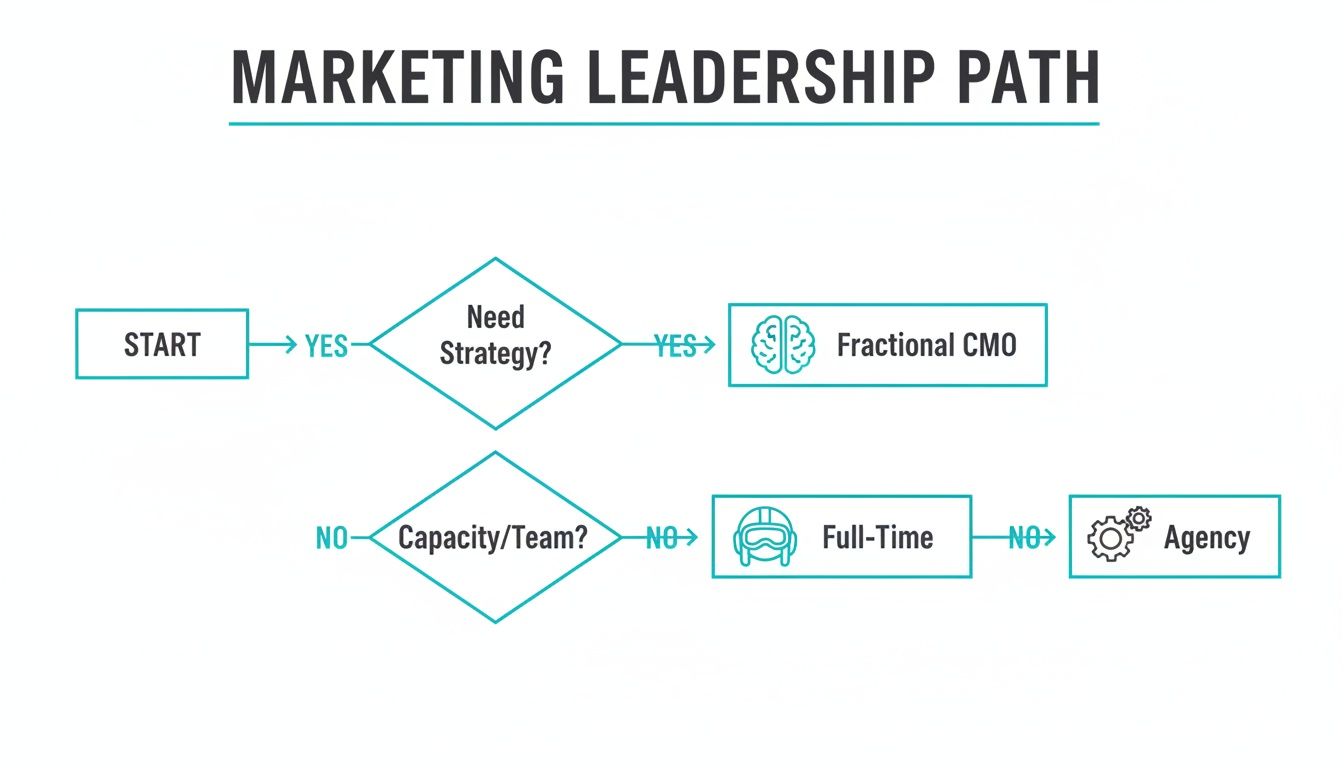
The key takeaway? When strategic direction is the primary gap, a fractional CMO is the most direct and efficient solution.
This isn't just about saving money; it's about investing smarter. By opting for a fractional CMO, you're not just cutting costs—you're redirecting capital from overhead into high-impact marketing activities that fuel real growth.
This strategic hire has a direct impact on key financial metrics. By implementing a focused, data-driven strategy, a fractional CMO can significantly lower your Customer Acquisition Cost (CAC) and improve lead conversion rates. Their expertise leads to a more efficient marketing spend and a clear lift in marketing-attributed revenue, turning your marketing function into a predictable and profitable growth engine.
How to Find and Vet the Right Fractional CMO
Hiring a fractional marketing leader isn’t like your typical recruitment process. You’re not just filling a seat on the org chart; you’re bringing in a strategic partner to build your entire growth engine from the ground up. The process demands a totally different lens—one focused on proven outcomes, not just a polished resume.
The goal is to find someone who has already solved the exact set of problems you’re facing right now. You need a strategic operator, not a consultant who just delivers a PowerPoint plan and walks away.
Where to Find Top-Tier Fractional Talent
The best fractional CMOs aren't hanging out on standard job boards. They’re usually found through curated networks and specialized firms that do the initial vetting for you.
Your search should focus on places where high-caliber talent gathers:
- Specialized Firms: Companies that live and breathe fractional placements, like Chief Outsiders or Kalungi, are an excellent starting point. They maintain a deep bench of leaders with specific B2B SaaS and tech experience.
- Curated Networks: Platforms like Fractional Jobs are essentially vetted databases of senior-level executives. This can be a more direct and efficient way to find a perfect match for your niche.
- Professional Platforms: LinkedIn is a goldmine if you know how to use it. Search for profiles with "Fractional CMO" or "Interim CMO" and zero in on people with deep experience in your space. Pay close attention to their recommendations and any case studies they share.
No matter where you look, the key is to hunt for evidence. A great candidate won’t just list their old responsibilities; they’ll show you the results they drove for companies just like yours.
When you're vetting a fractional CMO, their case studies are far more important than their resume. A list of past job titles is interesting, but a documented history of solving growth problems like yours is what really matters.
Critical Interview Questions to Uncover Strategic Depth
Once you have a shortlist, the interview is where you separate the real strategists from the tacticians. You need to test their thinking, not just their knowledge of marketing channels. Ditch the generic questions and dig deep into their actual process.
For a complete playbook, check out our detailed guide on how to hire a fractional CMO.
Here are a few powerful questions designed to reveal how they tackle real-world challenges:
- "Walk me through your process for building a 90-day marketing plan for a company like ours."
- What you're listening for: A great answer always starts with discovery—auditing the current state, talking to customers, and aligning with sales. They should outline a clear, phased approach that moves from diagnosis to strategy to execution.
- "How would you diagnose a broken or underperforming marketing funnel?"
- What you're listening for: Look for a data-first methodology. They should talk about analyzing conversion rates at each stage, identifying the bottlenecks, and using CRM data and analytics to prove where the problem is.
- "Describe a time you had to pivot a marketing strategy that wasn't working. What happened, and what did you do?"
- What you're listening for: This question tests adaptability and problem-solving. A strong candidate will show humility and a commitment to results over ego, explaining how they used data to justify the change.
Red Flags to Watch Out For
Just as important as knowing what to look for is knowing what to avoid. A few warning signs can help you dodge a bad fit before it’s too late.
Be wary of candidates who:
- Promise immediate, unrealistic results. Real growth takes time. Anyone guaranteeing 10x returns in the first month is selling you hype, not a strategy.
- Focus on buzzwords over process. If they talk a lot about "synergy" and "growth hacking" but can't explain their step-by-step approach, they probably lack the operational depth to execute.
- Lack specific B2B tech or SaaS experience. Your industry has unique challenges. A leader without relevant experience will spend your time and money learning on the job.
Finding the right fractional CMO service is really about finding a partner who brings a proven system for growth. By focusing your search on specialized networks and asking questions that test strategic thinking, you can confidently find the expert who will build the foundation for your company's future success.
Your First 90 Days with a Fractional CMO
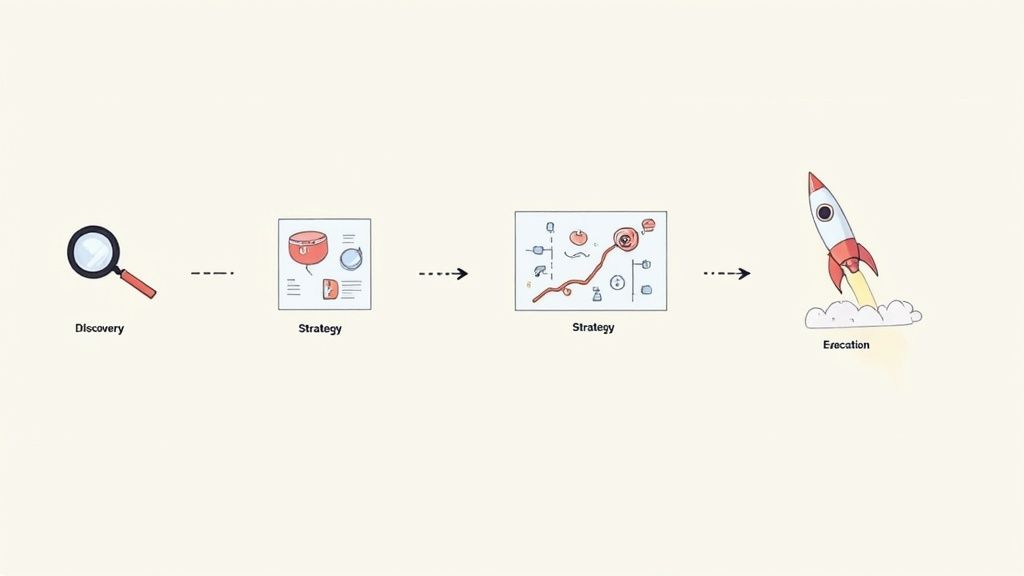
So, you’ve hired a fractional CMO. What actually happens next? The first three months aren’t about launching a whirlwind of new campaigns. It’s about building a solid, strategic foundation so that every marketing dollar you spend from day 91 onward is aimed at the right target.
A great fractional CMO service follows a structured approach to turn ambiguity into a clear, actionable growth plan. Think of it as building a high-performance engine, not just slamming on the accelerator. We move from diagnosis to strategy to execution in a deliberate sequence.
Phase 1: Discovery and Audit (Days 1-30)
The first 30 days are all about deep listening and diagnosis. Your new leader embeds themselves in the business to understand the full picture—what's working, what isn't, and where the biggest opportunities are hiding. They aren’t there to make assumptions; they're there to gather data and facts.
Key activities during this phase usually include:
- Stakeholder Interviews: Talking with sales, product, and leadership to get a 360-degree view of business goals and internal challenges.
- Customer and Market Research: Digging into your Ideal Customer Profile (ICP) and mapping out the competitive landscape. Who are you selling to, and who are you up against?
- Tech Stack and Funnel Audit: Analyzing your current marketing technology, data, and conversion points to find leaks and bottlenecks.
Phase 2: Strategy and Planning (Days 31-60)
With a clear diagnosis in hand, the next month is dedicated to building the blueprint. This is where your fractional CMO translates insights from the discovery phase into a prioritized, documented marketing strategy. It’s all about defining the "what," "why," and "how" of your growth plan for the next six to twelve months.
You can expect to receive:
- A formalized marketing strategy that outlines core objectives, messaging, and KPIs.
- A detailed 90-day execution plan with clear priorities, owners, and timelines.
- A proposed marketing budget that ties every dollar of spending to a strategic goal.
Phase 3: Execution and Optimization (Days 61-90)
Now, the plan comes to life. In the third month, your fractional CMO shifts from architect to general contractor, leading the execution of the newly defined strategy. This phase is about getting quick wins on the board, testing assumptions, and establishing an operational rhythm for ongoing success.
The first 90 days with a fractional CMO aren’t just about planning; they are about building momentum. The process moves from deep analysis to a clear strategic roadmap, culminating in focused execution that sets the stage for scalable growth.
This is also where key performance indicators (KPIs) become the central focus. A good leader will set up dashboards to track progress on metrics that matter, like Marketing Qualified Leads (MQLs), pipeline value, and marketing-attributed revenue.
The growth in this model is hard to ignore. The fractional CMO market is projected to see a 50% increase in positions by 2025 as more companies catch on. Businesses that adopt this model see 29% higher revenue growth on average, driven by better lead quality and sales velocity. You can find more insights about how fractional leaders are driving growth in tech on growthgenerators.io.
By the end of 90 days, you won't just have a plan; you'll have a functioning marketing engine poised for real, sustainable growth.
A Few Common Questions About Fractional CMOs
Even after seeing the benefits, most founders and CEOs still have a few questions before they pull the trigger on a fractional CMO service. It's a big decision, and you deserve straight answers. We've compiled the questions we hear most often from B2B tech leaders to give you the clarity you need.
Let’s dig in.
How Long Does a Typical Engagement Last?
There’s no magic number, but most fractional CMO engagements run between 6 to 18 months. That gives the leader enough runway to handle discovery, build a solid strategy, and get the first few big campaigns out the door. The goal is never to create a permanent dependency—it’s to build a marketing engine that runs on its own, then hand you the keys.
The timeline really hinges on your goals:
- Short-Term Sprints (3-6 Months): This works great for a specific project, like nailing a product launch or building your first real go-to-market strategy.
- Longer-Term Builds (12+ Months): This is a better fit if you're making a major strategic pivot, scaling up a team, or chasing big revenue milestones that take time.
How Do They Integrate with Our Full-Time Team?
A great fractional CMO doesn't just email in a plan from the sidelines. They become an embedded part of your team. Their first job is to build trust with your existing people, whether that’s a couple of junior marketers or just your head of sales wearing a marketing hat on Tuesdays.
They plug in by:
- Mentoring and coaching: They level up your current team members, turning junior staff into more capable, confident marketers.
- Running the meetings: They take charge of the weekly marketing syncs, set the agenda, and build a rhythm of accountability.
- Aligning with other leaders: A huge part of their job is making sure marketing is in lockstep with sales, product, and finance. No more silos.
The best fractional CMOs feel like a seamless part of your leadership team. They bring structure and focus, empowering your full-time employees to do their best work without feeling micromanaged.
Can a Fractional CMO Manage an Agency or Freelancers?
Absolutely. In fact, it's one of their most valuable functions. Many startups already have a few agencies or freelancers handling things like SEO, content, or paid ads. A fractional CMO steps in to manage all those moving parts.
They make sure every vendor's work ladders up to the main strategy and delivers a real ROI. This is a massive time-saver. Instead of you juggling five different contacts, your fractional leader becomes the single point of accountability, making sure you get what you’re paying for.
Ready to see how a seasoned marketing leader can build your growth engine without the full-time cost? Value CMO provides the strategic expertise B2B tech companies need to achieve predictable revenue. Learn more about our approach and book a discovery call today.