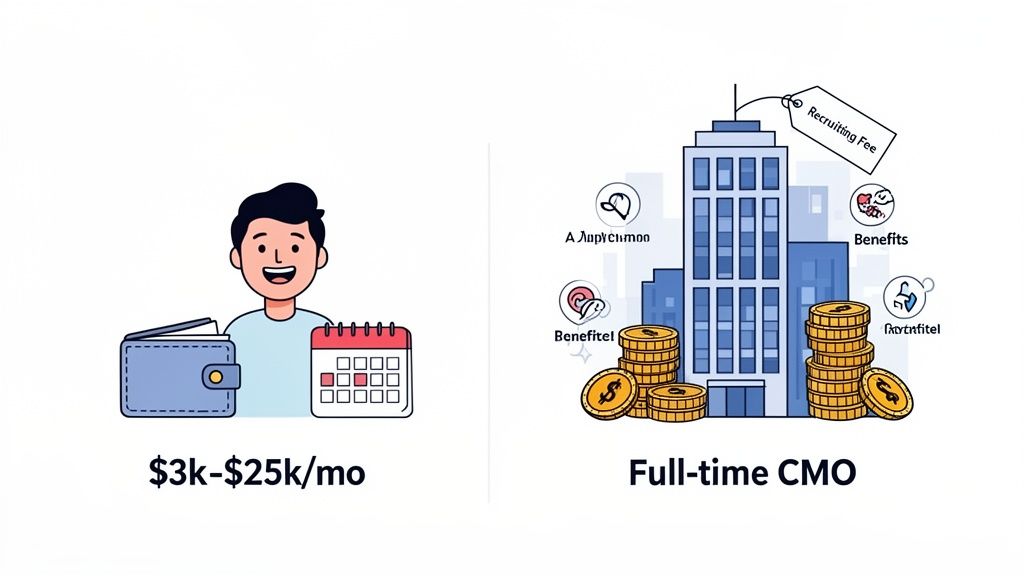
Let's get straight to the point: a fractional CMO typically costs between $3,000 and $25,000 per month. That might sound like a wide range, but it's a massive strategic advantage when you stack it up against the alternative—hiring a full-time executive.
The Real Cost of Marketing Leadership
Hiring a fractional CMO isn’t about finding a cheap replacement; it's about making a smarter investment.
Think of it this way: bringing on a fractional expert is like getting an all-access pass to a world-class gym. You get to use the elite equipment and trainers exactly when you need them. Hiring a full-time CMO, on the other hand, is like buying the entire gym outright—a massive capital expense, whether you use every machine or not.
For B2B tech startups and scale-ups where every dollar has a job to do, that distinction is everything. You get C-suite expertise without the staggering overhead.
Unpacking the Full Financial Picture
When founders look at the fractional CMO cost, it's easy to just compare the monthly fee to a salary. But that misses the real story. The true savings pop out when you look at the total financial baggage that comes with a full-time executive.
Beyond the six-figure salary, you're on the hook for a lot more:
- Hefty Bonuses: Performance bonuses can easily tack on another 15-30% to the base salary.
- Equity Dilution: Stock options are standard, which means less ownership for you and your early investors.
- Benefits and Overhead: Health insurance, retirement plans, and payroll taxes add another 20-30% to the total compensation package.
- Recruiting Fees: Finding top C-suite talent is expensive. Headhunter fees often hit 20-30% of the first year's salary.
A fractional CMO engagement wipes these extra costs right off the books. The fee is all-inclusive, giving you a predictable, clean monthly expense without the long-term financial drag.
Full-Time CMO Vs Fractional CMO Annual Cost Breakdown
Let’s put some real numbers on this. The table below lays out the fully-loaded annual cost of a full-time CMO versus a mid-range fractional CMO.
| Cost Component | Full-Time CMO (Annual) | Fractional CMO (Annual) |
|---|---|---|
| Base Salary | $250,000 | N/A |
| Performance Bonus (20%) | $50,000 | N/A |
| Benefits & Overhead (25%) | $62,500 | N/A |
| Recruiting Fee (25%) | $62,500 | N/A |
| Fractional Retainer ($12k/mo) | N/A | $144,000 |
| Total Annual Cost | $425,000 | $144,000 |
The numbers don't lie. A full-time CMO can easily cost a B2B tech company between $400,000 and $725,000 per year. Opting for a fractional leader can slash those leadership costs by 50-70%, freeing up critical capital for growth.
This isn’t just about saving money—it's about reallocating it. The capital you save can be poured directly into the marketing programs, tech, and talent that actually move the needle. You can learn more about how the role works in our guide on what a fractional CMO is.
Ultimately, by choosing a fractional leader, you're not just cutting an expense line; you're funding your own growth engine.
How Fractional CMO Pricing Models Work
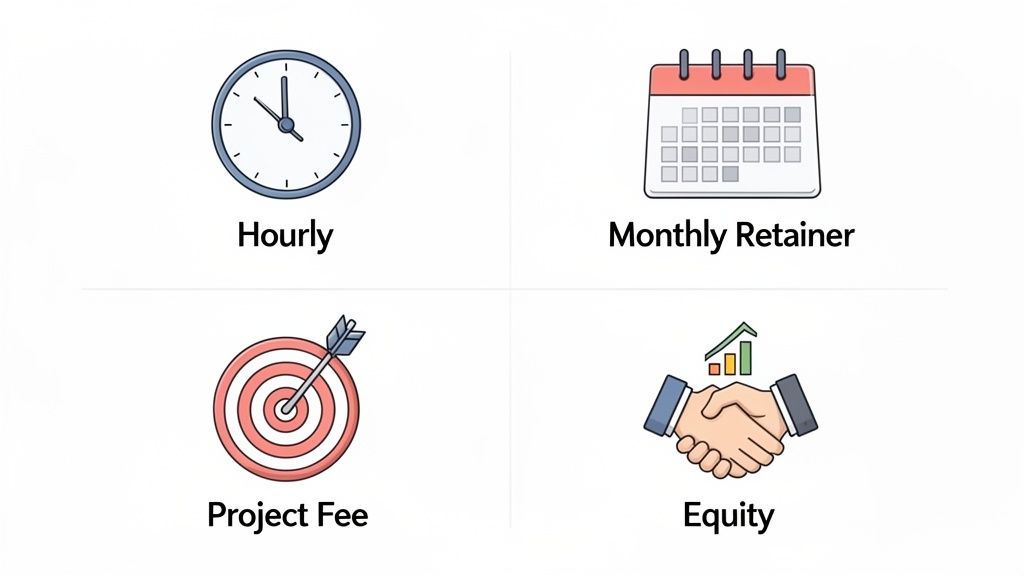
Before you can figure out the fractional CMO cost, you have to understand how they bill. It's not like a simple salary. These pricing models are built for flexibility, letting you match your spend directly to what your startup needs right now.
Think of it like hiring a personal trainer. You can pay by the hour to fix your form, put them on a monthly retainer for steady progress, or fund a complete 12-week transformation program. Each model serves a different goal. The same is true here.
Let's unpack the four most common ways fractional CMOs structure their fees, using scenarios any B2B tech founder will recognize.
The Hourly Rate Model
This is the simplest model: pay-as-you-go. It’s perfect when you need a quick shot of senior-level thinking without a long-term commitment.
The hourly model shines for specific, short-term tasks. Maybe you need an expert to stress-test your go-to-market messaging or give a second opinion on your tech stack before you sign a big contract. Rates for experienced fractional CMOs typically land between $150 and $350+ per hour, depending on their track record.
- Best For: Quick strategic reviews, ad-hoc problem-solving, or pre-launch workshops.
- Think of It As: Calling a specialist for a consultation on a specific problem, not booking a full annual check-up.
- B2B Tech Scenario: Your startup has a huge investor meeting next week. You hire a fractional CMO for a half-day to sharpen your pitch and make sure the marketing slides are bulletproof.
The Monthly Retainer Model
The monthly retainer is the workhorse of fractional engagements. It gives you budget predictability and guarantees you have consistent access to your marketing leader.
With a retainer, you're not just buying hours—you're securing a partner. They become an integrated part of your leadership team, overseeing strategy and driving execution week after week. Retainers can run from $6,000 to over $25,000 a month, reflecting how deeply they’re involved.
A monthly retainer shifts the focus from counting hours to achieving outcomes. You're investing in continuous momentum and strategic direction that adapts as your business grows.
The Project-Based Fee Model
Sometimes you don’t need ongoing help, but you have one big, well-defined project that absolutely has to be done right. That's what project-based pricing is for.
This model uses a fixed fee for a specific outcome with a clear start and end. It’s ideal for things like building a complete go-to-market strategy, overhauling your brand messaging, or creating a content engine from the ground up. Project fees can be anywhere from $8,000 for a small initiative to $30,000+ for a complex GTM plan.
- Best For: One-off strategic sprints with clearly defined deliverables.
- Think of It As: Hiring a contractor to build a deck. You agree on the design and price upfront, and they deliver the finished product.
- B2B Tech Scenario: Your SaaS company is moving into a new vertical. You bring in a fractional CMO for a six-week project to handle market research, validate your ICP, map out a channel strategy, and plan the first campaigns.
The Equity Model
For very early-stage startups where cash is tight but the vision is huge, an equity model can be a game-changer. It’s less common but signals the deepest level of partnership.
Here, the fractional CMO takes a slice of their compensation in company stock, tying their success directly to yours. This is usually paired with a smaller cash retainer. It’s a powerful way to land A-list talent you can't yet afford, turning a consultant into a true long-term partner.
What Drives a Fractional CMO’s Price Tag?
Ever get a quote for $5,000 a month from one fractional CMO and $15,000 from another and wonder what’s going on? It’s not random. That price gap comes down to a few core variables that spell the difference between a high-level advisor and a hands-on growth driver.
Getting a handle on these factors is the key to evaluating proposals like a pro. Instead of just comparing numbers, you can start to see the actual expertise and impact you’re paying for. Think of it like buying a car—the base model gets you there, but the fully-loaded performance version is a different machine entirely.
Let's unpack the four biggest things that move the needle on cost so you know exactly what you’re investing in.
The Scope Of Work
The single biggest factor is the scope. What, exactly, are you asking the fractional CMO to own? The price is a direct reflection of their level of hands-on involvement.
A purely strategic advisor who joins a few leadership calls a month to offer guidance is one thing. They’re the architect drawing the blueprint. That’s valuable, but it’s a lighter lift and will cost less.
But what if you need a leader to roll up their sleeves, manage your marketing team, own the vendor relationships, and drive the execution of the entire growth plan? That’s a much bigger commitment. This person isn’t just the architect; they're the general contractor running the entire job site.
Think about scope in these tiers:
- Strategic Oversight: High-level GTM strategy, positioning, and planning. This is the least intensive and most affordable option.
- Team Leadership & Mentorship: Involves managing your existing marketers, setting KPIs, and coaching them up.
- Full Functional Ownership: The most comprehensive scope. The fractional CMO runs the entire marketing function—from budget and tech stack to campaign execution and board reporting.
Experience And Niche Specialization
Not all marketing leaders are built the same. You’d pay more for a surgeon who’s done a complex procedure a thousand times, right? It’s the same here. You pay a premium for a fractional CMO with deep, proven experience in your specific corner of the tech world.
A generalist with broad B2C experience might come in with a lower rate. But a veteran who has scaled three B2B SaaS companies from $5M to $50M ARR brings a playbook, a network, and a sixth sense for what works. You’re not just buying their time; you’re buying their judgment, which has been battle-tested for years.
When you hire a specialist, you're buying speed. They've already made the mistakes somewhere else, so they can help you avoid them, accelerating your path to revenue.
This is especially true in complex niches like fintech, health tech, or enterprise software, where knowing the regulatory landscape, long sales cycles, and buyer committees is non-negotiable. An expert in your world can deliver value in weeks, not months.
Expected Deliverables And Outcomes
Next up: what do you actually get? The cost is directly tied to the results the fractional CMO is on the hook for.
Is the main deliverable a documented strategy—like a 90-day marketing plan or a new messaging guide? Those are tangible, but they are finite outputs.
Or is the fractional CMO expected to move the needle on specific business outcomes? Think hitting a target like increasing MQLs by 40% in six months or cutting customer acquisition cost (CAC) by 25%.
Engagements focused on hard business metrics demand more intensive work and carry more accountability, which naturally commands a higher price. Be clear with yourself: are you paying for a plan, or are you paying for the performance that plan is supposed to generate?
Engagement Duration And Intensity
Finally, the length and intensity of the engagement matter. A short, intense project is priced differently than a long, steady partnership.
- Short-Term Sprint (e.g., 3 months): Often used to hit a specific goal, like a product launch or a strategic reset. These gigs are usually intensive, requiring more of the CMO’s weekly focus and carrying a higher monthly rate.
- Long-Term Partnership (e.g., 12+ months): A longer commitment often comes with a slightly lower monthly retainer, as the CMO becomes a stable part of your leadership rhythm. The value here is in sustained momentum and continuous improvement.
At the end of the day, a higher fractional CMO cost shouldn’t be a red flag. It’s often a signal that you’re investing in a deeper scope, more specialized expertise, and a real commitment to driving business results.
Finding The Right Engagement Level For Your Startup
Picking a fractional CMO engagement isn’t like ordering from a menu. It’s more like getting a diagnosis. You have to understand your startup’s specific growing pains to find the right cure.
The best engagement always matches your most pressing challenge. This makes sure you’re not paying for a long-term overhaul when all you really need is a quick, strategic fix to get unstuck.
Over the years, I've seen it all. There’s the early-stage founder with a dozen great ideas but no clear direction. Or the scale-up where sales and marketing can't seem to agree on what a good lead even is. And, of course, the high-growth company stuck in a tactical rut, doing a lot but moving nowhere.
This is your playbook for connecting the problem to the right solution. Let’s break down the most common challenges and the exact engagement models built to solve them.
Problem One: You Need A Clear Direction, Fast
You're an early-stage B2B tech founder with a fantastic product, but the road ahead is foggy. The questions just keep piling up. Who is our real ideal customer? Which marketing channels should we ignore? What's the one message that will actually cut through all the noise?
When you're facing this, you need an Ignition Plan.
The Ignition Plan is a short, high-impact sprint designed to deliver one thing: strategic clarity. We’re not trying to boil the ocean here. The entire point is to build a solid foundation and a 90-day roadmap you can start executing immediately.
- The Process: Think of it as a concentrated dose of strategy. We run a series of intense workshops covering your Ideal Customer Profile (ICP), core messaging, competitive positioning, and a prioritized channel strategy.
- The Outcome: You walk away with a documented go-to-market plan, clear messaging pillars, and an actionable 90-day roadmap. No fluff, just focus.
- Best For: Seed-stage or pre-Series A startups that need to go from just "doing things" to "doing the right things" without a big, long-term commitment.
Problem Two: Sales and Marketing Are Not Aligned
Sound familiar? Your sales team complains about lead quality, while your marketing team feels completely unappreciated. They use different language, track different metrics, and point fingers when revenue targets get missed. It's a classic—and very costly—disconnect.
This is a clear signal that you need an Alignment Sprint.
This engagement is built specifically to bridge the gap between your commercial teams. A fractional CMO steps in as the translator and facilitator, getting everyone unified around a single source of truth for your customer and your go-to-market motion.
The goal of an Alignment Sprint isn't just to make teams talk; it's to make them operate as one unified revenue engine, driven by shared goals and a crystal-clear understanding of the customer journey.
The sprint is all about co-creating the essential assets that force alignment:
- Shared ICP Definition: Getting both teams to finally agree on exactly who you’re selling to.
- Unified Messaging: Crafting value propositions and talking points that sales can actually use.
- Service-Level Agreements (SLAs): Defining the handoff process from MQL to SQL so nothing ever falls through the cracks again.
- Tech Stack Audit: Making sure your CRM and marketing automation tools are actually set up to support a seamless process, not hinder it.
The outcome is a cohesive team that’s finally ready to execute a strategy everyone actually believes in. The fractional CMO cost for a targeted sprint like this is a tiny price to pay for fixing a leaky revenue pipeline.
Problem Three: You Are Ready To Scale But Lack Leadership
Your startup has hit an inflection point. You have product-market fit, you have funding, but growth has flatlined. Your marketing team is full of talented specialists, but they don't have the senior leadership to connect their day-to-day work to the big-picture business goals.
This is the moment for a CMO Accelerator.
The CMO Accelerator is the most comprehensive engagement, providing ongoing, embedded strategic leadership. The fractional CMO doesn’t just advise from the sidelines; they become part of your leadership team, own the marketing function, and drive execution month after month.
This decision tree shows how things like scope, experience, and deliverables all play into your fractional CMO cost.
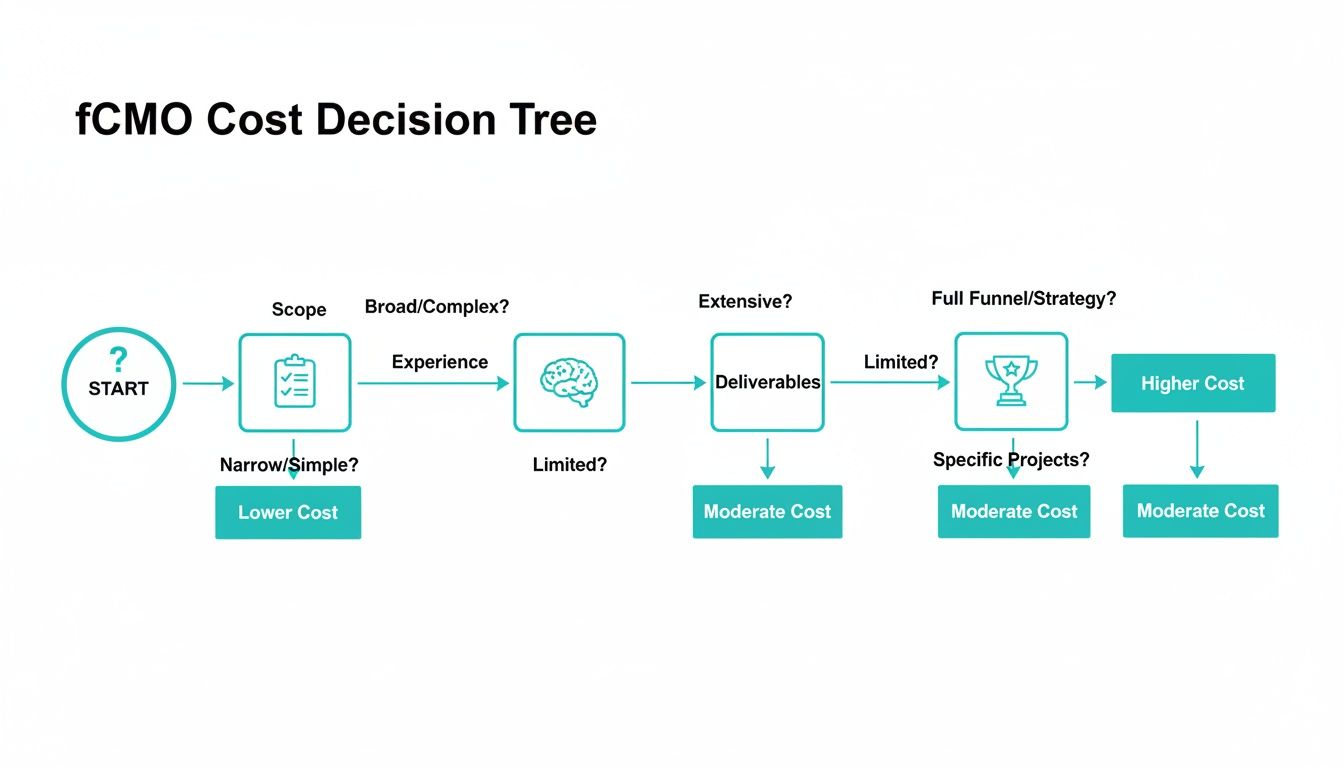
As you can see, a broader scope and a need for more seasoned leadership directly increase the investment required.
This model is all about building a sustainable growth engine. It includes:
- Developing a full-funnel marketing strategy and budget.
- Managing and mentoring your existing marketing team.
- Selecting and managing vendors and the martech stack.
- Reporting on performance to the executive team and board.
This is the right move when you need true C-suite expertise to navigate the complexities of scaling up. If you're ready to make this strategic hire, you can learn more about how to hire a fractional CMO and what to look for in a partner.
Which Value CMO Engagement Is Right For You?
To make it even clearer, here's a quick summary to help you map your business challenge directly to the right solution.
| Engagement Model | Best For | Primary Outcome |
|---|---|---|
| Ignition Plan | Early-stage startups needing a clear go-to-market strategy without a long commitment. | An actionable 90-day marketing roadmap and foundational messaging. |
| Alignment Sprint | Companies where sales and marketing teams are out of sync, hurting revenue. | A unified commercial team, shared goals, and a streamlined lead process. |
| CMO Accelerator | Scale-ups with product-market fit that need ongoing executive leadership to grow. | A sustainable growth engine managed by an experienced marketing executive. |
Ultimately, the goal is to get the right level of support for the specific stage you're in. Whether it's a quick injection of strategy or long-term leadership, there's a model designed to help you get to the next level.
Calculating The Real ROI Of Your Investment
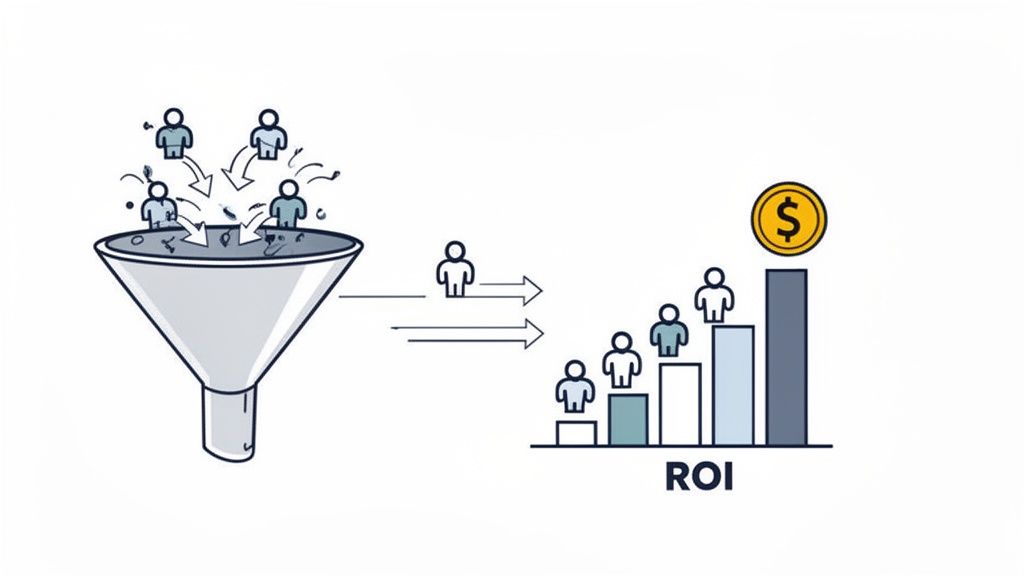
Let's shift the conversation from fractional CMO cost to return on investment. This is where the real value snaps into focus. Saving a bundle on a full-time hire is a great start, but the true power of a fractional leader is their ability to make you money.
Think of it less as an expense line and more as a high-impact investment in your growth engine.
So, how do you actually measure the returns? A great fractional CMO’s impact is rarely fuzzy. It shows up in hard numbers across your entire sales and marketing funnel, turning smart strategies into real revenue.
Accelerating Your Time-To-Market
One of the first places a fractional CMO delivers ROI is by increasing your speed. For a B2B tech startup, every month you put off a product launch is a month of lost revenue and another month for competitors to gain ground. A seasoned leader has a playbook for this.
They don’t waste time reinventing the wheel. They bring proven frameworks for go-to-market strategy, channel selection, and messaging that cut right through the noise. This lets you launch faster and more effectively, capturing revenue weeks or even months sooner.
The ROI here is simple: it’s the revenue you capture by not waiting. A fractional CMO collapses the learning curve, turning hesitation into immediate, focused action.
Plugging Leaks In Your Sales Pipeline
Is your sales team constantly complaining about lead quality? A "leaky" pipeline—where potential customers drop off between stages—is a massive, hidden cost. This is where a fractional CMO can make a swift and significant impact.
They step in to align sales and marketing, making sure the leads marketing generates are the ones sales actually wants. By refining your Ideal Customer Profile (ICP), sharpening your messaging, and optimizing conversion points, they directly improve the quality of your entire pipeline.
This leads to higher conversion rates at every single stage. A 5% lift in your lead-to-opportunity conversion rate doesn't just sound good; it translates directly into more deals from the exact same marketing spend. That's a clear, trackable return.
Driving Down Customer Acquisition Cost (CAC)
Customer Acquisition Cost (CAC) is a critical metric for any startup. It’s the total cost of your sales and marketing efforts to acquire one new customer. A high CAC can burn through your funding and kill your ability to scale.
A fractional CMO tackles this head-on by optimizing your entire marketing mix. They find and cut wasteful spending on channels that aren't performing while doubling down on the ones that deliver high-quality customers efficiently.
- Example Scenario: Imagine a B2B SaaS company spending $15,000 a month on various channels with a CAC of $5,000. A fractional CMO, costing $10,000 a month, reallocates the budget, refines targeting, and improves landing page conversions.
- The Result: Within six months, the CAC drops to $3,500. This 30% reduction means they can now acquire more customers for the same budget, directly boosting the ROI of every single marketing dollar spent.
Increasing Marketing-Sourced Revenue
Ultimately, the most important metric is revenue. A fractional CMO’s primary job is to build a predictable engine that generates a steady stream of marketing-sourced revenue. They do this by focusing on measurable outcomes, not just busywork.
A key part of their role involves strategic content initiatives, and it's crucial to apply clear methods for measuring content marketing ROI to see the direct business value.
Consider a $10,000 monthly investment in a fractional CMO. If they build a demand generation program that leads to a 40% increase in qualified leads in six months, and your sales team converts those leads at their typical rate, the return is undeniable. You can draw a straight line from their strategy to the new deals closed.
For a deeper dive, check out our guide on how to measure marketing ROI.
Answering Your Top Questions About Fractional CMOs
By now, you've seen the numbers, run through the models, and looked at the ROI. But getting over the finish line usually comes down to a few practical questions that are still kicking around in your head. When you’re on the fence, a straight answer makes all the difference.
This section tackles the most common questions founders ask right before bringing on a fractional CMO. Let's clear up any final gray areas so you can move forward with confidence.
How Is A Fractional CMO Different From A Marketing Agency?
This is probably the question I hear most, and the difference is critical. It’s like hiring an architect versus hiring a construction crew.
An agency is your crew—a team of skilled specialists you hire to execute specific jobs. They're great at building the walls (running paid ads), installing the plumbing (handling SEO), or wiring the house (creating content). You give them a project, they get it done.
A fractional CMO, on the other hand, is the architect. They own the entire vision. They draw the blueprint, make sure every piece fits together, and are ultimately accountable for whether the final structure is sound and hits your goals. They provide strategic ownership from inside your leadership team.
A fractional CMO is an embedded leader who sets the strategy and owns the outcome. An agency is an external partner that executes specific parts of that strategy. You need the architect before you can effectively direct the construction crew.
So, while you might hire an agency to manage your LinkedIn campaigns, you hire a fractional CMO to decide if LinkedIn is even the right channel to begin with, how it fits into the go-to-market plan, and what the budget and goals should be.
How Long Does It Take To See Real Results?
Every business is unique, but you should see progress in clear stages. A good fractional CMO engagement follows a 30-60-90 day roadmap that delivers value at each step, moving from foundational work to measurable impact. Big strategic shifts take time, but you won't be left wondering if anything is happening.
Here’s a typical timeline:
- First 30 Days (Discovery & Quick Wins): The first month is a deep dive. Your fractional CMO will be auditing your current marketing, tech stack, team skills, and sales data. From this, you should see quick wins pop up—things like sharpening your ideal customer profile (ICP) or optimizing a key landing page.
- By Day 60 (Strategy & Execution Kickoff): With a solid grasp of the business, a formal strategic plan is locked in. This isn't just a document; it's an actionable roadmap. Execution begins on the highest-priority initiatives, whether that's launching a new messaging framework or kicking off a demand gen campaign.
- By Day 90 (Leading Indicators of Success): Three months in, you should see clear leading indicators that the strategy is working. It might not be a huge jump in revenue yet, but it will be tangible progress like a 20% increase in qualified leads, faster pipeline velocity, or higher website conversion rates. You’ll have data proving you’re on the right track.
Can A Fractional CMO Manage My Existing Marketing Team?
Absolutely. In fact, this is one of their most valuable functions. A fractional CMO isn't just a strategist who drops off a plan and disappears. They are a leader and mentor who elevates your entire marketing function from the inside.
This is a huge win for startups with talented but more junior team members. Your marketing coordinator or digital specialist is probably great at their job, but they don't have the senior-level experience to connect their daily tasks to the company's big-picture revenue goals.
A fractional CMO bridges that gap. They can:
- Provide Clear Direction: Set clear KPIs and goals so everyone knows what they’re working toward and why it matters.
- Mentor and Upskill: Coach your junior marketers, helping them grow their skills and take on more strategic work.
- Build a Cohesive Engine: Turn a group of individual contributors working in silos into a focused, high-performing team executing a unified plan.
This function builds your company’s long-term internal capabilities, making your team more effective even after the fractional engagement ends.
How Should I Budget For A Fractional CMO Engagement?
Thinking about the fractional CMO cost requires a bit of a mindset shift. Instead of seeing it as another operational expense, frame it as a direct investment in a specific growth target.
For example, if your goal is to add $1 million in new pipeline next quarter, what percentage of that return are you willing to invest in the strategic leadership needed to get there? Tying the budget to an outcome makes the decision much clearer.
When negotiating, focus the conversation on the deliverables and results you need, not just the hourly rate. A cheaper option that delivers a generic plan is far more expensive than a premium partner who can actually help you hit your revenue goals.
A smart way for many startups to start is to think small. Begin with a defined, project-based engagement like an Ignition Plan or an Alignment Sprint. This lets you test the partnership, see their working style, and confirm it's a great fit before committing to a longer-term retainer. It de-risks the investment and ensures you find the right strategic partner to help you scale.
Ready to stop guessing and start growing? Value CMO provides the senior marketing leadership B2B tech startups need to build a focused, data-driven growth engine. We deliver practical, no-fluff plans that create momentum and measurable results.
Book a free consultation today to see how we can help you scale.