Let's be real for a second. "Market positioning" sounds like stuffy corporate jargon you're supposed to nod along with. But it's not. At its heart, it’s about finding your unique spot in a crowded market and owning it inside your customer's head. It's the simple, killer answer to the question: "Why should our ideal customer choose us over every other option out there?"
What Is Market Positioning and Why It Matters
Imagine the B2B tech market is a packed stadium parking lot. Without a clear position, you're just another car circling endlessly, hoping someone—anyone—notices you. Market positioning is your reserved spot right by the entrance. It makes you the obvious, easy choice for the right people.
It’s all about the strategic work of defining how your brand is the only real solution for a very specific audience. This isn't just a fluffy marketing exercise; it's a core business strategy. A strong position becomes your company's North Star, guiding every single decision you make.
Your Startup's North Star
When your positioning is sharp, it has a ripple effect on the most critical parts of your business, especially for a startup trying to break through. It tells you how to build your product, who your salespeople should be talking to, and what stories your marketing team needs to tell.
Get this right, and you'll see the benefits pile up fast. A well-defined position helps you:
- Attract Better Leads: When your message is specific, you pull in prospects who already get your value. You stop wasting time on folks who were never going to be a good fit.
- Shorten Sales Cycles: Prospects just "get it" faster. Your sales team can spend less time explaining the basics and more time closing deals because your value is crystal clear from day one.
- Command Higher Prices: A unique position means you’re not just another commodity competing on price. You're selling a specific outcome or solution that justifies a premium.
- Build a Stronger Brand: Consistency builds trust and recognition. Over time, that makes your company memorable and way more valuable.
Ultimately, great market positioning is how you nail what is product market fit, making sure your product resonates so deeply with your target audience that it feels like it was built just for them.
In B2B tech, a vague or copycat position is a recipe for being ignored. Your ability to explain where you fit and why you win isn't just important—it’s the foundation for real growth and a much stronger company valuation.
The Essential Frameworks for Your Positioning Strategy
Knowing why positioning is a big deal is one thing. Knowing how to actually do it is a whole different ballgame. Building a strong market position isn't about guesswork or trusting your gut; it's about using proven frameworks to bring some serious clarity to your strategy. Think of these as your workshop tools—each one designed for a specific job.
We'll walk through the four core models every B2B tech founder needs to carve out a distinct space in the market. These frameworks are designed to build on one another, turning fuzzy ideas into a concrete plan that guides your entire go-to-market strategy.
This visual shows exactly how it all connects—how a clear position becomes the guiding force that attracts the right customers and defines your place in the market.
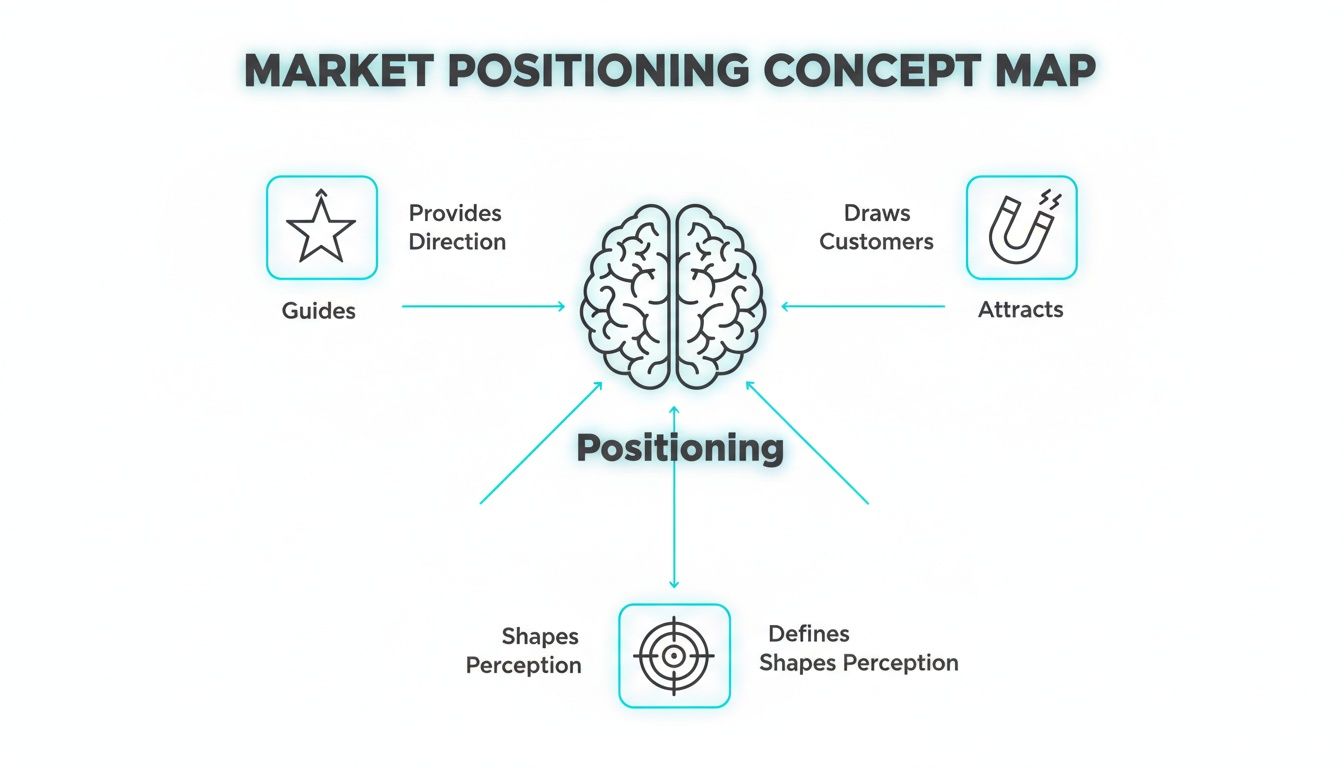
Get these pieces right, and they snap together to create a powerful, unified message that your ideal buyer actually understands and cares about.
To bring this to life, here’s a quick summary of the core frameworks we'll be breaking down. Each one plays a unique role in building your strategic foundation.
Positioning Frameworks at a Glance
| Framework | Primary Purpose | Key Question It Answers |
|---|---|---|
| Positioning Statement | Internal alignment and clarity | Who are we, who do we serve, and why are we different? |
| Value Proposition Canvas | Product-market message fit | Does our product solve problems customers actually care about? |
| Perceptual Map | Competitive landscape visualization | Where is the uncontested space in our market? |
| ICP Alignment | Audience focus and precision | Are we aiming all this work at the right target? |
These tools aren't just for a business school textbook; they are the practical building blocks for a positioning strategy that drives real revenue. Now, let’s dig into how to use each one.
1. Crafting a Clear Positioning Statement
Your positioning statement is your internal North Star. It’s a short, sharp description of your target customer, the problem you solve, and what makes you the only logical choice. This isn't marketing copy you splash on your website—it’s the source code for your marketing copy.
Here’s a simple, battle-tested template to get you started:
For [your ideal customer profile], who [has a specific, painful problem], our [product/company] is a [product category] that [delivers a key, measurable benefit]. Unlike [the primary competitor or status quo], we [provide this unique, defensible differentiator].
This little fill-in-the-blanks exercise is deceptively powerful. It forces you to make tough choices about who you serve and how you win. Nail this statement, and you make sure your entire team—from sales to product to marketing—is telling the exact same story.
2. Mapping Your Value Proposition
Next up is the Value Proposition Canvas. Think of this framework as your reality check, making sure the product you’re so proud of actually solves problems your customers lose sleep over. It’s a simple tool that directly connects your product’s features to your customer’s real-world "jobs," "pains," and "gains."
Here's how it breaks down:
- Customer Pains: What frustrates your customers? What roadblocks are killing their productivity?
- Customer Gains: What outcomes would make them look like a hero to their boss? What do they truly want to achieve?
- Product Features: How do your product’s capabilities directly relieve those specific pains and create those specific gains?
This exercise stops you from building features in a bubble. More importantly, it ensures your messaging is always centered on what your customer gets, not just a list of technical specs nobody really cares about.
3. Visualizing the Competitive Landscape
A perceptual map is a simple 2×2 matrix that lets you see the entire competitive playing field at a glance. You pick two attributes that matter most to your customers—think "Price vs. Performance" or "Ease of Use vs. Power"—and plot yourself and your competitors on the grid.
The process instantly shows you where the market is crowded. But its real magic is in revealing the unoccupied white space—the corners of the market no one else is owning. That's your opportunity to build a unique, defensible position.
You can dive deeper into different types of maps in our complete guide to the marketing positioning matrix.
4. Aligning with Your Ideal Customer Profile
Finally, none of this matters if you’re aiming at the wrong target. Every framework we’ve talked about has to be built on the foundation of your Ideal Customer Profile (ICP). Your ICP is a super-specific definition of the exact company that gets the most value from your solution and, in turn, provides the most value back to you.
Getting this right requires a deep, almost obsessive understanding of your audience, often sharpened through a rigorous customer segmentation analysis. Without a crystal-clear ICP, your positioning is just a shot in the dark. With one, every message, feature, and campaign hits its mark.
Learning from Positioning Done Right
Theory is one thing, but seeing great positioning in the wild is what makes it all click. Frameworks are the blueprints; successful companies are the finished buildings. When you look at how B2B tech giants carved out their space, you can see a straight line from a sharp position to total market domination.
These examples aren't just about a clever tagline. They show a deliberate choice to own a specific idea in the customer's mind. It’s the art of becoming the only logical answer to a very specific problem.

Slack: The Email Killer
Before Slack came along, team communication was a hot mess—endless email chains, random IMs, and clunky file-sharing apps. Slack didn’t invent a new technology, but it positioned an existing one in a way that felt like a complete revolution.
Their position was brutally simple: the "channel-based messaging platform" that makes internal email obsolete. By framing the enemy as "email clutter" and their solution as "organized channels," they created an entirely new category in their customers' minds.
You could see this focus everywhere:
- Website Copy: It was all about working together, cutting through the noise, and getting everything in one place.
- Sales Messaging: They hammered home the productivity gains, showing teams how much time they were losing in their inboxes.
- Marketing Campaigns: They weren't just selling a tool; they were spreading the gospel of a new way to work.
Slack’s genius was changing the conversation. They didn't sell a better messaging app; they sold a better, more productive workday. Their biggest competitor wasn't another app—it was just sticking with the old way of doing things.
HubSpot: The Inbound Marketing Engine
HubSpot stepped into a world where businesses lived and died by "outbound" tactics like cold calls and annoying ads. Instead of playing that game, they invented a new one.
Their entire position was built around a single idea: "inbound marketing." They weren't just selling software; they were selling a philosophy. Attract customers with valuable content, don't interrupt them. This perfectly aligned their product with how modern buyers actually research and make purchases.
HubSpot’s software became the essential engine for this new approach. Their blog, free tools, and educational content all reinforced this one idea, simultaneously teaching the market a new way of doing business and positioning their platform as the only one built for it. This kind of consistency is a hallmark of the most effective examples of strategic marketing plans out there.
When you look back at these successes, it’s obvious that their marketing, sales, and product teams were all singing from the same hymn sheet. That alignment is the ultimate goal—turning a strategic choice into undeniable market leadership.
Positioning for Global and Local Markets
It’s easy to think that a powerful message in your home market will work just as well everywhere else. But a one-size-fits-all positioning strategy is one of the most common—and expensive—mistakes a growing startup can make. The value proposition that absolutely crushes it in Silicon Valley might completely fall flat in Berlin or Tokyo.
The real challenge is finding the balance between a consistent global brand and a message that actually connects with people on a local level.
This isn't about reinventing your company for every new country. It’s about speaking the local language of value. True global positioning means adapting your core promise to fit the unique cultural norms, competitive pressures, and customer problems you'll find in each region.
Think Global, Act Local
Your global positioning is your foundation—your core promise and brand identity. Think of it as the "what" and the "why." Local positioning is the "how"—the smart adjustments you make to ensure that promise gets heard and understood.
This means tweaking your messaging to hit on specific local pain points. For example, a productivity tool's main benefit in the U.S. might be framed as “saving time.” In a market like Germany, a more compelling angle could be “improving process efficiency and compliance.” Same product, different value that people care about.
The shift to localized marketing is picking up speed, and it's challenging the old guard of multinational brands. People prefer buying local, and this trend is especially strong in North America. Just look at China, where six of the top ten beauty brands with the fastest market share growth since 2020 are local. It's a clear signal that tuned-in local players can outmaneuver global giants. You can find more on these trends in McKinsey's research on the state of the consumer.
A Framework for Adaptation
Adapting your positioning doesn't mean you have to start from scratch. It’s about making smart, informed tweaks. Here’s a simple way to think about it:
- Analyze Local Competitors: Don't just keep an eye on your global rivals. Who are the local heroes in that market? How are they positioned? Find the gaps they aren't filling.
- Understand Cultural Nuances: How are business decisions made there? Is the communication style direct or more subtle? These little things have a huge impact on how your message is received.
- Validate Pain Points: Never assume the customer's biggest problem is the same everywhere. Jump on some calls with local customers or run surveys to confirm what really matters to them.
The goal is to maintain a consistent brand story worldwide while making your solution feel like it was built specifically for the local customers you’re trying to win. It's the difference between being a tourist and a trusted neighbor.
Common Positioning Mistakes to Avoid
Knowing the theory is great, but knowing where the traps are is half the battle. Even the most promising tech startups can stumble if their positioning is built on a shaky foundation. These aren't just minor missteps—they're strategic errors that lead to confusing messages, wasted marketing dollars, and a product that just gets lost in the noise.
Think of your positioning as the DNA of your go-to-market strategy. If there are flaws in it, those weaknesses will pop up everywhere. Let's break down the most common and damaging mistakes so you can steer clear of them.
Focusing on Features Instead of Outcomes
This is the classic engineer's trap. You’re proud of your elegant code and slick features, so that's what you talk about. The problem? Your customers don't buy features; they buy solutions to their problems. They care about the outcome, not the tech behind it.
Instead of saying, "We have an AI-powered analytics dashboard," you should be saying, "We help you cut your reporting time in half so you can focus on growth." Always translate your features into real, valuable results for your customer.
The most powerful way to explain market positioning is to remember that you aren't selling a drill. You're selling the perfectly-sized hole the customer needs to hang a picture. Your messaging should always focus on the hole, not the drill.
Trying to Be Everything to Everyone
The fear of missing out is a powerful thing, but a vague position is a weak position. When you try to appeal to every possible customer out there, your message becomes so generic that it doesn't really connect with anyone. You end up as just another "all-in-one solution" that sounds exactly like ten of your competitors.
Effective positioning requires making hard choices. It means saying "no" to certain markets so you can become the obvious "yes" for a specific, well-defined audience. Being the go-to solution for one niche is far more profitable than being a forgotten option for everyone.
This is especially critical in markets where generational preferences play a huge role. For instance, brand positioning research shows that around 51% of customers aged 45-54 prefer established, trustworthy businesses over newer entrants. Trying to appeal to them and a younger, more disruptive audience with the same message is a recipe for failure. You can discover more insights on these generational divides to see just how different buyer perceptions can be.
Ignoring Your Competition
Another common mistake is thinking you're so unique that you have no competitors. Here's a reality check: every customer has an alternative, even if that alternative is just using a spreadsheet or sticking with their clunky manual process. Ignoring the competitive landscape means you can't clearly explain why you’re the better choice.
You have to understand how your competitors position themselves so you can find your own unique space. Are they the low-cost option? The premium, white-glove provider? The easiest to use? Find the empty space on the map and own it.
Your Actionable Market Positioning Checklist

Alright, let's move from theory to action. This isn’t just another list to check off; think of it as a practical project plan to get this done, from the first bit of research to a full-blown market launch.
We'll break the work into three manageable phases. This is the bridge from learning about positioning to actually doing it, making sure every step you take is deliberate and builds on the last.
Phase 1: Discovery
The goal here is simple: gather your raw materials. You can't just define your position in a boardroom. This entire phase is about looking outward at the two groups that matter most—your customers and your competitors.
- Talk to Your Customers: Get your best customers on the phone. Ask them why they really chose you, what specific problem you solved, and how they’d describe your company to a coworker. Don't ask leading questions. Just listen.
- Analyze Your Competitors: Map out your top 3-5 rivals. Dig into their website copy, read their G2 reviews (the good and the bad), and see what story their case studies are telling. You're hunting for the gaps in their messaging—the things they aren't saying.
- Nail Down Your Differentiators: Based on what you've learned, what do you do that is both valuable to your customers and genuinely different from the competition? Be brutally honest with yourself here. "Better service" doesn't count unless you can actually prove it.
Phase 2: Strategy
With your research in hand, it’s time to make some choices. This is where you translate all those customer insights and competitive gaps into the core assets that will define your market position.
- Craft Your Positioning Statement: Use that classic template to create a clear, internal North Star. Remember, this isn't marketing copy; it's a tool to get your entire team on the same page.
- Build Your Value Proposition: This is your customer-facing promise. It’s the headline on your website, the hook in your ads. For a deeper dive, check out our guide on how to create a value proposition that actually connects.
- Map Your Market: Draw a simple 2×2 perceptual map. This isn’t just a homework assignment—it’s a way to visually confirm there's open space for you to own.
Phase 3: Activation
A brilliant strategy that lives and dies in a Google Doc is worthless. Activation is all about bringing your positioning to life across every single customer touchpoint, from your website homepage to your sales deck.
This final step is often the hardest. A powerful positioning strategy fails every time without consistent, disciplined execution. The goal is to make your position an undeniable reality in the market.
Lead the Charge: So, who's going to own this? Will you drive it internally, or do you need an outside perspective to speed things up? A fractional CMO can bring both the expertise and the dedicated focus needed to get this done right, get it done fast, and drive immediate momentum.
Got Questions? Let's Clear Things Up.
Even the best plans bring up questions. When founders and marketers start really digging into positioning, a few common ones always seem to pop up. Let's tackle them head-on so you can move forward with confidence.
How Is Positioning Different From Branding?
Think of it like this: positioning is the strategy, branding is the execution.
Positioning is the internal work you do to figure out where you’ll compete and why you’ll win. It's you planting your flag in the ground. Branding is how you communicate that position to the world—your logo, your website's look and feel, your tone of voice.
You absolutely need a clear position before you can build a meaningful brand that actually connects with customers.
How Often Should We Revisit Our Positioning?
Market positioning is definitely not a “set it and forget it” kind of deal. You should plan for a deep review every 18-24 months, or sooner if there’s a major shake-up in your market—like a new competitor landing or a sudden change in what your customers need.
But the real key is to always be listening. If you notice the way customers talk about their problems and your solution no longer lines up with your core message, that's your cue. It's time for a refresh.
Your positioning should be a living part of your business strategy. It needs to be durable enough to guide you but flexible enough to adapt when the market sends you clear signals.
Can We Have More Than One Positioning Strategy?
Nope, you should have one core market position for your company as a whole. This is your anchor.
What you can and should do, however, is create tailored messaging for different buyer personas or industries, all based on that single position. Your core promise never changes, but how you frame it for a CFO versus a Head of IT will naturally sound different.
It’s all about being consistent in your promise, with flexibility in how you deliver it.
Ready to build a market position that drives real growth? Value CMO provides the fractional CMO leadership B2B tech startups need to clarify their strategy, align their teams, and accelerate their pipeline. Get the expert guidance you need to win your market.