Let's be honest: creating a marketing plan from scratch can feel pretty overwhelming. You see the term 'strategic marketing' thrown around everywhere, but what does it actually look like when the rubber meets the road? It’s not about dense jargon or 100-page documents that just gather dust. A great plan is really just a clear, focused roadmap that connects every single marketing action to a real business goal.
For B2B tech startups, there's zero room to waste time or money on tactics that don't move the needle. You need a plan that’s both ambitious and achievable, built on a deep understanding of your ideal customer and your unique place in the market. In this guide, we're cutting through the fluff to show you exactly that.
We're going to break down 10 tangible examples of strategic marketing plans, showing you the 'how' and the 'why' behind their success. We'll look at the specific goals, the tactics they used, and the key lessons you can steal for your own business. To really see these ideas in action, you might also want to explore further case studies on strategic marketing that showcase a bunch of different successful approaches. This guide is all about turning abstract theory into a powerful, revenue-generating reality for your company.
1. Example 1: The Account-Based Marketing (ABM) Plan for a SaaS Scale-Up
Picture a B2B SaaS company with a fantastic product but a sales pipeline that's gone flat. Their broad, top-of-funnel marketing is bringing in tons of low-quality leads, which is creating friction between sales and marketing and just wasting money. This is a classic scenario where one of the most effective examples of strategic marketing plans comes into play: a targeted Account-Based Marketing (ABM) strategy.
Instead of casting a wide net and hoping for the best, an ABM approach is all about "fishing with a spear." It treats a handpicked group of high-value target accounts as individual markets. This means sales and marketing have to be in lockstep to create and deliver hyper-personalized campaigns. The goal here is quality over quantity, aiming to land and expand within a curated list of dream customers who are a perfect fit for what you offer.
Strategic Breakdown
- Objective: Speed up the sales pipeline and land 10 new enterprise clients from a target list of 50 within six months.
- Tactics:
- Coordinated Outreach: Sales and marketing work together on personalized email sequences, LinkedIn messages, and even direct mail campaigns for key decision-makers at target accounts.
- Custom Content: You create account-specific content, like a custom business case or a special landing page showing exactly how your product solves their unique challenges.
- Targeted Ads: You run super-specific ads on platforms like LinkedIn, targeting employees at those chosen companies with messages that speak directly to their roles.
- Actionable Takeaway: Start small. Seriously. Kick off a "pilot" ABM campaign with just 5-10 target accounts. This lets your team test the messaging, smooth out the personalization process, and prove it works before you go all-in on a bigger program.
2. Omnichannel Marketing Strategy
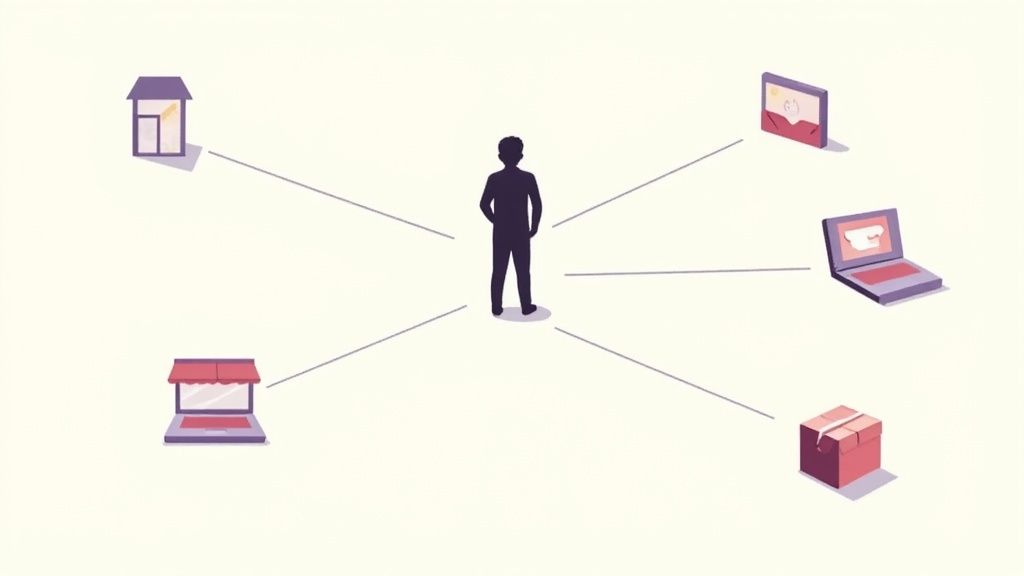
Think about a B2B tech firm with a complex software solution. Their customers might start by reading a blog post, then watch a webinar, chat with a sales rep on LinkedIn, and finally request a demo through the website. If each of those touchpoints feels disconnected, the customer journey becomes clunky and you start to lose their trust. This is exactly where an omnichannel marketing strategy becomes one of the most powerful examples of strategic marketing plans to put in place.
This approach is all about creating a seamless and integrated experience for your customer across every single channel, both online and off. Unlike multichannel marketing, which is just using a bunch of platforms, omnichannel makes them all work together as one cohesive unit. The goal is to provide a unified brand experience, making sure the customer feels seen and valued at every step, no matter how they choose to interact with you.
Strategic Breakdown
- Objective: Boost the lead conversion rate by 15% and improve customer lifetime value (CLV) by 20% over 12 months by creating a more unified experience.
- Tactics:
- Unified Customer Profile: Use a CRM and a Customer Data Platform (CDP) to get a single view of each customer, tracking their interactions across your website, email, social media, and sales calls.
- Consistent Messaging: Develop a core messaging framework that gets adapted, not completely changed, for each channel. This keeps your brand consistent everywhere.
- Cross-Channel Retargeting: Launch retargeting campaigns that follow users from one platform to another. For example, if someone watches 75% of your webinar, you could retarget them on LinkedIn with a case study on that same topic.
- Actionable Takeaway: Map your customer journey first. Seriously, identify every single touchpoint a prospect has with your brand before they become a customer. This map will show you exactly where the biggest gaps and inconsistencies are, pointing you to where you should focus your integration efforts first.
3. The Content Marketing Engine for Lead Generation
Imagine a B2B tech company that's struggling to bring in a steady stream of high-quality leads. Cold outreach is pricey and doesn't work that well, and paid ads give you a quick sugar rush but no lasting results. Their ideal customers are out there searching for solutions online, but the company is basically invisible. This is the perfect situation for one of the most foundational examples of strategic marketing plans: building a content marketing engine.
This strategy flips the script from direct selling to attracting an audience by creating and sharing genuinely valuable content. Instead of interrupting potential buyers, you earn their attention and trust by solving their problems and answering their questions. The goal is to become the go-to authority, pulling prospects into your world and nurturing them until they’re ready to have a sales conversation. This approach builds a long-term, sustainable asset that keeps generating leads over time.
Strategic Breakdown
- Objective: Increase marketing-qualified leads (MQLs) by 40% in six months by building out a topic cluster around a core product use case.
- Tactics:
- Pillar Content: Create a massive, comprehensive "pillar" guide on a high-value topic that you know your ideal customers are searching for.
- Cluster Content: Write a series of related blog posts, create videos, and design social media content that all link back to that main pillar page, showing Google you're an expert on the topic. For more ideas, check out these B2B content marketing best practices.
- Lead Magnets: Offer gated goodies like checklists, templates, or exclusive reports within your content to capture people's contact information.
- Actionable Takeaway: Don't try to be everywhere at once. Pick one core problem your audience has and build your entire initial content strategy around solving it. Once you start getting traction and seeing results, then you can expand your focus to other areas.
4. The Influencer Marketing Plan for Niche Audience Penetration
Let's say a B2B tech company is launching a new developer tool. Traditional digital ads are not only expensive but are often completely ignored by a skeptical, ad-hating audience. The company needs a way to build credibility and reach developers where they actually hang out and learn online. This is the perfect time to roll out one of the best examples of strategic marketing plans for building real trust: an influencer marketing strategy.
Instead of just shouting into the void, this plan uses the authority of respected people within the developer community. We're not talking about celebrity endorsements here; it's about partnering with knowledgeable creators who produce tutorials, write technical blogs, or host podcasts. The goal is to get a genuine stamp of approval from voices the target audience already trusts, weaving your product into educational content that provides real value.
Strategic Breakdown
- Objective: Get 500 qualified sign-ups for the new developer tool and see a 20% jump in brand mentions within the developer community in one quarter.
- Tactics:
- Micro-Influencer Partnerships: Find and team up with 15-20 micro-influencers (think 5k-50k followers) who are active on platforms like YouTube, Twitch, and technical blogs.
- Value-Driven Content: Sponsor "how-to" video tutorials or deep-dive blog posts where influencers use your tool to solve a real-world problem, showing off its features in a natural way.
- Affiliate Tracking: Give each influencer a unique tracking link or promo code so you can measure sign-ups and see the direct ROI from their efforts.
- Actionable Takeaway: Prioritize audience alignment over a massive follower count. A micro-influencer with a highly engaged, niche audience of developers will be way more effective and cheaper than a general tech celebrity with millions of followers who don't care. Start by building genuine relationships first.
5. Account-Based Marketing (ABM) Strategy
Imagine a B2B SaaS company with a great product but a sales pipeline that's gone flat. Their broad, top-of-funnel marketing is bringing in tons of low-quality leads, which is creating friction between sales and marketing and just wasting money. This is a classic scenario where one of the most effective examples of strategic marketing plans comes into play: a targeted Account-Based Marketing (ABM) strategy.
Instead of casting a wide net and hoping for the best, an ABM approach is all about "fishing with a spear." It treats a handpicked group of high-value target accounts as individual markets. This means sales and marketing have to be in lockstep to create and deliver hyper-personalized campaigns. The goal here is quality over quantity, aiming to land and expand within a curated list of dream customers who are a perfect fit for what you offer.
Strategic Breakdown
- Objective: Speed up the sales pipeline and land 10 new enterprise clients from a target list of 50 within six months.
- Tactics:
- Coordinated Outreach: Sales and marketing work together on personalized email sequences, LinkedIn messages, and even direct mail campaigns for key decision-makers at target accounts.
- Custom Content: You create account-specific content, like a custom business case or a special landing page showing exactly how your product solves their unique challenges.
- Targeted Ads: You run super-specific ads on platforms like LinkedIn, targeting employees at those chosen companies with messages that speak directly to their roles and buying signals.
- Actionable Takeaway: Start small. Seriously. Kick off a "pilot" ABM campaign with just 5-10 target accounts. This lets your team test the messaging, smooth out the personalization process, and prove it works before you go all-in on a bigger program.
6. The Performance Marketing Plan for Rapid, ROI-Driven Growth
For any B2B tech company that needs to generate leads and sales with a clear, measurable return, a performance marketing strategy is an absolute must-have. Unlike old-school marketing where you spend money and hope for the best, this approach ties every dollar directly to a specific action—a click, a lead, or a sale. This makes it one of the most accountable examples of strategic marketing plans for any business focused on data-driven growth.
It's basically a "pay-for-results" model. Think about giants like Booking.com or Amazon. They built their empires by mastering performance channels. They don't just spend on ads; they invest in a sophisticated system where every campaign is constantly tested, measured, and optimized to drive profitable customer acquisition. The focus is purely on tangible outcomes, making it perfect for companies that need to prove marketing’s direct impact on the bottom line.
Strategic Breakdown
- Objective: Bring in 200 new qualified leads per month with a Cost Per Acquisition (CPA) below $150, while keeping a 3:1 LTV:CAC ratio.
- Tactics:
- High-Intent Search Ads: Launch targeted Google Ads and Bing Ads campaigns zeroing in on bottom-of-funnel keywords (like "[competitor] alternative," or "[software category] for small business").
- Paid Social Conversion Campaigns: Use LinkedIn and Facebook ads with lead generation or conversion goals, targeting lookalike audiences of your best existing customers.
- Affiliate & Partner Programs: Build a commission-based program with industry influencers and complementary tech partners to drive referrals.
- Actionable Takeaway: Start with just one high-intent channel, like Google Ads search campaigns. Focus on a small group of super-specific, "ready-to-buy" keywords. Prove you can get a positive ROI there before you start spreading your budget across other channels.
7. The Customer Retention and Loyalty Plan for a Mature SaaS
For a mature SaaS company, the frantic race for new customers often overshadows a much more profitable activity: keeping and growing the accounts you already have. When it gets more expensive to acquire new customers and the market gets crowded, shifting your focus inward is a game-changer. This is where a customer retention and loyalty plan becomes one of the smartest examples of strategic marketing plans you can use.
Instead of pouring the whole budget into finding new people, this strategy reinvests in the customers who already trust you. It's all about increasing customer lifetime value (CLV) and turning happy users into your biggest fans. By creating programs that reward loyalty and deliver personalized value—think Amazon Prime or Sephora's Beauty Insider—companies build a protective wall around their customer base, making it way harder for competitors to steal them away.
Strategic Breakdown
- Objective: Reduce monthly churn by 15% and increase upsell/cross-sell revenue by 20% within 12 months.
- Tactics:
- Tiered Loyalty Program: Create a program (e.g., Bronze, Silver, Gold tiers) that offers better benefits as customers move up, like early access to new features, dedicated support, or exclusive content.
- Personalized Engagement: Use customer data to send personalized messages, like offering an advanced feature tutorial to a power user or a special discount on an add-on they’ve been looking at.
- Proactive Churn Prevention: Analyze usage data to spot at-risk accounts. You can then trigger automated outreach from your customer success team with helpful resources or a special offer to win them back.
- Actionable Takeaway: Start by figuring out who your most valuable customers are. Build a simple pilot loyalty program just for them, like access to a private monthly webinar with your product team. This proves the concept works and gets you some early wins before you roll it out to everyone.
8. Social Media Marketing Strategy
Having a strong social media presence has gone from a "nice-to-have" to an essential piece of a healthy marketing engine. For a B2B tech company, it's not just about posting company news. It's about building a brand personality, engaging with potential customers, and creating a community around your solution. While companies like Wendy's and GoPro are consumer rockstars, in B2B, it's about being a thought leader and showing the human side of your brand. A well-run social media plan is one of the most visible examples of strategic marketing plans because it puts your brand right in the middle of your audience's daily conversations.
This strategy mixes organic content, paid ads, and community management to drive brand awareness and generate good leads. It moves the focus from hard selling to building relationships and providing value, which helps nurture people through your sales funnel. It’s about showing up, being relevant, and being helpful where your audience is already spending their time.
Strategic Breakdown
- Objective: Increase brand engagement on LinkedIn by 25% and generate 50 qualified MQLs from social channels each quarter.
- Tactics:
- Pillar Content: Create a major "pillar" piece of content, like a deep research report. Then, slice and dice it into dozens of smaller, platform-specific posts (e.g., infographics for LinkedIn, video clips for Twitter, and key data points for threads).
- Employee Advocacy: Start a program that encourages and helps your employees share company content and their own insights with their personal networks. This massively expands your reach and feels more authentic.
- Interactive Engagement: Run polls, ask questions, and host live Q&A sessions with industry experts or your product leads to spark a real two-way conversation with your audience.
- Actionable Takeaway: Set aside 30 minutes every single day for genuine engagement. This doesn't mean just posting. It means actively commenting on industry posts, replying to your followers, and jumping into relevant conversations. This consistent, real interaction builds community way more effectively than just broadcasting your own message.
9. Product Launch Marketing Strategy for a New B2B Platform
Let's imagine a well-funded B2B tech startup is about to launch a game-changing new project management platform. They have an amazing product, but in a crowded market, a great tool just isn't enough. Without a coordinated launch, even the best products can fizzle out before they even get started. This is where one of the most critical examples of strategic marketing plans comes in: a dedicated product launch strategy designed to build hype, capture early fans, and create immediate momentum.
Instead of just flipping the "marketing switch" on launch day, this strategy coordinates all activities across a detailed timeline. It’s about building a story and creating a real event around the launch, much like Apple does with its famous iPhone releases. The goal is to go from a total unknown to a talked-about solution by orchestrating every single touchpoint, from pre-launch teasers to post-launch follow-ups.

Strategic Breakdown
- Objective: Generate 1,000 new sign-ups and get featured in 5 major industry publications within the first 30 days of launch.
- Tactics:
- Pre-Launch Hype: Create a "coming soon" landing page with a waitlist to capture early interest. Share teaser content and a countdown on social media to build excitement.
- Influencer & PR Seeding: Give a select group of industry influencers and journalists early, embargoed access 6-8 weeks before launch to make sure you get coverage on day one.
- Launch Day "Blitz": Coordinate a press release, guest posts on popular blogs, a founder AMA (Ask Me Anything) on a relevant forum, and a live demo webinar to maximize your visibility all at once.
- Actionable Takeaway: Map out a detailed three-month launch timeline. Give clear ownership for every single task across PR, content, social media, and sales. This master document ensures nothing gets missed and all your teams are perfectly in sync for a high-impact launch.
10. The Data-Driven Marketing Strategy for Predictive Growth
Picture a B2B tech firm that feels like it's marketing in the dark. They're spending a lot on campaigns but can't really connect their efforts to revenue, which leads to a lot of guesswork and wasted budget. This is where a data-driven approach, one of the most transformative examples of strategic marketing plans, completely changes the game from intuition to insight.
Instead of making broad assumptions, a data-driven strategy uses analytics, customer feedback, and market research to guide every single decision. It’s all about using the mountain of information you have—from web analytics to CRM data—to personalize experiences, predict what customers will do next, and optimize performance. Companies like Amazon and Netflix are masters of this, using behavioral data to create hyper-relevant recommendations that feel uniquely personal. This strategy turns marketing into more of a predictable science than a speculative art.
Strategic Breakdown
- Objective: Improve the MQL-to-SQL conversion rate by 30% and reduce customer acquisition cost (CAC) by 20% in six months.
- Tactics:
- Predictive Lead Scoring: Set up a system that analyzes historical data to score new leads based on how likely they are to convert. This lets your sales team focus on the hottest prospects first.
- Behavioral Segmentation: Group users based on what they do in your app or on your website. This allows you to deliver targeted content, like a webinar invitation for people who visited your pricing page three times.
- A/B Testing: Constantly test things like ad copy, landing page headlines, and email subject lines to figure out what really clicks with your audience and make small changes for better results.
- Actionable Takeaway: Start with just one key metric you want to improve, like your email open rates. Gather the data, form a hypothesis (e.g., "I bet subject lines with numbers in them perform better"), and run a simple A/B test. This small win builds momentum and shows everyone the value of a data-first mindset.
Comparison of 10 Strategic Marketing Plans
| Strategy | Implementation complexity 🔄 | Resource requirements ⚡ | Expected outcomes 📊 | Ideal use cases 💡 | Key advantages ⭐ |
|---|---|---|---|---|---|
| Value Proposition Strategy | 🔄 Medium — deep customer research and clear positioning | ⚡ Moderate — research, messaging, creative resources | 📊 Strong differentiation, higher loyalty and pricing power | 💡 Product-market fit, premium positioning, branding refresh | ⭐ Builds defensible brand and reduces CAC |
| Omnichannel Marketing Strategy | 🔄 High — systems integration and cross‑team alignment | ⚡ High — CRM, inventory sync, unified data, training | 📊 Improved conversion, higher AOV and CLV | 💡 Retail, omnichannel commerce, large retailers | ⭐ Seamless customer experience across touchpoints |
| Content Marketing Strategy | 🔄 Medium — process for continuous content creation | ⚡ Moderate — content team, SEO tools, time investment | 📊 Long‑term organic traffic, authority, qualified leads | 💡 B2B inbound, thought leadership, education-driven sales | ⭐ Cost‑effective, durable traffic and lead assets |
| Influencer Marketing Strategy | 🔄 Low–Medium — partner sourcing and campaign coordination | ⚡ Variable — influencer fees, management overhead | 📊 Rapid awareness and high engagement in niche audiences | 💡 DTC, lifestyle products, targeted awareness campaigns | ⭐ Authentic credibility and access to engaged audiences |
| Account-Based Marketing (ABM) Strategy | 🔄 High — personalized campaigns and sales coordination | ⚡ High — dedicated resources, intent data, ABM tools | 📊 Higher ROI and faster deal velocity on target accounts | 💡 Enterprise B2B, high-contract-value sales, complex buying committees | ⭐ Maximizes revenue from high-value accounts |
| Performance Marketing Strategy | 🔄 Medium — tracking, attribution and continuous testing | ⚡ Moderate–High — ad spend, analytics, optimization tools | 📊 Measurable ROI, scalable acquisition, fast feedback loops | 💡 E‑commerce, growth experiments, direct-response campaigns | ⭐ Pay-for-results model with rapid optimization |
| Customer Retention & Loyalty Strategy | 🔄 Medium — ongoing personalization and program ops | ⚡ Moderate — loyalty systems, segmentation, rewards budget | 📊 Increased CLV, repeat purchase rate, predictable revenue | 💡 Subscriptions, retail with frequent repeat buyers | ⭐ Lower acquisition cost and stronger customer advocacy |
| Social Media Marketing Strategy | 🔄 Medium — content cadence, community management | ⚡ Moderate — creators, paid social budget, monitoring tools | 📊 Brand awareness, engagement, community growth | 💡 Consumer brands, engagement-driven campaigns, real-time marketing | ⭐ Direct audience access and fast feedback |
| Product Launch Marketing Strategy | 🔄 High — cross‑department coordination and timing | ⚡ High — PR, events, influencer seeding, paid media | 📊 Rapid awareness, initial sales momentum, PR coverage | 💡 New product releases, major feature or market entries | ⭐ Generates concentrated buzz and positioning impact |
| Data‑Driven Marketing Strategy | 🔄 High — data infrastructure, governance, analytics culture | ⚡ High — CDP, BI tools, analytics talent, integrations | 📊 Improved targeting, predictive insights, better ROI | 💡 Large organizations needing personalization and measurement | ⭐ More accurate decisions and reduced marketing waste |
Turning These Examples into Your Winning Strategy
So, we've walked through a whole spectrum of strategic marketing plans, from the laser-focused precision of ABM to the steady engine of a great Content Marketing strategy. While each example tackles a different business challenge, they all share some common DNA: a relentless focus on the customer, a clear definition of success, and a commitment to results you can actually measure.
The most important takeaway here isn't to just copy and paste one of these templates. It’s to really get the principles behind them. A truly effective marketing plan isn't about throwing every possible tactic at the wall to see what sticks; it’s about making smart, deliberate choices that build on each other over time. Think of the examples of strategic marketing plans we've discussed as blueprints, not rigid prescriptions.
Synthesizing the Core Principles
As you move from feeling inspired to actually doing the work, remember that every successful strategy is built on a few core pillars. These are the non-negotiables that separate a plan that looks good on paper from one that actually works in the real world.
- Customer-Centricity is Everything: Every single plan, from launching a product to keeping customers happy, started with a deep, almost obsessive understanding of the ideal customer. Who are they? What keeps them up at night? Where do they go for solutions? Answering these questions is always step one.
- Get Crystal Clear on Your Objectives: Vague goals like "increase brand awareness" lead to scattered, ineffective efforts. The best plans have specific, measurable, achievable, relevant, and time-bound (SMART) objectives, like "Generate 200 MQLs from enterprise accounts in Q3" or "Improve customer retention by 15% over the next 12 months."
- Integration Beats Isolation: The omnichannel example really drove this home, but the lesson applies everywhere. Your social media should feed your content strategy, your paid ads should amplify your best content, and your retention efforts should give you ideas for your value proposition. Everything has to work together.
Your Actionable Next Steps
Feeling inspired is great, but taking action is what really drives growth. Your job now is to turn these insights into a real, tangible plan for your B2B tech company.
- Do a Strategic Audit: Before you build something new, take stock of what you already have. Which channels are actually working for you right now? Where are the biggest gaps in your customer's journey? What data do you have, and what data do you wish you had?
- Prioritize One Core Goal: What is the single most important thing marketing needs to accomplish in the next six to twelve months? Is it generating brand-new leads? Creating a new product category? Keeping the customers you have? Pick one primary objective to anchor your entire strategy.
- Select Your Strategic Framework: Based on that goal, choose the main strategic model you'll use. If your goal is to land a specific list of high-value accounts, an ABM framework is your starting point. If you need to build a sustainable inbound machine, focus on a content and data-driven strategy.
To help you picture how these ideas turn into real-world success, checking out specific examples like Lemlist's growth strategy from 0 to 20M ARR can be incredibly valuable. The journey from an idea to a full-blown growth engine is tough, but it all starts with a single, focused, and well-thought-out plan.
Ready to move from theory to execution but need an expert guide to help build and run your plan? Value CMO provides fractional CMO services to help B2B tech founders and CEOs develop a data-driven growth strategy that delivers real results. Get the senior-level marketing leadership you need to turn these examples into your own success story by visiting Value CMO.