At its heart, a Customer Acquisition Cost (CAC) calculator is a pretty simple tool. It takes all the money you've spent on sales and marketing over a certain time, divides it by the number of new customers you won, and spits out a single number: the average cost to land one new customer. Getting a real handle on this figure is the first step toward building a growth strategy that actually works.
Why Your CAC Calculator Is Your Growth Compass
Let's be real. A Customer Acquisition Cost (CAC) calculator isn't just another shiny tool in your tech stack; it’s the compass that should guide every single marketing and sales decision you make. Forget the dry textbook definitions for a second. If you want your business to grow sustainably, tracking this metric is non-negotiable. It’s the difference between just throwing money at the wall and investing it with a purpose.
Ignoring your CAC is like driving with a blindfold on. Sure, you're moving, but you have no idea if you're heading toward profit or straight off a cliff. I’ve seen way too many businesses burn through their budgets on campaigns that feel like they're working—they’re getting clicks, leads, and buzz—but are actually financial black holes.
Revealing the Health of Your Funnel
Your CAC tells a story. It’s a direct reflection of how well your entire sales and marketing machine is running. If that number is high or starting to creep up, it's a massive red flag signaling problems that need your attention, like, yesterday.
- A Leaky Funnel: Are you spending a fortune to get people to your website, only for them to disappear before buying? Your CAC will shout this from the rooftops.
- Inefficient Channels: A blended, company-wide CAC is a good start, but the real magic happens when you break it down by channel. You’ll quickly see which platforms are actually driving growth and which ones are just draining your bank account.
- Misaligned Messaging: If it costs a ton to win a customer, it might mean your value proposition isn't quite hitting the mark, forcing you to spend more and more to convince each person.
A healthy business isn't just about getting customers; it's about getting them profitably. Your CAC is the simplest, most honest way to know if your growth is built on a solid foundation or on borrowed time.
The Bedrock of Profitability
When you get right down to it, the real power of CAC is unlocked when you pair it with Customer Lifetime Value (LTV). That LTV:CAC ratio is one of the most important vital signs for your business's long-term health. A strong ratio, usually around 3:1 or higher, is proof that you're not just making sales—you're building a profitable company that can scale. You can see how this fits into the bigger picture in this breakdown of the 10 B2B tech metrics that matter for growth.
And this isn't just a fleeting trend. The pressure to get acquisition costs under control has absolutely exploded. A decade ago, many ecommerce companies were losing an average of $9 on every new customer they acquired. Fast forward to today, and that loss has ballooned by over 222%. You can dig into more of these evolving acquisition costs on LoyaltyLion.
That staggering jump shows just how unforgiving the market has become for businesses that don't obsessively track their spending. It's exactly why a customer acquisition cost calculator has become a must-have in any modern marketing toolkit.
Gathering the Right Numbers for Your CAC
A customer acquisition cost calculator is a powerful tool, but hey, it's only as good as the numbers you feed it. This is where so many businesses stumble, ending up with a CAC that looks great on a spreadsheet but is dangerously misleading in the real world.
To get a number you can actually trust, you have to dig much deeper than just your ad spend.
Think of it like building a house. You wouldn't just count the cost of the wood and nails; you’d factor in the labor, permits, tools, and everything else. The exact same idea applies here. Your total acquisition cost is the sum of every single penny that helps you win a new customer.
This process flow shows how a clear CAC helps you reveal the truth about your spending, validate your strategy, and find a profitable balance.
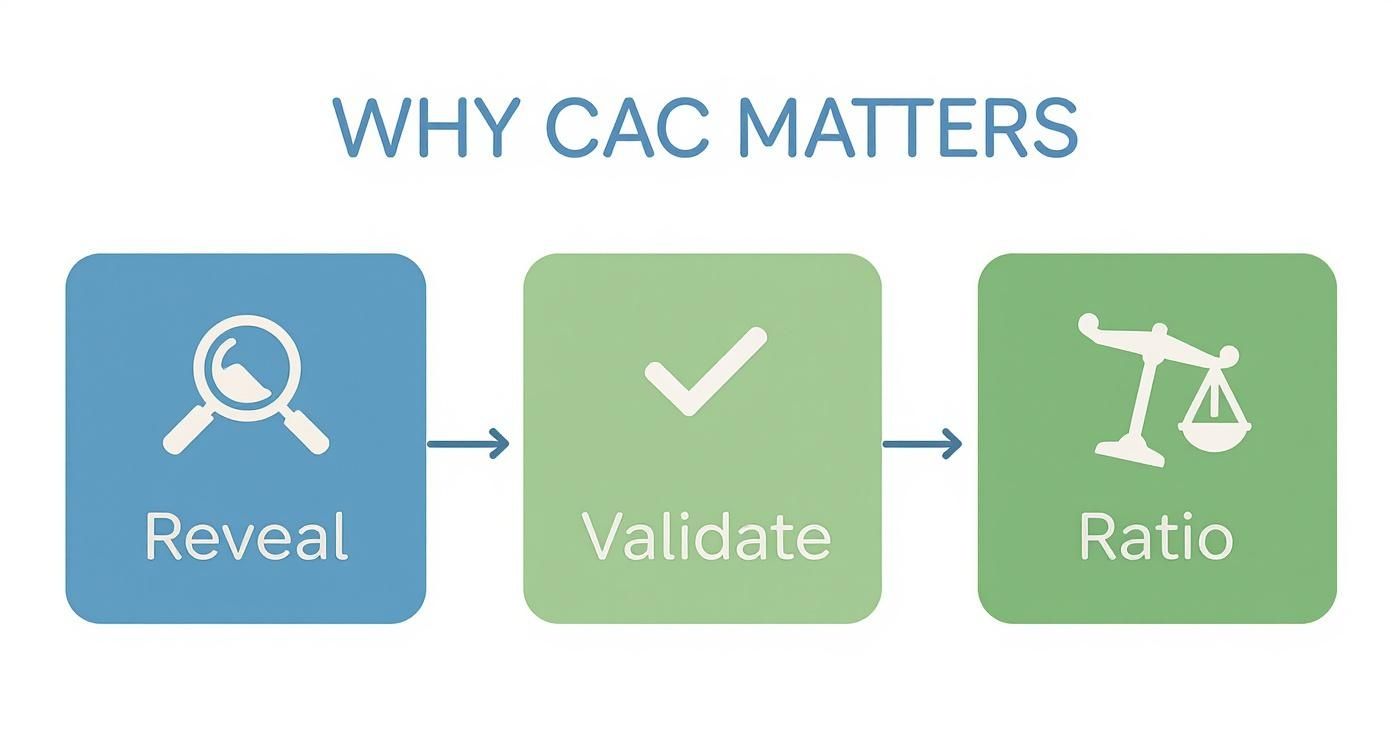
Calculating CAC isn’t just an accounting chore. It’s a strategic way to make smarter, faster decisions about how you grow.
Pinpointing Your Sales and Marketing Expenses
Let's break down where to find all the numbers you need. Most companies have a good handle on the obvious costs, but it's the hidden ones that can throw off the entire calculation. We'll start with a handy checklist of everything you need to pull together for an accurate CAC.
Essential Data for Your CAC Calculator
| Cost Category | Examples | Why It's Important |
|---|---|---|
| Marketing Spend | Paid ads (Google, LinkedIn), sponsorships, event costs | These are your most direct acquisition costs. They're easy to track but are only part of the story. |
| Marketing Team Salaries | Salaries & benefits for marketers in acquisition roles | Your people are your biggest investment. A chunk of their cost has to be attributed to acquisition. |
| Marketing Tools & Tech | SEO tools (Ahrefs), marketing automation (HubSpot), analytics software | Your tech stack is a big, recurring cost that directly supports bringing in new customers. |
| Creative & Content | Freelance writers, video production, graphic design fees | The cost to create the assets that attract and convert people is a direct acquisition expense. |
| Sales Team Salaries | Salaries, commissions & benefits for SDRs, Account Executives | If their job is to close new business, their pay is a core part of your CAC. |
| Sales Tools & Tech | CRM (Salesforce), sales intelligence, dialers | These platforms are what your sales team needs to find and close deals efficiently. |
| Overhead & Miscellaneous | Sales-related travel, prospect gifts, trade show booths | These "softer" costs really add up and are part of the total investment to win a new customer. |
This table isn't just a suggestion—it's the blueprint for an honest calculation. If a cost, a salary, or a tool touches the process of turning a stranger into a customer, it belongs in your CAC.
Don't Forget the Hidden Costs
Some of the most forgotten expenses are the ones that support your front-line teams.
For instance, a portion of your marketing manager's salary is absolutely an acquisition cost. If you have a content creator spending 50% of their time on blog posts that attract new prospects, then you've got to factor in 50% of their salary. It's as simple as that.
The same logic applies to your tools. A CRM isn't just a database; it's often essential for marketing attribution and nurturing leads. A piece of that cost belongs in your CAC, too.
Getting this right means being brutally honest with yourself. Every person, platform, and ad dollar involved in the acquisition journey has a price tag. Add it all up.
By creating a complete checklist, you build a full picture of your true acquisition expenses. This is the only way to make sure your CAC calculator gives you an answer you can actually use to guide your strategy.
Calculating and Making Sense of Your CAC
You’ve done the hard work of gathering all your expenses. Now it's time to put those numbers to work. The calculation itself is surprisingly simple, but the real magic happens when you start figuring out what the result means. Let’s get you a number you can actually use.
At its core, the customer acquisition cost formula is refreshingly straightforward:
CAC = (Total Sales & Marketing Costs) / (Number of New Customers Acquired)
This gives you a quick, blended average of what it costs to get each new customer in the door. It’s an essential health metric and a great starting point to track month over month.
A Real-World SaaS Example
Let's imagine a B2B SaaS company in its second year of business. Last quarter, they spent a total of $75,000 on all their sales and marketing efforts. In that same period, they brought on 150 brand new customers.
Plugging this into the formula:
- Total Costs: $75,000
- New Customers: 150
- Calculation: $75,000 / 150 = $500
Their CAC for the quarter was $500. So, is that good? A number on its own is just noise. The answer really depends on the industry, the business model, and, most importantly, the Customer Lifetime Value (LTV).
Getting your CAC is step one. The second, more crucial step is understanding what that number is telling you about whether your business can last. A $500 CAC could be a bargain or a disaster—it all comes down to context.
What Does Your CAC Really Mean?
That $500 CAC only becomes meaningful when you put it up against industry benchmarks and your own internal numbers. To truly understand its impact, you should look at it alongside other key sales KPIs, which give you vital context on how efficiently your sales and marketing dollars are working. The end goal is simple: make sure you can make back what you spend on acquiring customers and turn a profit in the long run.
This is where knowing the industry benchmarks comes in handy. Average CACs can be wildly different from one sector to another. For example, a typical B2B SaaS company might spend around $536 to acquire a customer in 2025. In contrast, financial services companies face an eye-watering average CAC of $1,450. Meanwhile, marketing agencies often have much lower CACs, sitting between $141 and $200.
This huge variation is exactly why using a customer acquisition cost calculator to see where you stand is so important.
The LTV to CAC Ratio: Your North Star
The single most important relationship to understand is the one between your CAC and your Customer Lifetime Value (LTV). LTV is the total revenue you can reasonably expect from a single customer over their entire time with you.
This ratio tells you the real story:
- A Healthy Ratio (3:1 or higher): This is the gold standard. For every dollar you spend, you get at least three dollars back. It’s a sign of a profitable, scalable business model.
- A Warning Sign (Below 3:1): This means you’re spending too much to get customers. You might be just breaking even or, worse, losing money on every new sale—a surefire path to trouble.
- An Opportunity (5:1 or higher): While this looks amazing on paper, a ratio this high might mean you’re underinvesting in growth. You could probably be growing much faster by strategically spending more to capture the market.
Analyzing this ratio is a fundamental part of figuring out how to measure marketing ROI with any real accuracy. When you connect acquisition cost to long-term value, you stop just tracking expenses and start making smart investment decisions that fuel real, profitable growth.
Putting Your CAC Insights into Action
You’ve got your number. Now what? This is the moment your customer acquisition cost calculator stops being a simple reporting tool and becomes a strategic weapon. The real value isn’t just in knowing your CAC; it’s in using that insight to make smarter, more profitable decisions that actually grow your business.
https://www.youtube.com/embed/e-N4QK2f4MU
It all starts by looking past a single, blended CAC. A company-wide average is a decent health check, but the real, actionable insights are found when you dig into a channel-by-channel analysis. Think about it: the cost to get a customer through a high-intent Google Ad is worlds apart from one who found you organically through a long-form blog post.
Calculating CAC for each channel shows you exactly where your money is working hardest. You might discover your paid social campaigns have a CAC of $150, while your organic content marketing brings in customers for just $45. This is your green light to act.
Reallocating Your Budget with Confidence
Armed with this channel-specific data, you can finally move your marketing budget around with confidence. This isn't about guesswork anymore; it's about making decisions based on data. Now you can strategically shift funds away from expensive, underperforming channels and double down on the ones delivering the best return.
For example, if LinkedIn Ads are costing you $800 per customer while your email marketing nurtures leads into customers for $90, the path forward becomes crystal clear. This kind of clarity empowers you to justify your marketing spend and prove the value of your efforts to the rest of the leadership team.
Your CAC data is a roadmap to efficiency. It points directly to the channels that deserve more investment and those that need a serious rethink—or maybe even need to be cut. Stop feeding the channels that don’t feed you back.
This strategic reallocation is one of the quickest ways to improve your overall profitability, often without increasing your total marketing budget by a single dollar.
Proven Strategies for Lowering Your CAC
Beyond just shifting budgets around, you can actively work to lower your acquisition costs across the board. This means optimizing every step of your customer journey to make your entire marketing and sales engine more efficient. If you're looking for a deep dive, there are plenty of detailed guides on how to reduce customer acquisition cost that can provide a comprehensive framework.
But here are a few high-impact strategies to get you started:
- Boost Your Conversion Rates: Even small improvements to your website's user experience, landing page copy, or checkout process can have a huge impact. A tiny 1% lift in your conversion rate can dramatically lower your CAC by getting more value from the traffic you already have.
- Launch a Referral Program That Works: Your happy customers are your best salespeople. A well-designed referral program gives them an incentive to bring in new leads, often at a fraction of the cost of traditional advertising.
- Strengthen Organic Channels: Investing in SEO and content marketing is a long-term play that pays off big time. While it takes a while to build momentum, a strong organic presence delivers a steady stream of high-quality leads with a very low marginal cost, continuously driving down your blended CAC over time.
Common Pitfalls in CAC Calculation
It's surprisingly easy to get your CAC calculation wrong. Even small mistakes can create a misleading number, sending you down the wrong path—like investing in losing channels or completely misjudging your company's financial health. Think of this as your field guide to the most common traps and how you can sidestep them.
Getting your data right is the entire foundation. If that foundation is shaky, everything you build on top of it is at risk.
Forgetting Key Salaries and Overhead
This is probably the most common mistake I see: people only count direct ad spend. While it's simple, it paints a dangerously rosy picture of your real acquisition costs. You have to account for the people and tools that make the acquisition engine run.
Let’s walk through a quick example. Say you spent $10,000 on ads and got 100 new customers. On paper, that’s a $100 CAC. Simple enough.
But what about the marketing manager who runs those campaigns? If they earn a $10,000 monthly salary and spend half their time on acquisition, that's $5,000 you need to add to the pot. Then there’s the $1,000 monthly subscription for the automation software they use.
Suddenly, your real costs are $10,000 (ads) + $5,000 (salary portion) + $1,000 (tools) = $16,000. Your true CAC is actually $160—a whopping 60% higher. Ignoring these costs means you’re fundamentally undervaluing what it really takes to get a customer.
Your CAC isn't just what you spend on ads; it’s the total cost of the engine that brings customers in the door. This includes the salaries of the people driving it and the fuel for the machine.
Mismatching Time Periods
Another common blunder is using a time period that doesn't really line up with your sales cycle. This creates a huge disconnect between your spending and your results.
For a B2C e-commerce store with a one-day sales cycle, calculating CAC monthly makes perfect sense. The cause and effect are almost immediate.
But for a B2B tech company with a three-month sales cycle, a monthly calculation is basically useless. The money you spent on marketing in January might not turn into a paying customer until March or April.
Here’s how to avoid this trap:
- Long Sales Cycles (B2B): Calculate your CAC quarterly or even semi-annually. This smooths out the lag between when you spend and when you see the results, giving you a much more stable and accurate picture.
- Short Sales Cycles (B2C/DTC): Monthly or even weekly calculations can be super effective for tracking the immediate impact of specific campaigns and making quick adjustments.
Ignoring Customer Segmentation
A blended CAC for your entire business is a good starting point, but it hides a ton of crucial details. The reality is that not all customers are created equal, and they definitely don't cost the same to acquire.
Think about it: an enterprise client you landed through a high-touch sales process will have a vastly different CAC than a self-serve small business customer who signed up after finding you through a Google search.
When you lump them all together, you can't see which segments are truly profitable and which ones might actually be losing you money. Segmenting your CAC by customer type, acquisition channel, or even geographic region is essential for making smart, strategic decisions and truly understanding where your growth is coming from.
Your Questions About CAC Answered
Even after you’ve nailed down how to use a customer acquisition cost calculator, a few questions always seem to pop up. It makes sense—when your budget and growth are on the line, you want to be crystal clear. Let's run through some of the most common ones I hear.
And if you’re still getting your head around the basics, this simple glossary entry on What is CAC? is a great place to start. It lays out the core concept perfectly.
For everyone else, let’s get into the details.
How Often Should I Calculate My Customer Acquisition Cost?
For most companies, calculating CAC monthly and quarterly is the right rhythm.
A monthly check-in gives you a real-time pulse on your business. It’s perfect for seeing how new campaigns are landing and for catching any red flags before they spiral out of control. Think of it as your short-term diagnostic tool.
The quarterly review, on the other hand, smooths out the monthly bumps and gives you a more stable, big-picture view. This is the number you want to use for strategic planning. Of course, if you’re in a fast-moving space like e-commerce, you might even need to run the numbers weekly just to keep up.
What Is a Good LTV to CAC Ratio?
The magic number you're aiming for is 3:1 or higher. This is widely considered the gold standard for a healthy, scalable business.
Put simply, it means for every dollar you spend bringing in a new customer, you’re getting at least three dollars back over their lifetime. It’s one of the clearest signs of profitability you can track.
A ratio below 3:1 is a warning sign. It suggests you’re either spending too much to get customers or you’re not keeping them long enough. On the flip side, a really high ratio, like 5:1, could mean you’re underinvesting in growth and leaving opportunities on the table.
Can I Use a CAC Calculator for Different Marketing Channels?
Absolutely. In fact, this is where a CAC calculator goes from a simple reporting tool to a strategic weapon.
Segmenting your CAC by channel is how you stop guessing and start making data-backed decisions about where to put your money. To pull this off, you need clean attribution data that lets you confidently tie your marketing spend and new customers to specific channels—like Google Ads, organic search, or social media.
This breakdown shows you which channels are your true workhorses, delivering customers at a profit. It gives you the hard proof you need to double down on what works and cut what doesn’t.
Ready to build a growth strategy based on profitable acquisition, not just guesswork? Value CMO provides the senior marketing leadership to clarify your go-to-market plan and build a data-driven roadmap for success. Let's build your growth engine.