Let's be honest—marketing automation software isn't a magic wand. If you're a B2B tech founder, you've probably figured out the real challenge isn't just buying a tool, but actually turning it into a revenue-generating engine. This is where consulting marketing automation becomes a game-changer. It’s about shifting from hoping software will solve your problems to hiring an expert who knows how to make it happen.
Why Founders Lean On Marketing Automation Consulting

As a startup leader, the promise of marketing automation sounds like a dream: a perfectly oiled machine that nurtures leads, personalizes conversations, and drives sales while you sleep.
The reality, however, often looks more like clunky integrations, messy data, and campaigns that fall completely flat. You end up with a powerful, expensive tool that feels more like a burden than a growth lever. Sound familiar?
This is the exact friction point where bringing in an expert makes all the sense in the world. A marketing automation consultant or fractional CMO isn't just a technical whiz; they're a strategic partner. Their whole job is to bridge the massive gap between your ambitious growth targets and the day-to-day grind required to hit them.
Translating Tools Into Revenue
Here's the secret: the problem is rarely the software itself. It's the lack of a smart blueprint guiding its use. Founders often lean on marketing automation consulting to figure out how to streamline business processes using AI automation in a way that actually drives efficiency and real growth.
An expert helps you move beyond just "sending more emails." They get to work building a scalable system that tackles your fundamental business challenges head-on.
This means they roll up their sleeves and start asking the tough questions:
- Fixing the Leaky Funnel: Where are prospects dropping off, and how can we use automated workflows to bring them back into the fold?
- Aligning Sales and Marketing: How do we create a unified lead handoff process and scoring model that both teams actually trust and use?
- Cleaning Up Messy Data: What rules do we need to put in place to ensure our automation is running on accurate, reliable information?
- Building a Predictable Pipeline: How do we turn a sporadic trickle of leads into a consistent, measurable source of qualified opportunities for the sales team?
The real value of an automation consultant is their ability to connect the dots between your technology, your go-to-market strategy, and your revenue goals. They make sure the machine is built to serve the business, not the other way around.
A Growing Demand For Strategic Guidance
This shift toward expert-led automation is a clear trend you can't ignore. The global market for marketing automation software is booming, but a huge chunk of that growth isn't just from software licenses. It’s from the advisory, implementation, and optimization services that turn those licenses into something you can actually take to the bank.
As of 2024, about 91% of organizations are feeling the heat to automate more internally. Yet, marketing teams are still using it 76% more than sales and 139% more than finance. This coordination gap is precisely what external experts are hired to close, ensuring your entire go-to-market team is playing from the same sheet of music.
You can dive deeper into what marketing consulting is all about and how it impacts your business with our detailed guide, "What Is Marketing Consulting?".
Laying the Groundwork for Automation That Actually Works
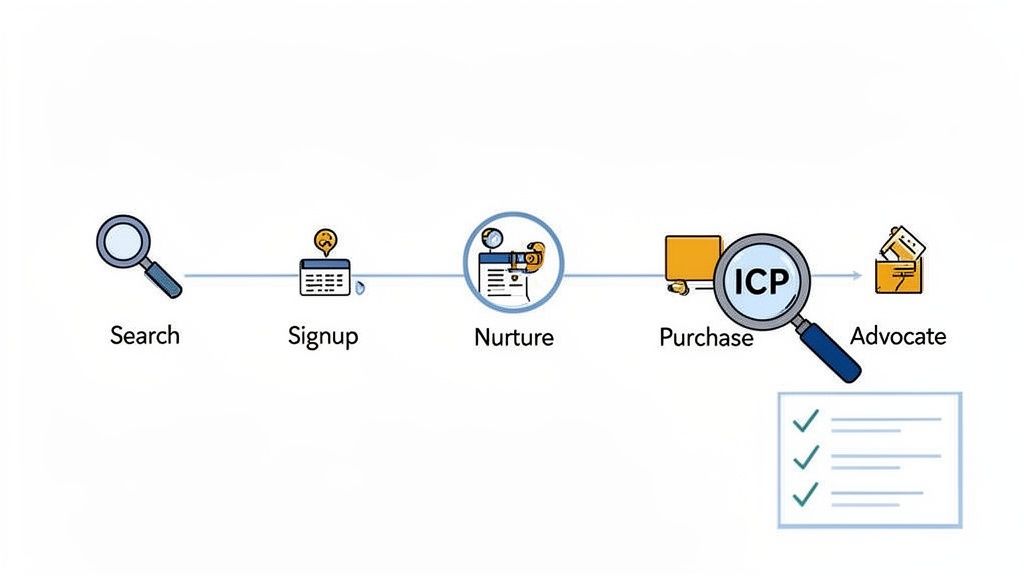
Before you touch a single piece of software or hire anyone, you need a blueprint. Diving straight into a martech platform is like starting a road trip without a map—you’ll burn a lot of fuel and end up right back where you started.
This initial planning phase is the single biggest predictor of whether your investment in marketing automation will pay off. It’s not a "nice-to-have"; it’s the foundation that dictates every workflow, email, and ad you’ll eventually build.
Without this clarity, automation just becomes a series of disjointed, expensive tactics instead of a cohesive revenue engine.
Nail Your Ideal Customer Profile with Data, Not Guesses
Guesswork is the enemy of great automation. Your Ideal Customer Profile (ICP) can’t be based on who you think your best customers are. It has to be built on the cold, hard data from your own business.
Any consultant worth their salt will start right here, digging into your real-world data to build a picture of your most profitable and loyal customers. This isn’t a quick little exercise. It involves two critical activities:
- Digging into Sales Data: They’ll get into your CRM and hunt for common traits among your best accounts. What’s the common thread in company size, industry, or the specific pain points they hired you to solve?
- Interviewing Your Best Customers: Talking to your happiest clients is pure gold. A good consultant will get on the phone with them and ask about their buying process, the "aha!" moment they had with your product, and what other options they kicked the tires on.
The goal is to go from a vague persona like "Tech Startups" to something sharp and actionable, like: "Series A B2B SaaS companies with 50-200 employees in the FinTech space who are struggling to scale lead nurturing beyond manual emails." That’s the level of detail that makes automation finally click.
An ICP built on real data is your North Star. It guarantees you're automating outreach for the people most likely to buy, stick around, and tell their friends about you.
Map the Entire Customer Journey
Once you know exactly who you’re talking to, the next step is to map how they buy. The customer journey is simply the path someone takes from first hearing about you to becoming a happy, paying customer. Mapping it out shows you exactly where automation can make the biggest difference.
Put yourself in their shoes. What are the key stages they pass through?
- Awareness: How do they even find out they have a problem you can solve? Is it a Google search for "how to improve sales follow-up" or an interesting post they stumbled upon on LinkedIn?
- Consideration: They’ve landed on your site. Now what? Do they read a blog, download an ebook, or sign up for a webinar? This is where your nurturing has to kick in.
- Decision: What pushes them over the edge to request a demo or start a trial? What information do they need to feel confident picking you over a competitor?
- Onboarding & Advocacy: The deal is closed—congrats! Now, what's the experience like? How do you turn a new customer into a power user who refers others?
Find the Bottlenecks and Quick Wins
With your journey map in hand, you can finally take an honest look at your current process. This is where you find all the friction—the leaky parts of your funnel where prospects get stuck or just fall through the cracks.
Look for the things that are manual, inconsistent, or just plain broken. Is your sales team still sending one-off follow-up emails after every demo? That’s a perfect spot for an automated sequence. Are new trial users getting a welcome email and then radio silence? That’s a bottleneck begging for an automated onboarding workflow.
By identifying these specific pain points first, you give your consulting marketing automation efforts a clear purpose. You're not just automating for the sake of it; you’re strategically applying technology to solve real business problems and directly impact your bottom line.
Choosing Your Expert: Fractional CMO vs. Consultant vs. Agency
Picking the right partner for your marketing automation push is a make-or-break decision. Get it right, and you accelerate growth, connecting your B2B tech startup with the right customers, faster. Get it wrong, and you’re looking at a wasted budget, stalled momentum, and a whole lot of frustration.
This isn’t about just grabbing a vendor off a list. It’s about matching the right kind of expert to your company’s specific stage and immediate needs. The help a seed-stage founder needs to find product-market fit is worlds away from what a Series B company requires to scale an already-proven playbook.
Let's break down the three main players you'll meet—the fractional CMO, the specialized consultant, and the full-service agency—so you can make a smart call.
The Fractional CMO: Your Strategic Quarterback
Think of a fractional CMO as a part-time, senior marketing executive who plugs right into your leadership team. They aren’t just there to run a single project; their job is to own the entire marketing strategy and how it directly impacts revenue. They bring that 10,000-foot view that connects marketing automation back to your bigger business plans.
This model is a godsend for early-stage startups that desperately need high-level strategic direction but can't justify a full-time, six-figure executive salary just yet.
- Best For: Seed-stage to Series A startups that need to build their first real marketing plan, define a go-to-market strategy, or mentor a junior team.
- Core Focus: High-level strategy, team leadership, and long-term growth planning. A good one will help you choose the right automation to build, not just build whatever you ask for.
- Real-World Scenario: You're a founder with a killer product but no clear marketing roadmap. A fractional CMO joins for 10-15 hours a week, defines your ICP, maps the entire customer journey, and builds the initial marketing and sales funnel inside a tool like HubSpot or ActiveCampaign.
The Specialized Consultant: The Deep-Dive Problem Solver
A specialized consultant is your go-to expert for a specific, well-defined problem. They are masters of a particular platform (like Marketo or Salesforce Account Engagement/Pardot) or a niche discipline like lead scoring models or tricky data integrations. You bring them in when you know exactly what you need done but don't have the deep in-house expertise to nail it.
Their work is almost always project-based and laser-focused. Think of them as the surgeon you call for a complex operation, not the family doctor you see for a routine check-up.
Consultants are your force multipliers for execution. They shine when you have a clear strategic direction and need an expert to build, fix, or optimize a specific part of your marketing machine with precision and speed.
For instance, if your lead handoff process between marketing and sales is a total mess, a consultant can parachute in, figure out the problem, and rebuild the workflows and data syncs between your marketing automation platform and CRM—often in just a few weeks.
The Marketing Agency: Your All-in-One Execution Team
A marketing agency brings a full team of specialists under one roof—content writers, designers, ad managers, and automation experts. They are built for outsourcing the doing. When you need to crank out a high volume of marketing assets and run multiple campaigns at once, an agency provides the raw horsepower.
But this breadth can sometimes come at the cost of deep strategic alignment with your business. You’re often working with a more junior account manager as your day-to-day contact, which can become a game of telephone if your own strategy is still in flux.
Agencies tend to be the best fit for more established companies that already have a defined brand and a clear strategy. They’re perfect when you need to scale content and campaign execution without blowing up your internal headcount.
To make the choice even clearer, here’s a quick-reference guide to help you decide which expert model best fits your B2B tech startup's current needs.
Choosing Your Marketing Automation Partner
| Factor | Fractional CMO | Specialized Consultant | Marketing Agency |
|---|---|---|---|
| Primary Value | Strategic Leadership | Technical Expertise | Execution & Manpower |
| Best For | Early-stage strategy gaps | Complex, defined projects | Scaling campaign output |
| Engagement Scope | Broad & ongoing | Narrow & project-based | Broad & task-based |
| Typical Cost | Monthly Retainer | Project Fee or Retainer | Higher Monthly Retainer |
Ultimately, choosing the right partner comes down to self-awareness. Be brutally honest about what your business truly needs right now. Is it high-level strategy, deep technical execution, or a team to run the plays you've already designed? Answering that question will point you directly to the right expert for your consulting marketing automation needs.
Building Your Martech Stack Without the Migraine
The world of marketing technology is a minefield of shiny objects. With over 11,000 tools out there, it’s ridiculously easy to get distracted by impressive features that promise the world but don't actually move the needle for your business.
This is where an expert in consulting marketing automation becomes your most valuable asset. Their job isn’t to sell you software; it’s to help you build a tech stack that works for you, not against you.
They cut through the noise to focus on one thing: creating a connected system where data flows seamlessly. This gives you a true, end-to-end view of your marketing’s impact on the bottom line. It’s about building a revenue engine, not just collecting expensive software subscriptions.
The process always starts with a clear-eyed look at what your business truly needs to grow, preventing you from over-investing in a complex system before you’re ready.
All-in-One vs. Best-of-Breed: The Big Debate
One of the first major decisions you'll face is whether to go with an all-in-one platform or a best-of-breed stack. A consultant can help you weigh the real-world trade-offs for your specific situation.
- All-in-One Platforms (e.g., HubSpot): These tools bundle everything—CRM, email marketing, landing pages, and analytics—into a single, unified system. The big benefit is simplicity. Your data is all in one place by default, and your team only has to learn one piece of software. This is often a great starting point for early-stage startups that need to get moving fast without a dedicated tech team.
- Best-of-Breed Stacks (e.g., Salesforce + Marketo + Outreach): This approach means picking the absolute best tool for each specific job and stitching them together. You get top-notch functionality for every task, but it adds a layer of complexity. You’re now on the hook for making sure these separate systems talk to each other flawlessly, which can be a serious technical headache.
There's no single right answer here. The best choice depends entirely on your team's technical skills, your budget, and how complex your go-to-market strategy is. A consultant’s experience is invaluable in helping you make this call based on where you are today.
The Devil Is in the Integration Details
Choosing the tools is only half the battle. Making them actually work together is where most companies stumble. A consultant’s deep technical knowledge is critical here, because they focus on the little details that often get ignored until it’s way too late.
They’ll stress-test your plan by asking the tough questions. Do these tools have solid, native integrations, or will you be relying on third-party connectors like Zapier that can become brittle over time? When building your stack, lead capture is a fundamental piece of the puzzle, and an essential guide to lead capture automation can help you think through the mechanics of this critical first step.
A great consultant also ensures your stack is built to scale. The tools that work for a team of five might grind to a halt when you have a team of 50. They help you think about future needs, ensuring your foundational data setup won’t need a complete, painful overhaul in two years. For an in-depth look at structuring these systems, our guide on choosing the right B2B marketing tech stacks offers practical frameworks.
Ultimately, this whole process is about creating a single source of truth. When your CRM, marketing automation platform, and sales tools are perfectly in sync, you finally get a clear, unfiltered view of what's really driving revenue. That clarity is the real promise of a well-built martech stack.
Your Implementation Playbook From Kickoff to Handover
A brilliant strategy doc is just that—a document. The real value comes from execution. The implementation phase is where your investment in consulting marketing automation truly pays off, turning a great idea into a revenue-generating machine.
This isn't about flipping a switch and hoping for the best. A solid implementation is a structured, collaborative process designed to build a system that lasts, not just a quick fix. A good consultant walks you through a clear playbook, making sure every step is transparent and tied directly to your business goals.
Let's break down what a realistic roadmap looks like, from the first kickoff call to the moment your team is confidently sitting in the driver's seat.
Phase 1: The Discovery and Audit
The project officially kicks off with a deep-dive discovery. This is where your consultant goes from an outsider to a true extension of your team. They’ll spend real time interviewing key people—from sales and marketing to customer success—to get to the root of the real-world friction points.
They will also run a full audit of your current tech and processes. This isn't just about listing your tools; it's about mapping how data and leads actually move through your organization right now. The goal here is to get a crystal-clear "before" picture, which is the only way to measure the "after" impact.
Key moves in this phase usually include:
- Stakeholder Interviews: Uncovering the pains and priorities of sales, marketing, and leadership.
- Process Mapping: Visually drawing out the current lead lifecycle, from first touch to closed deal.
- Tech Stack Audit: Looking at how your CRM, marketing platform, and other tools are (or aren't) talking to each other.
Phase 2: Workflow Architecture and Build
With a solid grasp of your business, the consultant moves into the architectural phase. This is where the strategic blueprint gets turned into technical specs. They'll design the core workflows, data models, and lead scoring systems that will become the engine of your automation.
This part has to be a team sport. Your consultant should walk your team through their proposed design, explaining the "why" behind every decision. For example, they’ll show you exactly how a new lead scoring model will help sales zero in on the hottest leads, backing it up with what they learned in the discovery phase.
Once you give the green light, the hands-on build starts. This is the heads-down work of configuring software, building out email nurture sequences, setting up landing page templates, and making sure the data sync between your marketing platform and CRM is flawless.
Don’t rush this phase. It’s a classic mistake. A well-designed architecture prevents countless headaches down the road. It ensures your system is not just functional but also scalable and easy for your team to manage long-term.
This visual shows the high-level process for getting your Martech stack right.
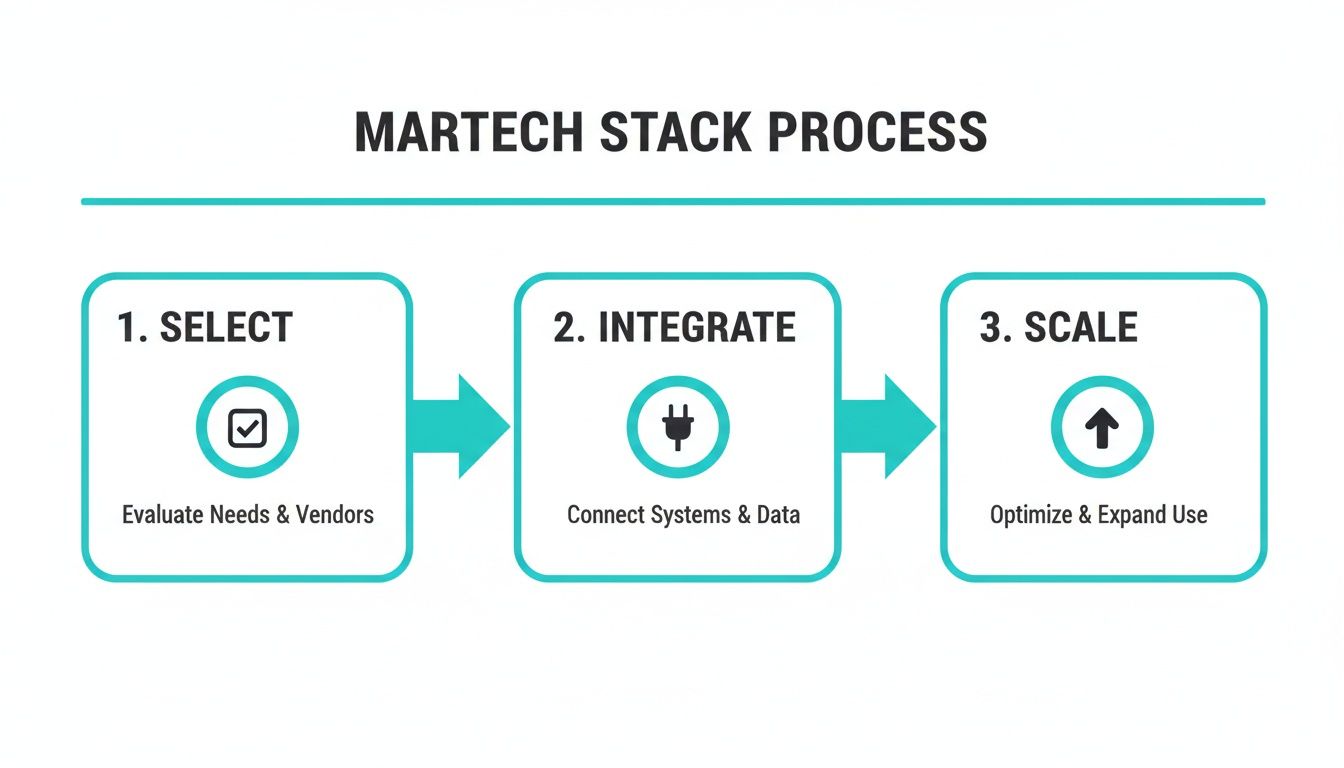
As the diagram shows, a successful implementation is a journey—from careful selection and seamless integration to being ready for future growth.
Phase 3: Testing and Meaningful Measurement
Before anything goes live, rigorous testing is non-negotiable. Your consultant will run a battery of tests to make sure every workflow triggers correctly, every link is tracked, and every bit of data passes between systems exactly as planned. This is the quality check that prevents embarrassing—and expensive—mistakes.
At the same time, they’ll help you build dashboards that track what actually matters. Forget vanity metrics like email open rates. The focus shifts to KPIs that directly reflect business impact.
Meaningful metrics for a B2B startup include things like:
- Pipeline Velocity: How fast are leads moving through your sales funnel?
- Marketing-Sourced Revenue: How much actual cash can you tie back to specific marketing efforts?
- Customer Acquisition Cost (CAC): What is the all-in cost to land a new paying customer?
Phase 4: Governance and Handover
The final phase is arguably the most important: empowering your team to own the system. A great consultant doesn’t build a black box that only they understand. They focus on training and documentation to make the handover as smooth as possible.
This means creating clear "rules of the road" documents that outline how the system should be used, who owns what, and how to keep the data clean. They'll run hands-on training sessions with your team, walking them through the new workflows and dashboards until everyone feels comfortable.
The goal is to build a sustainable, in-house capability. By the time the project wraps up, your team shouldn't just know how to use the tools; they should understand the strategy behind them. That’s what ensures the system keeps evolving and driving growth long after the consultant is gone.
Common Pitfalls and High-Impact Quick Wins
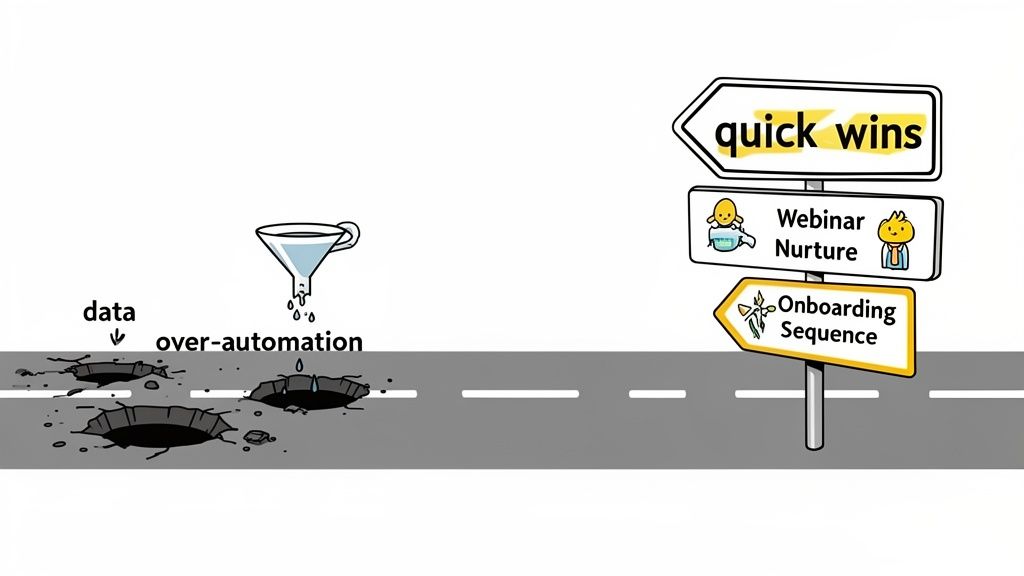
Learning from someone else’s mistakes is always cheaper. When it comes to marketing automation, a few common but expensive errors can kill a strategy before it ever gets a chance to deliver results.
Bringing in an expert in consulting marketing automation is like hiring a guide who’s already seen what goes wrong—and knows how to steer you around the biggest potholes. I’m sharing those hard-won lessons straight from the trenches of B2B marketing.
Steering Clear of Common Automation Traps
I’ve seen founders fall into the same traps over and over again. The good news? They’re all avoidable if you know what to look for. Just being aware of these potential slip-ups is the first step toward building a system that actually works.
Here are the three most common pitfalls:
- Over-automating the human touch: It's so tempting to automate everything. But in high-value B2B sales, your prospects still need to talk to a real person. Automating the initial nurture is smart. Automating the entire sales follow-up without any personal outreach is how you lose deals to competitors who aren't afraid to pick up the phone.
- Ignoring data cleanliness: Your automation is only as good as the data it runs on. If your CRM is a swamp of duplicate contacts, old info, and messy fields, your campaigns are going to fall flat. One wrong job title can push a great prospect into the wrong email sequence, making your brand look sloppy.
- Building a lead score sales ignores: A complex lead scoring model is worthless if your sales team doesn’t trust it. This usually happens when marketing builds the model in a vacuum. After a salesperson gets burned by a few “hot” leads that are actually duds, they’ll go right back to trusting their gut over your system.
The goal of automation isn't to replace your team. It's to make them smarter and more efficient, freeing them up for the high-value, human conversations that actually close deals.
These issues are more than just annoying—they kill momentum. We’ve seen so many founders get stuck here that we put together a full guide on the top 10 B2B marketing fails and how to sidestep them.
High-Impact Quick Wins to Build Momentum
While you need to watch out for the traps, you also need to build positive momentum fast. You don’t need a six-month project to start seeing a real return.
Here are a couple of high-impact automations that a good consultant can help you get live in weeks, not months. These “quick wins” deliver tangible results, build confidence in your strategy, and help fund the bigger projects down the line.
1. Webinar and Event Follow-Up Nurture
You just spent a ton of time and money getting people to your webinar. Don't let those leads go cold.
- The Play: Instead of one generic "thanks for coming" email, build a simple 3-5 email sequence. Split the list: one path for people who showed up live, another for those who only registered. Share the recording, pull out key takeaways, link to a relevant case study, and end with a clear call-to-action to book a demo.
- Why It Works: This is low-hanging fruit. These people already raised their hands and showed interest. A timely, relevant follow-up is often all it takes to turn that interest into a sales-qualified opportunity.
2. New Trial User Onboarding Sequence
For SaaS companies, the first few days of a trial are everything. An automated onboarding sequence makes sure every new user gets a consistent, helpful experience that guides them to that "aha!" moment with your product.
- The Play: Kick off an email sequence the second a user signs up. The first email should be a personal welcome from the founder. The next few should spotlight key features, link to short how-to videos, and proactively offer help.
- Why It Works: It crushes churn and boosts activation rates. By guiding users, you help them see your product's value faster, making them way more likely to pull out their credit card when the trial ends. This is pure revenue-driving automation.
At Value CMO, we help B2B tech founders sidestep these common pitfalls and focus on high-impact wins that build a predictable revenue engine. If you're ready to move beyond the theory and start executing, learn how our fractional CMO services can build and lead your marketing automation strategy by visiting us at https://valuecmo.com.