In a sea of B2B tech startups, a sharp brand positioning statement isn't just fluffy marketing talk; it's your North Star. It’s what gets your team rowing in the same direction and tells the world exactly who you are, who you’re for, and why you’re the only real choice for your ideal customer. Think of it as the DNA for your entire go-to-market strategy, shaping everything from your website copy and product roadmap to your sales pitches. It’s the difference between being just another vendor and becoming a partner your customers can’t live without.
But let’s be honest, crafting a great one is tough. Most guides offer vague advice or show off examples from giants like Nike or Coca-Cola, which just don't click for a B2B tech company. Founders and marketers often end up with a generic, forgettable statement that fails to connect with their audience or stand out from the crowd.
This article is here to cut through that noise. We’ve pulled together a handpicked list of powerful brand positioning statement examples made for B2B tech startups and scale-ups. But we're not just going to list them—we're going to break down the "why" behind each one. For every example, you'll get:
- A simple breakdown of the positioning strategy they used.
- A look at their ideal customer, the "aha!" moment they tapped into, and what makes them different.
- Real, actionable takeaways and a template you can steal to build your own strategy.
By the end, you'll have a clear playbook for creating a positioning statement that doesn't just sound good but actually drives real growth.
1. The Value Proposition Positioning Statement
The Value Proposition Positioning Statement is a no-nonsense, benefit-first approach. It gets straight to the point of what your product actually does for your customer. It answers the big question: "What real business result will I get from using this?" For B2B tech startups, this is a super effective method because it skips the jargon and focuses on the concrete problem you solve, making it one of the best brand positioning statement examples for a clear, powerful launch.
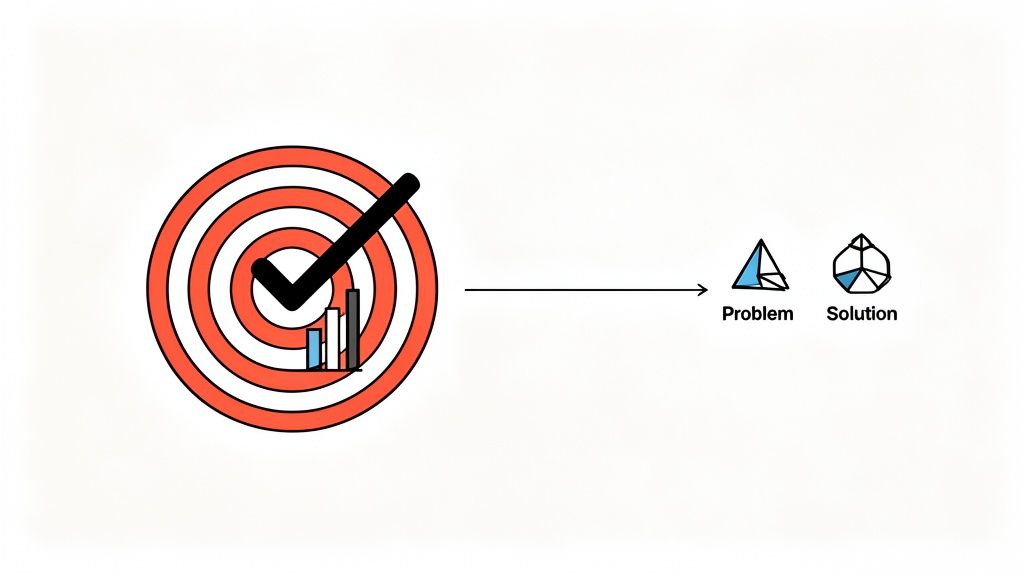
Made famous by marketing legends like Al Ries, Jack Trout, and Geoffrey Moore, this approach frames your brand around the main value it delivers. It's not about features; it’s about the transformation your customer experiences. Think of it as the promise you make about the results they can expect.
Example Breakdown: Notion
- Positioning Statement: "One workspace for your wiki, docs, and projects."
- Target ICP: Tech teams, startups, and project managers who are drowning in a sea of disconnected tools like Google Docs, Trello, and Confluence.
- Core Insight: Knowledge workers lose a ton of time switching between apps and hunting for information. What they really need is a single, unified source of truth.
- Differentiation: Notion doesn’t sell itself as just a better doc editor or a slicker project board. Its magic is in the integration of these things, killing the chaos of multiple subscriptions and siloed data. It’s a classic "category of one" play.
Actionable Takeaways for Your B2B Startup
- Find the Core Pain: Start by mapping out your ideal customer's biggest frustration. Is it inefficiency, poor collaboration, or data chaos? Your value proposition should be the direct cure.
- Put a Number on It: Whenever you can, quantify the outcome. Instead of "faster approvals," try "cut approval times by 50%." This makes the benefit real and easier to sell internally.
- Keep it Simple: Your positioning should be so clear that your sales team and your customers can repeat it easily. Notion’s statement is a masterclass in this.
- Align Your GTM: Make sure your entire go-to-market strategy hammers home this one single-minded value. If you want to dive deeper, you can explore guides on how to create a value proposition that really connects.
2. The Market Category Positioning Statement
The Market Category Positioning Statement is a bold move where a brand doesn't just play in an existing market—it creates a brand new one. This strategy instantly makes your company the leader and innovator in a space you own. For B2B scale-ups, this is the ultimate power play. It lets you set the rules, charge premium prices, and build a powerful moat around your business.
Popularized by big thinkers like April Dunford and Geoffrey Moore, this method is all about framing the problem in a new light, making the market see your solution as the only logical choice. Instead of being a "better" option, you become the "only" option in a category you invented. It’s high-risk, high-reward, but it can completely change your game.
Example Breakdown: HubSpot
- Positioning Statement: "The #1 CRM platform for scaling companies." (Today, this has evolved from its category-creation roots).
- Target ICP: Small to medium-sized businesses (SMBs) and marketing managers who were fed up with pushy, outbound marketing tactics that just weren't working anymore.
- Core Insight: The way people buy has completely changed. They don’t want to be sold to; they want to be helped. The old marketing playbooks were broken.
- Differentiation: HubSpot didn't just sell software; it created and evangelized the "Inbound Marketing" category. By coining the term and giving away tons of valuable content (blogs, free certifications), it taught the market a new philosophy and then sold the very platform needed to execute it. This made competitors look like relics from the old "outbound" era.
Actionable Takeaways for Your B2B Startup
- Define Your Category: Frame your category narrowly enough to own it but broadly enough to be a real market. Are you "AI for Sales" or the more specific "Conversational Intelligence for AE Ramp Time"? Be crystal clear.
- Teach, Don't Just Sell: Go all-in on content, thought leadership, and community building to teach the market your new way of thinking. Your goal is to become the name everyone associates with the category.
- Match Your Product to Your Vision: Your product roadmap has to deliver on the promise of the category you're creating. Every new feature should strengthen your leadership and expand the definition of your category.
- Map Your Landscape: To see where your new category fits, use a simple tool like a marketing positioning matrix to visualize your unique space.
3. The Outcome-Based Positioning Statement
The Outcome-Based Positioning Statement switches the focus from your product’s cool features to the real-world business results your customer gets. It directly answers the question every executive asks: “What specific, measurable win will we see if we invest in this?” This approach is incredibly powerful for enterprise B2B tech, where deals are driven by ROI and big-picture goals, not just small workflow tweaks.
This method, often used by enterprise SaaS leaders and modern marketers, frames your brand as the direct path to a better business state. It moves beyond solving a simple process problem and positions you as a partner in hitting major goals like revenue growth, market share, or efficiency.
Example Breakdown: Salesforce
- Positioning Statement: "Close deals faster and grow your business."
- Target ICP: Sales leaders, VPs of Sales, and CROs at growing companies who live and die by their ability to hit revenue targets and boost team performance.
- Core Insight: Sales leaders don’t buy a CRM because they need another contact database. They buy it to solve huge problems like stalled deals, messy forecasting, and missed revenue goals.
- Differentiation: Instead of talking about CRM features like "contact management" or "pipeline tracking," Salesforce positions itself around the ultimate business outcomes its customers care about. This lifts the conversation from a tool discussion to a strategic one, making it a perfect example of outcome-driven brand positioning.
Actionable Takeaways for Your B2B Startup
- Define Key Outcomes: Figure out the top 3-5 metrics your ideal customer is judged on. Are they trying to increase customer lifetime value, cut churn, or speed up sales cycles? Build your statement around those KPIs.
- Show, Don't Tell, with Case Studies: Your best weapon is proof. Create customer case studies with specific before-and-after numbers that back up your claims. For example, "Company X cut its sales cycle by 25%."
- Get Sales and Marketing on the Same Page: Make sure your sales decks, marketing campaigns, and customer stories all sing the same tune about business results. Your team needs to speak the language of outcomes, not just features.
- Always Ask ‘So What?’: For every feature you build, keep asking "so what?" until you land on a clear business outcome. Feature: Automated lead routing. So what? Faster response times. So what? Higher lead conversion rates. That last part is your message.
4. The Customer-Centric Positioning Statement
The Customer-Centric Positioning Statement puts your ideal customer at the very heart of the story. Instead of leading with what your product does, you lead with who your customer is and what they want to become. Championed by experts like Adele Revella, this method helps you build a brand that feels like it was made just for your target audience. It's a fantastic choice among brand positioning statement examples for zeroing in on a specific market niche.
This strategy works wonders when your product serves a few different types of customers, as it lets you tailor your message to resonate with each group's unique world. It shifts the focus from "what we sell" to "who we serve," creating a much stronger, more personal bond.
Example Breakdown: Loom
- Positioning Statement: "The async video revolution for knowledge workers."
- Target ICP: Remote and hybrid teams, especially product managers, engineers, and marketers who are tired of back-to-back meetings and endless email threads.
- Core Insight: The modern workplace is drowning in synchronous communication. People don't just need a tool; they need a new way to work that gives them back their time and focus. "Async video" is the movement, and Loom is its champion.
- Differentiation: While competitors might talk about screen recording features, Loom positions itself as a new behavior. It’s not just a utility; it's a philosophy for a more efficient, flexible work life. This customer-centric identity has created a tribe of loyal fans.
Actionable Takeaways for Your B2B Startup
- Get to Know Your Personas: Do 10-15 customer interviews for each of your main customer types to really understand their motivations, pains, and daily grind. You want to get beyond job titles to what makes them tick.
- Speak Their Language: Frame your solution in the context of your customer's world. Asana’s "built for the digital workplace" speaks directly to how modern teams actually operate.
- Create ICP-Specific Messaging: Develop unique messages for each of your core customer segments. Your website, ads, and sales materials should all reflect this tailored approach. If you need a hand with this, you can learn how to create buyer personas that actually drive results.
- Check in with Sales: Before you go live, test your new positioning with your sales team. They’re on the front lines and will know instantly if the message hits home with real buyers.
5. The Competitive Differentiation Positioning Statement
The Competitive Differentiation Positioning Statement is a bold, head-on strategy where you carve out your space by directly contrasting your brand with a well-known competitor. This approach clearly answers the customer's question: "Why should I pick you over the other guys?" For companies in crowded, established markets, this is a great way to control the conversation and shine a spotlight on your unique strengths.
This classic positioning, made famous by Al Ries and Jack Trout, forces you to define your brand in relation to the competition. It’s not about listing a bunch of features; it's about finding that one critical thing that makes you fundamentally different and better. This clarity helps buyers make a choice, especially when they’re already looking at the big players.
Example Breakdown: Stripe
- Positioning Statement: "The new standard in online payments. We offer a suite of payment APIs that powers commerce for online businesses of all sizes." (This was implicitly aimed at older, clunkier systems like PayPal).
- Target ICP: Developers and modern businesses who were sick of the rigid, non-API-first systems of old-school payment processors.
- Core Insight: Legacy payment platforms were built for merchants, not developers. This created huge headaches for modern internet businesses that needed smooth, customizable payment setups.
- Differentiation: Stripe's killer differentiator was being developer-centric. While PayPal focused on a merchant dashboard, Stripe obsessed over clean documentation, powerful APIs, and easy integration. This wasn't just a feature; it was a whole new philosophy that changed the game.
Actionable Takeaways for Your B2B Startup
- Pick a Fight That Matters: Don’t try to differentiate on a tiny feature. Focus on a core philosophical or technical difference that delivers real value, like Stripe’s laser focus on developers.
- Frame the Story: Your positioning should teach the market about a new, better way of doing things. Stripe didn’t just say they were easier; they established "developer-first" as the new gold standard.
- Arm Your Sales Team: This kind of positioning is pure gold for your sales team. Give them clear battle cards that spell out your key differentiators and teach them how to handle competitor objections like a pro.
- Keep Your Eyes Open: Markets change fast. Watch how your competitors position themselves and be ready to tweak your messaging to stay ahead.
6. The Innovation-Led Positioning Statement
The Innovation-Led Positioning Statement frames your brand as a true pioneer, using breakthrough tech or a totally new approach to solve a problem. This strategy speaks directly to early adopters and forward-thinking companies hungry for a competitive edge. For B2B tech startups with unique technology or a disruptive method, this is one of the most powerful brand positioning statement examples for creating a new category or taking on a giant.
Inspired by ideas like Clayton Christensen's "Disruptive Innovation," this approach is about more than just a new feature. It's about showing that you’ve fundamentally changed the game. You're not just a better version of the old way; you are the new way. This positioning requires you to really educate the market on why your innovation is such a big deal.
Example Breakdown: Databricks
- Positioning Statement: "The Data and AI Company."
- Target ICP: Data scientists, enterprise data architects, and CIOs at big companies struggling to bring massive datasets together for analytics and machine learning.
- Core Insight: Old-school data warehouses and data lakes were kept separate, which created a huge mess. Companies needed a single, unified platform (a "lakehouse") to handle both data engineering and AI projects.
- Differentiation: While competitors were offering separate tools for either data storage or analytics, Databricks created a whole new category with its "lakehouse" architecture. Its innovation wasn't just a product; it was a new way of thinking about enterprise data, built on the rock-solid credibility of open-source projects like Apache Spark.
Actionable Takeaways for Your B2B Startup
- Own a Technical Story: Your innovation needs a name and a story. Databricks didn't just sell a platform; they evangelized the "lakehouse." Coin a term for your unique approach and build your content around it.
- Publish and Educate: Back up your innovator status by publishing research, whitepapers, and thought leadership. This builds credibility and teaches buyers why your new way is better.
- Protect Your IP: File patents and trademark your key concepts to build a strong defense around your innovation. This gives you tangible proof of your unique spot in the market.
- Build a Community: Create an ecosystem around your innovation. Things like an advisory board, user groups, or an open-source community can help validate your approach and get the market on board faster.
7. The Relationship-Based Positioning Statement
The Relationship-Based Positioning Statement frames your brand not around what you sell, but how you partner with your customers. This approach puts the relationship first, emphasizing things like trust, support, and shared success. It's a killer strategy in crowded B2B markets where technology is similar, making the customer experience the main thing that sets you apart.
Made popular by the customer-first philosophies of leaders like Dharmesh Shah at HubSpot, this method builds a moat of loyalty around your business. It shifts the conversation from a one-time sale to a long-term partnership, answering the customer's question: "Will you have my back when things get tough?"
Example Breakdown: HubSpot
- Positioning Statement: "The Customer Platform"
- Target ICP: Scaling businesses (from small businesses to mid-market) that need to get their marketing, sales, and service teams aligned to create an amazing customer experience.
- Core Insight: Disconnected tools create a clunky and frustrating journey for the end customer. Businesses don't just want software; they want a partner to help them grow by treating their own customers better.
- Differentiation: While competitors like Salesforce can feel complex and built for huge enterprises, HubSpot positions itself as an accessible, unified platform built around the customer. Its entire world, from the CRM to its free educational content, is all about helping businesses grow by building better relationships.
Actionable Takeaways for Your B2B Startup
- Build a Customer-First Culture: This can't just be a marketing slogan. It has to be real. Train everyone, from engineers to salespeople, to think from the customer’s point of view.
- Invest in Customer Success: Your customer success team is the living, breathing version of this positioning. Give them the tools and power to be proactive partners, not just a reactive help desk.
- Create Community: Bring people together through customer advisory boards, user groups, and online communities. This reinforces the idea that you're all in it together.
- Showcase Partnership in Case Studies: Don't just talk about outcomes. Tell stories of how you worked with customers to solve problems together, highlighting the strength of the relationship.
8. The Problem-Centric Positioning Statement
The Problem-Centric Positioning Statement grabs your audience's attention by leading with their most frustrating, costly, or urgent pain point. Instead of starting with what you do, you start with the problem they have. This approach means really digging in and describing the customer's struggle in their own words, making your solution feel like it was made just for them. It works incredibly well for buyers who know they have a problem but haven't figured out the root cause yet.
Popularized by inbound marketing, this method positions your brand as an expert guide. By focusing on the "why" behind their pain, you build trust and educate the market, setting the stage for a real conversation about their needs. This is one of the most powerful brand positioning statement examples for getting noticed in a noisy market.
Example Breakdown: Calendly
- Positioning Statement: "Stop wasting time scheduling meetings."
- Target ICP: Anyone who has to schedule meetings for a living: sales reps, recruiters, consultants, and customer success managers who are sick of the email back-and-forth.
- Core Insight: The chore of scheduling isn't just a minor annoyance; it’s a massive productivity killer and can slow down important business conversations. The pain is universal and instantly relatable.
- Differentiation: While other tools focused on calendar features, Calendly named the enemy: the inefficient process itself. It doesn't sell a "scheduling tool"; it sells a solution to a time-wasting problem. Its simplicity is the perfect answer to the complexity of the pain it solves.
Actionable Takeaways for Your B2B Startup
- Make Sure the Problem is a Big Deal: Use customer interviews and data to confirm that the problem you're highlighting is a major headache, not just a small inconvenience. The bigger the pain, the stronger your positioning.
- Show the Business Impact: Frame the problem in terms of its cost, risk, or missed opportunity. For example, turn "scheduling is slow" into "slow scheduling costs your sales team 10 hours a month."
- Educate Before You Sell: Create content (blogs, webinars, reports) that helps your ideal customer diagnose their own problem. This problem-first approach is perfect for early-funnel marketing.
- Build an ROI Calculator: Create a simple tool that shows the real cost of the problem versus the investment in your solution. This gives your champions a clear business case to take to their boss.
9. The Efficiency-and-Scale Positioning Statement
The Efficiency-and-Scale Positioning Statement centers your brand on one powerful promise: helping customers do more with less. It highlights automation, simplicity, and getting things done better and faster. This attracts lean teams and bootstrapped startups that are obsessed with optimizing their resources, moving quickly, and scaling up. It's one of the most compelling brand positioning statement examples for any tool that unlocks productivity.
Made popular by the no-code movement and workflow automation tools, this approach frames your product as a force multiplier. You're not just another tool in the toolbox; you're the engine that lets a small team punch way above its weight. It directly speaks to the "do more with less" mantra that defines so many modern businesses.
Example Breakdown: Zapier
- Positioning Statement: "Automate your work across 5,000+ apps."
- Target ICP: Operations managers, marketers, and small business owners who are stuck manually moving data between their different SaaS tools, wasting hours on boring, repetitive tasks.
- Core Insight: The modern tech stack is a fragmented mess. The real bottleneck for small teams isn't a lack of tools, but the lack of connection between them. Manual work is slow, full of errors, and impossible to scale.
- Differentiation: While other tools focus on doing one thing really well, Zapier's whole purpose is to connect everything else. Its superpower is its massive ecosystem of integrations, making it the universal translator for the internet and the secret weapon for lean operations.
Actionable Takeaways for Your B2B Startup
- Benchmark the "Before": Figure out how much time and money your ideal customer is currently spending on manual tasks. Use this data to build ROI calculators and case studies that show off dramatic efficiency gains.
- Focus on Workflows, Not Features: Create content and playbooks that show people specific, high-value automation recipes. Show them how to connect their tools to solve a painful business problem.
- Speak the 'Force Multiplier' Language: Use words like "automate," "scale," "streamline," and "without code" in your messaging. Your goal is to empower non-technical users to build powerful systems. For brands focused on efficiency, strategies like customer service automation are a natural fit.
10. The Trust-and-Security Positioning Statement
The Trust-and-Security Positioning Statement frames your brand as the safest, most reliable choice out there. It goes beyond features and benefits to address a deep customer need: avoiding risk. This approach is absolutely essential for any B2B company that handles sensitive information, from financial data to user passwords. It’s a powerful way to stand out, especially when you're up against bigger, more established players.
This strategy became a must-have with the rise of enterprise SaaS and cybersecurity threats. It directly answers the question, "Can I trust you with my company's most valuable asset: its data?" For B2B buyers, especially in regulated industries, proof of security isn't a nice-to-have; it's a ticket to the game. This positioning builds a fortress around your brand that less-secure competitors can't get through.
Example Breakdown: Snyk
- Positioning Statement: "Developer security that finds and fixes vulnerabilities."
- Target ICP: Development teams and CTOs at fast-moving tech companies who see traditional security tools as a roadblock to innovation.
- Core Insight: Developers want to build secure code, but they’re often slowed down by security teams and tools that don't fit into how they work. The real pain isn't just security risks; it's the constant friction between speed and security.
- Differentiation: Snyk doesn’t just position itself against other security tools. It positions itself as the security solution that empowers developers instead of holding them back. By building security right into the developer's existing workflow, it changes the conversation from "security gatekeeper" to "developer enabler."
Actionable Takeaways for Your B2B Startup
- Invest in Certifications: Prioritize getting industry-standard certifications like SOC 2, ISO 27001, and HIPAA compliance. These aren't just logos for your website; they are real proof points that speed up enterprise sales.
- Arm Your Sales Team: Give your go-to-market teams clear, simple messaging about your security. They need to be able to confidently answer tough questions about data encryption, access controls, and compliance.
- Make Security a Resource: Create a dedicated "Trust Center" on your website. This page should have all your security documents, compliance reports, and privacy policies, making it easy for prospects to do their homework.
- Be Proactive: Don't wait for a problem. Regularly communicate your security updates, improvements, and best practices to your customers. This kind of transparency builds long-term trust and loyalty.
Comparison of 10 Brand Positioning Statements
| Approach | Implementation Complexity 🔄 | Resource Requirements ⚡ | Expected Outcomes 📊 | Ideal Use Cases 💡 | Key Advantages ⭐ |
|---|---|---|---|---|---|
| The Value Proposition Positioning Statement | 🔄 Low–Moderate: concise messaging + iterative testing | ⚡ Low: marketing alignment and customer data | 📊 Clear ROI messaging; shorter sales cycles | 💡 Early-stage B2B SaaS; pitch decks; cost-conscious buyers | ⭐ Easy to communicate; resonates with decision-makers |
| The Market Category Positioning Statement | 🔄 High: long-term narrative and category work | ⚡ High: sustained content, PR, analyst relations | 📊 Market leadership, premium pricing, investor interest | 💡 Scale-ups creating or owning a category | ⭐ Strong brand authority; defensible positioning |
| The Outcome-Based Positioning Statement | 🔄 Moderate–High: requires measurement & proof | ⚡ Moderate: analytics, case studies, customer success | 📊 Measurable business results; higher-quality pipeline | 💡 Enterprise deals where outcomes drive purchase | ⭐ Differentiates on results; aligns GTM to metrics |
| The Customer-Centric Positioning Statement | 🔄 Moderate: deep segment research and personas | ⚡ Moderate: interviews, personalization, tooling | 📊 Higher relevance, conversion, and retention | 💡 Multiple ICPs or persona-driven markets | ⭐ Strong emotional resonance; tailored messaging |
| The Competitive Differentiation Positioning Statement | 🔄 Moderate: continuous competitive intelligence | ⚡ Moderate: analysis, battle cards, sales training | 📊 Clear buyer choice; improved win rates vs rivals | 💡 Crowded markets where head‑to‑head comparison matters | ⭐ Makes comparisons simple; supports sales objections |
| The Innovation-Led Positioning Statement | 🔄 High: R&D, IP and thought leadership needed | ⚡ High: R&D spend, patents, analyst engagement | 📊 Media attention, investor interest, premium pricing | 💡 Venture-backed tech with unique IP or breakthroughs | ⭐ Attracts early adopters; perceived market leadership |
| The Relationship-Based Positioning Statement | 🔄 Moderate: company‑wide culture and processes | ⚡ Moderate–High: customer success, support infrastructure | 📊 Higher retention, LTV, referrals | 💡 Subscription businesses prioritizing retention | ⭐ Drives loyalty and expansion revenue |
| The Problem-Centric Positioning Statement | 🔄 Moderate: deep problem research and education | ⚡ Moderate: content, research, demand-gen programs | 📊 Strong lead generation; engages buyers early | 💡 Early-funnel demand gen; problem-aware buyers | ⭐ Engages buyers before solution comparison; shortens cycles |
| The Efficiency-and-Scale Positioning Statement | 🔄 Low–Moderate: focus on metrics and workflows | ⚡ Low–Moderate: ROI calculators, automation playbooks | 📊 Demonstrable time/cost savings; scalable adoption | 💡 Bootstrapped/lean startups; ops-focused teams | ⭐ Resonates with cost-conscious buyers; clear ROI |
| The Trust-and-Security Positioning Statement | 🔄 High: ongoing compliance and audit processes | ⚡ High: security controls, certifications, audits | 📊 Reduced buyer risk; access to regulated customers | 💡 Regulated industries and enterprise sales | ⭐ Removes procurement friction; enables premium deals |
Now It's Your Turn: Craft a Positioning Statement That Actually Works
We've walked through a whole arsenal of brand positioning statement examples, from Slack's category-creating genius to Calendly's simple, problem-focused clarity. But seeing how others did it is just step one. The real magic happens when you translate these ideas into a razor-sharp statement for your own B2B tech startup. The gap between a company that struggles to get noticed and one that breaks out is often this simple, foundational clarity.
A powerful positioning statement is so much more than marketing jargon; it's your company's North Star. It gets your product, marketing, and sales teams all marching to the same beat, with a single vision of who you serve, what problem you solve, and why you're the only real choice. As we saw in the examples, the best statements come from a deep obsession with your customers and a brutally honest look at the competition.
Recapping Your Toolkit: From Theory to Action
Remember the core pieces we broke down in each example. A great positioning statement isn't just a random string of buzzwords. It’s a precise formula that has to clearly nail four things:
- Your Target Customer (ICP): Who, exactly, are you for? Go beyond job titles. Think about their pains, their goals, and the world they live in.
- Their Unmet Need or Problem: What critical gap exists that you were born to fill? This is the "why" behind your business.
- Your Solution & Category: What is your product, and what market category do you play in? This gives buyers a familiar frame of reference.
- Your Key Differentiator & Unique Value: Why should they choose you over anyone else or just doing nothing? This is your secret sauce, your unique advantage.
Look back at the Value Proposition, Competitive Differentiation, and Problem-Centric frameworks. These aren't just academic exercises. They are real-world tools designed to force the tough conversations and strategic thinking needed to boil your company’s essence down into one powerful sentence.
Common Pitfalls to Avoid on Your Path to Clarity
As you start writing, watch out for the common traps that make most positioning statements totally useless. So many well-meaning founders create statements that sound great in a meeting but fall flat in the real world.
Avoid these mistakes at all costs:
- Vague and Fluffy Language: Ditch generic words like "innovative," "world-class," or "synergistic." If your competitor can say the same thing, your statement isn’t doing its job. Be specific and concrete.
- Focusing on Features, Not Outcomes: Your customers don't buy features; they buy solutions to their problems and a better future for their business. Frame your value in terms of what they'll achieve.
- Trying to Be Everything to Everyone: The strongest positioning is narrow and deep. A statement that tries to appeal to everyone will end up connecting with no one. Be brave and choose your niche.
- Forgetting to Test It: Your positioning statement isn't done until you've validated it. Does your sales team feel confident using it? Does it resonate in customer conversations? Does it make sense to people outside your company bubble?
Your goal is to create a statement that is not only true but also believable, ownable, and irresistible to your ideal customer. Use the brand positioning statement examples we've looked at not as templates to copy, but as inspiration to guide your own hard work. The clarity you'll get from this exercise is the single most powerful fuel for your startup’s growth, shaping every piece of copy you write and every sales call you make.
Feeling stuck turning these concepts into a high-growth strategy? The journey from a good idea to a market-leading brand requires expert guidance. The fractional CMOs at Value CMO specialize in translating these foundational principles into actionable go-to-market plans that drive real revenue for B2B tech companies like yours. Explore how Value CMO can build your strategic roadmap today.