
A solid B2B social media strategy is your game plan for using social platforms to actually hit business goals. Think of it as more than just posting into the void; it’s a deliberate approach to build authority, connect with decision-makers, and pull in high-quality leads by sharing content that shows you genuinely understand their world.
Why Your B2B Social Strategy Is Falling Flat
Let’s be honest. A lot of B2B social media feels like shouting into a hurricane. You’re posting regularly, sharing the latest company press release, maybe even tossing a few bucks at ads, but the pipeline is still stubbornly empty. Sound familiar? You’re not alone—and the good news is, it’s fixable.
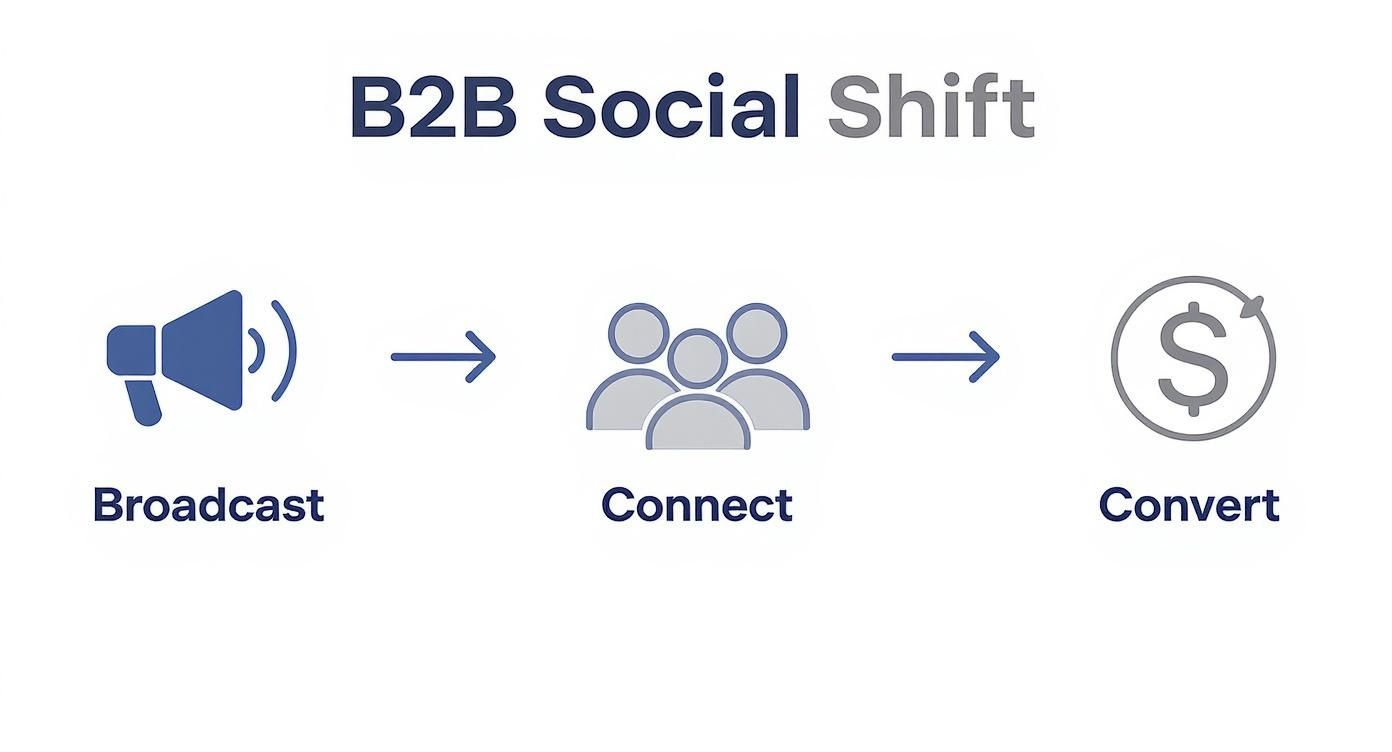
The real issue? A disconnect. Most B2B brands are still broadcasting, but buyers aren’t listening. They don’t scroll through LinkedIn hoping for a sales pitch or another generic product update. They’re hunting for expertise, clear answers, and—most importantly—a real human connection that solves real business challenges.
The Shift from Broadcasting to Connecting
For years, social media was just a megaphone: blast a corporate message and hope it sticks. Today, that feels like noise. Modern B2B buyers—now over 70% millennial—expect a conversation, not a commercial. They want proof of expertise before they’ll even consider talking to sales.
That means a mindset overhaul:
- From Seller to Media Company: Treat your social channels as the go-to source for insights in your niche. Think less “buy now” and more “here’s what you need to know.”
- From Corporate-Speak to Authenticity: Drop the stiff tone. Buyers connect with real stories, relatable voices, and honest opinions, not faceless logos.
- From Vanity Metrics to Business Impact: Likes and follower counts feel good, but a winning B2B social strategy is measured by qualified leads, pipeline influence, and real closed deals.
The core issue is that most B2B brands talk at their audience instead of with them. The magic happens when you stop selling a product and start sharing expertise that solves your audience’s biggest headaches.
Building a Strategy That Actually Converts
To break through the clutter, your strategy has to rest on pure value. This isn’t about listing features; it’s about painting a picture of the better future you’ll help them create. You’ve got to earn trust and attention long before someone even thinks about hitting “Request a Demo.”
This is where you transform followers into a genuine community of brand fans—and turn social media from a cost center into a powerful revenue engine.
Building a Foundation That Drives Results
A powerful B2B social media strategy isn’t guesswork. It’s built on a deep, almost obsessive understanding of who you’re talking to and what success looks like. This is the unglamorous but essential work that separates campaigns that fill your pipeline from those that just generate noise.
It all starts with your Ideal Customer Profile (ICP).
Forget surface-level demographics. A truly effective ICP dives into your buyer’s real-world challenges, motivations, and daily routines. What podcasts do they binge? Which newsletters actually make them click? Answer these and you’ll show up in the right places with a message that lands.
Define Your Ideal Customer Profile
Get out of your head. Talk to sales. Interview top customers. Use social listening to tune into conversations they’re already having.
You’re hunting for details like:
- Primary Pain Points: What keeps them up at night?
- Key Motivations: What does “win” look like for them?
- Information Sources: Where do they turn for trusted advice?
- Decision Triggers: What kicks off their search for a solution like yours?
This deep dive becomes the bedrock of every piece of content, every ad, every engagement tactic you deploy. For a full playbook, check out our B2B marketing strategy framework that brings this customer-first approach to life.
Set Crystal-Clear Goals
With a vivid picture of your audience, you can finally set goals that matter—specific, measurable, and tied to real business outcomes. Vague objectives like “increase engagement” won’t cut it. You need precision.
A great goal sounds more like a business commitment than a marketing wish. It’s the difference between “get more followers” and “generate 20 Marketing Qualified Leads (MQLs) per month from LinkedIn.”
Modern B2B social strategies go beyond broadcasting to zero in on connection and conversion.
Data backs this up. Today, 87% of B2B marketers use social media for content distribution, making it a core part of their mix. And LinkedIn? It dominates. 62% of marketers say it drives leads at twice the rate of any other platform.
Looking ahead, an overwhelming 85% of B2B marketers view LinkedIn as their top channel by 2025, reinforcing its central role in any serious B2B strategy. Defining your audience and setting concrete goals means every post moves the needle.
Choosing Your Platforms and Content Pillars
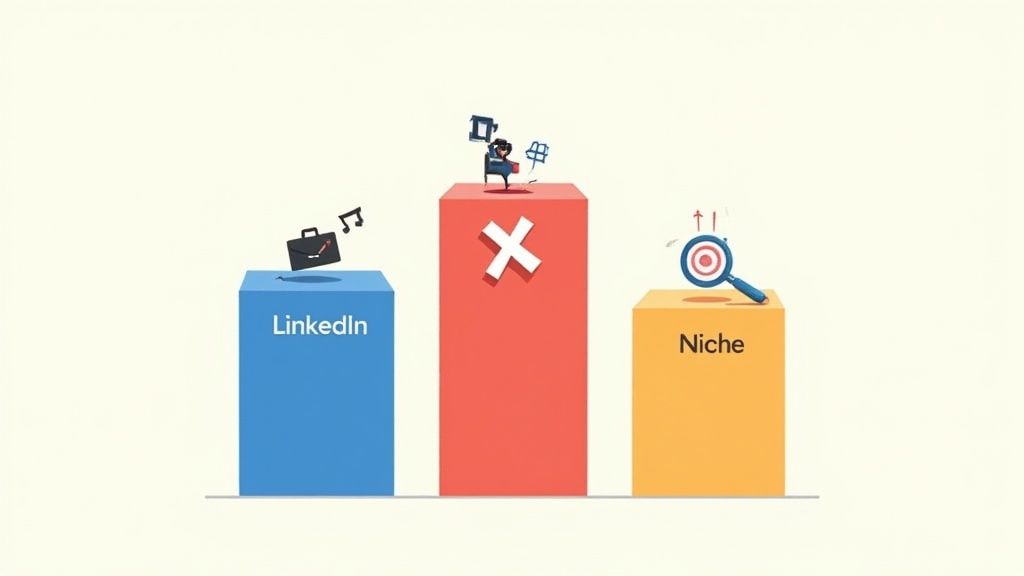
Here’s a common misstep: trying to be everywhere at once. It’s the fastest way to burn budget, stretch the team thin, and dilute your message to zero impact.
A smarter B2B social media strategy isn’t about posting more; it’s about posting right. Go back to your ICP and ask: where do they actually hang out to learn, network, and solve problems?
For most B2B tech companies, the conversation lives on LinkedIn. It’s the undisputed hub for professional networking and thought leadership. But don’t stop there.
X (formerly Twitter) is your ticket into real-time industry chats. A dedicated YouTube channel can become a powerhouse for demos, webinars, and expert interviews. The trick is to master one or two primary platforms before expanding.
Find Your Platform Sweet Spot
Choosing channels is about context and intent. A CTO browsing LinkedIn during lunch is in a different mindset than when they’re flipping through Instagram. You must meet them where their headspace matches your message.
Here’s a breakdown to help you decide where to focus:
B2B Social Media Platform Focus
| Platform | Primary Use Case | Best Content Formats | Target Audience Focus |
|---|---|---|---|
| Thought Leadership & Lead Gen | Articles, Case Studies, Company News, Text Posts, Polls, Video | C-Suite, VPs, Directors, Technical Decision-Makers | |
| X (Twitter) | Real-Time Engagement & News | Quick Takes, Industry News, Thread Discussions, Memes, Links | Founders, Journalists, Tech Influencers, Event Audiences |
| YouTube | Education & Demonstration | Product Tutorials, Webinars, Customer Testimonials, Interviews | Users, Technical Buyers, Implementation Teams |
This list isn’t exhaustive, but it covers the core battlegrounds for most B2B tech brands. Pick the spots where your expertise can genuinely shine and solve real problems.
The goal isn’t just to be present; it’s to become an essential part of the conversations happening on each platform.
Define Your Core Content Pillars
Once you’ve picked your channels, nail down your content pillars—your 3-5 core themes. Think of them as the sections of your own media publication, the topics your audience looks forward to.
This approach stops random posts and ensures everything you publish reinforces your authority.
For example, a B2B SaaS company selling an automation tool might choose:
- AI-Powered Automation: Tips, trends, and success stories about scaling operations with automation.
- Go-To-Market Strategy: Actionable advice for founders on launching and growing tech startups.
- Data-Driven Decision Making: Showcasing how analytics improve business outcomes.
- Team Leadership & Culture: Highlighting your values and how you build high-performing teams.
Every post, video, or article should tie back to one of these pillars. This keeps your message focused, consistent, and valuable—turning your feed into a go-to resource for your ideal customer.
Create Content That Actually Connects

Let’s face it: a lot of B2B content is just plain dull. It lists features, drowns readers in jargon, and misses the one thing that moves the needle—a human connection.
Great content doesn’t just inform; it builds trust and makes people feel seen. That’s where storytelling comes in. Don’t just present data—frame it as a narrative. Turn a customer success story into the journey of a hero (your customer) beating a villain (their biggest challenge) with your product as their guide.
That simple shift makes your content memorable and relatable.
Embrace the Human Element
Your secret content weapon isn’t a fancy tool—it’s your people. Skip generic, AI-spun posts and start showcasing the brilliant minds behind your brand. This is the heart of authentic thought leadership.
Highlight genuine insights and stories from your team:
- Opinionated LinkedIn posts from your CTO on industry trends.
- Short video series where your head of sales dives into common customer headaches.
- Behind-the-scenes photos from team brainstorming sessions.
People follow people, not logos. By putting your experts front and center, you become a go-to resource packed with real expertise.
On platforms like LinkedIn and Instagram, authenticity pays off—70% and 68% of marketers, respectively, report high confidence in the ROI of genuine engagement.
Balance Your Content Mix
A winning B2B social media strategy needs variety. You can’t post the same type of update on repeat and expect sustained interest. Build a content engine people genuinely want to follow because it lives up to three promises:
- Educate: How-to guides, industry analysis, and practical tips that solve real problems.
- Inspire: Customer success stories, team spotlights, and content that highlights your mission and values.
- Entertain: Behind-the-scenes glimpses, industry-relevant humor, or interactive polls and quizzes that spark conversation.
The most effective B2B brands borrow from the B2C playbook. They know that even serious business decisions are made by people who crave authenticity, stories, and a dash of personality.
This balanced approach keeps your feed fresh and prevents follower fatigue. By applying B2C tactics for B2B marketing success, you build stronger relationships rather than just broadcasting messages.
Turn Up the Volume on Your Reach and Engagement
Creating incredible content is a huge win, but it’s only half the battle. If your ideal customer never sees it, you might as well not have bothered. Here’s where you switch from creator to amplifier, making sure all that hard work lands in front of the right eyes.
Paid social ads are the most direct route. Think of them as a turbo boost for your best organic content. That LinkedIn article that killed it organically? Amplify it. The video case study with killer watch time? Put budget behind it to reach decision-makers on your target account list.
Social advertising in B2B is exploding—global social ad spend is on track to top $256 billion by 2025. But this isn’t about throwing money at the wall; it’s about precision. With intent data and tight targeting, you can reach potential buyers with surgical accuracy. Short-form video is a shining example—35% of social marketers rave about its high ROI, making platforms like YouTube (and yes, even TikTok) more important than ever. Dive into more B2B social media trends on Intentsify.io.
Stop Broadcasting and Start Building a Community
Paid ads can give you a lift, but a sustainable B2B social media strategy needs community. That means rolling up your sleeves and engaging.
Don’t just post your own content and wait for likes. Jump into the conversations already happening. Join niche LinkedIn Groups. Follow industry hashtags on X. When someone comments on your post, don’t just tap “like”—ask a thoughtful follow-up to keep the dialogue flowing.
Your social channels should be the go-to spot for your industry’s conversations. The aim is to become an indispensable part of the dialogue, not just another brand shouting into the void.
Turn Your Team into Your Biggest Advocates
Your employees are your most credible brand champions. Encourage them to share company content—and empower them to build their own professional brands by sharing their unique expertise.
Here’s how to make it easy:
- Offer simple guidelines. Give a quick rundown on voice, but let personality shine.
- Make sharing effortless. Use a tool or Slack channel to serve up pre-approved posts they can grab and customize.
- Celebrate their wins. Publicly recognize team members who do a great job engaging.
This approach humanizes your company and expands your reach exponentially. For an extra edge, learn how to harness trendjacking in B2B marketing to jump into timely conversations.
It’s the mix of paid amplification and genuine community building that turns passive followers into true fans.
Measuring What Matters And Proving ROI
Likes and follower counts look pretty but won’t drive deals. In your B2B social playbook, you want metrics that map directly to revenue. Track every touchpoint from first impression through closed-won.
Start by focusing on KPIs tied to sales goals. Maybe you want to boost lead conversion or slash acquisition costs. When you see those numbers shift in the right direction, you know your social efforts are paying off.
Key Metrics To Track
- Lead Conversion Rate: % of social leads that become Marketing Qualified Leads (MQLs) or Sales Qualified Leads (SQLs)
- Cost Per Acquisition (CPA): Total ad spend ÷ number of new customers
- Social Influenced Revenue: Deals where social interactions contributed above your threshold
- Pipeline Velocity: Average time social leads take to move through funnel stages
- Customer Lifetime Value (CLV): Estimated total revenue from social-sourced accounts
With these metrics, benchmark performance month over month. For example, aim to cut your CPA by 20% over the next quarter. These benchmarks spotlight trends and guide your optimizations.
Building Your Dashboard
| Metric | Definition | Quarterly Target |
|---|---|---|
| Lead Conversion Rate | % of social leads becoming MQLs/SQLs | 10%+ |
| Cost Per Acquisition | Ad spend ÷ new customer | < $150 |
| Pipeline Velocity | Avg days for social leads to close | < 60 days |
This simple layout becomes your team’s north star. Spot a metric drifting? Drill into the data, tweak your ads or content, and watch it move back on course.
A dashboard that updates in real time powers faster decisions and proves your strategy isn’t vanity—it’s a revenue engine.
Tools like Google Data Studio or Tableau automate these feeds so you can focus on insights, not manual reporting.
Reporting To Leadership
When briefing execs, context is king. Frame each slide with a quick takeaway: what changed, why it happened, and where you’re headed next.
I swear by this structure:
- Highlight Key Wins: Show revenue gains tied to recent campaigns
- Explain Variances: Pinpoint why metrics rose or dipped
- Recommend Next Steps: Offer data-backed tweaks for underperforming channels
- Request Resources: Back resource asks with projected impact
For instance, a scale-up I advised saw a 35% spike in MQLs after shifting more budget into LinkedIn sponsored posts. That win cemented ongoing investment in our B2B social approach.
Keep the rhythm tight—tactical check-ins weekly, strategic reviews monthly. That cadence ensures social stays top of mind as a growth driver, not just another budget line item.
By focusing on the right KPIs and clear visual dashboards, you’ll prove how social media fuels revenue. Once leadership sees those numbers climb, ongoing support and budget become a no-brainer.
Got Questions? Here Are a Few We Hear All the Time
Running a B2B social media strategy always brings up tricky, recurring questions. Here are the top three I hear from tech startups and scale-ups:
- How do I handle negative comments without making things worse?
- Which metrics actually show if this is working?
- How much should I realistically budget for paid social ads?
How to Handle Negative Feedback (Without Freaking Out)
Seeing public criticism of your product? It stings—but it’s also a chance to show you care. When someone posts a complaint, the clock starts ticking.
My rule: respond within 24 hours, leading with empathy, not defensiveness.
Here’s a quick playbook to turn a bad comment into a trust-building moment:
- Acknowledge their specific problem. No generic “we’re sorry.”
- Offer to take the conversation private. A DM or direct email shows you’re serious.
- If you have a fix, share it transparently. Honesty wins.
- Once resolved, circle back publicly: “Glad we could sort this out for you!”
A simple table helps keep your team consistent when the pace picks up:
| The Problem | A Human-Sounding Response |
|---|---|
| A feature bug | "Ugh, that's frustrating. We're sorry you ran into that bug. Our team is on it now and we'll let you know as soon as it's fixed." |
| A service delay | "Thanks for flagging this—that's not the experience we want for you. Our support team will reach out directly in the next hour to help." |
This isn’t about templates; it’s about having a calm, consistent process.
Calculating Your Real Social Media ROI
Measuring B2B social ROI goes beyond likes and shares. You need to connect social activity to revenue. It’s the only way to prove value to your CEO and CFO.
Zero in on these metrics:
- Lead Conversion Rate: % of social leads that become MQLs or SQLs
- Cost Per Acquisition (CPA): Total ad spend ÷ number of new customers
- Social-Influenced Revenue: Deals in your pipeline touched by social media
- Engagement Rate: Are people asking real questions and starting conversations?
Sometimes a channel with a higher CPA drives leads that close twice as fast. You won’t know unless you track pipeline velocity alongside your social metrics.
Putting these side by side in a quarterly review makes budget decisions crystal clear.
| Channel | CPA | Lead Conversion |
|---|---|---|
| LinkedIn Ads | $120 | 15% |
| X Ads | $90 | 12% |
Despite a lower CPA on X, LinkedIn delivers higher-quality leads. That’s a data-driven reason to shift budget.
How to Invest in Paid Social (Without Wasting Money)
Budgeting for paid campaigns can cause analysis paralysis. The secret? Start small, learn fast, and scale what works. Don’t boil the ocean.
A good starting point: allocate 5-10% of your total marketing budget to run experiments on LinkedIn or X. Compare cost per lead and adjust your spend accordingly.
Tactics to make your budget work harder:
- Run A/B tests on ad creative and copy.
- Use buyer intent data to build hyper-targeted audiences.
- Set daily budgets to keep spending in check.
- Check your CPA weekly.
Benchmarks help, but your own data matters most.
| Platform | Ad Type | Typical CPA |
|---|---|---|
| Sponsored InMail | $80-150 | |
| X | Promoted Post | $50-100 |
| Lead Gen Form | $40-90 |
Use these as guides, not rules. Test, learn, and find your sweet spot.
The best strategies blend smart paid campaigns with authentic organic engagement. Empower your team to spot trending conversations and jump in. With consistency and adaptability, social media stops being a chore and becomes a predictable growth engine.
Ready to turn your B2B social media from a cost center into a revenue driver? Value CMO provides the expert guidance and hands-on support that tech startups and scale-ups need. Learn more about how we can help and schedule your free consultation today.
Article created using Outrank