

A solid B2B marketing team structure is more than just an org chart—it’s the blueprint for how you'll grow. Think of it less like a rigid hierarchy and more like a flexible, goal-driven system that pulls together specialized pros in areas like content, demand generation, and product marketing into one powerhouse engine.
Why Your B2B Marketing Team Structure Matters
Building a B2B marketing team feels a lot like putting together a high-performance engine. Get the structure right, and you’ve got a powerful force for growth. Get it wrong, and you're stuck with friction, missed targets, and wasted cash.
This guide is your blueprint for building a team that fires on all cylinders.
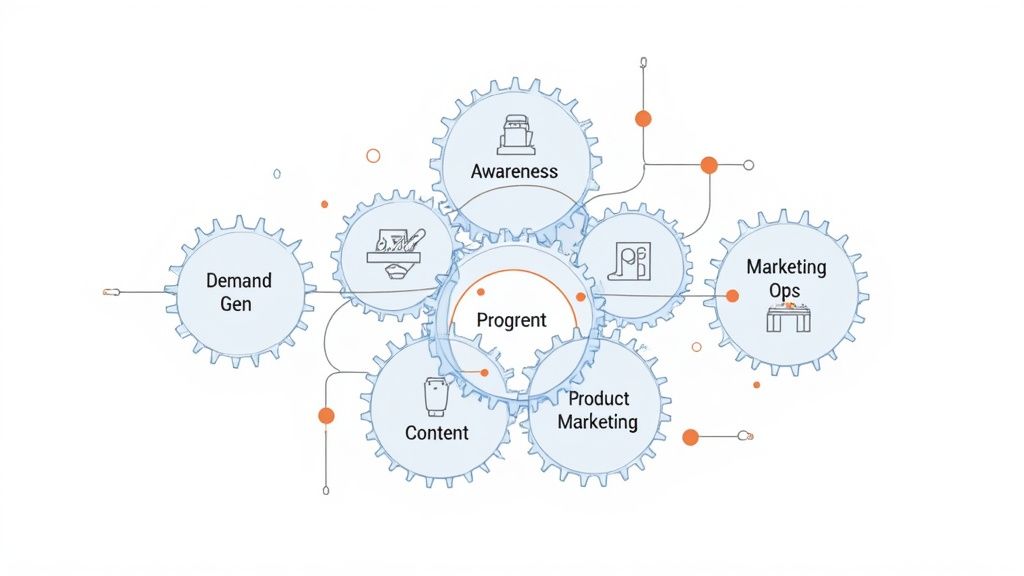
This isn’t about just drawing lines and boxes. A modern B2B marketing structure is all about creating a system where every function is interconnected, driving real momentum and putting actual business results on the board.
The Foundation of a Growth-Oriented Team
The whole point of a team structure is to line up specialized skills with your company's big goals. B2B marketing has grown to include a whole bunch of roles, from product marketers and content creators to demand gen specialists. The right mix for you always depends on your company size, industry, and what you’re trying to pull off.
A solid structure brings clarity and accountability, making sure everyone knows their role and how their work connects to the bigger picture. This alignment is huge for a few key reasons:
- Better Efficiency: When roles are clearly defined, there’s less overlap and fewer tasks fall through the cracks.
- Smarter Collaboration: A good structure naturally helps different functions talk to each other, like making sure your content team is actually creating stuff that fuels your demand gen efforts.
- Scalable Growth: The right framework lets your team grow and adapt as the company gets bigger, minus the chaos.
At its heart, a marketing team needs to own a few key functions to really push the business forward.
Core Functions of a Modern B2B Marketing Team
This table breaks down the non-negotiable functions and their main goals. No matter how big or small your team is, these responsibilities have to be covered.
| Core Function | Primary Goal | Key Responsibilities |
|---|---|---|
| Strategy & Leadership | Align marketing with revenue goals | Planning, budgeting, team management, performance tracking |
| Product Marketing | Position the product to win its market | Messaging, positioning, sales enablement, competitive analysis |
| Demand Generation | Create qualified pipeline for sales | Paid ads, SEO, email campaigns, lead nurturing |
| Content Marketing | Build authority and attract prospects | Blog posts, case studies, webinars, social media, SEO content |
| Brand & Communications | Shape market perception and build trust | Public relations, brand identity, social media presence, events |
| Marketing Operations | Provide the tech and data for growth | Martech stack management, analytics, reporting, process automation |
Ultimately, you can find more detailed insights into marketing department structures and common organizational models, but these functions are the bedrock.
Connecting Structure to Strategy
Your team’s design should be a direct reflection of your business goals. A structure that works for a startup trying to build brand awareness will look totally different from one built for an enterprise pushing for market expansion.
That's why you have to build your team around a solid go-to-market plan. You can check out our guide on how to build a powerful B2B marketing strategy framework to make sure your team is set up for success from day one.
The most effective B2B marketing teams aren't defined by rigid hierarchies but by how well they can adapt and collaborate. Your structure should empower specialists to do their best work while making sure every single thing they do is tied directly to revenue.
In the end, designing your B2B marketing team is all about putting the right people in the right seats to hit specific goals. In the next sections, we’ll break down the key roles, stage-based models, and reporting lines you need to build a truly high-performing team.
Meet the Key Players in Your Marketing Engine
A high-performing B2B marketing team isn't just a collection of people; it's a symphony of specialized skills. Think of it like a Formula 1 pit crew—each person has a distinct job, but they all work in perfect sync to win the race.
Let's move past the theory and meet the specialists who actually make the marketing magic happen. Once you get a feel for these roles, you'll know exactly how to build your own team and what to expect from each player.
The Content Marketer: The Storyteller
The Content Marketer is your team’s chief storyteller. They don't just churn out blog posts; they build the entire story that attracts, educates, and earns the trust of your audience. Their job is to answer your prospects' questions before they even think to ask them.
This person owns the editorial calendar, pumping out high-quality stuff like articles, whitepapers, case studies, and webinars. Success isn't just about page views—it's about engagement, how long people stick around, and how well their content turns readers into leads. They work hand-in-hand with the SEO Strategist to make sure those stories actually get found.
The Demand Generation Specialist: The Pipeline Builder
If the Content Marketer builds the audience, the Demand Generation Specialist turns that audience into a predictable sales pipeline. This role is laser-focused on one thing: creating qualified leads. They are the architects of your lead-gen machine, running everything from paid search and social ads to email marketing.
Their world revolves around metrics like Cost Per Lead (CPL), Marketing Qualified Leads (MQLs), and conversion rates. A great Demand Gen Specialist is part scientist, part artist—always testing ad copy, tweaking landing pages, and digging into the data to find the most efficient path to revenue.
Key Insight: The partnership between Content and Demand Generation is the bedrock of modern marketing. Content creates the valuable stuff (the "bait"), and Demand Gen builds the systems to get that bait in front of the right fish at the right time.
The Product Marketing Manager: The Market Translator
The Product Marketing Manager (PMM) is the critical bridge connecting your product, marketing, and sales teams. Their mission is to understand the market, the competition, and the customer so deeply that they can craft messaging that just clicks.
Think of them as a translator. They take complicated product features and turn them into real-world benefits that resonate with buyers. A PMM’s key duties include:
- Go-to-Market Strategy: Planning and pulling off flawless product launches.
- Sales Enablement: Arming sales reps with battle cards, case studies, and demos that help them close deals.
- Market Intelligence: Keeping a close eye on competitors and industry trends to keep your strategy sharp.
Without a strong PMM, even the best products can get lost in the noise.
The SEO Strategist: The Visibility Expert
The SEO Strategist is obsessed with making your brand impossible to ignore on search engines. This role is about way more than just "keywords." They manage the technical health of your website, build a high-quality backlink profile, and make sure your content strategy lines up with what your ideal customers are actually searching for.
They analyze search trends and user intent to guide the content team, ensuring every article is primed to rank for high-value terms. Their success is measured in organic traffic growth, keyword rankings, and, most importantly, the number of leads that come straight from search.
The Marketing Operations Pro: The Engine Builder
Last but definitely not least is the Marketing Operations (Ops) professional. If your marketing team is a high-performance engine, Marketing Ops is the engineer who designs, builds, and maintains it. They own the entire martech stack, from your marketing automation platform to your analytics tools.
This person makes sure data flows cleanly between systems, builds dashboards that deliver real insights, and automates processes to make the whole team more efficient. Their work is the invisible foundation that makes scalable, data-driven marketing possible.
Building a team with these roles is tough, especially when you're up against common industry hurdles. Recent surveys show 47% of B2B marketers see a lack of brand awareness as a major obstacle, with market competition close behind at 44%. These specialists are your frontline defense. You can explore more about the current state of B2B marketing on SurferSEO.
Leading this group requires a unique skill set, which is why finding the right marketing leader is so critical. If you're looking for guidance on that front, check out our comprehensive CMO hiring guide for founders and HR leaders.
Structuring Your Team for Every Growth Stage
The scrappy two-person marketing "team" that gets a startup off the ground is a world away from the global department of a large enterprise. Growth doesn't just happen; it demands that you evolve. Your marketing team structure has to adapt to support—and even accelerate—each new phase of your company's journey.
Building a team proactively, not reactively, is the key. You have to anticipate what you'll need before it becomes a burning problem. Instead of scrambling to hire when things are already breaking, a stage-based approach gives you a clear roadmap for scaling your marketing function intelligently.
This timeline shows exactly how a marketing team's focus shifts—from finding product-market fit as a startup to optimizing for global reach as an enterprise.
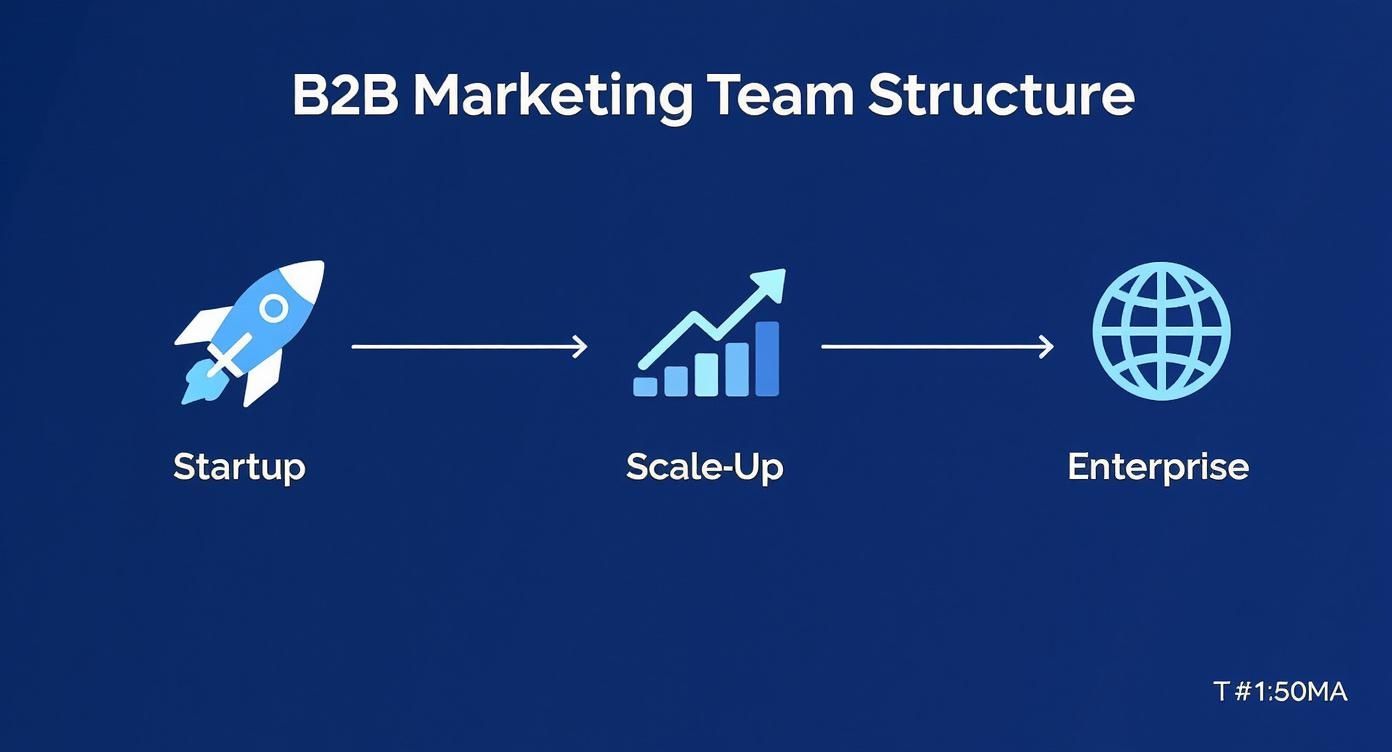
As you can see, what starts as a hunt for initial traction evolves into a machine built for repeatable growth. Eventually, it becomes a complex system designed for market dominance.
The Startup Stage: Finding Your Footing
In the early days (think 5-50 employees), your marketing is all about being nimble and trying new things. The goal isn't perfection; it's finding product-market fit and generating your first trickle of revenue. Your team will be lean, flexible, and made up of generalists.
Your budget is tight, so every hire needs to pack a punch. The average B2B marketing team for a startup is just two to five people. These initial hires are the Swiss Army knives of your company—they have to wear a lot of hats.
Here are the first roles to lock in:
- Marketing Lead/Head of Marketing: This person isn't just a manager; they're a doer. They set the initial strategy, manage the budget, and will probably write copy, run ads, and analyze data themselves.
- Content Marketer/SEO Specialist: This role is critical for building your foundational online presence. They’ll create the early blog posts, landing pages, and sales sheets needed to attract and convert your first customers.
- Growth Marketer: This person is obsessed with experimentation. They’ll test everything from paid social ads to email sequences to find the most effective paths to lead generation. Fast.
Key Takeaway: In the startup phase, hire versatile marketers who are comfortable with a little chaos and have a strong bias for action. The structure is flat, and the goal is simply to prove the marketing model works.
The Scale-Up Stage: Building Repeatable Growth
Once you've found product-market fit and have a steady stream of revenue (around 100-1,000 employees), it's time to pour fuel on the fire. The scale-up stage is all about building repeatable, predictable processes. The focus shifts from frantic experimentation to systematic optimization.
This is when you start hiring specialists to own specific functions. Your team starts to look less like a small crew and more like a collection of specialized pods. Your marketing gets more complex, and you need experts who can go deep in their respective areas to drive results.
Your team will expand to include roles like:
- Demand Generation Manager: This person owns the MQL number. They're responsible for building a scalable lead generation engine through channels like paid search, SEO, and webinars.
- Product Marketing Manager: As your product evolves, you need someone to own messaging, positioning, and sales enablement. They make sure your value prop is sharp and your sales team is effective.
- Marketing Operations Specialist: With more complexity comes the need for better systems. This person manages your martech stack (HubSpot, Marketo, etc.), ensures data is clean, and builds the dashboards that track performance.
- Dedicated Content Creators: Your single content marketer can no longer keep up. You'll need dedicated copywriters, video producers, or social media managers to scale content production.
The Enterprise Stage: Optimizing for Dominance
At the enterprise level (1,000+ employees), marketing is a well-oiled machine. You have a proven system for generating revenue, and the focus shifts to optimization, market expansion, and brand dominance. Your B2B marketing team structure becomes highly specialized and often global.
The team is now led by a C-level executive—the Chief Marketing Officer (CMO)—who oversees multiple directors responsible for large, specialized teams. The structure is hierarchical and designed for executing complex, large-scale initiatives with precision.
At this stage, you'll add highly specialized leadership and individual contributor roles:
- VP of Demand Generation: Oversees all pipeline-generating activities, including digital, ABM, and field marketing.
- Director of Brand & Communications: Manages public relations, analyst relations, and large-scale brand campaigns to shape how the market sees you.
- Director of Product Marketing: Leads a team of PMMs, each focused on specific products or market segments.
- Director of Content Marketing: Sets the overarching content strategy and manages a large team of creators, editors, and SEO managers.
- Customer Marketing Manager: Focuses on retention, advocacy, and upselling to the existing customer base, maximizing customer lifetime value.
To make this even clearer, here's a simple table breaking down how the team and its goals evolve with each stage.
Team Structure Models by Company Stage
| Growth Stage | Key Roles to Hire | Primary Marketing Goal |
|---|---|---|
| Startup | Marketing Lead, Content Marketer/SEO, Growth Marketer | Find Product-Market Fit & Generate Initial Revenue |
| Scale-Up | Demand Gen Manager, Product Marketing Manager, Marketing Ops Specialist, Dedicated Content Creators | Build Repeatable, Scalable Growth Engines |
| Enterprise | VP of Demand Gen, Director of Brand, Director of Product Marketing, Director of Content, Customer Marketing | Optimize for Efficiency, Expand Market Share, & Dominate |
Building your team based on your growth stage ensures you have the right talent focused on the right priorities at the right time. This strategic approach to team design is the foundation for sustainable, long-term success.
Choosing Your Team's Operating Model
https://www.youtube.com/embed/fUqoYP4EKVY
How your team talks, collaborates, and makes decisions is just as critical as who’s on it. The best talent in the world can't fix a clunky workflow or a misaligned structure. Your team’s operating model—its reporting structure—is the playbook that dictates everything from who greenlights a campaign to how fast you can jump on a market trend.
Think of it like setting up a sports team. You wouldn’t use a defensive formation if your goal was an all-out offensive blitz. In the same way, your B2B marketing team structure has to be wired for your specific business goals, your company’s culture, and your go-to-market strategy.
Let's break down the three most common models to see which one fits your company.
The Centralized Model: A Single Source of Truth
The centralized model is the classic pyramid. One marketing leader—a CMO or VP of Marketing—sits at the top, and all marketing functions, from content and demand gen to product marketing, report straight up the chain. Simple and direct.
This structure is built for consistency. With one leader overseeing the whole show, it's far easier to keep the brand message tight, control the budget, and make sure every single activity ladders up to one unified strategy. It’s a great fit for companies with a single core product where a consistent message is non-negotiable.
The flip side? This model can become a bottleneck. When every big decision has to funnel through one person or a small leadership team, things inevitably slow down. It can also insulate the marketing team from the specific, on-the-ground needs of different product lines or business units.
The Decentralized Model: Embedded and Agile
In a decentralized model, you blow up the central department. Instead, marketers are embedded directly within different business units, product lines, or regional teams. A marketer working on Product A reports to the General Manager of Product A, not to a CMO miles away.
This structure is all about agility and deep specialization. An embedded marketer lives and breathes their specific product and customer. They can react to market feedback in real-time and tailor strategies on the fly, without waiting for a sign-off from corporate. You see this a lot in large, diversified companies where different divisions operate almost like their own separate businesses.
The risk here is fragmentation. Without a central hub, you can easily end up with inconsistent branding, duplicated work, and campaigns that unknowingly compete with each other. Sharing wins and resources across the organization gets a lot harder, which can breed inefficiency.
A team's operating model isn't just an org chart; it's a statement about what the business values most. Centralized models prioritize consistency and control, while decentralized models prioritize speed and specialization.
The Hybrid Model: The Best of Both Worlds
The hybrid model, often called a matrix structure, is an attempt to get the perks of both centralized and decentralized setups. In this world, a marketer might have two bosses: a "solid-line" manager for their function (like a Director of Content) and a "dotted-line" manager in a business unit (like a Product Manager).
The goal is to achieve both alignment and agility. A central marketing team is responsible for the big-picture brand strategy, shared services like marketing ops, and setting best practices. At the same time, marketers are dedicated to specific business units, which keeps them connected to the product and the customer.
The biggest challenge is complexity. Having two bosses can create confusion and conflicting priorities if it’s not managed with extreme clarity. It demands rock-solid communication and well-defined roles to prevent chaos. For most growing B2B tech companies, though, this model strikes the right balance between strategic oversight and nimble execution.
Many businesses find that bringing in outside expertise helps them navigate this complexity. For companies needing high-level strategic guidance without the full-time cost, exploring what is a fractional CMO can provide a flexible and experienced leader to guide these crucial structural decisions.
How Leadership and Measurement Drive Success
A perfectly designed B2B marketing team structure is like a high-performance race car—it has all the right parts in all the right places. But without a skilled driver and a clear destination, it’s just a shiny piece of machinery going nowhere. In marketing, leadership is the driver, and your metrics are the destination.

Even the most talented team will drift without strong guidance and clear, measurable goals. This is where a true marketing leader—a CMO or VP of Marketing—transforms a group of specialists into a predictable revenue engine.
The Leader's Role Beyond Management
In B2B, a manager just organizes tasks; a leader inspires direction and purpose. Their main job is to draw a straight line from every single marketing activity, whether it’s a blog post or a paid ad, directly to business revenue.
They are the chief translators, turning marketing efforts into a language the C-suite understands: growth, pipeline, and profit.
A great leader also defines a clear compensation philosophy to attract and keep top talent, ensuring everyone’s incentives are pointed in the same direction. They build the culture, set the pace, and hold the team accountable for outcomes, not just output.
Measuring What Truly Matters
"Are we getting a return on our marketing spend?" This is the one question every marketing leader must be ready to answer, anytime.
With 70% of B2B marketers facing pressure to prove ROI, gut feelings and vanity metrics just don't fly anymore. You have to connect the dots between your team's work and tangible growth.
That means moving past top-of-funnel fluff like clicks and impressions and focusing on the KPIs that really impact the bottom line.
Here are the numbers that matter most:
- Marketing-Sourced Revenue: This is the gold standard. It answers the question, "How much new revenue did marketing directly bring in?" It's the cleanest measure of your team's contribution.
- Marketing-Influenced Revenue: This metric acknowledges that marketing touches prospects multiple times. It tracks every deal where marketing played a role, even if it wasn't the last touchpoint.
- Customer Acquisition Cost (CAC): This tells you exactly how much you're spending to land each new customer. A falling CAC means your team is getting more efficient and profitable.
- Customer Lifetime Value (CLV): A high CLV shows you're attracting and keeping high-value customers—a direct result of smart targeting and messaging.
- Pipeline Velocity: This measures how quickly leads move through the sales funnel. A faster velocity means your marketing is effectively speeding up the sales cycle.
By focusing on these business-centric KPIs, marketing leaders can shift the conversation from "How much did we spend?" to "How much did we generate?" This empowers you to confidently justify your budget and prove your team is an indispensable growth engine, not a cost center.
Common Questions We Hear About Building a Marketing Team
As you start sketching out your B2B marketing org chart, the real-world questions pop up fast. A diagram on a slide is one thing; a team that actually ships work and hits numbers is another. Let’s tackle the questions that always come up.
How Many People Should My B2B Marketing Team Have?
There's no magic number here. Anyone who gives you one is selling something. For a seed-stage startup, the “team” might just be one versatile marketer and a freelancer or two.
A good rule of thumb is to dedicate 5-10% of your company’s revenue to the marketing budget, which has to cover salaries. But a more practical way to think about it is to hire for your biggest bottleneck. No leads? You need a demand generation person. High traffic but no conversions? Time for a content or product marketer. The key is to hire to solve a specific business problem, not just to fill a box on a chart.
What’s the Real Difference Between Product Marketing and Content Marketing?
They’re close cousins, but they have different jobs. Here’s a simple way to think about it:
Product Marketing owns the product’s story in the market. They figure out the messaging, define the buyer personas, and create the sales tools—like battle cards and case studies—that help reps close deals.
Their job is to answer the question: "Why should our ideal customer care about this product right now?"
Content Marketing, on the other hand, owns the audience’s problems. They create helpful blogs, guides, and webinars to attract and teach potential customers—often before those people even know your product exists. Their job is to answer the question: “What does our audience struggle with, and how can we help them solve it?”
Should My B2B Marketing Team Report to Sales?
This is the classic debate, but in most modern, high-growth companies, the answer is no. Marketing and Sales should be peer departments, both reporting up to a Chief Revenue Officer (CRO) or directly to the CEO.
When marketing reports to sales, long-term brand building and strategic plays almost always get sacrificed for short-term lead quotas.
The goal isn’t a hierarchy; it’s alignment. The best setups create a true partnership where both teams are tied to the same revenue number. They operate with a clear Service Level Agreement (SLA) that spells out exactly what each team owes the other. Marketing commits to delivering a certain number of qualified leads, and Sales commits to working them within a specific timeframe. That’s how you build a revenue engine that actually works.
Getting the structure right is step one, but leading the team with a clear, revenue-focused strategy is what makes it all click. Value CMO gives B2B tech companies the experienced, on-demand marketing leadership needed to build and guide high-performing teams. If you need a proven strategist to help you grow faster, let’s talk. Learn more at ValueCMO.com.