Let's be honest, B2B marketing strategy consulting is about getting a seasoned expert to build a focused growth plan for you—without the hefty price tag of a full-time executive. It’s the quickest way to stop throwing random tactics at the wall and start building a real, data-driven engine that lands customers and hits predictable revenue goals.
What Is B2B Marketing Strategy Consulting

Think of a B2B marketing strategy consultant less like an advisor and more like an architect for your company’s growth. They don’t just hand you a complicated blueprint and disappear. They get in there with you, helping lay the foundation and build a machine designed for one thing: attracting and keeping high-value business customers.
For so many tech founders and startup leaders, marketing feels like a jumble of to-dos—a blog post here, a social media campaign there—with no clear line connecting all that effort to actual money in the bank. This is exactly where a consultant steps in to cut through the noise and provide a clear path forward.
Moving From Tactics To Strategy
The real magic here is the shift from just doing things to having an intentional strategy. Instead of guessing what might work this week, a consultant helps you build a solid game plan based on what's actually worked for other companies like yours.
This process usually involves a few crucial steps:
- Getting Clear on the Vision: Making sure every single marketing move you make directly supports your bigger business goals.
- Sharpening Your Focus: Defining a razor-sharp Ideal Customer Profile (ICP) so you stop wasting money on audiences that will never, ever buy.
- Building a Roadmap: Creating a practical, step-by-step plan that lays out exactly what to do, when to do it, and why it's important.
This strategic alignment ensures every dollar and hour you spend on marketing actually moves the needle. A huge part of this is often hammering out a solid go-to-market (GTM) strategy, which becomes your master plan for finding customers and standing out from the competition.
An Architect For Your Growth Engine
Imagine trying to build a high-performance engine by just grabbing parts off a shelf. You might get lucky, but you’ll probably end up with something that sputters and stalls. A consultant is the master mechanic who knows how all the components—from your messaging and content to your channels and tech—need to fit together perfectly.
A great consultant doesn’t just give you a plan; they give you a system. They build a repeatable process for growth that your team can own and scale long after they're gone.
At the end of the day, B2B marketing strategy consulting is all about building momentum. It gives you the senior-level know-how needed to create a clear path forward, empowering your team to execute with confidence and drive real, predictable revenue. If you want to dig a little deeper, check out our guide on what marketing consulting is all about.
When Your Tech Startup Needs a Marketing Strategist
Does this sound familiar? You’ve poured your heart into building an incredible product and your team is amazing, but growth feels like a rollercoaster. One month you’re on top of the world, the next you're staring at a flat line. That kind of inconsistency is the number one reason founders start looking for a b2b marketing strategy consultant.
Sooner or later, every tech startup hits a wall where hustle just isn't enough anymore. You don’t need more activity; you need a smart system. Knowing when to call in an expert is often the difference between getting stuck and truly scaling up.
It’s all about turning that raw potential into predictable performance. An outside strategist brings the senior-level thinking you need to build a repeatable growth engine, turning your marketing budget from a hopeful gamble into a reliable investment.
The Tipping Points: When to Call for Help
Most founders don’t just wake up one day and decide they need a strategist. It’s usually a nagging problem that finally becomes too painful to ignore. These are the signals that your current approach just isn't cutting it and you need a real plan.
Here are a few of those "aha!" moments when a consultant can make all the difference:
- Your Pipeline is a Total Mystery: If you have no earthly idea where next quarter’s leads are coming from, you don’t have a strategy—you have a collection of random tactics. A consultant’s first job is to build a predictable pipeline that you can actually count on.
- A Big Product Launch is Crashing and Burning: You’ve got a game-changing feature ready to go, but the launch is a dud. A strategist can quickly figure out why, fix the messaging, and build a go-to-market plan that gets it in front of the right people.
- Your Junior Marketing Team is Drifting: You hired smart, talented marketers who are great at getting things done. But without a senior leader to set the vision, they’re just spinning their wheels, unable to drive real impact.
- Sales and Marketing are at War: Sales is complaining about lead quality while marketing feels like their hard work disappears into a black hole. A consultant acts as the bridge, getting both teams aligned around a single Ideal Customer Profile (ICP) and the same goals.
If any of these hit a little too close to home, it’s a clear sign you need an architect to design a better system for growth.
Navigating a World of Rising Costs and Fierce Competition
Let's be honest: the B2B world isn’t getting any simpler. It costs more than ever to get a customer, and it feels like a new competitor pops up every single week. Just throwing more money at the problem without a tight strategy is a surefire way to burn through your cash.
This is where expert guidance stops being a luxury and becomes a necessity. Budgets are on the rise again as leaders shift from a "do more with less" mindset to making smart investments. A recent study found that a whopping 83% of B2B marketing leaders expect their budgets to grow in the next year. With total B2B marketing spend in the U.S. rocketing toward $69 billion a year, making every dollar count is everything. You can get a deeper look at these trends by exploring the full B2B marketing forecast.
Bringing in a B2B marketing strategy consultant is about making sure that as your budget grows, your results grow even faster. They give you the framework to invest smartly, putting your money into the channels and plays with the highest possible return.
Finding The Right Consulting Engagement Model
Bringing in a B2B marketing strategy consultant isn't a one-size-fits-all deal. The right partnership really depends on where your business is right now and what you absolutely need to get done next. If you get the model wrong, you're looking at mismatched expectations and wasted money. Get it right, and you can pour gasoline on your growth.
Think of it like hiring a personal trainer. Do you just need one session to get a workout plan you can run with on your own? Or do you need someone spotting you three times a week, pushing your limits and keeping you accountable? Both are valuable, but they solve completely different problems.
In the same way, consulting engagements are built for specific outcomes. Sometimes you need a short, intense burst of strategic planning to get unstuck. Other times, you need ongoing senior leadership to steer the ship. Let's break down the most common models so you can find your perfect fit.
Project-Based Sprints For Rapid Strategy
Sometimes, you just need a plan. You have a team ready to go, but they’re spinning their wheels without a clear roadmap. This is where a project-based sprint comes in. It’s a short, super-focused engagement designed to deliver one specific, tangible result in a fixed amount of time—usually just a few weeks.
This model is a lifesaver for startups needing to solve a single, urgent problem fast. Maybe you need to finally nail down your Ideal Customer Profile (ICP), map out a go-to-market strategy for a new product, or build a content engine from scratch. The consultant dives in, works intensely with your team, and leaves you with a complete, actionable playbook.
It’s the strategic equivalent of a double espresso. The goal is to get maximum impact in minimum time, giving your team the clarity and direction they desperately need to finally hit the ground running. If you're wondering whether stalled growth is the right signal for this kind of help, this decision tree can make things clearer.
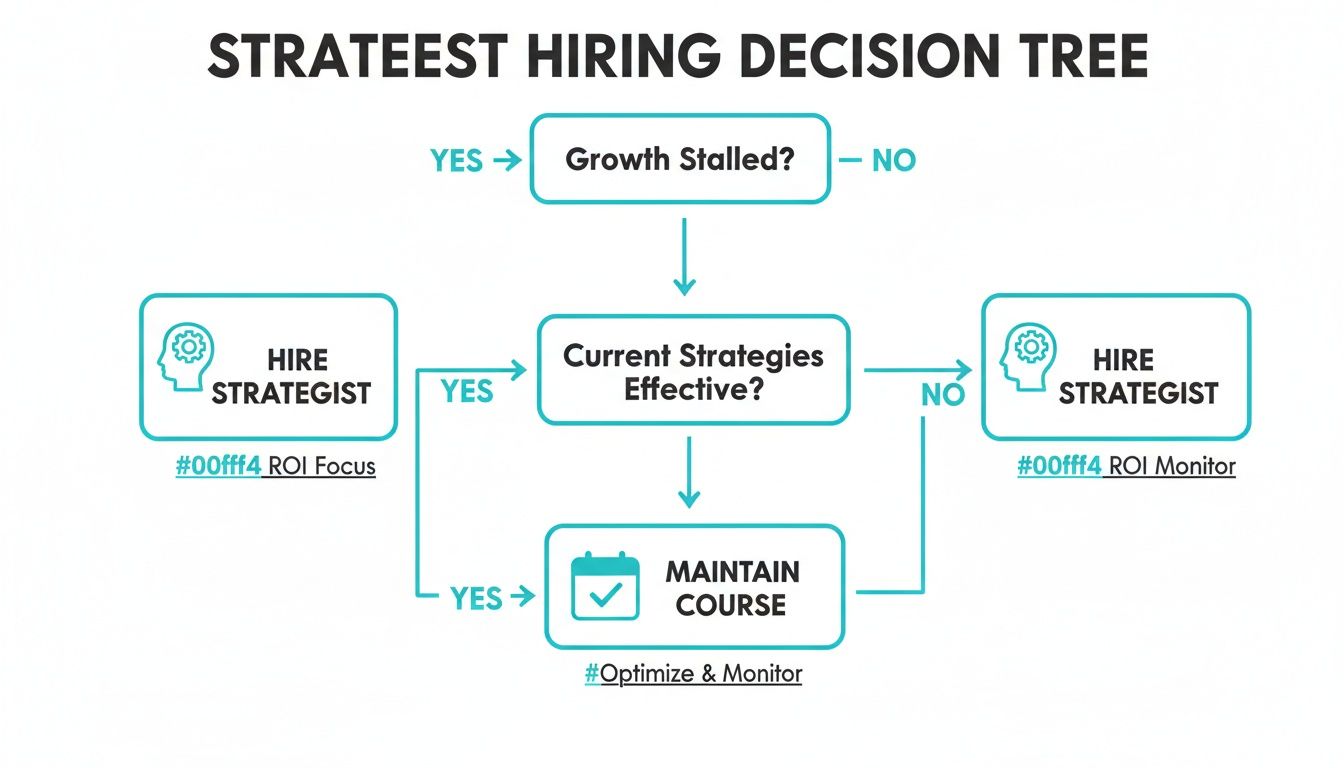
The visualization shows a clear fork in the road: if your growth has flatlined, bringing in a strategist is the best way to figure out what's broken and build a new plan to fix it.
Fractional CMO Retainers For Ongoing Leadership
But what if a plan isn't enough? What if you need the senior-level horsepower to actually implement it, mentor your team, and make tough decisions week after week? This is the job of a fractional CMO.
This model embeds a dedicated marketing executive into your leadership team for a "fraction" of the cost and commitment of a full-time hire. A fractional CMO doesn't just hand you a strategy; they own its success. They're in the trenches with you, managing the budget, coaching your marketers, picking vendors, and reporting on performance to the CEO and the board.
This isn't just advice; it's leadership. A fractional CMO acts as a true partner, accountable for hitting your pipeline and revenue targets over the long haul.
This approach is perfect for startups that have a marketing team in place but are missing that senior experience to guide them. It’s also an excellent bridge when you’re not quite ready for a full-time VP of Marketing but can no longer afford to let marketing run on autopilot. For a deeper dive, you can learn more about the perks of bringing in an outsourced marketing leader.
Choosing Your B2B Marketing Consulting Model
Picking the right engagement model is the first step toward a great partnership. To make it easier, the table below breaks down the key differences to help you decide which path makes the most sense for your company's immediate needs and long-term goals.
| Engagement Model | Best For | Typical Duration | Key Deliverables |
|---|---|---|---|
| Project-Based Sprint | Startups needing a specific, actionable plan to solve a single problem like GTM or ICP definition. | 2-6 Weeks | Documented Go-To-Market strategy, validated Ideal Customer Profile, prioritized marketing roadmap. |
| Fractional CMO | Companies needing ongoing strategic leadership, team mentorship, and accountability for results. | 6-12+ Months | Marketing plan ownership, budget management, team leadership, KPI reporting, revenue growth. |
Ultimately, sprints give you a map, while fractional CMOs help you drive to the destination. Your choice depends on whether you need a navigator for a tricky part of the journey or a co-pilot for the long haul.
Key Deliverables and KPIs to Expect
When you hire a b2b marketing strategy consultant, you’re not just paying for ideas. You’re investing in a concrete plan and results you can actually measure.
The engagement should end with real assets that arm your team for success, not just a fancy slide deck that collects digital dust. A great consultant moves you from theory to action with a set of core deliverables that become your company’s growth playbook.
This means no fluff. Every document, roadmap, and recommendation has to serve one clear purpose: helping you find, win, and keep the right customers more efficiently.
The Foundational Strategic Deliverables
Think of these as the essential blueprints for your marketing engine. They give your team the clarity and direction they need to execute with confidence and stop wasting money on stuff that doesn’t drive revenue.
Without these, you’re just guessing.
A successful consulting engagement should leave you with these core assets:
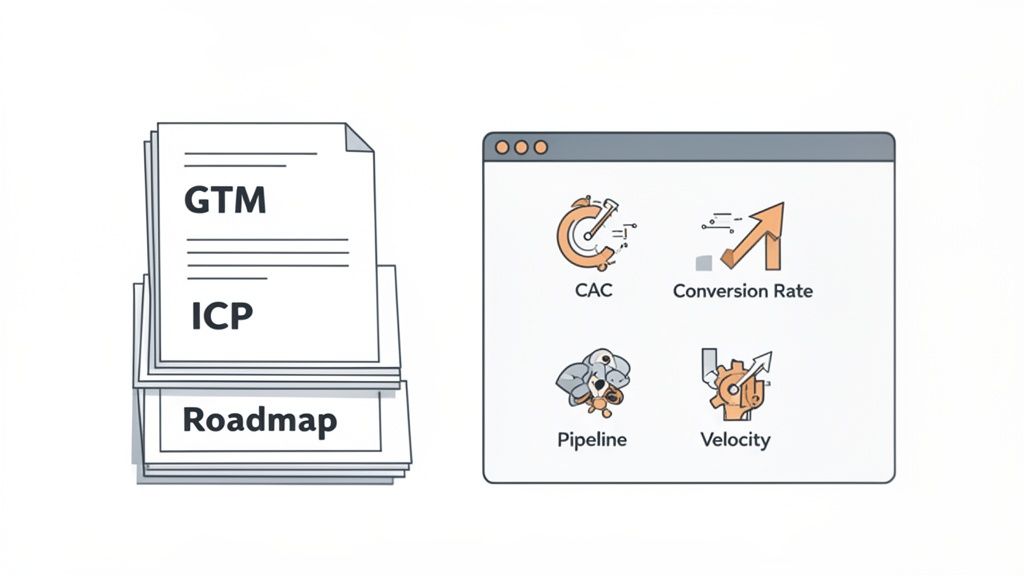
- A Documented Go-To-Market (GTM) Strategy: This is your master plan. It spells out which markets to go after, how to position your product, what to charge, and which channels will actually reach your buyers.
- A Crystal-Clear Ideal Customer Profile (ICP): We're talking way beyond vague personas. A data-backed ICP defines the exact firmographic and behavioral traits of your most profitable customers. This becomes the single source of truth for both your sales and marketing teams.
- A Prioritized 90-Day Marketing Roadmap: This isn't a year-long wish list. It’s a focused, actionable plan laying out the exact things to tackle in the next quarter, complete with who owns what and when it's due.
- A Recommended Martech Stack: Based on your needs and budget, the consultant should recommend the right tools for CRM, marketing automation, and analytics to make your strategy happen—without overcomplicating things or breaking the bank.
This level of clarity is everything. With B2B buying committees now involving 6-10 decision-makers, a unified strategy isn't just nice to have; it's absolutely essential.
Measuring What Matters Most
A plan is only as good as the results it delivers. A top-tier consultant will tie every piece of their strategy to the key performance indicators (KPIs) that actually matter to your CEO and investors. Forget vanity metrics like social media likes; we're talking about numbers that connect directly to your bottom line.
The ultimate goal of B2B marketing strategy consulting isn't to make marketing look busy. It’s to make marketing a predictable, revenue-generating part of the business. The right KPIs provide stone-cold proof of that impact.
These metrics prove that your marketing isn't just an expense but a critical investment in your growth. By focusing on them, you can have clear, productive conversations about what’s working and where to double down. For a deeper dive, check out our guide on how to measure marketing ROI effectively.
The KPIs That Drive Revenue
Your consultant should help you build a dashboard focused on the metrics that track the entire journey from a curious prospect to a happy, paying customer. This is how you make sure marketing and sales are perfectly aligned and chasing the same goals.
Expect to track and improve KPIs like these:
- Pipeline Velocity: How fast are deals moving through your sales funnel? This shows if your marketing isn't just generating leads, but actually helping to close deals faster.
- Customer Acquisition Cost (CAC): What’s the total cost to land a new customer? The goal is to consistently push this number down by getting smarter with your targeting and conversions.
- Lead-to-Customer Conversion Rate: What percentage of your qualified leads actually become paying customers? This is the ultimate test of lead quality.
- Marketing-Sourced Revenue: How much new revenue can be directly traced back to marketing's efforts? This is the bottom-line number that proves marketing’s value to the business.
Getting sales and marketing on the same page with these metrics is a game-changer. Research shows that fully aligned companies have 38% higher win rates and generate 208% more revenue from their marketing.
Driving Growth with Account-Based Marketing
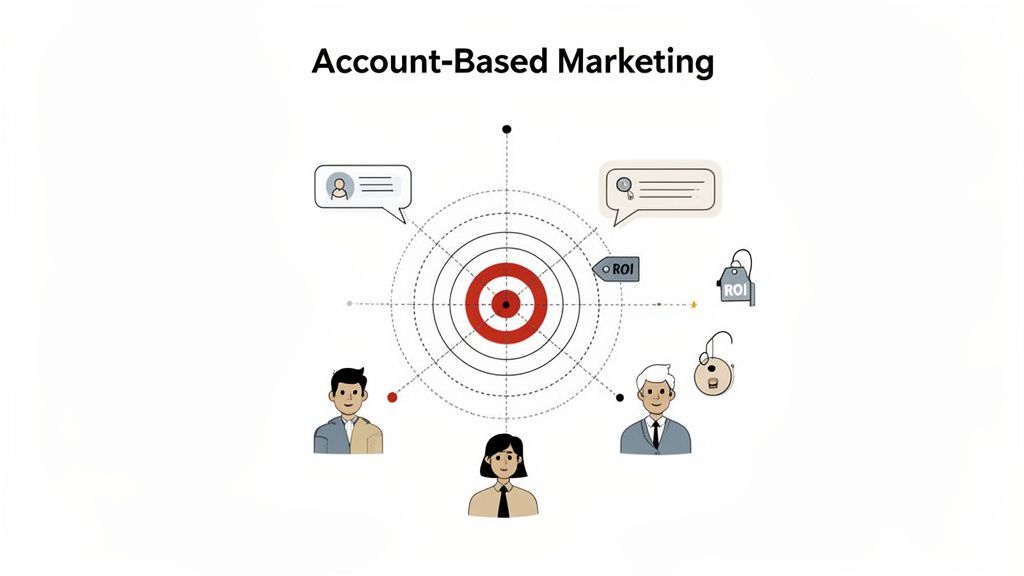
A sharp b2b marketing strategy consultant will almost always have a powerful play in their back pocket: Account-Based Marketing (ABM). Forget casting a wide net and just hoping for the best. ABM completely flips the old marketing funnel on its head.
Think of it as the difference between a sniper and a shotgun. Instead of blasting a generic message out to a huge audience, you treat each high-value target account like it's its own market. Every move is calculated, personalized, and aimed at a specific, game-changing customer.
This hyper-focused approach is a godsend for B2B tech companies, especially if you're dealing with long sales cycles and big, complex buying committees. It’s all about quality over quantity—building deep, meaningful relationships with the handful of accounts that can actually transform your business.
From ICP to ABM Launchpad
All that foundational work a consultant does to nail down your Ideal Customer Profile (ICP) isn't just a theoretical exercise. It’s the launchpad for a killer ABM program. Once you know exactly who your dream customers are, ABM gives you the framework to go after them with relentless focus.
This is where strategy turns directly into revenue. A clear ICP lets you build a shortlist of perfect-fit companies. From there, your marketing and sales teams work together like a well-oiled machine, creating personalized campaigns designed to get the attention of key decision-makers inside those specific organizations.
ABM isn't just another tactic; it's a mindset for your whole organization. It forces sales and marketing to rally around a shared list of high-priority accounts, holding both teams accountable for breaking in and driving revenue together.
This alignment is the secret weapon. It puts an end to the endless bickering over lead quality and gets everyone gunning for the same prize.
Why ABM Outperforms Traditional Outreach
For too many tech startups, a stalled pipeline comes from generic outreach that just gets lost in the noise. ABM cuts through because it’s impossible to ignore. Because the messaging is so relevant and personal, it builds trust and shows you’ve actually done your homework on a prospect’s unique problems.
The results speak for themselves. ABM has quickly gone from a niche tactic to a core growth engine for B2B. Recent data shows that 57% of marketers are now planning or actively running ABM programs, with 52% already seeing a positive ROI. This is especially critical now that buying committees have ballooned to 6-10 decision-makers per deal, making coordinated, account-wide engagement a must.
This is exactly how expert consultants fix broken pipelines. To really make ABM work, you need to understand the individuals you’re targeting, not just the company. This is where tools like a people enrichment API become incredibly valuable, turning a simple email address into a full professional profile. That deeper intelligence allows you to craft messages that speak directly to each person's pains and priorities.
By focusing your resources on the accounts most likely to buy, you speed up sales cycles, increase deal sizes, and get a much higher return on your marketing spend.
How to Choose the Right Marketing Consultant
Picking the right B2B marketing consultant is one of those make-or-break decisions for your company's growth. The right partner becomes a true extension of your team, bringing strategic clarity and hitting the accelerator on your revenue goals.
The wrong one? They can burn through your cash and time, leaving you more tangled up than when you started.
Finding the perfect fit isn't about falling for the slickest proposal. It’s about asking the kind of questions that cut through the fluff and show you a consultant's real-world strategic depth, their track record, and whether they can actually deliver.
Questions That Reveal True Strategic Depth
When you’re vetting a potential partner, you need to move past the generic interview questions and get straight to the heart of how they think and operate. Their answers will tell you everything you need to know.
Here are the questions I always recommend founders ask:
- Can you share a case study from a B2B tech company at our exact stage? This is non-negotiable. It tests for relevant experience. A consultant who has already guided a company from your current revenue level to the next has walked this path before and knows where the landmines are.
- How do you measure success and align your KPIs with our sales team? You're looking for answers that are all about revenue. Things like pipeline velocity, customer acquisition cost (CAC), and lead-to-customer conversion rates. If they start talking about website traffic, they're not thinking about your bottom line.
- What does your process for defining our Ideal Customer Profile (ICP) look like? A great consultant won’t just say they "run a workshop." They'll describe a data-backed process—interviewing your sales team, analyzing your current customer data, and digging into market research. It's a forensic investigation, not a brainstorming session.
- How will you get our team and stakeholders on board with this new strategy? The best strategy on paper is useless if your team doesn't buy into it. An experienced pro will have a clear playbook for building consensus and making sure everyone is rowing in the same direction.
An experienced consultant won't just tell you what you want to hear. They'll challenge your assumptions, push back with data-backed insights, and keep the conversation focused squarely on business outcomes, not just marketing activities.
This direct, outcome-first approach is the signature of a true strategic partner.
Red Flags to Watch For
Just as important as knowing what to look for is knowing what to run from. Certain promises and behaviors are dead giveaways that a consultant is more interested in closing a deal than in driving your success.
Be wary of anyone who:
- Promises Guaranteed Results: Marketing is about stacking the odds in your favor, not predicting the future. A seasoned expert talks about building a predictable engine for growth, not promising a specific number of leads by next Tuesday.
- Offers a Generic, One-Size-Fits-All Solution: If their proposal feels like it could have been sent to any company, it probably was. Your business has unique challenges, and you need a strategy tailored to you, not an off-the-shelf template.
- Lacks Hands-On B2B Tech Experience: The B2B tech world is its own ecosystem. It has its own language, sales cycles, and buyer dynamics. A consultant without direct, in-the-trenches experience here will be learning on your dime.
Ultimately, picking the right consultant comes down to finding an outcome-focused expert who can build a practical plan and empower your team to run with it.
Common Questions from Founders
When you're looking into B2B marketing strategy consulting, a lot of questions pop up. Getting straight answers is the first step toward making a smart call for your startup. Here are the most common ones we hear, broken down into simple terms.
How Much Does B2B Marketing Strategy Consulting Cost?
This is always the first question, and the honest answer is: it depends on what you actually need. The price tag is tied directly to the kind of help you’re looking for and how deeply the consultant gets involved.
Here’s a rough breakdown of typical pricing bands:
- Project-Based Strategy: For a specific, one-time project like building a go-to-market plan, expect a range of $5,000 to $15,000.
- Intensive Alignment Sprints: Need to get your team on the same page, lock in your ideal customer profile, and choose your tech? That kind of focused sprint usually falls between $15,000 and $30,000.
- Fractional CMO Retainer: For ongoing, embedded leadership, retainers typically run from $7,000 to $20,000 per month. You get senior strategic guidance for a fraction of a full-time executive's loaded salary.
The right way to look at this isn't as a cost, but as an investment. You're buying speed and predictability for your revenue growth.
What's The Difference Between a Consultant and an Agency?
This one trips up a lot of people, and it’s a crucial distinction. While you might end up needing both, they play fundamentally different roles in your growth.
Think of it like this:
A strategy consultant is the architect who designs the blueprint for your growth engine. A marketing agency is the skilled construction crew that builds it.
A consultant lives in the "why" and the "how." They’re focused on building your foundational go-to-market strategy, defining who you sell to, and creating the high-level roadmap. Their job is to make sure you're pointed in the right direction.
An agency, on the other hand, is all about the "what"—the day-to-day execution. They're the ones running your Google Ads, managing your social media, or writing blog posts. A great consultant will often help you find, hire, and manage the right agencies to make sure their execution aligns perfectly with the big-picture strategy.
How Quickly Can We Expect to See Results?
Every founder wants to see an immediate impact, and that's totally fair. The right consultant should deliver value quickly, but it’s important to have realistic expectations for different types of results.
You should feel a difference within the first 30-60 days. That’s when you get strategic clarity, team alignment, and a documented, actionable plan. It's the groundwork that makes everything else possible.
As for the hard numbers—like a measurable jump in qualified leads or a faster pipeline—those typically start showing up within 90-180 days. It just takes time for a new strategy to be fully implemented, get traction in the market, and start changing how buyers behave. The goal is to build momentum fast while setting you up for sustainable, long-term growth.
Ready to build a predictable revenue engine for your B2B tech startup? At Value CMO, we provide the senior marketing leadership you need to get from strategy to execution, fast. Learn how our fractional CMO services can help you scale.