A B2B go-to-market (GTM) strategy is really just a fancy term for your company's game plan to launch a product, break into a new market, or win over a new crowd of customers. It’s an actionable blueprint that gets your product, marketing, and sales teams all rowing in the same direction toward one shared goal—making money efficiently.
Think of it as the bridge between the awesome thing you've built and the people who actually need to buy it.
Your GTM Strategy Is More Than Just a Marketing Plan
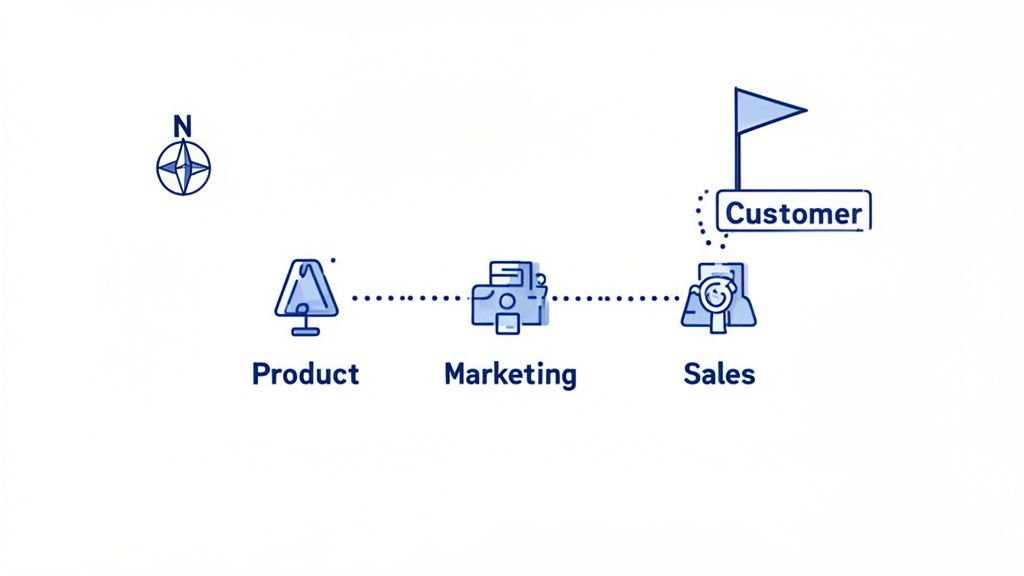
Let's be honest, "go-to-market strategy" sounds like another piece of dense corporate jargon. But at its heart, the idea is simple and incredibly powerful.
Imagine trying to build a house without any architectural plans. You could have the best materials and a skilled crew, but without a shared blueprint, the foundation will be crooked, the walls won’t line up, and the whole project is doomed to fail.
That’s exactly what happens when a business tries to grow without a solid GTM strategy. The product team builds features for one audience, marketing writes messages for another, and the sales team is left trying to sell a confusing product to people who aren't a good fit. The result? Wasted money, frustrated teams, and growth that grinds to a halt.
The Purpose of a GTM Strategy
A well-crafted B2B go-to-market strategy saves you from all that chaos by forcing you to answer the tough questions before you spend a single dollar on marketing or sales. It’s a framework for getting clear, making sure every department is working from the same playbook.
Specifically, your GTM strategy nails down:
- Who you’re selling to: A laser-focused definition of your Ideal Customer Profile (ICP).
- What you’re selling: A clear value proposition that solves a real, nagging problem.
- Where you’ll find them: The marketing and sales channels your ideal customers actually pay attention to.
- How you’ll win: A unique spot in the market that makes you the obvious choice over the competition.
A GTM strategy isn't a static document that collects dust on a server. It’s a living, breathing plan that gets all your teams—product, sales, marketing, and customer success—working together to drive predictable revenue growth.
Go-To-Market vs. Marketing Strategy
It’s easy to mix up a GTM strategy with a traditional marketing plan, but they do very different jobs. A marketing plan outlines how the marketing team will generate leads and build brand awareness through specific campaigns and channels.
A B2B go-to-market strategy is much bigger than that. It’s the overarching roadmap that sets the direction for all your customer-facing teams. It covers everything from pricing and product positioning to the sales process and how you welcome new customers.
In short, the marketing plan is a vital piece of the GTM strategy, but the GTM strategy is the master plan that guides the entire revenue engine.
Defining Your Ideal Customer and Market Position
The fastest way to burn through your budget and crush your team's spirit is to try and sell to everyone. A killer B2B go-to-market strategy doesn't start with your product's slick features; it starts with a deep, almost obsessive focus on the customer. This means building a rock-solid Ideal Customer Profile (ICP).
An ICP is a detailed portrait of the exact type of company that gets the most value from your product—and, in turn, gives the most value back to you. We're not just talking about industry or employee count. It's about finding the businesses that are a perfect fit.

This focus stops you from shouting into the void. Instead, you start having real conversations with companies that genuinely need what you’re selling.
Digging Deeper Than Demographics
A truly useful ICP goes way beyond the basic facts (like company size or location). You need to uncover the real-world context of your best customers. Your job is to become an expert on their pains, motivations, and what finally makes them decide to buy.
To get this right, you need a mix of quantitative and qualitative data.
- Quantitative Data: Take a look at your current customer list. Who are your happiest, most profitable, and longest-lasting accounts? Find the patterns in their company size, industry, the tech they use, and their growth rate.
- Qualitative Data: This is where the magic happens. Hop on the phone with your best customers. Ask open-ended questions to understand what their world was like before and after they found you.
This blend of hard numbers and human stories gives you a three-dimensional view of your target market. To get started, you can explore a dedicated guide and download an ideal customer profile template to keep your research organized.
From Customer Insight to Market Position
Once you have a crystal-clear ICP, you can carve out your spot in the market. Your market position is the specific space you own in your target customer's mind. It’s the answer to the question: "Why should I choose you over every other option, including doing nothing at all?"
Think of it this way: your ICP tells you who to talk to, and your market position tells you what to say. It’s the unique value you bring to the table, tailored to the exact pains and goals you uncovered in your research.
Your market position isn't what you think makes you special. It's what your ideal customers perceive as your unique value, explained in a way that speaks directly to their most urgent problems.
Crafting a Winning Value Proposition
A strong value proposition is the cornerstone of your entire GTM strategy. It needs to be clear, concise, and all about the customer. Here’s a simple way to think about it:
- Identify the Core Problem: What's the single biggest challenge your ICP faces that you solve better than anyone?
- Define Your Unique Solution: How does your product specifically fix that problem in a way your competitors can't touch?
- Quantify the Outcome: What's the tangible, measurable result a customer can expect? Think more revenue, lower costs, or saved time.
For example, a generic value prop is "We sell project management software." A powerful, ICP-focused one is: "We help remote-first engineering teams ship products 25% faster by automating sprint planning and progress tracking."
See the difference? The second one speaks to a specific audience, hits on a clear pain point, and promises a real win. That’s the kind of clarity that turns a GTM guess into a genuine plan for growth.
Choosing the Right GTM Motions and Channels
Knowing who your customer is is half the battle. The other half is figuring out where to find them and how to bring them in. This is where your GTM motion comes into play—it's the fundamental way you go after, win, and keep your customers.
Think of it like choosing your main vehicle for the road trip ahead.
Are you building a superhighway for customers to drive right up to your door (Inbound)? Are you sending out expedition teams to hunt for them (Outbound)? Or are you launching a targeted special ops mission for a handful of giant accounts (Account-Based Marketing)?
Getting this choice right is everything. It shapes your budget, your team structure, and how you define a win. Nail it, and you'll avoid the classic startup mistake of throwing a little money at a dozen different channels, only to become a master of none.
Decoding the Four Primary GTM Motions
Most B2B companies build their strategy around one of these four core approaches, or maybe a mix of two. Each one is built for a different kind of product, price point, and buyer. Getting your head around them is the first step to building a revenue engine that actually works.
- Inbound Motion: This is all about pulling customers in by creating valuable content and experiences they’re already searching for. Think blog posts, SEO, webinars, and smart social media. It's a killer strategy when your buyers like to do their own research before they even think about talking to sales.
- Outbound Motion: This is the direct approach where you make the first move. We're talking cold calls, targeted email outreach, and LinkedIn prospecting. It’s incredibly effective for reaching specific, high-value accounts that might never stumble across you otherwise.
- Account-Based Marketing (ABM): ABM flips the old-school marketing funnel on its head. Instead of casting a wide net, you treat a single target account like its own market, surrounding it with super-personalized marketing and sales plays designed to win it over.
- Product-Led Growth (PLG): Here, the product itself does the selling. Companies use freemium models or free trials to let users experience the value for themselves, turning them into paying customers right inside the app.
The real secret isn't just picking one and sticking with it. The sharpest B2B go-to-market strategies blend them. A classic combo is using an inbound strategy to fill the top of the funnel while running a tight ABM play to close your biggest, most strategic deals.
Aligning Your Motion with Your Business Model
So, how do you pick the right one? The single most important clue is your product's price, or Annual Contract Value (ACV). A high-touch, expensive outbound sales team makes zero sense for a $50/month tool. Likewise, a self-serve PLG model will fall flat trying to land a million-dollar enterprise deal.
Use this as a starting point:
- Low ACV (Under $5,000): The numbers here scream for a low-touch, high-volume model. PLG and inbound marketing are your best friends, letting you acquire customers at scale without a huge sales payroll.
- Mid-Range ACV ($5k – $25k): This is hybrid territory. You can use inbound marketing to generate a steady stream of qualified leads and have an inside sales team ready to nurture and close them.
- High ACV (Over $25,000): These are complex deals built on relationships. Outbound sales and Account-Based Marketing (ABM) are your go-to moves for getting in front of all the key players and navigating long, complicated sales cycles.
Recent data shows this isn’t just theory. While inbound is the most popular motion overall, picking the "best" one means nothing if you can't execute. The numbers show PLG absolutely dominates for products under a $5K ACV, while ABX (Account-Based Experience) is the clear winner for deals over $25K. At the end of the day, the best B2B SaaS marketing strategy is the one that lines up your motion with your market. For a deeper dive, check out the latest GTM Strategist 2025 report on these B2B GTM trends.
To help you visualize the trade-offs, here’s a quick comparison of the primary GTM motions.
Comparing B2B GTM Motions
| GTM Motion | Best For (ACV) | Primary Channels | Key Metric |
|---|---|---|---|
| Product-Led (PLG) | < $5,000 | Freemium, Free Trial, In-App Messaging | Product-Qualified Leads (PQLs) |
| Inbound | < $25,000 | SEO, Content, Social Media, Webinars | Marketing-Qualified Leads (MQLs) |
| Outbound | > $10,000 | Cold Email, Cold Calling, LinkedIn | Meetings Booked / SQLs |
| ABM | > $25,000 | Personalization, Direct Mail, Events | Target Account Engagement |
Choosing the right motion helps you focus your firepower where it will have the most impact.
Once you’ve locked in your primary motion, the final step is picking the one or two marketing channels where your Ideal Customer Profile (ICP) actually hangs out. Don’t try to be everywhere. Find a channel you can own, measure the heck out of your results, and only expand once you've got a repeatable win. That kind of focus is what turns a B2B go-to-market strategy into real, predictable growth.
Building Your Actionable GTM Roadmap
A great B2B go-to-market strategy is worthless if it just sits in a slide deck. The real magic happens when you turn those ideas into a concrete, step-by-step plan that your teams can actually follow. This is where we build the operational heart of your strategy—the actionable GTM roadmap.
Think of your strategy as the destination on a map and your roadmap as the detailed, turn-by-turn directions to get there. It breaks the whole launch into manageable chunks, assigns clear ownership, and sets realistic deadlines. Without one, you're just hoping to stumble your way to success.
From Pre-Launch To Post-Launch Momentum
A successful launch isn't a single event. It’s a carefully orchestrated sequence of activities. Your roadmap should be broken down into three critical phases, each with its own distinct goals and milestones to keep your marketing, sales, and product teams perfectly in sync.
- Pre-Launch Phase: This is all about testing the waters and getting ready. It's where you pressure-test your messaging, build your initial marketing assets, and get your sales team armed with the right materials and training. The goal is to iron out all the kinks before you go live.
- Launch Phase: Showtime. The focus here is on making a big splash and generating that first wave of momentum. It involves kicking off your marketing campaigns, unleashing your sales team, and closely watching how early customers engage.
- Post-Launch Phase: The work doesn’t stop once the product is out there. This phase is all about gathering feedback, tweaking your channels based on real-world data, and doubling down on what works. It’s a continuous loop of learning and improving.
An actionable roadmap transforms your GTM strategy from a theoretical document into a practical execution plan. It ensures every team member knows exactly what they need to do, by when, and how their piece contributes to the bigger picture of revenue growth.
The process flow below shows how different GTM motions—like inbound, outbound, and ABM—fit into this operational plan.
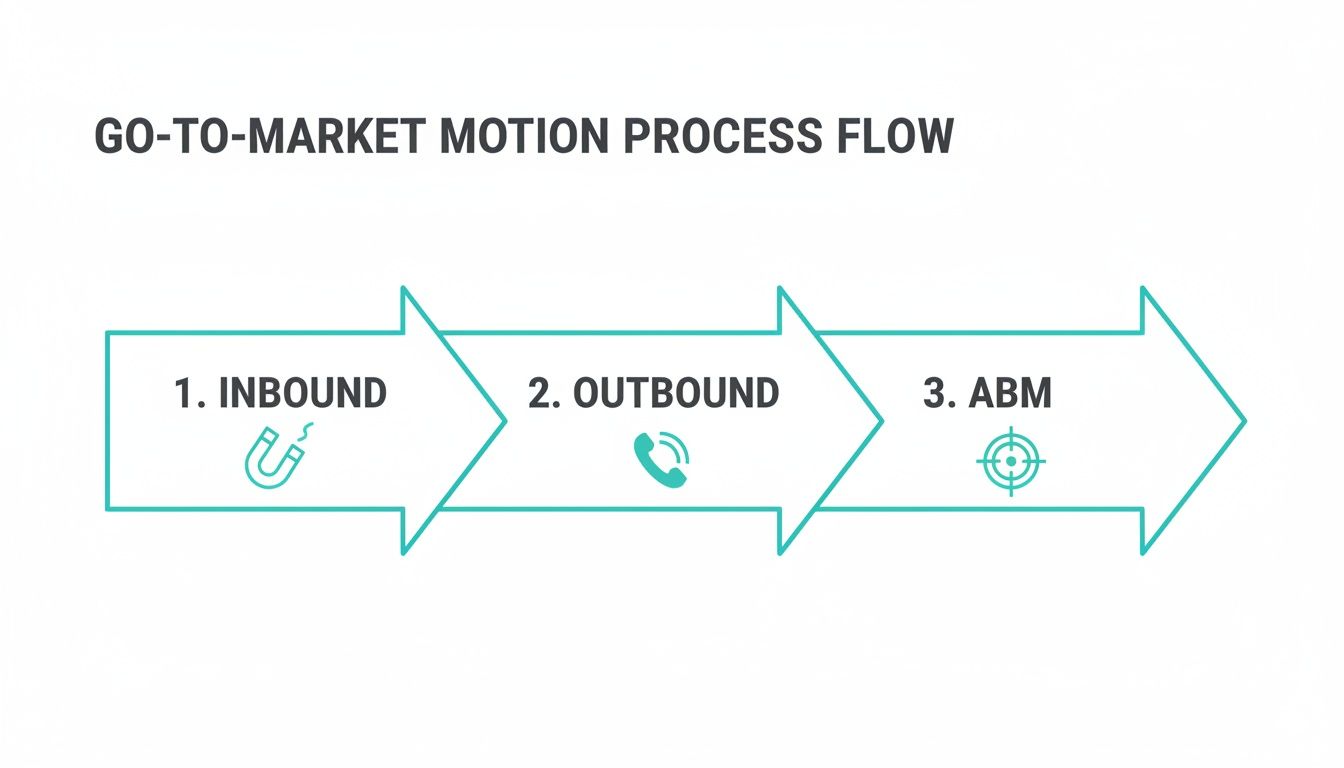
This helps you see how each motion acts as a distinct engine for bringing in customers, which your roadmap needs to coordinate.
A Sample 90-Day GTM Timeline
To make this real, let's look at a simplified 90-day timeline. This isn't a rigid formula but a flexible template you can adapt. As you build your own, using a comprehensive B2B marketing plan template can give you a solid head start.
Phase 1: The First 30 Days (Pre-Launch)
The first month is about laying a solid foundation. You're not trying to do everything at once; you're focused on getting the essentials right to ensure a smooth launch.
- Finalize ICP & Messaging (Week 1): Lock in your Ideal Customer Profile and core value proposition. The marketing lead is responsible for getting the final thumbs-up from everyone involved.
- Develop Core Assets (Weeks 2-3): Create foundational content like a landing page, a one-page sales slick, and an initial email nurture sequence. Assign this to your content and design folks.
- Sales Team Enablement (Week 4): Run training sessions to get the sales team confident with the new messaging and armed with the right tools. The sales lead owns this milestone.
Phase 2: The Next 30 Days (Launch)
With the groundwork laid, the second month is all about execution. Time to make some noise and drive awareness to generate your first wave of qualified leads.
- Launch Primary Channel Campaign (Week 5): Whether it's a targeted outbound sequence or an SEO-focused content push, this is when your main customer-getting engine roars to life.
- Activate Sales Outreach (Week 6): Your sales team starts actively prospecting and booking meetings using the new messaging and assets.
- Monitor Early Metrics (Weeks 7-8): Keep a close eye on key performance indicators (KPIs) like website traffic, conversion rates, and the number of qualified leads. The marketing lead should be reporting on this weekly.
Phase 3: The Final 30 Days (Post-Launch Optimization)
The final month is all about learning from what the market is telling you. This is where you figure out which strategies are winners and which ones fell flat.
- Gather Customer Feedback (Week 9): Systematically collect insights from your first users and sales conversations. Product and sales teams should work closely together here.
- Analyze Performance Data (Week 10): Dive deep into your metrics. What channels are performing best? Where are people dropping off in your funnel?
- Optimize & Plan Next Steps (Weeks 11-12): Use the data and feedback to make smart decisions. Double down on what’s working, cut what isn't, and start planning the next 90-day sprint. This creates the feedback loop that drives sustainable growth.
How to Measure the Success of Your GTM Strategy
So, is any of this actually working? A go-to-market strategy without clear metrics is like flying blind. You’re moving, sure, but you have no idea if you’re gaining altitude or heading for a nosedive. This is where you cut through the noise and track what really drives growth.
The goal isn't just to report a bunch of numbers. It's to understand the story your data is telling you. A simple, focused dashboard of the right Key Performance Indicators (KPIs) gives you an honest, real-time picture of what’s going on.
Essential KPIs for Your GTM Dashboard
Instead of drowning in data, focus on a handful of metrics that draw a straight line from your GTM activities to your bank account. These KPIs help you spot problems, make smarter bets, and prove that marketing is actually contributing to the bottom line.
Here are a few you absolutely can't ignore:
- Customer Acquisition Cost (CAC): This is the total cost of your sales and marketing efforts divided by the number of new customers you brought in. It’s the ultimate measure of efficiency—are you buying customers at a profit?
- Pipeline Velocity: How fast are deals moving from the first "hello" to a signed contract? If your velocity is slowing down, it’s an early warning that something is off in your sales process or messaging.
- Conversion Rates by Funnel Stage: Don't just watch the final sale. Track conversions from lead to MQL, MQL to SQL, and SQL to close. This tells you exactly where your funnel has leaks.
Tracking these reveals the health of your entire revenue engine, not just little pieces of it. And while you’re looking at your own funnel, it’s also smart to look outward and learn how to calculate your brand's share of voice to see how you stack up in the broader market.
From Data to Decisions
Metrics are useless unless they lead to action. The real power is using your dashboard to ask tough questions and make data-backed adjustments. Is your CAC climbing? It might be time to rethink a marketing channel or get even tighter on your ICP.
Too many companies get stuck right here. It’s a big reason why overall account executive quota attainment has stalled at just 58%. Meanwhile, AI-native companies are crushing it, with average conversion rates of 56% from free trials and POCs. That’s what optimized execution looks like.
Measuring your B2B go-to-market strategy isn't about creating perfect reports. It's about building a culture of accountability where data—not gut feelings—guides your next move and turns your GTM plan into a predictable growth machine.
Bringing in an Expert to Lead Your GTM Strategy
Let's be real: nailing a B2B go-to-market strategy is tough. It takes a level of seasoned experience that most startups or lean teams just don't have in-house. This is exactly where things get stuck—pipelines go flat, big product launches get kicked down the road, and all that early momentum dies.
You might have a killer product and a team of smart, hungry marketers. But without senior strategic leadership, you can burn through a ton of cash chasing the wrong audience or pouring money into channels that will never pay off. This is the moment when bringing in an expert isn't a luxury; it's a strategic necessity.
When to Call for Reinforcements
Knowing when you need help is a sign of smart leadership, not weakness. If any of these GTM headaches sound familiar, it’s probably time to look for a strategic partner.
Here are the most common red flags:
- A Stalled Pipeline: Your lead flow has dried up and the sales team is missing its numbers, but nobody can figure out why or how to fix it.
- A Delayed Product Launch: The launch date keeps slipping because there's no clear, actionable plan to actually get the product into customers' hands.
- A Junior Team Needing Guidance: You have talented but inexperienced marketers who need a senior mentor to guide their execution and help them level up.
- Lack of Internal Alignment: Marketing, sales, and product are all working in different directions, with conflicting priorities and no shared definition of what success even looks like.
An experienced GTM strategist, like a fractional CMO, can step in and provide immediate clarity. They don’t just deliver a plan; they build an actionable roadmap and lead the execution, turning growth goals into measurable results without the long-term cost of a full-time executive.
The Fractional CMO Advantage
Hiring a full-time, C-suite marketing executive is a massive commitment, both in salary and equity. For many B2B tech companies, a fractional CMO is a much smarter, more flexible option. You get the high-level strategic thinking and hands-on leadership you need, but only when you need it.
An expert can quickly diagnose the root causes of your GTM problems, get your entire company rowing in the same direction, and build the systems for predictable, repeatable growth. This kind of focused help can have a huge impact. For instance, some GTM leaders are tackling scaling challenges with proven playbooks, like the firm that sharpened its strategy to generate £6m (about $7.6m) in new revenue, proving that expert guidance drives real results. Discover more about how GTM strategies drive revenue and deliver a real ROI.
By bringing in the right expert, you’re not just hiring a consultant. You’re adding a leader to your team who can finally bridge the gap between your vision and your revenue goals. If your strategy needs a serious boost, exploring what dedicated go-to-market consultants can do for your business is a smart next step.
A Few Lingering GTM Questions
Even a rock-solid B2B go-to-market plan comes with questions. I get these all the time from founders and CEOs trying to turn strategy into reality. Here are quick answers to the most common ones to help you navigate the tricky spots with a bit more confidence.
How Often Should We Revisit Our B2B GTM Strategy?
Think of your GTM strategy as a living document, not something carved in stone. For any early-stage company, you should be doing a major review annually or whenever something big changes—like a new product launch, a push into a new market, or a competitor making a serious move.
On a tactical level, you need to be checking the numbers monthly and quarterly. This is where you make the small, data-driven tweaks to your channels, messaging, and campaigns. The whole point is to stay agile and listen to what the market is telling you.
What Is the Biggest GTM Mistake Most Startups Make?
Hands down, the biggest mistake is having a fuzzy or nonexistent Ideal Customer Profile (ICP). If you don't have a deep, almost empathetic understanding of who your best customer is, every other piece of your GTM strategy will be wobbly.
Your messaging will feel generic. You’ll burn cash on the wrong channels. Your sales team will waste months chasing leads that were never going to close.
Nailing your ICP is the foundation. It prevents wasted time, money, and morale. Everything else in your B2B go-to-market strategy depends on getting this one thing right first.
How Much Should We Budget for Our GTM Strategy?
There’s no magic number here; it really depends on your growth stage, industry, and revenue goals. That said, a common benchmark for venture-backed B2B SaaS companies is to put 80% to 120% of their first-year revenue target toward sales and marketing.
Once the business matures a bit, that number usually settles into the 40-60% range of your annual contract value (ACV). What's most important is tying your budget directly to your GTM plan, making sure every dollar is assigned to an activity designed to hit your revenue targets.
If your go-to-market strategy feels stuck or you’re missing the senior leadership to execute with confidence, Value CMO can help. We provide the fractional CMO expertise B2B tech companies need to build and run a high-performance growth engine. Clarify your strategy and accelerate your revenue today.