In the fast-paced world of B2B tech, a flat pipeline isn’t just a concern—it’s an existential threat. The generic marketing tactics that worked yesterday are falling flat today. Your buyers are smarter, the market is more crowded, and getting your message to the right people at the right time can feel like trying to hit a moving target in the dark. You're not just looking for more leads. You're looking for predictable, scalable growth that keeps your startup on that steep upward trajectory.
This is exactly why getting a handle on B2B demand generation best practices is non-negotiable for founders, CEOs, and go-to-market leaders. It’s all about building a system that consistently brings in, engages, and converts high-value customers. Forget the surface-level tips and vague advice. This guide breaks down 10 proven strategies that cut through the noise and deliver real results. We'll move beyond the buzzwords and get into actionable frameworks, covering everything from hyper-targeted ABM plays to community-led growth and data-driven attribution. These are the tactics real tech companies are using right now to build a powerful, revenue-driving machine. Let's dive in.
1. Account-Based Marketing (ABM)
Account-Based Marketing (ABM) flips the old-school demand generation funnel on its head. Instead of casting a wide net hoping to catch as many leads as possible, ABM is a super-focused strategy where your marketing and sales teams join forces to go after a handpicked list of high-value accounts. Think of it as treating each target company as its own little market, allowing for incredibly personal outreach.
This approach is one of the most effective b2b demand generation best practices because it puts your best resources to work on the accounts most likely to turn into big wins. By getting sales and marketing aligned from day one, you make sure every touchpoint is consistent, relevant, and speaks directly to the specific headaches of the key decision-makers in that account.

How to Get Started with ABM
For startups and scale-ups, the trick is to start small. Don't try to target hundreds of accounts right out of the gate. Instead, run a pilot ABM program with a handful of your dream customers to iron out your process.
- Get Sales and Marketing on the Same Page: This is a deal-breaker. Both teams have to agree on the target account list, what success looks like (think account engagement, not just lead count), and who does what.
- Pick and Research Your Targets: Use data like industry, company size, and revenue (firmographics) and what tech they're using (technographics) to build your ideal customer profile. Tools like Demandbase or 6sense can even help you spot accounts that are showing signs they're ready to buy.
- Create Personalized Campaigns: Craft content, ads, and outreach that speak directly to the challenges of each specific account. A campaign for a Fortune 500 bank should look and feel completely different from one for a mid-market tech company.
- Measure and Adjust: Keep an eye on account-level metrics, not just individual lead scores. Watch how engagement across the entire account changes over time and tweak your strategy as you go.
2. Content Marketing and Thought Leadership
Think of content marketing as the engine of modern demand generation. It’s all about creating and sharing valuable, relevant stuff to attract and keep a specific audience. You’re here to educate your potential customers and solve their problems, not just push your product. Thought leadership takes it a step further by positioning your company and your leaders as the go-to experts in your field, which builds a ton of trust and credibility.
This strategy is one of the most fundamental b2b demand generation best practices because it naturally pulls buyers toward you. Instead of interrupting people, you’re providing the answers they’re already looking for, making your brand a trusted guide. Great content, like HubSpot’s massive blog or Forrester’s industry reports, doesn’t just generate leads; it builds an audience that trusts you long before they’re even thinking about buying.

How to Do Content Marketing and Thought Leadership Right
Effective content isn't a numbers game; it’s about strategic value and consistency. The goal is to become an indispensable resource for your target audience. You can learn more about the specifics with these B2B content marketing best practices.
- Define Your Pillar Topics: Pick 3-5 core areas where your company has real expertise. Build your entire content strategy around these pillars. This helps you establish deep authority instead of being just another generalist.
- Use Your Own Data and Research: Stand out from the crowd by publishing your own data, survey results, or unique industry insights. This creates awesome, linkable content that makes you the primary source of information.
- Map Content to the Buyer's Journey: You need content for every stage. Think top-of-funnel blog posts for awareness, mid-funnel webinars and case studies for when they’re considering options, and bottom-funnel product comparisons for decision time.
- Optimize and Repurpose Everything: Make sure every piece of content is optimized for what people are searching for. And get the most out of your efforts by turning one big asset, like a research report, into a bunch of blog posts, infographics, videos, and social media updates.
3. LinkedIn Marketing and Social Selling
In the B2B world, LinkedIn has grown far beyond a digital resume folder; it’s the spot for professional networking and a beast for demand generation. This strategy is about using the platform for smart content distribution, building your brand’s authority, and giving your sales team a direct line to key decision-makers through social selling.
This is one of the most crucial b2b demand generation best practices because you’re meeting your ideal customers right where they are—actively learning and connecting. By combining targeted ads, valuable content, and real one-on-one conversations, you can build meaningful relationships and guide people through their buying journey, all inside the LinkedIn ecosystem.
How to Make LinkedIn Work for You
For a startup, a strong LinkedIn presence makes your brand feel more human and gives you a direct line to your target market without needing a massive budget. Start with a solid foundation, then get your whole team involved.
- Spruce Up Your Company Page: Treat your LinkedIn page like a landing page. It needs a great banner, a compelling description that hits on your ideal customer's pain points, and a clear call-to-action.
- Start an Employee Advocacy Program: Your employees are your most believable advocates. Encourage them to share company content and their own insights. Give them some training and resources, just like Salesforce does, to help them build their own professional brands.
- Lean on LinkedIn Sales Navigator: For social selling, this tool is a game-changer. Use its advanced filters to find the right people at your target accounts, see what they're up to, and find the perfect moment to start a personalized conversation.
- Create and Share Genuinely Useful Content: Don't just post about your product. Share industry news, how-to guides, and thought leadership that actually helps your audience. Jump into conversations on posts from your target accounts to stay on their radar.
- Personalize Your Outreach: Ditch the generic, copy-paste connection requests. Mention a shared connection, a post they recently shared, or a common interest to show you’ve actually done your homework.
4. Marketing Automation and Lead Nurturing
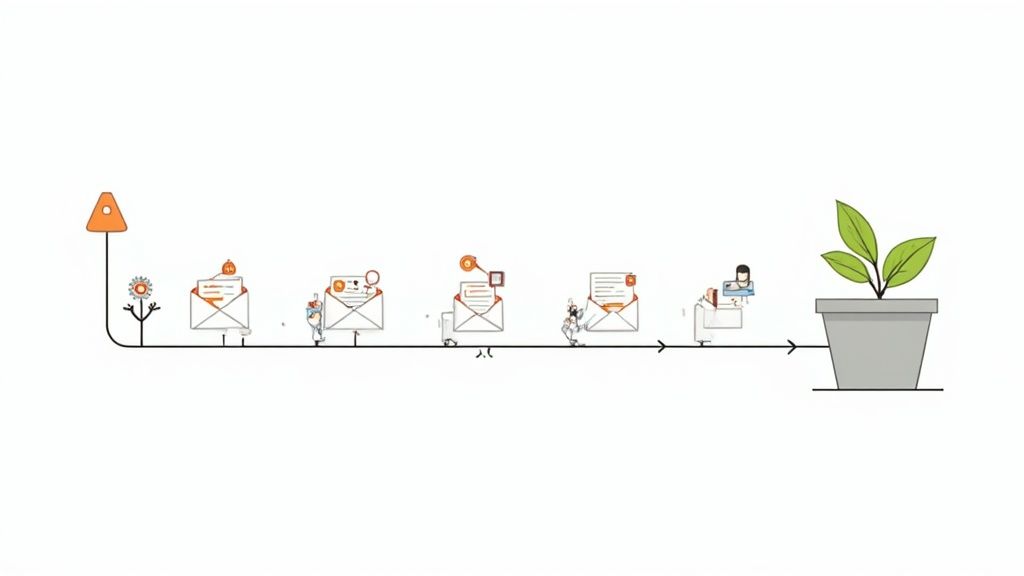
Marketing automation is all about using software to streamline, automate, and measure your marketing efforts. Instead of manually sending every email or tracking every interaction, these platforms let you build smart, trigger-based campaigns that nurture prospects over time, guiding them with the right content at the right moment.
This is a cornerstone of modern b2b demand generation best practices because it lets you scale your efforts without losing that personal touch. It ensures no lead gets forgotten and that every prospect gets timely, relevant messages based on their behavior, moving them closer to being sales-ready without you having to lift a finger every time. Think platforms like HubSpot, Marketo, and Pardot.
How to Get Started with Marketing Automation
If you’re a startup, don't try to automate everything at once. Start by targeting the most repetitive, high-impact tasks. Map out your main customer journey and find the key spots where automation can make the experience better.
- Set Up Lead Scoring: Create a scoring system based on who they are (job title, industry) and what they do (visit your pricing page, request a demo). This helps your sales team focus on the hottest leads first.
- Build Nurture Workflows: Create automated email sequences for different groups. For instance, someone who downloaded an ebook should get a different follow-up series than someone who attended a webinar.
- Segment Your Audience: Don’t blast the same message to everyone. Use data like company size, industry, or past interactions to slice up your lists and send more personal, effective campaigns. For more tips, check out these B2B email marketing best practices.
- Automate Lead Handoffs: Set up rules to automatically send high-scoring, qualified leads to the right salesperson. This guarantees a quick follow-up when someone is showing strong buying signals.
5. Webinars and Virtual Events
Webinars and virtual events are fantastic for engaging with qualified prospects in real time. Instead of just pushing content out, they create a two-way conversation, letting you show off your expertise, answer questions directly, and build real connections with potential buyers. This format is perfect for showing off complex products and nurturing leads through education.
This strategy is one of the most effective b2b demand generation best practices because it captures high-intent leads who are actively looking for answers. A great webinar, like the ones from HubSpot or Gartner, can bring in thousands of qualified leads, position your brand as a thought leader, and seriously speed up the sales cycle by delivering value right away.
How to Host a Great Webinar or Virtual Event
Success all comes down to delivering valuable, problem-solving content—not a thinly veiled sales pitch. Pick a specific pain point your audience has and give them actionable solutions.
- Promote Like Crazy: Start promoting your event at least 3-4 weeks out across email, social media, and paid ads. Team up with complementary companies to co-host and get in front of their audience for even more reach.
- Bring in Credible Speakers: Invite respected industry experts, analysts, or happy customers to speak. Their credibility adds weight to your event and attracts a more engaged audience than if it was just you talking.
- Make It Easy to Sign Up and Show Up: Keep your registration forms short and sweet (3-5 fields is plenty) to reduce friction. Send automated reminder emails 24 hours and 1 hour before the event to get as many live attendees as possible.
- Give it a Second Life: Record the webinar and put the on-demand version behind a form on a landing page. This way, you can keep capturing leads long after the live event is over. Follow up with both attendees and no-shows with tailored content and next steps.
6. Search Engine Marketing (SEM) and SEO
Search Engine Marketing (SEM) and Search Engine Optimization (SEO) are the one-two punch for grabbing high-intent B2B buyers the moment they start looking for a solution. SEM is about paid ads (PPC) on platforms like Google to get top placement for specific keywords, while SEO is the organic game of making your website more visible through technical tweaks, great content, and building authority.
This combined approach is one of the most powerful b2b demand generation best practices because you’re targeting people who are actively trying to solve a problem. When someone searches for "CRM for small business" or "cybersecurity compliance software," they're telling you they have an immediate need. By showing up at the top of those results, you position your brand as the answer at the most critical point in their journey.
How to Tackle SEM and SEO
For B2B tech companies, a balanced strategy is key. SEM gets you quick, measurable results, while SEO builds a sustainable, long-term asset that brings in more and more organic traffic over time.
- Focus SEM on High-Intent Keywords: Put your budget toward commercial keywords that scream "I'm ready to buy," like "salesforce alternative" or "project management tool pricing." Use negative keywords to weed out irrelevant searchers, like students or job seekers.
- Build Topical Authority for SEO: Don't just chase random keywords. Create big clusters of content around the core topics related to your product. For example, a data analytics company should have content covering everything from "data visualization techniques" to "predictive analytics models."
- Track Your Conversions Religiously: For both SEM and SEO, you have to know which keywords and pages are driving real actions like demo requests or free trials. Constantly tweak your campaigns and content based on this performance data.
- Earn High-Quality Backlinks: Backlinks from reputable industry sites are a huge ranking factor for SEO. Get into guest posting, digital PR, and partnerships to build your website's authority in the eyes of search engines.
7. Partner and Channel Marketing
Partner and channel marketing is all about teaming up with complementary companies, resellers, and other partners to expand your reach. Instead of doing it all yourself, you tap into their established networks and trusted brands to co-market and co-sell, getting you in front of new audiences you couldn't reach on your own.
This strategy is one of the smartest b2b demand generation best practices for scaling up efficiently. It lets you borrow credibility, share the marketing load, and get your solution in front of qualified buyers through a source they already trust. For big B2B tech companies like Salesforce and HubSpot, their partner ecosystems are a massive engine for growth.
How to Build a Partner Marketing Program
For a startup, a great partnership starts with a clear win-win. Focus on creating a scenario where both you and your partner benefit from working together toward a shared goal.
- Find the Right Strategic Partners: Look for companies that sell complementary, non-competing products to a similar customer. These could be tech partners for integrations, resellers, or consulting firms that advise your ideal customers.
- Create a Clear Partner Program: Lay down the rules of engagement. Be clear about roles, responsibilities, incentives, and how you’ll handle lead sharing and attribution. A formal agreement helps avoid confusion and gets everyone on the same page.
- Set Your Partners Up for Success: Don't just sign an agreement and hope for the best. Give them everything they need to succeed, including product training, co-branded marketing materials, and joint go-to-market plans.
- Launch Co-Marketing Campaigns: Run joint campaigns to generate demand for both of you. This could be co-hosted webinars, collaborative content like case studies, or sharing a booth at an industry event. The goal is to combine your expertise and reach for a bigger impact.
8. Community Building and User Groups
Building an engaged community turns your customers into loyal fans who drive growth for you. Instead of just relying on traditional marketing, this strategy creates a space where your users can connect, share tips, and solve problems together. This builds deep brand loyalty and generates authentic word-of-mouth demand.
This approach is one of the most powerful b2b demand generation best practices because it builds a self-sustaining ecosystem of support and advocacy. A thriving community, like Salesforce's Trailblazer Community, not only cuts down on customer support costs but also becomes an amazing source of product feedback and high-quality referrals, creating a serious competitive advantage.
How to Start Building a Community
For startups, a community doesn't have to be huge from day one. Start by nurturing a small, core group of your most passionate users and grow it from there.
- Choose the Right Platform: Pick a platform that fits where your audience already hangs out. Options range from dedicated community platforms like Circle to simpler channels like a dedicated Slack workspace or a private forum.
- Empower Your Early Adopters: Find your "power users" and make them feel special. Give them exclusive access, early product previews, or special recognition to encourage them to become leaders in the community.
- Consistently Provide Value: A community will die without value. Host regular events like "Ask Me Anything" sessions with your product team, share exclusive content, and encourage member-led discussions to keep things lively.
- Set Clear Ground Rules: Create and enforce clear moderation policies to make sure the community stays a safe, positive, and productive space for everyone.
- Measure the Health of Your Community: Look beyond just member count. Track metrics like active participation rates, how much content is user-generated, and how the community is impacting customer retention and new sales pipeline.
9. Paid Advertising (Display, Retargeting, Native)
Paid advertising lets B2B companies strategically put their brand and message in front of specific audiences all over the web. We’re talking about more than just search ads; this includes display, native, and retargeting campaigns on platforms like LinkedIn and the Google Display Network. These are all crucial for building awareness, keeping prospects interested, and re-engaging people who’ve already checked you out.
This multi-faceted approach is one of the most powerful b2b demand generation best practices because it lets you meet buyers wherever they are on their journey. Instead of waiting for them to find you, you can proactively serve them relevant content—from high-level thought leadership in a native ad to specific product features in a retargeting campaign—to make sure your brand stays top-of-mind.
How to Get Started with Paid Advertising
For startups, a phased approach works best. Start with retargeting, which targets a warm, high-intent audience, before you broaden out to bigger awareness campaigns.
- Start with Retargeting: Kick things off with campaigns aimed at people who have already visited your website. This is a low-cost, high-return tactic because you’re talking to an audience that already knows who you are.
- Get Super-Specific with Your Audiences: Don't run generic campaigns. Use firmographic and behavioral data to create hyper-targeted audience segments. For example, target specific job titles at companies of a certain size that have visited your pricing page.
- Match Your Creative to the Funnel Stage: A cold prospect seeing a display ad for the first time needs brand-building content like a case study or an industry report. Someone you’re retargeting, on the other hand, might be more interested in a demo offer or a free trial.
- Measure Beyond Just Clicks: Track things like view-through conversions and account-level engagement, not just direct clicks. Paid ads often influence decisions indirectly, so it’s key to measure their impact on your overall pipeline and brand awareness.
10. Data-Driven Analytics and Attribution Modeling
Data-driven analytics and attribution modeling take demand generation from guesswork to a science. Instead of just going with your gut, this approach uses data to figure out exactly which marketing efforts are making you money. It connects every touchpoint, from the first blog post a prospect reads to the final demo they attend, giving you a clear picture of what’s actually working.
This is an absolutely essential part of modern b2b demand generation best practices because it proves marketing’s ROI and tells you where to put your money. By truly understanding the customer journey, you can double down on the channels that are performing well and fix the ones that aren't, making sure every dollar is spent effectively to build a predictable pipeline.
How to Get Started with Analytics and Attribution
Getting started means committing to clean data and having a clear idea of your business goals. You don’t need a super-complex system overnight; just start by tracking the key touchpoints and build from there.
- Define Your Model: Pick an attribution model that makes sense for your sales cycle. Simple models like first-touch or last-touch are easy to start with. Multi-touch models (like linear or time-decay) give you a more complete picture for those longer, more complex B2B buying journeys.
- Get Your Data in One Place: You need a single source of truth. Tools like a Customer Data Platform (CDP) or marketing automation platforms like HubSpot or Marketo can help you connect all your campaign data with your CRM records.
- Focus on What Really Matters: Revenue: Shift your focus from vanity metrics like lead volume to KPIs that directly affect the bottom line, such as pipeline velocity, customer acquisition cost (CAC), and lifetime value (LTV).
- Create Actionable Dashboards: Build dashboards that are tailored to different people. Your CEO needs a high-level view of ROI, while your marketing team needs the nitty-gritty data on campaign performance to make real-time adjustments.
B2B Demand Gen: A 10-Strategy Cheat Sheet
| Tactic | 🔄 How Hard Is It? | ⚡ Resources & Speed | 📊 What to Expect | 💡 Best For… | ⭐ Biggest Win |
|---|---|---|---|---|---|
| Account-Based Marketing (ABM) | Very high — deep account research & sales‑marketing alignment | High resource intensity per account; slower to scale ⚡ | High-value pipeline, larger deal sizes, improved win rates | Enterprise accounts, high ACV, strategic expansions | ⭐ Superior ROI for targeted accounts; tighter sales-marketing alignment |
| Content Marketing & Thought Leadership | Moderate — editorial planning, research, SEO work | Ongoing content investment; slow to show SEO ROI (3–6 months) ⚡ | Increased organic visibility, inbound leads, authority | Brand building, top-of-funnel education, long-term lead gen | ⭐ Long-term discoverability and cost-effective inbound demand |
| LinkedIn Marketing & Social Selling | Moderate — profile/page optimization and outreach workflows | Medium resources; can drive quick prospecting and engagements ⚡ | Targeted professional engagement, qualified conversations | B2B prospecting, executive outreach, account engagement | ⭐ Access to high-quality B2B audience with strong intent signals |
| Marketing Automation & Lead Nurturing | High — workflow design, CRM integration, data hygiene | Significant platform & training costs; highly scalable once set ⚡ | Consistent nurturing, higher MQL→SQL conversion, faster follow-ups | Repeatable buyer journeys, SaaS, lead scoring programs | ⭐ Operational efficiency and personalization at scale |
| Webinars & Virtual Events | Moderate–high — event production, speaker coordination | Moderate cost; can produce immediate high-quality leads ⚡ | Engaged leads, direct interaction, reusable content assets | Product demos, thought leadership, lead capture campaigns | ⭐ High engagement and strong qualification via live interaction |
| SEM & SEO (Search) | Moderate — technical SEO and paid campaign management | SEM needs budget for immediate results; SEO requires sustained effort; SEM quick, SEO slow ⚡ | High-intent traffic, measurable conversions, sustained organic growth | Demand capture, product/solution searches, short- and long-term mix | ⭐ Captures active buyers; highly measurable ROI for paid search |
| Partner & Channel Marketing | High — partner selection, enablement, joint planning | Shared marketing costs but requires enablement resources; scalable via partners ⚡ | Expanded reach, partner-sourced pipeline, credibility | Market entry, complementary product ecosystems, channel sales | ⭐ Cost-sharing, accelerated access to new customer networks |
| Community Building & User Groups | High ongoing — moderation, program management | Low–moderate direct cost but slow to build critical mass ⚡ | Loyal advocates, organic referrals, rich product feedback | Customer retention, product-led growth, advocacy programs | ⭐ Authentic word-of-mouth and long-term customer lifetime value |
| Paid Advertising (Display/Retargeting/Native) | Moderate — creative, targeting, programmatic setup | Requires ad spend and creative ops; fast awareness and retargeting ⚡ | Broad awareness, mid-funnel traffic, retargeted conversions | Awareness campaigns, retargeting visitors, multi-channel reach | ⭐ Scales reach quickly with precise audience targeting |
| Data-Driven Analytics & Attribution Modeling | Very high — integrations, data engineering, model selection | High investment in tools and analytics talent; accelerates optimization once built ⚡ | Clearer ROI, optimized budget allocation, actionable insights | Cross-channel programs, scaling marketing ops, executive reporting | ⭐ Enables revenue-focused decisions and measurable marketing impact |
From Theory to Traction: Your Next Move
So, we've walked through a whole toolkit of B2B demand generation best practices, from the laser-focus of ABM to the wide-reaching power of community and the crucial clarity of data. If there's one big takeaway from all this, it's that successful demand gen isn't about doing everything at once. It's about building a smart, connected engine where every part makes the others stronger.
The real challenge isn't knowing what to do; it's knowing what to do next. For a tech startup, trying to implement all ten strategies at the same time is a surefire way to burn out your team and your budget. The real goal is to figure out where you are in your growth journey, pinpoint your biggest bottleneck, and pick the one or two tactics that will give you the biggest bang for your buck right now.
Your Actionable Roadmap Forward
To turn this knowledge into actual pipeline growth, you need to be strategic and focused. Don't let all the options lead to analysis paralysis. Instead, commit to a clear, step-by-step approach.
- Start with an Audit: Where are the biggest holes in your demand gen efforts right now? Are you struggling to get noticed (look at Content Marketing and SEO), or are you failing to convert the interest you already have (focus on Marketing Automation and Lead Nurturing)? A quick, honest audit will tell you what you need most.
- Prioritize for Impact: Based on your audit, pick the strategy that best fits your immediate goals and what you can realistically afford. If you have a crystal-clear ideal customer but aren't reaching them, a small ABM pilot could be your highest-leverage move.
- Execute and Measure: Commit to a 90-day sprint focused on your chosen practice. Define what success looks like from the very beginning. Whether it's increasing Marketing Qualified Leads (MQLs), lowering your Customer Acquisition Cost (CAC), or improving your lead-to-opportunity conversion rate, having a measurable goal is non-negotiable.
Mastering these B2B demand generation best practices is the difference between surviving and thriving. It’s how you go from being a product-focused startup to a market-leading scale-up. By building a systematic, data-informed, and customer-obsessed demand engine, you create a predictable and scalable path to growth, cementing your place in a crowded market. The time to start building that engine is now.
Struggling to build a strategic roadmap and execute on these B2B demand generation best practices? A fractional CMO from Value CMO provides the senior-level expertise to build your growth engine without the full-time executive cost. Get the strategic leadership you need to accelerate your pipeline today.