Let's get one thing straight: B2B customer acquisition isn't about throwing a bunch of tactics at the wall to see what sticks. It’s the deliberate, repeatable system you build to find, attract, and sign up other businesses as paying customers. This requires a smart mix of marketing and sales plays that guide a prospect from "Who are you?" to "Where do I sign?"
Your Blueprint for B2B Customer Growth
Welcome to the definitive guide for building a customer acquisition machine that actually works—especially if you're a lean tech team where every dollar and hour counts. Acquiring the right customers is the lifeblood of your business, and this playbook is all about creating a durable system for sustainable growth, not just chasing shiny objects.
We’re going to move past the generic advice and dig into a practical framework. We’ll cover everything from nailing your ideal customer profile to building actionable playbooks and measuring what truly drives revenue. First, we'll build a solid foundation—getting crystal clear on who you're selling to and mapping their journey—before we explore the high-impact channels that deliver real results.
The Core Components of Your Strategy
Think of a winning acquisition strategy like building a house. You wouldn’t start without a solid blueprint, the right materials, and a clear sequence for construction. B2B marketing is no different. You need a clear, integrated strategy where every piece supports the others. For a fresh take on building that foundation, you could try weaving in effective B2B video marketing strategies to show, not just tell, your value.
This guide will break down the essential pillars of a modern B2B customer acquisition strategy. By the end, you'll have everything you need to build a machine that consistently brings in new business.
A great strategy isn't about doing everything; it's about doing the right things consistently. For lean teams, focus beats breadth every time. This means putting your energy into the channels and tactics that align directly with how your ideal customer actually buys.
Before we dive deep, here’s a quick overview of the core components we’ll cover. Each one is a critical piece of the puzzle, designed to help lean teams like yours build a winning customer acquisition engine without wasting precious resources.
Core Components of a Modern B2B Acquisition Strategy
This table lays out the essential pillars we will cover in this guide to build a successful customer acquisition machine.
| Strategy Component | Core Objective | Why It Matters for Lean Teams |
|---|---|---|
| Ideal Customer Profile (ICP) | To define exactly who you're selling to, including their pains and goals. | Keeps you from wasting time and money on prospects who will never buy. |
| Buyer Journey Mapping | To understand the path people take from awareness to purchase. | Helps you deliver the right message at the right time, building trust. |
| Channel Prioritization | To select the most effective marketing channels for your specific ICP. | Focuses your limited resources on what works, avoiding burnout and poor ROI. |
| Playbook & Measurement | To document processes and track meaningful KPIs like CAC and LTV. | Creates a repeatable, scalable process and proves marketing's impact. |
Think of these components as the fundamental building blocks. Get them right, and you'll have a sturdy foundation for everything that follows.
Defining Who You're Actually Selling To
Before you spend a single dollar on ads or an hour on outreach, the first—and most critical—step is answering a brutally simple question: who are we actually selling to?
Get this wrong, and you'll burn cash on generic messaging that speaks to no one. You'll fill your pipeline with leads who look good on paper but will never, ever buy. Getting this right isn’t just a box to check; it’s the compass for your entire growth engine.
Think of your Ideal Customer Profile (ICP) as a detailed blueprint of the perfect company for your solution. This goes way beyond basic info like industry or employee count. A strong ICP digs into the operational DNA of a business—the tech they use, their growth trajectory, their hiring patterns, even their company culture.

From Data Points to Human Problems
Your best customers are not just rows in a spreadsheet. They're companies run by people with real challenges, pressures, and goals. The whole point of an ICP is to move from abstract ideas to a concrete profile of a business that gets overwhelming value from what you offer.
This is where you get to be a detective.
Start by looking at your happiest, most successful customers—the ones who rave about you. What do they all have in common? Look for patterns in their business models, the specific pain points they brought up in sales calls, and the tangible results they've seen since signing on.
Building Your ICP Step-by-Step
Creating a data-backed ICP is a methodical process. It’s part quantitative analysis, part qualitative deep-dive. Done right, it turns guesswork into a reliable strategic asset.
- Analyze Your Best Customers: Pinpoint your top 5-10 customers based on revenue, product usage, and how happy they are. Write down their attributes: industry, company size, revenue, tech stack, and location.
- Conduct Customer Interviews: Actually talk to these people. Ask open-ended questions to uncover the real story. "What was the tipping point that made you finally seek a solution?" or "What does success look like for your team now that you're using our product?"
- Review Sales and CRM Data: Your historical data is a goldmine. Dig into your win/loss reports. What are the common threads among the deals you won? What killed the ones you lost?
- Synthesize and Document: Pull all your findings into a clean, one-page document. This isn't an academic exercise; it's a practical guide for your entire go-to-market team. To get started, this ideal customer profile template provides a great structure for capturing these details.
A well-defined ICP is the ultimate filter. It ensures every piece of content, every sales email, and every ad campaign is laser-focused on the audience most likely to convert, which dramatically improves your ROI.
This disciplined approach ensures your b2b customer acquisition strategies are built on a foundation of reality, not assumptions. And it's just the beginning. To refine your targeting even further, you'll need to master customer segmentation strategies.
With a clear ICP in hand, you finally stop shouting into the void and start having meaningful conversations with the businesses that truly need you.
Mapping the Modern B2B Buyer's Journey
Once you’ve nailed who you’re selling to, the next question is how they buy. A B2B sale is almost never a single event. It’s a long, winding conversation that happens across a dozen channels and involves a handful of people. Mapping this journey is how you turn a vague strategy into a concrete plan that actually helps buyers move forward.
Think of the buyer's journey as a roadmap. Without it, you're just guessing where your prospects are and what they need to hear from you. With a clear map, you can meet them exactly where they are, guide them through their decision, and build the trust you need to win. This is how you stop good leads from falling through the cracks just because you showed up with the wrong message at the wrong time.
The Three Core Stages of Buying
Let's be clear: the modern B2B buyer's journey isn't a neat, linear funnel. People jump between stages, read content out of order, and talk to their peers constantly. Still, their process usually falls into three recognizable phases. Getting these stages right is the foundation of any solid B2B customer acquisition strategy.
- Awareness Stage: The buyer knows they have a problem, but they haven't put a name to it yet. They’re looking for answers and education, not a sales pitch. Your job is to be the expert who helps them understand the problem itself.
- Consideration Stage: Now they've defined the problem and are actively researching potential solutions. They're comparing different approaches, categories, and vendors. Here, you show them why your type of solution is the smartest way to fix their specific challenge.
- Decision Stage: The buyer has picked a solution category and is now comparing a shortlist of specific vendors. They want proof, validation, and a clear reason to choose you over the competition. This is where you bring out the case studies, demos, and sharp differentiators.
The point isn't to force people through a funnel. It's to line up your marketing and sales activities with the natural way your ideal customers make decisions. When you get it right, the whole process feels less like selling and more like helping.
Aligning Content and Channels to Each Stage
Knowing the stages is one thing, but putting them to work is another. The trick is to match the right content and channels to each phase of the journey so your message actually connects and moves the conversation forward.
For example, a prospect in the Awareness stage is nowhere near ready for a demo. They’re much more likely to click on a blog post or join a webinar that helps them diagnose their pain points. Sending them a "Book a Demo" email is like proposing on a first date—it’s just too much, too soon.
The average B2B deal now involves more than 62 touchpoints over six months, and your content is the thread connecting them all. High-quality, educational content is especially powerful early on. In fact, 53% of marketers say webinars are the top-of-funnel format that generates the best leads, which just goes to show you how critical education is. You can find more data like this in Backlinko's report on B2B marketing statistics.
Putting It All Together: A Practical Example
Let's say you sell project management software to marketing agencies. Here’s what your journey map could look like in action:
- Awareness: You publish a blog post called "Why Agency Projects Always Go Over Budget." A marketing director finds it on Google, reads it, and downloads your linked ebook, "The 5 Hidden Bottlenecks Killing Agency Profitability."
- Consideration: A week later, you invite them to a webinar on "How to Streamline Client Workflows." During the session, you show different methodologies and explain how specialized software helps.
- Decision: Now they're actively evaluating solutions. You send a targeted case study showing how a similar agency boosted its margins by 20% with your platform. The final step is a personalized demo to prove how it solves their specific workflow problems.
By mapping this out, you create a logical and helpful path that guides prospects from a vague problem to a confident purchase.
Choosing Your High-Impact Acquisition Channels
Okay, you’ve defined your ideal customer and mapped their journey. Now for the hard part: picking your battlegrounds.
As a lean team, you can't be everywhere at once. Spreading yourself thin across every marketing channel is the fastest way to burn cash and morale with nothing to show for it. The goal isn’t to do everything; it's to build a focused, high-impact acquisition portfolio that delivers predictable pipeline.
Think of it less like carpet bombing and more like a precision strike. You need to pick the one or two channels where your ideal customers actually live and breathe.
Where to Place Your Bets
So, how do you decide where to invest your limited time and money? The answer is always at the intersection of your customer's behavior, your average deal size, and the length of your sales cycle. Different b2b customer acquisition strategies are built for different business models.
Here are the primary channels to consider, each with its own rhythm and requirements:
- Targeted Outbound: This is all about proactive outreach—cold email, LinkedIn messages, even direct calls. It’s incredibly powerful for high-value deals where you absolutely have to get in front of specific decision-makers. It’s a grind, but the right messaging and persistence pay off.
- Content & SEO: This is the long game. By creating genuinely useful content that answers your ICP’s biggest questions, you attract qualified prospects through search engines like Google. It builds a sustainable, compounding asset over time, but you have to be patient. Real results often take six months or more.
- Paid Advertising: Platforms like Google Ads or LinkedIn Ads give you immediate visibility and sharp targeting. This is your go-to for generating leads quickly and testing new messages. The catch? It requires a consistent budget and obsessive management to keep your ROI positive.
- Strategic Partnerships: Teaming up with non-competing businesses that serve the same ICP can be a massive growth lever. Think co-hosted webinars, cross-promotions, or referral programs. It lets you tap into an established, trusted audience without starting from scratch.
This diagram shows how these channels map to the classic B2B buyer’s journey—moving from broad awareness-building to sharp, proof-driven tactics.
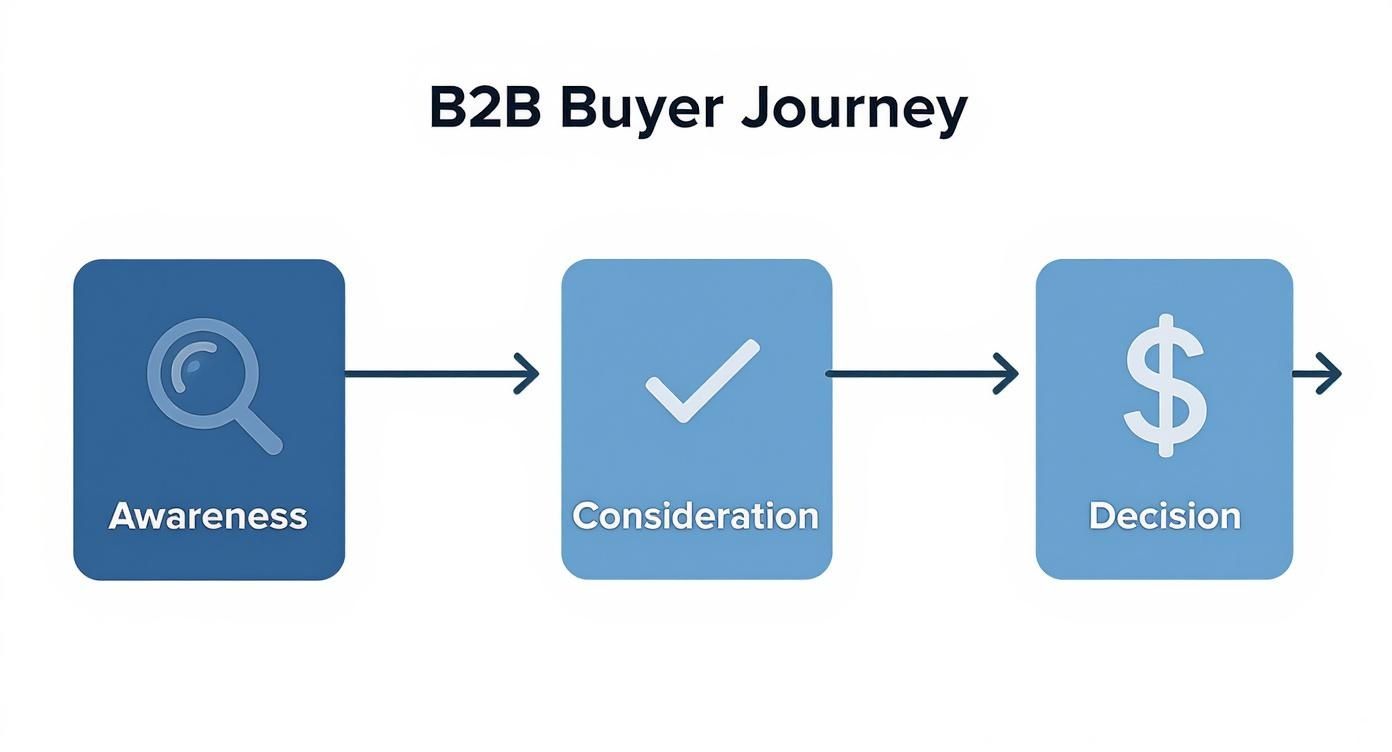
As you can see, your focus shifts—from broad educational content at the top of the funnel to highly specific, proof-oriented assets when a decision is on the line.
Comparing B2B Acquisition Channels for Startups
For lean teams, the trade-offs between cost, speed, and scale are everything. This table breaks down the core channels to help you decide where to make your initial bets.
| Acquisition Channel | Typical Cost | Time to Results | Scalability | Best For |
|---|---|---|---|---|
| Outbound Sales | Moderate (Tools, list building) | Fast (Weeks) | Moderate (Linear with headcount) | High ACV deals, niche markets, and getting early customer feedback. |
| Content & SEO | Low to Moderate (Time, freelance writers) | Slow (6-12+ months) | High (Compounding, non-linear growth) | Building a long-term, sustainable lead engine and establishing trust. |
| Paid Ads | High (Direct ad spend) | Immediate (Days) | High (As long as ROI is positive) | Validating demand quickly, targeting specific segments, and ABM plays. |
| Partnerships | Low (Time and revenue share) | Moderate (3-6 months to build relationships) | High (Tapping into established audiences) | Expanding reach, building credibility, and accessing warm leads. |
| Product-Led Growth | Low (Embedded in product) | Slow to Moderate (Depends on user adoption) | Very High (Self-serve model) | Products with fast time-to-value and a clear user-driven benefit. |
Use this as a starting point. Your specific ICP, product, and market will ultimately determine the right mix, but it clarifies the compromises you'll have to make.
A Framework for Testing and Validation
Choosing your first channels is really just making an educated guess. The real magic is in validating that guess with a disciplined approach to testing. Never, ever commit your entire budget to one channel until you have cold, hard proof that it works for your business.
Start with small, low-cost experiments. For example, run a small LinkedIn ad campaign for one month. At the same time, test a targeted cold email sequence to a small, hand-picked list of prospects.
Track the essential metrics for each test:
- Cost Per Lead (CPL): How much did it cost to get one person to raise their hand?
- Lead-to-Meeting Rate: What percentage of those leads actually agreed to a call?
- Pipeline Contribution: How much potential revenue did this channel actually generate?
After a set period—say, 90 days—compare the results. Put your money on the channel that delivers the highest-quality leads for the lowest cost, and be ruthless about cutting what doesn't work. This cycle of test-measure-iterate is how you find your unique growth levers and build an acquisition engine that actually scales.
Winning High-Value Deals with Account-Based Marketing
For most B2B tech companies, casting a wide net is a recipe for wasted time and money. You end up talking to a lot of people who will never buy from you. This is where Account-Based Marketing (ABM) completely changes the game.
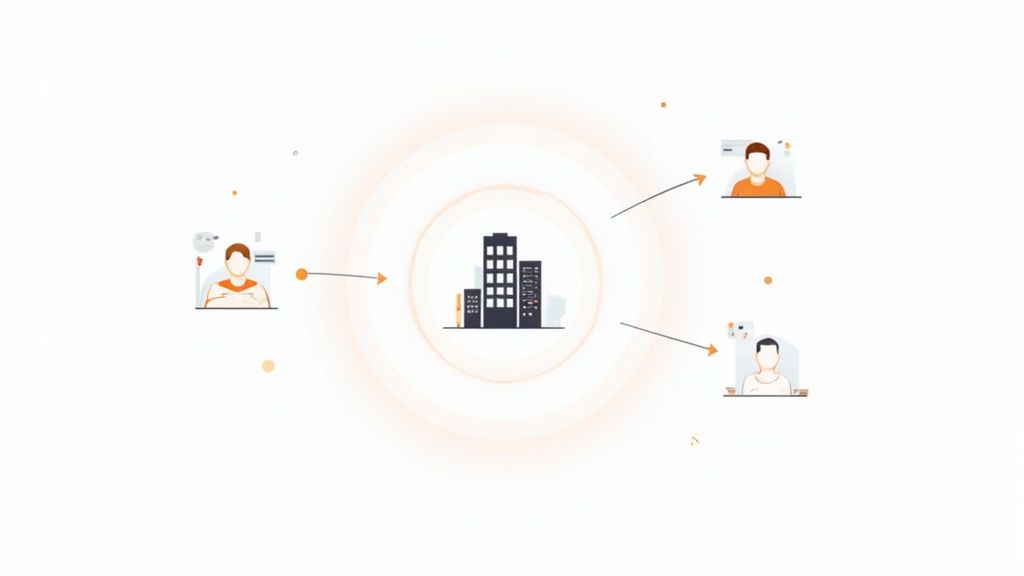
ABM is a laser-focused strategy that flips the traditional marketing funnel on its head. Instead of chasing thousands of leads and hoping a few convert, you start with a hand-picked list of dream clients. Then you focus all your resources on winning them over.
Think of it as treating each target company as its own market.
Aligning Sales and Marketing for Precision Strikes
The real magic of ABM is how it forces sales and marketing to work together. Both teams collaborate from the very beginning to identify high-value accounts, map out the key players inside them, and build hyper-personalized campaigns that speak directly to their pain points.
This approach is perfect for companies chasing bigger, more strategic deals. It boosts engagement, shortens sales cycles, and builds stronger relationships from day one. In short, no more marketing leads that sales ignores, and no more sales complaints about a lack of air cover.
This has quickly become one of the most effective b2b customer acquisition strategies for landing enterprise-level clients. Industry reports show 58% of B2B marketers see larger deal sizes with ABM, and 56% report better sales and marketing alignment. You can read more about these B2B acquisition findings to dig into the data.
Launching a Lean ABM Pilot Program
You don’t need a massive budget or a huge team to get started with ABM. A lean pilot program is the perfect way to test the waters and prove the model works before you scale. The trick is to stay focused.
Here are the four essential steps to get your first campaign off the ground:
- Select Your Target Accounts: Work with sales to pick 5-10 companies that are a perfect fit for your Ideal Customer Profile. These should be high-potential accounts where you know you can deliver massive value.
- Research and Personalize: Go deep. Find the key players, understand their business priorities, and look for recent news or trigger events you can use to make your outreach feel personal and timely.
- Create a Multi-Channel Campaign: Plan a coordinated sequence of touchpoints. This could involve personalized emails, targeted LinkedIn ads, a well-timed piece of direct mail, or even a custom landing page built just for that account.
- Execute and Measure: Launch the campaign and watch engagement like a hawk. Are they opening emails? Clicking ads? Visiting your landing page? The goal isn't just a click—it's to start a real conversation.
ABM isn't just another marketing tactic; it's a strategic shift. By focusing your best efforts on your best-fit future customers, you create a more efficient and predictable way to win the deals that truly move the needle.
This focused approach makes sure every dollar and hour spent contributes directly to revenue. If you're looking to go deeper, check out our other articles on account-based marketing to build out your playbook.
Creating Your Playbook and Measuring What Matters
A brilliant strategy is useless if it just lives in a slide deck. The real work is turning your plans into a repeatable, scalable process that anyone on the team can run with. This is where a customer acquisition playbook becomes your single most valuable asset.
Think of it as the instruction manual for your growth engine. It documents everything—your ICP, your core messaging, the exact steps for an outbound sequence, the settings for a new ad campaign. By building this single source of truth, you create consistency and make it dead simple to get new hires up to speed.
Documenting Your Process for Scale
Building a playbook isn't about creating rigid, bureaucratic rules. It’s about codifying what works so you can do it again and again, reliably. This should be a living document, capturing the essential workflows your team uses to find and win customers.
That clarity is the foundation for scaling your B2B customer acquisition strategies. It removes the guesswork and gives your team the confidence to move fast.
A simple, effective playbook needs just a few core parts:
- Your Ideal Customer Profile (ICP): The detailed breakdown of exactly who you sell to.
- Core Messaging Pillars: The key value props and pain points that hit home with your audience.
- Channel-Specific Workflows: Step-by-step instructions for each acquisition channel, like SEO content briefs or LinkedIn ad setup checklists.
- Key Performance Indicators (KPIs): The specific metrics you use to measure success for every activity.
Moving Beyond Vanity Metrics
This is where so many teams get it wrong. They chase vanity metrics—website traffic, social media followers, email open rates. These numbers feel good, but they don't tell you if your strategy is actually working or just keeping you busy.
To prove your impact, you have to focus on the numbers that connect directly to revenue.
In B2B marketing, the only metrics that truly matter are the ones that track the journey from a click to a closed deal. Everything else is just noise.
This means shifting your focus to a handful of core business KPIs. These are the metrics that tell the real story of whether your acquisition engine is profitable.
Your Essential B2B Acquisition Dashboard
Forget sprawling reports nobody reads. Build a simple dashboard that tracks the vital signs of your customer acquisition engine. This keeps everyone zeroed in on what drives sustainable growth.
Here are the must-track KPIs:
- Customer Acquisition Cost (CAC): This is your total sales and marketing spend divided by the number of new customers you won in a given period. It tells you exactly how much it costs to land a new deal.
- Customer Lifetime Value (LTV): LTV is the total revenue you can reasonably expect from a single customer over the entire time they do business with you. A healthy business model needs an LTV that's way higher than its CAC.
- LTV to CAC Ratio: This is the ultimate health check for your acquisition strategy. A common benchmark for SaaS is a ratio of 3:1 or better—meaning for every dollar you spend, you get at least three dollars back.
- Pipeline Velocity: This measures how quickly deals move through your sales funnel from first touch to close. A faster velocity means a shorter sales cycle and more efficient growth.
Tracking these numbers gives you a crystal-clear picture of performance. It helps you make smarter budget decisions and proves the direct financial impact of your marketing to the rest of the leadership team. You can get a handle on your numbers with this handy customer acquisition cost calculator.
Common B2B Acquisition Questions Answered
Even with a killer plan, building a B2B growth engine is messy. You’re going to run into practical hurdles and tough questions. Let's tackle a few of the big ones that always come up for lean teams in the trenches.
How Long Until We See Real Results?
This is the million-dollar question, and the only honest answer is: it depends entirely on the channels you pick. Not all B2B customer acquisition strategies are built for speed.
- Paid Ads: This is your fast lane. You can get leads trickling in from Google or LinkedIn within days of launch. It's the quickest way to get real-world data and see if your message is landing.
- Outbound & ABM: A sharp, targeted outreach or Account-Based Marketing campaign can start booking meetings in a few weeks. But to build a predictable pipeline? You're looking at 2-4 months of consistent, focused effort.
- Content & SEO: This is the long game—think of it like planting an orchard. You won't see a harvest overnight. It takes a solid 6-12 months (sometimes more) to gain real traction, but the payoff is a compounding asset that brings in leads for years.
What Is the Single Biggest Mistake to Avoid?
Easy. Failing to nail down a crystal-clear Ideal Customer Profile (ICP). It’s the foundational mistake that makes everything else fall apart. Get this wrong, and nothing else matters.
Without a sharp ICP, your messaging is generic mush, your ad spend gets torched on unqualified clicks, and your sales team wastes cycles on leads who were never a fit. It's like trying to drive across the country without a map—you’ll be busy, but you won't get anywhere.
How Much Should We Budget for Acquisition?
There's no magic number, but there is a golden ratio that tells you if you're building a healthy business: the LTV to CAC ratio.
Your Customer Lifetime Value (LTV) needs to be at least three times your Customer Acquisition Cost (CAC). A 3:1 ratio is the benchmark for a reason—it means for every dollar you spend to land a customer, you get three dollars back.
Early on, it’s normal for that ratio to be lower as you invest heavily to get off the ground. But the goal is always to get to that 3:1 mark. It’s the discipline that forces you to make smart bets and ensures you're not just buying customers, but building a profitable company.
Feeling the pressure of building a predictable growth engine from scratch? Value CMO provides the senior marketing leadership you need without the full-time overhead. We build focused, data-driven roadmaps that help B2B tech companies scale customer acquisition and revenue.